
Are Private Blockchains Just Databases? Debunking the Misconceptions


Welcome to Blockchain Trends, your compass in the rapidly evolving landscape of decentralized innovation! Are you ready to look beyond the hype and uncover the true potential of blockchain technology? In this article, we dive into a fundamental question: are private blockchains really just databases in disguise? Prepare to debunk the misconceptions and explore the crucial differences that make private blockchains a powerful tool for enterprises and beyond. Intrigued? Read on to discover why the answer might surprise you...
Are Private Blockchains Just Databases? Debunking the Misconceptions
- Introduction: Understanding Private Blockchains and Their Purpose
- Private Blockchains vs. Traditional Databases: Key Differences
- Debunking the Myths: Addressing Specific Misconceptions
- Use Cases for Private Blockchains
- The Future of Private Blockchains: Innovation
- Conclusion: Private Blockchains - More Than Just Databases
-
Frequently Asked Questions
- What is the primary difference between a private blockchain and a traditional database?
- How does immutability differ between private blockchains and databases?
- In what scenarios might a private blockchain be preferred over a database?
- What are the key considerations when evaluating the performance of private blockchains versus databases?
- What are the regulatory implications for using private blockchains vs. databases, especially concerning data privacy?
- Final Reflection: Beyond the Database: Reimagining Trust
- Unlock the True Potential of Private Blockchains!
Introduction: Understanding Private Blockchains and Their Purpose
The landscape of distributed ledger technology extends far beyond the public, permissionless networks like Bitcoin and Ethereum. Private blockchains represent a significant segment of this ecosystem, specifically designed to meet the needs of enterprises and consortia. Unlike their public counterparts, private blockchains operate within a closed network where participation requires explicit permission. This fundamental difference shapes their architecture, performance characteristics, and applicability, often leading to comparisons – and misconceptions – when placed alongside traditional database systems. Understanding the intended purpose of private blockchains is crucial to appreciating their unique value proposition.
These permissioned networks are typically deployed by a single organization or a group of known entities collaborating on a shared process or data set. The primary drivers for adopting a private blockchain include enhanced data integrity, streamlined business processes involving multiple parties, and the creation of a shared, immutable record of transactions without exposing sensitive information to the public. While they share some foundational principles with public blockchains, such as cryptographic linking of blocks and distributed ledgers, their controlled environment allows for different trade-offs in terms of scalability, privacy, and consensus mechanisms.
Defining Private Blockchains in the Enterprise Context
In the enterprise realm, a private blockchain is a distributed ledger network where participation is by invitation only. This means that entities wishing to join the network must be vetted and granted permission by the network administrators or a governing body. Participants are identified, and the network typically operates under a defined set of rules agreed upon by all members. This contrasts sharply with public blockchains, where anyone can join, participate in consensus, and view transactions (though transaction details might be obfuscated).
Enterprise private blockchains are often built using platforms like Hyperledger Fabric, R3 Corda, or Quorum (an Ethereum-based platform). These platforms offer features tailored for business use cases, such as fine-grained access control, transaction privacy through channels or private data, and pluggable consensus mechanisms. The structure of these networks allows businesses to maintain control over who can access data and participate in network activities, addressing critical concerns around data confidentiality and regulatory compliance that are often prohibitive for purely public blockchain adoption.
Addressing the Common Misconception
The most pervasive misconception surrounding private blockchains is that they are merely complex, over-engineered databases. This view often arises because, like databases, they store data and manage transactions. However, this perspective overlooks the fundamental architectural, operational, and trust model differences that distinguish private blockchains from traditional centralized or even distributed databases. The comparison of private blockchains vs databases requires a deeper look into their core mechanics.
While both systems handle data storage and retrieval, a private blockchain introduces concepts like immutability, distributed consensus among potentially competing entities, and cryptographic verification that are not inherent to standard database designs. A database primarily focuses on efficient data storage, retrieval, and manipulation (CRUD operations - Create, Read, Update, Delete) within a trusted, centrally managed environment.
A private blockchain, however, is designed to create an immutable, verifiable history of transactions shared across multiple, potentially distrusting parties, where data is appended, not easily altered or deleted retrospectively. This distinction is critical when evaluating private blockchains vs databases for specific use cases.
Private Blockchains vs. Traditional Databases: Key Differences
The comparison of private blockchains vs databases reveals significant architectural and operational disparities that make them suitable for different purposes. Understanding these differences is key to selecting the right technology for a given problem. While both store information, the way they store, manage, and validate that information, and the environment in which they operate, are fundamentally distinct.
Data Structure and Immutability
One of the most defining differences when comparing private blockchains vs databases lies in how data is structured and the resulting immutability properties. Traditional databases, whether relational (like PostgreSQL, MySQL) or NoSQL (like MongoDB, Cassandra), organize data into tables, documents, or other structures that are highly flexible and designed for efficient querying and modification. Records can be easily updated or deleted by authorized users.
A private blockchain, conversely, structures data as a series of cryptographically linked blocks, forming a chain. Each block contains a batch of transactions and a hash of the previous block. This structure inherently provides a degree of immutability; altering data in an old block would change its hash, which would then invalidate the hash stored in the subsequent block, breaking the chain and making tampering evident. This append-only nature, combined with cryptographic linking, is a core feature not present in standard database designs.
Blockchain's Chain-like Structure and Cryptographic Hashing
The architecture of a private blockchain relies on a sequential, linked list of blocks. Each block is sealed with a cryptographic hash that uniquely identifies its contents. Crucially, each new block also includes the hash of the block that immediately preceded it. This creates a dependency chain: Block 2 contains the hash of Block 1, Block 3 contains the hash of Block 2, and so on. If even a single bit of data in an early block (e.g., Block 1) were altered, its hash would change.
Because Block 2 stores the original hash of Block 1, the stored hash would no longer match the altered Block 1's new hash. This inconsistency propagates up the chain, invalidating all subsequent blocks. Verifying the integrity of the chain simply requires checking that each block's stored "previous hash" matches the calculated hash of the actual previous block. This cryptographic linking provides a tamper-evident audit trail that is foundational to blockchain's security model, a feature not native to traditional database systems which rely on access controls and logs for auditing.
Database Flexibility vs. Blockchain's Audit Trail
Traditional databases are designed for dynamic data management. Operations like UPDATE and DELETE are fundamental to their functionality. This flexibility is excellent for applications requiring frequent data modification, such as customer relationship management (CRM) systems or real-time inventory tracking where data needs to be constantly adjusted. A relational database can update millions of records efficiently based on specific criteria.
However, this flexibility comes at the cost of inherent immutability. While databases maintain transaction logs and audit trails, these logs can potentially be altered by a system administrator or malicious actor with high-level access. A private blockchain, by design, prioritizes creating an immutable, verifiable history.
Data, once added to a block and the block is confirmed, is extremely difficult and computationally expensive to alter retrospectively without being detected by other network participants. This makes private blockchains particularly well-suited for use cases where trust in the integrity and history of records is paramount, such as tracking the provenance of goods in a supply chain or maintaining regulatory compliance records.
Consensus Mechanisms: Achieving Decentralized Trust
Another critical differentiator in the private blockchains vs databases discussion is the method used to achieve agreement on the state of the ledger. Traditional databases rely on a centralized authority – typically a database administrator or a central server – to manage concurrent access and ensure data consistency. This central point of control simplifies management but also represents a single point of failure and requires all users to trust the administrator implicitly.
Private blockchains, even though permissioned, still employ a distributed consensus mechanism. While not as open as the Proof-of-Work (PoW) or Proof-of-Stake (PoS) used in public blockchains, these mechanisms ensure that all participating nodes agree on the order and validity of transactions before they are added to the ledger. This distributed agreement process eliminates the need for a single, trusted central authority to validate transactions, distributing trust across the network participants.
How Private Blockchains Achieve Consensus
Private blockchain platforms utilize various consensus algorithms adapted for permissioned environments. These often prioritize speed and efficiency over the high decentralization of public networks. Examples include:
- Proof-of-Authority (PoA): Transactions are validated by pre-approved nodes (authorities). These nodes are known identities, and their reputation is often at stake. This is common in enterprise settings where participants are identified entities.
- Byzantine Fault Tolerance (BFT) variants: Algorithms like Practical Byzantine Fault Tolerance (pBFT) or variants like IBFT (Istanbul BFT) or BFT-SMaRt are used. These allow a network to reach consensus even if some nodes are malicious or fail, provided a supermajority (e.g., 2/3) of nodes are honest and operational. These offer high transaction finality.
- Raft or Paxos: While not strictly BFT, these algorithms are used in some private blockchain implementations (like parts of Hyperledger Fabric) for ordering transactions within a single organization or channel, providing consensus on transaction order before validation.
These mechanisms ensure that no single participant can unilaterally alter the ledger or approve fraudulent transactions. For instance, in a PoA network with 10 validating nodes, a transaction might require signatures from a majority (e.g., 6) of these nodes to be considered valid and added to the ledger. This distributed validation process is a core aspect of private blockchains distinguishing them from centralized database operations.
Database Reliance on Centralized Authority
In contrast, a traditional database system operates under a model of centralized control. A single entity, the database administrator (DBA), typically has overarching authority to manage the database schema, user permissions, backups, and system maintenance. When multiple users or applications interact with the database, a central database management system (DBMS) handles concurrency control, locking mechanisms, and transaction management to ensure data consistency.
For example, in a typical enterprise resource planning (ERP) system backed by a relational database, all updates to inventory levels, customer orders, or financial records go through the central database server. The DBMS ensures that concurrent transactions don't conflict and that data integrity constraints are enforced. While this centralized model is efficient for single-party control and management, it places complete trust in the central authority and infrastructure.
If the central server fails, the database becomes inaccessible. If the administrator is compromised, the entire database is at risk. This fundamental reliance on a single point of control and trust is a major difference when considering private blockchains vs databases for multi-party scenarios.
Access Control and Permissions: Defining Network Boundaries
Access control is a critical aspect of both private blockchains and traditional databases, but the models differ significantly. In a traditional database, access control is managed centrally by the DBA or system administrators. Permissions are typically granted based on user roles and privileges defined within the DBMS, controlling who can read, write, update, or delete specific tables or records.
Private blockchains also employ robust access control, but it operates at the network and data level in a distributed manner. Since participation is permissioned, the network itself defines who can join and operate a node. Furthermore, within the network, access to specific transactions or data can be further restricted, often through concepts like channels or private data collections, ensuring that sensitive information is only shared among authorized participants within the consortium. This layered approach to permissions is a key characteristic of private blockchains when compared to the centralized access management of databases.
Fine-grained Access Control in Private Blockchains
Private blockchain platforms are built with enterprise requirements for granular permissions. Participants are identified, and their roles and permissions are often defined and enforced by smart contracts or policy configurations agreed upon by the network members. For instance, in a supply chain private blockchain, manufacturers might have permission to initiate "product shipment" transactions, logistics providers to update "in transit" status, and retailers to confirm "delivery received," while regulators might only have read-only access to specific data relevant for compliance.
Platforms like Hyperledger Fabric use "channels" to create separate, private sub-ledgers between subsets of network participants. Data shared on one channel is not visible to participants on other channels, even if they are on the same broader network. R3 Corda uses a "confidentiality by design" approach where transaction data is shared only with relevant participants, not broadcast to the entire network. This ability to define intricate permissioning schemes and data visibility rules among known participants is a major advantage of private blockchains for collaborative business processes involving sensitive information.
Database Access: Centralized Control
Traditional database access control, while powerful, is fundamentally centralized. Permissions are managed within the database system itself, controlled by administrators. Users authenticate against the central database server, and their actions are authorized based on the privileges assigned to their user account or role. For example, a user might be granted SELECT, INSERT, UPDATE permissions on a 'Customers' table but only SELECT permission on a 'Financials' table.
This model works effectively within a single organizational boundary where a central IT department manages the database infrastructure and user accounts. However, sharing data or granting write access to external parties in a traditional database setup often involves complex integrations, granting direct access to internal systems (with associated security risks), or relying on less secure methods like file transfers.
The trust model is binary: either you trust the central administrator and the system fully, or you don't. This contrasts with the distributed trust model and fine-grained, participant-controlled data sharing inherent in many private blockchain designs when comparing private blockchains vs databases for multi-party collaboration.
Security Considerations: Protecting Data
Security is paramount for any data storage system, and both private blockchains and traditional databases employ various security measures. However, their approaches and inherent strengths differ, particularly regarding data integrity and resistance to tampering. The security model is a major point of divergence when evaluating private blockchains vs databases.
Traditional databases rely heavily on perimeter security, access controls, encryption at rest and in transit, and audit logs to protect data. Security is managed centrally. A breach of the central server or compromise of an administrator account can potentially expose or compromise the entire database.
Blockchain's Resistance to Tampering
Private blockchains offer a unique security property: tamper-evidence and, effectively, tamper-resistance for historical data. This is due to the cryptographic linking of blocks and the distributed nature of the ledger.
While a private network has fewer participants than a public one, the consensus mechanism still requires agreement among a defined set of nodes to validate and add new blocks. Altering a historical transaction would require not only changing the data in a block but also re-calculating the hash for that block and all subsequent blocks, and then convincing a majority of the network's validating nodes to accept this altered chain as the correct one.
For example, if a fraudulent transaction were inserted into a block several days old, an attacker would need to regenerate the hashes for that block and every block mined since. They would then need to propagate this altered chain to the other validating nodes and get them to accept it over the original chain.
In a network with multiple independent organizations operating validating nodes, achieving this collusion or overpowering the majority of nodes is extremely difficult and easily detectable by comparing ledger copies. This makes private blockchains exceptionally good at providing an immutable, verifiable history of transactions, a key advantage when comparing private blockchains vs databases for audit and compliance purposes.
Database Security: Centralized System Dependency
The security of a traditional database system is heavily dependent on the security of the central server, the database management system software, and the effectiveness of the implemented access controls and network security measures. While robust security practices can make databases very secure, they remain susceptible to attacks targeting the central infrastructure or administrative credentials.
A successful breach of the central database server can potentially allow an attacker to access, modify, or delete large amounts of data undetected, provided they can also manipulate audit logs. Examples of large-scale data breaches often involve attackers gaining unauthorized access to centralized database systems holding millions of customer records.
While database vendors and administrators deploy sophisticated security layers (firewalls, intrusion detection, encryption), the fundamental reliance on a single point of control means that point is a prime target. This contrasts with the distributed security model of a private blockchain, where compromising one node does not compromise the entire network's historical data integrity, highlighting a key difference when comparing private blockchains vs databases for resilience against internal or external tampering.
Debunking the Myths: Addressing Specific Misconceptions
Despite the clear technical differences, several myths persist about private blockchains, often stemming from comparing them unfairly to public blockchains or misunderstanding their design goals when considering private blockchains vs databases. Addressing these misconceptions is vital for a clear understanding of their capabilities and limitations.
Myth 1: Private Blockchains Offer No Decentralization
A common criticism is that because private blockchains are permissioned and controlled by a limited number of entities, they are not truly decentralized and therefore offer no benefit over a traditional database. This myth arises from equating "decentralization" solely with the open, anonymous participation of public networks.
While private blockchains do not offer the same level of censorship resistance or open participation as public networks, they do offer decentralization in terms of control and data replication across multiple, independent entities. The ledger is not stored in a single location or controlled by a single database administrator. Instead, copies of the ledger are distributed among the participating nodes, and the consensus mechanism requires agreement from multiple parties to validate transactions.
Exploring Decentralization in Private Networks
Decentralization in a private blockchain context means distributing the authority to validate transactions and maintain the ledger across several distinct organizations or departments within an organization. For example, a consortium of five banks using a private blockchain for interbank transfers would have each bank operating one or more validating nodes. No single bank has the power to unilaterally approve a transaction or alter the ledger state without the agreement of the others (as defined by the consensus rules).
This distribution of control mitigates the risk associated with relying on a single central authority. If one bank's node goes offline or is compromised, the network can continue to operate and validate transactions as long as a sufficient number of other nodes are available and honest. This improves resilience and reduces counterparty risk compared to a centralized system managed by just one of the banks. It's a different form of decentralization than public networks, focused on distributing trust and control among identified participants, which is a key aspect of the private blockchains vs databases comparison.
The Role of Pre-selected Participants
The fact that participants in a private blockchain are pre-selected and known is not a lack of decentralization but a design choice that enables different properties. By knowing the identities of participants, private blockchains can enforce accountability and incorporate traditional legal frameworks alongside the cryptographic security. If a participant acts maliciously, they can be identified and held accountable.
This permissioned model allows for more efficient consensus mechanisms (like PoA or BFT) that don't require the extensive computational resources of PoW. It also simplifies governance, as network rules and updates can be decided upon through agreed-upon processes among the known members.
While this means the network is not open to everyone, it provides a level of trust and efficiency suitable for business consortia that is fundamentally different from both a fully centralized database and a fully open public blockchain. The pre-selection defines the boundaries of the decentralized network, which is a crucial element when discussing private blockchains vs databases in a business context.
Myth 2: Private Blockchains are Slower than Traditional Databases
Another common misconception is that blockchain technology, even in a private setting, is inherently slower than traditional database systems. This myth often stems from the performance characteristics of early public blockchains like Bitcoin, which are limited by their consensus mechanisms (PoW) and block size/time constraints (e.g., ~7 transactions per second for Bitcoin).
While it is true that some database operations (like simple read queries on indexed data) can be faster in a traditional database, private blockchains are often designed for high throughput of transaction processing and can outperform traditional databases in specific multi-party write-heavy workloads where data integrity and distributed agreement are critical. The comparison of private blockchains vs databases performance depends heavily on the specific workload and architecture.
Understanding Transaction Processing Speed
Private blockchain platforms are engineered for enterprise-level performance. Because participation is permissioned, they can use more efficient consensus algorithms that don't require solving complex cryptographic puzzles. Consensus can be reached in seconds or even milliseconds, not minutes. Furthermore, transaction throughput is not limited by the need to compensate anonymous miners or validators with cryptocurrency.
Platforms like Hyperledger Fabric have demonstrated transaction speeds exceeding 1,000 transactions per second in test environments, and R3 Corda reports similar figures depending on the complexity of the smart contracts and network configuration. While a highly optimized centralized database might achieve tens of thousands of simple transactions per second, these benchmarks often don't account for the overhead of achieving distributed consensus across multiple organizations or the cost of ensuring the same level of data immutability and auditability provided natively by a blockchain.
The performance of private blockchains vs databases is not a simple "faster/slower" comparison but depends on the specific requirements.
Factors Affecting Performance: Network Size and Consensus
The performance of a private blockchain is influenced by several factors, including the number of participating nodes (especially validating nodes), the choice of consensus mechanism, the complexity of the smart contracts (chaincode) being executed, and network latency between nodes. A network with a few dozen nodes using a BFT consensus might process transactions much faster than a network with hundreds of nodes using a less efficient algorithm.
However, these factors are typically controllable and optimized within a private network. Unlike public blockchains where performance is limited by global network effects and protocol rules designed for open participation, private blockchains can be scaled and configured to meet specific enterprise throughput requirements. While a traditional database excels at high-velocity CRUD operations within a single trust domain, a private blockchain excels at high-velocity immutable transaction recording and validation across multiple trust domains. This distinction is key when evaluating private blockchains vs databases for collaborative business processes.
Myth 3: Private Blockchains Lack Transparency
Another misconception is that private blockchains are inherently non-transparent because they are not open to the public. This myth confuses public visibility with transparency within a defined group. While data on a private blockchain is not typically visible to the general public, it can be highly transparent to the authorized participants within the network.
The level of transparency in a private blockchain is a configurable parameter, determined by the network's design and governance. Participants can have access to view all transactions on the ledger, or access can be restricted based on their role or the specific channel they are part of. The key is that the transparency is shared and verifiable among the authorized members, unlike a centralized database where transparency is solely dependent on the administrator granting access and providing reports.
Transparency Within Defined Network
Within a private blockchain network, transparency means that authorized participants have access to a shared, consistent, and verifiable record of transactions. Every participant running a node typically holds a copy of the ledger (or relevant portions of it, in systems using channels or partitioning). They can independently verify the history of transactions using cryptographic proofs.
For instance, in a supply chain consortium using a private blockchain, all participating companies (manufacturer, logistics, distributor, retailer) could potentially see the full history of a product's journey recorded on the ledger – who handled it, when, and where. This shared, immutable view of events increases trust and accountability among the parties, as no single party can secretly alter the record.
This contrasts with traditional supply chain systems where each party maintains their own separate database, leading to data silos and disputes over the true state of goods. The transparency model in private blockchains vs databases shifts from relying on one party's reporting to shared, cryptographically verifiable access.
Database Transparency: Dependent on Admin Controls
Transparency in a traditional database is entirely contingent on the database administrator's decisions and the reporting tools provided. Access to raw data requires explicit permission, and insights are typically gained through reports generated by the central system. Users only see the data they are allowed to see, and the underlying audit logs or transaction history might only be accessible to administrators.
While administrators can generate comprehensive reports, there is no inherent mechanism for external parties to independently verify the integrity of the data or the complete history of changes without trusting the administrator and the system implicitly. If an administrator wanted to hide certain transactions or alter historical records, they could potentially do so within a centralized database system, provided they have sufficient privileges and can cover their tracks (e.g., by altering audit logs).
The transparency offered by private blockchains, where multiple independent parties hold and verify the ledger, provides a different and often higher level of trust for multi-party processes compared to the centralized transparency model of traditional databases when evaluating private blockchains vs databases for collaborative scenarios.
Use Cases for Private Blockchains
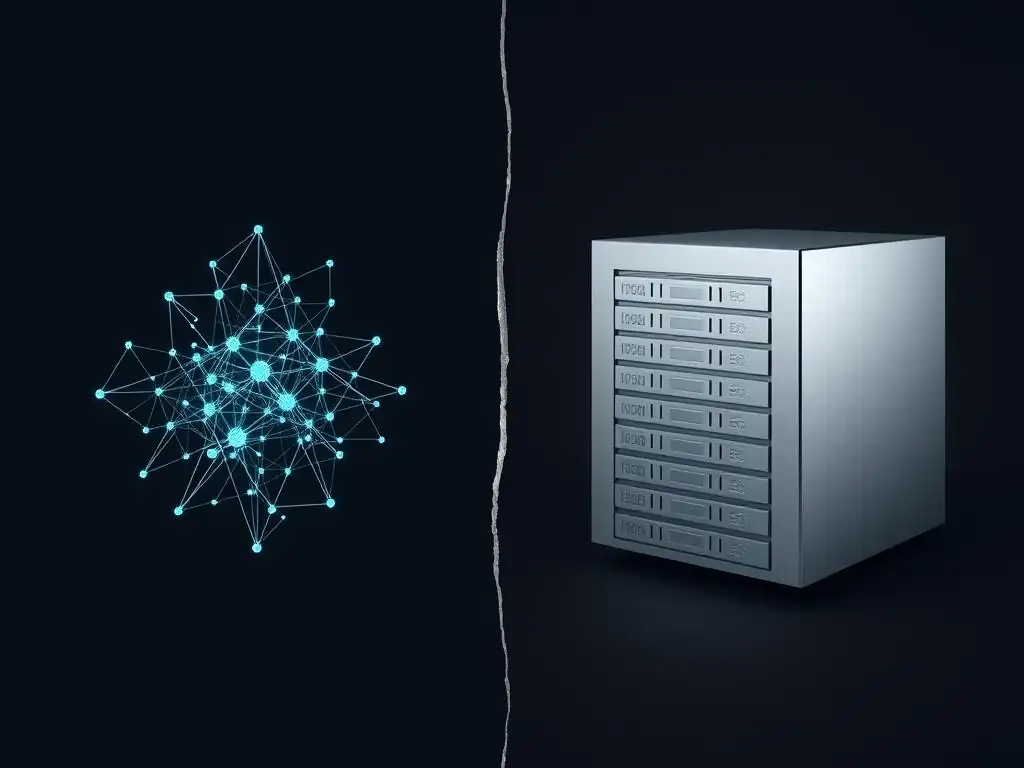
Given their unique characteristics – permissioned access, distributed immutability, and decentralized consensus among known parties – private blockchains are particularly well-suited for enterprise and consortium use cases where multiple organizations need to share data and execute transactions in a secure, verifiable, and efficient manner without a central intermediary. The strengths of private blockchains vs databases become apparent in these multi-party scenarios.
Supply Chain Management: Traceability and Accountability
Private blockchains are being adopted in supply chain management to improve transparency, traceability, and accountability. Tracking goods from origin to destination often involves numerous parties – raw material suppliers, manufacturers, logistics providers, distributors, and retailers – each maintaining their own separate records in traditional databases. This leads to data silos, delays, and difficulty in verifying the provenance or status of goods.
A private blockchain allows all authorized participants to record and view key events (e.g., shipment created, goods dispatched, received at warehouse, customs cleared) on a shared, immutable ledger. This creates a single, trustworthy source of truth for the product's journey. For instance, IBM Food Trust, built on Hyperledger Fabric, connects growers, processors, wholesalers, distributors, manufacturers, retailers, and others in the food ecosystem.
Participants can trace the journey of produce in seconds, compared to days or weeks with traditional methods. This enhanced traceability improves food safety recalls and reduces waste, showcasing a clear advantage of private blockchains vs databases for multi-party process tracking.
Healthcare: Secure Data Sharing
In healthcare, securely sharing patient data among hospitals, clinics, laboratories, and payers is challenging due to privacy regulations (like HIPAA in the US or GDPR in Europe) and fragmented data systems. Private blockchains offer a potential solution for managing access to and sharing sensitive health information while maintaining patient privacy.
A private blockchain can serve as an index or consent layer, recording patient consent for data sharing and providing an immutable log of who accessed which data and when. The sensitive patient data itself might remain stored off-chain in existing databases, with only hashed references stored on the blockchain.
This allows authorized healthcare providers to request access to patient records based on recorded consent, and the blockchain ensures that all access requests are logged and verifiable by the patient or auditors. Projects are exploring using private blockchains to streamline claims processing, verify provider credentials, and manage the secure exchange of medical records, leveraging the distributed trust and auditability features that differentiate private blockchains vs databases for sensitive, regulated data.
Financial Services: Streamlining Processes
The financial services industry is actively exploring private blockchains to streamline complex multi-party processes like interbank payments, securities settlement, and trade finance. These processes traditionally involve multiple intermediaries, manual reconciliation, and significant delays, often relying on disparate, centralized databases that require extensive effort to synchronize.
Private blockchains can enable participants (e.g., banks, clearinghouses, regulators) to transact directly on a shared ledger, reducing the need for intermediaries and speeding up settlement times. R3 Corda, specifically designed for financial institutions, focuses on enabling direct peer-to-peer transactions between parties while maintaining privacy.
For example, a private blockchain network could reduce the time taken for cross-border payments from days to minutes, or automate trade finance processes by linking participants (exporters, importers, banks, insurers) on a shared workflow. The ability to execute shared business logic via smart contracts on a distributed, immutable ledger provides efficiencies and reduces counterparty risk in ways not possible with traditional, siloed database systems, highlighting the value proposition of private blockchains vs databases in complex financial workflows.
The Future of Private Blockchains: Innovation
The development of private blockchain technology is ongoing, driven by the need to address enterprise requirements for scalability, interoperability, and integration with existing IT infrastructure. The future trajectory involves increasing connectivity between different networks and making private blockchains easier to adopt and manage within complex corporate environments.
Interoperability with Public Blockchains
While private and public blockchains serve different purposes, there is growing interest in enabling interoperability between them. This could allow businesses to leverage the strengths of both – using a private blockchain for sensitive internal processes while anchoring data hashes onto a public blockchain (like Ethereum or Bitcoin) to provide an extra layer of immutability and public verifiability.
Projects are exploring technologies like atomic swaps, relay networks, and cross-chain communication protocols to enable value or data transfer between private and public ledgers. For instance, a company might manage the lifecycle of a digital asset on a private blockchain but use a public blockchain for its final transfer of ownership to an external, untrusted party.
This hybrid approach could unlock new use cases and combine the efficiency and privacy of private networks with the broad reach and high security of public ones. The evolution of private blockchains vs databases will increasingly involve how they connect to the broader decentralized ecosystem.
Integration with Existing Enterprise Systems: Hybrid Architectures
For private blockchains to achieve widespread adoption, they must seamlessly integrate with the legacy systems and databases that enterprises currently rely on. Most companies cannot rip and replace their entire IT infrastructure. Therefore, hybrid architectures, where private blockchains work in concert with existing enterprise resource planning (ERP), customer relationship management (CRM), and database systems, are the most likely path forward.
This involves developing robust APIs, connectors, and middleware that allow data to flow securely and efficiently between blockchain networks and traditional databases or applications. For example, a private blockchain might record the immutable history of supply chain events, while an ERP system continues to manage inventory levels based on data pulled from the blockchain.
This integration allows companies to leverage the specific benefits of blockchain (immutability, distributed trust) for particular processes while continuing to use their existing systems for tasks better suited to traditional database capabilities (e.g., complex reporting, high-volume simple data entry). The future will see private blockchains vs databases not as mutually exclusive options, but often as complementary technologies in a hybrid IT landscape.
Conclusion: Private Blockchains - More Than Just Databases
While private blockchains share the fundamental task of storing and managing data with traditional databases, the comparison of private blockchains vs databases clearly shows they are fundamentally different technologies designed for different trust models and use cases. The assertion that private blockchains are "just databases" is a significant oversimplification that ignores their core defining features: cryptographic immutability, distributed consensus among multiple parties, and a focus on creating a shared, verifiable ledger of transactions across organizational boundaries.
Recap of Key Differences and Benefits
The key differences lie in their architecture (linked blocks vs. flexible tables), data mutability (append-only vs. CRUD operations), consensus mechanisms (distributed agreement vs. centralized control), access control philosophy (permissioned network & granular data sharing vs. centralized admin), and security model (tamper-evidence via cryptography vs. perimeter/access security). Private blockchains excel in scenarios requiring a shared, immutable record among multiple, potentially competing entities who need to collaborate without a single point of trust or control.
Benefits derived from these differences include enhanced data integrity and auditability, streamlined multi-party workflows by providing a single source of truth, reduced reliance on central intermediaries, and increased resilience through distributed data replication. While traditional databases remain superior for applications requiring rapid data modification within a single trusted domain, they lack the native capabilities for distributed trust and verifiable immutability that private blockchains offer. The debate of private blockchains vs databases highlights that each technology serves distinct purposes and solves different problems.
Emphasizing Value for Specific Enterprise Needs
Ultimately, the value of private blockchains lies in their ability to address specific enterprise needs that traditional databases are not optimally designed for. These include building trust and transparency in multi-party business networks, creating tamper-evident audit trails for compliance and regulatory requirements, and enabling new forms of digital asset transfer and shared process automation among collaborating organizations. They are not a replacement for all databases, but rather a complementary technology for use cases demanding distributed trust and verifiable data integrity across organizational silos.
Understanding the nuances of private blockchains vs databases is essential for businesses evaluating distributed ledger technology. By focusing on their unique capabilities for enabling secure, collaborative, and transparent processes among identified participants, enterprises can leverage private blockchains to unlock significant value, streamline operations, and build more resilient and trustworthy business networks. They are a powerful tool in the modern enterprise technology stack, distinct from, though often integrated with, traditional database systems.
Frequently Asked Questions
What is the primary difference between a private blockchain and a traditional database?
A private blockchain offers decentralized data management with enhanced security and transparency, while a database relies on a centralized authority for control and access. This difference in architecture significantly impacts trust and auditability.
How does immutability differ between private blockchains and databases?
Private blockchains achieve immutability through cryptographic hashing and a distributed ledger, making data tamper-proof. Databases can have audit trails, but data is generally mutable by administrators, creating a risk of alteration.
In what scenarios might a private blockchain be preferred over a database?
Private blockchains are useful where data integrity and transparency are paramount, such as supply chain management or secure voting systems. Databases are typically sufficient for applications needing high-speed transactions and centralized control, like customer relationship management (CRM).
What are the key considerations when evaluating the performance of private blockchains versus databases?
Databases generally offer superior transaction speeds and scalability compared to private blockchains, due to their centralized nature. However, private blockchains can improve data security and auditability, which may outweigh performance concerns in some cases.
What are the regulatory implications for using private blockchains vs. databases, especially concerning data privacy?
Private blockchains can enhance data privacy through encryption and access controls, potentially aiding compliance with regulations like GDPR. However, ensuring data deletion rights on a blockchain can be challenging, requiring careful design considerations.
Final Reflection: Beyond the Database: Reimagining Trust
The debate surrounding private blockchains vs databases often boils down to a misunderstanding of their fundamental purposes. While both store data, the inherent trust and immutability offered by even a private blockchain, however limited, provides a crucial distinction in scenarios demanding verifiable integrity, a need increasingly prevalent in today's data-driven world.
The ongoing influence of blockchain technology, even in its private iterations, lies in its potential to reshape how we perceive and interact with data. This shift towards verifiable truth, even within controlled environments, is a powerful force that promises to democratize access to information and foster greater accountability. The blockchain is not only a technology but a social and political innovation that can transform the way we organize ourselves.
- Don Tapscott.
As we move forward, let us not be confined by the limitations of current perceptions. Consider how the principles of transparency and immutability, inherent in blockchain technology, can be applied to your own endeavors, fostering trust and building a more reliable future, one block at a time.
Unlock the True Potential of Private Blockchains!
Thank you for exploring the nuances of private blockchains and understanding their distinct advantages over traditional databases. You've seen how they offer much more than simple data storage. Are you ready to apply this knowledge?
Here are some ways to harness the power of private blockchains:
- Analyze your organization's data management needs to identify areas where the unique benefits of a private blockchain—such as immutability, auditability, and controlled access—can provide a strategic advantage. This is the essential first step toward impactful implementation.
- Share this article with a colleague to initiate a discussion about the future of private blockchain applications within your industry. You might discover innovative ideas and new opportunities.
- Explore real-world case studies outside your immediate sector to uncover hidden use cases and gain fresh perspectives on how private blockchains can enhance efficiency and innovation.
What specific data management challenge could your organization address using the capabilities of a private blockchain, and what initial step will you take to explore this further?
Leave a Reply