
The Role of NFTs in Shaping the Future of Creative Industries

Welcome to Blockchain Trends, your compass in the ever-evolving world of decentralized technologies.
Delve into the profound impact of blockchain beyond the headlines, exploring its revolutionary applications in finance, enterprise, and beyond. Are you ready to discover how NFTs are not just digital collectibles, but are fundamentally transforming creative industries? This article, falling under the "Tokenization and Tokenomics" category, offers a glimpse into that future. What new possibilities are unlocking for artists, creators, and collectors? Let's explore together.
- The Role of NFTs in Shaping the Future of Creative Industries
- Understanding NFTs and Their Impact on Creative Fields
- NFTs: Empowering Artists and Creators
- Transforming Different Creative Sectors with NFTs
- The Creator Economy Powered by NFTs
- Challenges and Opportunities for NFTs in Creative Industries
- Real-World Examples: Successful NFT Projects
- The Future of Creative Industries: A Decentralized and NFT-Driven Ecosystem
-
Frequently Asked Questions
- What are NFTs and how are they related to the creative industries?
- How are NFTs transforming the way artists are compensated for their creations?
- Beyond art, what other creative industries are being impacted by NFTs?
- What are some of the challenges and concerns associated with NFTs in the creative space?
- How might regulations shape the future of NFTs and their impact on creative industries?
- Final Reflection: Embracing the NFT Revolution
- Unleash Your Creative Potential with NFTs!
The Role of NFTs in Shaping the Future of Creative Industries
Non-Fungible Tokens (NFTs) have rapidly emerged as a disruptive force, extending the capabilities of blockchain technology far beyond the realm of cryptocurrencies. These unique digital assets are fundamentally changing how value is perceived, transferred, and owned within creative sectors. By providing verifiable ownership and scarcity for digital items, NFTs are transforming creative industries, offering artists, musicians, filmmakers, and other creators unprecedented control and opportunities.
Understanding NFTs and Their Impact on Creative Fields
NFTs represent a significant shift in how digital assets are treated. Unlike cryptocurrencies, where each unit is interchangeable, each NFT is unique and cannot be replicated. This inherent scarcity and verifiability on a blockchain are proving particularly impactful for creative works, which often rely on uniqueness and authenticity.
What are NFTs and How Do They Work?
NFTs are cryptographic tokens existing on a blockchain, most commonly Ethereum, though other blockchains like Flow, Tezos, and Solana also support them. Each NFT contains unique identification codes and metadata that distinguish it from other NFTs. This data is typically stored on the blockchain or linked via interplanetary file systems (IPFS), ensuring its permanence and transparency. When a creator mints an NFT, they are essentially creating a unique digital certificate of ownership for a specific asset, which can be anything from a digital painting or song to a video clip or virtual item.
The token itself represents ownership or proof of authenticity tied to the digital asset. While the asset itself can often be copied or viewed by anyone, the NFT proves who owns the original or a specific edition verified on the blockchain. Smart contracts govern the rules of the NFT, including how it can be transferred, sold, or used, and can even automate royalty payments back to the original creator on secondary sales. This technological foundation is key to how NFTs are transforming creative industries by establishing clear, verifiable digital property rights.
Limitations of Traditional Creative Models
Traditional creative industries have long faced significant challenges regarding ownership, distribution, and fair compensation for creators. Artists often rely on intermediaries like galleries, record labels, publishers, and streaming platforms, which can take substantial cuts of revenue, sometimes leaving creators with only a small percentage of the profits from their work. For instance, musicians on major streaming services might earn fractions of a cent per stream, making it difficult to earn a living wage unless they achieve massive scale.
Furthermore, proving provenance and authenticity in the digital realm has historically been difficult. Digital files are easily copied, leading to widespread piracy and devaluing original works. Artists have also struggled to maintain control over their creations once they are distributed, losing potential revenue from secondary market sales. These limitations highlight the need for new models that empower creators and provide more direct pathways to monetize their work, which is precisely where the potential of NFTs transforming creative industries becomes apparent.
How NFTs Address Challenges in Creative Industries
NFTs offer compelling solutions to many of the inherent problems within traditional creative models. By tokenizing creative works, NFTs provide immutable proof of ownership recorded on a public ledger, effectively solving the problem of digital scarcity and authenticity. A collector can verify the legitimate owner of a specific digital artwork or collectible by checking the blockchain, regardless of how many copies of the file might exist elsewhere.
Crucially, NFTs enable creators to bypass many traditional gatekeepers and intermediaries. Artists can sell directly to their fans and collectors through decentralized marketplaces, retaining a much larger share of the revenue. Smart contracts can be programmed to automatically pay the original creator a percentage royalty every time the NFT is resold on a secondary market, creating a perpetual income stream that was previously non-existent for most digital art or music sales. This ability to establish direct relationships and unlock new revenue streams is a core component of how NFTs are transforming creative industries.
NFTs: Empowering Artists and Creators
The rise of NFTs is fundamentally shifting the power dynamic in favor of individual artists and creators. By leveraging blockchain technology, creators gain unprecedented control over their work, its distribution, and its monetization, fostering a more equitable creative landscape. This empowerment is a key aspect of NFTs transforming creative industries.
Direct Connection with Fans and Collectors
NFTs facilitate a direct relationship between creators and their audience, removing layers of intermediaries like galleries, labels, or distributors. When a collector purchases an NFT directly from an artist, they are not just acquiring a digital asset; they are often joining a community centered around the artist's work. This direct connection allows artists to build stronger relationships, receive direct feedback, and cultivate a dedicated fanbase willing to support them financially.
This direct channel also allows for more personalized interactions and exclusive offerings. Artists can provide unlockable content within the NFT, such as high-resolution files, behind-the-scenes footage, or even personal interactions like virtual meet-and-greets. This fosters a sense of exclusivity and community that traditional platforms often struggle to replicate, solidifying the role of NFTs transforming creative industries by enabling a creator-centric model.
Increased Revenue for Creators
One of the most significant impacts of NFTs is the potential for creators to earn substantially more from their work compared to traditional models. Instead of earning small percentages from streaming or traditional sales, creators can sell unique or limited-edition digital assets at prices determined by market demand. High-profile sales, such as Beeple's "Everydays: The First 5000 Days" selling for $69.3 million, demonstrate the potential for significant upfront revenue.
Beyond initial sales, the built-in royalty mechanism in many NFT smart contracts ensures that creators receive a percentage (often ranging from 5% to 15%) of the sale price every time their NFT is resold on a secondary market. This provides a continuous revenue stream that can far exceed the initial sale price over time, a stark contrast to traditional art markets where only the initial seller and subsequent resellers benefit from appreciation. This innovative financial model is a powerful driver in NFTs transforming creative industries.
New Avenues for Creative Expression with NFTs
NFTs are not just changing how creative work is sold; they are also inspiring new forms of creative expression. The digital nature and programmability of NFTs allow for interactive, evolving, or generative art that was previously impossible to create or own in a verifiable way. Artists are experimenting with digital-only installations, virtual reality art pieces, and dynamic NFTs that change based on external data or interactions.
Furthermore, NFTs can represent fragments or components of larger works, enabling collaborative projects or allowing fans to own a piece of a collective creation. This opens up possibilities for decentralized art installations, community-owned music albums, or interactive narratives. The flexibility of the NFT format encourages innovation in how art is created, experienced, and collected, proving that NFTs are transforming creative industries by pushing the boundaries of artistic mediums.
Transforming Different Creative Sectors with NFTs
The impact of NFTs is not confined to a single creative field; their potential is being explored and realized across a wide range of industries, each finding unique applications for this technology. The versatility of NFTs is a key factor in their role transforming creative industries globally.
NFTs in Digital Art: Ownership and Provenance
Digital art was one of the first creative sectors to embrace NFTs, primarily because it directly addressed the challenge of proving ownership and scarcity in a medium that is infinitely reproducible. Before NFTs, a digital painting could be copied with a click, making it difficult for digital artists to command value for original pieces in the same way traditional painters could. NFTs changed this by providing a unique, verifiable token linked to the specific digital file.
Platforms like SuperRare, Foundation, and Nifty Gateway became early hubs for digital artists to mint and sell their works as NFTs. Collectors could now acquire provably scarce digital artworks, leading to a boom in the market. The transparency of blockchain transactions provides a clear history of ownership, addressing provenance issues that exist even in the traditional art world. This verifiable ownership and history are crucial aspects of how NFTs are transforming creative industries, particularly in the digital art space.
NFTs in Music: Revolutionizing Music Ownership and Royalties
The music industry has long been criticized for its opaque royalty structures and the small share of revenue that reaches artists from streaming. NFTs offer musicians a way to regain control and explore alternative monetization strategies. Artists can sell unique editions of songs, albums, or digital collectibles like cover art or backstage passes directly to fans.
Artists like 3LAU and Kings of Leon have successfully experimented with NFT album releases, generating significant revenue and engaging fans in new ways. 3LAU's ultraviolet collection reportedly generated over $11 million in sales for tokenized albums and experiences. NFTs can also represent fractional ownership of song royalties or even grant holders special access or voting rights related to the artist's future work. This potential to create new revenue streams and fan engagement models is a significant part of NFTs transforming creative industries within the music sector.
NFTs in Film and Video: Funding and Distribution Models
The film and video industry is exploring NFTs for funding projects, distributing content, and creating collectible moments. Producers can sell NFTs representing shares in a film's future revenue, exclusive behind-the-scenes content, or unique digital props and memorabilia. This allows filmmakers to raise capital directly from their audience and build a community around the project from its inception.
NFTs can also be used to distribute limited editions of films or specific scenes, offering collectors exclusive access or ownership. Quentin Tarantino, for example, announced plans to sell NFTs based on original screenplay excerpts from Pulp Fiction, raising legal questions but highlighting the potential for tokenizing film assets. While still early, the potential for NFTs transforming creative industries like film lies in democratizing funding and creating new ways for fans to engage with and own parts of cinematic history.
NFTs in Gaming: In-Game Assets and Player Ownership
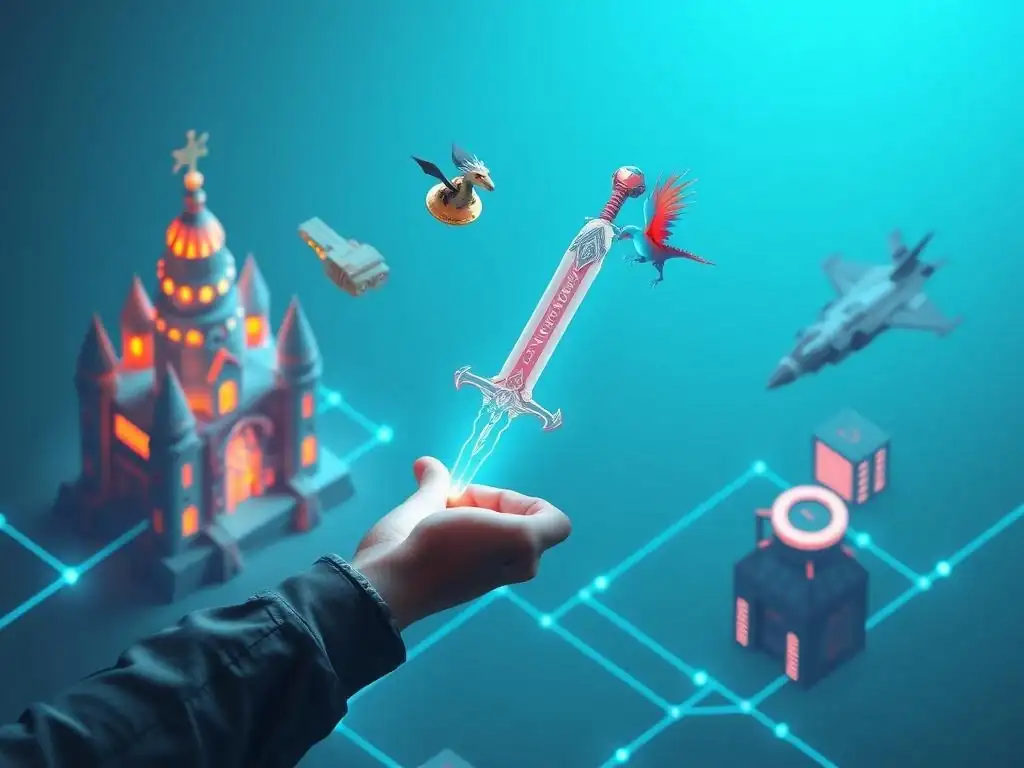
The gaming industry is perhaps one of the most natural fits for NFT integration. Players often spend significant time and money acquiring in-game items, but traditionally, they do not truly own these assets. They exist within the game's ecosystem, controlled by the game developer. NFTs change this by allowing players to own unique in-game items – like weapons, skins, or virtual land – as verifiable tokens on a blockchain.
This ownership means players can potentially trade, sell, or even use these assets across different compatible games (interoperability). Play-to-earn games like Axie Infinity demonstrate a model where players can earn cryptocurrency and NFTs through gameplay, creating real economic opportunities. This shift from simply playing a game to potentially owning and trading digital assets is a major way NFTs are transforming creative industries, specifically the gaming landscape.
NFTs in Fashion: Digital Collectibles and Virtual Wearables
The fashion world is embracing NFTs for digital collectibles, virtual wearables, and proof of authenticity for physical goods. Luxury brands are creating limited-edition digital sneakers, virtual clothing for avatars in metaverses, and tokenized versions of their physical collections. These digital assets cater to a growing demand for self-expression in virtual worlds and provide new revenue streams for brands.
NFTs can also serve as digital certificates of authenticity for high-value physical items, helping combat counterfeiting. Owning a digital twin of a physical luxury bag or watch, represented by an NFT, can add value and provide verifiable provenance. The intersection of physical and digital fashion through NFTs is a rapidly evolving area, showcasing another facet of NFTs transforming creative industries.
The Creator Economy Powered by NFTs
The rise of NFTs is intrinsically linked to the growth of the "creator economy," a model where individual creators can build businesses around their skills and audiences without relying on traditional institutions. NFTs provide the infrastructure for creators to directly monetize their work and build independent careers. This synergy is central to NFTs transforming creative industries.
Building Communities Around NFT Projects
Many successful NFT projects are not just about selling a digital asset; they are about building a community around the creator or project. Owning an NFT can grant access to exclusive Discord channels, private events, or early access to future releases. This sense of belonging and shared interest is a powerful driver for collectors and fans.
Creators are leveraging this by actively engaging with their NFT holders, involving them in decisions, or providing ongoing value through airdrops or perks. This community-centric approach fosters loyalty and can create a self-reinforcing ecosystem where the value of the NFT is tied not only to the asset itself but also to the strength and engagement of the community surrounding it. This community-building aspect is a key component of NFTs transforming creative industries by fostering direct artist-fan relationships.
Decentralized Autonomous Organizations (DAOs) and Creative Collaboration
NFTs can also play a role in enabling decentralized autonomous organizations (DAOs) for creative projects. A DAO is an organization run by rules encoded as computer programs on a blockchain, with decisions made by token holders. In the creative space, a group of artists, collectors, and fans could form a DAO where ownership of specific NFTs or governance tokens grants voting rights on project direction, funding allocation, or curation decisions.
This model allows for more collaborative and community-driven creative endeavors. For example, a group could pool funds via a DAO to commission art, develop a game, or produce an album, with NFT holders having a say in the creative process and potentially sharing in the project's success. This opens up new possibilities for decentralized production and ownership, further illustrating how NFTs are transforming creative industries.
NFT Marketplaces and Platforms for Creators
The infrastructure supporting the NFT ecosystem is rapidly evolving, with numerous marketplaces and platforms emerging to facilitate the creation, buying, and selling of NFTs. Platforms like OpenSea (the largest general marketplace), Rarible, and smaller curated platforms cater to different types of NFTs and audiences. These platforms provide the tools for creators to "mint" (create) their NFTs, list them for sale (via auction or fixed price), and manage transactions.
These marketplaces are vital for the creator economy powered by NFTs, providing the necessary visibility and tools for creators to reach potential buyers globally. They handle the technical complexities of blockchain transactions, making it relatively easier for artists without extensive technical knowledge to participate in the NFT space. The growth and specialization of these platforms are essential for the continued expansion of NFTs transforming creative industries.
Challenges and Opportunities for NFTs in Creative Industries
Despite the immense potential, the widespread adoption of NFTs in creative industries faces several hurdles. Addressing these challenges is crucial for the sustainable growth and positive impact of NFTs transforming creative industries.
Environmental Concerns and Sustainable NFT Practices
A significant concern surrounding NFTs, particularly those minted on the Ethereum blockchain using the Proof-of-Work (PoW) consensus mechanism, is their environmental impact due to high energy consumption. The energy required to validate transactions on PoW blockchains is substantial, leading to criticism regarding the carbon footprint of NFTs.
However, the blockchain space is actively working towards more sustainable solutions. Many new blockchains utilize Proof-of-Stake (PoS), which is significantly more energy-efficient than PoW. Ethereum itself has transitioned to PoS ("The Merge"), drastically reducing its energy consumption by an estimated 99.9%. Additionally, Layer 2 scaling solutions and sidechains offer faster and cheaper transactions with lower energy footprints. The opportunity lies in adopting these more sustainable technologies as the standard for minting NFTs.
Legal and Regulatory Considerations for NFTs
The legal and regulatory landscape for NFTs is still evolving and presents uncertainties. Issues include whether certain NFTs could be classified as securities, subject to financial regulations. Consumer protection laws, anti-money laundering (AML) regulations, and tax implications for NFT sales also vary significantly across jurisdictions.
Creators and platforms must navigate this complex and changing environment. Clearer regulations are needed to provide certainty for participants. However, this also presents an opportunity for innovation in compliance solutions and legal frameworks that support the unique nature of digital assets, ensuring that NFTs transforming creative industries do so responsibly.
Copyright and Intellectual Property Issues with NFTs
A common misconception is that buying an NFT automatically grants the buyer full copyright or intellectual property (IP) rights to the underlying asset. In most cases, owning an NFT means owning the unique token and the associated digital file, but the creator usually retains the copyright and IP rights unless explicitly transferred.
This distinction can lead to confusion and potential legal disputes. Clear licensing terms need to be established and communicated when selling NFTs. The opportunity lies in developing standardized licensing models for NFTs (like Creative Commons licenses adapted for NFTs) and educating both creators and collectors about what rights are being transferred upon sale. Addressing these IP nuances is vital for the long-term success of NFTs transforming creative industries.
The Future of NFTs: Innovation and Evolution
The NFT space is incredibly dynamic, with continuous innovation driving its evolution. Future developments include the growth of fractionalized NFTs (allowing multiple people to own a piece of a high-value asset), the integration of NFTs into the metaverse and virtual worlds, and the development of more complex utility for NFTs beyond simple collectibles (e.g., granting access, voting rights, or real-world benefits).
Furthermore, as the technology matures, user experience is expected to improve, making it easier for mainstream creators and consumers to engage with NFTs. The potential for cross-chain compatibility and increased interoperability between different platforms and blockchains will also expand the possibilities. The future opportunities for NFTs transforming creative industries lie in leveraging these technological advancements to create even more seamless, impactful, and widely accessible applications.
Real-World Examples: Successful NFT Projects
Examining specific successful projects provides concrete examples of how NFTs are transforming creative industries and demonstrating their real-world impact.
Case Study 1: CryptoPunks and Digital Art Collectibles
CryptoPunks, launched in 2017, were one of the earliest examples of NFTs on the Ethereum blockchain and are considered foundational to the digital art collectible movement. This collection of 10,000 unique 8-bit style pixel art characters was initially given away for free to anyone with an Ethereum wallet. As the NFT market grew, CryptoPunks became highly sought-after digital collectibles, with individual Punks selling for millions of dollars.
For instance, CryptoPunk #7523, a rare "Alien" punk with a medical mask, sold for $11.7 million at Sotheby's in June 2021. The project demonstrated the concept of provable digital scarcity and ownership, proving that value could be assigned to unique digital items. While not initially created by traditional artists, their success paved the way for other digital artists and collections, highlighting the potential of NFTs transforming creative industries by creating a market for purely digital assets.
Case Study 2: Kings of Leon and NFT Music Albums
Kings of Leon became one of the first major bands to release an album as an NFT in March 2021. Their album "When You See Yourself" was offered as part of a collection that included three types of tokens: one for the album itself with enhanced media, one for live show perks, and one for exclusive audiovisual art. The album NFT included special features like a limited-edition vinyl and a digital download.
The band generated over $2 million from the NFT sale, including over $500,000 from tokenized perks like front-row seats for life. This project demonstrated a new model for musicians to release work, engage superfans with exclusive content and experiences, and capture value directly, bypassing traditional distribution channels. It served as a significant example of NFTs transforming creative industries within the music sector.
Case Study 3: Axie Infinity and Play-to-Earn Gaming
Axie Infinity is a blockchain-based game where players collect, breed, battle, and trade creatures called Axies, which are NFTs. The game utilizes a play-to-earn model, allowing players to earn cryptocurrency (Smooth Love Potion - SLP) and NFTs (Axies and virtual land) through gameplay. This model gained significant traction globally, particularly in countries like the Philippines, where players earned income that, for some, exceeded local minimum wages.
At its peak, Axie Infinity had millions of daily active users and generated billions in NFT sales volume. While the game has faced challenges regarding tokenomics sustainability, it remains a pioneering example of how NFTs can integrate into gaming to create player ownership and foster new economic models. Axie Infinity showcased the potential of NFTs transforming creative industries by merging entertainment with tangible digital asset ownership and economic opportunity.
The Future of Creative Industries: A Decentralized and NFT-Driven Ecosystem
The trajectory suggests that NFTs will play an increasingly vital role in the future of creative industries, fostering a more decentralized, creator-centric ecosystem. The ongoing development of blockchain technology and the growing understanding of NFTs' potential point towards a significant reshaping of how creative work is created, distributed, owned, and valued.
Predictions for NFTs and the Creator Economy
Experts predict continued growth and diversification in the types of creative assets tokenized as NFTs. We may see NFTs representing fractional ownership of high-value art, digital fashion integrated seamlessly into various virtual environments, and tokenized experiences becoming more common. The creator economy is expected to flourish further as more tools and platforms emerge, making it easier for independent creators to leverage NFTs.
Furthermore, the integration of NFTs into the metaverse is anticipated to create vast new opportunities for creators to build immersive digital experiences and economies. Virtual real estate, digital avatars, and in-world assets will increasingly be represented by NFTs, providing creators with new canvases and marketplaces. The ability of NFTs transforming creative industries will be amplified within these emerging digital worlds.
How Blockchain Technology Will Enhance Creative Industries
Beyond NFTs, the underlying blockchain technology itself offers numerous benefits for creative industries. Blockchain provides transparency and immutability, which can be used for registering copyrights, tracking the usage of creative works, and managing licensing agreements in a verifiable and automated way. Smart contracts can automate royalty payments across complex distribution chains, ensuring creators are fairly compensated.
Decentralized storage solutions (like IPFS) paired with blockchain can ensure the long-term availability and integrity of digital assets, addressing concerns about centralized platforms shutting down. As blockchain technology becomes more scalable, affordable, and user-friendly, its foundational capabilities will continue to enhance various aspects of the creative process and business models.
Long-Term Impact of NFTs on Artistic Expression and Ownership
In the long term, NFTs are poised to fundamentally alter perceptions of artistic expression and ownership in the digital age. They legitimize digital art and collectibles as valuable assets and empower creators by giving them direct control and new revenue streams. This shift could lead to greater artistic freedom, as creators become less dependent on traditional institutions and funding models.
The concept of verifiable digital ownership is likely to become more mainstream, influencing how we interact with digital content across all forms. While challenges remain, the core innovation of NFTs – enabling scarcity, authenticity, and direct monetization for digital assets – establishes them as a powerful force in NFTs transforming creative industries for decades to come. The future points towards a more democratic, decentralized, and creator-friendly landscape built on the foundation of blockchain technology and non-fungible tokens.
Frequently Asked Questions
NFTs, or non-fungible tokens, are unique digital assets representing ownership of items. In the creative industries, they are revolutionizing how artists monetize their work and interact with fans by allowing them to sell directly to consumers.
How are NFTs transforming the way artists are compensated for their creations?
NFTs enable artists to bypass traditional intermediaries like galleries and record labels. This allows them to retain a larger share of the revenue generated from their art and benefit from resale royalties.
Beyond art, what other creative industries are being impacted by NFTs?
NFTs are finding applications in music, film, gaming, and fashion. They offer new ways to fund projects, engage audiences, and create unique digital experiences.
What are some of the challenges and concerns associated with NFTs in the creative space?
Concerns include the environmental impact of certain blockchain technologies, intellectual property rights issues, and the potential for fraud and scams. These issues are being actively addressed by the community and regulators.
How might regulations shape the future of NFTs and their impact on creative industries?
Regulations could provide clarity on legal ownership, taxation, and consumer protection. This can lead to greater market stability and increased adoption by both artists and consumers in the long run.
Final Reflection: Embracing the NFT Revolution
The journey through the evolving landscape of NFTs within creative industries reveals a profound shift, and its impact is undeniably here and now. From digital art to music and beyond, NFTs are not merely a fleeting trend but a foundational element reshaping how creators connect with audiences, monetize their work, and redefine ownership in the digital age. This transformation demands our attention and understanding.
The ripple effects of this technology are already being felt across the cultural landscape. The democratization of art ownership and the empowerment of independent creators are particularly compelling aspects of this revolution. As we witness the rise of new artistic expressions and business models, it's crucial to remember the core principle driving this change: The goal isn't to live forever, the goal is to create something that will.
- Chuck Palahniuk. This quote encapsulates the enduring power of creativity, now amplified by the transformative potential of NFTs.
Now, as you reflect on the possibilities presented by NFTs transforming creative industries, consider how you can engage with this evolving ecosystem. Whether you're an artist, a collector, or simply a curious observer, embrace the opportunity to learn, experiment, and contribute to the future of creativity. The power to shape this future lies within each of us.
Unleash Your Creative Potential with NFTs!
Thank you for exploring how NFTs are transforming the creative industry. We hope you gained valuable insights into the opportunities they present. Now, it's time to take action and become part of this exciting movement.
Here are a few steps you can take:
- Start Small: Mint your first NFT!: Use platforms like OpenSea or Rarible to familiarize yourself with the process. Even creating a simple digital asset can open new doors for your creativity.
- Join the Conversation: Share your favorite NFT artists and projects on social media using a dedicated hashtag. Let’s amplify the voices shaping the future of digital art.
- Explore New Frontiers: Discover how NFTs are being utilized in industries beyond art and collectibles. Could they revolutionize music licensing, digital publishing, or scientific research?
Are you ready to harness the transformative potential of NFTs and push the boundaries of creativity? What is one project you’d love to see tokenized, and why?
Leave a Reply