
Merkle Trees: The Cryptographic Backbone of Efficient Blockchain Verification


Welcome to Blockchain Trends, your guide to understanding the revolutionary world beyond Bitcoin! Are you curious about how blockchains achieve unparalleled data integrity and efficiency?
Dive into our deep dive on Merkle Tree Blockchain Verification and uncover how this ingenious cryptographic structure forms the backbone of trust in decentralized systems. Learn how Merkle Trees make verifying transactions faster and more secure than ever before. Ready to unravel the mystery? Let's explore!
Merkle Trees: The Cryptographic Backbone of Efficient Blockchain Verification
- Introduction to Merkle Trees and Blockchain Technology
- What is a Merkle Tree? A Deep Dive
- Merkle Tree Blockchain Verification: How It Works
-
Benefits of Using Merkle Trees in Blockchain Systems
- Reduced Storage Requirements for Blockchain Nodes: SPV Clients and Partial Block Downloads
- Simplified Payment Verification (SPV) and Lightweight Clients: Enabling Mobile and Resource-Constrained Devices
- Enhanced Security and Data Integrity in Distributed Ledgers: Data Consistency and Byzantine Fault Tolerance
- Merkle Trees vs. Other Data Structures in Blockchain
-
Real-World Applications of Merkle Trees in Blockchain
- Merkle Trees in Bitcoin and Other Cryptocurrencies: Transaction Verification and Block Integrity
- Using Merkle Trees for Data Integrity in Supply Chain Management: Tracking Product Provenance and Authenticity
- Applications of Merkle Trees in Decentralized File Storage Systems: Data Integrity and Content Addressing
- Limitations and Challenges of Merkle Trees
-
Merkle Tree Variants and Advanced Implementations
- Exploring Different Types of Merkle Trees: Binary, N-ary, and Sparse Merkle Trees: Trade-offs and Performance Characteristics
- Optimizing Merkle Tree Performance with Advanced Techniques: Caching, Parallelization, and Tree Pruning
- Future Trends and Innovations in Merkle Tree Research and Development: Vector Commitments and Accumulators
- Merkle Trees and the Future of Blockchain Scalability
- Conclusion: The Enduring Importance of Merkle Trees in Blockchain
-
Frequently Asked Questions
- What is a Merkle Tree and why is it important for blockchain verification?
- How does a Merkle Tree facilitate efficient blockchain verification?
- What role does the root hash play in Merkle Tree-based verification?
- Can Merkle Trees be used in blockchain applications besides transaction verification?
- What are the advantages of using Merkle Trees for blockchain verification compared to other methods?
- Final Reflection: The Enduring Power of Trustless Verification
- Unlock Deeper Insights: Become a Merkle Tree Master!
Introduction to Merkle Trees and Blockchain Technology
Blockchain technology has revolutionized digital interactions by enabling trustless, distributed ledgers. At its core, a blockchain is a chain of blocks, where each block contains a list of transactions and is cryptographically linked to the previous one. This structure ensures immutability and transparency. However, as the number of transactions and blocks grows, efficiently verifying the integrity of this vast amount of data becomes a significant challenge. This is where cryptographic data structures like Merkle trees play a crucial role, particularly in streamlining Merkle tree blockchain verification.
Understanding Blockchain Data Structures: Blocks, Hashes, and Chains
A blockchain is fundamentally composed of blocks, each holding a batch of validated transactions. Each block is uniquely identified by a cryptographic hash, typically generated using algorithms like SHA-256. This hash is computed not just over the transactions within the block, but also includes the hash of the preceding block, creating a secure, chronological chain.
If any data within a block is altered, its hash changes, breaking the link to the subsequent block and immediately signaling tampering. This chaining mechanism is the foundation of blockchain's security, but verifying the integrity of all transactions within a block efficiently requires more than just the block hash.
Within each block, transactions are not stored as a simple list. Instead, they are organized into a Merkle tree. The hash of the root of this tree, known as the Merkle root, is included in the block header.
This single hash acts as a fingerprint for all the transactions in that block. To verify if a specific transaction is included in a block, a node doesn't need to download the entire block's transaction list; it only needs the transaction itself, the block header (containing the Merkle root), and a small path of hashes from the Merkle tree, called a Merkle proof. This structure is vital for efficient Merkle tree blockchain verification.
Why Efficient Verification is Crucial for Blockchain Scalability: Transaction Throughput and Node Synchronization
The ability to process and verify a high volume of transactions is paramount for blockchain scalability. Without efficient verification mechanisms, every full node would need to download and process every transaction ever recorded on the chain. For large blockchains like Bitcoin or Ethereum, which have accumulated hundreds of gigabytes of data and processed millions of transactions, this becomes computationally expensive and storage-intensive, limiting participation to powerful machines.
Efficient Merkle tree blockchain verification significantly reduces the resources required for nodes, especially those that don't need to store the full blockchain history. This enables a wider range of devices, including lightweight clients or mobile wallets, to participate in the network by verifying transactions without the overhead of full nodes. This differentiation between full nodes (which verify everything) and lightweight nodes (which rely on Merkle proofs and full nodes for trust) is critical for improving transaction throughput across the network and ensuring faster, more distributed synchronization among various types of nodes.
What is a Merkle Tree? A Deep Dive
A Merkle tree, also known as a hash tree, is a tree-like data structure where every non-leaf node is a hash of its child nodes. It's a fundamental concept in computer science, particularly useful for verifying the integrity and consistency of data sets efficiently. In the context of blockchain, Merkle trees are specifically used to summarize all the transactions within a block into a single root hash, enabling lightweight verification without needing the entire list of transactions.
Defining the Core Components of a Merkle Tree: Leaves, Nodes, and the Root
A Merkle tree is constructed from the bottom up. The base level consists of the leaf nodes, which are typically the individual data elements being hashed – in a blockchain, these are the transaction hashes. Each leaf node is a hash of a single transaction. If there's an odd number of transactions, the last transaction hash is often duplicated to ensure an even number for pairing.
Above the leaf nodes are the internal nodes. Each internal node is created by hashing the concatenation of its two child hashes. This process continues level by level, pairing hashes and hashing their combinations, until only one hash remains at the very top. This final hash is the Merkle root. The Merkle root is the cryptographic summary of all the transaction hashes below it. Any change, no matter how small, to even a single transaction at the leaf level will propagate up the tree, resulting in a completely different Merkle root.
How Merkle Trees Work: Hashing, Branching, and the Root Hash Generation Process
The construction of a Merkle tree begins by taking a list of data elements (e.g., transaction hashes T1, T2, T3, T4). Each element is hashed individually to form the leaf nodes (Hash(T1), Hash(T2), Hash(T3), Hash(T4)). These leaf hashes are then paired up, and the hash of the concatenation of each pair is computed to form the next level of the tree. For example, Hash(Hash(T1) + Hash(T2)) forms one parent hash, and Hash(Hash(T3) + Hash(T4)) forms another.
This process of pairing and hashing continues up the tree. If at any level there's an odd number of hashes, the last hash is typically duplicated to create a pair. The tree branches upwards, with each node summarizing the data in its subtree. The process culminates in a single hash at the top, the Merkle root. This root hash is deterministic; given the same set of transactions and the same hashing algorithm, the Merkle root will always be identical. This property is fundamental to Merkle tree blockchain verification.
The Role of Cryptographic Hash Functions in Merkle Tree Security: Collision Resistance and Data Integrity
The security of a Merkle tree relies heavily on the properties of the cryptographic hash function used, such as SHA-256, commonly employed in Bitcoin. Crucially, these functions must be collision-resistant, meaning it is computationally infeasible to find two different inputs that produce the same hash output. They must also be preimage-resistant, making it infeasible to determine the input data from its hash output, and second-preimage resistant, making it infeasible to find a second input that hashes to the same value as a given input.
These properties ensure the data integrity guaranteed by the Merkle root. If even a single bit is changed in any transaction at the leaf level, its hash changes. This change cascades up the tree, altering all parent hashes on the path to the root, ultimately changing the Merkle root itself.
Therefore, if a verifier checks the Merkle root included in a block header against a Merkle root they compute using a subset of data and a Merkle proof, any discrepancy immediately indicates that the data has been tampered with. This robust integrity check is a cornerstone of Merkle tree blockchain verification.
Merkle Tree Blockchain Verification: How It Works
Merkle trees are specifically designed to make verifying the inclusion and integrity of data within a large dataset highly efficient. In the context of blockchain, this translates to verifying that a specific transaction is indeed part of a particular block without needing to download and process every transaction in that block. This mechanism is central to the concept of Merkle tree blockchain verification, especially for lightweight clients.
Efficient Data Verification with Merkle Proofs: Path Reconstruction and Hash Validation
To verify a specific transaction (say, Transaction T3) within a block using a Merkle tree, you don't need the entire tree. What you need is the transaction itself, the Merkle root of the block (found in the block header), and a Merkle proof.
A Merkle proof consists of the hashes of the sibling nodes on the path from the transaction's leaf hash up to the Merkle root. For example, to verify T3 in a simple tree with T1, T2, T3, T4, the proof for T3 would include the hash of T4's leaf node and the hash of the parent node of T1 and T2 (Hash(Hash(T1)+Hash(T2))).
With the transaction T3, you first compute its hash, Hash(T3). Then, using the hashes provided in the Merkle proof, you reconstruct the path up to the root. You hash Hash(T3) with its sibling's hash (Hash(T4)) to get their parent hash. Then, you hash this result with the next sibling's hash (Hash(Hash(T1)+Hash(T2))) to get the root hash. If the final computed hash matches the Merkle root stored in the block header, the Merkle tree blockchain verification is successful, confirming that T3 is indeed included in that block and has not been altered.
Verifying Transactions in a Blockchain Using Merkle Trees: Block Headers and Transaction Inclusion
The process of verifying a transaction's inclusion in a blockchain block leverages the Merkle tree structure within each block. A full node, which stores the entire blockchain, can easily verify any transaction by checking its presence in the block's transaction list and recalculating the Merkle root. However, lightweight clients, like those used on mobile phones, cannot store the full chain.
Instead, a lightweight client interested in verifying a transaction relevant to its address (e.g., a payment received) requests the block header containing the transaction and a Merkle proof for that specific transaction from a full node. The client then performs the Merkle tree blockchain verification steps described above: hash the transaction, use the Merkle proof to compute the path up the tree, and compare the final computed root hash with the Merkle root in the block header.
If they match, the client has high confidence that the transaction is included in that block and is valid, without ever seeing any other transaction in the block.
The Significance of the Root Hash in Blockchain Integrity: Immutability and Tamper Detection
The Merkle root is arguably the most critical component of the Merkle tree in the context of blockchain integrity. As the single, unique hash representing the entire set of transactions in a block, it acts as a powerful integrity check.
This root hash is included in the block header, which is then hashed to create the block's unique identifier. Because the next block's header includes the hash of the previous block (which contains the Merkle root), any change to the Merkle root would change the current block's hash, subsequently changing the next block's hash, and so on, propagating the change throughout the chain.
This interconnectedness, facilitated by the Merkle root and block hashing, makes the blockchain highly resistant to tampering. To alter a transaction in an old block, an attacker would not only have to change the transaction but also recalculate all the hashes up to the Merkle root, change the block header's hash, and then recalculate the hashes of every subsequent block.
On a live network with significant computing power performing proof-of-work or proof-of-stake, this becomes computationally infeasible for blocks buried deep within the chain. Thus, the Merkle root is a cornerstone of blockchain's immutability and the efficiency of Merkle tree blockchain verification.
Benefits of Using Merkle Trees in Blockchain Systems
The integration of Merkle trees into blockchain architecture provides several significant advantages that contribute to the technology's efficiency, scalability, and accessibility. These benefits are particularly evident in how data is managed, verified, and accessed by different types of network participants. The core advantage lies in facilitating efficient Merkle tree blockchain verification.
Reduced Storage Requirements for Blockchain Nodes: SPV Clients and Partial Block Downloads
One of the most impactful benefits of Merkle trees is the drastic reduction in storage requirements for certain types of blockchain nodes, specifically Simplified Payment Verification (SPV) clients. Full nodes must store the entire blockchain history, which can amount to hundreds of gigabytes (e.g., the Bitcoin blockchain size is over 500 GB as of late 2023). This imposes a high barrier to entry for running a full node.
SPV clients, however, do not need to download every block and every transaction. Instead, they download only the block headers, which are significantly smaller (each header is typically around 80 bytes in Bitcoin). To verify a transaction, they request only the specific transaction and its Merkle proof from a full node.
This allows an SPV client to verify the transaction's inclusion in a block by checking it against the Merkle root in the downloaded header, requiring only a few hundred kilobytes of data per verification instead of downloading potentially megabytes of block data. This efficiency in Merkle tree blockchain verification makes blockchain participation much more accessible.
Simplified Payment Verification (SPV) and Lightweight Clients: Enabling Mobile and Resource-Constrained Devices
The concept of SPV, as outlined in the original Bitcoin whitepaper, is made possible by Merkle trees. SPV clients, also known as lightweight clients, are designed to run on devices with limited resources, such as smartphones or tablets. They don't validate the entire blockchain or all transactions. Instead, they rely on the network of full nodes to provide them with block headers and Merkle proofs.
When an SPV client needs to verify a payment, it finds the relevant block header and requests a Merkle proof for the transaction. By performing the Merkle tree blockchain verification using the transaction, the proof, and the block header's Merkle root, the client can be reasonably certain that the transaction is valid and included in a block that is part of the longest chain (by verifying that the block header is linked into the chain).
This allows users to send and receive transactions and verify their status without the need for a full node, significantly expanding the usability and reach of blockchain technology.
Enhanced Security and Data Integrity in Distributed Ledgers: Data Consistency and Byzantine Fault Tolerance
Beyond efficiency, Merkle trees bolster the security and data integrity of distributed ledgers. By summarizing all transactions into a single Merkle root, they provide a concise and cryptographically secure way to represent the entire set of data within a block. This ensures data consistency across different nodes. If two full nodes have the same block header with the same Merkle root, they can be confident that they contain the exact same set of ordered transactions, even if they haven't compared every single transaction.
Furthermore, Merkle trees contribute to the Byzantine Fault Tolerance (BFT) properties of a blockchain system. While the consensus mechanism handles agreement on the order of blocks, Merkle trees ensure agreement on the content within each block. Nodes can quickly challenge the integrity of a block presented by another node simply by checking its Merkle root against the root they compute or expect.
Any discrepancy proves that the block's transaction data is inconsistent or has been tampered with, allowing honest nodes to reject it and maintain the integrity of the shared ledger. This makes Merkle tree blockchain verification a key defense mechanism.
Merkle Trees vs. Other Data Structures in Blockchain
While blockchain relies on various data structures, Merkle trees are uniquely suited for the specific requirements of efficient transaction verification and data integrity within blocks. Comparing them to other structures highlights why Merkle trees became the standard for this purpose in most major blockchains.
Comparing Merkle Trees to Linear Hashing and Bloom Filters
A simple alternative to a Merkle tree for summarizing data would be a linear hash of all concatenated transactions. However, verifying a single transaction would require concatenating and hashing all transactions up to that point, or at least providing all preceding transactions to compute the hash path. This would negate the storage and computational savings offered by Merkle proofs. Merkle trees allow for verification of a single element by providing only a logarithmic number of hashes relative to the total number of elements, a stark contrast to the linear requirement of simple concatenation hashing.
Bloom filters offer a probabilistic way to check for element inclusion in a set, providing a "maybe in set" or "definitely not in set" answer. While Bloom filters can be used in lightweight clients to query for transactions (e.g., "show me transactions involving address X"), they have a potential for false positives (saying a transaction might be in a block when it's not) and require the client to trust the full node providing the filter.
Merkle trees, on the other hand, provide a deterministic proof of inclusion or exclusion. A Merkle proof definitively proves that a transaction is either in the block or it isn't, with no possibility of false positives regarding inclusion, making Merkle tree blockchain verification more reliable for confirming specific transactions.
Advantages of Merkle Trees for Blockchain Scalability and Efficiency: Proof Size and Verification Time
The primary advantage of Merkle trees for blockchain scalability and efficiency lies in the size of the Merkle proof and the speed of verification. For a block containing N transactions, a Merkle proof for any single transaction requires providing only log₂(N) hashes. For example, in a block with 1024 transactions, a Merkle proof needs just 10 hashes (log₂(1024) = 10). This is vastly smaller than needing to provide 1023 other transactions or hashes.
Consequently, the time required for Merkle tree blockchain verification using a proof is also logarithmic, growing very slowly as the number of transactions per block increases. This logarithmic efficiency is crucial for allowing blocks to contain a substantial number of transactions (e.g., Bitcoin blocks can hold thousands of transactions, Ethereum blocks many more) while still enabling fast and low-bandwidth verification for lightweight clients. This efficiency is a key enabler for broader blockchain adoption and scalability.
Use Cases Where Merkle Trees Excel in Blockchain Applications: Data Availability and Audit Trails
Merkle trees are not limited to just transaction verification in cryptocurrencies. Their ability to efficiently summarize and prove the integrity of large datasets makes them valuable in various blockchain and decentralized applications. One significant use case is ensuring data availability in systems where data is sharded or stored off-chain, such as in some Layer-2 scaling solutions. A Merkle root of the off-chain data can be committed to the main chain, allowing anyone to verify the integrity of a piece of that data using a Merkle proof without needing the entire dataset.
Another area where Merkle trees excel is in creating verifiable audit trails. By structuring a sequence of records or events into a Merkle tree, any future attempt to alter a past record can be detected instantly by comparing the current Merkle root to a previously committed one. This is useful in supply chain tracking, document management, and other applications where maintaining an immutable and verifiable history of data modifications is critical. The efficiency of Merkle tree blockchain verification extends beyond financial transactions to general data integrity proofs.
Real-World Applications of Merkle Trees in Blockchain
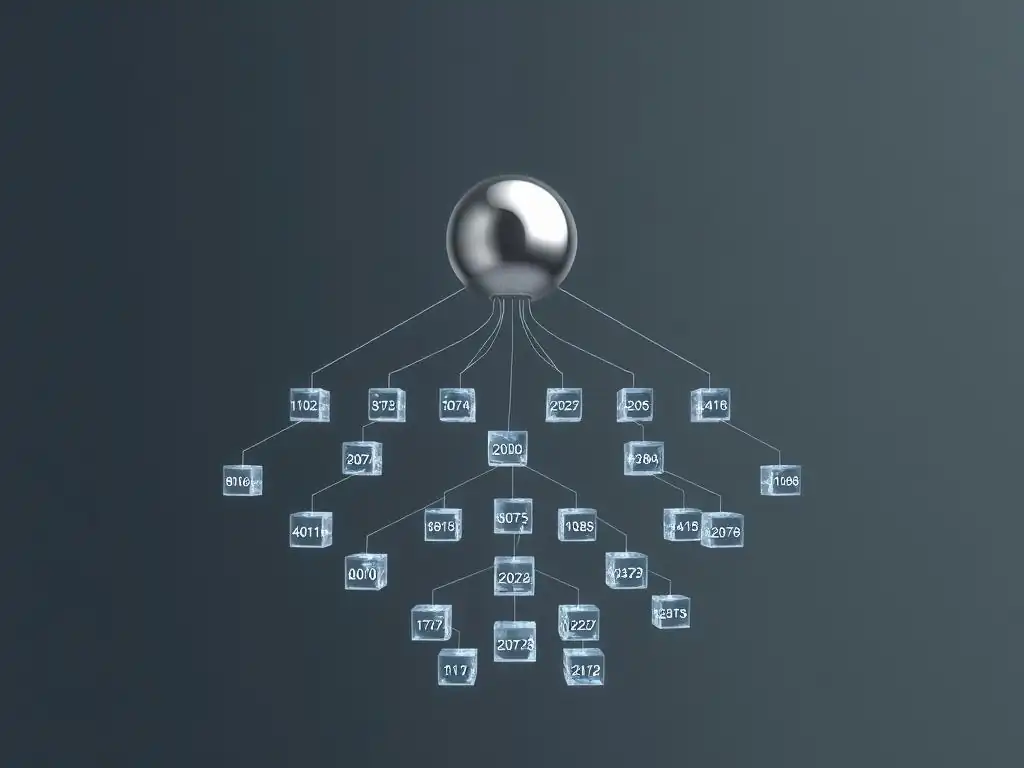
Merkle trees are not just theoretical constructs; they are fundamental components powering some of the most widely used blockchain applications today. Their practical implementation demonstrates their effectiveness in ensuring data integrity and enabling efficient verification across different domains.
Merkle Trees in Bitcoin and Other Cryptocurrencies: Transaction Verification and Block Integrity
Bitcoin was one of the first major applications to heavily rely on Merkle trees. Every Bitcoin block contains a Merkle tree of all transactions included in that block. The Merkle root is stored in the block header. This design allows SPV wallets (like many mobile Bitcoin wallets) to verify whether a transaction is included in a block without downloading the entire block's transaction data, which can be several megabytes (e.g., a full Bitcoin block can reach up to 4MB with SegWit).
Other cryptocurrencies, including Ethereum, Litecoin, and countless others, also utilize Merkle trees for structuring transactions within blocks and enabling efficient verification. While some newer architectures or Layer-2 solutions might use variations or different proof systems, the core principle of using a hash tree to summarize data for efficient Merkle tree blockchain verification remains a standard practice in block construction across most established blockchains.
Using Merkle Trees for Data Integrity in Supply Chain Management: Tracking Product Provenance and Authenticity
Beyond currency, Merkle trees are being applied in enterprise blockchain solutions, particularly in supply chain management. Companies are using blockchain to track goods from origin to destination, recording each step (manufacturing, shipping, customs, delivery) as a transaction or data entry. These entries for a batch of products or a shipment can be organized into a Merkle tree.
The Merkle root of this data can be recorded on a public or private blockchain. A user or auditor can then be given a specific data point (e.g., the manufacturing date of a product) and a Merkle proof. Using the Merkle root on the blockchain, they can verify the integrity and authenticity of that specific data point without needing access to the entire supply chain history for all products. This enhances transparency and trust, allowing stakeholders to verify product provenance or detect counterfeit goods efficiently using Merkle tree blockchain verification techniques applied to supply chain data.
Applications of Merkle Trees in Decentralized File Storage Systems: Data Integrity and Content Addressing
Decentralized file storage systems, such as IPFS (InterPlanetary File System), also make extensive use of Merkle trees (specifically, a directed acyclic graph or DAG of Merkle trees, called a Merkle DAG). When a file is added to IPFS, it is broken down into smaller chunks. Each chunk is hashed, and these hashes become the leaves of a Merkle tree. Intermediate nodes are created by hashing the hashes of their children, culminating in a root hash for the entire file.
This Merkle tree structure provides content addressing – the hash of the Merkle root acts as the unique identifier for the file. If even one chunk of the file is altered, the root hash changes, indicating tampering. To retrieve and verify a file, a user can request the file using its Merkle root hash.
The system can then provide the necessary chunks and the Merkle tree structure (or a Merkle proof for specific parts), allowing the user to verify the integrity of the downloaded data by recomputing the Merkle root and comparing it to the requested hash. This ensures that the data received is exactly what was expected, leveraging Merkle tree blockchain verification principles for file integrity.
Limitations and Challenges of Merkle Trees
While highly beneficial, Merkle trees are not without their limitations and associated challenges. Understanding these aspects is important for appreciating the complexities involved in implementing and scaling blockchain systems.
Potential Vulnerabilities and Security Considerations: Second Preimage Attack and Hash Function Weaknesses
The security of a Merkle tree is fundamentally tied to the strength of the underlying cryptographic hash function. If the hash function is weak or compromised, potential vulnerabilities arise. A significant theoretical concern is a second preimage attack. If an attacker could find a different transaction that produces the same hash as an original transaction, they could potentially substitute a malicious transaction for a legitimate one at the leaf level without changing the parent hash. However, for strong hash functions like SHA-256, finding such a second preimage is computationally infeasible with current technology.
Another consideration is related to the construction of the tree itself. If not implemented carefully, padding or ordering issues could potentially be exploited. However, standard Merkle tree implementations, like those in Bitcoin, define precise rules for ordering transactions and handling odd numbers of leaves to mitigate these risks. While Merkle tree blockchain verification is robust with strong hashes, the reliance on the hash function is absolute.
Computational Costs and Optimization Strategies: Tree Construction and Proof Generation
While Merkle tree verification is efficient (logarithmic time), the initial construction of the Merkle tree for a block still requires hashing every transaction and then hashing pairs iteratively up to the root. For a block with N transactions, this involves 2N-1 hashing operations. For blocks containing thousands of transactions, this can represent a non-trivial computational cost for block producers (miners or validators).
Optimization strategies are employed to mitigate this cost. Parallel processing can be used to compute hashes at each level of the tree simultaneously. Caching of intermediate hashes can speed up the process if parts of the tree need to be recomputed. For very large datasets or specialized applications, techniques like incremental tree updates or partial tree reconstruction might be used. These optimizations are crucial for maintaining the speed of block creation and propagation, complementing the efficiency of Merkle tree blockchain verification for consumers of the data.
Addressing Scalability Issues with Merkle Tree Variants: Large Datasets and High Transaction Volumes
As blockchains scale to handle millions of transactions per second, even the logarithmic time complexity of Merkle proofs can become a consideration, especially in scenarios involving proofs across extremely large state trees (like in Ethereum 2.0). Furthermore, while Merkle proofs are small, verifying their path up a deep tree still requires computational steps.
For applications dealing with massive datasets or requiring even faster verification, alternative Merkle tree variants or related cryptographic structures are being explored. Sparse Merkle trees (SMTs), Patricia Merkle trees (used in Ethereum's state), and other specialized structures are designed to optimize for specific access patterns, such as proving the non-inclusion of data or efficiently handling large, sparse datasets. These variants aim to maintain or improve upon the efficiency of standard Merkle tree blockchain verification in more demanding environments.
Merkle Tree Variants and Advanced Implementations
The basic binary Merkle tree is the most common form, but the concept is flexible and has led to the development of several variants designed to address specific use cases and improve performance in certain scenarios. These advanced implementations are pushing the boundaries of Merkle tree blockchain verification efficiency.
Exploring Different Types of Merkle Trees: Binary, N-ary, and Sparse Merkle Trees: Trade-offs and Performance Characteristics
The standard Merkle tree used in Bitcoin is a binary Merkle tree, where each non-leaf node has exactly two children. This structure is simple and efficient. However, Merkle trees can also be N-ary, where each node has N children. An N-ary tree is wider and shorter than a binary tree for the same number of leaves. This means Merkle proofs might be shorter (fewer levels), but each step in verification involves hashing N items instead of two, potentially increasing computational cost per step. The choice between binary and N-ary depends on specific implementation trade-offs.
Sparse Merkle Trees (SMTs) are optimized for datasets where most possible leaves are empty or zero. They are particularly useful for representing large state spaces, like accounts in a blockchain, where only a tiny fraction of possible addresses are active. Instead of storing hashes for every possible path, SMTs only store paths for existing data, using a default hash for empty subtrees.
This drastically reduces storage for the tree itself and makes proofs for both inclusion and non-inclusion efficient. Ethereum 1.0 uses a variation called a Merkle Patricia Trie/Tree for its world state, combining Merkle trees with a trie structure for efficient key-value lookups and state verification, enhancing Merkle tree blockchain verification for state changes.
Optimizing Merkle Tree Performance with Advanced Techniques: Caching, Parallelization, and Tree Pruning
To enhance the performance of Merkle tree operations, especially tree construction and proof generation, several advanced techniques are employed. As mentioned earlier, parallelization can significantly speed up the initial hashing process by computing hashes for sibling nodes concurrently. Caching intermediate hash values allows for quicker access if parts of the tree need to be re-accessed or updated.
Tree pruning involves removing branches of the tree that are no longer needed for verification or historical purposes, typically in lightweight or archival nodes. While full nodes retain the entire tree structure implicitly through storing all transactions, some systems might prune parts of the tree to save space if data availability is handled elsewhere.
Techniques like Merkle proofs of non-inclusion (enabled by sorted leaves or SMTs) also represent performance optimizations by allowing efficient verification that a specific piece of data is not in the tree, which is crucial in many blockchain applications. These methods further refine Merkle tree blockchain verification.
Future Trends and Innovations in Merkle Tree Research and Development: Vector Commitments and Accumulators
Research continues into improving cryptographic data structures for decentralized systems. While Merkle trees are robust, newer concepts like Vector Commitments and Accumulators offer potentially even greater efficiency or functionality in specific contexts. Vector commitments allow committing to a vector (list) of data and later opening (proving) individual elements or sub-vectors with very short proofs, potentially shorter than Merkle proofs in some scenarios.
Cryptographic accumulators allow users to commit to a set of elements and provide short proofs of membership for individual elements. While conceptually similar to Merkle trees, some accumulator schemes (like RSA accumulators) offer constant-size proofs, regardless of the size of the set, which could be revolutionary for Merkle tree blockchain verification in extremely large datasets. These innovations build upon the principles established by Merkle trees, aiming for ever-greater efficiency and scalability in verifying data integrity in decentralized environments.
Merkle Trees and the Future of Blockchain Scalability
The drive for greater blockchain scalability is one of the most active areas of research and development in the space. Merkle trees, and their advanced variants, are positioned as key components in many proposed solutions to handle increasing transaction volumes and data loads.
The Role of Merkle Trees in Layer-2 Scaling Solutions: Rollups and Sidechains
Layer-2 scaling solutions, such as optimistic rollups and zero-knowledge rollups, aim to process transactions off the main blockchain (Layer 1) to reduce congestion and fees, while still inheriting the Layer 1 chain's security. Merkle trees are integral to how these solutions achieve this. In rollups, a large batch of transactions is processed off-chain, and the state change resulting from these transactions is summarized. A commitment to this new state, often in the form of a Merkle root or the root of a Merkle Patricia tree, is posted back to the Layer 1 chain.
Merkle trees enable efficient verification of these Layer-2 operations. For example, in optimistic rollups, a Merkle root of the post-state is published. If this state is challenged, a Merkle proof can be used to demonstrate the correctness of a specific transaction or state transition within the batch.
In ZK-rollups, proof of the state transition is provided by a zero-knowledge proof, but the underlying data structure being committed to and verified is often still a Merkle tree or a similar structure. This makes Merkle trees essential for the verifiable data structures used in these scaling methods, proving their continued importance for Merkle tree blockchain verification in future architectures.
Enabling Efficient Data Availability and Validation in Decentralized Systems: Ensuring Data Integrity and Trust
Ensuring data availability is a critical challenge for scaling solutions and decentralized systems. If data is processed off-chain or sharded, how can participants be sure that the data is available for auditing or reconstruction if needed? Merkle trees provide a mechanism for committing to the availability of data without requiring everyone to download all of it.
By publishing the Merkle root of a dataset, anyone can later challenge the availability of a specific part of the data. If the data provider cannot produce the requested data chunk and a valid Merkle proof matching the committed root, it indicates data unavailability.
This concept is fundamental to proposed data availability layers and sharding designs in blockchains like Ethereum 2.0. Merkle trees or related polynomial commitments (which can be seen as generalizations of Merkle trees) allow validators to verify the integrity of data shards or attest to their availability using small proofs, rather than processing the entire shard. This efficiency in validating data availability is crucial for maintaining trust and security in highly scaled decentralized networks, underpinning advanced Merkle tree blockchain verification use cases.
Merkle Trees as a Key Component of Next-Generation Blockchain Architectures: Sharding and Interoperability
Future blockchain architectures, particularly those implementing sharding, will heavily rely on Merkle trees and their variants. In a sharded blockchain, the network is divided into smaller partitions (shards), each processing a subset of transactions or managing a part of the state. Merkle trees are used within each shard to summarize the shard's state or transactions. More importantly, Merkle roots of the shard states or transaction batches are often communicated between shards or committed to a central beacon chain.
This cross-shard communication and verification of state integrity are made efficient through Merkle proofs. A transaction in one shard that interacts with the state of another shard can use a Merkle proof to demonstrate the relevant state from the other shard. Similarly, the overall integrity of the sharded system is maintained by committing and verifying Merkle roots of shard states on a global level.
Furthermore, Merkle trees can play a role in cross-chain interoperability solutions, allowing proofs about the state of one chain (represented by a Merkle root) to be verified on another chain. Merkle tree blockchain verification is thus not only essential within a single chain but increasingly important between chains.
Conclusion: The Enduring Importance of Merkle Trees in Blockchain
Merkle trees are far more than just a technical detail; they are a foundational cryptographic primitive that underpins the efficiency, scalability, and integrity of blockchain technology. From the earliest days of Bitcoin to the cutting-edge research in Layer-2 scaling and sharding, Merkle trees have provided a robust and elegant solution for summarizing large datasets and enabling efficient verification.
Recap of Merkle Tree Benefits for Blockchain Verification: Scalability, Security, and Efficiency
The core benefits of Merkle trees for Merkle tree blockchain verification are clear and significant:
- Scalability: They enable lightweight clients (SPV) to verify transactions without downloading the entire blockchain, drastically reducing resource requirements and broadening accessibility.
- Security: They provide a cryptographically secure way to ensure the integrity and consistency of data within a block. Any tampering with a transaction is immediately detectable by a mismatch in the Merkle root.
- Efficiency: Merkle proofs allow for verifying the inclusion of a single data element in logarithmic time, making transaction verification fast and bandwidth-efficient compared to verifying against a linear list.
These advantages have made Merkle trees indispensable for the current generation of blockchain networks.
The Future of Merkle Trees in Shaping the Blockchain Landscape: Innovation and Adoption
As blockchain technology continues to evolve, the principles behind Merkle trees will remain central to its development. While new variants and related cryptographic structures like Vector Commitments and Accumulators may emerge, they often build upon the fundamental idea of using hash-based structures to create efficient, verifiable commitments to data.
Merkle trees will continue to play a critical role in scaling solutions, data availability layers, and cross-chain communication, pushing the boundaries of what decentralized systems can achieve. Their elegance and efficiency in enabling Merkle tree blockchain verification ensures their enduring importance as a cryptographic backbone for the decentralized future. Understanding Merkle trees is key to understanding how blockchains work and how they can scale to support a global, decentralized economy.
Frequently Asked Questions
What is a Merkle Tree and why is it important for blockchain verification?
A Merkle Tree is a data structure that summarizes and verifies the integrity of large datasets. In blockchain, it's crucial for efficiently verifying transactions within a block without needing to download the entire blockchain. It ensures data immutability and tamper-proof verification.
How does a Merkle Tree facilitate efficient blockchain verification?
It allows a user to verify if a specific transaction is included in a block by only downloading a small part of the tree called a Merkle proof. This proof, along with the transaction's hash, can be used to recalculate the root hash and verify its presence in the block's header.
What role does the root hash play in Merkle Tree-based verification?
The root hash, also known as the Merkle root, is a single hash value that represents the entire tree. If even one transaction is altered, the root hash changes, making it a powerful tool for detecting tampering and verifying the integrity of the entire block.
Can Merkle Trees be used in blockchain applications besides transaction verification?
Yes, Merkle Trees have applications beyond transaction verification, including data synchronization, file sharing, and certificate authentication. They are beneficial in any scenario where you need to verify the integrity of large datasets efficiently.
What are the advantages of using Merkle Trees for blockchain verification compared to other methods?
Merkle Trees offer significant advantages such as scalability, efficiency, and reduced storage requirements. They allow for partial verification, meaning users don't need to download the entire blockchain to verify a specific transaction, making the verification process faster and more economical.
Final Reflection: The Enduring Power of Trustless Verification
The journey through the intricate world of Merkle Trees reveals their profound and enduring relevance in today's digital landscape. The ability to efficiently and securely verify data integrity, particularly within the context of blockchain technology, is more crucial than ever in an era defined by increasing data breaches and the need for trustless systems. Merkle Trees are not merely a theoretical construct; they are the silent guardians of data authenticity, underpinning the very foundation of decentralized trust.
The impact of Merkle Trees extends far beyond the technical realm, influencing how we perceive and interact with digital information. The elegance and efficiency of this cryptographic structure, its ability to distill vast amounts of data into a single, verifiable root, is a testament to human ingenuity and our relentless pursuit of secure and transparent systems. Trust, but verify.
This adage, often attributed to Ronald Reagan, perfectly encapsulates the essence of Merkle Trees: they empower us to verify information independently, fostering a culture of informed skepticism and accountability.
As we conclude this exploration of Merkle Trees and their role in blockchain verification, I invite you to consider the implications of this technology in your own life. How can you leverage the principles of verifiable integrity to protect your digital assets and ensure the authenticity of the information you consume? Embrace the power of trustless verification, and become an active participant in shaping a more secure and transparent digital future.
Unlock Deeper Insights: Become a Merkle Tree Master!
Thank you for exploring the fascinating world of Merkle Trees. We hope you now have a clearer understanding of how these structures support efficient and secure blockchain verification. Ready to test your knowledge?
Here’s how you can take the next step:
- Commit the core concepts to memory — practice drawing a Merkle Tree by hand and explaining each step to reinforce your understanding.
- Explore real-world implementations: Dive into the source code of a popular cryptocurrency like Bitcoin to see Merkle Trees in action.
- Share your newfound knowledge: Help others understand this crucial technology by explaining Merkle Trees to a friend or colleague.
What’s one creative way you can visualize or explain the benefits of Merkle Trees to someone unfamiliar with blockchain technology? Share your ideas in the comments below!
Leave a Reply