
EventDriven Smart Contracts: Building RealTime Decentralized Applications


Welcome to Blockchain Trends, your compass in the rapidly evolving world of decentralized technology. Delve into the transformative potential of blockchain, venturing far beyond the realm of cryptocurrencies.
Are you ready to unlock the power of Event-Driven Smart Contracts? Discover how this innovative approach is revolutionizing decentralized application development, enabling real-time responsiveness and dynamic interactions within the blockchain ecosystem. Explore the possibilities and build the future with us!
Event-Driven Smart Contracts: Building Real-Time Decentralized Applications
- Introduction to Event-Driven Smart Contracts
- Core Concepts of Event-Driven Smart Contract Development
- Benefits of Event-Driven Smart Contracts
- Use Cases for Event-Driven Smart Contracts
- Developing Event-Driven Smart Contracts: A Step-by-Step Guide
- Security Considerations for Event-Driven Smart Contracts
- Advanced Techniques in Event-Driven Smart Contract Development
- Limitations and Challenges of Event-Driven Smart Contracts
- The Future of Event-Driven Smart Contracts and Blockchain
- Conclusion: Embracing Event-Driven Smart Contracts for Dynamic dApps
-
Frequently Asked Questions
- What are event-driven smart contracts, and how do they differ from traditional smart contracts?
- Why is event-driven architecture important for developing real-time decentralized applications?
- What are some common use cases for event-driven smart contracts beyond finance?
- What are the key challenges in developing event-driven smart contracts?
- How does the development process for event-driven smart contracts differ from traditional smart contract development?
- Final Reflection: Embracing the Dynamic Future of Decentralization
- Unleash the Power of Real-Time DApps!
Introduction to Event-Driven Smart Contracts
Understanding Event-Driven Architecture in Blockchain
Event-driven architecture (EDA) is a software design pattern where decoupled services communicate through events. In the context of blockchain, this means that smart contracts, which are programs running on the blockchain, can emit signals (events) when certain actions occur or state changes happen.
These events are then recorded on the blockchain as part of the transaction receipt, but crucially, they are primarily designed to be consumed by off-chain applications or other systems that are "listening" for them. This allows for a reactive programming model where external systems don't need to constantly poll the blockchain state but can instead react immediately when a relevant event is emitted by a smart contract.
This architectural pattern contrasts with traditional request-response models often seen in web applications. While smart contracts can be queried for their state (reading data), this requires explicit requests. Events, on the other hand, push notifications of significant occurrences out to anyone interested. This push mechanism is fundamental to building responsive decentralized applications (dApps) and forms a core part of effective event-driven smart contracts development. It enables a flow of information from the immutable, decentralized ledger to external systems, powering everything from user interfaces to complex backend services reacting to on-chain activity.
The Need for Real-Time Decentralized Applications (dApps)
Modern users expect applications to be fast, responsive, and provide immediate feedback. Whether it's confirming a financial transaction, receiving a notification about an item being shipped in a supply chain, or seeing an update in a decentralized game, delays significantly degrade the user experience. Traditional dApps, which might rely solely on polling the blockchain state to detect changes, often suffer from latency issues and inefficient use of resources. Polling requires repeatedly asking the blockchain for information, which is slow and costly if done frequently on many nodes.
Real-time capabilities are not just about user experience; they are essential for the functionality of many advanced dApps. Consider automated trading bots in DeFi that need to react to price changes within seconds, or supply chain systems that must trigger immediate actions when goods arrive at a checkpoint. These scenarios demand a mechanism for dApps to be instantly notified of relevant on-chain events without constant, resource-intensive querying. Event-driven smart contracts provide this crucial link, enabling the development of dApps that can operate with the speed and responsiveness required by today's digital landscape.
Event-Driven Smart Contracts: Bridging the Gap
Event-driven smart contracts serve as the critical bridge between the deterministic, secure environment of the blockchain and the dynamic, responsive world of off-chain applications and users. By emitting events, smart contracts can signal that a specific condition has been met or an action has been completed on-chain. For instance, a smart contract managing a token exchange might emit a Swap event whenever a trade occurs, including details like the tokens exchanged, amounts, and participants.
Off-chain components, such as a dApp's front-end, a backend service, or a data analytics platform, can listen for these specific events. When an event is detected, the off-chain system can process the data contained within the event and trigger subsequent actions. This could be updating a user interface, sending a push notification, triggering another transaction, or logging data in a conventional database.
This pattern moves the heavy lifting of monitoring and reacting off-chain, allowing the smart contract to focus on its core logic and state management, while enabling off-chain systems to provide real-time interactivity based on on-chain occurrences. This is a fundamental aspect of effective event-driven smart contracts development.
Core Concepts of Event-Driven Smart Contract Development
Defining Events in Smart Contracts: A Deep Dive
In Solidity, the most common language for smart contract development on platforms like Ethereum, events are defined using the event keyword. An event declaration specifies the name of the event and the data types of the parameters it will carry. For example, an event signaling a token transfer might be defined as event Transfer(address indexed from, address indexed to, uint256 value);. The indexed keyword is particularly important as it allows specific parameters to be easily filtered when querying past events, significantly improving the efficiency of searching through event logs. Up to three parameters can be indexed per event.
When an event is triggered within a smart contract function, the emit keyword is used, followed by the event name and the values for its parameters. For instance, after successfully transferring tokens, a contract would execute emit Transfer(msg.sender, recipientAddress, transferAmount);. This action writes the event data to the transaction's log bloom filter and the transaction receipt. While event data is stored on the blockchain, it's not directly accessible from within other smart contracts (except for the transaction hash and block number where it occurred). Its primary purpose is external communication, making event-driven smart contracts development efficient for off-chain integration.
Event Listeners and Off-Chain Interactions
Off-chain applications interact with event-driven smart contracts by using libraries like Web3.js or Ethers.js in JavaScript, or similar libraries in other languages (e.g., Web3.py). These libraries connect to a blockchain node (either a public node like Infura or Alchemy, or a self-hosted node) and provide methods to subscribe to emitted events or query past events. Subscribing allows the application to receive real-time notifications as events are included in new blocks, while querying is useful for retrieving historical data within a specified block range.
When an off-chain application receives an event, it gets a structured object containing information like the block number, transaction hash, the contract address that emitted the event, and the event's parameters. For indexed parameters, the raw hash is provided, requiring the listener to know the expected data type. The application can then parse this data and trigger corresponding actions, such as updating a database, notifying a user via email or push notification, or initiating another transaction on or off the blockchain. This reactive pattern is central to building responsive interfaces and backend processes in event-driven smart contracts development.
Gas Optimization Strategies for Event Emission
Event emission is significantly cheaper in terms of gas costs compared to storing data in the smart contract's state variables. Writing to storage is one of the most expensive operations on the Ethereum Virtual Machine (EVM), costing thousands of gas units per 32-byte word depending on whether the slot is zeroed or modified. In contrast, emitting event data costs gas primarily for writing the data to the transaction log, which is appended rather than modifying existing state. A general approximation is around 8 gas per byte of event data, plus a base cost.
This cost differential makes events ideal for logging information that needs to be accessible off-chain but doesn't necessarily need to be retrieved or modified by other smart contracts. Instead of storing a history of every action in state variables (which would quickly become prohibitively expensive), smart contracts can emit detailed events for every significant change. Off-chain listeners can then reconstruct the history or current state based on processing these event streams. For instance, a list of all past token transfers can be derived from Transfer events without storing a massive array of transfer records in the contract's storage, which would require a much higher gas cost for each addition. This strategic use of events is a key optimization technique in event-driven smart contracts development.
Benefits of Event-Driven Smart Contracts
Enhanced Responsiveness and User Experience
One of the most tangible benefits of using event-driven smart contracts is the significant improvement in the responsiveness and overall user experience of dApps. Instead of requiring users or applications to constantly poll the blockchain for state changes, events provide a push mechanism. When a user interaction triggers a transaction that modifies the smart contract state – for example, completing a trade on a decentralized exchange – the smart contract emits an event. An off-chain application listening for this event can immediately detect that the transaction has been included in a block and the event emitted.
This immediate notification allows the user interface to update almost in real-time, showing the successful trade, the updated token balances, or a confirmation message without delay. For instance, a user might see their new balance reflected within seconds of a transaction being confirmed, rather than waiting for a polling mechanism to check the state minutes later. This direct feedback loop makes dApps feel snappier and more aligned with the responsiveness users expect from modern web and mobile applications, significantly enhancing the user experience provided by event-driven smart contracts development.
Improved Scalability and Performance
Event-driven architecture contributes to the scalability and performance of decentralized systems by shifting the burden of data monitoring and processing off-chain. Smart contracts on the blockchain are inherently resource-constrained, and complex computations or extensive data storage are expensive and can hit gas limits. By using events, the smart contract only needs to perform the core logic and emit a signal about the outcome. The computationally heavier tasks of filtering, aggregating, or reacting to this information can be handled by off-chain services that have access to far more computing power and storage.
This separation of concerns allows the blockchain to focus on consensus and state transitions, while off-chain infrastructure handles data presentation, complex analytics, and triggering subsequent actions based on events. For example, building a historical dashboard of all transactions for a specific user or asset would be impractical to do directly from a smart contract.
However, an off-chain service listening to relevant events can easily build and maintain such a database. This architecture scales better because adding more users or activity primarily increases the load on the more flexible off-chain infrastructure, while the on-chain component remains lean and focused, demonstrating the performance benefits of event-driven smart contracts development.
Real-Time Data Integration with Oracles
Event-driven smart contracts play a crucial role in integrating real-world data into the blockchain via oracles. Oracles are services that connect smart contracts with external information, such as asset prices, weather data, or the outcome of real-world events. While smart contracts cannot directly fetch external data, they can interact with oracle contracts. An event-driven pattern can be used in several ways in this interaction.
A smart contract might, for instance, emit an event requesting specific data from an oracle contract. An off-chain service monitoring these request events can then retrieve the data from external sources and submit it back to the oracle contract on-chain. Alternatively, an oracle contract itself might emit an event whenever it updates a data feed.
Smart contracts or off-chain applications listening for this oracle update event can then react to the new data in real-time. For example, a DeFi lending protocol might listen for price updates from a Chainlink oracle event and trigger liquidations if a user's collateral ratio falls below a threshold. This real-time data flow enabled by events is vital for dApps that rely on external information, highlighting the power of event-driven smart contracts development in connecting on-chain and off-chain worlds.
Use Cases for Event-Driven Smart Contracts
Real-Time Supply Chain Tracking with Smart Contracts
Event-driven smart contracts are highly effective for building transparent and real-time supply chain tracking systems. A smart contract can represent the state of goods as they move through the supply chain, with functions for actions like 'Ship', 'Receive', 'Inspect', or 'TransferOwnership'. Each time one of these functions is executed and the state changes, the contract can emit a corresponding event, such as ItemShipped(uint256 itemId, address fromLocation, address toLocation, uint64 timestamp) or ItemReceived(uint256 itemId, address location, uint64 timestamp).
Off-chain applications used by manufacturers, logistics providers, distributors, and end consumers can listen for these specific events related to items they are interested in. When an ItemReceived event is emitted at a distribution center, for example, the system can immediately update the item's status in a database, notify the next party in the chain, or update a user-facing dashboard. This provides real-time visibility into the movement and status of goods, enabling faster responses to delays or issues, and building trust through verifiable, timestamped records on the blockchain, a key application area for event-driven smart contracts development.
Decentralized Finance (DeFi) Applications: Automated Trading
DeFi protocols heavily rely on event-driven architecture to enable automated trading and sophisticated financial operations. Decentralized exchanges (DEXs) like Uniswap or SushiSwap emit events for every trade executed, such as Swap(address indexed sender, uint256 amount0In, uint256 amount1Out, address indexed to). Lending protocols emit events for actions like depositing collateral ( Deposit), borrowing assets ( Borrow), repaying loans ( Repay), or liquidating positions ( Liquidation).
Trading bots and algorithmic strategies are off-chain applications that constantly monitor these events across various DeFi protocols. Upon detecting a specific event, such as a large swap that might affect prices or a liquidation event, the bot can immediately trigger its own logic. This might involve placing a new trade, adjusting positions, or capitalizing on arbitrage opportunities. The low latency provided by listening to events directly, rather than constantly querying contract states, is critical for the profitability and speed of these automated systems, making event-driven smart contracts development fundamental to the DeFi ecosystem.
Gaming and NFT Applications: Dynamic In-Game Events
In blockchain-based gaming and NFT applications, event-driven smart contracts enable dynamic and responsive gameplay and asset management. Smart contracts can manage game logic, character states, item ownership (NFTs), and battle outcomes. Events can be emitted for significant in-game occurrences, such as BattleWon(uint256 gameId, address indexed winner, address indexed loser, uint256 rewardAmount), ItemMinted(uint256 itemId, address indexed owner, uint256 rarity), or LevelUp(address indexed player, uint256 newLevel).
The game's front-end or backend servers listen for these events. When a BattleWon event is detected, the game interface can immediately display a victory screen, update the player's score, and credit their account with the reward amount. For NFTs, an ItemMinted event signals that a new asset is available and can be displayed in the player's inventory or on a marketplace. This event-driven approach allows for real-time updates and interactions within the game based on verifiable on-chain actions, creating a more immersive and responsive experience for players and showcasing the versatility of event-driven smart contracts development.
Decentralized Insurance: Automated Claim Processing
Decentralized insurance platforms can leverage event-driven smart contracts to automate claim processing and policy management. A smart contract can define policy terms, premium payments, and conditions for claim payouts. Events can signal key stages, such as PolicyCreated(uint256 policyId, address indexed insured, uint256 coverageAmount), PremiumPaid(uint256 policyId, uint256 amount), or ClaimSubmitted(uint256 policyId, address indexed claimant, string description).
When a ClaimSubmitted event is emitted, an off-chain service can pick it up. This service might then interact with an oracle to verify the claim's validity based on external data (e.g., flight delay data for travel insurance). Once the oracle confirms the event (e.g., emitting a ClaimVerified event), the insurance smart contract could automatically trigger a payout function, emitting a ClaimPaid(uint256 policyId, uint256 payoutAmount) event. This event notifies the claimant and updates the policy status. This automated, event-driven workflow significantly speeds up claim processing, reduces administrative overhead, and increases transparency compared to traditional insurance models, illustrating a powerful use case for event-driven smart contracts development.
Developing Event-Driven Smart Contracts: A Step-by-Step Guide
Setting Up Your Development Environment (Solidity, Truffle/Hardhat)
The first step in event-driven smart contracts development is setting up a suitable development environment. You'll need Node.js installed to manage dependencies and run development tools. The primary language for writing smart contracts on many blockchains is Solidity, so you'll need a Solidity compiler ( solc), often included with development frameworks. Popular frameworks like Truffle or Hardhat provide essential tools for compiling, deploying, and testing smart contracts.
Using a framework like Hardhat involves installing it via npm ( npm install --save-dev hardhat). Hardhat provides a local development blockchain (Hardhat Network) for fast testing, tools for deploying to testnets or mainnets, and a robust testing framework. Truffle offers similar capabilities. You'll also need a text editor or IDE with Solidity syntax highlighting (like VS Code with the Solidity extension) and potentially tools for interacting with smart contracts, such as MetaMask for browser-based dApps or command-line interfaces provided by the frameworks.
Defining Events and Data Structures
Within your Solidity smart contract file ( .sol), you define events using the event keyword. Choose descriptive names for your events that clearly indicate what action occurred. Define the parameters the event will carry, specifying their data types (e.g., address, uint256, string, bytes32). Remember to use the indexed keyword for parameters you anticipate filtering on when querying logs, such as addresses or unique identifiers.
pragma solidity ^0.8.0;

contract MyEventContract {
    // Define an event for a new item being created
    event ItemCreated(
        uint256 indexed itemId,
        address indexed owner,
        string name,
        uint256 price
    );

    // Define an event for an item sale
    event ItemSold(
        uint256 indexed itemId,
        address indexed seller,
        address indexed buyer,
        uint256 price
    );

    // State variables (optional, but useful for context)
    struct Item {
        string name;
        uint256 price;
        address owner;
    }

    mapping(uint256 => Item) public items;
    uint256 nextItemId = 1;

    // Function to create an item and emit an event
    function createItem(string memory _name, uint256 _price) public {
        uint256 currentItemId = nextItemId++;
        items[currentItemId] = Item(_name, _price, msg.sender);
        // Emit the event
        emit ItemCreated(currentItemId, msg.sender, _name, _price);
    }

    // Function to simulate selling an item and emit an event
    function sellItem(uint256 _itemId, address payable _buyer) public {
        require(items[_itemId].owner == msg.sender, "Not item owner");
        require(_buyer != address(0), "Invalid buyer address");

        uint256 itemPrice = items[_itemId].price;
        address seller = msg.sender;

        // Transfer logic would go here (simplified for example)
        // payable(seller).transfer(itemPrice); // Example transfer

        items[_itemId].owner = _buyer; // Update owner state

        // Emit the event
        emit ItemSold(_itemId, seller, _buyer, itemPrice);
    }
}
This code snippet shows how events ItemCreated and ItemSold are defined with indexed and non-indexed parameters, and how state variables like items and nextItemId are used alongside the event definitions. This structure is fundamental in event-driven smart contracts development.
Implementing Smart Contract Logic with Event Emission
Integrate the emit statements within your smart contract functions at the points where a significant action is completed or a state change occurs that external applications need to be aware of. Place the emit statement after the logic that performs the action it is signaling, ensuring the action was successful before the event is logged. Pass the relevant data from the function's execution as parameters to the event.
For instance, in a function that transfers tokens, the emit Transfer(...) call would typically come after the token balances have been successfully updated. In the example contract above, the emit ItemCreated call is placed after the items mapping and nextItemId state variables are updated. Similarly, emit ItemSold is called after the item's owner is updated. This ensures that the emitted event accurately reflects the state change that just occurred on-chain.
Creating Off-Chain Event Listeners (Web3.js/Ethers.js)
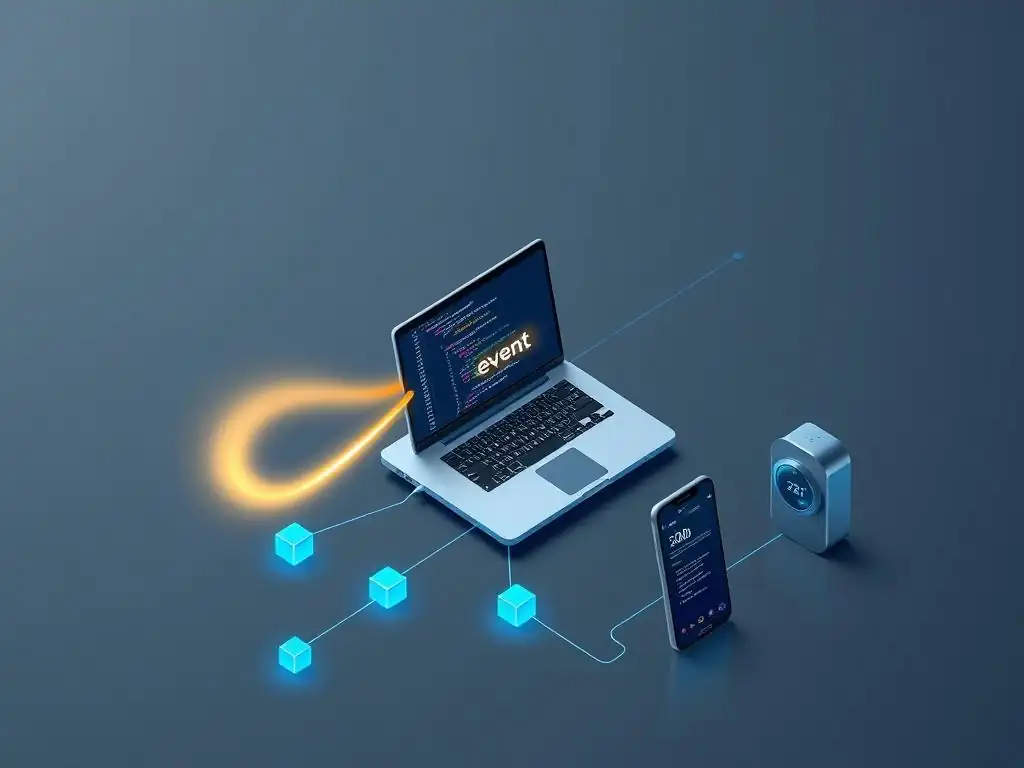
To consume the events emitted by your smart contract, you need to create off-chain applications that act as event listeners. Using libraries like Ethers.js or Web3.js in a Node.js environment or a web browser, you can connect to an Ethereum node and interact with your deployed contract. You'll need the contract's address and its Application Binary Interface (ABI), which describes the contract's functions and events.
With the contract instance created using the address and ABI, you can subscribe to specific events. Ethers.js provides a straightforward way using the contract.on() method. For example, to listen for the ItemSold event from the previous example:
// Assuming 'contract' is an Ethers.js Contract instance connected to a provider

// Listen for all ItemSold events
contract.on("ItemSold", (itemId, seller, buyer, price, event) => {
    console.log(`Item Sold! Item ID: ${itemId}, Seller: ${seller}, Buyer: ${buyer}, Price: ${price}`);
    console.log("Event details:", event); // Contains blockHash, transactionHash, etc.

    // Perform off-chain actions here, e.g., update UI, send notification, store in DB
    updateSalesDashboard({
        id: itemId.toString(),
        seller: seller,
        buyer: buyer,
        price: price.toString() // Convert BigNumber to string
    });
});

// You can also listen for events only once using contract.once()
// Or query past events using contract.queryFilter()
This code sets up a listener that triggers a callback function every time an ItemSold event is detected on the blockchain. The callback receives the event parameters and the full event object, allowing the off-chain application to react in real-time, demonstrating a core part of event-driven smart contracts development.
Testing and Deploying Your Event-Driven Smart Contract
Thorough testing is crucial for event-driven smart contracts development. Your tests should verify not only that the smart contract logic performs correctly and updates state as expected but also that events are emitted correctly with the right data at the right time. Frameworks like Hardhat and Truffle provide testing environments (often using Mocha or Chai). You can write tests that call your contract functions and then check the transaction receipt for the presence of expected events and verify the data within those events.
Once testing is complete on a local development network and potentially a public testnet (like Sepolia or Mumbai), you can deploy your smart contract to the desired blockchain network. Deployment scripts (often written in JavaScript using Hardhat or Truffle) handle sending the contract creation transaction. After deployment, note the contract address and the network's chain ID. Your off-chain event listeners will need this address and the contract's ABI to start monitoring for events on the live network, bringing your event-driven dApp to life.
Security Considerations for Event-Driven Smart Contracts
Preventing Event Manipulation and Data Integrity
While events themselves are immutable once included in a block as part of a transaction log, the data they contain is dependent on the smart contract's logic. Flaws in the smart contract code could lead to events being emitted with incorrect data, or malicious actors exploiting vulnerabilities to trigger events improperly. For example, if a contract relies on external input to determine event parameters without proper validation, an attacker might provide manipulated data, causing misleading events to be logged.
Furthermore, off-chain systems that consume events must be careful about relying solely on event data for critical state. While events are a reliable signal that something happened, the definitive source of truth remains the smart contract's state variables. An off-chain listener should ideally verify critical information received via an event by querying the contract's state, especially for sensitive operations like financial settlements. For instance, after receiving a ClaimPaid event, an insurance dApp's backend might query the policy status in the contract's state to double-check the payout amount and policy validity before marking the claim as finalized in its internal database. This dual verification strengthens the data integrity in event-driven smart contracts development.
Secure Off-Chain Communication Channels
The off-chain infrastructure that listens for and processes events is a critical part of the system and must be secured. Event listeners typically connect to blockchain nodes (e.g., via RPC endpoints). Ensure these connections are secure, ideally using HTTPS for API calls to node providers. If running your own node, secure its access points. The off-chain services that react to events and potentially interact with other systems (databases, APIs, user notification services) must also follow standard security practices.
This includes securing APIs with proper authentication and authorization, encrypting data in transit and at rest, and protecting against common web vulnerabilities like injection attacks or cross-site scripting, especially if the off-chain service provides a user interface. The integrity of the entire event-driven system depends not just on the smart contract's security but also on the security of the off-chain components that consume and act upon the emitted events. A robust security posture for the off-chain infrastructure is paramount in event-driven smart contracts development.
Auditing Event-Driven Smart Contract Code
Security audits are essential for any smart contract, and event-driven smart contracts require specific attention during the auditing process. Auditors should review how events are defined, where and when they are emitted in the contract's logic, and what data they contain. They should verify that events accurately reflect the state changes and intended outcomes of functions.
Specific audit points for event-driven smart contracts development include checking for:
- Events being emitted before the state change they are meant to signal (leading to misleading logs).
- Sensitive data being included in non-indexed event parameters that could be easily read, if privacy is a concern (though event data is public by nature).
- Lack of necessary events for critical actions, making it difficult for off-chain systems to monitor important contract activity.
- Potential for attackers to manipulate inputs in a way that causes incorrect events to be emitted without necessarily compromising the core contract state (which could still mislead off-chain systems).
A thorough audit ensures the reliability and security of the event emission mechanism, which is vital for the integrity of the entire dApp ecosystem built around these events.
Advanced Techniques in Event-Driven Smart Contract Development
Using Indexed Events for Efficient Filtering
As mentioned earlier, marking event parameters with the indexed keyword is a crucial optimization technique for event-driven smart contracts development. When querying past events using libraries like Ethers.js or Web3.js, you can specify filters based on the values of indexed parameters. The blockchain node can use internal data structures (like Bloom filters) to quickly find transaction logs that match the indexed criteria without having to scan the full data of every log entry in the specified block range.
For example, if you have a Transfer event defined as event Transfer(address indexed from, address indexed to, uint256 value);, you can efficiently query for all transfers from a specific address or all transfers to a specific address within a range of blocks. Querying for transfers with a specific value (a non-indexed parameter) would require fetching all Transfer events in the range and then filtering them programmatically off-chain, which is much less efficient. By carefully selecting which parameters to index (up to three per event), developers can enable highly performant off-chain data retrieval and filtering based on on-chain activity.
Combining Events with State Variables for Data Consistency
In event-driven smart contracts development, it's often beneficial to use events in conjunction with state variables to ensure data consistency and provide robust off-chain data management. While events are excellent for signaling occurrences and logging historical data, the smart contract's state variables represent the current, definitive state on the blockchain. Off-chain applications consuming events should ideally use the event data as a trigger or initial information source but confirm critical details by querying the contract's state, especially after a transaction is confirmed.
For example, an event might signal that a user's balance has been updated. The event could include the new balance. However, to be absolutely certain and protect against potential edge cases or race conditions in off-chain processing, the off-chain application should, after receiving the event and confirming the transaction, query the smart contract's public balance function to retrieve the canonical balance directly from the state. This pattern ensures that the off-chain system's view of the world is always synchronized with the true, immutable state on the blockchain, providing an extra layer of data integrity.
Design Patterns for Complex Event Handling
As dApps grow in complexity, managing the flow of information via events requires thoughtful design patterns. One common pattern is the use of a dedicated "Listener Service" or "Indexer". This is an off-chain application specifically designed to connect to the blockchain, listen for all relevant events from one or more smart contracts, process the event data, and store it in a queryable database (like PostgreSQL or MongoDB).
Another pattern involves using events to signal the need for off-chain computation or interaction with other systems. For example, a smart contract might emit an event ProcessOrder(uint256 orderId) after validating an order. An off-chain microservice listening for this specific event could then pick up the orderId, retrieve further details by querying the contract state or an off-chain database, and trigger actions like sending a confirmation email or initiating a shipping process. This pattern allows for complex workflows to be orchestrated off-chain based on simple, verifiable triggers from the blockchain, showcasing advanced event-driven smart contracts development.
Limitations and Challenges of Event-Driven Smart Contracts
Gas Costs Associated with Event Emission
While emitting events is significantly cheaper than writing to storage, it is not free. Each emitted event adds to the transaction's total gas cost. The cost depends on the amount of data included in the event and whether parameters are indexed. Non-indexed data costs approximately 8 gas per byte. While this is low compared to storage writes (potentially 20,000 gas for a cold SSTORE), a smart contract that emits a very large number of events within a single transaction, or emits events with extensive data payloads, can still incur substantial gas fees.
For instance, a batch operation that updates many items and emits an event for each update could become expensive. Developers engaged in event-driven smart contracts development must be mindful of the data size in their events and the frequency of emission within functions, especially in gas-sensitive environments. While necessary for off-chain communication, excessive event emission can lead to high transaction costs for users, impacting the usability and economic viability of the dApp.
Potential Latency in Off-Chain Event Processing
Although events provide a push mechanism, there is still inherent latency between an event being emitted on-chain and an off-chain listener reacting to it. This latency is influenced by several factors: the time it takes for a transaction to be included in a block (block time – e.g., Ethereum averages ~12 seconds, Polygon ~2 seconds), the time it takes for the block to propagate through the network, and the time it takes for the off-chain listener to receive and process the event from the blockchain node.
While faster than polling, this latency means that "real-time" in a decentralized context is typically measured in seconds rather than milliseconds. For applications requiring extremely low latency (e.g., high-frequency trading), relying solely on blockchain events might not be sufficient, and alternative or supplementary mechanisms might be needed. Developers must consider these latency factors when designing systems based on event-driven smart contracts development and manage user expectations accordingly.
Complexity in Managing Off-Chain Infrastructure
Developing event-driven smart contracts is only half the story; the other half involves building and maintaining the off-chain infrastructure that consumes and acts upon these events. Running reliable event listeners requires dedicated servers or cloud functions that are always running and connected to a blockchain node. This infrastructure needs to be robust enough to handle potential node outages, network instability, and spikes in event volume.
Furthermore, processing event streams often involves storing the data in a database, which requires database administration, scaling, and backup strategies. Ensuring that event processing is idempotent (can be run multiple times without causing issues, important for handling duplicate event deliveries from nodes) and handling potential reorgs (temporary forks where a block and its events might be reverted) adds further complexity. This operational overhead for managing the off-chain components is a significant challenge in event-driven smart contracts development that is not present in purely on-chain solutions.
The Future of Event-Driven Smart Contracts and Blockchain
Integration with Layer-2 Scaling Solutions
Layer-2 scaling solutions (like Optimistic Rollups and ZK-Rollups) are designed to increase transaction throughput and reduce costs by processing transactions off the main chain (Layer 1) and periodically submitting summaries or proofs back to L1. The way events are handled in L2 solutions impacts event-driven smart contracts development. While events emitted within the L2 execution environment are immediately visible to listeners connected directly to the L2 node, there can be a delay in these events being fully finalized or accessible via L1 mechanisms.
Accessing events from L2 can involve querying the L2 execution layer directly or waiting for batched transaction data and proofs to be posted to L1. The specifics vary between L2 implementations. However, as L2 adoption grows, reliable and low-latency access to L2 events will become crucial for event-driven dApps that benefit from the lower transaction costs and higher speeds of L2s. Future developments in L2 infrastructure will likely focus on improving the efficiency and standardization of accessing event data.
The Role of Event-Driven Architecture in Enterprise Blockchain Adoption
Enterprise blockchain solutions often involve integrating blockchain networks with existing legacy systems, databases, and business processes. Event-driven architecture is a natural fit for this integration challenge. Smart contracts on an enterprise blockchain can emit events signaling key business milestones or data changes – for example, a supply chain contract emitting an event when goods clear customs, or a financial contract emitting an event when a payment settles.
Off-chain enterprise systems can listen for these blockchain events and automatically trigger corresponding actions within the company's existing IT landscape, such as updating an ERP system, sending notifications to relevant departments, or initiating downstream processes. This avoids the need for constant polling of the blockchain by enterprise systems and enables a more reactive and efficient integration. Event-driven smart contracts development is therefore expected to play a significant role in facilitating seamless and robust enterprise adoption of blockchain technology.
Emerging Trends in Real-Time dApp Development
Beyond traditional event listeners, emerging trends in real-time dApp development might involve more sophisticated event processing frameworks and decentralized messaging protocols. We might see the rise of decentralized protocols specifically designed for event notification and routing, ensuring censorship resistance and further decentralization of the event consumption layer.
Furthermore, serverless architectures and edge computing could be leveraged to run event listeners closer to users or data sources, reducing latency in off-chain processing. As blockchain technology matures and becomes more integrated into the broader digital ecosystem, the tools and patterns for building responsive, event-driven applications based on on-chain activity will continue to evolve, pushing the boundaries of what's possible with event-driven smart contracts development.
Conclusion: Embracing Event-Driven Smart Contracts for Dynamic dApps
Key Takeaways on Event-Driven Smart Contract Development
Event-driven smart contracts development is a powerful paradigm for building responsive and efficient decentralized applications. By emitting events, smart contracts provide a mechanism for off-chain systems to react in real-time to on-chain activity without the need for constant, inefficient polling. Events are cheaper than storage writes, making them ideal for logging historical data and signaling important occurrences.
Successful event-driven smart contracts development requires careful definition of events, strategic use of indexed parameters for efficient querying, and robust off-chain infrastructure to reliably listen for and process events. While challenges exist, such as gas costs, potential latency, and off-chain management complexity, the benefits in terms of user experience, scalability, and real-time data integration are significant. Mastering this technique is essential for developers aiming to build dynamic and high-performance dApps.
The Potential of Real-Time Decentralized Applications
The ability to build real-time dApps unlocks a vast potential across various sectors. In finance, it enables automated trading and instant settlement notifications. In supply chains, it provides transparent, real-time tracking of goods. In gaming, it facilitates dynamic and responsive gameplay. In insurance, it allows for automated and rapid claim processing.
As blockchain technology matures and becomes more integrated into our digital lives, the demand for applications that can react instantly to on-chain events will only grow. Real-time dApps, powered by effective event-driven smart contracts development, move the blockchain experience beyond slow, asynchronous interactions towards the dynamic and responsive applications that users expect in the modern digital landscape. This responsiveness is key to broader adoption and impact.
Resources for Further Learning about Event-Driven Smart Contracts
To deepen your understanding of event-driven smart contracts development, explore official documentation for Solidity, which details event syntax and usage. Dive into the documentation for Web3.js and Ethers.js to learn how to connect to blockchain nodes, subscribe to events, and query historical logs from off-chain applications.
Study the source code of popular decentralized protocols on platforms like GitHub; many projects in DeFi, NFTs, and gaming heavily utilize events, providing practical examples. Look for tutorials and guides on development frameworks like Hardhat and Truffle that often include sections on testing and interacting with contract events. Engaging with developer communities and forums can also provide valuable insights and help troubleshoot specific challenges in your event-driven smart contracts development journey.
Frequently Asked Questions
What are event-driven smart contracts, and how do they differ from traditional smart contracts?
Event-driven smart contracts react to real-time events on or off the blockchain. Traditional contracts are typically triggered by predefined conditions within the contract code itself, not external occurrences.
Why is event-driven architecture important for developing real-time decentralized applications?
It enables smart contracts to respond to external changes, such as sensor data or market fluctuations. This real-time reactivity allows for more dynamic and responsive decentralized applications (dApps).
What are some common use cases for event-driven smart contracts beyond finance?
Beyond DeFi, they can be used in supply chain management for tracking goods, IoT for managing devices, and healthcare for monitoring patient data. The key is responding to external stimuli.
What are the key challenges in developing event-driven smart contracts?
Challenges include handling data oracles securely, ensuring data integrity, and managing the complexity of real-time systems within the decentralized environment.
How does the development process for event-driven smart contracts differ from traditional smart contract development?
It requires a greater focus on integrating external data sources and carefully designing the event listeners. This necessitates utilizing off-chain data oracles and robust security measures.
Final Reflection: Embracing the Dynamic Future of Decentralization
The exploration of event-driven smart contracts reveals not just a technological advancement, but a paradigm shift in how we build decentralized applications. The ability to react in real-time to on-chain and off-chain events unlocks a new level of responsiveness and efficiency, moving beyond static, pre-defined interactions. This capability is crucial in today's rapidly evolving digital landscape, where users demand immediate feedback and dynamic experiences.
The impact of event-driven architectures on the blockchain space is already palpable, fostering more interactive and user-friendly applications. Witnessing this evolution firsthand underscores the importance of embracing innovation and pushing the boundaries of what's possible with decentralized technology. The future of decentralized applications lies in their ability to seamlessly integrate with the real world, reacting to events as they happen and providing users with a truly dynamic and personalized experience.
This quote encapsulates the transformative potential of event-driven smart contracts, highlighting their capacity to bridge the gap between the digital and physical realms.
As we stand at the cusp of this new era, I invite you to reflect on the possibilities that event-driven smart contracts unlock. Consider how you can leverage this technology to build more responsive, engaging, and ultimately, more impactful decentralized applications. Embrace the challenge of mastering eventdriven smart contracts development, and contribute to shaping a future where decentralized technologies are not just powerful, but also intuitive and adaptable to the ever-changing needs of the world around us.
Unleash the Power of Real-Time DApps!
Thank you for exploring the world of event-driven smart contracts! We hope this article illuminated how you can build responsive and dynamic decentralized applications. Now it's time to put that knowledge into action.
What's next?
- Dive deep and start building your own event-driven smart contract on a test network. Experience the power of real-time responses firsthand! This is your key takeaway, so put it into practice.
- Explore existing decentralized applications that leverage event-driven architecture. Analyze their designs and identify opportunities for improvement or inspiration for your own projects.
- Share this article with fellow blockchain enthusiasts and spark a discussion about the future of real-time DApps.
What innovative real-time decentralized application idea are you most excited to build with event-driven smart contracts? Share your thoughts in the comments below!
Leave a Reply