
Advanced Security Features of Hardware Crypto Wallets You Need to Know

Welcome to Blockchain Trends, your guide to understanding the revolutionary impact of blockchain technology. Beyond the buzz around cryptocurrencies, blockchain is reshaping industries from finance to supply chains.
Are you truly safeguarding your digital assets? Dive into our latest article, " Advanced Security Features of Hardware Crypto Wallets You Need to Know," and discover the critical hardware crypto wallet security features that can protect your investments. What vulnerabilities are you overlooking, and how can you fortify your defenses? Read on to find out!
- Introduction to Hardware Crypto Wallet Security Features
- What Makes Hardware Crypto Wallets Secure?
- Advanced Security Features of Top Hardware Crypto Wallets
- Comparing Security Features of Leading Hardware Crypto Wallets
- Additional Security Measures for Hardware Crypto Wallet Users
- Myths and Realities About Hardware Crypto Wallet Security
- Conclusion: Maximizing Security with Hardware Crypto Wallets
-
Frequently Asked Questions
- What are the most important hardware crypto wallet security features that protect my digital assets?
- How do hardware crypto wallets differ from software wallets in terms of security?
- What role does a secure element play in the overall security of a hardware crypto wallet?
- What are the best practices for maintaining the security of my hardware crypto wallet and its associated recovery phrase?
- How do firmware updates impact the security features of a hardware crypto wallet?
- Final Reflection: Securing Your Digital Future
- Fortify Your Crypto Future: Act Now!
Introduction to Hardware Crypto Wallet Security Features
Understanding the Importance of Hardware Wallets in Crypto Security
In the volatile world of cryptocurrency, safeguarding digital assets is paramount. Software wallets, while convenient, expose private keys to the internet, making them susceptible to online threats such as malware, phishing attacks, and viruses that can compromise a user's funds. A study by Chainalysis in 2022 estimated that billions of dollars are lost annually due to crypto hacks and scams, many originating from compromised private keys held in hot wallets. This stark reality underscores the critical need for enhanced security measures beyond traditional software solutions.
Hardware wallets offer a robust defense by storing private keys in an offline, physical device. This isolation from internet-connected devices dramatically reduces the attack surface available to malicious actors. Even if the computer or smartphone connected to the hardware wallet is infected, the private key remains secure within the device's protected environment, making it virtually impossible for malware to access or steal it. This fundamental principle of air-gapping the private key is the core reason why hardware crypto wallet security features are considered the gold standard for self-custody.
Overview of Key Security Features in Hardware Crypto Wallets
Hardware crypto wallets are engineered with multiple layers of security to protect digital assets. At the heart of their security model is the secure element or secure chip, a tamper-resistant microcontroller specifically designed to store sensitive data like private keys in isolation. This chip is often certified to high-security standards, such as Common Criteria Evaluation Assurance Level (EAL) 5+ or higher, ensuring it can withstand sophisticated physical and logical attacks.
Beyond the secure chip, hardware wallets incorporate essential user-facing security features. These include PIN protection, which requires a user-defined code to access the device, and a recovery phrase (typically 12 or 24 words) that serves as a backup to restore access to funds if the wallet is lost or damaged. Transactions must be physically confirmed on the device screen, preventing remote manipulation. These combined hardware crypto wallet security features create a formidable barrier against unauthorized access and theft.
What Makes Hardware Crypto Wallets Secure?
The Role of Private Keys in Hardware Wallet Security
Private keys are the cryptographic secrets that prove ownership of cryptocurrency on a blockchain and authorize transactions. If a private key is compromised, the associated funds can be spent by anyone who possesses it. Software wallets store these keys on internet-connected devices, making them vulnerable to online threats. For instance, a simple keylogger installed on a computer could potentially capture a private key when it's used or accessed.
Hardware wallets fundamentally alter this risk landscape by generating and storing private keys directly on the device, never exposing them to the internet. When a transaction is initiated on a connected computer or phone, the transaction details are sent to the hardware wallet. The signing process, which uses the private key, occurs inside the secure environment of the hardware wallet. Only the signed transaction is then sent back to the connected device for broadcast to the network. This ensures the private key never leaves the hardware device, making it impervious to malware or phishing attempts targeting the connected device.
Secure Enclave Technology: How It Protects Your Assets
Secure enclave technology, often implemented as a dedicated secure element chip, is a cornerstone of hardware crypto wallet security features. This is not just a standard processor; it's a specialized, tamper-resistant hardware component isolated from the main processor of the device and any connected computer. Manufacturers like Ledger use chips such as the ST33J205 (found in Ledger Nano X) or ST31H320 (in Ledger Nano S Plus), which are certified secure elements.
The secure element serves as a vault for your private keys. It's designed to prevent physical tampering and resist various side-channel attacks (like analyzing power consumption or electromagnetic emissions) that could otherwise leak sensitive information. When a transaction needs to be signed, the private key is used within this secure environment, and only the digital signature is released. The private key itself never resides in the device's general memory or is transmitted externally, providing a critical layer of defense against sophisticated attacks aimed at extracting the key.
Multi-Signature Support for Enhanced Security
Multi-signature (multisig) is a cryptographic technique that requires multiple private keys to authorize a single transaction. It's akin to a safety deposit box requiring keys from several individuals to open. Hardware wallets can support multisig schemes, significantly enhancing the hardware crypto wallet security features for shared or high-value accounts. For example, a business might require 3 out of 5 key holders to sign off on any transaction, preventing any single individual from unilaterally moving funds.
Implementing multisig with hardware wallets means that each required signature must be generated on a separate hardware device, each holding one of the necessary private keys. This setup adds a powerful layer of protection against theft or loss of a single device. Even if one hardware wallet is compromised or lost, the attacker cannot access the funds because they lack the other required signatures. While not all hardware wallets natively support multisig for every cryptocurrency, many top-tier devices offer this capability for major coins like Bitcoin, providing a robust security option for users needing collaborative control or extra redundancy.
Advanced Security Features of Top Hardware Crypto Wallets
Ledger Nano X: Bluetooth Security and Hardware Encryption
The Ledger Nano X is a popular hardware wallet known for its extensive coin support and mobile connectivity via Bluetooth. Its security architecture is built around a certified Secure Element chip (ST33J205), which is designed to withstand sophisticated attacks. All critical operations, including private key generation, storage, and transaction signing, occur within this isolated and tamper-resistant chip. This secure element ensures that private keys are never exposed, even when the device is connected to a potentially compromised computer or smartphone.
While Bluetooth connectivity adds convenience, it's a feature that often raises security questions. Ledger addresses this by ensuring that Bluetooth is used only for transporting public transaction data to the mobile app for display and confirmation. Crucially, private keys never leave the Secure Element, and signing operations only happen within the chip. Any transaction confirmation requires a physical button press on the device itself, ensuring user intent. The data transmitted via Bluetooth is also encrypted end-to-end, adding another layer of protection against interception.
Features That Enhance Security
The Ledger Nano X incorporates several features specifically designed to bolster its hardware crypto wallet security features. At its core is the aforementioned Secure Element chip, certified to CC EAL5+. This is a higher level of assurance than typically found in smartphones. The device requires a PIN code of 4 to 8 digits, which is validated by the Secure Element.
Three incorrect PIN attempts will reset the device, wiping the private keys (which can then be restored using the 24-word recovery phrase). The transaction details are displayed on the device's screen, and confirmation requires pressing both physical buttons simultaneously, preventing remote execution of transactions. The recovery phrase itself is generated offline by the device and should be stored securely offline by the user.
Pros and Cons of Using Ledger Nano X
- Pros:
- Certified Secure Element (CC EAL5+).
- Extensive support for a wide range of cryptocurrencies (over 5,500 according to Ledger).
- Bluetooth connectivity for convenience with mobile devices.
- Large screen for easy transaction verification.
- Robust ecosystem with Ledger Live software.
- Physical transaction confirmation buttons.
- Cons:
- Bluetooth connectivity, despite security measures, can be perceived as a larger attack surface by some security purists.
- Firmware is not entirely open source, which some users prefer for full transparency.
- Higher price point compared to some other models.
- Past data breach incidents (unrelated to the device's security, but impacting customer information) have affected user trust for some.
Trezor Model T: User-Friendly Interface with Advanced Security
The Trezor Model T, produced by SatoshiLabs, is another leading hardware wallet prioritizing both security and user experience, featuring a color touchscreen interface. Unlike Ledger, Trezor has historically emphasized open-source firmware, allowing the broader security community to audit its code for vulnerabilities. While it doesn't use a certified Secure Element in the same way Ledger does, it relies on a general-purpose microcontroller (typically an ARM Cortex-M4) combined with a robust, audited security architecture including bootloader validation and firmware integrity checks.
The Model T's touchscreen is a key feature not just for usability but also for security. It allows users to directly enter their PIN and passphrase on the device itself, rather than on a connected computer. This mitigates the risk of keyloggers capturing sensitive input. The device's security relies heavily on its open-source nature, the strength of its encryption, and the user's diligence in protecting their recovery seed and passphrase.
Cutting-Edge Security Features
The Trezor Model T includes several advanced hardware crypto wallet security features. Its primary security mechanism is the isolation of private keys within the device's memory, protected by the bootloader and firmware design. The device uses a standard ARM processor but employs cryptographic techniques and software design principles to secure the private keys. A notable feature is the passphrase capability, which acts as a 25th word for the recovery seed, creating a "hidden wallet."
This adds an extra layer of plausible deniability and security; even if the 24-word seed is found, the passphrase is required to access the main funds. The touchscreen allows for secure PIN and passphrase entry directly on the device. Trezor also supports advanced backup methods like Shamir's Secret Sharing (SLIP39), allowing users to split their seed into multiple unique shares, requiring a minimum number to reconstruct the seed.
When to Choose Trezor Model T
The Trezor Model T is an excellent choice for users who prioritize open-source security, transparency, and advanced features. Its open-source firmware appeals to security-conscious individuals and developers who can inspect the code. The touchscreen provides a user-friendly interface and enhances security by allowing direct PIN/passphrase entry. Users interested in advanced backup solutions like Shamir's Secret Sharing will find the Model T appealing. It's also a good fit for users who value a strong emphasis on software security architecture combined with hardware isolation, even without a separate certified secure element chip.
BitBox02: Open-Source Security for Crypto Enthusiasts
The BitBox02, developed by Shift Crypto, positions itself as a simple, secure, and open-source hardware wallet. It focuses on providing strong hardware crypto wallet security features with a minimalist design and a commitment to transparency. It comes in two main versions: one for Bitcoin-only and one for multiple coins, both sharing core security principles. Like Trezor, BitBox02 champions open-source firmware, allowing for public scrutiny of its security implementation.
A key aspect of the BitBox02's security is its combination of a secure chip (ATECC608B) with an open-source microcontroller. The ATECC608B is a dedicated secure element used primarily for seed generation and protection against side-channel attacks, adding a hardware root of trust. The main microcontroller runs the open-source firmware and handles the user interface and communication. This hybrid approach aims to combine the benefits of a secure element's resistance to physical attacks with the transparency and auditability of open-source code.
Unique Security Aspects and Benefits
The BitBox02 incorporates several unique hardware crypto wallet security features. It uses the ATECC608B secure chip for cryptographic operations and seed storage, complementing the open-source main chip. Backup is handled via a microSD card, providing a simple and reliable offline method separate from writing down words, although the 24-word seed phrase is also available.
The device features touch sensors for interaction rather than physical buttons, and transaction details are shown on its OLED display for verification. The firmware is entirely open source, including the code running on the main microcontroller and the bootloader, offering maximum transparency. Integrated coin control features for Bitcoin users provide more granular control over transaction inputs, which can be beneficial for privacy.
Ideal Use Cases for BitBox02
The BitBox02 is particularly well-suited for users who place a high value on open-source software and hardware, prioritizing transparency and community auditability. Bitcoin maximalists might prefer the Bitcoin-only version for its reduced attack surface and focus on Bitcoin-specific features like coin control. Users who appreciate a simple, minimalist design and a reliable microSD card backup method will also find the BitBox02 appealing. Its combination of a secure element for key functions and open-source firmware on the main chip offers a unique blend of hardware and software security principles.
Comparing Security Features of Leading Hardware Crypto Wallets
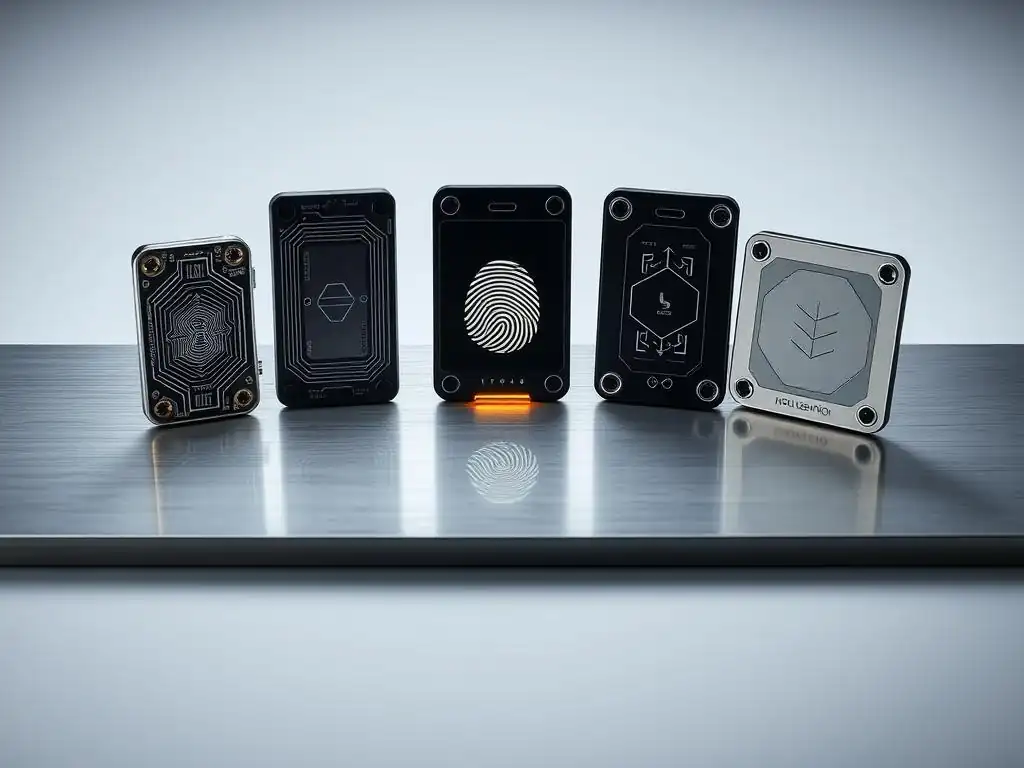
Ledger vs. Trezor: A Security Feature Comparison
When comparing the hardware crypto wallet security features of Ledger and Trezor, the primary difference lies in their approach to security architecture. Ledger relies heavily on a certified Secure Element chip (like the ST33J205 in Nano X), which is a closed-source, tamper-resistant chip designed to isolate the private key. This chip undergoes rigorous third-party security evaluations (like CC EAL5+ certification), providing a high level of assurance against sophisticated physical attacks. However, the firmware running on the secure element is proprietary.
Trezor, conversely, uses a general-purpose microcontroller (e.g., ARM Cortex-M4) and relies more on its entirely open-source firmware and bootloader for security. The argument here is that full transparency allows the community to find and report vulnerabilities, making the software architecture more robust over time. While lacking a separate certified Secure Element in the Ledger sense, Trezor's design includes bootloader checks to prevent malicious firmware loading and cryptographic separation of sensitive data. Both devices require physical confirmation for transactions and utilize PINs and recovery seeds, but their underlying security philosophies regarding hardware vs. software emphasis differ significantly.
BitBox02 vs. Ledger: Which Offers Better Security?
Comparing BitBox02 and Ledger's hardware crypto wallet security features highlights a blend of approaches. Ledger uses a certified Secure Element for all key operations, offering strong resistance to hardware attacks but with closed-source firmware on that chip. BitBox02 uses a combination of a secure chip (ATECC608B) for specific cryptographic tasks and seed storage alongside an open-source microcontroller running the main firmware. The secure chip provides hardware-level protection for the seed and critical functions, similar to Ledger's principle, while the open-source nature of the main firmware offers the transparency favored by Trezor.
Deciding which offers "better" security often depends on one's threat model and trust assumptions. If the primary concern is resistance to highly sophisticated physical attacks targeting the chip itself, Ledger's higher certification levels on its main Secure Element might be preferred by some. If transparency and the ability for the community to audit the entire codebase are paramount, BitBox02's fully open-source firmware (on the main chip) combined with a secure element might be seen as superior. Both offer strong hardware crypto wallet security features compared to software wallets, but they achieve it through different architectural choices.
Choosing the Right Wallet Based on Security Needs
Selecting the optimal hardware crypto wallet requires evaluating its security features against your specific needs and risk tolerance. Consider your "threat model" – who are you trying to protect your assets from? If you anticipate sophisticated adversaries capable of physical device attacks, a wallet with a highly certified Secure Element like Ledger might be a priority due to its certified resistance to such attacks. If you are more concerned about supply chain attacks or prefer the transparency that allows community audits of the code, an open-source wallet like Trezor or BitBox02 might be a better fit.
Beyond the core architecture (Secure Element vs. Open Source), look at specific hardware crypto wallet security features offered. Do you need multisig support? Is a passphrase feature for plausible deniability important? How do you prefer to back up your seed (written words, Shamir shares, microSD card)? Consider the device's interface for PIN/passphrase entry (on-device screen vs. connected computer). While all reputable hardware wallets offer significantly better security than software wallets, the nuances in their implementation of hardware crypto wallet security features can make one a more suitable choice for your particular situation and peace of mind.
Additional Security Measures for Hardware Crypto Wallet Users
Importance of Firmware Updates for Security
Firmware is the low-level software embedded in your hardware wallet that controls its functions, including security operations. Just like operating systems on computers or phones, firmware can contain vulnerabilities that, if exploited, could compromise the device's security. Manufacturers continuously develop updates to patch these vulnerabilities, improve existing hardware crypto wallet security features, and add support for new cryptocurrencies or features. Ignoring these updates leaves your device exposed to known exploits that attackers could potentially leverage.
Therefore, regularly updating your hardware wallet's firmware through the official software provided by the manufacturer (e.g., Ledger Live, Trezor Suite, BitBoxApp) is a critical security practice. These updates often include patches for recently discovered bugs or enhancements to the cryptographic libraries used. Always follow the manufacturer's instructions precisely during the update process and ensure you are using legitimate software downloaded from the official website to avoid falling victim to phishing or malware designed to trick you into installing malicious firmware.
Safe Backup Practices for Your Hardware Wallet
The 12 or 24-word recovery phrase (seed phrase) is the master key to your cryptocurrency. It's a mnemonic representation of your private key and can be used to restore your wallet on any compatible device if your hardware wallet is lost, stolen, or damaged. While hardware wallets excel at protecting the active private key, the security of your backup phrase is entirely your responsibility and is arguably the single most critical point of failure for hardware crypto wallet security features.
Your recovery phrase should be written down offline on a durable material (like paper, metal, or plastic) and stored in one or preferably multiple secure, secret locations. These locations should be resistant to fire, flood, and theft. Never store your seed phrase digitally (on a computer, phone, cloud storage, or password manager), as this defeats the purpose of using a hardware wallet. Treat your seed phrase with the same or greater care as you would a large amount of physical cash or valuable jewelry. Anyone who finds your seed phrase can access and steal your funds.
Using Password Managers for Enhanced Security
While your hardware wallet secures your private keys, you still interact with various online services related to your crypto holdings, such as exchange accounts, crypto-related websites, and wallet software interfaces. These interactions often require passwords, PINs (for accessing the hardware wallet itself), and potentially other credentials. Using strong, unique passwords for each online service is crucial to prevent credential stuffing attacks, where attackers use passwords leaked from one site to try and access your accounts on others.
A reputable password manager provides a secure, encrypted vault to store all your complex, unique passwords and PINs. This eliminates the need to remember multiple complex strings or reuse passwords, significantly reducing your risk of having accounts compromised independently of your hardware wallet's security. While you should never store your hardware wallet's recovery seed phrase in a password manager, storing the PIN to unlock the device or passwords for exchange accounts within a secure manager adds another layer to your overall digital security posture, complementing the hardware crypto wallet security features.
Myths and Realities About Hardware Crypto Wallet Security
Debunking Common Myths About Hardware Wallet Security Features
One prevalent myth is that hardware wallets are absolutely impenetrable and guarantee the safety of your funds under all circumstances. This is not entirely true. While they offer excellent protection against remote attacks and malware, they are not immune to all threats.
For example, a sophisticated attacker could potentially exploit vulnerabilities during the manufacturing or supply chain process (though this is rare and difficult). More commonly, user error can compromise security. If you fall for a phishing scam and enter your recovery phrase online, or store your seed phrase insecurely, the hardware wallet's security features cannot protect you from yourself.
Another myth is that losing or damaging your hardware wallet means losing your funds forever. This is false, provided you have securely backed up your recovery phrase. The hardware wallet is merely a device that holds the private key derived from your seed phrase. If you have your 12 or 24-word seed, you can purchase a new compatible hardware wallet (or even use certain software wallets in an emergency, though less secure) and restore access to your funds by entering the seed phrase. The funds reside on the blockchain, not physically inside the hardware wallet device itself.
Realities of Hardware Wallet Security: What You Need to Know
The reality is that hardware crypto wallet security features provide the strongest protection available for self-custody of digital assets against the most common threats, particularly online attacks. They effectively isolate your private keys from vulnerable internet-connected devices using secure hardware and cryptographic processes. Reputable manufacturers invest heavily in secure hardware design, firmware development, and rigorous testing to minimize vulnerabilities.
However, the effectiveness of hardware wallet security is fundamentally dependent on the user's security practices. The single point of failure is almost always the recovery seed phrase.
If the seed phrase is compromised (e.g., stored digitally, written down poorly and lost, or phished from the user), the funds are at risk regardless of how secure the hardware wallet device is. Users must understand that hardware wallets are tools that enable secure self-custody, but they require diligent and responsible handling of the backup materials and adherence to security best practices, such as verifying transaction details on the device screen and only using official software.
Conclusion: Maximizing Security with Hardware Crypto Wallets
Final Recommendations on Choosing the Best Hardware Crypto Wallet
Choosing the best hardware crypto wallet involves weighing various hardware crypto wallet security features against usability, supported cryptocurrencies, and your personal threat model. For those prioritizing a certified secure element and a wide range of supported assets, devices like the Ledger Nano X or Nano S Plus are strong contenders.
Users who value open-source transparency, advanced backup options like Shamir's Secret Sharing, or a touchscreen interface might lean towards the Trezor Model T or Model One. The BitBox02 offers a compelling mix of a secure element and open-source firmware, appealing to those who want both hardware assurance and auditability, particularly Bitcoin enthusiasts.
Ultimately, any reputable hardware wallet provides a monumental leap in security compared to keeping significant amounts of crypto in software wallets or on exchanges. Focus on devices from established companies with a track record in security. Read reviews, understand the specific hardware crypto wallet security features of potential candidates, and consider which user interface and backup method you are most comfortable with, as user error is a significant risk factor.
The Future of Hardware Crypto Wallet Security Features
The landscape of hardware crypto wallet security features is continuously evolving. We can anticipate further advancements aimed at improving security and usability. Potential developments include the integration of more sophisticated biometric authentication methods (beyond simple fingerprint sensors seen in some prototypes) that are securely processed within the device's secure environment. Multi-Party Computation (MPC) is another area being explored, which could potentially distribute the signing process across multiple devices or parties without ever creating a single, complete private key, adding a novel layer of security.
Improvements in tamper-evidence and tamper-resistance are also likely, making it even harder for attackers to physically compromise devices or introduce malicious elements during the supply chain. As the blockchain space matures and becomes more attractive to larger institutions and a broader user base, the demand for robust, user-friendly, and highly certified hardware crypto wallet security features will drive innovation, pushing the boundaries of what's possible in securing digital assets offline.
Frequently Asked Questions
What are the most important hardware crypto wallet security features that protect my digital assets?
Essential features include secure element chips that isolate your private keys, PIN protection to prevent unauthorized access, and physical buttons for transaction confirmation to avoid malware manipulation.
How do hardware crypto wallets differ from software wallets in terms of security?
Hardware wallets offer significantly enhanced security by storing your private keys offline, shielding them from online threats like hacking and malware, unlike software wallets which are connected to the internet.
What role does a secure element play in the overall security of a hardware crypto wallet?
The secure element is a specialized chip designed to resist tampering and extract your private keys by storing them in an isolated environment, making it extremely difficult for attackers to compromise them.
What are the best practices for maintaining the security of my hardware crypto wallet and its associated recovery phrase?
Keep your recovery phrase stored in a secure, offline location, preferably in a fireproof and waterproof container. Regularly update your wallet's firmware and be wary of phishing attempts targeting your hardware crypto wallet.
How do firmware updates impact the security features of a hardware crypto wallet?
Firmware updates often patch vulnerabilities, improve security protocols, and add new security features to your hardware wallet, making it crucial to install them promptly to protect against emerging threats.
Final Reflection: Securing Your Digital Future
The exploration of hardware crypto wallet security features reveals more than just technical specifications; it highlights a fundamental shift in how we perceive and protect our digital assets in an increasingly vulnerable world. The intricacies of secure elements, PIN protection, and recovery phrases aren't merely conveniences; they are the cornerstones of individual financial sovereignty in the decentralized age.
This journey into the heart of hardware wallet security underscores the profound responsibility we each bear in safeguarding our digital wealth. The peace of mind that comes from truly owning and controlling your assets, free from the vulnerabilities of centralized exchanges, is invaluable. Security is always excessive until it's not enough.
This sentiment resonates deeply in the crypto space, where vigilance and proactive measures are paramount to preserving your financial future.
As you navigate the ever-evolving landscape of cryptocurrency, remember that knowledge is your strongest defense. Take the time to understand the security features available to you, choose wisely, and actively participate in securing your digital future. The power to protect your assets lies within your grasp – embrace it, learn from it, and build a more secure and decentralized world for yourself and for generations to come.
Fortify Your Crypto Future: Act Now!
Thank you for exploring the advanced security features of hardware crypto wallets! We hope you're now inspired to take control of your digital assets. It's time to move from learning to action—let's apply that knowledge and secure your crypto future.
Here are a few steps you can take right now:
- Transfer your crypto to a hardware wallet to ensure maximum security. This is the most significant step you can take today.
- Explore additional features like passphrase support and multi-signature setups to strengthen your wallet's protection.
- Share this article with three friends who are also invested in cryptocurrency—help them safeguard their digital assets too!
Which advanced security feature are you most eager to implement in your crypto storage strategy, and why? Let’s discuss in the comments below!
Leave a Reply