
Visualizing Consensus: Diagrams and Illustrations to Understand Complex Mechanisms


Welcome to Blockchain Trends, your guide to navigating the revolutionary world of blockchain technology! Dive deep into the transformative potential extending far beyond cryptocurrencies. Ever wondered how blockchain networks actually agree on a single, truthful history? Our latest article, " Blockchain consensus mechanisms explained visually," demystifies these critical processes with diagrams and illustrations. Prepare to unlock the secrets behind decentralized trust and discover how these mechanisms are shaping the future of finance, supply chains, and beyond. Intrigued? Keep reading to see it all unfold!
- Blockchain Consensus Mechanisms Explained Visually: Diagrams and Illustrations
- Fundamentals of Blockchain Consensus: Visualizing Key Concepts
- Visualizing Proof-of-Work (PoW): A Step-by-Step Diagram
- Proof-of-Stake (PoS) Explained Through Illustrations
- Demystifying Delegated Proof-of-Stake (DPoS) with Diagrams
- Visualizing Practical Byzantine Fault Tolerance (pBFT)
- Comparative Visual Analysis of Blockchain Consensus Algorithms
- The Future of Blockchain Consensus: Emerging Mechanisms and Visualizations
-
Frequently Asked Questions
- What is a blockchain consensus mechanism?
- Why are visual aids important for understanding blockchain consensus mechanisms?
- How does Proof of Work (PoW), a common consensus mechanism, function visually?
- What are some alternatives to Proof of Work (PoW) and how do they differ visually?
- What are the key benefits of understanding blockchain consensus mechanisms beyond cryptocurrency?
- Final Reflection: Illuminating the Blockchain's Heart
- Ignite Your Understanding: Decode the Blockchain Now!
Blockchain Consensus Mechanisms Explained Visually: Diagrams and Illustrations
Understanding Consensus in Blockchain: A Visual Approach
Blockchain technology fundamentally relies on consensus mechanisms to achieve agreement among distributed nodes on the state of the ledger. Without a central authority, these mechanisms are crucial for validating transactions and adding new blocks securely and reliably. Understanding how different blockchain consensus mechanisms work is key to grasping the strengths and weaknesses of various decentralized networks.
Visualizing these processes through diagrams and illustrations can dramatically simplify complex concepts, making them accessible to a wider audience. This article aims to explain blockchain consensus mechanisms explained visually, breaking down intricate algorithms into more digestible parts, focusing on the underlying logic that ensures trust and integrity in a trustless environment.
The challenge in distributed systems, particularly blockchains, is coordinating actions and agreeing on a single version of truth when nodes might be unreliable or even malicious. This is where consensus algorithms shine, acting as the distributed decision-making engine. By explaining blockchain consensus mechanisms explained visually, we can better appreciate the steps involved in reaching agreement, whether it's through competitive computation (like Proof-of-Work), economic stake (like Proof-of-Stake), or delegated voting (like Delegated Proof-of-Stake). These visual explanations help demystify the "magic" behind how thousands of independent computers scattered across the globe can maintain a single, consistent, and immutable ledger.
Why Visualize Consensus Mechanisms? Simplifying Complexity
Blockchain consensus mechanisms are inherently complex, involving sophisticated cryptographic techniques, economic incentives, and network protocols. For newcomers and even experienced individuals outside the core development teams, grasping the nuances of algorithms like Practical Byzantine Fault Tolerance (pBFT) or the intricacies of sharding within Proof-of-Stake can be daunting. Visual aids, even described textually in a way that evokes imagery, serve as powerful tools for simplifying these complex systems.
They help break down abstract processes into concrete steps and interactions, showing the flow of information and the roles of different participants. Explaining blockchain consensus mechanisms explained visually bridges the gap between theoretical concepts and practical understanding.
Consider the process of block creation in Proof-of-Work. Describing cryptographic hashing, nonce finding, and difficulty adjustment can be dense. However, visualizing it as a race where participants repeatedly attempt to solve a puzzle, with the winner broadcasting their solution to the network, provides a much clearer picture.
Similarly, illustrating Proof-of-Stake as a lottery where participants' chances are weighted by their staked assets offers intuitive insight. Visualizing blockchain consensus mechanisms explained visually is not just about aesthetics; it's a pedagogical necessity that aids retention and promotes deeper understanding by engaging spatial reasoning and pattern recognition, making the core principles of decentralized agreement much more intuitive.
Fundamentals of Blockchain Consensus: Visualizing Key Concepts
What is Blockchain Consensus? A Simplified Definition
At its core, blockchain consensus is the process by which all participants in a decentralized network agree on the current state of the ledger. It's the method used to validate transactions, confirm their order, and agree on the block that should be added next to the chain. Imagine a group of people trying to agree on who won a race without a finish line judge – they need a predetermined set of rules and a process to collectively decide.
In a blockchain, this "group of people" is the network of nodes, and the consensus mechanism provides the rules and process. This agreement is vital because without it, different nodes would have conflicting versions of the transaction history, rendering the blockchain useless for maintaining a single, immutable record.
Think of blockchain consensus as a distributed decision-making protocol that ensures every honest node arrives at the same conclusion about valid transactions and the order of blocks. For instance, in a public blockchain like Bitcoin or Ethereum (post-Merge), consensus ensures that a transaction is only confirmed and added to the ledger if the majority of the network agrees it is valid (e.g., the sender has sufficient funds, the signature is correct).
This collective agreement prevents issues like double-spending, where someone tries to spend the same cryptocurrency twice. Explaining blockchain consensus mechanisms explained visually often starts with this fundamental concept of distributed agreement, showing how individual nodes contribute to a unified decision.
The Importance of Consensus in Decentralized Systems
Consensus is the cornerstone of trust and security in decentralized systems. In traditional centralized systems, a single authority (like a bank or a company database) maintains the authoritative record. Users trust this central entity. In a decentralized system like a blockchain, there is no single authority to trust. Instead, trust is distributed across the network participants, and the consensus mechanism is what enforces the rules and maintains integrity without relying on any single point of control or failure. It's the engine that drives the network's ability to operate autonomously and resist censorship or tampering.
The primary goal of consensus is to ensure that even if some participants are malicious or fail (known as Byzantine faults), the honest majority can still reach an agreement and continue operating correctly. This property, known as Byzantine Fault Tolerance (BFT), is critical for the resilience of public blockchains.
Without robust consensus, a decentralized ledger would be vulnerable to attacks where malicious actors could create fraudulent transactions or fork the chain to their advantage. The various blockchain consensus mechanisms explained visually highlight different approaches to achieving this fault tolerance and security, showcasing how each algorithm balances factors like security, scalability, and energy efficiency.
The Byzantine Generals Problem in Blockchain
The Byzantine Generals Problem is a classic computer science analogy that perfectly illustrates the core challenge that blockchain consensus mechanisms are designed to solve. Imagine a group of Byzantine generals surrounding a city they need to attack. They must all agree on a plan (e.g., attack or retreat) simultaneously.
However, some of the generals might be traitors, and they can send conflicting messages to different generals. The problem is reaching a unified decision despite the presence of these traitors, ensuring all loyal generals act in unison. In the context of a blockchain, the generals are the nodes in the network, and the city is the state of the ledger (the sequence of transactions and blocks).
This problem translates directly to a decentralized network where nodes need to agree on the validity and order of transactions and blocks. Some nodes might be offline, slow, or actively trying to spread false information (the "traitors"). The blockchain consensus mechanism must enable the honest nodes to reach a consensus and maintain a single, correct version of the ledger, even if a certain percentage of nodes are malicious.
Different consensus algorithms offer varying degrees of tolerance to Byzantine faults. For example, Proof-of-Work provides probabilistic Byzantine fault tolerance based on computational power, while algorithms like pBFT aim for deterministic fault tolerance under specific conditions. Explaining blockchain consensus mechanisms explained visually often uses the Byzantine Generals Problem as a foundational concept to highlight the inherent difficulties of achieving reliable agreement in a decentralized, potentially hostile environment.
Visualizing Proof-of-Work (PoW): A Step-by-Step Diagram
PoW Visualized: Mining and Block Creation
Proof-of-Work (PoW) is perhaps the most well-known blockchain consensus mechanism, famously used by Bitcoin and historically by Ethereum. Visualizing PoW involves picturing a global competition among network participants called "miners." These miners use powerful computers to solve a complex mathematical puzzle related to the data in the next block. The puzzle requires finding a specific number (a "nonce") such that when combined with the block data and hashed, the resulting hash meets a certain target requirement (starts with a certain number of zeros). This process is computationally intensive and requires significant energy.
Imagine countless miners simultaneously trying different nonces, performing trillions of hashes per second globally (Bitcoin's network hash rate often exceeds 300 Exahashes/second). The first miner to find a valid nonce solves the puzzle, broadcasts the block to the network, and if other nodes validate it as correct, the block is added to the blockchain. The successful miner is rewarded with newly minted cryptocurrency and transaction fees.
This "work" (the computational effort) is difficult to perform but easy for others to verify, ensuring that significant resources were expended to propose the block, making it economically infeasible for malicious actors to rewrite the chain unless they control the majority of the network's hashing power (a 51% attack). Explaining blockchain consensus mechanisms explained visually often depicts this race, showing miners connected to the network, their computers working furiously, and one miner eventually succeeding and broadcasting the winning block.
Understanding Hash Rate and Difficulty Adjustment Visually
Hash rate is a key concept in PoW, representing the total computational power being used by all miners in the network to solve the puzzle. It's typically measured in hashes per second (H/s), often reaching levels like terahashes (TH/s), petahashes (PH/s), or exahashes (EH/s).
Visualizing hash rate is like seeing the combined effort of all miners – the higher the hash rate, the more secure the network is against a 51% attack, as it requires proportionally more computing power for an attacker to gain control. Bitcoin's hash rate has grown from kilobytes per second in its early days to hundreds of exahashes per second today, requiring massive data centers full of specialized hardware.
Complementing the hash rate is the difficulty adjustment mechanism. To ensure that blocks are found at a relatively constant rate (e.g., roughly every 10 minutes for Bitcoin), the network automatically adjusts the difficulty of the puzzle. If the hash rate increases, blocks are found faster, so the difficulty is raised, making the puzzle harder.
If the hash rate decreases, blocks are found slower, so the difficulty is lowered. Visualizing this is imagining a scale balancing the network's total computational power against the target block time. If the computational power goes up, the scale tips, and the target difficulty is increased to bring it back into balance.
This dynamic adjustment is crucial for the stable operation of PoW networks, ensuring predictable block times regardless of fluctuations in the number of participating miners. Explaining blockchain consensus mechanisms explained visually highlights this feedback loop between hash rate and difficulty, showing how the system self-regulates.
PoW's Strengths and Weaknesses: Visual Summary
Proof-of-Work's primary strength is its proven security and resilience, particularly evident in Bitcoin's decade-plus of operation without fundamental compromise. The immense computational power required to attack the network creates a significant economic barrier. Visualizing this strength is seeing the sheer scale of energy and hardware committed to securing the network – a formidable defense wall built of computational effort. However, this strength is also PoW's most significant weakness: its massive energy consumption. The energy required to run PoW networks like Bitcoin is often compared to the energy consumption of entire small countries, raising significant environmental concerns.
Another weakness is scalability. PoW networks typically have limited transaction throughput compared to centralized systems, as the block creation rate is intentionally slowed to maintain security and allow for propagation across the network. Visualizing this limitation might show a bottleneck where transactions queue up waiting for the next block to be mined.
Furthermore, the concentration of mining power in large pools raises concerns about centralization risks, even though the algorithm is designed to be decentralized. Explaining blockchain consensus mechanisms explained visually requires presenting these trade-offs – the robust security achieved at the cost of high energy use and limited transaction speed, often summarized in a simple visual comparison chart contrasting these factors.
Proof-of-Stake (PoS) Explained Through Illustrations
PoS Visualized: Staking and Block Validation
Proof-of-Stake (PoS) is an alternative consensus mechanism that aims to solve the energy consumption issues of PoW. Instead of relying on computational power, PoS relies on economic stake. Participants, known as "validators," lock up a certain amount of cryptocurrency (their "stake") in a smart contract to participate in the consensus process. Visualizing PoS is like seeing a group of token holders who have put their assets on the line for the security of the network. The larger the stake a validator has, the higher their chance of being selected to propose or validate the next block.
When a new block needs to be added, the PoS protocol randomly selects a validator (or a committee of validators) based on factors that often include the size of their stake and how long it has been staked. The selected validator proposes a new block containing recent transactions. Other validators then vote on the validity of the proposed block.
If a supermajority of validators agrees that the block is valid, it is added to the blockchain, and the proposing and validating validators receive rewards (usually in the form of transaction fees or newly minted tokens). If a validator acts maliciously (e.g., proposes conflicting blocks), they risk losing a portion of their staked tokens, a penalty known as "slashing." Explaining blockchain consensus mechanisms explained visually for PoS often depicts validators with varying amounts of stake, highlighting how stake size influences their chances of selection and the risk of slashing.
Visualizing the Selection Process for Block Producers
The selection process in PoS is a critical component and varies significantly between different PoS implementations. It's not purely random; factors like stake size, age of stake, and sometimes even validator behavior or reputation can influence the probability of being selected as a block producer or validator. Imagine a lottery where each ticket represents a certain amount of staked cryptocurrency.
The more tokens a validator stakes, the more "tickets" they have, increasing their odds of winning the right to propose a block. Ethereum's Beacon Chain (part of Ethereum 2.0, now the main chain) uses a randomized selection process based on a verifiable random function (VRF), ensuring fairness and unpredictability.
Visualizing this selection process involves showing a pool of validators and a process that randomly draws from this pool, weighted by stake. For instance, if Validator A has 1000 tokens staked and Validator B has 100 tokens, Validator A is roughly 10 times more likely to be selected in a given round. Once selected, that validator has a specific time slot to propose a block.
If they fail or propose an invalid block, they might be penalized, and another validator might be selected. Explaining blockchain consensus mechanisms explained visually focuses on this probabilistic selection, demonstrating how economic commitment replaces computational power as the basis for trust and participation in block creation and validation.
PoS's Advantages and Disadvantages: A Visual Comparison with PoW
Proof-of-Stake offers several key advantages over PoW, most notably significantly reduced energy consumption. Because validators are selected based on stake rather than computational race, the energy required is minimal – comparable to running a regular computer. Visualizing this advantage is striking: contrasting the image of energy-hungry mining farms with validators running software on standard servers. For example, Ethereum's transition from PoW to PoS is estimated to have reduced its energy consumption by over 99.9%.
PoS also generally offers better scalability and faster transaction finality compared to PoW because the block creation time is not tied to solving a complex puzzle. The network can be designed to produce blocks much more frequently. However, PoS is not without its disadvantages. One common criticism is the "nothing-at-stake" problem, where validators in a fork situation have no incentive not to validate on both chains, potentially hindering consensus. Although various mechanisms like slashing are designed to mitigate this. Another concern is potential centralization if large amounts of stake become concentrated in the hands of a few entities (e.g., large exchanges or staking pools). Visualizing the comparison might use a chart showing PoS excelling in "Energy Efficiency" and "Scalability," while PoW is strong in "Proven Security" and "Decentralization" (though the latter is debated due to mining pool concentration), providing a clear visual trade-off analysis of blockchain consensus mechanisms explained visually.
Demystifying Delegated Proof-of-Stake (DPoS) with Diagrams
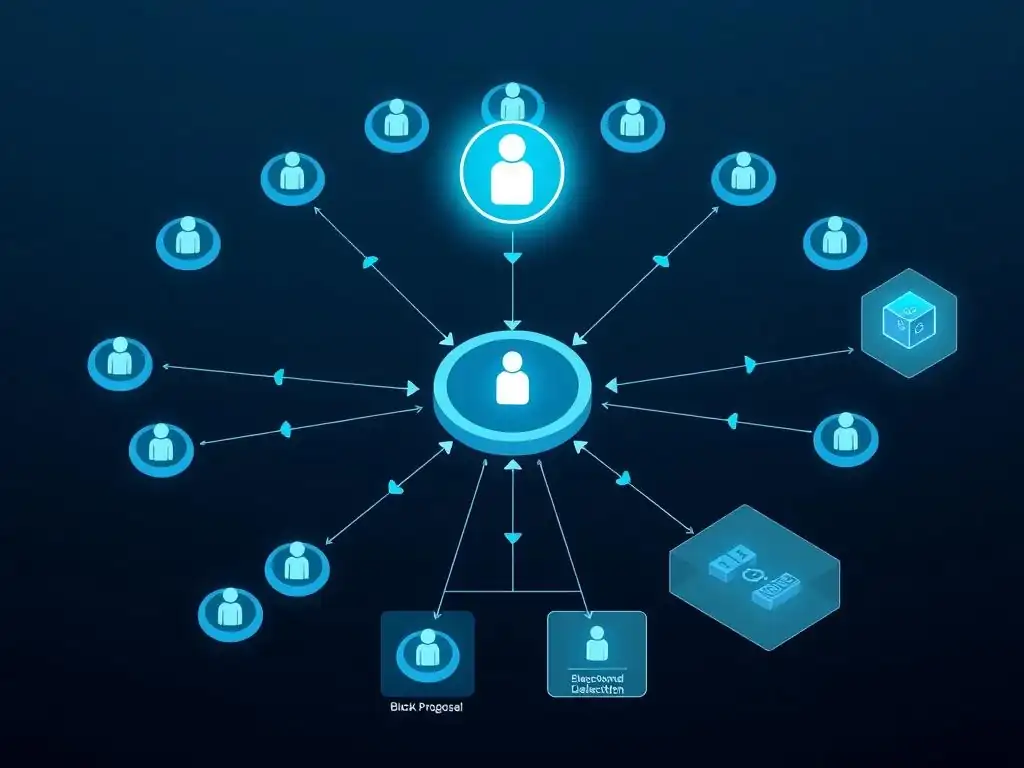
DPoS Visualized: Electing Delegates and Consensus
Delegated Proof-of-Stake (DPoS) is a variation of PoS that introduces a layer of representation. Instead of all token holders participating directly in consensus, they vote for a smaller, fixed number of "delegates" or "witnesses" who are responsible for validating transactions and creating blocks. Visualizing DPoS involves picturing a democratic system within the blockchain network. Token holders are the voters, and they elect a council of delegates who then perform the consensus duties on their behalf. The weight of each vote is proportional to the voter's stake.
These elected delegates (often around 20-100, depending on the network, like EOS which has 21 active Block Producers) are responsible for maintaining the network and producing blocks in a scheduled order. They are typically compensated for their work. If delegates fail to perform their duties or act maliciously, they can be voted out by the token holders and replaced. Explaining blockchain consensus mechanisms explained visually for DPoS focuses on this two-tiered structure: the token holders who vote and the elected delegates who secure the network, highlighting the representative nature of this consensus model.
The Role of Witnesses in DPoS: A Visual Explanation
In many DPoS implementations, the elected delegates are referred to as "witnesses" or "block producers." These witnesses are responsible for achieving consensus on the order and validity of transactions and adding new blocks to the chain. They typically take turns producing blocks in a predefined schedule, ensuring a consistent block production rate (e.g., every 0.5 seconds). Once a witness produces a block, other witnesses validate it. Consensus is usually achieved when a supermajority of active witnesses (e.g., 2/3 + 1) agree on the block.
Visualizing the role of witnesses in DPoS is imagining a round-robin system where each elected delegate gets a turn to propose a block. They sign the block, and then it's passed around to other witnesses for verification and approval. If a witness misses their turn or proposes an invalid block, they might be penalized and potentially voted out by the community.
This system allows for very fast block times and high transaction throughput compared to PoW and even some PoS implementations. Explaining blockchain consensus mechanisms explained visually emphasizes this scheduled, representative block production process, showing the elected few maintaining the chain on behalf of the many token holders.
DPoS's Governance Model: Visualizing the Delegate System
The governance model is a defining feature of DPoS. The ability of token holders to vote for and remove delegates introduces a form of on-chain governance. This allows the network to adapt and evolve more rapidly than networks with more rigid consensus mechanisms. If the community is unhappy with the performance or behavior of the current delegates, they can vote in new ones. Visualizing this governance is seeing the token holders holding voting power, acting as a checks-and-balances system over the delegates.
This democratic element provides flexibility but also introduces potential points of centralization. The limited number of delegates means that control over the network is concentrated in the hands of these few elected entities.
While token holders can vote them out, voter apathy or the influence of large stakeholders could lead to a small group effectively controlling the network. Explaining blockchain consensus mechanisms explained visually for DPoS highlights the benefits of speed and governance flexibility derived from representation, while also acknowledging the potential risks associated with concentrating block production power in a limited set of delegates, providing a nuanced view of this consensus model.
Visualizing Practical Byzantine Fault Tolerance (pBFT)
pBFT Visualized: The Consensus Rounds
Practical Byzantine Fault Tolerance (pBFT) is a consensus algorithm designed for asynchronous systems that can tolerate Byzantine faults (malicious nodes). Unlike PoW or PoS which are often probabilistic and designed for large, open networks, pBFT is typically used in permissioned or smaller-scale distributed systems where the set of participants is known and relatively stable. Visualizing pBFT involves picturing a choreographed, multi-step communication process among a fixed set of nodes to agree on the validity of a transaction or block.
The process operates in rounds. When a "leader" node proposes an action (like adding a block), it sends a "PRE-PREPARE" message to all other nodes. If nodes agree, they send "PREPARE" messages to each other. Once a node receives a sufficient number of matching PREPARE messages from different nodes (specifically, 2f+1, where f is the maximum number of faulty nodes the system can tolerate), it moves to the "COMMIT" phase, sending COMMIT messages.
Finally, upon receiving 2f+1 COMMIT messages, nodes agree that the transaction/block is valid and committed. This structured message exchange ensures all honest nodes reach consensus on the same state. Explaining blockchain consensus mechanisms explained visually for pBFT requires illustrating this precise sequence of message passing and verification among nodes in each round.
Understanding Message Exchange in pBFT through Diagrams
The key to pBFT's operation is the extensive message exchange between all participating nodes in each consensus round. For a system with N nodes tolerating f faults, where N >= 3f + 1, each consensus decision requires a significant number of messages to be passed and verified. Imagine a network where every node is constantly communicating with almost every other node during a consensus round. A single transaction or block proposal triggers a cascade of messages: the leader's proposal, followed by rounds of endorsements (PREPARE and COMMIT) from the replica nodes.
For example, in a system with 4 nodes (N=4), it can tolerate f=1 faulty node (since 4 >= 3*1 + 1). To reach consensus, the leader sends a message to 3 replicas. Each replica then sends messages to the other 3 nodes.
This quickly scales up; in a system with 30 nodes, the number of messages per consensus decision can be substantial, making it less suitable for very large, public networks due to communication overhead. Explaining blockchain consensus mechanisms explained visually for pBFT often uses diagrams showing nodes exchanging messages in distinct phases (PRE-PREPARE, PREPARE, COMMIT), highlighting the intensive communication pattern required to achieve deterministic finality and Byzantine fault tolerance.
pBFT's Fault Tolerance: A Visual Representation
pBFT is designed to tolerate up to 'f' Byzantine faults among 'N' nodes, where N is at least 3f + 1. This means the system can continue to operate correctly and reach consensus even if 'f' nodes are malicious or fail arbitrarily. Visualizing this fault tolerance is showing a group of nodes, with a certain number of them marked as potentially faulty or malicious. Despite the presence of these faulty nodes, the majority of honest nodes, through their structured message exchange and verification process, can still agree on a single outcome.
The requirement for 2f+1 matching messages in both the PREPARE and COMMIT phases is what provides this resilience. This threshold ensures that even if 'f' malicious nodes send conflicting information or don't participate, the honest nodes can still gather enough endorsements from other honest nodes to be certain of the validity and agreement. For example, if f=1, you need 2*1+1 = 3 matching messages.
If you have 4 nodes (N=4), and one is faulty, the 3 honest nodes can still reach 3 matching messages among themselves, ignoring the faulty one. This deterministic guarantee of reaching consensus as long as the number of faulty nodes doesn't exceed 'f' is a strong advantage for specific use cases, such as enterprise blockchains or distributed databases, and is a key aspect when explaining blockchain consensus mechanisms explained visually in a permissioned context.
Comparative Visual Analysis of Blockchain Consensus Algorithms
PoW vs. PoS vs. DPoS vs. pBFT: A Visual Side-by-Side Comparison
Comparing different blockchain consensus mechanisms side-by-side visually helps highlight their fundamental differences and suitability for various applications. Imagine a chart or matrix with key criteria like Energy Consumption, Scalability (Transactions per Second), Security (under different attack models), Decentralization, and Finality (how quickly a transaction is considered irreversible). PoW would typically score high on security (assuming sufficient hash rate) and decentralization (in theory, though mining pools complicate this), but low on energy efficiency and scalability. PoS would score high on energy efficiency and potentially scalability and finality, but might face questions regarding centralization of stake and long-range attacks.
DPoS would stand out for high transaction speed and efficient governance, but scores lower on decentralization due to the small number of delegates. pBFT would be shown as excellent for rapid finality and security in permissioned environments with known participants, but poor for scalability in open, large-scale networks due to communication overhead, and inherently centralized compared to public PoW/PoS. Explaining blockchain consensus mechanisms explained visually often uses such comparative visuals to summarize the trade-offs inherent in each design, helping readers quickly grasp which mechanism might be appropriate for different blockchain use cases, from public cryptocurrencies to private enterprise ledgers.
Visualizing Scalability and Energy Consumption Across Different Mechanisms
Scalability, often measured in transactions per second (TPS), and energy consumption are two critical dimensions where consensus mechanisms differ vastly. Visualizing scalability could involve bar charts showing the typical TPS range for each mechanism: PoW networks like Bitcoin around 5-7 TPS, public PoS networks like Ethereum aiming for thousands of TPS with sharding, DPoS networks like EOS claiming thousands of TPS, and permissioned pBFT systems like Hyperledger Fabric processing hundreds or thousands of TPS within their specific scope. The visual contrast in TPS numbers immediately highlights the performance differences.
For energy consumption, a simple visual comparison, perhaps using icons or a dramatic scale, clearly shows PoW's enormous energy footprint versus the minimal energy required by PoS, DPoS, and pBFT. Bitcoin's annual energy consumption is estimated to be comparable to that of Norway or Argentina, while Ethereum's PoS consumption post-Merge is negligible by comparison. This stark visual difference in energy cost is a major driver for the adoption of alternative consensus mechanisms. Explaining blockchain consensus mechanisms explained visually emphasizes these quantitative differences, making the performance and environmental implications of each algorithm immediately apparent through comparative data points.
Security Considerations: A Visual Comparison of Attack Vectors
Security is paramount in blockchain, and different consensus mechanisms have varying vulnerabilities. Visualizing security involves illustrating the primary attack vectors for each mechanism. For PoW, the main threat is the 51% attack, where an entity controls the majority of the network's hash rate, allowing them to potentially double-spend or prevent transactions. Visualizing this might show one large mining pool overpowering all others. For PoS, potential attacks include the "nothing-at-stake" problem (mitigated by slashing) and potential centralization of stake. Visualizing this could show validators voting on multiple chain forks or a few large pools controlling a disproportionate amount of stake.
DPoS faces risks if delegates collude or if voter apathy allows malicious actors to gain control of delegate seats. Visualizing this might show a small group of elected delegates making decisions that benefit them rather than the network.
pBFT, while very secure against Byzantine faults within its known set of participants, is vulnerable if more than 'f' nodes are compromised or if the identity of participants is not strictly controlled. Visualizing security across these mechanisms involves depicting these specific failure points and attack scenarios, providing a visual risk assessment for each type of consensus, crucial for understanding the security trade-offs when explaining blockchain consensus mechanisms explained visually.
The Future of Blockchain Consensus: Emerging Mechanisms and Visualizations
Beyond the major consensus mechanisms, several emerging or specialized algorithms are gaining traction. Proof-of-Authority (PoA), for instance, is often used in permissioned blockchains or consortium chains. In PoA, consensus is reached by a limited number of approved validators whose identities are known and verified. There's no mining or staking competition; authority is granted based on reputation or identity. Visualizing PoA shows a small, trusted group of entities (e.g., companies in a consortium) signing blocks based on their established authority. This offers high performance and scalability but sacrifices decentralization, as trust is placed in specific parties.
Proof-of-History (PoH), used by Solana, is not a traditional consensus mechanism on its own but rather a way to create a historical record that proves an event occurred at a specific moment in time. It works in conjunction with a consensus algorithm (like PoS). PoH creates a verifiable sequence of events by continuously hashing outputs, creating a chain of hashes that serves as a global clock.
Visualizing PoH is imagining a cryptographic timeline or clock that orders events before they are agreed upon by consensus, significantly speeding up the consensus process by reducing the need for nodes to coordinate on time. Exploring these variations expands the scope of blockchain consensus mechanisms explained visually, showing how new approaches address specific limitations of earlier algorithms.
Visualizing Hybrid Consensus Models: Combining Different Approaches
The future of blockchain consensus likely involves hybrid models that combine elements from different mechanisms to leverage their strengths and mitigate weaknesses. For example, some systems might use a fast, pBFT-like consensus for quick transaction finality within a small group of validators, while using a slower, more decentralized PoS or PoW chain to periodically anchor the state and ensure overall security and decentralization. Another hybrid approach might involve combining PoS with sharding, where different shards use PoS internally, and a separate mechanism coordinates consensus across shards (as planned for future Ethereum upgrades).
Visualizing hybrid models is complex but essential for understanding next-generation blockchains. It involves showing different consensus processes interacting – perhaps a fast inner loop for rapid agreement and a slower outer loop for broader security or checkpointing. These models aim to achieve a better balance between scalability, security, and decentralization than any single algorithm can achieve alone. Explaining blockchain consensus mechanisms explained visually in the context of hybrids requires illustrating how these different components work together harmoniously to secure the network and process transactions efficiently, representing a significant step forward in blockchain design.
The Role of Visualizations in Blockchain Education and Adoption
As blockchain technology continues to evolve and become integrated into various industries beyond cryptocurrency (like supply chain, healthcare, and finance), understanding its underlying mechanisms becomes increasingly important. Visualizations play a critical role in making this complex technology accessible to developers, business leaders, regulators, and the general public. Diagrams, flowcharts, and illustrations simplify abstract concepts like distributed ledgers, cryptography, and especially, consensus algorithms.
Clear and effective visualizations demystify how trust is established in a trustless environment and how different blockchain networks achieve security and agreement. By explaining blockchain consensus mechanisms explained visually, educators and communicators can lower the barrier to entry for understanding blockchain, fostering greater adoption and innovation. As new consensus mechanisms emerge and hybrid models become more prevalent, the need for sophisticated and intuitive visual explanations will only grow, ensuring that the transformative potential of blockchain technology is understood and embraced by a wider audience.
Frequently Asked Questions
What is a blockchain consensus mechanism?
A blockchain consensus mechanism is a fault-tolerant process used to achieve agreement on a single state of the blockchain network. It ensures that all nodes agree on the validity of transactions and the order in which they are added to the chain, even when some nodes are malicious or faulty.
Why are visual aids important for understanding blockchain consensus mechanisms?
Complex concepts like blockchain consensus can be difficult to grasp through text alone. Visual aids, such as diagrams and illustrations, offer a more intuitive and accessible way to understand how these mechanisms work, simplifying the explanation.
How does Proof of Work (PoW), a common consensus mechanism, function visually?
Visually, Proof of Work can be represented as a race where miners compete to solve a complex mathematical puzzle. The first miner to solve the puzzle adds a new block to the chain and is rewarded, demonstrating the computational effort required.
What are some alternatives to Proof of Work (PoW) and how do they differ visually?
Alternatives like Proof of Stake (PoS) can be visualized as a system where validators are selected based on the amount of cryptocurrency they hold and are willing to "stake". This shows a shift from computational power to economic investment for securing the network.
What are the key benefits of understanding blockchain consensus mechanisms beyond cryptocurrency?
Understanding these mechanisms is crucial for recognizing the potential of blockchain in areas like supply chain management, digital identity, and secure data sharing. They offer a way to establish trust and transparency in various decentralized applications, beyond just cryptocurrency transactions.
Final Reflection: Illuminating the Blockchain's Heart
The journey of understanding blockchain consensus mechanisms can often feel like navigating a labyrinth. Visualizing these complex processes, as we've explored, isn't just about simplification; it's about unlocking understanding and fostering wider participation in this transformative technology. By demystifying the inner workings of blockchains through diagrams and illustrations, we empower individuals to engage critically and contribute meaningfully to its evolution.
The power of visual representation extends far beyond mere comprehension. It shapes our perception, influences our decisions, and ultimately, drives innovation. The ability to see, in a clear and concise manner, how consensus is achieved within a blockchain network fosters trust and encourages further exploration. The best and most beautiful things in the world cannot be seen or even touched - they must be felt with the heart.
- Helen Keller. This sentiment rings true when considering the intangible yet powerful impact of consensus mechanisms on the integrity and security of decentralized systems.
Now, take a moment to reflect on what you've learned. Consider how these visual representations can inform your own understanding of blockchain technology and its potential impact. How can you leverage this knowledge to contribute to a more transparent and equitable future? The blockchain revolution is ongoing, and your informed participation is crucial. Embrace the power of visualization, continue to explore, and help shape the future of decentralized systems.
Ignite Your Understanding: Decode the Blockchain Now!
Thank you for exploring how visual learning can help you understand complex blockchain consensus mechanisms. We hope you’ve gained a new appreciation for how diagrams and illustrations can enhance comprehension. Now, let’s put that knowledge into action!
Here’s how you can continue your learning:
- Create your own consensus diagram. Choose a consensus mechanism that interests you and try sketching it out. This hands-on approach is the best way to reinforce your understanding.
- Explore related articles and tutorials on blockchaintrends.org to see practical applications of various consensus mechanisms.
- Challenge a friend or colleague to a “explain the diagram” contest. Teaching others is a powerful way to deepen your own knowledge—see if you can visually explain how different consensus mechanisms work.
What innovative ways can you imagine visualizing the future of blockchain, and what insights might they reveal? Share your thoughts in the comments below!
Leave a Reply