
Solana's Architecture: A Technical Breakdown of Its HighPerformance Design


Welcome to Blockchain Trends, your go-to source for understanding the real-world impact of blockchain technology. Ever wondered how some blockchains achieve blazing-fast transaction speeds? Dive in as we unlock the secrets behind one of the most innovative platforms in the space with our Solana blockchain architecture tutorial. Get ready to explore the technical intricacies that make Solana a high-performance powerhouse and discover what it means for the future of decentralized applications.
Solana's Architecture: A Technical Breakdown of Its High-Performance Design
- Introduction to Solana's Innovative Blockchain Architecture
-
Deep Dive into Solana's Core Architectural Components
- Proof of History (PoH): Revolutionizing Blockchain Timekeeping
- Tower BFT: Solana's Consensus Mechanism
- Turbine: Solana's Block Propagation Protocol
- Gulf Stream: Solana's Transaction Forwarding Protocol
- Sealevel: Parallel Transaction Processing on Solana
- Pipelining: Optimizing Solana's Data Processing
- Cloudbreak: Solana's Scalable State Architecture
- Solana Blockchain Development
- Solana's Advantages and Disadvantages: An Architectural Perspective
- Solana vs. Other High-Performance Blockchains: An Architectural Comparison
- The Future of Solana's Architecture: Ongoing Developments and Research
- Conclusion: Solana's Architectural Innovations and Their Significance
-
Frequently Asked Questions
- What is the main goal of Solana's architecture?
- How does Solana differ from other blockchain architectures?
- What are the key components of Solana's architecture that contribute to its high performance?
- What are some potential use cases for Solana's high-performance architecture beyond cryptocurrency?
- Is Solana's architecture considered to be fully decentralized?
- Final Reflection: Unlocking the Potential of Decentralized Speed
- Dive Deeper: Unleash Your Solana Potential!
Introduction to Solana's Innovative Blockchain Architecture
Understanding the Need for High-Performance Blockchains
The blockchain landscape is rapidly evolving, with an increasing demand for applications that require high throughput and low latency. Traditional blockchain architectures, like those of Bitcoin and early Ethereum, often face limitations in transaction processing speed and scalability.
This bottleneck hinders their ability to support applications requiring rapid and high-volume transactions, such as decentralized finance (DeFi), high-frequency trading platforms, and large-scale decentralized applications (dApps) intended for mass adoption. The need for high-performance blockchains stems from the ambition to move beyond simple cryptocurrency transactions and enable a broader spectrum of real-world use cases, demanding significantly improved transaction processing capabilities and reduced transaction costs.
As blockchain technology matures, the focus shifts towards creating platforms that can handle transaction volumes comparable to traditional financial systems. Consider the Visa network, which processes an average of 1,700 transactions per second (TPS), with a theoretical peak capacity of 24,000 TPS. For blockchain to become a mainstream technology powering global financial systems or large-scale applications, it must achieve similar levels of performance. High-performance blockchains are designed to address this scalability challenge, aiming to bridge the performance gap and unlock the full potential of decentralized technologies for widespread adoption.
Solana's Position in the Blockchain Ecosystem
Solana has emerged as a prominent player in the blockchain ecosystem, specifically designed to tackle the scalability limitations of earlier blockchain platforms. Unlike many blockchains that rely on sharding or layer-2 solutions to improve throughput, Solana takes a different approach by optimizing the base layer architecture itself.
It positions itself as a layer-1 blockchain capable of achieving exceptionally high transaction speeds and low transaction costs without sacrificing decentralization or security, at least in theory. This approach aims to provide a robust foundation for a wide range of applications, from DeFi and NFTs to gaming and enterprise solutions, directly on the main chain.
Solana's architecture is built from the ground up with performance as a primary design goal. It incorporates a suite of innovative technologies and protocols working in concert to maximize throughput and minimize latency. By implementing novel solutions like Proof of History (PoH), Turbine, and Gulf Stream, Solana aims to overcome the inherent limitations of traditional blockchain designs. This focus on architectural innovation has allowed Solana to carve out a distinct niche in the crowded blockchain space, attracting developers and projects seeking a high-performance platform for demanding applications.
Deep Dive into Solana's Core Architectural Components
Proof of History (PoH): Revolutionizing Blockchain Timekeeping
Proof of History (PoH) is a core innovation at the heart of Solana's architecture, designed to solve the timekeeping problem inherent in distributed systems. In traditional blockchains, nodes must communicate to agree on the order of transactions, leading to latency. PoH provides a cryptographic clock, allowing nodes to independently verify the passage of time and the order of events without constant communication overhead. This significantly reduces the time needed for consensus and boosts transaction throughput.
How PoH Works: A Step-by-Step Explanation
PoH utilizes a Verifiable Delay Function (VDF). In Solana's implementation, this VDF is a sequential pre-image resistant hash function. Essentially, data is hashed repeatedly, and each hash becomes the input for the next. This process creates a long, unbroken chain of hashes that can be publicly and efficiently verified. The key is that this hashing process takes a specific amount of time to compute sequentially, but verification can be done very quickly in parallel.
- Sequential Hashing: A node starts with an initial input and repeatedly applies a hash function to it. Each hash output is timestamped.
- Creating the History: These timestamped hashes form a verifiable historical record, demonstrating that a certain amount of time has passed between each hash.
- Event Recording: Events, like transactions, are inserted into this hash sequence. This cryptographically proves that an event occurred before or after a specific point in the PoH sequence.
- Verification: Other nodes can quickly verify the entire PoH sequence and the order of events by checking the hashes and timestamps, without needing to recompute the entire sequence.
Benefits of PoH for Solana's Throughput
The primary benefit of PoH is a dramatic increase in transaction throughput. By establishing a verifiable order of events without requiring nodes to constantly communicate and reach consensus on timestamps, PoH significantly reduces the overhead associated with traditional blockchain timekeeping. This allows Solana to process transactions much faster and achieve higher TPS compared to blockchains that rely on traditional consensus mechanisms alone for ordering transactions.
Furthermore, PoH enhances efficiency by allowing leaders to produce blocks more rapidly. In traditional systems, leaders must wait for other nodes to confirm timestamps. With PoH, the timestamp is cryptographically embedded in the block itself, removing the need for this waiting period. This accelerated block production directly translates to faster transaction confirmation times for users and higher overall network throughput. Solana claims to achieve block times of around 400 milliseconds, a speed largely attributed to the efficiency gains from Proof of History.
Tower BFT: Solana's Consensus Mechanism
Tower BFT is Solana's custom implementation of a Practical Byzantine Fault Tolerance (pBFT) consensus mechanism, optimized to leverage Proof of History. While PoH provides a reliable timestamping mechanism, Tower BFT is responsible for validator agreement on the state of the blockchain. It is designed to be fast and fault-tolerant, ensuring that the network can continue to operate even if some validators are offline or acting maliciously.
Tower BFT and Fault Tolerance
Tower BFT is designed to tolerate Byzantine faults, meaning it can function correctly even if up to one-third of the validators are faulty or malicious. This fault tolerance is a critical aspect of blockchain security and reliability. Tower BFT achieves this by using a voting mechanism where validators vote on the validity of blocks. Byzantine Fault Tolerance ensures that even if some validators attempt to disrupt the consensus process, the honest validators can still reach agreement and maintain the integrity of the blockchain.
In practice, Solana aims for high fault tolerance to ensure network resilience. While the theoretical limit of pBFT is one-third, the actual resilience depends on the distribution and behavior of validators in the network. Tower BFT, coupled with Solana's economic incentives for validators, is designed to encourage honest participation and maintain a robust and secure consensus process.
How Tower BFT Differs from Traditional BFT
Tower BFT distinguishes itself from traditional BFT implementations primarily through its integration with Proof of History. Traditional BFT systems often rely on inter-validator communication for time synchronization and ordering of messages, which can introduce latency. Tower BFT leverages the pre-established time order provided by PoH, significantly reducing the communication overhead. Validators can use the PoH timestamps to quickly verify the order of events and reach consensus more efficiently.
Another key difference is Tower BFT's optimistic approach. It assumes that validators are generally honest and responsive. In cases where validators are unresponsive (e.g., due to network issues), Tower BFT uses a slashing mechanism to penalize them, incentivizing validators to remain online and participate actively in consensus. This optimistic strategy, combined with PoH, allows Tower BFT to achieve faster consensus times and higher throughput than traditional BFT implementations.
Turbine: Solana's Block Propagation Protocol
Turbine is Solana's block propagation protocol, specifically designed to efficiently disseminate block data to a large number of nodes in a short amount of time. In a blockchain network, efficient block propagation is crucial for maintaining network synchronization and achieving high throughput. Turbine addresses the challenges of bandwidth limitations and network congestion that can arise when broadcasting large blocks to thousands of validators.
Efficient Data Distribution with Turbine
Turbine employs a technique similar to BitTorrent, where block data is divided into smaller packets and transmitted in layers. Instead of a single validator broadcasting the entire block to all other validators, Turbine uses a hierarchical distribution model. The leader validator divides the block into packets and transmits them to a small group of validators (peers). These peers then forward packets to another set of peers, and so on. This layered approach significantly reduces the bandwidth burden on any single validator.
This process of packet forwarding happens in parallel, allowing the block data to spread rapidly across the network. By breaking down the block into smaller, manageable packets and distributing the broadcasting workload, Turbine ensures efficient and fast block propagation, even with large blocks and a high number of validators. This is critical for maintaining Solana's high transaction processing speeds.
Minimizing Bandwidth Requirements
Turbine is designed to minimize bandwidth requirements for individual validators, making it easier for more participants to run validator nodes. Traditional block propagation methods can require significant bandwidth, potentially limiting the number of validators who can participate and increasing centralization risks. Turbine's layered approach reduces the bandwidth needed by each validator because they are only responsible for forwarding a small portion of the block data.
By minimizing bandwidth requirements, Turbine contributes to a more decentralized and robust network. It lowers the barrier to entry for validators, allowing for a larger and more geographically diverse validator set. This increased decentralization strengthens the network's security and resilience. Furthermore, reduced bandwidth consumption can also translate to lower operational costs for validators, further incentivizing participation.
Gulf Stream: Solana's Transaction Forwarding Protocol
Gulf Stream is Solana's transaction forwarding protocol that optimizes transaction propagation and processing. In traditional blockchains, transactions are typically broadcast to the network and then processed sequentially by validators. Gulf Stream aims to streamline this process by proactively forwarding transactions to validators even before the previous block is finalized. This pre-processing of transactions reduces confirmation times and increases overall network throughput.
Pre-Processing Transactions for Faster Confirmation
Gulf Stream works by having each validator maintain a mempool of pending transactions. However, unlike traditional mempools where transactions are simply waiting to be included in a block, Gulf Stream enables validators to start processing and executing transactions speculatively before they are officially included in a block. When a validator is elected as the next leader, it already has a pool of pre-processed transactions ready to be included in the next block.
This anticipatory transaction processing significantly reduces the time it takes for transactions to be confirmed. Instead of waiting for a block to be finalized and then starting transaction processing, validators are already ahead of the curve. This "forwarding" and pre-processing approach is a key factor in Solana's ability to achieve fast confirmation times, often cited as being in the range of seconds.
Reducing Memory Pressure on Validators
While pre-processing transactions can improve speed, it could potentially increase memory pressure on validators if they need to store and manage very large mempools. Gulf Stream addresses this by optimizing mempool management and transaction forwarding. Validators only need to keep a relatively small pool of pending transactions readily available for pre-processing. The protocol ensures efficient transaction propagation without overwhelming validator memory resources.
By optimizing transaction forwarding and pre-processing, Gulf Stream contributes to Solana's high performance without placing excessive strain on validator hardware. This balance between performance and resource efficiency is crucial for maintaining a scalable and sustainable blockchain network. The reduced memory pressure allows validators to operate efficiently and contribute to the network's overall speed and responsiveness.
Sealevel: Parallel Transaction Processing on Solana
Sealevel is Solana's runtime environment that enables parallel transaction processing. Most blockchains process transactions sequentially, meaning one transaction must be fully processed before the next one can begin. Sealevel breaks this paradigm by allowing for concurrent execution of transactions, significantly increasing transaction throughput, especially for applications with high transaction volume and concurrency.
Enabling Concurrent Transaction Execution
Sealevel achieves parallel processing by allowing transactions that do not affect the same state to be executed simultaneously. It does this by allowing developers to specify dependencies between transactions. If transactions are independent of each other (i.e., they don't interact with the same accounts or smart contract state), Sealevel can execute them in parallel across multiple CPU cores. This is a significant departure from the sequential processing model of many other blockchains.
This parallel execution capability is particularly beneficial for applications like DeFi and exchanges, where many users might be interacting with different smart contracts or accounts at the same time. Sealevel can handle these concurrent transactions efficiently, leading to much higher throughput and lower latency compared to sequential processing blockchains. Solana claims to be able to process tens of thousands of transactions per second, a figure largely attributed to Sealevel's parallel processing capabilities.
Optimizing Smart Contract Performance
Sealevel's parallel processing not only increases overall throughput but also optimizes the performance of individual smart contracts. By allowing for concurrent execution of different parts of a smart contract or different instances of the same contract, Sealevel can improve the efficiency and responsiveness of decentralized applications built on Solana. Developers can design their smart contracts to take advantage of Sealevel's parallel processing capabilities, leading to faster and more scalable dApps.
To fully utilize Sealevel's potential, smart contract developers need to be mindful of transaction dependencies and design their applications to maximize concurrency. By structuring smart contracts and transactions in a way that allows for parallel execution, developers can unlock the full performance benefits of Solana's architecture and build highly scalable and responsive decentralized applications.
Pipelining: Optimizing Solana's Data Processing
Pipelining is a CPU optimization technique that Solana leverages to further enhance its data processing efficiency. In a typical computer processor, instructions are executed sequentially through different stages of a pipeline (e.g., fetching, decoding, executing). Pipelining allows multiple instructions to be in different stages of processing simultaneously, improving overall throughput. Solana applies this concept to its block processing pipeline.
Data Processing Stages in Solana
Solana's data processing pipeline can be conceptually divided into stages, including:
- Fetching: Retrieving block data and transactions.
- Verification: Verifying signatures and Proof of History.
- Execution: Executing transactions using Sealevel.
- State Updates: Updating the blockchain state.
- Broadcasting: Propagating the finalized block to the network.
Pipelining in Solana means that these stages are overlapped. While one block is being executed, the next block can be fetched and verified, and the block before that can be having its state updated. This parallel processing of different stages for different blocks significantly increases the overall efficiency of block processing.
The Role of Pipelining in Achieving High Throughput
Pipelining is crucial for achieving Solana's high throughput by maximizing the utilization of validator hardware. Without pipelining, validators would be idle during certain stages of block processing, limiting overall performance. By overlapping these stages, pipelining ensures that validator resources are continuously utilized, leading to a substantial increase in the number of blocks processed per unit of time.
This optimization is particularly important for handling the high volume of transactions that Solana is designed to process. Pipelining allows Solana to maintain its high TPS even under heavy network load. It is a key architectural element contributing to Solana's ability to process transactions at speeds comparable to centralized payment processors.
Cloudbreak: Solana's Scalable State Architecture
Cloudbreak is Solana's state architecture, designed to handle the ever-growing state of the blockchain in a scalable and efficient manner. Blockchain state refers to the current balances, smart contract data, and other information that needs to be stored and accessed by validators. As a blockchain grows and processes more transactions, the state size increases, potentially leading to performance bottlenecks if not managed effectively.
Efficient Data Storage and Retrieval
Cloudbreak is designed as a horizontally scaled database optimized for read and write operations required by Solana's high-performance architecture. It uses a memory-mapped file approach, allowing validators to access state data directly from memory, significantly speeding up read and write operations. This memory-mapped architecture is critical for supporting Sealevel's parallel transaction processing, which requires rapid access to state data.
Cloudbreak's design prioritizes fast data retrieval and updates, ensuring that validators can quickly access the state information needed to process transactions and maintain consensus. This efficient state management is a key factor in Solana's ability to handle a large volume of transactions without experiencing significant performance degradation due to state access bottlenecks.
Addressing State Growth Challenges
As the Solana blockchain continues to grow, the state size will inevitably increase. Cloudbreak is designed to address these state growth challenges through its scalable architecture. While specific details of future scaling strategies are constantly evolving, the fundamental design of Cloudbreak as a horizontally scalable database provides a foundation for handling increasing state size. Strategies like state pruning and sharding at the state level might be considered in the future to further enhance state scalability.
Cloudbreak is an essential component of Solana's architecture, ensuring that state management does not become a bottleneck as the blockchain scales. Its efficient data storage and retrieval mechanisms are crucial for maintaining Solana's high performance and supporting the long-term growth of the network and its ecosystem.
Solana Blockchain Development
Setting Up a Solana Development Environment
To begin developing on Solana, you'll need to set up your development environment. This typically involves installing the Solana command-line interface (CLI) tools, which include essential utilities for creating, deploying, and interacting with Solana programs (smart contracts). You'll also need Node.js and npm (Node Package Manager) for managing JavaScript dependencies, as Solana development often involves using JavaScript or TypeScript for client-side interactions and program development.
The official Solana documentation provides detailed step-by-step instructions for setting up your development environment on various operating systems (macOS, Linux, Windows). This includes downloading and installing the Solana CLI, configuring your system path to access Solana commands, and verifying the installation. It's also recommended to install a code editor like VS Code with Solana extensions for syntax highlighting and development tools to enhance your coding experience. A local Solana cluster can also be set up for testing and development purposes, allowing you to simulate a Solana network on your machine without interacting with the public mainnet or testnets.
Deploying a Smart Contract on Solana
Deploying a smart contract (program) on Solana involves writing your program in Rust or C++, compiling it into bytecode, and then using the Solana CLI to deploy it to the Solana network. Solana programs are typically written in Rust due to its performance, security, and memory safety features, which are crucial for blockchain applications. The Solana Program Library (SPL) provides a collection of pre-built programs and libraries that developers can use as building blocks for their own applications.
The deployment process involves several steps using the Solana CLI. First, you'll need to build your Rust program using the cargo build-bpf command, which compiles the Rust code into bytecode compatible with the Solana virtual machine (SVM). Then, you'll use the solana program deploy command along with the compiled program's .so file to upload and deploy your program to the Solana network. This deployment process incurs a transaction fee, which is paid in SOL, Solana's native token. After deployment, your program will be assigned a unique program address, which is used to interact with it from client-side applications or other programs.
Analyzing Transaction Processing Times on Solana
Analyzing transaction processing times on Solana can be done using various tools and methods. The Solana CLI provides commands like solana confirm and solana transaction-show that can be used to inspect transaction details and confirmation times. Block explorers like Solscan and Solana Beach also provide real-time data on transaction processing times, block times, and network performance metrics. These explorers allow you to search for specific transactions and view their confirmation status and processing latency.
For more in-depth analysis, developers can use Solana's performance monitoring tools and APIs to collect detailed data on transaction execution times, resource utilization, and network latency. This data can be used to optimize program performance, identify bottlenecks, and fine-tune application parameters for optimal efficiency. Understanding transaction processing times is crucial for building responsive and performant dApps on Solana and ensuring a smooth user experience. Real-world transaction confirmation times on Solana are often observed to be in the range of a few seconds, showcasing the network's high-performance capabilities.
Solana's Advantages and Disadvantages: An Architectural Perspective
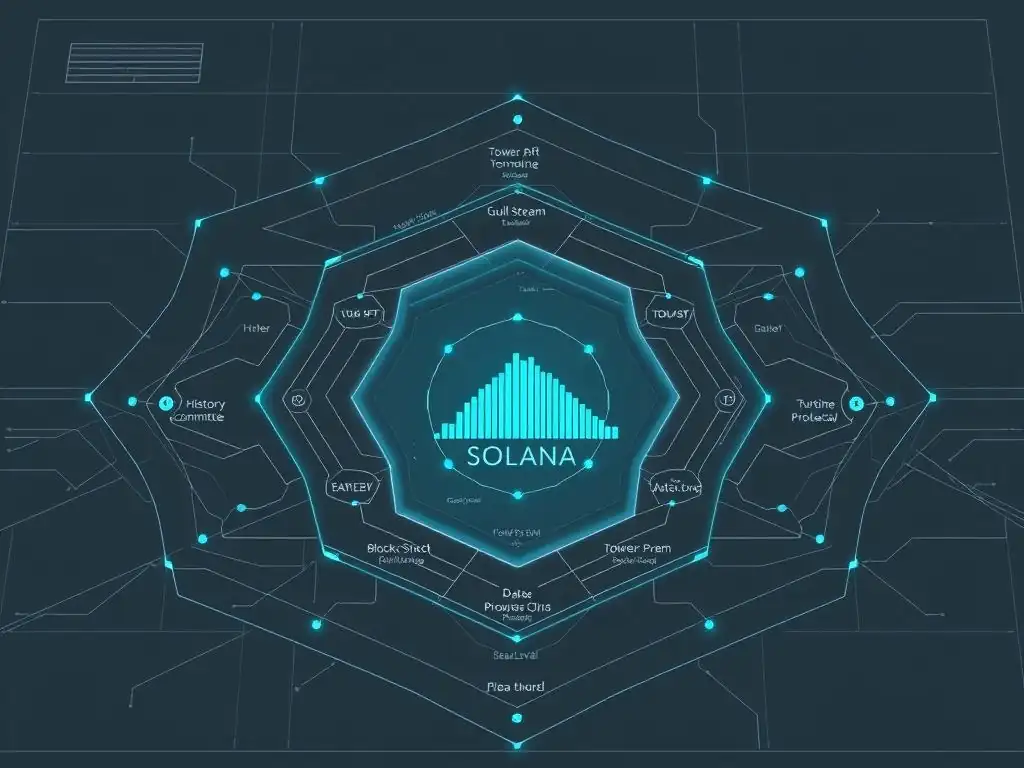
Strengths of Solana's Design
High Transaction Throughput
Solana's architecture is explicitly designed for high transaction throughput, and this is arguably its most significant strength. By combining Proof of History, Turbine, Gulf Stream, Sealevel, and Pipelining, Solana achieves significantly higher transaction processing speeds compared to many other blockchains. While exact TPS can vary based on network conditions and transaction complexity, Solana has demonstrated sustained throughput in the thousands of transactions per second in test environments and on its mainnet. This high throughput makes Solana suitable for applications requiring high transaction volumes, such as DeFi platforms, exchanges, and high-frequency trading systems.
Independent benchmarks and real-world performance observations generally support Solana's claims of high throughput. While reaching the theoretical maximum TPS can be challenging under real-world conditions, Solana consistently outperforms many other layer-1 blockchains in terms of transaction processing speed. This advantage in throughput is a key differentiator for Solana and a major factor in its adoption by projects requiring scalability.
Low Transaction Fees
Another significant advantage of Solana's architecture is its ability to maintain low transaction fees, even with high throughput. Due to its efficient design and high capacity, Solana can process a large volume of transactions without experiencing significant network congestion and fee spikes. Transaction fees on Solana are typically very low, often fractions of a cent, making it significantly more affordable for users compared to blockchains with higher fees, especially during periods of network congestion.
The consistently low transaction fees on Solana are a major draw for users and developers alike. They enable microtransactions and make it economically viable to use blockchain for a wider range of applications, including those involving frequent small transactions. This low-fee environment is a competitive advantage for Solana and contributes to its attractiveness as a platform for mass adoption.
Fast Confirmation Times
Solana's architecture is optimized for fast transaction confirmation times. Proof of History and Gulf Stream, in particular, contribute to reducing the time it takes for transactions to be finalized and confirmed on the blockchain. Confirmation times on Solana are typically measured in seconds, often around 400 milliseconds to a few seconds, which is significantly faster than many other blockchains where confirmation times can range from minutes to hours.
These fast confirmation times provide a smoother and more responsive user experience, especially for applications that require immediate transaction finality, such as trading platforms and payment systems. The speed of confirmations on Solana is a key factor in its appeal for users who value quick and efficient transactions. This rapid finality is a direct result of Solana's architectural focus on performance and optimization.
Potential Limitations of Solana's Architecture
Hardware Requirements for Validators
To achieve its high performance, Solana's architecture places significant demands on validator hardware. Running a Solana validator node requires powerful processors, substantial RAM, and high-speed storage, as detailed in Solana's validator documentation. These hardware requirements are considerably higher than those for validators on many other blockchains, potentially increasing the cost of participation and potentially impacting decentralization.
The high hardware requirements can act as a barrier to entry for individuals or smaller entities wanting to become validators. While Solana aims for decentralization, the cost of running validator nodes might lead to a concentration of validators among larger, well-resourced organizations. This is a potential trade-off inherent in Solana's design, where high performance is prioritized, which necessitates powerful infrastructure.
Centralization Concerns
While Solana is designed to be a decentralized blockchain, its architectural choices and practical realities have raised some centralization concerns. The high hardware requirements for validators, as mentioned earlier, can contribute to validator concentration. Additionally, the initial distribution of SOL tokens and the concentration of stake among a relatively small number of entities have also been points of discussion regarding decentralization.
Critics argue that the trade-offs made in Solana's architecture to achieve high performance might have come at the expense of some aspects of decentralization. While Solana has a large number of validators, the distribution of stake and the influence of larger validators are ongoing topics of debate within the blockchain community. Maintaining a balance between high performance and robust decentralization remains a key challenge for Solana and other high-performance blockchains.
Solana vs. Other High-Performance Blockchains: An Architectural Comparison
Solana vs. Ethereum 2.0: A Technical Comparison
Solana and Ethereum 2.0 (now just Ethereum after the merge) represent different approaches to achieving high performance. Ethereum 2.0 relies heavily on sharding, dividing the blockchain into multiple shards to process transactions in parallel. Solana, on the other hand, focuses on optimizing the base layer architecture itself, using innovations like Proof of History and parallel transaction processing to achieve high throughput on a single chain.
Ethereum's sharding approach aims to scale horizontally by distributing the workload across multiple shards, while Solana's approach focuses on vertical scaling by maximizing the performance of each node and the network as a whole. Ethereum's transition to proof-of-stake (PoS) also differs from Solana's hybrid approach combining PoH and Tower BFT. Ethereum's scalability roadmap is complex and involves multiple phases, while Solana's architecture is designed for high performance from the outset. Both platforms aim to address scalability but through fundamentally different architectural choices.
Solana vs. Avalanche: Key Architectural Differences
Avalanche is another high-performance blockchain platform, but it differs significantly from Solana in its architecture. Avalanche uses a novel consensus mechanism called Snowball and Avalanche consensus, which is based on repeated random sampling and sub-sampled voting. Unlike Solana's Proof of History, Avalanche does not rely on a cryptographic clock for timekeeping. Avalanche is designed to be highly customizable and interoperable, with a focus on subnets and the ability to create application-specific blockchains.
Architecturally, Avalanche is more focused on flexibility and interoperability, while Solana is primarily optimized for raw performance and high throughput on a single, unified chain. Avalanche's consensus mechanism is designed to be fast and energy-efficient, but it takes a different approach to achieving speed compared to Solana's PoH and Tower BFT. Avalanche also emphasizes subnetworks, allowing for greater customization and isolation of applications, a feature not directly comparable to Solana's core architecture.
Solana vs. Polkadot: Comparing Scalability Solutions
Polkadot is a heterogeneous multi-chain platform that focuses on interoperability and scalability through parachains – independent blockchains that connect to Polkadot's Relay Chain. Polkadot's scalability comes from distributing transaction processing across these parachains, which can operate in parallel. Solana, in contrast, aims for scalability within a single blockchain, using architectural innovations to maximize throughput on its main chain.
Polkadot's parachain model allows for different blockchains with varying architectures and functionalities to interoperate, while Solana focuses on optimizing a single, high-performance blockchain. Polkadot's Relay Chain provides shared security for parachains, while Solana's security model is based on its validator set and consensus mechanism. Polkadot's approach is more about creating a network of interoperable blockchains, whereas Solana's is about building a highly scalable monolithic blockchain.
The Future of Solana's Architecture: Ongoing Developments and Research
Planned Upgrades and Enhancements
Solana's architecture is continuously evolving, with ongoing research and development focused on further improvements and enhancements. Planned upgrades often include optimizations to existing components like Turbine and Gulf Stream to further reduce latency and increase throughput. Improvements to Sealevel and Cloudbreak are also continuously explored to enhance parallel transaction processing and state management efficiency. The Solana core development team and community are actively working on refining and optimizing various aspects of the architecture.
Specific future enhancements are often detailed in Solana's roadmap and development updates. These may include improvements to validator client performance, network communication optimizations, and refinements to the consensus mechanism. The focus remains on pushing the boundaries of blockchain performance and scalability while maintaining security and stability.
Exploring New Scalability Solutions
Beyond incremental improvements, Solana's research and development efforts also explore entirely new scalability solutions. This might involve investigating advanced sharding techniques, layer-2 solutions integrated with Solana's layer-1 architecture, or novel consensus mechanisms that could further enhance performance. The blockchain space is constantly innovating, and Solana's team is actively researching and evaluating new technologies and approaches to maintain its position as a leading high-performance blockchain.
Exploring new scalability solutions is crucial for ensuring Solana's long-term competitiveness and ability to handle increasing transaction volumes and more complex applications. This forward-looking approach to research and development is essential for adapting to the evolving demands of the blockchain ecosystem and maintaining Solana's architectural leadership.
The Impact of Solana on the Blockchain Landscape
Solana's architectural innovations have had a significant impact on the blockchain landscape. It has demonstrated the feasibility of achieving extremely high throughput and low latency on a layer-1 blockchain, pushing the boundaries of what is considered possible in blockchain performance. Solana's success has inspired other blockchain projects to explore similar architectural optimizations and has raised the bar for performance expectations in the industry.
Solana's emphasis on performance has also driven innovation in areas like consensus mechanisms, transaction processing, and state management. Its approach has influenced the design and development of other high-performance blockchains and has contributed to a broader understanding of the trade-offs and possibilities in blockchain architecture. Solana's impact extends beyond its own ecosystem, contributing to the overall advancement of blockchain technology and its potential for wider adoption.
Conclusion: Solana's Architectural Innovations and Their Significance
Solana's architecture represents a significant leap forward in blockchain design, achieving remarkable performance through a combination of innovative technologies. Proof of History, Tower BFT, Turbine, Gulf Stream, Sealevel, Pipelining, and Cloudbreak work synergistically to deliver high transaction throughput, low fees, and fast confirmation times. These architectural innovations have positioned Solana as a leading platform for demanding blockchain applications, particularly in DeFi and other high-volume use cases.
While Solana's architecture offers substantial advantages, it also presents certain trade-offs, such as higher hardware requirements for validators and ongoing discussions around decentralization. Nevertheless, Solana's impact on the blockchain landscape is undeniable. It has demonstrated the potential for layer-1 blockchains to achieve performance levels previously considered unattainable, pushing the boundaries of scalability and paving the way for wider blockchain adoption across diverse industries. Solana's architectural innovations serve as a valuable case study in the pursuit of high-performance decentralized systems.
Frequently Asked Questions
What is the main goal of Solana's architecture?
The primary goal is to achieve high throughput and fast transaction speeds while maintaining scalability and decentralization. This is achieved through innovative design choices.
How does Solana differ from other blockchain architectures?
Solana utilizes a unique Proof of History (PoH) consensus mechanism, which provides a globally synchronized clock. This contrasts with Proof of Work (PoW) or Proof of Stake (PoS) used by many other blockchains.
What are the key components of Solana's architecture that contribute to its high performance?
Key components include Proof of History (PoH), Turbine (a block propagation protocol), Gulf Stream (a transaction forwarding protocol), and Sealevel (parallel transaction processing). These are designed to minimize bottlenecks.
What are some potential use cases for Solana's high-performance architecture beyond cryptocurrency?
Potential use cases include DeFi applications requiring rapid transaction speeds, high-frequency trading platforms, and decentralized social media networks with large user bases.
Is Solana's architecture considered to be fully decentralized?
While Solana aims for decentralization, its architectural choices, particularly the hardware requirements for validators, raise concerns about potential centralization risks. Further development is ongoing to address these concerns.
Final Reflection: Unlocking the Potential of Decentralized Speed
The journey through Solana's architecture reveals more than just technical intricacies; it unveils a paradigm shift in blockchain design. The pursuit of high-performance decentralization is no longer a theoretical aspiration, but a tangible reality. Solana's innovative solutions, from Proof of History to Turbine, demonstrate a commitment to scalability that directly addresses the limitations hindering widespread blockchain adoption today. This isn't just about faster transactions; it's about enabling entirely new classes of decentralized applications and services.
The impact of Solana's architecture extends far beyond the realm of developers and engineers. Its ability to process transactions at speeds rivaling traditional financial systems has the potential to revolutionize industries ranging from finance and supply chain management to gaming and social media. The future is already here – it's just not evenly distributed.
- William Gibson. This quote resonates deeply when considering Solana's potential to democratize access to financial services and empower individuals with greater control over their data and digital assets. The ongoing evolution of its ecosystem underscores the enduring importance of understanding and contributing to this groundbreaking technology.
As you delve deeper into the world of blockchain technology, remember that the true power lies not just in understanding the technical details, but in envisioning the possibilities they unlock. Let Solana's architecture serve as an inspiration to push the boundaries of what's possible, to challenge conventional thinking, and to contribute to a future where decentralized technologies empower individuals and transform industries. Embrace the challenge, explore the potential, and become a builder in the decentralized revolution.
Dive Deeper: Unleash Your Solana Potential!
Thank you for exploring the intricacies of Solana's architecture with us! We hope this breakdown has illuminated the innovative design choices behind its impressive performance. Now, it's time to translate that knowledge into action.
Here are a few ways to further your Solana journey:
- Start Building! Explore the Solana Cookbook (Solana's official documentation for developers) and try deploying a simple smart contract. This is the best way to truly grasp the nuances of the platform.
- Join the Solana Community: Connect with fellow enthusiasts on Discord and Twitter to exchange ideas, troubleshoot challenges, and stay up-to-date on the latest developments.
- Uncover Hidden Gems: Research projects building unique solutions on Solana, from DeFi applications to innovative NFT platforms. You might just discover the next big thing!
What's one small, experimental project you could build on Solana to put your newfound knowledge to the test?
Leave a Reply