
BeginnerFriendly Crypto Margin Trading? Proceed with Caution (and the Right Exchange)


Welcome to Blockchain Trends, your trusted guide to navigating the ever-evolving world of blockchain technology. Beyond the hype, we delve into the real-world applications and transformative potential of decentralized systems. Intrigued by margin trading crypto, especially as a beginner? Proceed with caution, as this article highlights the key considerations and crucial choices you need to make before diving in, including selecting the right exchange. Learn what to consider and why it's important.
-
Beginner-Friendly Crypto Margin Trading? Proceed with Caution (and the Right Exchange)
- Why Beginners Are Tempted by Crypto Margin Trading
- Understanding the Allure of Leverage in Crypto
- The Reality: Why Margin Trading Crypto is Inherently Risky for Beginners
- Key Risks of Leverage Trading for Novices
- What is Crypto Margin Trading (Simply Explained)
- How Leverage Amplifies Both Gains and Losses
- The Dangers of Liquidation for Beginner Crypto Traders
- Why Most Beginners Should Avoid Crypto Margin Trading
- Safer Alternatives for Beginner Crypto Investors
- If You Insist: Finding a (Relatively)
-
Frequently Asked Questions
- ### What is crypto margin trading, and why is it considered beginner-unfriendly?
- ### How does leverage work in crypto margin trading, and what are the potential risks?
- ### What are some key factors to consider when choosing a crypto exchange for margin trading, especially as a beginner?
- ### What are the best risk management strategies for beginners engaging in crypto margin trading?
- ### Besides cryptocurrencies, where else is blockchain being used?
- Final Reflection: Navigating the Risky Waters of Crypto Margin Trading
- Unlock Your Crypto Potential: Trade Smarter, Not Harder!
Beginner-Friendly Crypto Margin Trading? Proceed with Caution (and the Right Exchange)
Why Beginners Are Tempted by Crypto Margin Trading
The world of cryptocurrency trading is fast-paced and exciting, often promising significant returns. For newcomers, the allure of amplifying potential profits quickly can be incredibly tempting. Seeing experienced traders discuss leveraged positions and rapid gains can create a sense that margin trading is a direct path to financial success in the crypto market.
This perception is fueled by social media and online communities where large, albeit often cherry-picked, profits from leverage trading are showcased, creating a powerful, albeit misleading, incentive for those new to the space. The accessibility of margin trading features on many popular crypto exchanges further lowers the barrier to entry, making it seem like just another trading option rather than a highly specialized and risky strategy.
Furthermore, the inherent volatility of cryptocurrencies like Bitcoin and Ethereum means that even small price movements can be significant. Beginners might look at a 5% daily swing and imagine how much more they could make if they could multiply that gain using leverage. This focus on potential upside, without a full grasp of the magnified risk, is a primary driver for beginners considering margin trading crypto. The desire for quick profits in a market that never sleeps, combined with easy-to-access tools, makes margin trading an unfortunately attractive, though dangerous, proposition for novice traders.
Understanding the Allure of Leverage in Crypto
Leverage allows traders to control a larger position in the market with a relatively small amount of capital. For example, with 10x leverage, a trader can open a $1,000 position using only $100 of their own funds. This ability to participate in larger trades magnifies potential profits from favorable price movements.
If the asset price increases by 10%, the $1,000 position gains $100. Without leverage, a $100 investment would only gain $10 from the same 10% price increase. This dramatic difference in potential returns is the core appeal of leverage, making it seem like a shortcut to accumulating wealth in the volatile crypto market.
The appeal is particularly strong in crypto because of its high volatility compared to traditional assets like stocks. While a 1% daily move in a major stock might be considered large, 5% to 10% swings are not uncommon for cryptocurrencies. Leverage amplifies these swings.
A trader using 20x leverage on a coin that moves up just 5% could potentially double their initial capital (minus fees), creating the perception of rapid wealth generation. This potent combination of high market volatility and the power of leverage is what draws many beginners towards margin trading crypto, often without fully appreciating the equally amplified downside.
The Reality: Why Margin Trading Crypto is Inherently Risky for Beginners
Despite the enticing potential for magnified gains, the reality of margin trading crypto for beginners is starkly different. The same leverage that amplifies profits also amplifies losses, often at an accelerated rate due to market volatility and funding costs. Beginners typically lack the experience, risk management skills, and emotional discipline required to navigate leveraged positions successfully. They may not understand complex order types, the impact of funding rates, or the critical importance of setting stop-loss orders, which are vital tools for managing the heightened risk.
Furthermore, the highly unpredictable nature of the crypto market means sudden, sharp price movements are common. A beginner might open a leveraged position based on a short-term trend, only for the price to reverse unexpectedly. With leverage, even a small adverse price move can quickly erode their initial capital, leading to significant losses or even complete liquidation of their position. Unlike spot trading where the maximum loss is the initial investment, margin trading exposes beginners to losing their entire margin balance very rapidly.
Key Risks of Leverage Trading for Novices
The primary risk for novices engaging in margin trading crypto is magnified losses. Using leverage like 5x or 10x means that for every 1% the market moves against your position, your capital decreases by 5% or 10% respectively. In the volatile crypto market, where sudden price drops of 10-20% can occur within hours, a leveraged position can be wiped out almost instantly. For instance, a trader using 10x leverage on Bitcoin who invests $500 could lose their entire $500 if Bitcoin drops just 10% against their position, whereas a spot trader would still have $450 of their initial $500.
Another critical risk is liquidation. This occurs when the market moves against your leveraged position to the point where your losses exceed the margin you've put up. The exchange automatically closes your position to prevent you from losing more money than you have in your margin account. For beginners, the liquidation price can often be much closer to their entry price than they realize, especially with higher leverage levels. Liquidation results in the loss of all the capital allocated to that specific trade, a frequent and devastating outcome for inexperienced margin traders.
What is Crypto Margin Trading (Simply Explained)
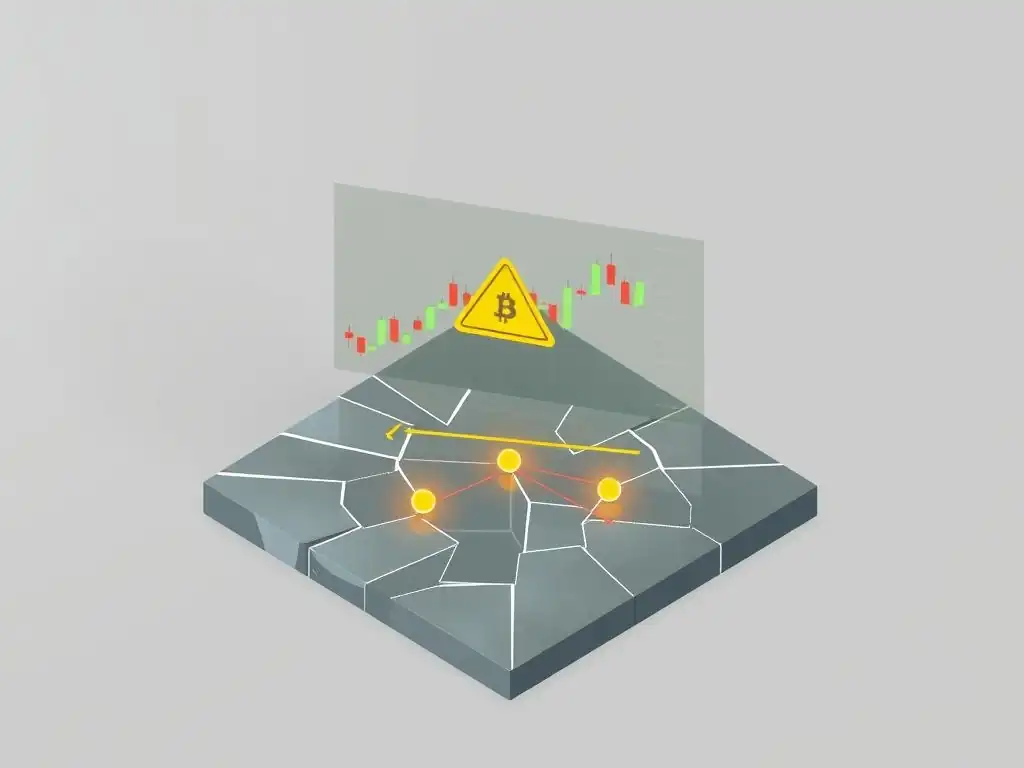
At its core, crypto margin trading involves borrowing funds from an exchange or other traders to increase your trading capital. Instead of just using your own money (e.g., $100) to buy or sell crypto, you use your money as collateral (margin) to borrow additional funds (e.g., $900) and trade with a larger amount ($1,000 total position). This borrowed capital allows you to open positions much larger than your initial investment, a concept known as leverage. The exchange typically facilitates this borrowing and holds your margin as security against potential losses.
Think of it like buying a house with a mortgage. You put down a percentage of the price (your margin) and borrow the rest from the bank (the exchange). You control the entire house (the larger crypto position), but if the price of the house drops significantly, the bank (exchange) might require you to put up more money or force you to sell the house (liquidation) to cover the loan. In crypto margin trading, the process is similar but happens much faster and with significantly more volatility.
How Leverage Amplifies Both Gains and Losses
Leverage is a double-edged sword because it multiplies the outcome of any price movement. If you use 5x leverage and the asset price increases by 10%, your profit on the total position is 10% of the larger amount. If your position size is $1,000 due to 5x leverage on $200 of your own funds, a 10% gain is $100. This represents a 50% return on your initial $200 margin. Compare this to a spot trade where $200 would yield only $20 (10% of $200) from the same price increase.
Conversely, if the asset price decreases by 10%, your loss is also 10% of the larger position size. On the $1,000 leveraged position, a 10% drop results in a $100 loss. This $100 loss represents a 50% reduction of your initial $200 margin. A spot trader losing 10% on $200 would only lose $20. This symmetrical amplification means that while gains are excitingly large, losses can be devastatingly quick, especially for beginners who may not have the capital reserves to withstand significant drawdowns.
The Dangers of Liquidation for Beginner Crypto Traders
Liquidation is the point of no return in margin trading. When the market moves against your leveraged position and your losses reach a certain percentage of your initial margin (often close to 100%, depending on the exchange and leverage), the exchange automatically closes your position. This prevents your account balance from going negative, but it means you lose the entire amount you put up for that specific trade. For a beginner margin trading crypto, experiencing liquidation is a harsh and often unexpected lesson.
The danger is amplified by the speed at which liquidation can occur in crypto. A sudden market crash or a 'wick' (a brief, sharp price spike or drop) can trigger liquidation before a beginner even has time to react or deposit more funds (a margin call). Unlike simply seeing an asset's value decline in a spot wallet, liquidation means the capital is gone. This risk is particularly high for beginners who tend to use high leverage, have insufficient margin, and lack experience in setting stop-loss orders to automatically close a position before liquidation is triggered.
Why Most Beginners Should Avoid Crypto Margin Trading
Considering the points above, it becomes clear why margin trading crypto is overwhelmingly unsuitable for beginners. The combination of high market volatility, amplified losses, the constant threat of liquidation, and the lack of experience, risk management skills, and emotional discipline among novices creates a perfect storm for financial loss. Statistics across trading platforms, both traditional and crypto, consistently show that a vast majority of retail traders who use leverage end up losing money. Some reports suggest figures as high as 70-90% of leveraged accounts lose funds over time.
Instead of seeking the high-risk, high-reward path of margin trading, beginners should focus on foundational trading skills. This includes understanding market analysis (technical and fundamental), developing a solid trading plan, practicing risk management (like position sizing and stop losses in spot trading), and gaining experience in less volatile conditions. Building a strong base with spot trading allows beginners to learn how the market moves and how to manage their emotions without the existential threat of rapid liquidation that comes with leverage.
Safer Alternatives for Beginner Crypto Investors
For those new to the crypto space looking to grow their capital, several safer alternatives exist compared to margin trading crypto beginners often stumble into. One primary alternative is spot trading. This involves buying and selling cryptocurrencies directly, owning the underlying asset.
While still subject to market volatility, the maximum you can lose on a spot trade is your initial investment in that specific asset. If Bitcoin drops 50%, your holdings lose 50% of their value, but you still own the Bitcoin and can wait for a recovery. This is fundamentally different from margin trading where a 50% drop against a leveraged position would have likely resulted in liquidation long before.
Other safer options include long-term investing (HODLing) in established cryptocurrencies, earning passive income through staking or lending on reputable platforms (understanding associated risks like smart contract failure or platform insolvency), or dollar-cost averaging (DCA) – investing a fixed amount regularly regardless of price to average out the purchase cost over time. These strategies focus on long-term growth and capital preservation rather than short-term speculation with borrowed funds, making them far more suitable for beginners learning the ropes of the crypto market.
If You Insist: Finding a (Relatively)
If, despite the significant risks outlined, you are determined to explore margin trading crypto as a beginner, it is paramount to select an exchange that offers some features that mitigate the extreme danger, though none eliminate the inherent risk. Look for platforms that prioritize user education and provide comprehensive learning resources specifically on margin trading and risk management.
A suitable exchange will also offer very low leverage options (e.g., 2x or 3x maximum for beginners), allowing for a smaller amplification of risk while you gain experience. Avoid exchanges that push extremely high leverage (50x, 100x, or more) as these are liquidation traps for novices.
Crucially, choose an exchange with robust security features, clear fee structures (including funding rates), and a simple, intuitive interface that reduces the chance of making costly errors. Test the platform thoroughly with a small amount of capital or a demo account (if available) before committing significant funds. Even with these precautions and selecting a platform that is relatively more beginner-friendly, the fundamental risks of margin trading crypto remain. Proceed with extreme caution, start with the absolute minimum possible capital, and be prepared for potential losses.
[ ] Acknowledge the risks of margin trading crypto beginners face.
[ ] Explain leverage clearly.
[ ] Detail the concept and danger of liquidation.
[ ] Provide reasons why beginners should avoid it.
[ ] Offer safer alternatives.
[ ] Describe characteristics of exchanges *if* a beginner insists on trying (without naming specific ones).
[ ] Use Markdown elements throughout.
[ ] Ensure at least two paragraphs per ### header.
[ ] Integrate keyword naturally.
[ ] Maintain informative, professional tone.
Frequently Asked Questions
### What is crypto margin trading, and why is it considered beginner-unfriendly?
Crypto margin trading allows you to trade with borrowed funds, amplifying both potential profits and losses. It's beginner-unfriendly due to its high risk and complexity in understanding leverage and liquidation.
### How does leverage work in crypto margin trading, and what are the potential risks?
Leverage multiplies your trading position, allowing you to control a larger amount with less capital. The risk is that losses are also magnified, potentially leading to rapid liquidation of your account and significant financial loss.
### What are some key factors to consider when choosing a crypto exchange for margin trading, especially as a beginner?
Consider factors like user-friendliness, robust security measures, transparent fee structures, and the availability of risk management tools (stop-loss orders, etc.). Also, look for exchanges with educational resources.
### What are the best risk management strategies for beginners engaging in crypto margin trading?
Start with low leverage, use stop-loss orders to limit potential losses, and only risk a small percentage of your total capital on each trade. Thorough research is also crucial.
### Besides cryptocurrencies, where else is blockchain being used?
Beyond crypto, blockchain technology is finding applications in DeFi (Decentralized Finance), supply chain management, enterprise applications, and various sectors seeking transparency and efficiency.
The allure of amplified gains in the volatile cryptocurrency market is undeniable, but as we've explored, margin trading for beginners is a double-edged sword. While the potential for profit is enticing, the inherent risks of leverage, especially for those new to the space, demand careful consideration and a strategic approach. Ignoring these warnings can lead to significant financial setbacks, underscoring the importance of education and selecting a reputable exchange.
The impact of accessible, yet potentially dangerous, financial tools like margin trading continues to shape the crypto landscape. It underscores the need for responsible innovation and user education within the industry. The ease with which beginners can access leverage often overshadows the complexities and risks involved. As the saying goes: With great power comes great responsibility.
This sentiment rings especially true in the context of crypto margin trading, where a lack of understanding can have devastating consequences.
Now, more than ever, it's crucial to approach the crypto market with a blend of enthusiasm and caution. Before diving into the world of margin trading, take the time to thoroughly educate yourself, choose a reliable exchange, and understand your own risk tolerance. Remember, responsible participation is key to navigating the exciting, yet unpredictable, world of cryptocurrency. Let's strive to make informed decisions and build a more sustainable and secure future for everyone involved.
Unlock Your Crypto Potential: Trade Smarter, Not Harder!
Thank you for exploring the world of crypto margin trading! We hope this article has provided you with the knowledge to navigate this exciting yet potentially risky environment. Now, it's time to put that knowledge into practice.
- Select a reputable exchange that offers strong security features and resources designed for beginners. Protecting your investment is paramount! This is your first essential step.
- Use paper trading or demo accounts to practice your strategies without risking real money. Hone your skills and familiarize yourself with the process before committing actual funds.
- Join our community forum to share insights, ask questions, and learn from experienced traders. Connect and grow together!
What’s one new risk management technique you plan to implement in your next crypto trade? Share your thoughts in the comments below!
Leave a Reply