
Decentralized Gaming Platforms: A Look at Current Trends and Future Possibilities


Welcome to Blockchain Trends, your guide to understanding the evolving world of decentralized technology.
Intrigued by the potential of blockchain beyond just cryptocurrencies? Dive in and explore how this revolutionary technology is reshaping industries, from DeFi to enterprise solutions. Curious about Blockchain gaming investment strategies? Our latest article delves deep into the current trends and future possibilities of decentralized gaming platforms, offering insightful perspectives and actionable information. Discover the opportunities and navigate the challenges in this rapidly expanding sector – let's unlock the future of gaming together!
Decentralized Gaming Platforms: A Look at Current Trends and Future Possibilities
- Understanding Decentralized Gaming and Its Potential
- Current Trends in Decentralized Gaming Platforms
- Blockchain Gaming Investment Strategies: Navigating the Landscape
- Future Possibilities for Decentralized Gaming
-
Frequently Asked Questions
- What are the primary benefits of decentralized gaming platforms compared to traditional gaming?
- How can blockchain technology improve the in-game economy and player experience in games?
- What are some blockchain gaming investment strategies that investors should consider?
- What are the major challenges hindering the widespread adoption of blockchain gaming?
- How are regulations impacting the development and growth of blockchain gaming and NFTs?
- Final Reflection: Embracing the Decentralized Gaming Revolution
- Ignite Your Game: Step into the Decentralized Revolution!
Understanding Decentralized Gaming and Its Potential
The Rise of Blockchain Gaming: An Overview
The gaming industry has consistently evolved, embracing new technologies to enhance player experiences. From arcade classics to the sophisticated online multiplayer environments of today, innovation has been the driving force. Recently, blockchain technology has emerged as a significant disruptor, paving the way for decentralized gaming platforms. Unlike traditional gaming, where game assets and economies are centrally controlled by developers, blockchain gaming leverages decentralized networks to empower players with true ownership and control. This shift represents a paradigm change, moving away from closed ecosystems towards open, player-centric models.
The initial forays into blockchain gaming were marked by simple collectible games and rudimentary play-to-earn mechanics. However, the industry has rapidly matured, witnessing the development of increasingly complex and engaging games across various genres. Early examples, while not graphically intensive, demonstrated the core principles of asset tokenization and player-driven economies.
Now, we are seeing AAA-quality games integrating blockchain, signaling a serious commitment from the gaming world and a growing recognition of the potential of decentralized platforms to reshape the future of interactive entertainment. This evolution marks a significant step in realizing the full potential of blockchain within the broader gaming landscape, moving beyond novelty to establish a sustainable and compelling alternative to traditional gaming models.
Benefits of Decentralized Gaming Platforms
Decentralized gaming platforms offer a multitude of advantages over their traditional counterparts, primarily centered around player empowerment and enhanced economic opportunities. One of the most significant benefits is true ownership of in-game assets. In traditional games, even purchased items remain under the control of the game developers and can be revoked or altered at their discretion.
Blockchain-based games, utilizing Non-Fungible Tokens (NFTs), grant players verifiable ownership of digital assets. These assets, ranging from characters and weapons to virtual land, are recorded on the blockchain, ensuring transparency and immutability of ownership. Players can freely trade, sell, or even utilize these assets across different compatible platforms, creating a truly open gaming ecosystem.
Furthermore, decentralized platforms often foster more transparent and equitable game economies. Smart contracts, self-executing agreements written in code and stored on the blockchain, can automate various game mechanics, including reward distribution and transaction processing. This reduces the potential for manipulation and ensures fair play.
Moreover, many decentralized games incorporate play-to-earn (P2E) models, allowing players to earn cryptocurrency or NFTs through gameplay, which can then be exchanged for real-world value. This fundamentally changes the relationship between players and games, transforming gaming from a purely leisure activity to a potential source of income, particularly in regions where traditional income opportunities are limited. This economic empowerment, combined with true asset ownership, positions decentralized gaming as a compelling alternative, attracting both players and investors interested in the future of interactive entertainment and blockchain gaming investment strategies.
Key Features of Blockchain-Based Games
Blockchain-based games are defined by a set of core features that differentiate them from traditional gaming experiences. Non-Fungible Tokens (NFTs) are central to this distinction, serving as the foundation for digital asset ownership. NFTs are unique cryptographic tokens that represent ownership of a specific item, whether it's a virtual sword, a piece of land, or a character skin.
Because they reside on the blockchain, their ownership and history are transparent and verifiable, creating digital scarcity and enabling player-driven economies. For example, in games like Axie Infinity, players own Axie NFTs, which they can breed, battle, and trade, creating a vibrant marketplace around these digital creatures.
Another key feature is the integration of cryptocurrencies as in-game currencies and rewards. These cryptocurrencies facilitate transactions within the game ecosystem and often serve as governance tokens, granting holders voting rights on game development decisions. This introduces a new layer of player participation in the game's evolution. Moreover, decentralized governance is increasingly becoming a hallmark of blockchain games.
Through Decentralized Autonomous Organizations (DAOs), players can collectively influence the game's direction, rules, and even the allocation of resources. This community-driven approach fosters a sense of ownership and shared responsibility, moving away from the top-down control typical of traditional game development. These features, combined, create a fundamentally different gaming paradigm that prioritizes player agency, economic participation, and community governance, attracting a new wave of gamers and investors seeking opportunities in blockchain gaming investment strategies.
Current Trends in Decentralized Gaming Platforms
Play-to-Earn (P2E) Gaming: A Deep Dive
The Evolution of P2E Models
The play-to-earn (P2E) model represents a significant evolution in gaming, shifting from a purely entertainment-focused industry to one that incorporates economic opportunities for players. Initially, P2E models were relatively rudimentary, often centered around simple tasks or repetitive gameplay loops that rewarded players with small amounts of cryptocurrency. Early examples, like the aforementioned Axie Infinity, popularized the concept, demonstrating the potential for players to earn income by engaging with a game. These early models often relied on inflationary tokenomics, where new tokens were continuously generated, leading to challenges in long-term sustainability.
As the P2E space matured, more sophisticated models emerged, focusing on creating more balanced and sustainable economies. Games began incorporating diverse earning mechanisms beyond simple daily rewards, such as competitive tournaments, crafting systems, and land ownership that generated passive income. Furthermore, there's a growing trend towards "Play-and-Earn" or "Play-to-Own" models, emphasizing enjoyable gameplay as the primary driver, with earning opportunities integrated more organically rather than being the sole focus.
This evolution reflects a recognition that long-term success in P2E requires a compelling gaming experience that attracts and retains players, rather than solely relying on economic incentives. This shift is crucial for the sustainable growth and wider adoption of P2E and influences blockchain gaming investment strategies as investors look for projects with robust and balanced economic models.
Challenges and Opportunities in P2E
While the play-to-earn (P2E) model has generated significant excitement and attracted a large player base, it also faces considerable challenges. One of the primary criticisms revolves around economic sustainability. Many early P2E games suffered from hyperinflation of their in-game tokens, as the supply of tokens outpaced demand, leading to a collapse in token value and player earnings. The reliance on new players joining the ecosystem to sustain the economy, often described as a "Ponzi-scheme" dynamic by critics, proved to be unsustainable in many cases. Games like Axie Infinity, despite initial success, experienced significant economic downturns as token prices plummeted.
However, the challenges also present significant opportunities for innovation and improvement. Developers are actively exploring solutions to address economic instability, including implementing token burning mechanisms, introducing deflationary tokenomics, and focusing on creating more diverse and engaging gameplay loops that drive demand for in-game assets and tokens beyond speculative investment. Furthermore, the P2E model has opened up economic opportunities for players in developing countries, where earnings from gaming can represent a significant portion of income.
For instance, in countries like the Philippines and Venezuela, P2E games provided crucial income streams during economic hardship. The future of P2E hinges on addressing the sustainability challenges while capitalizing on the potential to create new economic models within gaming and exploring viable blockchain gaming investment strategies that support long-term growth and player engagement.
NFT Integration in Gaming: Ownership and Scarcity
Exploring NFT Gaming Assets
Non-Fungible Tokens (NFTs) are revolutionizing gaming by introducing verifiable digital ownership and scarcity to in-game assets. NFTs in games encompass a wide range of digital items, transforming how players interact with and value their virtual possessions. Common examples include cosmetic items like character skins and weapon appearances, which, as NFTs, gain a layer of uniqueness and tradability beyond simply being in-game customizations. Games like Decentraland and The Sandbox feature virtual land NFTs, allowing players to own and develop plots of virtual real estate, creating persistent digital worlds owned by their users.
Beyond cosmetics and land, NFTs represent in-game items with utility, such as weapons, armor, and tools that enhance gameplay. These NFTs can have varying stats and rarities, directly impacting gameplay and creating a market for powerful and sought-after items. Collectible card games, like Gods Unchained, are entirely built around NFT cards, where each card is a unique NFT with different abilities and strategic value.
The diversity of NFT assets within gaming is constantly expanding, encompassing everything from music and art within virtual worlds to even in-game avatars and characters. This broad application of NFTs is reshaping the concept of digital ownership in gaming and creating new avenues for blockchain gaming investment strategies focused on the value and utility of these digital assets.
The Impact of NFTs on Game Economies
The integration of NFTs has a profound impact on game economies, shifting them from developer-controlled systems to more player-driven and open marketplaces. NFTs enable the creation of player-to-player (P2P) marketplaces where players can freely buy, sell, and trade their in-game assets. This contrasts sharply with traditional games, where trading is often restricted or prohibited, and players are reliant on the developer-controlled in-game store. These NFT marketplaces can be integrated directly into the game or exist on third-party platforms like OpenSea or Magic Eden, fostering a vibrant ecosystem around game assets.
NFTs also introduce the concept of digital scarcity, which can significantly impact asset value. Developers can control the supply of NFT assets, creating rare and limited edition items that command higher prices in the marketplace. This scarcity, combined with player-driven demand, creates dynamic and potentially lucrative in-game economies.
Furthermore, NFTs facilitate interoperability between games and metaverses. While still in its early stages, the potential for using the same NFT assets across different compatible games and virtual worlds is a compelling prospect, further enhancing the utility and value of these digital items. The shift towards NFT-driven game economies is not only empowering players but also creating new investment opportunities and influencing blockchain gaming investment strategies focused on the long-term value and potential of these digital ecosystems.
Metaverse Integration: Immersive Gaming Experiences
Decentralized Gaming in the Metaverse
The metaverse, envisioned as persistent, shared virtual worlds, is increasingly intertwined with decentralized gaming, creating more immersive and interconnected experiences. Decentralized gaming platforms are finding a natural home within metaverse environments, leveraging blockchain technology to power ownership, economies, and governance within these virtual worlds. Games like The Sandbox and Decentraland are prime examples, functioning as both games and metaverse platforms, where users can build, explore, and socialize within blockchain-based virtual spaces. These platforms utilize NFTs for land ownership, avatars, and in-world assets, creating player-owned and operated digital economies.
The integration of decentralized gaming into the metaverse enhances the sense of immersion and agency for players. By owning digital assets within these virtual worlds, users have a tangible stake in the metaverse ecosystem. Furthermore, decentralized governance models, often implemented through DAOs, allow metaverse users to participate in shaping the direction and rules of these virtual environments.
This combination of ownership and governance fosters a sense of community and belonging, making metaverse experiences more engaging and meaningful. The convergence of decentralized gaming and the metaverse is creating new paradigms for online interaction and entertainment, attracting both gamers and investors interested in the future of virtual worlds and blockchain gaming investment strategies within these evolving digital landscapes.
Creating Persistent Virtual Worlds
Blockchain technology is instrumental in building persistent virtual worlds by enabling verifiable ownership, decentralized economies, and community governance, all crucial for long-term sustainability and user engagement. Persistence in this context refers to the idea that virtual worlds continue to exist and evolve even when individual users are offline. Traditional online games often rely on centralized servers, making them vulnerable to shutdowns and data loss. Blockchain, with its decentralized and immutable nature, provides a more robust foundation for persistent virtual worlds. Assets and data stored on the blockchain are less susceptible to single points of failure and censorship.
Furthermore, blockchain facilitates the creation of open and interoperable virtual worlds. NFTs, representing in-world assets, can potentially be used across different compatible metaverse platforms, breaking down the walled gardens of traditional gaming and virtual environments. This interoperability is a key element in building a truly interconnected metaverse.
Decentralized governance, through DAOs, allows the community to collectively manage and develop these persistent virtual worlds, ensuring that they evolve in a way that reflects the desires and needs of their users. The combination of persistence, ownership, and community governance, powered by blockchain, is paving the way for truly immersive and user-centric virtual worlds, and is a key area of focus for blockchain gaming investment strategies looking towards the future of digital interaction and entertainment.
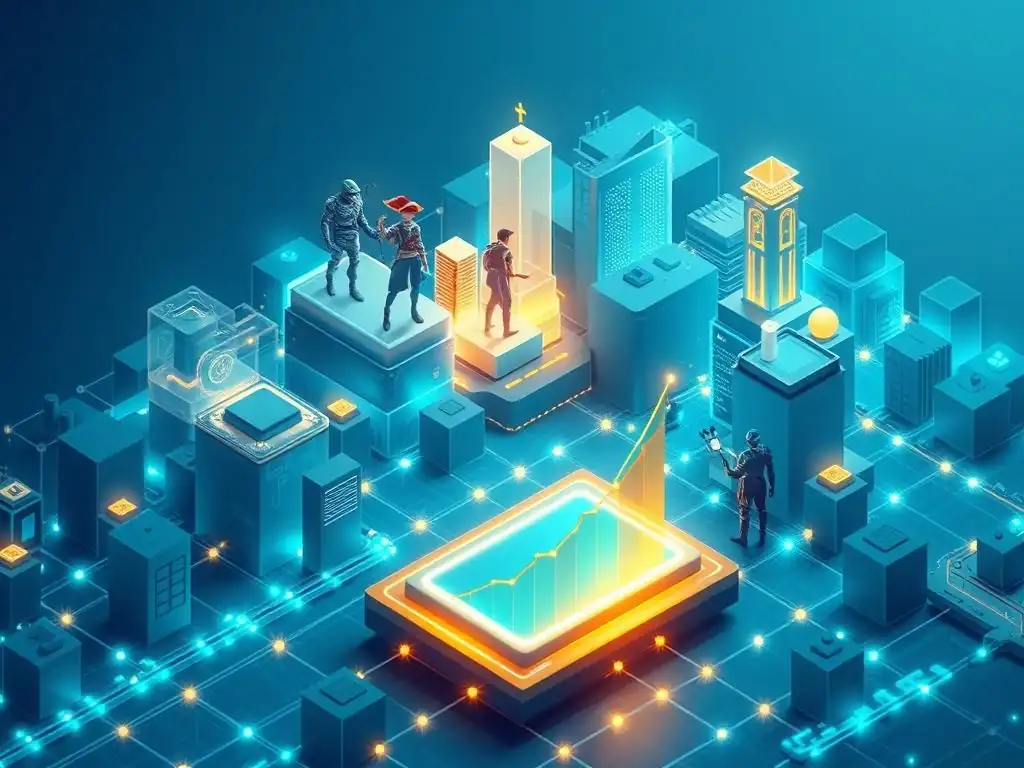
Identifying Promising Decentralized Gaming Projects
Evaluating Project Tokenomics
A crucial aspect of blockchain gaming investment strategies is thoroughly evaluating the tokenomics of a project. Tokenomics refers to the economic model of a cryptocurrency or token, encompassing its supply, distribution, utility, and mechanisms for value accrual. A sustainable and well-designed tokenomic model is vital for the long-term success of a decentralized gaming project. Investors should analyze the token distribution, understanding how tokens are allocated between the development team, investors, and the community. A large percentage allocated to the team or early investors might raise concerns about potential token dumps and price volatility.
The utility of the token within the game ecosystem is paramount. A token should have clear and compelling use cases, such as being required for in-game transactions, staking, governance, or accessing premium features. Tokens with limited utility are less likely to sustain long-term value. Investors should also examine the token supply and inflation mechanisms.
Is the token supply fixed, or is it inflationary? If inflationary, what mechanisms are in place to control inflation and maintain token value? Token burning mechanisms, where a portion of tokens are permanently removed from circulation, can help to counter inflationary pressures. Analyzing these tokenomic factors provides crucial insights into the potential long-term viability and investment attractiveness of a decentralized gaming project and is a core component of informed blockchain gaming investment strategies.
Assessing Team and Community Support
Beyond tokenomics, evaluating the project team and community support is crucial for informed blockchain gaming investment strategies. The team behind a decentralized gaming project is a strong indicator of its potential success. Investors should research the team's experience and track record, particularly in gaming and blockchain development. Are the team members publicly known and reputable? Do they have a history of successfully delivering projects? A strong and experienced team increases the likelihood of the project being well-executed and navigating the challenges of game development and the blockchain space.
Community support is another vital indicator. A vibrant and engaged community suggests strong interest in the project and can contribute significantly to its growth and adoption. Investors should assess the size and activity of the project's community on platforms like Discord, Telegram, and social media. Is the community actively involved in discussions and providing feedback?
Is there a sense of enthusiasm and organic growth? A strong community can act as a powerful marketing force and contribute to the game's long-term sustainability. Analyzing both the team's expertise and the community's engagement provides a holistic view of a project's viability and is an essential element in making sound blockchain gaming investment strategies.
Diversifying Your Blockchain Gaming Investment Portfolio
Risk Management in Blockchain Gaming Investments
Blockchain gaming investment strategies, while potentially lucrative, also carry significant risks, and effective risk management is paramount. The blockchain gaming space is highly volatile, with token prices and project valuations subject to rapid and unpredictable fluctuations. One of the primary risks is market volatility inherent in the cryptocurrency market. Gaming tokens often exhibit even greater volatility than established cryptocurrencies, making investments susceptible to sharp price drops.
Another significant risk is project failure. Many blockchain gaming projects are still in early stages of development, and there's no guarantee of their success. Projects can fail due to various factors, including poor game design, unsustainable tokenomics, or lack of adoption. "Rug pulls," where developers abandon a project after raising funds, are also a risk, though increasingly less common as the space matures.
To mitigate these risks, diversification is a key strategy. Instead of investing heavily in a single project, investors should spread their investments across multiple games and platforms. This reduces the impact of any single project failing. Due diligence is also crucial.
Thoroughly researching projects, evaluating their tokenomics, team, and community, and understanding the risks involved before investing is essential. Investing only what you can afford to lose is a fundamental principle of risk management in any speculative market, and particularly relevant to blockchain gaming investment strategies. Finally, staying informed about market trends, regulatory developments, and project updates is crucial for adapting investment strategies and managing risks effectively.
Long-Term vs. Short-Term Investment Strategies
Blockchain gaming investment strategies can be broadly categorized into long-term and short-term approaches, each with its own goals, risks, and considerations. Long-term investment in blockchain gaming typically involves identifying projects with strong fundamentals, sustainable tokenomics, and long-term growth potential. This strategy focuses on holding assets for extended periods, often years, anticipating that the blockchain gaming market will continue to expand and mature.
Long-term investors often prioritize projects with solid teams, compelling gameplay, and strong communities, believing these factors contribute to sustained value appreciation over time. This approach is less focused on short-term price fluctuations and more on the overall growth of the ecosystem and the project's long-term viability.
Short-term investment, on the other hand, aims to profit from short-term price movements and market trends. This strategy often involves actively trading gaming tokens, capitalizing on volatility and hype cycles. Short-term investors may focus on technical analysis, market sentiment, and news events to make quick trading decisions. This approach is inherently riskier and requires more active management and market awareness.
It is crucial for short-term investors to have a clear understanding of trading strategies and risk management techniques. The choice between long-term and short-term strategies depends on an investor's risk tolerance, investment goals, and time horizon. Understanding these different approaches is essential for developing informed and personalized blockchain gaming investment strategies within the dynamic blockchain gaming landscape.
Analyzing Market Trends in Decentralized Gaming
Tracking Key Metrics and Indicators
Analyzing market trends is crucial for successful blockchain gaming investment strategies. Tracking key metrics and indicators provides valuable insights into the health and direction of the decentralized gaming market. Trading volume of gaming tokens on cryptocurrency exchanges is a primary indicator of market activity and liquidity. High trading volume often suggests strong investor interest and market momentum.
Platforms like CoinGecko and CoinMarketCap provide real-time trading volume data for various gaming tokens. Number of active players in blockchain games is another crucial metric. Tracking daily or monthly active users provides insights into the adoption and engagement levels of individual games and the overall market. Data on active players can often be found on project websites, blockchain explorers, or specialized gaming analytics platforms.
NFT sales volume and average NFT prices are important indicators of the health of in-game asset markets. Tracking these metrics provides insights into the demand for NFTs and the overall economic activity within blockchain games. Platforms like CryptoSlam and NFT Price Floor track NFT sales data across various blockchain networks and gaming projects.
Social media sentiment and community growth can also be valuable indicators. Monitoring social media platforms like Twitter and Discord for discussions, sentiment analysis, and community growth trends can provide early signals of emerging trends and project popularity. By tracking these key metrics and indicators, investors can gain a deeper understanding of market trends and make more informed blockchain gaming investment strategies.
Understanding Regulatory Considerations for Blockchain Gaming Investments
Navigating the regulatory landscape is a critical aspect of informed blockchain gaming investment strategies. The regulatory environment for blockchain gaming, like the broader cryptocurrency space, is still evolving and varies significantly across jurisdictions. Regulations related to cryptocurrencies directly impact blockchain gaming, as many games utilize cryptocurrencies for in-game economies and rewards. Countries have different stances on cryptocurrencies, ranging from outright bans to more permissive frameworks. Investors need to be aware of the cryptocurrency regulations in their jurisdiction and the jurisdictions where the gaming projects they are interested in operate.
NFT regulations are also becoming increasingly relevant. While NFTs are currently often treated as digital collectibles, their potential classification as securities or financial instruments is under scrutiny in some jurisdictions. Regulatory clarity on NFTs is still developing, and investors should be mindful of potential future regulatory changes that could impact NFT markets and blockchain gaming. Gaming regulations themselves also play a role.
Traditional gambling regulations may apply to some blockchain games, particularly those with play-to-earn mechanics that resemble gambling. Understanding the specific gaming regulations in different regions is crucial for assessing the legal risks associated with blockchain gaming investments. Staying informed about evolving regulatory landscapes and seeking legal advice when necessary is essential for mitigating regulatory risks and making sound blockchain gaming investment strategies.
Future Possibilities for Decentralized Gaming
Advancements in Blockchain Technology for Gaming
Scalability Solutions for Blockchain Games
Advancements in blockchain technology are crucial for unlocking the full potential of decentralized gaming. Scalability has been a significant challenge for blockchain games, as traditional blockchains like Ethereum often struggle to handle the high transaction volumes and low latency required for complex gaming experiences. Layer-2 scaling solutions are emerging as a promising avenue to address this limitation.
Layer-2 solutions, such as Polygon, Optimism, and Arbitrum, operate on top of a main blockchain (Layer-1), offloading transaction processing and increasing throughput. Polygon, for example, has become a popular choice for blockchain games due to its lower transaction fees and faster processing times compared to Ethereum mainnet.
Sidechains are another scalability solution. Sidechains are separate blockchains that run parallel to the main blockchain and are connected to it through bridges. They can be optimized for specific applications, such as gaming, offering increased scalability and customization.
Sharding, a more complex scaling technique, involves dividing a blockchain's network into smaller, more manageable pieces (shards), allowing for parallel transaction processing and increased overall throughput. As these scalability solutions mature and become more widely adopted, they will enable the development of more complex, graphically intensive, and massively multiplayer blockchain games, pushing the boundaries of decentralized gaming and attracting further blockchain gaming investment strategies.
Enhanced Security and Transparency
Blockchain technology inherently offers enhanced security and transparency, which are highly beneficial for gaming platforms. Security is paramount in gaming, especially in decentralized games where valuable digital assets are at stake. Blockchain's cryptographic security and decentralized nature make it significantly more resistant to hacking and fraud compared to centralized gaming systems. The immutability of blockchain records ensures that game data and asset ownership are tamper-proof and verifiable. Smart contracts, automating game mechanics and transactions, reduce the risk of manipulation and ensure fair play.
Transparency is another key advantage. Blockchain provides a transparent and auditable record of all transactions and game events. This transparency fosters trust and accountability within the gaming ecosystem. Players can verify the fairness of game mechanics and the integrity of asset ownership. For developers, blockchain can offer greater transparency in revenue sharing and royalty distribution. As blockchain technology continues to evolve, further advancements in security and transparency will enhance player trust and confidence in decentralized gaming platforms, attracting a wider audience and fostering a more robust ecosystem, thereby influencing positive blockchain gaming investment strategies.
The Role of DAOs in Decentralized Game Governance
Community-Driven Game Development
Decentralized Autonomous Organizations (DAOs) are playing an increasingly important role in shaping the future of decentralized gaming, particularly in fostering community-driven game development. DAOs are online communities with shared bank accounts and decision-making power, governed by code and smart contracts rather than traditional hierarchical structures. In the context of gaming, DAOs empower players to participate directly in the game development process. Community-driven content creation is a key aspect of DAO-governed games. Players can contribute to game design, create in-game assets, and even develop new game modes, with the DAO voting on proposals and allocating resources.
Decentralized decision-making through DAOs allows the community to influence critical game parameters, such as tokenomics, gameplay rules, and the game's roadmap. This shifts power away from centralized developers and towards the player community, fostering a sense of ownership and shared responsibility.
Examples like Yield Guild Games (YGG), while not a game itself, are a DAO that invests in NFT assets in various play-to-earn games and empowers a community of players through scholarships and shared governance. As DAOs become more sophisticated and integrated into gaming platforms, they are likely to drive more innovative and player-centric game development models, further solidifying the appeal of decentralized gaming and influencing blockchain gaming investment strategies that favor community-governed projects.
Decentralized Autonomous Organizations (DAOs) and Gaming
Decentralized Autonomous Organizations (DAOs) offer a novel approach to game governance, transforming how games are managed and evolved. DAOs in gaming typically operate through a system of token-based voting. Holders of a game's governance token can submit proposals and vote on key decisions related to the game's development and operation.
This tokenized governance model ensures that decision-making power is distributed among token holders, rather than being concentrated in the hands of a central authority. Smart contracts automate the execution of DAO decisions. Once a proposal is approved by the community through voting, the smart contract automatically implements the changes, ensuring transparency and immutability of governance processes.
DAOs can govern various aspects of a game, including economic parameters, such as token supply, inflation rates, and reward distribution. They can also govern gameplay rules, balancing game mechanics and addressing community feedback. Furthermore, DAOs can manage treasury funds, allocating resources for game development, marketing, and community initiatives.
The use of DAOs in gaming fosters greater transparency, decentralization, and community participation in game governance. While still in its early stages, DAO governance is expected to become increasingly prevalent in decentralized gaming, shaping the future of game development and operation and becoming a key factor for evaluating blockchain gaming investment strategies focused on long-term sustainability and community engagement.
Predictions for the Future of Blockchain Gaming Platforms
Mass Adoption of Decentralized Games
The future of decentralized gaming platforms points towards potential mass adoption, driven by several converging factors. Improved user experience is crucial for attracting mainstream gamers. As blockchain technology matures and user interfaces become more intuitive, the onboarding process for decentralized games will become smoother and less technically demanding.
Advancements in wallet technology and blockchain infrastructure will contribute to a more seamless and user-friendly gaming experience, removing barriers to entry for non-crypto native gamers. Integration with traditional gaming platforms could also accelerate mass adoption. Partnerships between blockchain gaming projects and established gaming companies or platforms could introduce decentralized gaming to a wider audience.
Evolving game quality is another key driver. As development tools and expertise in blockchain gaming grow, we are likely to see the emergence of higher-quality, more engaging, and visually appealing decentralized games that can compete with traditional AAA titles. The play-to-earn model, while facing challenges, has already demonstrated the potential to attract a large player base, particularly in emerging markets.
Refined and sustainable P2E models, combined with compelling gameplay, could further drive adoption. Mass adoption of decentralized gaming would represent a significant shift in the gaming industry and create substantial opportunities for blockchain gaming investment strategies focused on projects that are positioned to capture a mainstream audience.
The Convergence of Gaming and the Metaverse
The convergence of gaming and the metaverse is a significant trend shaping the future of decentralized gaming platforms. Interoperability between games and metaverse platforms is a key aspect of this convergence. The ability to use NFT assets across different virtual worlds and games will enhance the utility and value of these assets, creating a more interconnected and open metaverse ecosystem.
This interoperability will blur the lines between individual games and create a more seamless and immersive metaverse experience. Persistent virtual worlds powered by blockchain are becoming increasingly sophisticated, offering users a persistent digital identity and the ability to build, socialize, and transact within these virtual environments.
Decentralized gaming within the metaverse will likely become a dominant form of entertainment and social interaction. Metaverse platforms will host a wide range of decentralized games, offering diverse gaming experiences within a shared virtual space. The economic opportunities within metaverse-integrated gaming, driven by NFTs and play-to-earn models, will further attract players and creators.
This convergence is creating a new paradigm for digital entertainment and online interaction, with decentralized gaming playing a central role in shaping the metaverse. The future of blockchain gaming investment strategies is increasingly intertwined with the development and growth of the metaverse, with projects that bridge gaming and metaverse experiences poised for significant growth and adoption.
Frequently Asked Questions
What are the primary benefits of decentralized gaming platforms compared to traditional gaming?
Decentralized platforms offer greater player ownership of in-game assets through NFTs, enhanced transparency and fairness via blockchain technology, and potential for earning real-world value.
How can blockchain technology improve the in-game economy and player experience in games?
Blockchain enables true ownership of digital assets, allowing players to trade, sell, and transfer items freely. This creates more dynamic and engaging in-game economies.
What are some blockchain gaming investment strategies that investors should consider?
Investors can explore investing in game development studios building on blockchain, purchasing in-game NFT assets with growth potential, or participating in governance tokens of decentralized platforms.
What are the major challenges hindering the widespread adoption of blockchain gaming?
Challenges include the complexity of blockchain technology, scalability issues that can affect gameplay performance, and the need for more user-friendly interfaces for non-crypto natives.
How are regulations impacting the development and growth of blockchain gaming and NFTs?
Regulatory uncertainty surrounding NFTs and virtual assets creates challenges for developers and investors. Clear and consistent regulations are needed to foster innovation and protect users.
Final Reflection: Embracing the Decentralized Gaming Revolution
The exploration of decentralized gaming platforms and blockchain gaming investment strategies reveals a landscape ripe with potential, yet fraught with nascent challenges. The convergence of gaming and blockchain technology represents a fundamental shift in how we perceive ownership, value, and community within digital spaces. This isn't just about playing games; it's about building economies and empowering players in ways previously unimaginable.
The impact of decentralized gaming extends far beyond mere entertainment. It's influencing the very fabric of digital ownership and community engagement, creating new avenues for creators and players alike. This paradigm shift resonates deeply, reminding us that the future of gaming is not just about advanced graphics or immersive storylines, but about genuine ownership and participation. The future of gaming is not just about playing; it's about owning, creating, and participating in a decentralized ecosystem.
This quote encapsulates the transformative power of blockchain gaming, highlighting its potential to redefine the relationship between developers and players.
As we stand at the cusp of this decentralized revolution, let us not be passive observers. Consider the possibilities presented by blockchain gaming investment strategies, not just as financial opportunities, but as chances to shape a more equitable and engaging digital future. Reflect on how you can contribute to this evolving ecosystem, whether as a player, a developer, or an investor, and embrace the power of decentralized gaming to build a more connected and empowered world.
Ignite Your Game: Step into the Decentralized Revolution!
Thank you for exploring the exciting world of decentralized gaming with us! Now that you've uncovered the trends and future possibilities, it's time to put your newfound knowledge into action. Here are a few ways to dive deeper and become a part of this transformative space:
- Support innovative projects by backing promising blockchain-based games through crowdfunding platforms.
- Join the discussion on our community forum and share your predictions for the future of decentralized gaming. Let’s shape this future together!
- Challenge yourself to learn a fundamental blockchain development skill, such as Solidity, to better understand the technology behind your favorite games.
Which trend in decentralized gaming excites you the most, and which game will you try first? Share your thoughts below!
Leave a Reply