
Verifiable Credentials and Data Ownership: Empowering Users with Control


Welcome to Blockchain Trends, your premier source for dissecting the revolution unfolding beyond cryptocurrencies. Are you ready to reclaim control of your digital identity? In this article, we delve into the critical topic of blockchain data ownership control, exploring how verifiable credentials are empowering users like never before. Discover how this groundbreaking technology is reshaping data privacy and security – and why it matters for your future. Let's unlock the potential together!
Verifiable Credentials and Data Ownership: Empowering Users with Control
- Introduction: Verifiable Credentials and the Future of Data Ownership
- Verifiable Credentials: A Deep Dive
- Blockchain's Role in Decentralized Data Ownership
- Benefits of Data Ownership Control with Verifiable Credentials
- Use Cases: Data Ownership Control in Action
- Challenges and Considerations
- The Future of Data Ownership and Verifiable Credentials
- Conclusion: Empowering Users with Data Ownership Control
-
Frequently Asked Questions
- How do verifiable credentials relate to blockchain data ownership control?
- Why is blockchain data ownership control important for individuals?
- What are some practical applications of verifiable credentials in achieving blockchain data ownership control?
- How does blockchain technology contribute to the security and verifiability of verifiable credentials?
- What are the potential challenges in implementing widespread blockchain data ownership control with verifiable credentials?
- Final Reflection: Reclaiming Digital Sovereignty
- Seize Your Data Destiny: Unlock Verifiable Credentials!
Introduction: Verifiable Credentials and the Future of Data Ownership
The Growing Need for User-Centric Data Control
In the digital age, individuals generate vast amounts of personal data daily, from browsing habits and purchase history to sensitive health records and financial information. Historically, this data has been collected and stored primarily by centralized entities – corporations, governments, and service providers.
This model has led to significant concerns regarding privacy breaches, misuse of personal information, and a fundamental lack of control for the individual over their own digital identity and data footprint. High-profile data breaches, impacting hundreds of millions of users across various sectors globally in recent years, underscore the critical need for a paradigm shift towards empowering users with genuine blockchain data ownership control.
The current centralized model creates honeypots of sensitive data, making them attractive targets for cybercriminals. Furthermore, individuals often have limited visibility into how their data is being used, shared, or even secured. This imbalance of power between data custodians and data subjects necessitates innovative solutions that place the individual back at the center of their data universe, providing tools and frameworks that enable them to manage, share, and revoke access to their information securely and transparently. Empowering users with blockchain data ownership control is becoming an essential component of building a more trustworthy and secure digital future.
Understanding Verifiable Credentials (VCs)
Verifiable Credentials represent a digital way to express information about an individual or entity that is cryptographically secure, privacy-preserving, and tamper-evident. Think of them as digital equivalents of physical documents like passports, driver's licenses, or university diplomas, but designed for the internet age. They are built upon open standards, most notably defined by the World Wide Web Consortium (W3C), ensuring interoperability across different systems and platforms. Unlike traditional digital identity systems that rely on centralized databases, VCs allow the holder of the credential to possess and control their information directly.
The core concept is that an issuer (like a university or government agency) creates a digital credential containing claims about a subject (the user). This credential is then signed cryptographically by the issuer. The user, or holder, receives and stores this credential securely, often in a digital wallet.
When proof of a claim is needed (e.g., proof of age or educational qualification), the holder can selectively present the relevant credential to a verifier (like a website or employer). This process significantly reduces reliance on centralized authorities for verification and empowers the user with granular control over what data is shared and with whom, laying a foundation for robust blockchain data ownership control.
How Blockchain Enhances Data Ownership and Security
While Verifiable Credentials can exist independently, their integration with blockchain technology offers significant advantages, particularly in enhancing data ownership and security. Blockchain provides a decentralized, immutable ledger that can be used to record cryptographic proofs or references related to VCs, rather than storing the sensitive personal data itself on the chain. This decentralized approach eliminates single points of failure and censorship resistance, which are inherent weaknesses in centralized identity systems. By anchoring credential proofs or Decentralized Identifiers (DIDs) on a blockchain, the system gains unprecedented levels of trust and transparency.
Blockchain technology ensures that the issuance status or revocation status of a credential can be verified in a trustless manner, without relying on the issuer being constantly online or susceptible to compromise. It provides a secure, timestamped record that makes it incredibly difficult to tamper with the history of a credential or identifier. This infrastructure is crucial for enabling true blockchain data ownership control, as it provides a reliable and verifiable layer for managing the lifecycle of digital identities and credentials, ensuring that users maintain control over their digital proofs and the associated data references.
Verifiable Credentials: A Deep Dive
Defining Verifiable Credentials: W3C Standards and Specifications
Verifiable Credentials are formally defined by the World Wide Web Consortium (W3C) through a set of specifications designed to create a global, interoperable framework for digital credentials. The core W3C Verifiable Credentials Data Model 1.0 provides the foundational rules for representing claims as VCs, ensuring consistency and compatibility across different implementations.
This standard specifies how information about a subject (holder) is packaged into a credential, signed by an issuer, and how its authenticity can be verified by a third party. The goal is to create a system where digital credentials are as trustworthy and universally accepted as their physical counterparts, enabling seamless digital interactions.
Beyond the data model, the W3C has developed related specifications that are critical for the VC ecosystem. These include standards for Decentralized Identifiers (DIDs), which provide a globally unique, persistent identifier that does not require a centralized registration authority, and DID Methods, which define how DIDs are created, resolved, and updated on specific decentralized networks, often blockchains. These standards are foundational for building Self-Sovereign Identity (SSI) systems, where individuals control their own identifiers and credentials, significantly advancing the concept of blockchain data ownership control by removing reliance on single, centralized identity providers.
The Key Components of a Verifiable Credential
A Verifiable Credential is structured around three primary roles that interact within the system. These roles are the Issuer, the Holder, and the Verifier. Understanding the function of each component is essential to grasping how VCs facilitate secure and user-controlled data sharing and contribute to robust blockchain data ownership control.
Issuer: Creating and Signing the Credential
The Issuer is the entity that attests to information about a subject and creates the Verifiable Credential. This could be a university issuing a degree, a government agency issuing a driver's license, or a company issuing proof of employment. The Issuer is responsible for verifying the accuracy of the claims being made at the time of issuance.
Once verified, the Issuer packages the claims into a digital credential and cryptographically signs it using their private key. This signature ensures the integrity and authenticity of the credential, allowing Verifiers to confirm that the credential was indeed issued by that specific entity and has not been tampered with since.
The Issuer's role is critical as they are the source of truth for the claims within the credential. While the holder controls the credential, the trust in the credential originates from the Issuer's reputation and the security of their signing process. The use of blockchain in conjunction with VCs can provide a public, immutable record of the Issuer's DID and potentially the issuance event (without revealing sensitive details), adding an extra layer of transparency and trust to the process and reinforcing the infrastructure for blockchain data ownership control.
Holder: Owning and Presenting the Credential
The Holder is the individual or entity about whom the claims in the Verifiable Credential are made, and who possesses the credential. The Holder receives the signed credential from the Issuer and stores it securely, typically in a digital wallet application on their smartphone or computer. The Holder has full control over their credentials and decides when and with whom to share them. This is a fundamental shift from traditional models where data resides in third-party databases.
When proof of a claim is required (e.g., proving eligibility for a service), the Holder presents the relevant credential to a Verifier. Crucially, the Holder can often selectively disclose only the specific information needed, rather than sharing the entire credential or linking back to a large, centralized profile. For example, they might only reveal that they are over 18 without disclosing their exact birth date. This granular control is at the heart of empowering users with blockchain data ownership control, allowing them to minimize the amount of personal data shared during transactions.
Verifier: Validating the Credential's Authenticity
The Verifier is the entity that receives a Verifiable Credential from a Holder and checks its validity. This could be a website requiring age verification, an employer verifying professional qualifications, or a bank performing Know Your Customer (KYC) checks. The Verifier uses the Issuer's public key (often discoverable via the Issuer's DID anchored on a blockchain) to cryptographically verify the Issuer's signature on the credential. This confirms that the credential was issued by the claimed Issuer and that its contents have not been altered.
Additionally, the Verifier may check the status of the credential to ensure it hasn't been revoked by the Issuer. This verification process can happen offline or by consulting a public registry or blockchain anchor point. The Verifier trusts the credential because they trust the Issuer and the cryptographic proof provided by the system. This trust model, facilitated by open standards and potentially blockchain anchoring, enables secure and efficient verification processes that respect user privacy and support the principles of blockchain data ownership control.
Types of Verifiable Credentials and Their Use Cases: Government ID, Professional Licenses
Verifiable Credentials are highly versatile and can represent virtually any claim about an individual or entity. The flexibility of the W3C data model allows for a wide array of use cases across various sectors. Common examples include digital versions of traditional identity documents and professional qualifications, streamlining processes and empowering users with better blockchain data ownership control.
Examples include:
- Government ID: A digital driver's license or national ID card issued by a government agency. The holder can selectively prove age or residency without revealing other personal information.
- Professional Licenses: Credentials issued by professional bodies (e.g., medical boards, bar associations) attesting to an individual's qualification or license to practice. This simplifies verification for employers or clients.
- Educational Diplomas and Transcripts: Universities issuing VCs for degrees and academic records. Employers or other educational institutions can verify qualifications instantly and reliably.
- Employment Records: Companies issuing VCs confirming employment history, roles, and dates. This simplifies background checks and job applications.
- Healthcare Records: Issuing VCs for specific medical events, vaccinations, or test results, allowing patients to share specific health data with providers or authorities as needed.
These diverse applications demonstrate the potential for VCs to replace outdated, paper-based, or centralized digital systems with a user-centric model that puts individuals in control of their verifiable information. The underlying infrastructure, potentially leveraging blockchain for anchoring and trust, is key to realizing the full benefits of blockchain data ownership control in these scenarios.
Blockchain's Role in Decentralized Data Ownership
Blockchain as a Secure Ledger for Verifiable Credentials
Blockchain technology serves as a crucial enabling layer for decentralized data ownership models like Self-Sovereign Identity (SSI) and Verifiable Credentials. While sensitive personal data is not stored directly on the blockchain (which would be a privacy violation and impractical), the blockchain acts as a secure, immutable, and decentralized ledger for anchoring cryptographic proofs and Decentralized Identifiers (DIDs). This anchoring provides a trust foundation for the entire system.
By recording a cryptographic hash of a credential or a reference to a DID on a public or permissioned blockchain, the system gains several advantages. It allows Verifiers to cryptographically verify the integrity and existence of an Issuer's DID or a credential's status in a way that is resistant to censorship or single-party control. This anchoring provides a verifiable, public record that enhances the trustworthiness of the VC ecosystem and is fundamental to establishing robust blockchain data ownership control by providing a decentralized root of trust for identity components.
Self-Sovereign Identity (SSI)
Self-Sovereign Identity (SSI) is a digital identity model where the individual is the owner and controller of their identity. It is a philosophical approach enabled by technologies like Verifiable Credentials and blockchain. In an SSI model, individuals use DIDs, often anchored on a blockchain, as persistent identifiers that they control, independent of any single institution or government. They collect VCs from various Issuers and store them in their digital wallet.
The key principle of SSI is that the individual decides which credentials to obtain, how to store them, and when and with whom to share them. This contrasts sharply with traditional federated or centralized identity systems where a third party manages the user's identity and data. SSI, powered by VCs and blockchain, represents the ultimate goal of blockchain data ownership control, giving individuals agency over their digital presence and the data associated with it.
Overcoming Centralized Data Silos with Decentralization
Traditional digital identity and data management systems are characterized by centralized data silos. Each service provider (bank, social media, healthcare provider, government) maintains its own database of user information. This leads to fragmented identity, inconsistent data, and requires users to repeatedly provide the same information to different entities. It also creates large, attractive targets for data breaches and limits user control.
Verifiable Credentials and blockchain offer a path to overcome these silos through decentralization. Instead of organizations holding copies of user data, the user holds their own verified credentials. Organizations become Issuers or Verifiers within a decentralized ecosystem. This architecture drastically reduces the need for multiple parties to store sensitive user data, mitigating the risk of breaches and simplifying compliance with data protection regulations like GDPR. This shift from centralized storage to user-held credentials, anchored by blockchain for trust, is a cornerstone of achieving meaningful blockchain data ownership control.
Benefits of Data Ownership Control with Verifiable Credentials
Enhanced User Privacy and Data Protection
One of the most significant benefits of empowering users with blockchain data ownership control through Verifiable Credentials is the substantial enhancement of privacy and data protection. In the VC model, sensitive personal information is not stored in large, centralized databases managed by third parties. Instead, the user holds their credentials securely in their own digital wallet. When proof of a claim is needed, the user can selectively disclose only the necessary piece of information, often without revealing underlying sensitive data.
For example, using a VC for age verification can involve presenting a proof that the user is "over 18" without revealing their exact date of birth, address, or other identity details contained in a full ID. This principle of selective disclosure minimizes the amount of personal data shared during interactions, drastically reducing the attack surface for data breaches and aligning with privacy-by-design principles. This granular control over data sharing is a direct result of the user holding the credential, a core tenet of blockchain data ownership control.
Increased Trust and Transparency
Verifiable Credentials, especially when combined with blockchain technology, foster increased trust and transparency in digital interactions. The cryptographic signatures from known Issuers provide strong assurance of a credential's authenticity and integrity. The use of blockchain to anchor DIDs or credential status provides a public, immutable, and auditable record that enhances the trustworthiness of the ecosystem without exposing private data.
Verifiers can independently verify credentials based on cryptographic proof and the public blockchain anchor, rather than relying on trusting a third-party database or the Holder's assertion alone. This transparency in the verification process, coupled with the user's ability to control and share their own verified data, builds a more trustworthy digital environment for all participants. This decentralized trust mechanism is a key enabler of effective blockchain data ownership control.
Streamlined Identity Verification
Verifiable Credentials can significantly streamline identity verification processes across various applications. Instead of manually submitting documents, filling out forms, or undergoing repetitive KYC checks for different services, users can present a relevant VC from their digital wallet. The automated, cryptographic verification process is much faster and more efficient than traditional methods.
For instance, onboarding to a new financial service could be accelerated by presenting a verified identity credential issued by a trusted government or identity provider. Similarly, proving eligibility for benefits or services can be done instantly by sharing the appropriate VC. This efficiency not only improves the user experience but also reduces the administrative burden and costs associated with manual verification processes, making blockchain data ownership control not just about privacy, but also about convenience and efficiency.
Reduced Costs and Administrative Burden
Implementing Verifiable Credentials and SSI can lead to significant cost reductions and decreased administrative burdens for both individuals and organizations. Users save time and effort by not having to repeatedly gather and submit documentation. Organizations benefit from faster, automated verification processes, reduced manual handling of sensitive data, and lower compliance costs related to data storage and security.
For example, a study by the European Commission on the potential impact of digital identity wallets estimated substantial savings across various sectors by streamlining interactions with public and private services. While specific global figures are still emerging, early pilot programs in areas like higher education credential verification have demonstrated reductions in verification time from days to seconds and significant decreases in associated labor costs. This economic efficiency is a compelling driver for adopting systems that offer blockchain data ownership control.
Use Cases: Data Ownership Control in Action
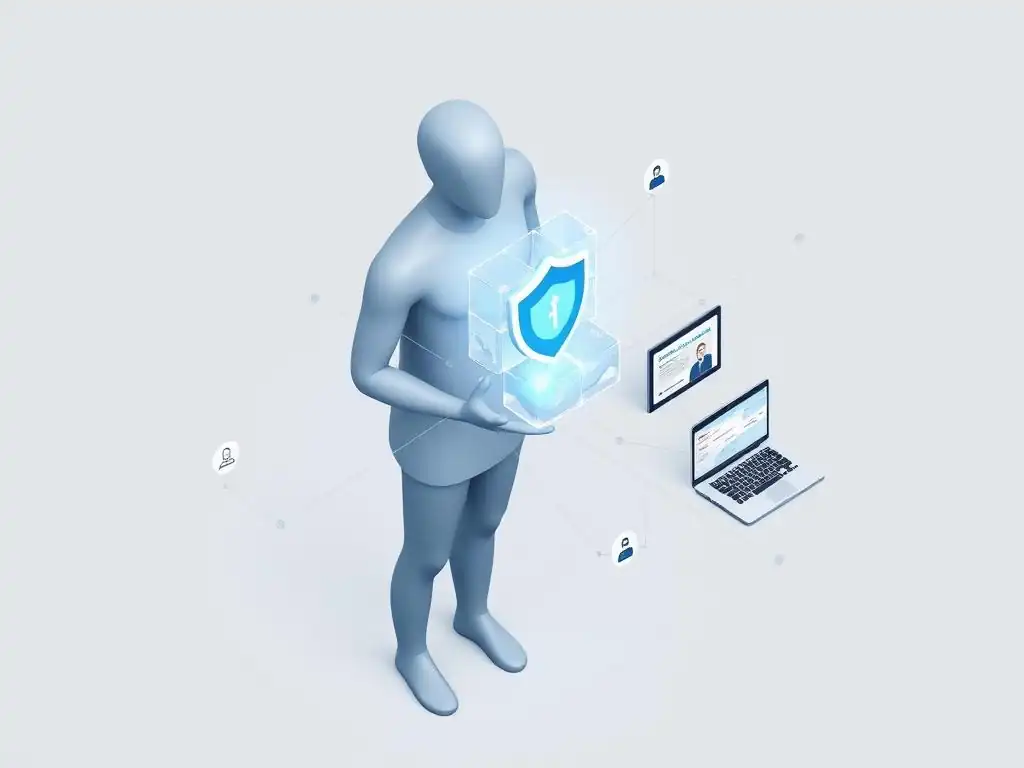
Healthcare: Patient-Controlled Medical Records
In healthcare, Verifiable Credentials can empower patients with unprecedented blockchain data ownership control over their medical records. Hospitals, clinics, and labs can issue VCs for specific health events, diagnoses, test results, or vaccination records. Instead of records being fragmented across different provider systems, the patient holds these VCs in their digital health wallet.
When visiting a new specialist, the patient can choose to share only the relevant VCs (e.g., recent lab results or a specific diagnosis) rather than granting access to their entire medical history. This granular control protects patient privacy and ensures that healthcare providers only access the information necessary for treatment. Early pilots, such as those exploring digital vaccination credentials, have demonstrated the feasibility and user preference for this model, highlighting the practical application of blockchain data ownership control in a highly sensitive domain.
Education: Verifiable Diplomas and Transcripts
The education sector is an early adopter of Verifiable Credentials to combat fraud and streamline verification. Universities and colleges can issue VCs for diplomas, degrees, and academic transcripts directly to graduates. The graduate stores these VCs and can share them with potential employers or other educational institutions instantly.
Employers or admissions offices can verify the authenticity of these credentials cryptographically in seconds, without needing to contact the issuing institution directly or rely on potentially slow and costly third-party verification services. This not only makes the process more efficient but also gives graduates immutable, verifiable proof of their achievements that they control, embodying blockchain data ownership control over their academic history. Initiatives like the European Digital Credentials for Learning are advancing this concept on a large scale, aiming to issue millions of digital credentials.
Supply Chain: Tracking Product Provenance
While not directly about personal data ownership, Verifiable Credentials can be applied to supply chains to provide verifiable claims about products, enhancing transparency and trust. Manufacturers, suppliers, and distributors can issue VCs attesting to a product's origin, components, certifications (e.g., organic, fair trade), or handling history.
Consumers or businesses down the chain can verify these claims by checking the VCs associated with a product, often linked via a QR code. This provides verifiable proof of provenance and quality directly to the end-user, bypassing intermediaries and increasing trust in the supply chain. While not centered on personal data, this use case illustrates the power of VCs to provide verifiable claims about anything, building a foundation of trust that can be extended to identity and blockchain data ownership control.
Finance: Streamlining KYC/AML Compliance
Financial institutions face significant regulatory burdens for Know Your Customer (KYC) and Anti-Money Laundering (AML) compliance, which often involves collecting and verifying large amounts of customer data. Verifiable Credentials offer a way to streamline this process while improving user privacy and blockchain data ownership control.
Users could obtain a verified identity credential from a trusted identity provider (potentially a government or specialized service). They could then present this credential to multiple financial institutions for KYC/AML purposes. The institution verifies the credential cryptographically and might receive only the specific proofs required (e.g., name, address, date of birth confirmed), reducing the need to handle and store copies of sensitive documents like passports or utility bills.
This reduces the financial institution's data liability while giving the user more control over how their identity is verified, a practical application of blockchain data ownership control in a highly regulated industry. Pilot programs exploring this approach estimate significant reductions in onboarding time and cost.
Challenges and Considerations
Scalability and Performance
Implementing Verifiable Credentials systems on a large scale, especially those leveraging blockchain for anchoring, faces challenges related to scalability and performance. Public blockchains, while offering decentralization and immutability, can sometimes struggle with high transaction volumes and latency, potentially impacting the speed at which DIDs or credential status can be resolved or updated.
While not every credential issuance or verification needs to be recorded on a blockchain, the anchoring of DIDs and revocation registries requires a robust underlying network. Solutions like layer 2 scaling, permissioned blockchains designed for identity use cases, or alternative decentralized ledger technologies are being explored to address these performance bottlenecks and ensure that systems enabling blockchain data ownership control can handle mass adoption. The technology needs to be performant enough to support millions or billions of users and credentials.
Interoperability
For Verifiable Credentials to achieve widespread adoption and truly empower users with blockchain data ownership control, interoperability is paramount. Credentials issued by one entity must be verifiable by any other entity, regardless of the specific software wallet, blockchain, or identity platform used. The W3C standards provide a foundation, but ensuring seamless interaction between diverse implementations remains an ongoing challenge.
Efforts are underway through various industry alliances and open-source projects to develop common profiles, best practices, and testing frameworks to ensure interoperability. Achieving true interoperability requires cooperation between technology providers, identity issuers, and verifiers across different sectors and jurisdictions. Without it, the vision of a portable, user-controlled digital identity ecosystem with effective blockchain data ownership control cannot be fully realized.
Regulatory and Legal Frameworks
The emergence of Verifiable Credentials and decentralized identity models introduces complexities for existing regulatory and legal frameworks. Laws governing data privacy (like GDPR and CCPA), digital signatures, and identity verification were often designed with centralized or federated systems in mind. Adapting these frameworks to accommodate user-controlled, cryptographically verifiable credentials and decentralized identifiers is necessary.
Questions arise regarding legal liability for Issuers, Holders, and Verifiers in a decentralized system, the legal status of a VC compared to a physical document, and how to handle issues like identity recovery or legal challenges to credentials. Regulatory clarity and supportive legal frameworks are essential to foster trust and accelerate the adoption of systems enabling blockchain data ownership control. Government initiatives, such as the European Union's work on a digital identity wallet framework, are beginning to address these challenges.
User Adoption and Education
Despite the compelling benefits of Verifiable Credentials and blockchain data ownership control, widespread user adoption requires significant effort in education and user experience design. The concepts of decentralized identifiers, cryptographic wallets, and managing one's own credentials can be complex for the average user accustomed to simple username/password logins.
Digital wallet applications need to be intuitive, secure, and easily accessible. Users need to understand why this model is better for them, particularly regarding privacy and control, and trust the applications they use to manage their credentials. Overcoming the inertia of existing systems and building user confidence through clear communication and seamless user interfaces are critical factors for the successful implementation of systems that provide true blockchain data ownership control. Industry estimates suggest that consumer awareness and trust are key hurdles that require significant investment in user-friendly applications and public education campaigns.
The Future of Data Ownership and Verifiable Credentials
Emerging Trends: Decentralized Identifiers (DIDs), Zero-Knowledge Proofs
The field of Verifiable Credentials and decentralized identity is continuously evolving, driven by emerging technologies and standards. Decentralized Identifiers (DIDs), as defined by the W3C, are foundational to SSI and blockchain data ownership control. They provide a persistent, globally unique identifier managed by the individual, often anchored on a blockchain or decentralized ledger, enabling secure and private communication and interaction without relying on centralized authorities.
Another critical emerging trend is the integration of Zero-Knowledge Proofs (ZKPs) with VCs. ZKPs are cryptographic techniques that allow one party (the prover) to prove to another party (the verifier) that a statement is true, without revealing any information beyond the validity of the statement itself. For example, a user could prove they are over 18 based on a VC from a government, without revealing their exact date of birth. ZKPs significantly enhance privacy and selective disclosure capabilities within the VC framework, further strengthening blockchain data ownership control by minimizing data leakage during verification.
The Potential to Revolutionize Data Governance
The widespread adoption of Verifiable Credentials and Self-Sovereign Identity has the potential to fundamentally revolutionize data governance. By shifting control of verified data from centralized custodians to the individual user, this model aligns data control with data ownership. It moves away from a world where organizations collect and manage vast amounts of user data (and the associated risks and liabilities) towards a model where organizations issue verified attestations, and users manage and share these attestations under their own terms.
This paradigm shift can lead to more responsible data handling practices, reduced incentives for mass data collection, and greater compliance with privacy regulations. It allows for a future where individuals can truly exercise their rights regarding their data, knowing who has verified what information about them and having the power to present or withhold that information. This transformation is central to achieving meaningful and effective blockchain data ownership control on a global scale.
Predictions for the Growth of Self-Sovereign Identity
Industry analysts predict significant growth in the adoption of Self-Sovereign Identity solutions leveraging Verifiable Credentials and blockchain. Factors driving this growth include increasing concerns over data privacy, the need for more efficient digital identity verification, and regulatory pushes towards user-centric data control. While mass consumer adoption is still in early stages, enterprise and government use cases are gaining traction.
Some market reports project the decentralized identity market, closely linked to SSI and VCs, to grow from hundreds of millions of dollars today to several billion dollars within the next five to seven years. Key sectors expected to drive this growth include finance (for KYC/AML), healthcare (for patient data access), education (for credential verification), and government (for digital ID). This projected growth underscores the increasing recognition of the value and necessity of empowering users with blockchain data ownership control in the digital economy.
Conclusion: Empowering Users with Data Ownership Control
The Transformative Power of VCs
Verifiable Credentials represent a transformative technology that promises to reshape how we manage and share identity and data in the digital world. By enabling the issuance of cryptographically secure, tamper-evident, and privacy-preserving digital claims, VCs shift control away from centralized entities and into the hands of the individual user, fulfilling the promise of blockchain data ownership control. This model allows users to own, control, and selectively share their verified information, enhancing privacy, security, and convenience across a multitude of applications.
When combined with the decentralized trust and immutability offered by blockchain technology, VCs form the foundation for Self-Sovereign Identity systems. These systems enable individuals to manage their digital identities and credentials independently, free from reliance on single points of control or failure. The potential benefits are far-reaching, from streamlining complex processes like identity verification and regulatory compliance to fundamentally altering the power dynamics between individuals and organizations regarding personal data.
The Importance of Continued Innovation and Collaboration
Realizing the full potential of Verifiable Credentials and achieving widespread blockchain data ownership control requires continued innovation and broad collaboration. Ongoing technical development is needed to enhance the scalability, interoperability, and user-friendliness of VC and SSI platforms, integrating emerging technologies like DIDs and Zero-Knowledge Proofs seamlessly.
Equally important is collaboration across industries, governments, and standards bodies to ensure interoperability between different systems and to develop supportive regulatory and legal frameworks. Educating users about the benefits and mechanics of this new model is also crucial for driving adoption. By working together, the ecosystem can build a more secure, private, and user-centric digital future where individuals truly have control over their identity and data, powered by the principles of blockchain data ownership control.
Frequently Asked Questions
How do verifiable credentials relate to blockchain data ownership control?
Verifiable credentials allow users to claim ownership and control access to their data stored on a blockchain or related systems. They act as a digital passport for information.
Why is blockchain data ownership control important for individuals?
It gives individuals autonomy over their personal data, preventing unauthorized access and usage. This is crucial for privacy and security in the digital age.
What are some practical applications of verifiable credentials in achieving blockchain data ownership control?
They can be used for self-sovereign identity, enabling users to prove their identity without relying on centralized authorities. This also allows for granular control over data sharing.
How does blockchain technology contribute to the security and verifiability of verifiable credentials?
Blockchain provides a tamper-proof and auditable ledger for recording credential issuance and verification. This ensures the integrity and authenticity of the data.
What are the potential challenges in implementing widespread blockchain data ownership control with verifiable credentials?
Challenges include scalability issues, interoperability between different blockchain systems, and the need for user-friendly interfaces for managing credentials.
Final Reflection: Reclaiming Digital Sovereignty
The journey through verifiable credentials and data ownership underscores a critical truth: the future of the internet hinges on empowering individuals with control over their digital identities. The current landscape, often characterized by centralized data silos and opaque algorithms, necessitates a paradigm shift towards user-centric models. Verifiable credentials, underpinned by blockchain technology, offer a tangible pathway to achieving this, fostering trust and transparency in online interactions.
This movement towards blockchain data ownership control is not merely a technological advancement; it's a cultural revolution. It's about reclaiming our digital sovereignty, demanding agency over our personal information, and building a more equitable and trustworthy online ecosystem. Information is power. But like all power, there are those who want to keep it for themselves.
- Aaron Swartz. This quote resonates deeply with the core principles of verifiable credentials, highlighting the urgent need to democratize access to and control over personal data.
As we stand on the cusp of this transformative era, I invite you to reflect on your own digital footprint. Consider the data you generate, the platforms you entrust with your information, and the power you implicitly cede. Let us collectively champion solutions like verifiable credentials, advocating for a future where individuals are not merely data points, but empowered participants in the digital landscape, actively shaping their online identities and controlling their digital destinies.
Seize Your Data Destiny: Unlock Verifiable Credentials!
Thank you for exploring the world of verifiable credentials and data ownership. We hope this article has helped you understand how to regain control over your personal information. Now, it's time to take action.
Start by exploring digital wallets that support verifiable credentials from trusted providers. This is your first step toward owning your data. As you learn more, share how verifiable credentials can improve security in your everyday transactions with friends and colleagues.
You might also consider attending webinars or workshops related to blockchain technology to deepen your understanding of self-sovereign identity.
Is there a particular area where you'd like to see verifiable credentials implemented to give you more control over your data? Share your thoughts in the comments below!
Leave a Reply