
SelfSovereign Identity: Empowering Individuals with Blockchain and Verifiable Credentials


Welcome to Blockchain Trends, your compass in the rapidly evolving world of decentralized technology. Beyond the hype, blockchain is reshaping industries and empowering individuals in profound ways. Intrigued by the potential of truly owning your digital identity? This article dives deep into blockchain selfsovereign identity solutions, exploring how verifiable credentials and decentralized identifiers (DIDs) are poised to revolutionize how we interact online. Discover how this paradigm shift could put you back in control of your personal data and unlock a future where digital interactions are more secure, transparent, and private. Ready to take control?
Self-Sovereign Identity: Empowering Individuals with Blockchain and Verifiable Credentials
- Understanding Self-Sovereign Identity (SSI) and Its Importance
- Blockchain Technology as the Foundation for SSI
- Verifiable Credentials: The Building Blocks of Self-Sovereign Identity
- Blockchain Self-Sovereign Identity Solutions: Exploring Practical Applications
- Key Components of a Blockchain SSI Ecosystem
- Implementing Blockchain Self-Sovereign Identity Solutions: Challenges and Considerations
- The Future of Self-Sovereign Identity: Trends and Predictions
- Case Study: British Columbia's Digital Identity and Trust Framework
- Conclusion: Empowering Individuals with Blockchain Self-Sovereign Identity Solutions.
-
Frequently Asked Questions
- What is Self-Sovereign Identity (SSI) and how does blockchain play a role?
- How do verifiable credentials work within a blockchain-based SSI system?
- What are some potential applications of blockchain self-sovereign identity solutions beyond personal identification?
- What are the key regulatory considerations surrounding the implementation of blockchain SSI solutions?
- What is the future outlook for blockchain self-sovereign identity, and what are some of the challenges?
- Final Reflection: Reclaiming Digital Identity
- Unlock Your Digital Freedom: Embrace Self-Sovereign Identity!
Understanding Self-Sovereign Identity (SSI) and Its Importance
Defining Self-Sovereign Identity: A New Paradigm for Digital Identity
Self-Sovereign Identity (SSI) represents a fundamental shift in how digital identity is managed, moving control away from centralized authorities and placing it firmly in the hands of the individual. At its core, SSI is based on the principle that individuals should own and control their digital identities, deciding who they share their data with and under what conditions.
This contrasts sharply with traditional models where identity information is fragmented across numerous databases held by governments, corporations, and online services, often without the individual's direct control or even awareness of how their data is being used. SSI leverages decentralized technologies, primarily blockchain and verifiable credentials, to create a system where claims about an individual's identity (like age, education, or employment) can be issued, stored, and verified in a secure, privacy-preserving, and user-controlled manner.
This new paradigm empowers individuals by giving them agency over their personal data. Instead of relying on a single entity to verify their identity, individuals can collect verifiable credentials issued by various trusted sources (e.g., a university issuing a diploma, a bank issuing proof of address, a government issuing a driver's license). These credentials are cryptographically signed and stored securely, typically in a digital wallet controlled by the user.
When proof of identity or a specific attribute is needed, the user can selectively share only the necessary credential, minimizing the exposure of sensitive personal information. This granular control is a cornerstone of SSI and a significant departure from the all-or-nothing approach often required by traditional identity systems.
The Limitations of Traditional Identity Management Systems
Traditional identity management systems suffer from several significant limitations that SSI aims to address. One major issue is the inherent centralization of data. Large databases holding vast amounts of personal information are attractive targets for cybercriminals. High-profile data breaches are commonplace, with incidents like the Equifax breach in 2017 exposing sensitive data of approximately 147 million consumers, or the Marriott data breach impacting over 500 million guests. These breaches highlight the vulnerability of centralized systems and the devastating consequences for individuals whose identities are compromised, including financial loss and identity theft.
Furthermore, traditional systems often lead to poor user experience and lack of interoperability. Individuals frequently have to create and manage dozens, if not hundreds, of separate digital identities (usernames and passwords) for different online services. This fragmentation is inconvenient and poses security risks due to password reuse.
Verifying identity across different services or jurisdictions is often a cumbersome, manual process involving physical documents. The lack of a universally accepted, secure, and user-centric digital identity framework hinders seamless online interactions and can exclude individuals who lack traditional forms of identification, estimated to be around 1 billion people globally according to the World Bank.
Why Self-Sovereign Identity Matters: Benefits for Individuals and Organizations
Self-Sovereign Identity offers substantial benefits for both individuals and organizations, making the development of Blockchain selfsovereign identity solutions increasingly important. For individuals, the primary advantage is enhanced privacy and control over personal data. They can choose exactly which pieces of information to share, reducing their digital footprint and minimizing the risk of oversharing or data exploitation.
SSI also promotes digital inclusion by providing a secure, portable, and universally verifiable identity that is not tied to physical documents or centralized databases, potentially enabling access to services like banking, healthcare, and education for marginalized populations. Users benefit from a streamlined identity verification process, eliminating the need for repetitive form-filling and providing a more secure alternative to passwords.
For organizations, adopting SSI can lead to significant cost reductions and improved efficiency in identity verification and onboarding processes. By relying on cryptographically verifiable credentials presented by the user, organizations can reduce the need for manual checks and mitigate fraud risks.
The decentralized nature of SSI also reduces the burden and liability associated with storing vast amounts of sensitive customer data, lowering the risk of costly data breaches and non-compliance penalties (e.g., GDPR fines can reach up to 4% of global annual revenue). Furthermore, SSI can build greater trust with customers by demonstrating a commitment to their privacy and data protection, fostering stronger relationships and potentially opening new avenues for secure digital interactions.
Blockchain Technology as the Foundation for SSI
How Blockchain Enables Decentralized Identity Management
Blockchain technology provides a robust and tamper-evident infrastructure essential for building decentralized identity management systems like SSI. Unlike traditional databases, a blockchain is a distributed ledger spread across multiple computers or nodes, making it extremely difficult for any single entity to alter records retroactively without the consensus of the network.
This immutability is critical for anchoring identity-related data, such as the public keys associated with Decentralized Identifiers (DIDs) or the hashes of verifiable credentials. By storing this foundational identity information on a blockchain, SSI systems ensure that the core identifiers are globally resolvable and resistant to censorship or single points of failure, which are common vulnerabilities in centralized identity systems.
The decentralized nature of blockchain aligns perfectly with the SSI principle of user control. Instead of a central authority managing identity records, the blockchain acts as a public, shared infrastructure that anyone can interact with according to defined protocols. This prevents any single company or government from having exclusive control over an individual's identity information.
While sensitive personal data itself is typically not stored directly on the public blockchain for privacy reasons, the blockchain securely records transactions related to identity, such as the issuance, revocation, or updates of DIDs. This provides a verifiable and auditable history of identity events without compromising the privacy of the individual's attributes.
The Role of Distributed Ledger Technology (DLT) in SSI
Distributed Ledger Technology (DLT), of which blockchain is a prominent type, plays a foundational role in enabling Self-Sovereign Identity by providing a secure, shared, and synchronized database across a network. For SSI, DLT is often used to manage the public keys and associated metadata for Decentralized Identifiers (DIDs). When a user creates a DID, the cryptographic link between the DID (a unique identifier like did:example:123456789abcdefghi) and their public key is typically recorded on a DLT. This allows anyone who needs to verify a credential issued by this DID to look up the corresponding public key on the ledger and cryptographically verify the signature on the credential.
The distributed nature of DLT ensures high availability and resilience. There is no single server that can be taken down, preventing denial-of-service attacks from disrupting identity verification processes. Furthermore, the cryptographic principles underlying DLT, such as hashing and digital signatures, provide integrity guarantees.
Once an entry (like a DID and its associated public key) is added to the ledger, it is extremely difficult to alter, ensuring that the foundational layer of the SSI system is trustworthy. Different DLTs can be used for SSI, including public blockchains like Bitcoin or Ethereum (though often with scaling layers or specific identity-focused sidechains), or permissioned ledgers depending on the specific requirements of the Blockchain selfsovereign identity solutions being implemented.
Enhancing Security and Privacy with Blockchain-Based Identity
Blockchain technology significantly enhances both security and privacy within SSI frameworks compared to traditional methods. Security is improved through cryptographic guarantees. Verifiable Credentials (VCs) are digitally signed by the issuer using their private key, and this signature can be verified by anyone using the issuer's public key, which is often anchored or resolvable via a DID on a blockchain.
This process ensures the integrity and authenticity of the credential – a verifier can be certain that the credential was issued by the claimed party and has not been tampered with. The decentralized anchor on the blockchain prevents malicious actors from easily forging or revoking identifiers.
Privacy is enhanced because sensitive personal data does not need to be stored on the blockchain itself. Instead, the data resides securely in the user's digital wallet. The blockchain primarily stores public information necessary for verification, such as DID documents containing public keys.
When presenting a credential, the user only shares the specific attributes required, often using privacy-preserving techniques like Zero-Knowledge Proofs (ZKPs). For example, instead of revealing their date of birth to prove they are over 18, a user could present a ZKP that cryptographically proves the statement "my date of birth indicates I am over 18" without revealing the actual date. This selective disclosure, enabled by the SSI architecture underpinned by blockchain, minimizes the exposure of personal information far beyond what is possible with centralized identity systems.
Verifiable Credentials: The Building Blocks of Self-Sovereign Identity
What are Verifiable Credentials (VCs)? A Detailed Explanation
Verifiable Credentials (VCs) are digital equivalents of physical credentials, such as a driver's license, diploma, or membership card. They are cryptographically signed data structures that represent claims made by an issuer about a holder.
A VC contains three main components: the issuer (the entity making the claim, e.g., a university), the holder (the individual the claim is about, e.g., a student), and the claims themselves (e.g., "John Doe graduated with a Bachelor of Science on May 15, 2023"). The defining characteristic of a VC is that it is verifiable – meaning a third party (the verifier) can cryptographically check that the credential was genuinely issued by the stated issuer and has not been tampered with.
VCs are designed to be machine-readable and interoperable, allowing them to be easily shared and verified across different systems and platforms. They are typically issued in a structured format, such as JSON-LD, and include metadata about the credential, such as its expiration date or revocation status.
The cryptographic signature binds the claims to the issuer and the holder's identifier (often a DID). This technical framework ensures that the credential is trustworthy and its provenance can be traced back to the issuing authority, providing a digital equivalent of the trust placed in physical documents but with enhanced security and privacy features.
The W3C Standard for Verifiable Credentials
The development and adoption of Verifiable Credentials have been significantly driven by the World Wide Web Consortium (W3C), which published the Verifiable Credentials Data Model 1.0 specification in 2019. This standard provides a common framework and data model for creating, exchanging, and verifying VCs across the web. The W3C standard defines the core components of a VC, including the structure of claims, the use of digital signatures, and mechanisms for referencing identifiers like DIDs. Adherence to this standard is crucial for ensuring interoperability between different SSI platforms and applications being built as Blockchain selfsovereign identity solutions.
The W3C standard also addresses important considerations like proof types (how the credential is signed, e.g., using linked data proofs) and revocation mechanisms (how an issuer can invalidate a previously issued credential). By providing a universally agreed-upon technical specification, the W3C has laid the groundwork for a global ecosystem of verifiable credentials. This standardization allows organizations and developers to build compatible SSI solutions, fostering wider adoption and enabling individuals to use their credentials seamlessly across various contexts, from proving their age online to accessing healthcare services or verifying their professional qualifications.
Issuance, Storage, and Verification of VCs within SSI Ecosystems
The lifecycle of a Verifiable Credential within a Blockchain selfsovereign identity ecosystem typically involves three key phases: issuance, storage, and verification. Issuance begins when a trusted entity (the issuer), such as a university, government agency, or employer, digitally signs a claim about an individual (the holder).
This signed credential is then typically sent to the holder, often via a secure channel, to be stored in their digital wallet. The issuer might also anchor a hash of the credential or a related identifier (like the holder's DID) on a blockchain or DLT, or publish revocation information, without putting the full credential data on the ledger.
Storage is managed by the individual holder, usually within a secure digital wallet application on their smartphone or computer. This wallet is under the user's sole control, typically protected by biometric authentication or strong passwords. The wallet stores the private keys associated with the user's DIDs and the Verifiable Credentials issued to them. The user can manage their credentials, review their details, and decide when and with whom to share them. Unlike traditional systems where credentials might be stored in centralized databases, the SSI model keeps the data decentralized and user-controlled.
Verification occurs when a third party (the verifier), such as a website, service provider, or another individual, needs proof of a specific claim. The holder presents the relevant VC from their wallet to the verifier. The verifier then uses the information within the VC, including the issuer's DID and the cryptographic signature, to verify its authenticity.
This verification process often involves looking up the issuer's public key via their DID (potentially resolved on a blockchain) and checking the signature on the credential. The verifier can also check the revocation status of the credential. This process is typically automated and happens instantly, providing a secure and efficient way to trust digital claims.
Blockchain Self-Sovereign Identity Solutions: Exploring Practical Applications
Use Cases in Healthcare: Secure and Patient-Controlled Medical Records
One compelling application of Blockchain selfsovereign identity solutions is in healthcare, enabling secure and patient-controlled access to medical records. Currently, patient data is often fragmented across different hospitals, clinics, and specialists, leading to inefficiencies, duplicated tests, and difficulty for patients in accessing their own comprehensive history. Using SSI, a patient could have a digital wallet containing Verifiable Credentials representing their health data – vaccination records issued by a clinic, lab results from a testing facility, or a list of allergies from their doctor.
With SSI, the patient holds the private keys to their medical identity and controls access to these VCs. They can grant a new doctor access to specific records for a limited time, without needing to request transfers between institutions or worry about their entire medical history residing in multiple vulnerable databases.
This not only enhances patient privacy and autonomy but also improves care coordination. Approximations suggest that inefficient health data management contributes significantly to healthcare costs; secure, interoperable SSI solutions could potentially reduce administrative overhead and improve patient outcomes by ensuring doctors have access to the most relevant, up-to-date information when needed, potentially saving billions annually in administrative and care costs across large health systems.
Applications in Education: Verifiable Diplomas and Credentials on the Blockchain
Education is another sector ripe for disruption by Blockchain selfsovereign identity solutions, particularly for issuing and verifying academic credentials. Issuing physical diplomas and transcripts is costly and susceptible to fraud. Verifying these credentials globally is often a slow, manual process involving contacting institutions. With SSI, universities can issue Verifiable Credentials representing degrees, course completions, or professional certifications directly to students' digital wallets.
A student holding a VC of their degree can instantly and securely share it with a prospective employer or another educational institution. The verifier can cryptographically confirm that the credential was issued by the stated university and has not been altered, often by referencing the university's DID anchored on a blockchain.
This eliminates the need for intermediaries, reduces administrative burden for institutions (potentially saving universities thousands annually in verification costs), and combats diploma mill fraud, which is estimated to cost the global economy billions of dollars per year. Projects are already underway, with some universities exploring issuing digital diplomas using blockchain and VC technology.
Streamlining Supply Chain Management with Blockchain-Based Identity
Blockchain selfsovereign identity solutions also offer significant potential for streamlining and securing supply chain management. In complex supply chains involving multiple parties – manufacturers, suppliers, logistics providers, regulators, and customers – verifying the identity and authenticity of each participant and product is crucial but challenging. SSI can provide a decentralized framework for managing the identities of organizations, devices (like IoT sensors), and even individual products.
Each entity in the supply chain could have a DID, anchored on a blockchain, allowing others to verify their identity and reputation. Verifiable Credentials could represent various states or attributes: a certificate of origin for raw materials issued by a supplier, a quality inspection report for a manufactured component issued by a testing agency, or a customs clearance document issued by a government authority.
By attaching these VCs to product identifiers (which could also be DIDs), a transparent and verifiable history of a product's journey can be created. This enhances traceability, reduces fraud (like counterfeiting, estimated to cost global businesses hundreds of billions annually), improves compliance, and enables more efficient recall processes, providing significant value across industries from pharmaceuticals to luxury goods.
Enhancing Financial Inclusion through Decentralized Identity Solutions
Financial inclusion remains a global challenge, with a significant portion of the world's population lacking access to basic financial services, often due to the inability to provide traditional forms of identification. Blockchain selfsovereign identity solutions offer a pathway to overcome these barriers by providing a secure, portable, and universally verifiable digital identity. Individuals who lack government-issued IDs or proof of address could accumulate alternative Verifiable Credentials about themselves.
These VCs could be issued by trusted community members, local businesses they interact with, or utility providers confirming their residence. Over time, a mosaic of such VCs could build a credible digital identity profile that financial institutions could potentially trust for onboarding or providing services like microloans or digital wallets. This decentralized approach empowers individuals to build their own verifiable identity history, independent of centralized systems, potentially enabling access to financial services for the estimated 1 billion adults globally who are unbanked, unlocking significant economic potential and improving livelihoods.
Key Components of a Blockchain SSI Ecosystem
Digital Wallets for Secure Credential Storage
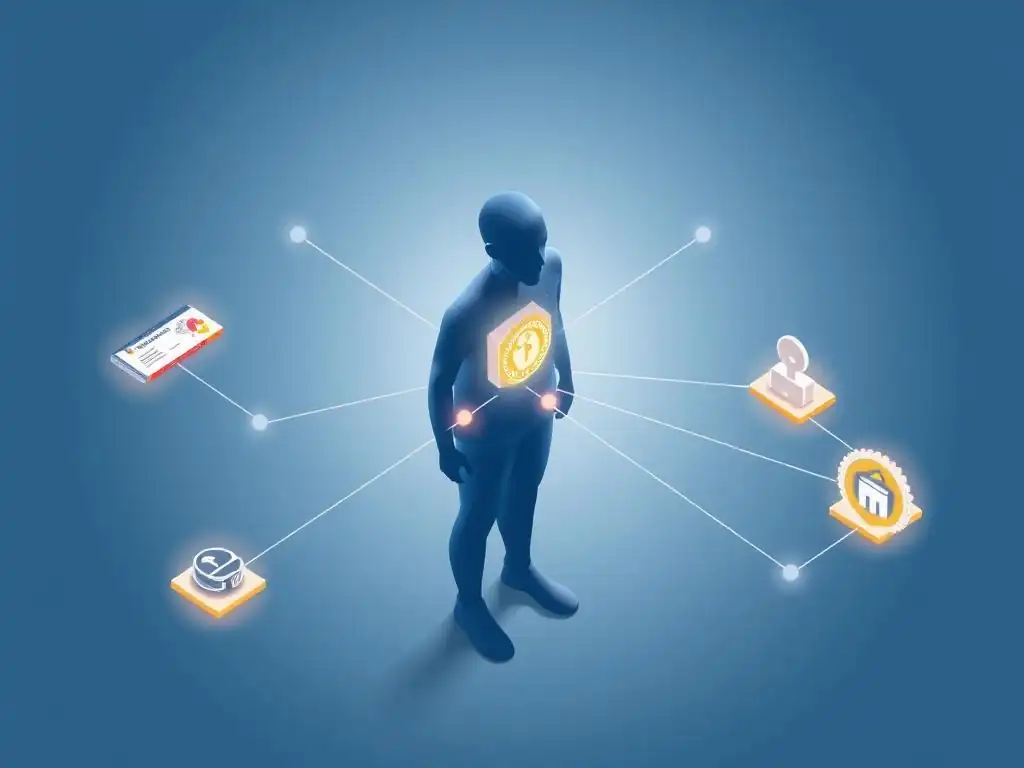
A fundamental component of any Blockchain selfsovereign identity solution is the digital wallet. This is the application or device where the individual holder securely stores their private keys and the Verifiable Credentials issued to them. Much like a physical wallet holds cards and IDs, a digital wallet for SSI holds digital representations of these credentials. The wallet is controlled solely by the user, typically protected by strong encryption and authentication methods like biometrics (fingerprint or facial recognition) or secure PINs.
The wallet's primary function is to provide a secure container for credentials and enable the user to interact with the SSI ecosystem. Users can receive credentials from issuers, review the details of the claims made within them, and selectively present specific credentials or proofs derived from them to verifiers.
The wallet manages the cryptographic operations necessary for SSI, such as generating key pairs for DIDs, storing private keys securely, and facilitating the creation of presentations (messages containing VCs or proofs) to be shared with verifiers. The user interface of the wallet is critical for adoption, needing to be intuitive and clearly communicate what information is being shared and with whom.
Identity Providers (IdPs) and Their Role in the SSI Framework
In the context of Self-Sovereign Identity, the role of Identity Providers (IdPs) shifts from being central authorities that manage and vouch for identities to becoming trusted issuers of Verifiable Credentials. Traditional IdPs, like government identity systems or corporate login services, hold and manage user data directly. In the SSI model, entities that can authoritatively make claims about an individual become issuers. These can be governments issuing proof of citizenship or driver's licenses, universities issuing diplomas, employers issuing proof of employment, or banks issuing proof of address.
These issuers are responsible for verifying the real-world identity or attribute of the individual through their existing processes and then issuing a cryptographically signed Verifiable Credential attesting to that claim. For example, after verifying a student's graduation status through their internal records, a university issues a VC confirming the degree. The issuer uses their private key (associated with their DID, often anchored on a blockchain) to sign the VC, making it verifiable.
While the issuer creates the credential, they typically do not retain a copy; the credential is sent to the holder's wallet. This model transforms IdPs into trusted sources of attestations rather than centralized repositories of personal data.
Decentralized Identifiers (DIDs) and Their Significance
Decentralized Identifiers (DIDs) are a core technical innovation underpinning Self-Sovereign Identity and Blockchain selfsovereign identity solutions. A DID is a new type of identifier designed to enable verifiable, decentralized digital identity. Unlike traditional identifiers (like usernames or email addresses) that are typically managed by a single organization, DIDs are registered on decentralized networks, often blockchains or other DLTs, and are controlled by the individual or entity they identify. A DID is a URI (Uniform Resource Identifier) that typically links to a DID Document.
The DID Document contains public keys, service endpoints (for secure communication), and other metadata associated with the DID holder. This document is often stored on or referenced from a decentralized network, allowing anyone to resolve the DID and retrieve the associated public keys necessary to verify credentials issued by or about that DID holder. DIDs are designed to be persistent, globally unique, and cryptographically verifiable.
They provide a stable anchor for an individual's digital identity that is not tied to any single organization or service, giving the user control over its management and lifecycle. This independence from centralized control is fundamental to the "sovereign" aspect of SSI.
The Importance of Interoperability in SSI Systems
For Self-Sovereign Identity to achieve widespread adoption and realize its full potential, interoperability is paramount. Interoperability in SSI means that Verifiable Credentials issued by one entity using one platform can be securely stored in any compliant digital wallet and verified by any compliant verifier, regardless of the underlying blockchain or specific SSI implementation used. Without interoperability, SSI ecosystems would become fragmented silos, defeating the purpose of creating a portable, user-controlled identity that works across different contexts and services.
Achieving interoperability relies heavily on adherence to open standards, primarily the W3C Verifiable Credentials Data Model and the W3C Decentralized Identifiers (DIDs) specification. These standards provide the common language and framework necessary for different components (issuers, holders' wallets, verifiers, and DLTs) to interact seamlessly.
Efforts are underway by various organizations and alliances (like the Decentralized Identity Foundation - DIF, and the Trust Over IP Foundation - ToIP) to develop and promote these standards and create interoperability profiles, ensuring that different Blockchain selfsovereign identity solutions can work together effectively, allowing individuals to use their digital identity freely across the digital and physical world.
Implementing Blockchain Self-Sovereign Identity Solutions: Challenges and Considerations
Scalability Issues and Potential Solutions for Blockchain SSI
Implementing Blockchain selfsovereign identity solutions at a national or global scale presents significant technical challenges, particularly concerning the scalability of the underlying blockchain or DLT. Public blockchains like Bitcoin or Ethereum, in their base layers, have limited transaction throughput (e.g., Bitcoin handles ~7 transactions per second, Ethereum ~15-30, though this is changing with upgrades). While SSI transactions primarily involve anchoring DIDs or revocation information, a system supporting millions or billions of users issuing and updating DIDs could overwhelm these networks.
Potential solutions involve utilizing more scalable DLTs specifically designed for identity (like Hyperledger Indy or Sovrin), employing Layer 2 scaling solutions (like state channels or rollups) on public blockchains, or using purpose-built decentralized identity networks optimized for high transaction volume and low cost. Another approach is to minimize the data written directly to the main chain, perhaps only anchoring cryptographic proofs or hashes, while managing DID documents and revocation status off-chain on more scalable decentralized storage systems, linked securely back to the blockchain anchor.
Research and development in this area are crucial for making Blockchain selfsovereign identity solutions viable for mass adoption.
Addressing Privacy Concerns and Data Protection Regulations (e.g., GDPR)
While SSI is designed to enhance privacy compared to traditional systems, implementing Blockchain selfsovereign identity solutions still requires careful consideration of privacy concerns and compliance with data protection regulations like the General Data Protection Regulation (GDPR) in Europe or the California Consumer Privacy Act (CCPA). A key challenge is ensuring that the use of blockchain, which is often immutable and public, does not inadvertently expose personal data or violate principles like the right to erasure.
Implementations must ensure that sensitive personal data is never stored directly on public, immutable ledgers. Instead, only non-sensitive data, like public keys or cryptographic hashes, should be anchored. The actual Verifiable Credentials containing personal attributes must reside securely in the user's wallet.
Furthermore, SSI systems must incorporate mechanisms for handling data subject rights, such as the right to access, rectify, or erase personal data, even though the data is decentralized. This requires designing systems where users can manage their DIDs (e.g., rotating keys, potentially deactivating DIDs) and securely delete credentials from their wallets. Compliance with regulations like GDPR requires careful architectural design to ensure data minimization, purpose limitation, and user consent are respected throughout the SSI lifecycle.
The Importance of User Experience (UX) in SSI Adoption
Despite the technical elegance of Blockchain selfsovereign identity solutions, user experience (UX) is a critical factor determining their adoption rate. Current digital identity processes, while flawed, are often familiar to users (e.g., logging in with username/password, showing a physical ID). SSI introduces new concepts like DIDs, Verifiable Credentials, and digital wallets, which can seem complex to the average user. A clunky or confusing user interface for managing credentials, connecting with issuers, or presenting proofs will hinder adoption, regardless of the underlying technology's security or privacy benefits.
Designing intuitive and user-friendly digital wallets is paramount. The process of receiving, storing, and sharing credentials must be as simple as using a traditional digital wallet for payments. Clear explanations of what information is being shared and why are essential for building user trust.
Onboarding processes for issuers and verifiers also need to be straightforward. Successful Blockchain selfsovereign identity solutions will require significant investment in UX design, user education, and building trust through reliable and seamless interactions. Without a focus on making SSI easy to use, it will struggle to compete with established, albeit less secure and private, identity systems.
Overcoming the Technical Complexity of Blockchain-Based Identity Systems
The underlying technology of Blockchain selfsovereign identity solutions, involving blockchain, DLT, cryptography, W3C standards for DIDs and VCs, and potentially zero-knowledge proofs, is technically complex. This complexity can be a barrier to development, deployment, and integration for organizations. Building and maintaining these systems requires specialized expertise in cryptography, distributed systems, and identity protocols. Integrating SSI capabilities into existing enterprise systems or consumer applications adds another layer of complexity.
Overcoming this requires developing robust, well-documented, and easy-to-use software development kits (SDKs) and APIs that abstract away the underlying technical complexities for developers. Open-source frameworks and reference implementations can accelerate development and promote standardization. Furthermore, educational initiatives are needed to train developers and IT professionals on the principles and implementation details of SSI. As the technology matures and development tools improve, the technical barrier to entry for building and deploying Blockchain selfsovereign identity solutions is expected to decrease, facilitating broader adoption across various sectors.
The Future of Self-Sovereign Identity: Trends and Predictions
The Convergence of SSI with Other Emerging Technologies (e.g., AI, IoT)
The future of Self-Sovereign Identity is likely to involve increasing convergence with other emerging technologies, creating more sophisticated and automated identity-aware systems. The Internet of Things (IoT), for example, can benefit immensely from SSI. Devices could possess DIDs and VCs proving their authenticity, ownership, and operational status, enabling secure communication and verifiable data exchange in smart homes, industrial settings, or supply chains. This is particularly relevant for proving the origin and integrity of data generated by devices.
Artificial Intelligence (AI) could also play a role, potentially assisting users in managing their credentials, automatically identifying which credentials are needed for a specific service, or even helping verify the integrity of credentials presented by others. However, the convergence must be handled carefully to maintain user privacy and control. AI systems interacting with SSI must respect the user's consent and data sharing preferences embedded within the SSI framework. This intersection promises more intelligent, secure, and privacy-preserving interactions between individuals, devices, and services, further expanding the potential applications of Blockchain selfsovereign identity solutions.
The Growing Importance of SSI in the Metaverse and Web3
As concepts like the Metaverse and Web3 gain traction, Self-Sovereign Identity is becoming increasingly recognized as a foundational requirement. In decentralized virtual worlds and next-generation internet applications, users need a persistent, portable, and trustworthy identity that is not tied to a single platform or corporate entity. SSI provides the framework for individuals to own and control their digital presence, reputation, and assets across disparate virtual environments.
In the Metaverse, a user could carry VCs representing their real-world identity attributes, digital assets (like NFTs), achievements, or reputation scores, and selectively reveal these to interact with others or access services. For example, a user could prove their age to enter a virtual venue, prove ownership of a digital asset to trade it, or present a VC of a professional certification to participate in a virtual work meeting – all without relying on a centralized platform to manage their identity.
SSI, powered by Blockchain selfsovereign identity solutions, is seen as key to ensuring user agency, privacy, and interoperability in the decentralized digital spaces of the future.
Regulatory Landscape and the Future of Digital Identity Governance
The regulatory landscape for digital identity is evolving rapidly, influenced by developments in technology like SSI and increasing concerns around privacy and data protection. Governments and international bodies are exploring frameworks that can support secure, trusted, and interoperable digital identities. Some jurisdictions are actively investigating or piloting Blockchain selfsovereign identity solutions for government services, recognizing the potential for increased security, efficiency, and citizen control.
Future digital identity governance is likely to involve a blend of technological standards (like W3C DIDs and VCs), legal frameworks (like updated data protection laws), and policy initiatives aimed at fostering trust and interoperability. There will be ongoing debates about the role of governments as issuers of foundational identity credentials within an SSI framework and how to ensure accountability and redress. The success of SSI will partly depend on favorable regulatory environments that recognize and support decentralized, user-centric identity models, paving the way for widespread adoption of robust Blockchain selfsovereign identity solutions in both public and private sectors.
Case Study: British Columbia's Digital Identity and Trust Framework
Context and Background of the Case Study
British Columbia, a province in Canada, has been a notable early adopter exploring Self-Sovereign Identity principles for its citizens. Recognizing the limitations of traditional identity verification processes for accessing government services and the need to enhance privacy and security for its residents, the province embarked on developing a digital identity and trust framework.
The goal was to create a system where individuals could securely prove who they are online without relying on vulnerable, centralized databases or repeatedly providing sensitive personal information to different government departments. This initiative aimed to improve the efficiency and accessibility of digital government services while giving citizens more control over their data.
The province's approach was influenced by global efforts towards decentralized identity and the potential of technologies like blockchain and verifiable credentials. They sought to build a system that aligned with SSI principles, allowing citizens to hold and manage their identity attributes and share them selectively with trusted verifiers. This move represented a forward-thinking stance by a government entity to embrace a user-centric model for digital identity, moving away from solely relying on government-issued physical IDs for online interactions and exploring how Blockchain selfsovereign identity solutions could underpin this transformation.
The Solution Implemented Using Blockchain and VCs
British Columbia's solution, known as the BC Services Card Digital Identity, leverages a trust framework that incorporates elements of Self-Sovereign Identity, utilizing Verifiable Credentials and a distributed ledger component. While not a purely public blockchain implementation, it uses DLT principles and W3C standards for DIDs and VCs to enable verifiable digital interactions. Citizens can obtain a digital representation of their BC Services Card, which acts as a foundational government-issued credential.
Within this framework, the government acts as a trusted issuer of VCs representing various attributes of the citizen (e.g., proof of identity, proof of residency). These credentials are issued to the citizen's secure digital wallet application.
When a citizen needs to access a government service online (acting as the verifier), they can use their wallet to present the necessary VC or a proof derived from it. The verifier system can then cryptographically verify the credential against the issuer's (government's) public keys, which are managed within the province's trust framework, ensuring the authenticity and integrity of the shared information without the verifier needing to connect to a central government database holding all citizen data.
Results and Impact of the Blockchain Self-Sovereign Identity Implementation
While precise public data on transaction volumes or specific cost savings are often proprietary or part of ongoing evaluations, the impact of British Columbia's digital identity framework, which incorporates SSI principles and components of Blockchain selfsovereign identity solutions, has been significant in establishing a precedent for government adoption of user-centric digital identity. The BC Services Card Digital Identity has seen considerable uptake, with millions of citizens enrolled, enabling secure access to a growing number of online government services, including health services, tax filing, and student aid applications.
The implementation has demonstrated that a government can successfully transition towards a more decentralized identity model that enhances privacy and security for citizens while improving the efficiency of service delivery. By allowing citizens to control and share their identity information selectively, the system reduces the risk of large-scale data breaches associated with centralized identity databases. It has also paved the way for potential future integrations with other sectors, such as healthcare and education, further expanding the utility of a user-controlled digital identity based on verifiable credentials and distributed ledger technology.
Conclusion: Empowering Individuals with Blockchain Self-Sovereign Identity Solutions.
Self-Sovereign Identity, built upon the robust foundations of blockchain and the flexible architecture of Verifiable Credentials, represents a powerful paradigm shift in how digital identity is perceived and managed. By moving control from centralized authorities to the individual, SSI promises a future where users have unprecedented privacy, security, and agency over their personal data. Blockchain selfsovereign identity solutions enable this by providing the necessary decentralized trust anchor and ensuring the integrity and verifiability of digital claims.
From revolutionizing healthcare data management and streamlining educational credential verification to securing supply chains and fostering financial inclusion, the practical applications of SSI are vast and transformative. While challenges related to scalability, regulatory compliance, user experience, and technical complexity exist, ongoing research, standardization efforts, and pioneering implementations like British Columbia's digital identity framework are actively addressing these hurdles.
As the digital world expands into areas like the Metaverse and Web3, the need for a decentralized, user-controlled identity becomes ever more critical. Blockchain selfsovereign identity solutions are poised to play a pivotal role in empowering individuals and building a more trustworthy and equitable digital future.
Frequently Asked Questions
What is Self-Sovereign Identity (SSI) and how does blockchain play a role?
SSI empowers individuals to control their own digital identities without relying on central authorities. Blockchain provides a decentralized and immutable ledger for storing verifiable credentials, enhancing security and trust. This allows for greater privacy and data ownership.
How do verifiable credentials work within a blockchain-based SSI system?
Verifiable credentials are digital certificates issued by trusted entities and cryptographically signed. These credentials are stored by the individual and can be presented to relying parties for verification. Blockchain ensures the authenticity and integrity of these credentials.
What are some potential applications of blockchain self-sovereign identity solutions beyond personal identification?
Beyond personal identification, SSI can be used in areas like supply chain management (tracking product provenance), healthcare (managing medical records), and education (verifying academic credentials). This increases efficiency and transparency across various sectors.
What are the key regulatory considerations surrounding the implementation of blockchain SSI solutions?
Regulatory considerations include compliance with data privacy laws like GDPR, ensuring interoperability between different SSI systems, and addressing potential liability issues related to credential issuance and verification.
What is the future outlook for blockchain self-sovereign identity, and what are some of the challenges?
The future looks promising, with potential for widespread adoption. However, challenges include scalability of blockchain networks, user education and adoption, and establishing global standards for interoperability.
Final Reflection: Reclaiming Digital Identity
The journey through the world of Blockchain selfsovereign identity solutions reveals more than just technological innovation; it unveils a fundamental shift in power dynamics. In an age where personal data is a commodity, the promise of individuals controlling their own digital identities is not just appealing, it's increasingly vital for a future where privacy and autonomy are not luxuries, but rights.
The impact of self-sovereign identity extends far beyond the technical realm. It touches upon the very fabric of our social and cultural interactions online and offline. The ability to prove who we are, without relying on centralized authorities, has the potential to revolutionize everything from voting and healthcare to education and finance. Identity is not just what you possess, but what you choose to reveal.
This quote underscores the core principle of self-sovereign identity: the power to control our own narrative.
As we stand on the cusp of this digital revolution, let us not merely be passive observers. Consider how you can embrace and advocate for self-sovereign identity solutions in your own life and community. Explore the available technologies, support initiatives that promote digital autonomy, and demand greater transparency and control over your personal data. The future of identity is in our hands; let's build a future where individuals are truly empowered.
Unlock Your Digital Freedom: Embrace Self-Sovereign Identity!
Thank you for exploring the potential of Self-Sovereign Identity (SSI) and its power to put you in control of your data. Now that you understand the fundamentals, let's translate this knowledge into action and begin your journey towards digital independence.
Here are some steps you can take right now:
- Research available SSI solutions and explore platforms that offer verifiable credentials. Empower yourself by understanding the tools available to manage your digital identity.
- Share this article with friends, family, and colleagues who value digital privacy and control. Let's build a movement of informed individuals!
- Think about real-world scenarios where you could use SSI to simplify your life — such as verifying your identity for online banking, accessing healthcare records, or managing loyalty programs.
How will you leverage the power of self-sovereign identity to reclaim your digital life? Share your thoughts and planned actions in the comments below!
Leave a Reply