
DApp Architecture for Decentralized Voting Systems: Secure and Transparent OnChain Voting Mechanisms


Welcome to Blockchain Trends, your guide to understanding the real-world impact of blockchain technology!
Ever wondered how blockchain can revolutionize democratic processes? Dive into our exploration of Onchain voting system architecture and discover how DApp technology is building secure and transparent voting mechanisms. Uncover the intricate details of decentralized applications and their potential to reshape the future of governance. Let's unlock the power of blockchain together!
DApp Architecture for Decentralized Voting Systems: Secure and Transparent OnChain Voting Mechanisms
Decentralized voting systems built on blockchain technology represent a significant shift from traditional methods, promising enhanced security, transparency, and accessibility. This article explores the architecture of such systems, focusing on the components and design principles required for robust and trustworthy onchain voting system architecture.
- Introduction to Decentralized Voting with DApps
- Understanding Onchain Voting System Architecture Fundamentals
- Designing a Secure Onchain Voting System Architecture
- Key Considerations for DApp Voting Architecture
- Onchain Voting System Architecture: Specific Implementation Details
- Case Studies: Examples of Onchain Voting DApp Architectures
- Future Trends in Onchain Voting System Architecture
- Best Practices for Developing a Robust Onchain Voting System
- Conclusion: The Future of Secure and Transparent Onchain Voting
-
Frequently Asked Questions
- What are the core components of an Onchain voting system architecture?
- How does blockchain technology enhance the security of a decentralized voting system?
- What are the main challenges in implementing an Onchain voting system architecture?
- How does Decentralized Finance (DeFi) principles apply to Onchain voting systems?
- What are the regulatory considerations for deploying a Decentralized Voting Application (DApp)?
- Final Reflection: Embracing the Future of Democratic Participation
- Empower Democracy: Build Your Own Voting DApp!
Introduction to Decentralized Voting with DApps
The integrity of voting processes is paramount for democratic systems and organizational governance. Traditional methods often face challenges related to security, transparency, and susceptibility to fraud or manipulation. Decentralized applications (DApps) offer a novel approach to address these issues by leveraging the inherent properties of blockchain technology.
The Need for Secure and Transparent Voting Systems
Public trust in electoral processes is fundamental, yet traditional systems often suffer from perceived or real vulnerabilities. Concerns about vote tampering, lack of auditability, and centralized control points necessitate alternatives that can offer verifiable security and complete transparency. The shift towards digital voting methods, while offering convenience, introduces new risks if not implemented with robust, decentralized safeguards.
For instance, a 2020 report by the Election Assistance Commission (EAC) in the United States highlighted ongoing challenges in election security, including maintaining voter registration data accuracy and securing voting equipment. These issues underscore the critical need for systems that are inherently resistant to manipulation and allow for public verification of the process, which is a core promise of a well-designed onchain voting system architecture.
Exploring the Benefits of DApp-Based Voting Solutions
DApp-based voting solutions offer several advantages over traditional systems. Foremost among these are immutability and transparency, stemming directly from the blockchain's distributed ledger technology. Once a vote is recorded on the blockchain, it is virtually impossible to alter or delete, and the entire voting record is publicly auditable (while potentially preserving voter privacy). This contrasts sharply with centralized databases, which are vulnerable to single points of failure and insider threats.
Furthermore, DApps can automate voting processes through smart contracts, ensuring that rules (like eligibility, voting period, and tallying methods) are enforced programmatically without human intervention after deployment. This reduces the potential for human error or bias. While adoption is still nascent, projects like the Aragon client demonstrated early attempts at decentralized governance and voting within blockchain-based organizations, illustrating the potential for more secure and transparent decision-making processes facilitated by onchain voting system architecture.
Understanding Onchain Voting System Architecture Fundamentals
An effective onchain voting system architecture is built upon a foundation of distributed ledger technology and smart contracts. It requires careful consideration of how voter identity is managed, how votes are cast and recorded, and how the final tally is determined, all while operating on a decentralized network.
Core Components of a Decentralized Voting Application (DApp)
A typical decentralized voting DApp comprises several key components working together on the blockchain. At its heart are the smart contracts, which encapsulate the voting logic, including registration rules, voting parameters (e.g., candidate list, voting weight), and the tallying mechanism. These contracts define the state of the voting process and enforce its rules. The user interface (UI), often a web or mobile application, interacts with these smart contracts via a blockchain node or gateway, allowing users to register and cast their votes.
Underpinning these components is the blockchain itself, which serves as the immutable ledger for recording all transactions related to the vote, from registration confirmations to the final vote casts. This decentralized infrastructure ensures that no single entity controls the voting data, making the onchain voting system architecture inherently more resilient and censorship-resistant than centralized alternatives.
Blockchain Technology for Voting: Ensuring Immutability and Auditability
The choice of blockchain technology is critical for an onchain voting system architecture. Public blockchains like Ethereum or Polygon offer high levels of decentralization and transparency, where every transaction (including vote casting) is visible to anyone. This public nature provides unparalleled auditability; anyone can verify that their vote was counted correctly and that the final tally reflects the recorded votes. The cryptographic nature of blockchain ensures that once a block containing vote data is added to the chain, it cannot be altered without invalidating subsequent blocks, a process that would require immense computational power, rendering vote tampering practically impossible.
Consider a simple example: a smart contract records each valid vote as a transaction on the blockchain, associated with a unique, pseudonymized voter ID. After the voting period ends, the smart contract executes the tallying function by summing up the votes recorded on the chain. This entire process, from vote submission to tallying, is transparently recorded, allowing third parties to independently verify the outcome by analyzing the public ledger data. This level of verifiable immutability is a cornerstone benefit of using blockchain in an onchain voting system architecture.
Designing a Secure Onchain Voting System Architecture
Security is paramount when designing an onchain voting system architecture. Vulnerabilities in smart contracts or identity management can compromise the integrity of the entire voting process. Therefore, robust design principles and careful implementation are essential.
Smart Contract Development for Voting Logic
Developing secure smart contracts is the most critical aspect of building a reliable onchain voting system architecture. The code must accurately reflect the desired voting rules and be free from bugs or exploits that could allow unauthorized voting, vote manipulation, or denial-of-service attacks. Common vulnerabilities in smart contracts, such as reentrancy attacks, integer overflows, or improper access control, could have catastrophic consequences in a voting context.
Best practices include rigorous testing, formal verification of the smart contract code, and following established security patterns. For instance, implementing a "pull" pattern for sending funds (if any are involved, e.g., in token-weighted voting) instead of a "push" pattern can mitigate reentrancy risks. Using established and audited libraries for common functions can also reduce the risk of introducing new bugs. A complex smart contract for an election might involve functions for voter registration, candidate listing, vote submission, and tallying, each requiring careful logic to prevent double-voting or unauthorized participation.
Voter Registration and Authentication Mechanisms on the Blockchain
Ensuring that only eligible voters can participate and that each voter can cast only one vote is a significant challenge in any voting system, including an onchain voting system architecture. Decentralized identity (DID) solutions and verifiable credentials offer promising avenues for voter registration and authentication on the blockchain. Instead of relying on a centralized database of voters, individuals can use self-sovereign identities attested by trusted entities (e.g., government agencies issuing "proof of citizenship" credentials).
A DApp could require users to present a specific verifiable credential linked to their blockchain address to register for an election. The smart contract would verify the validity of the credential without needing to store sensitive personal data on-chain, thus preserving privacy. Authentication during voting could involve cryptographically signing the vote transaction with the private key associated with the registered address. This ensures that the vote originates from a registered identity. While implementing such systems is complex, it moves the onchain voting system architecture closer to enabling secure, authenticated participation without relying on traditional centralized identity verification systems.
Vote Casting and Tallying: Best Practices for Secure Implementation
The process of casting and tallying votes in an onchain voting system architecture must be designed to prevent manipulation and ensure accuracy. Votes are typically submitted as transactions to the smart contract during a specified voting period. To prevent front-running or manipulation based on early vote visibility, techniques like commit-reveal schemes can be employed. In this scheme, voters first submit a cryptographic commitment to their vote (a hash) and later reveal the actual vote. The smart contract verifies that the revealed vote matches the initial commitment.
Tallying is performed by the smart contract after the voting period ends. The contract iterates through the recorded, revealed votes and calculates the totals according to the defined rules. To ensure transparency and auditability, the tallying logic should be simple, verifiable, and executed on-chain.
The final result, once calculated by the smart contract, is recorded immutably on the blockchain. Best practices dictate that the tallying function should be callable only after the voting period has concluded and should ideally be designed to be gas-efficient, especially for large electorates, although this remains a significant challenge for onchain voting system architecture on public blockchains.
Key Considerations for DApp Voting Architecture
Beyond the core components, several critical factors must be addressed when designing and implementing an onchain voting system architecture. These include ensuring the system can handle the required load, protecting against malicious attacks, and making the system accessible and usable for the target electorate.
Scalability Challenges in Onchain Voting Platforms
Scalability is perhaps the most significant hurdle for widely adopting onchain voting system architecture, particularly on public blockchains like Ethereum Mainnet. Current transaction throughput limitations (e.g., Ethereum's capacity of roughly 15-30 transactions per second before Layer 2) and potentially high gas costs make it challenging to handle large-scale elections involving millions of voters. Each vote cast often requires a separate transaction, which can quickly overwhelm the network and become prohibitively expensive.
Consider a national election with tens or hundreds of millions of voters. Processing each vote on-chain would require a throughput far exceeding current capabilities and incur astronomical transaction fees. Solutions are being explored using Layer-2 scaling techniques (like rollups) or building on blockchains designed for higher throughput (though often sacrificing some degree of decentralization). Achieving true scalability while maintaining decentralization and security is an active area of research and development for onchain voting system architecture.
Addressing Security Vulnerabilities in Decentralized Voting Applications
While blockchain offers inherent security benefits, the overall onchain voting system architecture is only as strong as its weakest link. Beyond smart contract vulnerabilities, other potential attack vectors exist. These include attacks on the user interface (e.g., phishing scams redirecting users to malicious DApp frontends), attacks on the underlying blockchain network (e.g., 51% attacks, though highly improbable on large public chains), or issues with the oracle services if external data is required.
Preventing these vulnerabilities requires a multi-layered security approach. User interfaces must be securely hosted and verified. The smart contracts should undergo extensive audits by independent security firms. The chosen blockchain platform's security and decentralization level must be appropriate for the sensitivity of the election. Education for voters on securely interacting with DApps and managing their private keys is also crucial. A comprehensive security strategy is vital for building trust in any onchain voting system architecture.
Ensuring Accessibility and User Experience in DApp Voting Systems
For an onchain voting system architecture to be viable for widespread use, it must be accessible and user-friendly for individuals with varying levels of technical proficiency. Interacting with blockchain DApps often requires managing cryptocurrency wallets, understanding transaction fees (gas), and navigating potentially complex interfaces. This presents a significant barrier to entry for many potential voters, particularly the elderly or those unfamiliar with blockchain technology.
Designing intuitive user interfaces that abstract away the underlying blockchain complexity is essential. Providing clear instructions, simplifying the key management process (perhaps through managed wallets or innovative recovery mechanisms), and potentially subsidizing or abstracting away transaction fees can improve accessibility. The goal is to make the experience of casting a vote on-chain as simple, or simpler, than traditional methods, ensuring that the technological design of the onchain voting system architecture does not disenfranchise potential voters.
Onchain Voting System Architecture: Specific Implementation Details
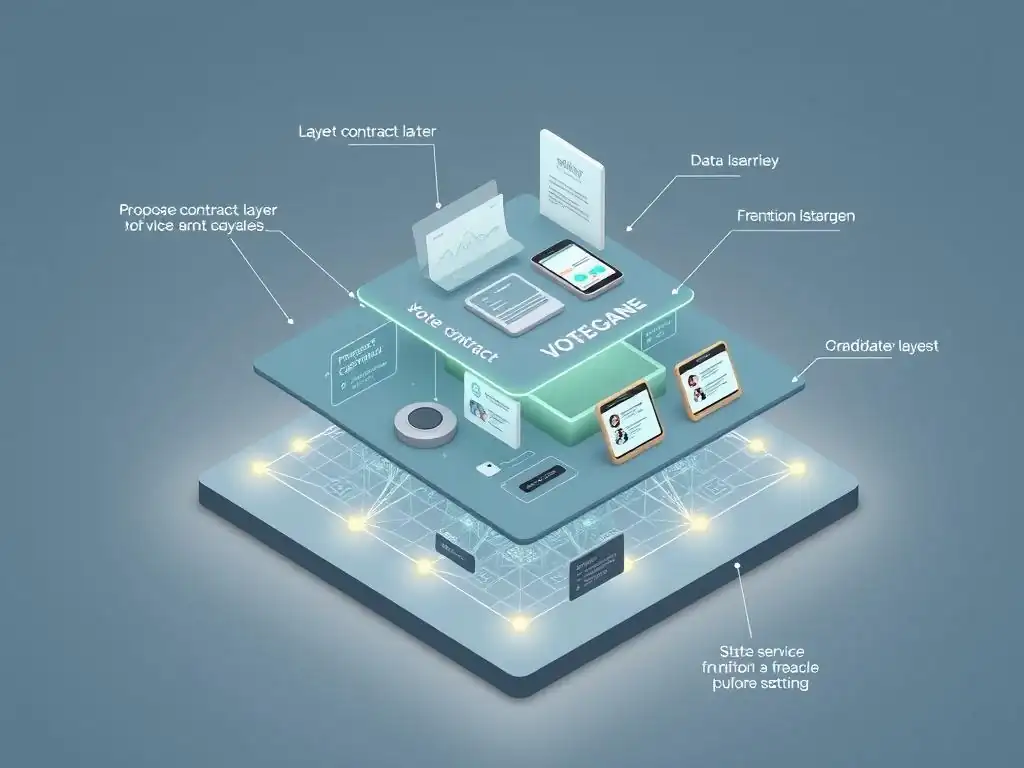
Moving from theoretical concepts to practical implementation requires making specific choices about the underlying technology and design patterns. These decisions significantly impact the performance, security, and usability of the final onchain voting system architecture.
Selecting the Appropriate Blockchain Platform for Voting (e.g., Ethereum, Polygon)
The choice of blockchain platform is a foundational decision for an onchain voting system architecture. Ethereum, with its large developer community and robust smart contract capabilities, is a popular choice, but faces scalability and cost challenges on its Layer 1. Layer 2 solutions on Ethereum, like Optimistic or ZK Rollups, offer significantly higher throughput and lower transaction costs, making them more suitable for larger-scale voting.
Alternatively, other blockchain platforms with different consensus mechanisms and architectures might be considered. For instance, platforms like Polygon (as a sidechain or Layer 2) or potentially other Layer 1 chains designed for higher transaction speeds could offer better scalability characteristics out-of-the-box, albeit potentially with different security or decentralization trade-offs compared to Ethereum Mainnet. The specific requirements of the voting scenario (e.g., number of voters, frequency of elections, need for maximum decentralization) will dictate the most appropriate platform for the onchain voting system architecture.
Implementing Identity Management for Voter Verification
Robust identity management is paramount in an onchain voting system architecture to prevent duplicate votes and ensure only eligible individuals participate. While storing sensitive personal data directly on a public blockchain is undesirable for privacy reasons, various methods can cryptographically verify identity off-chain or using privacy-preserving techniques on-chain.
One approach involves using verifiable credentials issued by trusted authorities. A voter could prove their eligibility (e.g., "is a registered citizen of X") by presenting a signed credential to the DApp, which the smart contract can verify cryptographically without learning the voter's specific identity details.
Another method involves linking a verified identity to a specific blockchain address off-chain, and then using zero-knowledge proofs (ZKPs) on-chain to prove that a vote cast from a specific address corresponds to a valid, verified identity without revealing which identity. Implementing such sophisticated identity solutions is a complex but necessary part of a secure onchain voting system architecture.
Designing a Transparent and Verifiable Vote Tallying Process
The tallying process in an onchain voting system architecture must be fully transparent and verifiable by any interested party. As mentioned, smart contracts can perform the tallying automatically based on the recorded votes. To enhance verifiability, the smart contract should ideally emit events for each vote processed during the tally, allowing auditors to trace the calculation step-by-step.
Furthermore, the final tally should be stored immutably on the blockchain. This ensures that the result cannot be altered after the fact. For complex voting rules or very large numbers of votes, off-chain tallying combined with on-chain verification mechanisms (like ZKPs proving the correctness of the off-chain calculation) might be necessary for scalability, though this adds complexity. The goal is always to ensure that anyone can independently verify that the sum of valid votes recorded on the ledger equals the final reported result, upholding the core principle of transparency in the onchain voting system architecture.
Case Studies: Examples of Onchain Voting DApp Architectures
Examining real-world implementations of decentralized voting systems provides valuable insights into the practical challenges and successes of onchain voting system architecture. While widespread governmental adoption is still future-facing, several projects and organizations have deployed DApp-based voting for internal governance or smaller-scale elections.
Analyzing Existing Decentralized Voting Solutions
Projects like Aragon and Snapshot (primarily used for DAO governance) offer examples of onchain voting system architecture in practice. Aragon historically used a module-based approach where different smart contracts handled aspects like token-weighted voting, identity, and proposal management. Snapshot utilizes off-chain signing of votes combined with on-chain verification of eligibility (based on token balances at a specific block), which offers scalability but is technically "off-chain voting" validated on-chain, rather than pure on-chain vote recording.
Other experiments include limited pilot programs for municipal or organizational elections. For example, some political parties or shareholder groups have explored blockchain-based voting for internal decisions. These systems often use permissioned or private blockchains for higher throughput and controlled access, illustrating a different type of onchain voting system architecture compared to public chain implementations. Analyzing these diverse examples reveals trade-offs between decentralization, scalability, privacy, and security depending on the specific use case.
Lessons Learned from Real-World DApp Voting Implementations
Early implementations of onchain voting system architecture have highlighted critical lessons. One major lesson is the significant challenge of user adoption and education; voters must understand how to use the system securely. Another is the difficulty in achieving true voter anonymity while maintaining eligibility verification and preventing double-voting – a problem often tackled with complex cryptographic techniques like ZKPs.
Furthermore, the cost and energy consumption associated with on-chain transactions on proof-of-work chains (like older Ethereum) or even proof-of-stake chains during peak times can be prohibitive. This has driven the exploration of Layer 2 solutions and alternative blockchain platforms. Security remains paramount; even small bugs in smart contracts have led to significant losses or system failures in other decentralized applications, emphasizing the need for extreme caution in a voting context. These lessons inform the ongoing development and refinement of onchain voting system architecture.
Future Trends in Onchain Voting System Architecture
The field of onchain voting system architecture is continuously evolving, driven by advancements in blockchain technology and cryptography. Several key trends are shaping the future of decentralized voting.
Exploring the Role of Zero-Knowledge Proofs in Enhancing Voting Privacy
Zero-Knowledge Proofs (ZKPs) are poised to play a significant role in enhancing privacy within onchain voting system architecture. ZKPs allow one party to prove to another that a statement is true without revealing any information beyond the validity of the statement itself. In a voting context, this could allow a voter to prove they are eligible to vote and that their vote is valid without revealing who they are or how they voted.
For example, a voter could use a ZKP to prove to the smart contract that they possess a valid "voter eligibility" credential and that their submitted encrypted vote corresponds to one of the valid options, all without revealing their identity or the specific vote. This addresses a major challenge in public onchain voting system architecture – balancing transparency with voter privacy – by allowing public verification of the correctness of the process and the tally without compromising individual anonymity.
The Integration of Decentralized Identity (DID) for Voter Authentication
The maturation of Decentralized Identity (DID) standards and technologies offers a promising path for robust voter authentication in onchain voting system architecture. DIDs allow individuals to control their digital identities and associated data, independent of any single centralized authority. Verifiable Credentials (VCs) linked to DIDs can serve as digital proofs of attributes, such as citizenship, age, or residency.
An onchain voting system architecture could leverage DIDs and VCs for voter registration. A voter could use their DID wallet to present a VC issued by an election authority proving their eligibility. The smart contract verifies the cryptographic signature on the VC, confirming its authenticity and validity, without requiring the voter to reveal personally identifiable information directly to the DApp or store it on-chain. This approach enhances privacy and security while enabling reliable authentication for the voting process.
The Potential of Layer-2 Solutions for Scalable Onchain Voting
As discussed, scalability is a major challenge. Layer-2 scaling solutions built on top of existing blockchains, such as Optimistic Rollups, ZK Rollups, or Validiums, offer a path towards building scalable onchain voting system architecture. These technologies process transactions off-chain in a highly efficient manner and then batch them into a single transaction or proof submitted to the main chain (Layer 1) for final settlement and security.
ZK Rollups, in particular, are promising as they use ZKPs to cryptographically prove the validity of off-chain state transitions, inheriting the security of the underlying Layer 1 blockchain. This allows for potentially thousands of votes per second to be processed off-chain, with only periodic, verified proofs submitted on-chain, drastically reducing costs and increasing throughput. Implementing onchain voting system architecture on Layer 2 could make it feasible to handle elections involving millions or even billions of votes in the future.
Best Practices for Developing a Robust Onchain Voting System
Developing a secure and reliable onchain voting system architecture requires adhering to rigorous development practices, engaging the community, and considering the broader legal and regulatory landscape.
Code Auditing and Security Testing for Smart Contracts
Given the immutable nature of blockchain and the critical function of voting, comprehensive code auditing and security testing are non-negotiable best practices for onchain voting system architecture. Before deployment, smart contracts must undergo multiple independent security audits by reputable firms specializing in blockchain security. These audits identify vulnerabilities such as reentrancy, access control issues, gas limit problems, and logical errors.
Automated testing, including unit tests, integration tests, and property-based testing, should cover all possible scenarios and edge cases. Formal verification methods can provide mathematical proof of the contract's correctness against a formal specification, offering the highest level of assurance for critical components of the onchain voting system architecture. Continuous monitoring post-deployment is also advisable.
Community Engagement and Feedback for DApp Improvement
Building trust in an onchain voting system architecture requires transparency not just in the process but also in the development. Engaging the community throughout the design and development lifecycle is crucial. This includes making the code open-source, soliciting feedback on the DApp's user interface and functionality, and being transparent about design decisions and potential limitations.
Bug bounty programs can incentivize the community to find and report vulnerabilities before they are exploited. For decentralized governance systems using DApp voting, establishing clear processes for proposing and voting on changes to the system itself is vital. A well-documented and community-approved onchain voting system architecture is more likely to be trusted and adopted.
Legal and Regulatory Considerations for Decentralized Voting
Implementing onchain voting system architecture is fraught with legal and regulatory complexities, particularly for governmental elections. Existing election laws are typically designed around traditional paper or electronic systems and may not accommodate the unique aspects of blockchain technology, such as finality, identity management, and potential issues with voter anonymity versus the need for auditable trails in case of disputes.
Questions around legal standing, dispute resolution, and compliance with existing electoral regulations (e.g., requirements for recounts, chain of custody) must be carefully addressed. Regulatory frameworks for DApps and digital assets are still evolving globally. Developers and deploying entities must navigate this uncertain landscape and ideally work with legal experts to ensure the onchain voting system architecture meets current (or anticipated) legal requirements, or advocate for necessary legal reforms.
Conclusion: The Future of Secure and Transparent Onchain Voting
The development of onchain voting system architecture represents a bold step towards creating more secure, transparent, and potentially more accessible voting processes. By leveraging the core principles of blockchain – immutability, transparency, and decentralization – DApps have the potential to address many of the shortcomings of traditional voting methods.
The Transformative Potential of Blockchain in Democratic Processes
Blockchain technology holds significant promise for transforming democratic processes beyond just voting, including petition signing, participatory budgeting, and legislative proposal management. A robust onchain voting system architecture is a foundational element for many of these applications. The ability to record actions and decisions immutably and transparently on a public ledger could foster greater public trust and engagement in governance.
Imagine a system where every citizen can verify that their vote was cast correctly, counted accurately, and contributed to a publicly auditable tally, without revealing their identity. This level of verifiable integrity could significantly enhance the legitimacy of electoral outcomes and reduce concerns about fraud or manipulation, fundamentally changing how we perceive and participate in democratic systems through advanced onchain voting system architecture.
Challenges and Opportunities in Adopting DApp Voting Systems
Despite the immense potential, significant challenges remain for the widespread adoption of onchain voting system architecture. Technical hurdles like scalability, usability, and the complexity of achieving both privacy and verifiability need further research and development. Legal and regulatory frameworks must evolve to accommodate decentralized systems. Public education and building trust in this new technology are also critical factors.
However, the opportunities are equally significant. Decentralized voting could potentially reduce election costs, increase voter turnout through greater accessibility (especially for overseas or disabled voters), and enhance the security and auditability of results. As blockchain technology matures and Layer 2 solutions become more prevalent, the vision of a truly secure and transparent onchain voting system architecture becomes increasingly attainable, paving the way for more trustworthy and resilient governance systems.
Frequently Asked Questions
What are the core components of an Onchain voting system architecture?
The core components typically include a smart contract to manage the voting process, a front-end interface (DApp) for voter interaction, and a data storage layer on the blockchain to record votes securely and transparently.
How does blockchain technology enhance the security of a decentralized voting system?
Blockchain's inherent features like immutability and cryptographic hashing ensure that votes are tamper-proof and verifiable. This enhances trust in the integrity of the voting process and prevents fraudulent activities.
What are the main challenges in implementing an Onchain voting system architecture?
Scalability is a major challenge, along with ensuring voter privacy and addressing potential governance concerns related to decentralized control. Gas fees and user accessibility can also be hurdles.
How does Decentralized Finance (DeFi) principles apply to Onchain voting systems?
DeFi principles emphasize transparency and autonomy, which are crucial for building trust in voting systems. Smart contracts automate the voting process, removing the need for centralized intermediaries.
What are the regulatory considerations for deploying a Decentralized Voting Application (DApp)?
Regulatory bodies are still developing frameworks for blockchain-based applications. Compliance with data privacy laws and ensuring legal validity of votes are key considerations for developers.
Final Reflection: Embracing the Future of Democratic Participation
The exploration of onchain voting system architecture has revealed a powerful potential to revolutionize democratic processes. No longer confined by the limitations of traditional methods, we stand at the cusp of a new era where secure, transparent, and verifiable elections are not just an aspiration, but a tangible reality. The principles of decentralization, immutability, and cryptographic verification offer a compelling alternative to the vulnerabilities and opacity that have plagued voting systems for far too long.
The impact of decentralized voting extends far beyond mere technological advancement. It touches upon the very core of civic engagement and trust in democratic institutions. The ability for individuals to directly verify the integrity of their vote, and the overall election process, fosters a sense of ownership and accountability that is crucial for a healthy society. Democracy is not just a system of government; it is a way of life, a way of thinking, and a way of being.
- Eleanor Roosevelt. This quote resonates deeply as we consider the potential of onchain voting to empower citizens and strengthen the foundations of democratic participation.
As we move forward, let us not shy away from embracing the transformative power of onchain voting. Let us actively participate in shaping the future of democratic governance by advocating for the adoption of secure and transparent decentralized systems. Consider how you can contribute to this evolution, whether through research, development, advocacy, or simply by staying informed and engaged. The future of democracy is not predetermined; it is a future we build together, one block at a time.
Empower Democracy: Build Your Own Voting DApp!
Thank you for exploring the architecture of decentralized voting systems. We hope you now have a solid understanding of how to leverage blockchain for secure and transparent elections. Are you ready to take the next step and contribute to the future of democracy?
Here's how you can make a difference:
- Start prototyping your own decentralized voting DApp today! Focus on smart contract security and designing user-friendly interfaces.
- Explore existing open-source voting applications. Contribute to their development and improvement. Collaborate and learn from others pushing the boundaries of blockchain voting.
- Share this article with anyone passionate about blockchain and its potential to revolutionize elections.
What innovative feature will you implement in your own decentralized voting application to further enhance security and voter participation?
Leave a Reply