
Understanding Polkadot's Governance Model: OnChain Democracy


Welcome to Blockchain Trends, your compass in the rapidly evolving world of decentralized technology. Beyond the hype, we delve into the real-world applications and transformative power of blockchain. Ever wondered how a truly decentralized system governs itself? This article explores the innovative Polkadot onchain governance model, a fascinating example of blockchain democracy in action. Discover how Polkadot is forging a new path for decentralized decision-making and why it matters. Intrigued? Let's dive in and unravel the complexities of onchain governance.
- Introduction to Polkadot Governance: Decentralized Decision-Making
- Polkadot's On-Chain Governance Model Explained: Components and Processes
- The Polkadot Governance Process: A Step-by-Step Guide
- Polkadot's Governance in Action: Real-World Examples
- Advantages of Polkadot's On-Chain Governance System
- Challenges and Considerations of Polkadot's Governance
- Polkadot vs. Other Governance Models: A Comparative Analysis
- The Future of Polkadot Governance: Potential Evolutions and Innovations
- Conclusion: The Significance of On-Chain Governance in Polkadot's Ecosystem
-
Frequently Asked Questions
- What is the Polkadot onchain governance model, and why is it considered "onchain"?
- How does Polkadot's governance differ from traditional governance systems?
- What are the key components of the Polkadot onchain governance model?
- How are decisions implemented within the Polkadot governance system after a vote?
- What are some potential benefits and challenges of using an onchain governance model like Polkadot's?
- Final Reflection: Embracing Decentralized Evolution
- Delve Deeper: Shape Polkadot's Future!
Introduction to Polkadot Governance: Decentralized Decision-Making
The Importance of On-Chain Governance in Blockchain Networks
On-chain governance is paramount in blockchain networks for ensuring their long-term sustainability, adaptability, and decentralization. Unlike traditional systems where changes are often dictated by a central authority, blockchain governance aims to distribute decision-making power among stakeholders. This is crucial because blockchains are designed to be immutable and resistant to censorship, necessitating a robust mechanism for upgrades and modifications to the network protocol. Without on-chain governance, blockchains risk stagnation, failing to adapt to technological advancements or address critical vulnerabilities. Furthermore, centralized control over protocol changes can undermine the core principles of decentralization and trustlessness that underpin blockchain technology.
The implementation of on-chain governance directly impacts a blockchain's resilience and evolution. Networks with effective on-chain governance mechanisms can seamlessly upgrade their protocols to incorporate new features, improve performance, or respond to security threats, all while maintaining consensus among their communities. This adaptability is vital in a rapidly evolving technological landscape.
Consider the historical challenges faced by Bitcoin, where protocol upgrades have been contentious and slow due to the lack of a formal on-chain governance system. In contrast, blockchains with well-defined on-chain governance frameworks are better positioned to navigate forks, protocol disputes, and the ever-changing demands of their user base, fostering a more dynamic and future-proof ecosystem.
Polkadot's Vision: Decentralized Control and Community Driven Evolution
Polkadot's vision for governance is deeply rooted in the principles of decentralization and community-driven evolution. Recognizing that blockchain technology must be agile and adaptable, Polkadot has designed its governance model to be inherently on-chain, transparent, and inclusive.
This approach contrasts sharply with off-chain governance models, where decisions might be made in closed forums or by a select group of developers, potentially leading to less transparency and community representation. Polkadot's on-chain governance model is intended to empower DOT token holders and stakeholders to directly participate in shaping the network's future, ensuring that the platform evolves in a manner that reflects the collective will of its community.
The core philosophy behind Polkadot's onchain governance model is to create a truly decentralized and democratic system. This means that significant decisions, from runtime upgrades to treasury spending, are subject to proposals and referenda that are voted on by the Polkadot community. By enshrining governance directly into the protocol, Polkadot aims to minimize the risks of centralized influence and ensure that the network's development path is determined by the collective consensus of its stakeholders. This commitment to decentralized control and community participation is central to Polkadot's long-term vision of a truly open and evolving Web3 ecosystem.
Polkadot's On-Chain Governance Model Explained: Components and Processes
Polkadot's Council: Representing Passive Stakeholders
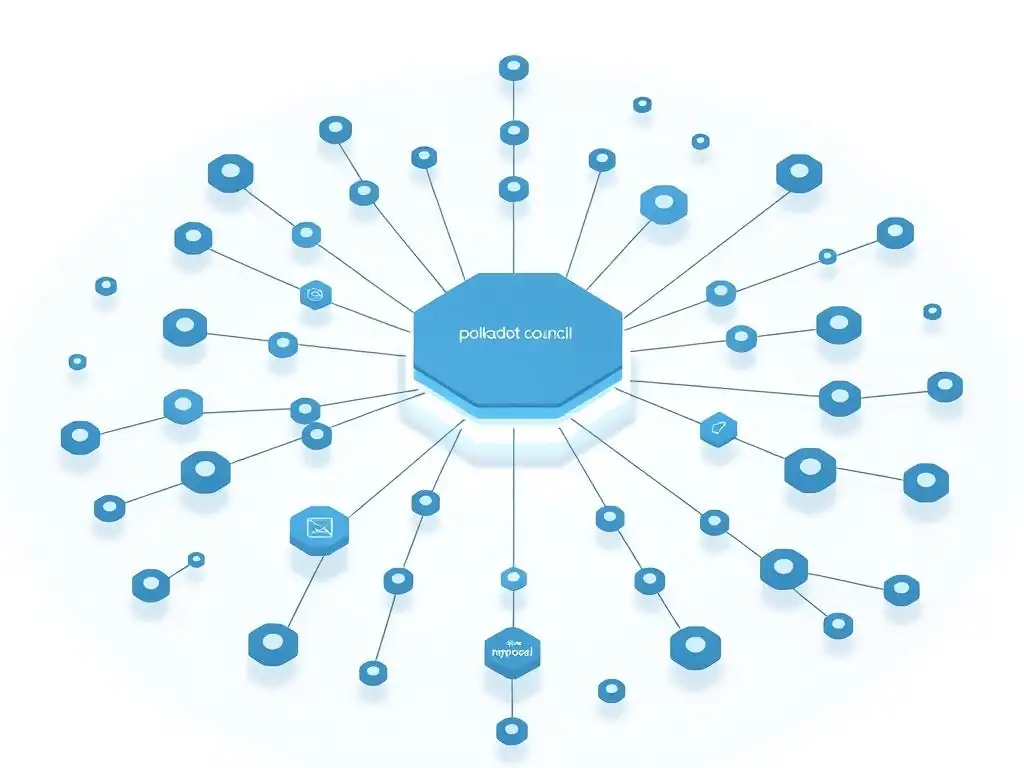
The Polkadot Council is a crucial component of its on-chain governance, designed to represent the interests of passive stakeholders within the network. Comprising elected members, the Council acts as a check and balance, mitigating potential issues that might arise from purely token-weighted voting systems. The Council's role is multifaceted, including proposing referenda, vetoing overtly malicious or spam proposals, and acting as an efficient body to expedite certain governance actions.
Initially, the Council was composed of 6 members, but this has evolved, and its size is subject to governance votes, reflecting the dynamic nature of Polkadot's governance itself. The election process for Council members is also on-chain, allowing DOT holders to vote for their preferred representatives, further embedding decentralization within its structure.
Beyond simply representing passive stakeholders, the Council plays a pivotal role in streamlining the governance process and ensuring efficiency. For instance, the Council can propose "fast-tracked" referenda for urgent matters, bypassing the standard lengthy proposal process. This capability is vital for responding swiftly to critical security vulnerabilities or time-sensitive network upgrades.
Furthermore, the Council can utilize its collective wisdom to reject frivolous or harmful proposals before they reach the referendum stage, preventing governance spam and ensuring that community attention is focused on meaningful issues. The Council's existence demonstrates Polkadot's commitment to a balanced governance system that combines direct community participation with efficient and informed decision-making through elected representatives.
The Technical Committee: Focusing on Technical Upgrades and Security
The Technical Committee in Polkadot governance is a specialized body composed of experienced development teams and technical experts from within the Polkadot ecosystem. Its primary function is to assess the technical feasibility and security implications of governance proposals, particularly those related to runtime upgrades and protocol modifications.
Unlike the Council which focuses on broader community representation, the Technical Committee provides crucial technical expertise to the governance process, ensuring that proposed changes are sound from an engineering perspective and do not introduce unforeseen vulnerabilities or instability to the network. Membership in the Technical Committee is by invitation, typically extended to teams with a proven track record of contributing to the Polkadot ecosystem's technical development.
The Technical Committee's influence is most pronounced in the "fast-tracked" referenda pathway. If both the Council and the Technical Committee unanimously agree on a proposal, it can be submitted directly as a fast-tracked referendum, significantly reducing the time required for enactment. This mechanism is especially critical for addressing urgent security patches or critical bug fixes that require immediate deployment.
The Technical Committee provides a vital layer of technical scrutiny, preventing potentially flawed or risky proposals from being implemented simply through a majority vote without adequate technical review. This emphasis on technical validation underscores Polkadot's commitment to maintaining a secure and robust network through informed and expert-driven governance processes.
Origins and Tracks: Classifying Proposals and Streamlining Execution
Polkadot's governance system utilizes the concept of "Origins" and "Tracks" to classify proposals and streamline their execution, introducing a sophisticated level of control and efficiency. Origins define the authority level required to initiate a particular governance action, while Tracks specify the decision-making process and execution timeline for proposals originating from different sources.
This framework allows for nuanced management of governance actions, ensuring that different types of proposals undergo appropriate levels of scrutiny and voting procedures. For example, proposals originating from the Council might follow a different track compared to proposals originating directly from the public, reflecting varying levels of pre-vetting and community consensus.
The Tracks system is crucial for managing the flow of governance proposals and preventing bottlenecks. By categorizing proposals into different tracks, each with its own defined decision-making parameters like voting periods, enactment delays, and approval thresholds, Polkadot can optimize the governance process for different types of changes. For instance, a simple treasury spending proposal might follow a "lower privilege" track with faster enactment, while a major runtime upgrade would proceed through a "higher privilege" track with more rigorous voting and longer enactment delays.
This granular control over governance workflows through Origins and Tracks is a key feature of Polkadot's onchain governance model, enabling it to handle a diverse range of governance actions efficiently and securely. The Tracks system was significantly revamped with the launch of OpenGov, introducing a more flexible and powerful framework.
Referenda: Voting on Proposals and Implementing Changes on Polkadot
Referenda are the cornerstone of Polkadot's on-chain governance, representing the direct democratic mechanism for implementing changes to the network. A referendum is a vote on a specific proposal, allowing DOT token holders to express their will and directly influence the direction of the Polkadot network. Any DOT holder can participate in referenda by locking their tokens and voting 'Aye' (yes) or 'Nay' (no) on a proposal.
The voting power is proportional to the amount of DOT locked and the duration for which it is locked, incentivizing long-term commitment to the network's governance. Referenda are used to decide on a wide range of issues, including runtime upgrades, treasury spending, parameter adjustments, and even changes to the governance mechanism itself.
The outcome of a referendum is determined by a weighted majority voting system, with different types of referenda requiring different thresholds for approval. For instance, some critical changes might require a super-majority for approval, while less critical changes might pass with a simple majority. Once a referendum passes and the enactment period concludes, the proposed change is automatically executed on the Polkadot network without requiring any further intervention.
This automated enactment is a key feature of Polkadot onchain governance model, ensuring that the community's decisions are implemented transparently and without the need for trusted intermediaries. Referenda provide the ultimate mechanism for decentralized decision-making, empowering the Polkadot community to collectively govern the network's evolution.
The Polkadot Governance Process: A Step-by-Step Guide
Proposal Submission: Initiating a Governance Action
The first step in Polkadot's governance process is proposal submission, which marks the initiation of a potential governance action. Anyone holding DOT tokens can submit a proposal, outlining a desired change to the Polkadot network. These proposals can range from requesting treasury funds for ecosystem development to suggesting modifications to the runtime logic or even proposing changes to the governance process itself.
Submitting a proposal typically requires a deposit of DOT tokens, which serves as a spam prevention mechanism and ensures that proposers have a genuine stake in the network. The details of the proposal, including its rationale, technical specifications (if applicable), and intended impact, are made publicly available for community review and discussion.
The process of proposal submission is designed to be permissionless and open to the entire Polkadot community. This inclusivity is fundamental to Polkadot's decentralized ethos, enabling anyone with a valuable idea or concern to initiate a governance action.
The submitted proposal then enters the governance pipeline, undergoing various stages of review, voting, and potential enactment depending on its origin and the track it follows. The initial proposal submission is therefore a crucial starting point for any change within the Polkadot ecosystem, demonstrating the power vested in DOT holders to shape the network's future direction through active participation in its onchain governance model.
Referendum Creation: Transforming Proposals into Voteable Actions
Following proposal submission, the next critical step is referendum creation, transforming a submitted proposal into a concrete, voteable action for the Polkadot community. Referenda are not automatically created for every submitted proposal. Instead, proposals typically need to be endorsed or advanced through specific governance pathways to become referenda.
For instance, the Council can vote to put a public proposal to a referendum. Alternatively, certain types of proposals, particularly those related to runtime upgrades, might be directly submitted as referenda by specific origins or through defined governance tracks. The act of creating a referendum signifies that a proposal has met certain criteria or gained sufficient support to warrant a network-wide vote.
The process of referendum creation is a crucial filter in Polkadot's onchain governance model, ensuring that only proposals deemed relevant and potentially impactful are put to a community vote. This prevents governance overload and focuses community attention on the most important decisions.
Once a referendum is created, it is assigned a unique ID and its details, including the proposal being voted on, the voting period, and the approval threshold, are publicly broadcast across the Polkadot network. This transparency ensures that all DOT holders are aware of upcoming referenda and have the opportunity to participate in the voting process, further solidifying the democratic nature of Polkadot's governance.
Voting Period and Thresholds: Participating in Polkadot's Democratic Process
The voting period and thresholds are essential parameters defining how referenda are decided within Polkadot's democratic process. Once a referendum is created, a designated voting period commences, during which DOT holders can participate by casting their votes. The length of the voting period varies depending on the track of the referendum, ranging from shorter periods for urgent matters to longer periods for more significant changes.
DOT holders can vote 'Aye' (yes) or 'Nay' (no) on a referendum, locking their tokens for the duration of their vote. The voting power is weighted by the amount of DOT locked and the lock duration, incentivizing long-term participation and commitment.
Approval thresholds dictate the percentage of votes required for a referendum to pass. These thresholds are not fixed and can vary based on the referendum track and the type of proposal. Polkadot employs a sophisticated adaptive quorum biasing system, dynamically adjusting the approval threshold based on voter turnout.
This mechanism aims to prevent low-turnout referenda from enacting significant changes and encourages broader community participation. The combination of the voting period and dynamic thresholds ensures that referenda are decided with sufficient community input and consensus, upholding the integrity and legitimacy of Polkadot's onchain governance model. Participating in these votes is a direct way for DOT holders to shape the network's evolution.
Proposal Enactment: Executing Approved Changes on the Polkadot Network
Proposal enactment is the final stage of the Polkadot governance process, where approved changes are automatically implemented on the network. Once a referendum passes and the voting period concludes, there is typically an enactment period, a delay before the changes are actually applied to the Polkadot runtime. This enactment delay provides a buffer period for validators and the network to prepare for the upcoming changes, ensuring a smooth and coordinated transition. After the enactment period, the approved changes are automatically executed by the Polkadot runtime logic, without requiring any further manual intervention or centralized control.
This automated enactment is a defining characteristic of Polkadot onchain governance model, guaranteeing that the community's decisions, expressed through referenda, are faithfully and transparently implemented. The code is law principle is deeply embedded in this process, minimizing the risks of human error or manipulation in the execution of governance outcomes.
Proposal enactment can involve various types of changes, from runtime upgrades that introduce new features or fix bugs, to treasury payouts for funding ecosystem initiatives, or even adjustments to network parameters. The seamless and automated enactment process reinforces the credibility and effectiveness of Polkadot's governance system, demonstrating its ability to evolve and adapt in a decentralized and community-driven manner.
Polkadot's Governance in Action: Real-World Examples
Case Study 1: Statemint Launch and Governance Approval
The launch of Statemint on Polkadot provides a compelling real-world example of Polkadot's governance in action. Statemint is a parachain designed for efficient and low-cost asset issuance, particularly fungible assets and NFTs. Its launch was not a centrally mandated decision, but rather a result of Polkadot's on-chain governance process. The proposal to launch Statemint underwent a referendum, allowing DOT holders to vote on whether to allocate a parachain slot and resources to this new functionality. The referendum process involved community discussion, technical review, and ultimately, a vote where DOT holders overwhelmingly approved the Statemint launch.
The successful governance approval and subsequent launch of Statemint demonstrate the effectiveness of Polkadot's onchain governance model in driving network evolution. It highlights how significant upgrades and new features are introduced through a decentralized and community-driven process, rather than being dictated by a central entity. The Statemint case study showcases the power of referenda in enabling the Polkadot network to adapt and expand its capabilities based on the collective will of its stakeholders. This real-world example solidifies the practical application and impact of Polkadot's governance framework in shaping the network's development trajectory.
Case Study 2: Treasury Spending Proposals and Community Debate
Polkadot's Treasury, funded by transaction fees, staking inefficiencies, and slashing, is governed entirely by the on-chain governance system. Numerous treasury spending proposals provide ongoing examples of community debate and decision-making within Polkadot. These proposals range from funding development grants for ecosystem projects, sponsoring community events, to commissioning security audits.
Each treasury spending proposal undergoes a governance process, often involving Council involvement and ultimately a referendum where DOT holders vote on whether to approve the requested funds. These proposals frequently spark community debate and discussion, with stakeholders weighing the merits of each project and its potential contribution to the Polkadot ecosystem.
The ongoing stream of treasury spending proposals and their associated community debates illustrate the dynamic and participatory nature of Polkadot's onchain governance model. It showcases how the community actively engages in resource allocation decisions, ensuring that treasury funds are used in a manner that aligns with the collective vision for Polkadot's growth and development.
The transparency of the treasury proposal process, coupled with the open referendum voting, fosters accountability and empowers DOT holders to directly influence how network resources are utilized. These real-world examples of treasury governance underscore the practical application of Polkadot's decentralized decision-making framework in managing network resources and fostering ecosystem growth.
Advantages of Polkadot's On-Chain Governance System
Increased Transparency and Accountability in Blockchain Development
One of the primary advantages of Polkadot's onchain governance model is the significant increase in transparency and accountability in blockchain development. All governance proposals, referendum votes, and their outcomes are recorded on the Polkadot blockchain, creating an immutable and publicly auditable record of the network's decision-making processes. This transparency contrasts sharply with off-chain governance models where decision-making can be opaque and less accessible to the broader community. The on-chain nature of Polkadot's governance ensures that stakeholders can readily track the evolution of the network, understand the rationale behind protocol changes, and hold decision-makers accountable for their actions.
Furthermore, the open and transparent nature of Polkadot's governance fosters greater accountability. Council members, Technical Committee members, and even DOT holders participating in referenda are all acting within a publicly visible framework. This transparency discourages behind-the-scenes deals or decisions that might not be in the best interests of the network as a whole. The auditable record of governance actions provides a mechanism for community oversight and ensures that the network's development is driven by open and verifiable processes, enhancing trust and confidence in the Polkadot ecosystem.
Enhanced Community Involvement and Decentralized Decision-Making
Polkadot's on-chain governance system is explicitly designed to enhance community involvement and promote decentralized decision-making. By empowering DOT holders to directly participate in governance through proposal submission and referendum voting, Polkadot fosters a sense of ownership and collective responsibility for the network's future. This level of community involvement is a significant departure from traditional blockchain governance models that often rely on core developer teams or foundations to dictate network upgrades and changes. Polkadot's approach democratizes blockchain governance, distributing decision-making power across a wider spectrum of stakeholders.
The decentralized nature of Polkadot onchain governance model is further reinforced by the absence of a single central authority controlling network upgrades or protocol modifications. Decisions are made through community consensus, expressed through referendum votes. This decentralized decision-making process mitigates the risks of centralized control and ensures that the network's evolution is guided by the collective will of its community, rather than the interests of a select few. This commitment to community involvement and decentralization is a core tenet of Polkadot's governance philosophy and a key driver of its long-term sustainability.
Faster Iteration and Adaptation to Evolving Needs
Polkadot's on-chain governance system facilitates faster iteration and adaptation to evolving needs compared to blockchains with less formalized or off-chain governance models. The structured proposal and referendum process provides a clear pathway for introducing and implementing changes to the network, whether they are bug fixes, performance improvements, new features, or even fundamental protocol upgrades. This streamlined governance mechanism enables Polkadot to respond more quickly to technological advancements, market demands, and community feedback, fostering a more agile and adaptable blockchain platform.
The ability to rapidly iterate and adapt is crucial in the fast-paced world of blockchain technology. Polkadot's onchain governance model allows it to stay ahead of the curve, incorporating innovations and addressing emerging challenges more efficiently than networks hampered by slow or contentious governance processes. This agility is a competitive advantage, enabling Polkadot to remain relevant and attractive to developers and users in the long run. The emphasis on efficient decision-making and rapid implementation of approved changes positions Polkadot as a forward-thinking and adaptable blockchain platform.
Mitigation of Centralized Control Risks in Blockchain Platforms
A significant advantage of Polkadot's on-chain governance is its inherent mitigation of centralized control risks, a common concern in many blockchain platforms. By distributing decision-making power across DOT holders and enshrining governance within the protocol itself, Polkadot minimizes the potential for a single entity or small group to exert undue influence over the network's direction. This decentralized governance structure reduces the risk of censorship, manipulation, and arbitrary changes that can undermine the trust and security of a blockchain network.
The Polkadot onchain governance model acts as a safeguard against the centralization tendencies that can creep into blockchain projects over time. The requirement for community consensus, expressed through referenda, ensures that significant changes are broadly supported and not imposed by a central authority. This decentralized control mechanism enhances the resilience and long-term stability of the Polkadot network, making it a more robust and trustworthy platform for decentralized applications and infrastructure. By prioritizing decentralization in its governance design, Polkadot reinforces its commitment to the core principles of blockchain technology.
Challenges and Considerations of Polkadot's Governance
Voter Participation and Engagement
Despite the robust design of Polkadot's on-chain governance, maintaining consistent voter participation and engagement remains a challenge. While the system empowers DOT holders to participate in referenda, voter turnout can sometimes be relatively low, especially for less publicized or technically complex proposals. Low voter participation can raise concerns about the representativeness of governance decisions and potentially lead to outcomes that do not fully reflect the collective will of the community. Encouraging broader participation and ensuring that DOT holders are informed and motivated to vote is an ongoing challenge for Polkadot governance.
Addressing the challenge of voter participation requires ongoing efforts to improve communication, simplify the voting process, and increase awareness of governance proposals. Educational initiatives and user-friendly voting interfaces can help lower the barriers to participation. Furthermore, exploring mechanisms to incentivize voting, such as participation rewards or reputation systems, could potentially boost voter turnout and ensure that Polkadot's onchain governance model operates at its full potential, reflecting the diverse perspectives of its community.
Potential for Governance Attacks and Manipulation
Like any decentralized governance system, Polkadot's on-chain governance is not immune to potential attacks and manipulation. While the system is designed to be resilient, various attack vectors exist, such as whale manipulation, where entities with large DOT holdings could attempt to sway referendum outcomes in their favor. Governance attacks could also involve social engineering or information manipulation to influence voter behavior. Mitigating these risks requires continuous vigilance and proactive measures to safeguard the integrity of the governance process.
Polkadot's governance framework includes mechanisms to mitigate some of these risks, such as weighted voting based on lock duration and adaptive quorum biasing. However, ongoing research and development are necessary to identify and address potential vulnerabilities and ensure the long-term security of the Polkadot onchain governance model against evolving attack strategies. Community awareness and education about governance security are also crucial in preventing successful manipulation attempts and maintaining trust in the system.
Complexity of the Governance Process
The sophistication and flexibility of Polkadot's on-chain governance, while advantageous, also introduce a degree of complexity. The various components, such as the Council, Technical Committee, Origins, and Tracks, along with the nuanced referendum process, can be challenging for new users to fully grasp. This complexity might deter some DOT holders from actively participating in governance, contributing to lower voter participation rates. Simplifying the user experience and providing clear educational resources are essential for making Polkadot's governance more accessible and user-friendly.
Addressing the complexity challenge involves ongoing efforts to improve the clarity and usability of governance interfaces and documentation. Developing intuitive tools and educational materials that explain the various aspects of Polkadot onchain governance model in a straightforward manner can empower more users to participate effectively. Striking a balance between the sophistication required for robust governance and the simplicity needed for broad accessibility is a key consideration for the continued evolution of Polkadot's governance system.
Balancing Speed and Security in Decision-Making
Polkadot's governance system aims to strike a balance between speed and security in decision-making, but achieving this balance is an ongoing consideration. While the on-chain governance mechanism allows for faster iteration compared to some other blockchains, there are inherent trade-offs between the speed of decision-making and the thoroughness of review and deliberation. Fast-tracking mechanisms, while valuable for urgent matters, need to be carefully managed to ensure that security and due diligence are not compromised in the pursuit of speed.
Maintaining the optimal balance between speed and security in Polkadot's onchain governance model requires continuous refinement of the governance parameters and processes. Adjusting voting periods, approval thresholds, and the utilization of fast-tracking mechanisms based on experience and evolving needs is crucial for ensuring that governance decisions are both timely and well-considered. The ongoing development of Polkadot governance aims to optimize this balance, enabling efficient decision-making without sacrificing the security and robustness of the network.
Polkadot vs. Other Governance Models: A Comparative Analysis
Polkadot vs. Ethereum: A Governance Comparison
Comparing Polkadot's on-chain governance to Ethereum's governance model reveals significant differences in approach and implementation. Ethereum, prior to the Merge and its transition to Proof-of-Stake, relied heavily on off-chain governance. Decisions regarding protocol upgrades and Ethereum Improvement Proposals (EIPs) were largely driven by core developers, researchers, and community discussions in forums and developer calls. While community feedback was considered, the final decision-making authority rested primarily with core developers and the Ethereum Foundation. This off-chain approach, while allowing for flexibility, could be less transparent and potentially more centralized compared to on-chain governance.
In contrast, Polkadot's onchain governance model is explicitly designed to be on-chain, transparent, and community-driven. All governance proposals and voting processes are recorded on the blockchain, and DOT holders have direct voting power through referenda. While Ethereum is moving towards more formalized governance with its shift to Proof-of-Stake and discussions around enshrining governance processes on-chain, it is still in a relatively earlier stage of on-chain governance evolution compared to Polkadot. Polkadot's proactive and comprehensive approach to on-chain governance from its inception distinguishes it significantly from Ethereum's historically more off-chain focused model.
Polkadot vs. Cosmos: Examining Interoperability and Governance
Comparing Polkadot and Cosmos governance models highlights interesting contrasts, particularly in the context of interoperability. Cosmos, focused on building an "Internet of Blockchains," emphasizes sovereign blockchains (zones) with independent governance. Each Cosmos zone is responsible for its own governance, allowing for greater customization and autonomy. Cosmos Hub, the central hub in the Cosmos network, also has its own on-chain governance mechanism, primarily focused on managing the Hub and its related services. Cosmos governance often relies on the token holders of individual zones to govern their respective blockchains.
Polkadot, while also focused on interoperability through parachains, adopts a more integrated governance approach. While parachains can have some degree of autonomy, the overarching Polkadot Relay Chain governance, as described in the Polkadot onchain governance model, has significant influence over the entire Polkadot ecosystem, including parachain upgrades and resource allocation. Polkadot's governance is more centralized at the Relay Chain level compared to Cosmos' decentralized zone-based governance. However, Polkadot's integrated governance can also facilitate more coordinated network-wide upgrades and ensure greater consistency across the Polkadot ecosystem, while Cosmos prioritizes sovereign control and flexibility for individual zones.
Polkadot vs. Tezos: Comparing Liquid Proof-of-Stake and Governance
Comparing Polkadot and Tezos governance models reveals similarities in their on-chain approach but differences in their specific implementations and consensus mechanisms. Tezos is known for its pioneering on-chain governance system, which is deeply integrated with its Liquid Proof-of-Stake (LPoS) consensus mechanism. Tezos token holders can participate in governance by delegating their staking rights to bakers, who then participate in voting on protocol upgrades and other governance proposals. Tezos governance operates through a series of amendment cycles, involving proposal submission, exploration, testing, and adoption phases, all managed on-chain.
Both Polkadot and Tezos embrace on-chain governance and empower token holders to participate in network upgrades. However, Polkadot's governance model, particularly with its Council, Technical Committee, and Tracks system, is arguably more complex and nuanced than Tezos' amendment cycle-based governance. Tezos' governance is tightly coupled with its LPoS mechanism, whereas Polkadot's governance operates more independently, although staking participation can influence voting power. Both platforms represent leading examples of on-chain governance, but they differ in their specific design choices and the level of complexity they incorporate into their governance frameworks.
The Future of Polkadot Governance: Potential Evolutions and Innovations
Exploring Decentralized Autonomous Organizations (DAOs) within Polkadot
The future of Polkadot governance may see increased integration with Decentralized Autonomous Organizations (DAOs). DAOs could play a significant role in further decentralizing decision-making within the Polkadot ecosystem, potentially governing specific parachains, Substrate-based projects, or even aspects of the Relay Chain governance itself. DAOs could offer more granular and specialized governance structures, allowing communities to self-organize and manage their own initiatives within the broader Polkadot framework. Exploring how DAOs can be seamlessly integrated with Polkadot's existing onchain governance model is a promising avenue for future development.
The potential for DAOs within Polkadot extends to various areas, including treasury management, parachain governance, and community-led initiatives. DAOs could be used to manage specific treasury funds, allowing communities to propose and vote on how allocated resources are utilized. Parachains could leverage DAOs for their internal governance, while still participating in the overall Polkadot governance framework. The integration of DAOs could foster greater community autonomy and specialization within the Polkadot ecosystem, further enhancing its decentralization and adaptability.
Integration of Prediction Markets for Enhanced Governance
Another potential innovation for the future of Polkadot governance is the integration of prediction markets. Prediction markets could be used to gauge community sentiment and forecast the outcomes of governance proposals, providing valuable insights to DOT holders and decision-makers. By leveraging the wisdom of the crowd through prediction markets, Polkadot governance could become more data-driven and informed, potentially leading to better decision outcomes. Exploring the feasibility and benefits of integrating prediction markets into the Polkadot onchain governance model is an area worth considering for future enhancements.
Prediction markets could be particularly useful in complex or contentious governance decisions, providing a signal of community expectations and potential risks associated with different proposals. They could also incentivize more informed participation in governance, as users would have a financial incentive to research and understand the implications of different governance actions. While challenges exist in ensuring the integrity and accuracy of prediction markets, their potential to enhance the intelligence and foresight of Polkadot governance is significant and warrants further exploration.
Conclusion: The Significance of On-Chain Governance in Polkadot's Ecosystem
Polkadot's on-chain governance model is of paramount significance to its ecosystem. It is not merely a feature but a foundational element that underpins the network's decentralization, adaptability, and long-term sustainability. By embedding governance directly into the protocol and empowering DOT holders to participate in decision-making, Polkadot has established a truly democratic and community-driven blockchain platform. The Polkadot onchain governance model ensures transparency, accountability, and faster iteration, enabling the network to evolve in response to the needs of its community and the ever-changing technological landscape.
The real-world examples of Statemint launch and treasury spending proposals vividly illustrate the practical impact and effectiveness of Polkadot's governance system. While challenges such as voter participation and potential governance attacks exist, Polkadot's proactive approach to addressing these issues and its ongoing exploration of innovative governance mechanisms, such as DAOs and prediction markets, demonstrate its commitment to continuous improvement and evolution. Ultimately, Polkadot's robust on-chain governance is a key differentiator, positioning it as a leading example of decentralized blockchain governance and a promising platform for the future of Web3.
Frequently Asked Questions
What is the Polkadot onchain governance model, and why is it considered "onchain"?
The Polkadot onchain governance model refers to the system by which changes to the Polkadot network are proposed, voted on, and enacted. It's "onchain" because the entire process, from proposal submission to voting and execution, is managed directly on the blockchain, making it transparent and auditable.
How does Polkadot's governance differ from traditional governance systems?
Unlike traditional systems, Polkadot's governance is decentralized and permissionless. Anyone holding DOT tokens can propose changes, and token holders directly participate in voting, leading to a more democratic and transparent decision-making process.
What are the key components of the Polkadot onchain governance model?
Key components include the Council, the Technical Committee, and the DOT token holders. The Council proposes and fast-tracks important proposals, the Technical Committee focuses on technical feasibility, and DOT holders ultimately vote on all proposals.
How are decisions implemented within the Polkadot governance system after a vote?
Once a proposal passes a vote, the changes are automatically executed on the Polkadot blockchain. This automated execution is a core feature of onchain governance, ensuring that decisions are implemented without intermediaries or manual intervention.
What are some potential benefits and challenges of using an onchain governance model like Polkadot's?
Benefits include increased transparency, security, and community involvement. Challenges can include voter apathy, the potential for malicious proposals, and the complexity of the governance mechanisms themselves, requiring user education.
Final Reflection: Embracing Decentralized Evolution
The intricacies of Polkadot's onchain governance model, as explored throughout this article, are not merely academic exercises; they represent a fundamental shift in how we envision decentralized decision-making. In a world increasingly grappling with centralized power structures, the ability for a community to directly shape its own future, as exemplified by Polkadot, offers a powerful alternative and a glimpse into a more equitable and transparent future.
The impact of this model extends far beyond the technical realm of blockchain. It's about empowering individuals and fostering a sense of collective ownership over the systems that govern them. This resonates deeply in a time when trust in traditional institutions is waning. The best argument against democracy is a five-minute conversation with the average voter.
- Winston Churchill. While this quote highlights a potential challenge, Polkadot's onchain governance actively seeks to educate and engage its community, striving to create a more informed and participatory electorate.
As you reflect on the principles and mechanisms of Polkadot's onchain governance model, consider how you can apply these lessons to your own life and community. How can you contribute to building more transparent, participatory, and equitable systems? The future of governance, both on and off the blockchain, hinges on our willingness to embrace decentralized evolution and actively shape the world we want to live in.
Okay, here's a CTA I've written based on the information provided about an article titled "Understanding Polkadot's Governance Model: OnChain Democracy" for the website "Blockchain Trends" with the domain "blockchaintrends.org":
Delve Deeper: Shape Polkadot's Future!
Thanks for taking the time to understand Polkadot's innovative governance model. You've gained valuable insights into how on-chain democracy is shaping the future of blockchain. Now, let's put that knowledge into action!
Here's how you can contribute to the Polkadot ecosystem:
- Cast Your Vote: Participate in Polkadot's Governance Proposals! (Primary action)
- Join the Polkadot Community Forum to discuss upcoming votes and contribute to shaping the future of the network.
- Surprise Action: Create educational content on Polkadot Governance, like articles or videos, and share them on your favorite platform.
What governance proposal are you most excited to research and potentially vote on next?
Leave a Reply