
Mythril and Slither: Popular Static Analysis Tools for Smart Contract Audits


Welcome to Blockchain Trends, your go-to resource for understanding the real-world impact of blockchain technology! Beyond the buzzwords, we delve into the transformative power of decentralized systems. Curious about ensuring the security and reliability of your smart contracts? Our latest article offers an in-depth Smart contract auditing tools review, focusing on Mythril and Slither. Discover how these powerful static analysis tools can protect your projects and unlock the true potential of blockchain. Read on to find out which one reigns supreme!
Static Analysis Tools for Smart Contract Audits
- Introduction to Smart Contract Security
- Mythril: A Smart Contract Security Analyzer
- Slither: A Static Analysis Framework for Solidity
- Mythril vs. Slither: Comparative Analysis
- Integrating Mythril and Slither into Auditing Workflow
- Conclusion: Choosing the Right Tool
-
Frequently Asked Questions
- What are Mythril and Slither, and why are they important?
- How do Mythril and Slither differ in their approach to smart contract auditing?
- What types of vulnerabilities can Mythril and Slither typically detect?
- Are Mythril and Slither suitable for auditing all types of smart contracts?
- How can I integrate Mythril and Slither into my smart contract development workflow?
- Final Reflection: Securing the Future of Smart Contracts
- Uncover Hidden Vulnerabilities: Secure Your Smart Contracts Now!
Introduction to Smart Contract Security
Smart contracts are self-executing contracts with the terms of the agreement directly written into code. They run on a blockchain, making transactions traceable, transparent, and irreversible. While offering immense potential for automation and decentralization across various industries, from DeFi to supply chain, their immutable nature also presents significant security challenges. Once deployed, fixing bugs or vulnerabilities can be extremely difficult or even impossible without complex upgrade mechanisms or migrating assets to a new contract.
The security of smart contracts is paramount, as vulnerabilities can lead to catastrophic financial losses. High-profile incidents, such as the DAO hack in 2016 which resulted in the loss of over 3.6 million Ether (worth tens of millions of dollars at the time), or the more recent exploits in DeFi protocols losing hundreds of millions, starkly underscore this risk. These events highlight the critical need for robust security measures throughout the smart contract development lifecycle, with a particular emphasis on rigorous testing and auditing before deployment.
The Importance of Smart Contract Audits
Smart contract audits are a systematic review of smart contract code to identify security vulnerabilities, design flaws, and optimization opportunities. They are a crucial step before deploying contracts to a production environment, especially when dealing with significant value or sensitive data. A thorough audit involves manual code review by experienced security professionals, automated analysis using specialized tools, and sometimes formal verification techniques.
The goal of an audit is not just to find bugs, but to ensure the contract behaves as intended under various conditions, including malicious attacks. A comprehensive smart contract auditing tools review often emphasizes that relying solely on manual review is insufficient due to the complexity and scale of modern smart contracts. Automated tools can quickly scan vast amounts of code, identifying common vulnerability patterns that might be missed by human eyes, thereby complementing the auditor's expertise.
Understanding Static Analysis
Static analysis is a method of computer program debugging that is done by examining the code without executing the program. In the context of smart contracts, static analysis involves analyzing the source code or bytecode of a contract to detect potential vulnerabilities and code quality issues before it is run on the blockchain. This differs from dynamic analysis, which involves executing the code and observing its behavior.
Static analysis tools for smart contracts employ various techniques, including control flow analysis, data flow analysis, symbolic execution, and pattern matching, to identify suspicious code constructs or known vulnerability patterns. These tools act like automated code reviewers, flagging potential issues such as reentrancy risks, integer overflows/underflows, access control problems, and gas inefficiencies. A smart contract auditing tools review focusing on static methods will often highlight their speed and ability to cover all possible execution paths without requiring extensive test cases.
Static Analysis Tools for Vulnerability Identification
Automated static analysis tools are essential components of a modern smart contract auditing process. They provide a rapid and scalable way to perform an initial scan of the codebase, identifying a baseline of potential issues that require further investigation. While they cannot replace the nuanced understanding and creative attack vectors explored by human auditors, they significantly reduce the time and effort required to find common and critical vulnerabilities.
The landscape of smart contract auditing tools review includes several prominent static analyzers, each with its strengths and weaknesses. Tools like Mythril and Slither are widely used within the Ethereum and broader EVM-compatible blockchain ecosystems. They analyze Solidity or Vyper code (or bytecode) to detect a range of security flaws, helping developers and auditors pinpoint areas that need attention before deployment, thereby enhancing the overall security posture of decentralized applications.
Mythril: A Smart Contract Security Analyzer
Mythril is an open-source security analysis tool for EVM bytecode. It uses symbolic execution, taint analysis, and control flow analysis to detect security vulnerabilities in smart contracts. Originally developed by ConsenSys, Mythril is a powerful tool for identifying a wide range of potential issues, making it a key component in many smart contract auditing tools review processes.
Mythril's core strength lies in its symbolic execution engine. Instead of executing the code with concrete inputs, symbolic execution assigns symbolic values to variables and explores all possible execution paths. This allows Mythril to uncover vulnerabilities that might only manifest under specific, complex conditions that would be difficult to replicate with traditional testing methods. It can analyze contracts written in Solidity, Vyper, or any other language compiling to EVM bytecode.
Mythril Overview: Features and Capabilities
Mythril provides a comprehensive suite of features aimed at automated smart contract security analysis. Its primary function is vulnerability detection, but it also offers capabilities for exploring contract states and understanding execution flows. The tool can be used via a command-line interface or as a Python library, offering flexibility for integration into various development and auditing workflows.
Key capabilities include the detection of common vulnerabilities like reentrancy, integer overflows/underflows, access control issues, and timestamp dependencies. It can analyze deployed contracts by fetching their bytecode from the blockchain or analyze local source code files. Mythril's reporting provides details about the identified issues, including the specific instruction or line of code where the vulnerability was found, helping auditors and developers quickly locate and understand the problem.
Mythril's Detection Capabilities: Vulnerability Identification
Mythril excels at identifying vulnerabilities by simulating potential attack vectors through symbolic execution. This allows it to explore states and execution paths that might not be covered by test cases. Its analysis goes beyond simple pattern matching, attempting to prove whether a specific vulnerability is reachable under certain conditions.
The tool is particularly effective at finding issues related to arithmetic operations, external calls, and state modifications based on potentially manipulated inputs. A smart contract auditing tools review often highlights Mythril's ability to find complex vulnerabilities that depend on the sequence of operations or interactions between different parts of the contract or external contracts.
Integer Overflow/Underflow Detection
Integer overflows and underflows occur when an arithmetic operation results in a value that exceeds the maximum or falls below the minimum value representable by the variable's data type. In smart contracts, this can lead to incorrect calculations of balances, allowances, or other critical values, potentially allowing attackers to drain funds or manipulate contract logic.
Mythril uses symbolic execution to explore arithmetic operations and determine if inputs could lead to overflow or underflow conditions. For example, if a contract calculates a new balance by adding an amount to an existing balance, Mythril can check if a large enough input amount would cause the sum to wrap around to a small number (overflow), or if subtracting a large amount could cause the balance to wrap up to a large number (underflow). It identifies the specific lines of code where these potential issues exist.
Reentrancy Vulnerability Analysis
Reentrancy is a critical vulnerability where an external call from a contract allows the called contract to call back into the original contract before the first invocation is finished. This can lead to unexpected execution flows and allow attackers to repeatedly withdraw funds or execute logic multiple times before the state is updated, as famously exploited in the DAO hack.
Mythril is designed to detect reentrancy patterns by analyzing the control flow and external calls within the contract. It identifies external calls that modify the contract's state after the call is made, which is a common pattern leading to reentrancy. By tracing the execution paths, it can determine if an external call could potentially lead back to a sensitive function within the same contract, flagging it as a potential reentrancy risk.
Timestamp Dependence Detection
Timestamp dependence vulnerabilities arise when a contract's logic relies on the block.timestamp or block.number as a source of randomness or for time-sensitive operations. While seemingly straightforward, miners have a limited ability to influence the timestamp of blocks they mine (within a certain range), which can be exploited in time-sensitive operations like lotteries, deadlines, or price feeds if not handled carefully.
Mythril analyzes the contract's use of block.timestamp and block.number in conditional statements or calculations that affect critical logic or state. It flags instances where the outcome of a function or state change depends directly on these values in a way that could be manipulated by a miner. This helps auditors identify potential vulnerabilities where the execution outcome is not truly independent of miner influence.
Using Mythril: Installation and Execution
Using Mythril typically involves installing the tool and then running it against the smart contract code or bytecode. It requires a Python environment.
Installing Mythril
Mythril can be installed using pip, the Python package installer. The standard command is pip install mythril. It also has dependencies that pip usually handles automatically. For more advanced usage or development, it can be installed from source.
pip install mythril
After installation, the myth command should be available in your terminal. Verifying the installation can be done by running myth --version.
Running Mythril on Smart Contract Code
Mythril can analyze local Solidity files or deployed contracts. To analyze a local file, you use the analyze command followed by the file path. For example, myth analyze my_contract.sol. To analyze a deployed contract, you need its address and the network it's on (e.g., Mainnet, Ropsten). The command would look something like myth analyze -a 0x1234... -s mainnet.
# Analyze a local Solidity file
myth analyze path/to/your/contract.sol

# Analyze a deployed contract on a specific network
myth analyze -a 0xYourContractAddressHere -s mainnet
Mythril will then perform its analysis and output a report detailing potential vulnerabilities found.
Mythril's Output and Interpretation: Security Report Analysis
Mythril's output provides a summary of the analysis performed and a detailed list of potential vulnerabilities identified. For each finding, it typically includes the vulnerability type, a brief description, the severity level (e.g., Warning, Error), the program counter (PC) or line number in the source code where the issue was detected, and sometimes a concrete example of how the vulnerability could be triggered (an "input").
Interpreting the report requires understanding the nature of each vulnerability type and examining the specific code flagged by Mythril. A "Warning" from Mythril indicates a potential issue that needs further investigation, while an "Error" usually points to a more certain vulnerability. Auditors and developers must review each finding, understand its context within the contract, and determine if it represents a genuine security risk or a false positive. This manual review step is crucial, as automated tools can sometimes flag benign code patterns.
Advantages and Limitations of Mythril
Mythril's primary advantage is its use of symbolic execution, which allows it to explore numerous execution paths and uncover vulnerabilities that might be missed by simpler static analysis techniques or standard testing. It is effective at finding complex state-dependent vulnerabilities like reentrancy and arithmetic issues. Its ability to analyze bytecode also makes it useful for auditing contracts where source code is not readily available, although source code analysis provides more precise line-number information.
However, Mythril has limitations. Symbolic execution can be computationally expensive and may not explore all possible execution paths in very complex contracts due to path explosion. It can also produce a significant number of false positives, requiring manual effort to verify each reported issue. Furthermore, its effectiveness is limited by the quality of its vulnerability signatures and the complexity of the contract's logic, particularly when interacting with external, complex protocols. A comprehensive smart contract auditing tools review will often note that Mythril is best used in conjunction with other tools and manual analysis.
Slither: A Static Analysis Framework for Solidity
Slither is a static analysis framework for Solidity, developed by Trail of Bits. Unlike Mythril's focus on EVM bytecode and symbolic execution, Slither operates directly on the Solidity Abstract Syntax Tree (AST) and Control Flow Graph (CFG). This allows it to understand the structure and logic of the Solidity code itself, enabling it to perform detailed analysis specific to the language's constructs.
Slither is designed to be extensible, built as a framework that allows developers to write custom analysis detectors. It identifies a wide range of vulnerabilities, including issues related to access control, state variables, function visibility, and error handling. Its focus on the Solidity source code level often results in more precise and context-aware findings compared to tools that only analyze bytecode.
Slither Overview: Architecture and Functionality
Slither's architecture is based on processing Solidity code through a series of steps: parsing the code into an AST, building a control flow graph, and performing various analyses using detectors. These detectors are written as Python scripts that traverse the AST and CFG, looking for specific patterns indicative of vulnerabilities or code quality issues.
Its functionality extends beyond just security vulnerabilities. Slither can also identify code smells, provide information about contract structure, and suggest gas optimizations. This makes it a versatile tool not only for security audits but also for code quality reviews and performance tuning. Its framework design encourages community contributions and the development of specialized detectors for new vulnerability types or project-specific checks.
Slither's Key Features
Slither offers several key features that make it a valuable tool in the smart contract auditing landscape. Its direct analysis of Solidity code provides deep insights into the contract's logic and structure.
Static Analysis for Code Optimization
Beyond security, Slither can analyze code for potential optimization opportunities. This includes identifying redundant operations, inefficient data storage patterns, and unnecessary computations that consume excessive gas. While not strictly a security feature, gas optimization is crucial for deployed smart contracts, especially on networks like Ethereum where gas costs can be significant.
Slither helps developers pinpoint areas where minor code changes could lead to substantial gas savings, improving the contract's efficiency and reducing user transaction costs. This aspect is often highlighted in a smart contract auditing tools review as a valuable add-on to core security checks.
Gas Optimization Opportunities
Specifically focusing on gas, Slither includes detectors that look for common gas-inefficient patterns. Examples include using public state variables when private or internal would suffice, performing computations inside loops that could be done outside, or using storage variables unnecessarily when memory variables would be cheaper.
By identifying these patterns, Slither provides actionable recommendations for optimizing the contract's gas usage. For instance, it might flag a loop that reads from storage repeatedly, suggesting that the relevant data could be loaded into memory once before the loop begins.
Code Smells and Design Flaw Detection
Slither also includes detectors for code smells and design flaws that, while not direct security vulnerabilities, can indicate potential issues, reduce code readability, or make the contract harder to maintain and audit. Examples include complex inheritance structures, long functions, excessive use of inline assembly, or state variables that are never read after being written.
Identifying code smells helps improve the overall quality and maintainability of the codebase. A contract with fewer code smells is generally easier to understand, audit, and less likely to hide subtle bugs or vulnerabilities. This focus on code quality is a strong point often noted in a smart contract auditing tools review of Slither.
Using Slither: Implementation Guide
Using Slither involves installing the tool and running it against your Solidity source files.
Installing Slither
Slither can be installed using pip. It requires Python 3.6 or later. The recommended way to install is using the following command:
pip install slither-analyzer
This installs Slither and its dependencies. You can verify the installation by running slither --version.
Analyzing Smart Contracts: Command-Line Options
To analyze a Solidity file or directory, you use the slither command followed by the file or directory path. For example, slither my_contract.sol or slither contracts/. Slither offers various command-line options to control the analysis, such as selecting specific detectors, outputting reports in different formats (e.g., human-readable, JSON), and specifying compiler versions.
# Analyze a single Solidity file
slither path/to/your/contract.sol

# Analyze all contracts in a directory
slither path/to/your/contracts_directory

# Analyze with a specific detector
slither --detector reentrancy path/to/your/contract.sol

# Output results in JSON format
slither --output results.json path/to/your/contract.sol
Slither will compile the contracts (using solc, which it can manage), build the AST and CFG, run its detectors, and report the findings.
Slither's Output and Interpretation: Reviewing Results
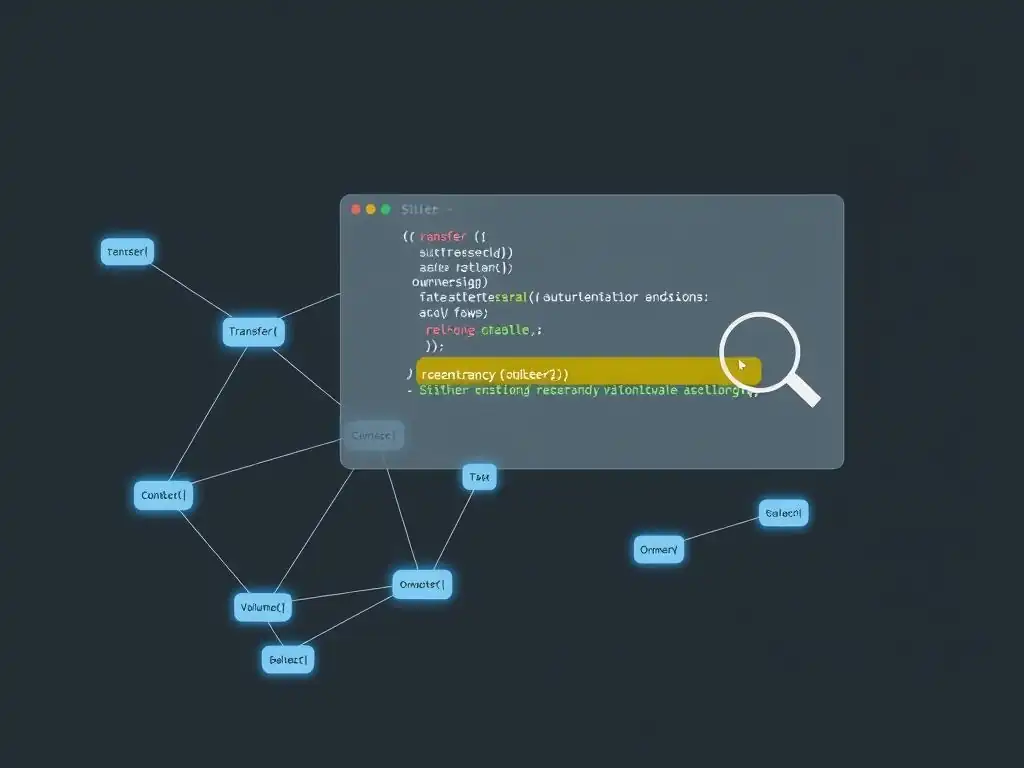
Slither's default output is designed to be human-readable, presenting findings categorized by detector. For each finding, it provides a description of the issue, the severity (e.g., High, Medium, Low, Informational), and the precise location in the source code (file name, line number, column). It often includes details about the specific contract and function involved.
Reviewing Slither's results requires understanding the implication of each finding. High-severity findings typically indicate critical security vulnerabilities like reentrancy or access control issues that must be addressed immediately. Lower severity findings might point to gas inefficiencies, code smells, or minor issues that should be considered. Like Mythril, Slither can produce false positives, so each finding requires manual verification by an auditor or developer to confirm it is a genuine issue in the specific context of the contract's logic and intended behavior.
Advantages and Disadvantages of Slither
Slither's main advantages stem from its direct analysis of Solidity source code and its framework design. Analyzing the AST and CFG allows for precise identification of code locations and a deeper understanding of the contract's logic flow. Its extensibility makes it adaptable to new types of analysis and specific project requirements. Slither is also generally faster than Mythril for initial scans due to not performing exhaustive symbolic execution by default. Its ability to detect code smells and gas optimizations is another significant benefit, broadening its utility beyond just security.
A disadvantage is that Slither requires the source code to perform its analysis effectively. While it can technically analyze bytecode, its strengths are fully realized with source code. It might also miss vulnerabilities that only manifest under complex runtime interactions or specific state configurations that are difficult to model statically, areas where symbolic execution tools like Mythril can sometimes excel. A thorough smart contract auditing tools review would recommend using both types of tools.
Mythril vs. Slither: Comparative Analysis
Choosing between Mythril and Slither, or more commonly, deciding how to use them together, depends on the specific needs of the smart contract audit. Both are powerful static analysis tools, but they approach the problem from different angles and have distinct strengths.
Mythril, with its symbolic execution engine analyzing EVM bytecode, is particularly strong at finding vulnerabilities that depend on complex execution paths and state changes, such as reentrancy and certain types of integer overflows. Slither, analyzing Solidity source code via AST and CFG, is excellent at identifying language-specific vulnerabilities, code structure issues, access control problems, and gas optimizations.
Feature Comparison: Mythril and Slither
| Feature | Mythril | Slither |
|---|---|---|
| Analysis Target | EVM Bytecode (can use source for context) | Solidity Source Code |
| Core Analysis Technique | Symbolic Execution | AST/CFG Analysis, Data/Control Flow Analysis |
| Vulnerability Detection | Reentrancy, Arithmetic, Access Control, etc. | Reentrancy, Access Control, State Vars, etc. |
| Code Quality/Smells | Limited | Yes |
| Gas Optimization | Limited/Indirect | Yes |
| Custom Detector Development | Possible (Python API) | Easier (Framework design) |
| Speed | Can be slower (symbolic execution) | Generally faster |
| Output Precision (Line No.) | Better with source, less precise with bytecode only | High (source code based) |
This table provides a high-level smart contract auditing tools review comparison of their core capabilities. Mythril focuses heavily on runtime behavior simulation, while Slither focuses on code structure and common Solidity pitfalls.
Vulnerability Detection Capabilities: Comparison
While there is overlap in the types of vulnerabilities they can detect (e.g., reentrancy, access control), their effectiveness can vary. Mythril's symbolic execution can sometimes uncover deeper, state-dependent vulnerabilities that might not be apparent from a static code structure analysis alone. For example, a subtle reentrancy vector that requires a specific sequence of calls and state manipulations might be more readily found by Mythril's path exploration.
Slither, conversely, is often more precise in identifying issues related to specific Solidity constructs, like incorrect function visibility ( public vs. external), state variable shadowing, or insecure casting. Its analysis of the CFG also helps it understand the flow of logic within functions and across function calls within the contract. A comprehensive smart contract auditing tools review suggests using both to maximize coverage.
Performance and Scalability: Efficiency Assessment
Performance and scalability are important considerations, especially for large and complex codebases. Static analysis can be computationally intensive. Mythril's symbolic execution, while powerful, can face challenges with path explosion in complex contracts, potentially leading to long analysis times or timeouts. The number of possible execution paths can grow exponentially with conditional statements and loops.
Slither, by focusing on AST and CFG analysis, is generally faster for an initial scan. It can process large codebases relatively quickly, providing a good first pass to identify common issues. However, the depth of analysis can depend on the complexity of the detectors being run. For very large projects, running the full suite of detectors with either tool might still take considerable time, but Slither often provides quicker results for a broad range of checks.
Ease of Use and Integration: User Experience Evaluation
Both tools are primarily command-line interfaces, which is standard for developer tools. Installation via pip is straightforward for both. Slither is often considered slightly easier to get started with for basic Solidity analysis due to its direct source code processing and clearer output for common issues. Its framework nature also makes writing custom checks more accessible for those familiar with Python.
Mythril's output, while detailed, can sometimes be harder to interpret for beginners, especially the symbolic execution inputs. Integrating both tools into automated workflows (like CI/CD pipelines) is feasible, though it requires scripting to parse outputs and handle results. A smart contract auditing tools review often finds that developers might start with Slither for quick checks and code quality, and then use Mythril for deeper vulnerability hunting.
Integrating Mythril and Slither into Auditing Workflow
The most effective approach to smart contract security auditing is to combine multiple methods and tools. Integrating static analysis tools like Mythril and Slither into a structured auditing workflow significantly enhances the process's efficiency and thoroughness.
These tools should not be seen as replacements for manual code review or formal verification but as powerful aids. They can perform the initial grunt work of scanning for known patterns and potential weaknesses, freeing up human auditors to focus on higher-level logic flaws, complex interactions, and novel attack vectors that automated tools might miss.
Combining Tools for Enhanced Security
Using both Mythril and Slither together provides a more comprehensive security analysis than using either tool alone. Slither can quickly identify a broad range of issues based on code structure and common Solidity mistakes, including code smells and gas inefficiencies. Mythril can then perform a deeper dive into potential runtime vulnerabilities by exploring execution paths through symbolic execution.
This layered approach ensures that contracts are checked from multiple perspectives – from source code structure and language-specific pitfalls to potential runtime exploits based on EVM behavior. Findings from one tool can also inform the investigation using the other. For instance, if Slither flags a potential reentrancy entry point, Mythril can be used to explore specific execution paths through that function to confirm exploitability.
Best Practices for Utilizing Mythril and Slither
To maximize the effectiveness of these tools, several best practices should be followed.
- Run Early and Often: Integrate tools into the development process from the beginning, not just before final deployment. Running static analysis frequently helps catch issues early when they are cheaper and easier to fix.
- Analyze All Code: Ensure that all relevant contract code, including libraries and inherited contracts, is included in the analysis.
- Use Latest Versions: Keep the tools updated to benefit from the latest vulnerability detectors and performance improvements.
- Configure Correctly: Use appropriate compiler versions and network settings when analyzing deployed contracts or code that depends on specific compiler features.
- Review All Findings: Do not automatically dismiss findings. Even low-severity warnings or informational messages can sometimes hint at underlying logic problems. Every reported issue requires manual verification by someone who understands the contract's intended behavior.
- Prioritize Findings: Focus on high-severity issues first, as they represent the most immediate risks.
- Document Findings and Fixes: Keep a record of all findings, the analysis performed, and the steps taken to remediate identified vulnerabilities.
Automating Security Checks with CI/CD
Integrating Mythril and Slither into a Continuous Integration/Continuous Deployment (CI/CD) pipeline is a highly effective way to automate security checks. Every code commit or pull request can trigger automated analysis, providing immediate feedback on new vulnerabilities introduced or existing ones fixed.
This automation ensures that a baseline level of static analysis is performed consistently across the project. The output of the tools can be integrated into reporting dashboards or used to fail builds if high-severity vulnerabilities are detected. While automated checks cannot replace a full audit, they provide a continuous security net, catching many common issues proactively and ensuring that the codebase maintains a certain security standard throughout its development. This is a critical part of a modern smart contract auditing tools review and implementation strategy.
Conclusion: Choosing the Right Tool
Selecting the "right" tool for smart contract static analysis is less about choosing one over the other and more about understanding their respective strengths and integrating them effectively into a comprehensive security strategy. Both Mythril and Slither are valuable assets in the smart contract auditing tools review landscape, offering distinct capabilities that complement each other.
Mythril's symbolic execution provides a deep analysis of potential runtime behaviors and is excellent at finding complex vulnerabilities that manifest under specific execution paths. Slither's source code analysis offers speed, precision in identifying language-specific issues, and valuable insights into code quality and gas efficiency.
Strengths and Weaknesses of Mythril and Slither
Mythril's strength lies in its powerful symbolic execution capable of uncovering subtle, state-dependent bugs. Its weakness is potential slowness and a higher rate of false positives due to the complexity of symbolic execution.
Slither's strength is its speed, precision in source code analysis, ease of extensibility, and ability to identify code quality issues and gas optimizations. Its weakness is that it might miss vulnerabilities that are only apparent through runtime interaction analysis, which is Mythril's forte. A comprehensive smart contract auditing tools review often concludes that using both tools in tandem provides the best coverage.
Future Trends in Static Analysis
The field of smart contract static analysis is continuously evolving. Future trends are likely to include improved accuracy in vulnerability detection, reduction of false positives, better support for new blockchain networks and programming languages, and enhanced integration with formal verification techniques. Machine learning might also play a role in identifying new vulnerability patterns.
As smart contracts become more complex and integral to critical infrastructure, the demand for sophisticated and efficient smart contract auditing tools review will grow. Tools will likely become more specialized while also offering better interoperability and reporting features to facilitate comprehensive security assessments.
Enhancing Security with Automated Auditing Tools
Ultimately, the goal of using automated static analysis tools like Mythril and Slither is to enhance the security of smart contracts and the decentralized applications built upon them. By automating the detection of common and complex vulnerabilities, developers and auditors can significantly reduce the risk of costly exploits.
While automated tools are not a panacea, they are indispensable components of a robust security process. Combining their capabilities with manual code review, dynamic analysis, and formal verification provides the strongest defense against smart contract vulnerabilities. A thorough smart contract auditing tools review demonstrates that integrating these tools effectively is crucial for anyone building or securing decentralized systems.
Frequently Asked Questions
What are Mythril and Slither, and why are they important?
Mythril and Slither are popular static analysis tools used for smart contract auditing. They are important because they help identify vulnerabilities and security flaws in smart contracts before deployment, reducing the risk of exploits.
How do Mythril and Slither differ in their approach to smart contract auditing?
Mythril uses a symbolic execution approach, exploring all possible execution paths. Slither focuses on static analysis techniques, such as data-flow analysis and taint tracking, to identify potential issues.
What types of vulnerabilities can Mythril and Slither typically detect?
These tools can detect a range of vulnerabilities, including reentrancy attacks, integer overflows, and timestamp dependencies. They also identify issues related to gas optimization and code quality.
Are Mythril and Slither suitable for auditing all types of smart contracts?
While they are powerful, neither tool is a silver bullet. They are most effective when used as part of a broader security audit process, alongside manual code review and dynamic testing. The complexity of the smart contract can impact the tool's effectiveness.
How can I integrate Mythril and Slither into my smart contract development workflow?
Both tools can be integrated into a CI/CD pipeline for automated security checks. Developers can use them during the development phase to proactively identify and fix vulnerabilities before deploying the smart contract to the blockchain.
Final Reflection: Securing the Future of Smart Contracts
The landscape of decentralized applications is rapidly evolving, making robust smart contract security more critical than ever. As we've explored the capabilities of Mythril and Slither, two prominent smart contract auditing tools, it's clear that proactive security measures are no longer optional, but essential for fostering trust and stability within the blockchain ecosystem. The stakes are high, and the tools we employ must be up to the challenge.
The ongoing influence of tools like Mythril and Slither extends far beyond simply identifying vulnerabilities; they shape the very culture of smart contract development, encouraging a shift towards more secure coding practices. This shift is paramount to building a future where decentralized systems are not only innovative but also resilient against malicious attacks. Security is not a product, but a process.
- Bruce Schneier. This quote encapsulates the continuous effort required to maintain secure smart contracts, a process that these tools significantly enhance.
Now, consider the role you play in this evolving landscape. Whether you're a developer, auditor, or simply an enthusiast, the principles of secure smart contract development are relevant to you. Take the lessons learned from this review and apply them to your own projects and understanding of blockchain technology. Let's collectively strive to build a more secure and trustworthy future for decentralized applications, one smart contract at a time.
Thank you for exploring Mythril and Slither! You now have a solid understanding of how these static analysis tools can help strengthen the security of your smart contracts. Are you ready to take the next step and safeguard your projects?
Here’s how you can put your new knowledge into practice:
- Download and run Mythril or Slither on one of your existing smart contracts or a publicly available contract. Discover any vulnerabilities that may be present. Hands-on experience is essential.
- Review the official documentation for both tools, paying close attention to rule sets and configuration options to enhance analysis accuracy.
- Share your findings and challenges on blockchain development forums or social media using the hashtag #SmartContractSecurity. Help grow the community’s collective knowledge!
What unexpected vulnerability did you uncover through static analysis? Share your experience in the comments below!
Leave a Reply