
Enterprise Blockchain Interoperability: Connecting Private and Public Networks


Welcome to Blockchain Trends, your compass in the rapidly evolving world of decentralized technologies. Dive into The Future of Blockchain and discover how this revolutionary technology is reshaping industries. Ever wondered how to seamlessly connect different blockchain networks to unlock unprecedented business value? This week, we explore crucial blockchain interoperability solutions for businesses, revealing how they can bridge the gap between private and public chains, fostering innovation and efficiency. Intrigued? Let's unlock the potential.
- Enterprise Blockchain Interoperability: Connecting Private and Public Networks
- Understanding Blockchain Interoperability Concepts
- Challenges in Achieving Enterprise Blockchain Interoperability
- Blockchain Interoperability Solutions for Businesses: A Comparative Analysis
- Use Cases: Real-World Applications of Enterprise Blockchain Interoperability
- Future Trends in Blockchain Interoperability
- Best Practices for Implementing Blockchain Interoperability in Enterprises
- Conclusion: The Future of Interconnected Blockchains for Enterprises
-
Frequently Asked Questions
- How can blockchain interoperability solutions benefit businesses?
- What are the key challenges in achieving blockchain interoperability for enterprises?
- What are some examples of blockchain interoperability solutions currently available for businesses?
- How does blockchain interoperability impact data security and privacy for businesses?
- What is the future outlook for blockchain interoperability solutions in the enterprise space?
- Final Reflection: Bridging the Blockchain Divide
- Unleash the Power of Connected Blockchains!
Enterprise Blockchain Interoperability: Connecting Private and Public Networks
Introduction: The Need for Seamless Blockchain Integration in Enterprises
Blockchain technology has moved beyond its origins in cryptocurrency to become a powerful tool for enterprises seeking greater transparency, efficiency, and security. However, the proliferation of different blockchain platforms – including public networks like Ethereum and private or consortium chains built on frameworks like Hyperledger Fabric or R3 Corda – has created a fragmented landscape.
Many early enterprise blockchain projects operated in isolation, fulfilling specific needs within a single company or a small consortium, but lacking the ability to interact with external networks or other internal systems. This siloed approach significantly limits the potential network effects and broader value that blockchain can deliver across complex business ecosystems.
The challenge lies in enabling these disparate networks to communicate, share data, and exchange assets in a secure and trustless manner. Without effective blockchain interoperability solutions, enterprises face significant hurdles.
Imagine a supply chain where the manufacturing stage is recorded on one private blockchain, logistics tracking uses another, and customs documentation resides on a third, while payment needs to occur using tokenized assets on a public or consortium chain. If these networks cannot seamlessly interact, the benefits of distributed ledger technology are confined within each silo, leading to manual processes, data reconciliation issues, and ultimately, hindering widespread adoption and value creation for businesses.
Addressing this fragmentation requires the development and implementation of robust cross-chain solutions. These technologies are designed to bridge the gaps between different blockchain protocols, allowing for the flow of information and value across network boundaries. The rise of these blockchain interoperability solutions for businesses is crucial for unlocking the next phase of enterprise blockchain adoption, enabling complex, multi-party workflows that span different organizations and blockchain environments, thereby realizing the full transformative potential of decentralized systems.
Understanding Blockchain Interoperability Concepts
Defining Blockchain Interoperability
Blockchain interoperability refers to the ability of different blockchain networks to exchange information, assets, and execute transactions or smart contract calls with each other. It is the digital equivalent of different languages being able to understand one another, allowing distinct systems to operate in a coordinated manner.
At a technical level, achieving interoperability involves creating mechanisms that can validate the state of one blockchain and securely relay that information or trigger actions on another, despite differences in consensus mechanisms, data structures, virtual machines, or governance models. This capability is fundamental for building interconnected applications and services that leverage the unique strengths of various blockchain platforms.
Key components enabling interoperable blockchain systems often include light clients or relay mechanisms that can verify proofs from other chains, cryptographic protocols for secure cross-chain communication, and smart contracts that manage the logic for asset transfers or data exchange. For instance, a relay might watch events on Chain A and, upon verifying their validity using cryptographic proofs, submit them to a smart contract on Chain B, which then executes a predefined action.
These components must be designed to maintain the security and trustless properties inherent in blockchain technology, even when interacting with external networks. The complexity increases significantly when connecting networks with vastly different architectures, such as a permissioned Hyperledger Fabric network needing to interact with a public Ethereum network.
The landscape of blockchain networks relevant to enterprises includes public networks (like Ethereum or Polygon), which are permissionless and transparent; private networks, which are permissioned and typically controlled by a single entity; and consortium networks (like R3 Corda or specific Hyperledger Fabric deployments), which are permissioned and governed by a group of organizations. Enterprise blockchain interoperability solutions must be capable of connecting any combination of these network types, allowing businesses to leverage the privacy and control of private/consortium chains while potentially accessing the liquidity and broader ecosystem of public chains, or connecting different private/consortium networks used by partners.
The Interoperability Landscape: A Taxonomy
One common approach to cross-chain interaction is the use of Token Bridges. These mechanisms allow users to transfer assets from one blockchain to another by locking the original asset on the source chain and issuing an equivalent "wrapped" or pegged asset on the destination chain. For example, Wrapped Bitcoin (WBTC) on Ethereum is created by locking BTC on the Bitcoin network and minting an equivalent amount of WBTC on Ethereum.
While convenient for asset mobility, bridges often involve points of centralization or complex smart contract logic, making them significant targets for security exploits. Reports indicate that hundreds of millions, potentially billions, of dollars have been lost in bridge hacks across various networks in recent years, highlighting the critical security risks associated with this type of blockchain interoperability solution.
Atomic Swaps offer a more decentralized method for exchanging assets directly between different blockchain networks without relying on a trusted third party or intermediary bridge. These swaps typically utilize cryptographic techniques like Hashed Timelock Contracts (HTLCs), which ensure that either both sides of the trade are executed simultaneously, or neither is.
If one party fails to complete their part of the swap within a specified time, the transaction is automatically canceled, and funds are returned. While providing greater security against counterparty risk compared to some bridge designs, atomic swaps are generally limited to simple asset exchanges and can be more complex to coordinate for multi-asset or complex transactional workflows required by enterprise blockchain interoperability solutions.
Sidechains and Relays represent other facets of the interoperability landscape. Sidechains are separate blockchain networks that are connected to a main blockchain (the "parent chain") in a way that allows assets to be moved back and forth. They can offer scalability or specialized functionality not present on the main chain, inheriting some degree of security from the parent chain depending on their design (e.g., merged mining, proof-of-stake with parent chain staking).
Relays, often part of broader interoperability protocols like Cosmos's IBC or Polkadot's XCMP, are mechanisms that monitor and verify the state of one chain and communicate it to another, enabling cross-chain message passing and transaction execution based on validated information. These approaches focus on enabling richer communication and application logic across chains, moving beyond simple asset transfers.
Finally, the development of standardized Blockchain Interoperability Protocols and Standards is crucial for enabling widespread, reliable cross-chain communication. Protocols like Cosmos's IBC (Inter-Blockchain Communication Protocol) define clear standards for how independent blockchains can connect and exchange messages, fostering an "internet of blockchains" where networks can plug and play.
Polkadot's architecture is inherently designed for interoperability between its connected "parachains" via the Relay Chain and Cross-Chain Message Passing (XCMP). As enterprises increasingly adopt blockchain, the need for universally accepted standards for data formats, communication protocols, and security practices across different platforms becomes paramount for creating truly integrated blockchain interoperability solutions for businesses.
Challenges in Achieving Enterprise Blockchain Interoperability
Technical Hurdles to Cross-Chain Communication
Achieving seamless communication between disparate blockchain networks presents significant technical challenges. One of the most critical is the security risk inherent in cross-chain bridges and protocols. When assets or data are moved between chains, they often pass through intermediary smart contracts or validators.
These points become potential vectors for attack. For example, vulnerabilities in bridge smart contracts or compromises of validator sets have led to massive thefts, including the exploit of the Ronin Network bridge in 2022, resulting in the loss of over $600 million, and other incidents involving bridges like Wormhole and Nomad, collectively accounting for billions in stolen assets. Designing secure, decentralized, and audited bridge mechanisms is an ongoing, complex task.
Scalability is another major hurdle for effective blockchain interoperability solutions. As the number of connected chains and the volume of cross-chain transactions increase, the infrastructure required to monitor, verify, and process these interactions can become overwhelmed. Relaying and validating proofs from multiple chains, managing state synchronization, and executing cross-chain smart contract calls can introduce latency and limit the overall throughput of interconnected networks. Ensuring that interoperability solutions can handle enterprise-scale transaction volumes, potentially involving millions of transactions daily across numerous parties and chains, requires sophisticated architectural design and optimization.
Furthermore, the complexity of implementing interoperability protocols across diverse blockchain technologies is considerable. Different blockchains use varying consensus algorithms (Proof-of-Work, Proof-of-Stake, BFT variations), virtual machines (EVM, WASM), programming languages (Solidity, Rust, Go), and data structures. Building a layer that can reliably translate and communicate between these fundamentally different systems requires deep technical expertise.
Developers must navigate issues like achieving consensus on the state of another chain, handling potential finality differences (probabilistic vs. deterministic), and ensuring consistent semantics for data and asset representation across boundaries. This technical complexity contributes to higher development costs and slower deployment cycles for enterprise blockchain interoperability solutions.
Governance and Standardization Issues
A significant non-technical challenge is the lack of universal standards for blockchain interoperability. While efforts are underway by various bodies and projects, there is no single, widely accepted framework that dictates how any two blockchains should connect. This results in a fragmented ecosystem where different interoperability solutions are often incompatible with each other.
For enterprises, this means choosing a solution might lock them into a specific ecosystem or require implementing multiple, complex bridging mechanisms to interact with different partners or public networks, hindering the vision of a truly interconnected network of business processes running on blockchain. The absence of common protocols for identity, data formatting, and cross-chain messaging complicates the development and adoption of seamless blockchain interoperability solutions for businesses.
Governance models for cross-chain networks also present complex issues. Who controls the interoperability layer? How are disputes resolved if a cross-chain transaction fails or if there's a disagreement about the state of a connected chain?
How are upgrades to the interoperability protocol managed across potentially dozens or hundreds of independent, self-governing blockchains? Centralized governance can introduce single points of failure or control, running counter to the decentralized ethos of blockchain, while decentralized governance across many stakeholders with conflicting interests can be slow and cumbersome. Establishing clear, robust, and fair governance frameworks is essential for the long-term stability and trustworthiness of blockchain interoperability solutions.
Finally, regulatory considerations add another layer of complexity for enterprises seeking interoperability. Moving tokenized assets or sensitive data across different blockchain networks, potentially spanning multiple jurisdictions, raises questions about compliance with diverse regulations such as KYC (Know Your Customer), AML (Anti-Money Laundering), and data privacy laws like GDPR or CCPA.
If a transaction starts on a permissioned chain with known participants and moves to a public chain or another permissioned chain in a different country, ensuring regulatory compliance throughout the process is challenging. Blockchain interoperability solutions for businesses must incorporate mechanisms to handle identity, permissions, and data sovereignty requirements across network boundaries to meet legal and compliance obligations.
Blockchain Interoperability Solutions for Businesses: A Comparative Analysis
Evaluating Different Enterprise Interoperability Platforms
Polkadot is designed from the ground up as an interoperability platform, aiming to connect various specialized blockchains called "parachains". Its core Relay Chain provides shared security and enables cross-chain message passing (XCMP) between connected parachains.
This architecture is particularly appealing for enterprises building dedicated application-specific chains that need to securely and efficiently communicate with other business units, partners, or public services operating on different parachains within the ecosystem. While still developing its full potential, Polkadot offers a vision of a network of interconnected, specialized blockchains sharing a common security and communication layer, presenting a powerful model for complex enterprise blockchain interoperability solutions.
Cosmos, often referred to as the "Internet of Blockchains," utilizes the Inter-Blockchain Communication (IBC) protocol to enable sovereign blockchains ("zones") to connect and exchange value and data. Unlike Polkadot's shared security model, Cosmos zones typically maintain their own security via independent consensus mechanisms, connecting to "hubs" via IBC.
This architecture allows for greater sovereignty and flexibility for individual chains, which can be attractive for enterprises or consortia that require full control over their network while still needing to interoperate with others. IBC has seen significant adoption, particularly within the decentralized finance (DeFi) space, demonstrating its capability for secure cross-chain communication and asset transfer, making it a viable option for businesses needing robust blockchain interoperability solutions.
Hyperledger Fabric, while primarily a framework for building permissioned enterprise blockchains, is highly relevant when discussing blockchain interoperability solutions for businesses because many existing enterprise deployments use Fabric. Interoperability efforts within the Hyperledger ecosystem and beyond focus on connecting different Fabric networks or bridging Fabric networks with other types of blockchains, including public ones.
Solutions like Hyperledger Cactus aim to provide a pluggable framework for connecting various DLTs, including Fabric, Corda, and Ethereum. While Fabric itself doesn't inherently provide a cross-chain protocol like IBC or XCMP, the need for enterprises using Fabric to interact with external networks drives the development of external or complementary blockchain interoperability solutions tailored to connect these prevalent permissioned environments.
Comparing Interoperability Approaches: Token Bridges vs. Atomic Swaps vs. Sidechains
Each approach to blockchain interoperability offers distinct advantages and disadvantages for businesses. Token Bridges are often the simplest for end-users and can facilitate the movement of wrapped assets between many different chains, including major public networks.
However, as discussed, they carry significant security risks due to potential vulnerabilities in smart contracts or reliance on centralized validator sets, making them less suitable for transferring high-value enterprise assets without rigorous security audits and operational controls. Despite the risks, their relative ease of implementation has made them a common, albeit cautious, choice for basic asset mobility, necessitating careful evaluation of the underlying security model when considering these blockchain interoperability solutions for businesses.
Atomic Swaps provide a more trustless method for direct peer-to-peer asset exchange between chains, eliminating the need for an intermediary bridge or wrapped assets in some cases. This can be advantageous for security-sensitive transactions. However, they are typically limited to simple swaps between two parties and two assets and require both parties to be online and cooperative within a specific time window.
Implementing complex, multi-step business logic or facilitating interactions between more than two chains using atomic swaps is significantly more challenging than with other methods. Their utility for enterprises might be limited to specific use cases like direct settlement between known parties on different chains, rather than broad cross-chain application interoperability.
Sidechains and interoperability protocols leveraging relays (like IBC or XCMP) generally offer more robust and versatile blockchain interoperability solutions. Sidechains can extend the functionality or scalability of a main chain, enabling complex operations off-chain while maintaining a link to the main chain for security or finality. Protocols like IBC and XCMP are designed to enable rich message passing and cross-chain application logic, allowing smart contracts on one chain to interact with those on another. While technically more complex to implement and potentially requiring participants to join a specific ecosystem (like Polkadot) or adopt a specific protocol (like IBC), they offer greater potential for building sophisticated, interconnected enterprise applications that go beyond simple asset transfers, addressing the need for seamless data and process flow across different blockchain networks. Choosing the right blockchain interoperability solutions for businesses depends heavily on the specific requirements: asset mobility, data sharing, or complex cross-chain process execution.
Use Cases: Real-World Applications of Enterprise Blockchain Interoperability
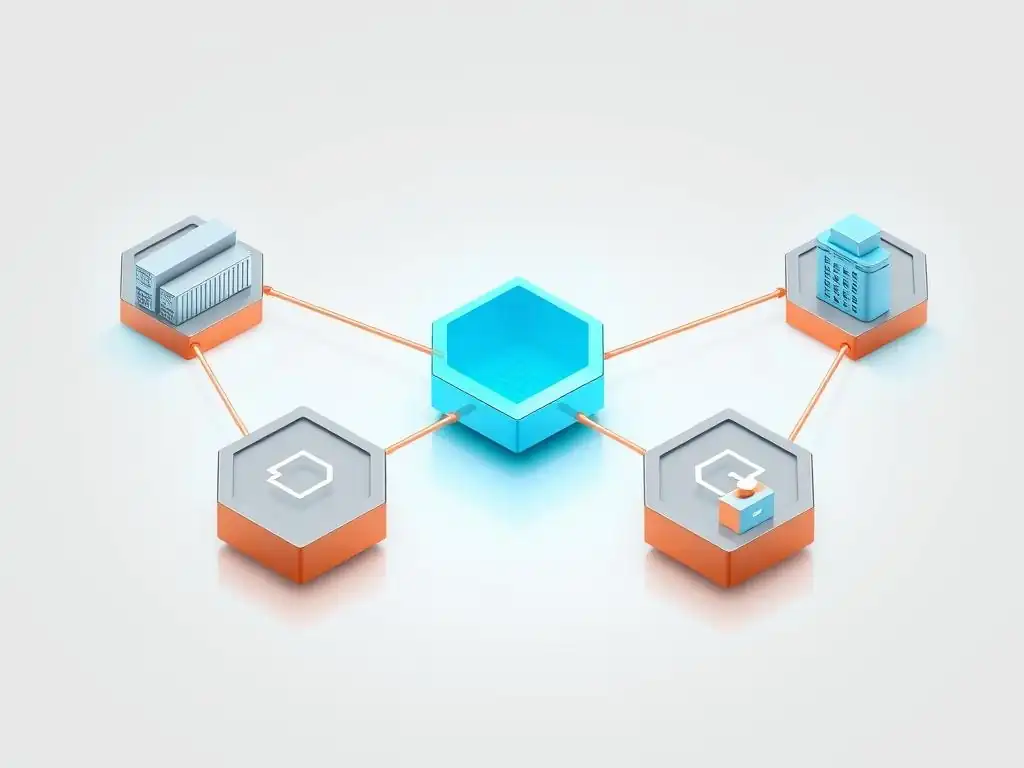
Supply Chain Management: Enhancing Traceability and Transparency
Supply chains are inherently multi-party, often involving manufacturers, logistics providers, distributors, customs agencies, and financiers, each potentially using different internal systems or even different blockchain platforms. Achieving end-to-end visibility and traceability requires connecting these disparate systems.
Blockchain interoperability solutions enable a manufacturer recording goods leaving the factory on their private Hyperledger Fabric network to share relevant, permissioned data with a logistics company tracking shipment on a different private or consortium chain. This data can then be accessed by customs authorities on yet another network and linked to payment triggers on a financial institution's network, all without needing a single, monolithic blockchain or relying on manual data reconciliation between silos.
Implementing interoperable logistics platforms can significantly improve efficiency. For instance, a bill of lading tokenized on one blockchain could trigger automated smart contract actions on another blockchain used by a financing partner when certain conditions (verified via cross-chain communication) are met, such as goods clearing customs.
This reduces delays, minimizes paperwork, and enhances trust among parties who might not have a direct relationship but can rely on the verified data shared across interconnected blockchain networks. While specific public data on cost savings from fully interoperable supply chain solutions is still emerging, early enterprise blockchain pilots in supply chain have reported potential reductions in administrative costs and disputes, and interoperability is key to scaling these benefits across complex, multi-stakeholder networks.
Financial Services: Streamlining Cross-Border Payments
Cross-border payments involve multiple intermediaries, legacy systems, and complex reconciliation processes, leading to high costs and slow settlement times, often taking several days. Financial institutions are exploring blockchain and tokenized assets to improve this, but different banks or payment providers might use different DLT platforms (e.g., some on R3 Corda, others using tokenized fiat on a permissioned Ethereum variant, or stablecoins on public networks).
Blockchain interoperability solutions for businesses in finance allow for the seamless transfer of tokenized value between these distinct networks. A bank on a Corda network could send tokenized fiat to a corporate treasury on a Fabric network, or a payment processor on a public chain could settle with an institution on a permissioned network.
Facilitating cross-chain asset transfers for financial institutions can dramatically reduce transaction costs and improve speed. By bypassing traditional correspondent banking layers, fees can be reduced, and settlement times can potentially be brought down from days to minutes or hours.
While precise, publicly available figures for cost reduction via fully interoperable blockchain systems are still maturing, industry estimates for blockchain-based payments often project significant savings, ranging from 40% to 80% for certain types of transactions compared to traditional methods. The ability to securely and reliably move tokenized assets like fiat currencies, securities, or commodities across different regulated blockchain networks is a key driver for the adoption of blockchain interoperability solutions in the financial sector.
Healthcare: Secure Data Sharing and Interoperability
Healthcare data is notoriously fragmented, stored in disparate systems across hospitals, clinics, laboratories, and pharmacies, often with limited ability to share information securely and efficiently. This siloed nature hinders patient care coordination, medical research, and public health initiatives. Blockchain technology offers a path towards secure, patient-controlled health records, but different healthcare providers might adopt different blockchain platforms or data models.
Blockchain interoperability solutions are essential to enable secure sharing of patient data across these different providers and systems, regardless of the underlying technology. A patient's record stored on a private hospital blockchain could be securely shared (with patient consent) with a specialist at a different clinic using a different blockchain, or with a pharmacy network.
Improving data integrity and interoperability in healthcare systems is a critical benefit. Blockchain ensures the immutability and auditability of medical records, enhancing trust in the data. Cross-chain capabilities allow researchers to access aggregated, anonymized data from multiple healthcare providers and research institutions, potentially on different blockchain networks, while maintaining patient privacy and complying with regulations like HIPAA.
This can accelerate the discovery of new treatments and improve population health analysis. A report by Deloitte in 2020 highlighted that interoperability is a key factor for blockchain to unlock its full potential in healthcare, enabling use cases like clinical trials, supply chain for pharmaceuticals, and health data exchange across diverse systems.
Future Trends in Blockchain Interoperability
The Evolution of Cross-Chain Technologies
The field of blockchain interoperability is rapidly evolving, driven by the increasing demand for interconnected decentralized applications and enterprise solutions. We are seeing the emergence of more sophisticated protocols that aim to improve upon earlier bridge designs, focusing on enhanced security and decentralization.
This includes research into and implementation of light client-based verification methods, which require less trust in intermediaries, and the application of advanced cryptographic techniques like zero-knowledge proofs and optimistic rollups to validate cross-chain transactions more efficiently and securely. These advancements are critical for building trust in blockchain interoperability solutions for businesses handling sensitive data and high-value assets.
Furthermore, efforts towards standardization are gaining momentum. Various industry bodies and open-source initiatives are working towards defining common protocols and APIs for cross-chain communication, data formats, and identity management across different blockchain platforms. As these standards mature and gain wider adoption, it will become easier for enterprises to integrate different blockchain networks and build truly seamless multi-chain applications. The role of AI and Machine Learning is also being explored, potentially for monitoring cross-chain traffic to detect fraudulent activity, optimizing routing paths for cross-chain transactions, or predicting network congestion to improve the reliability and performance of blockchain interoperability solutions.
The Impact of Interoperability on Enterprise Blockchain Adoption
The widespread availability of robust and secure blockchain interoperability solutions is poised to be a major catalyst for enterprise blockchain adoption. By breaking down the silos between different networks, interoperability enables businesses to move beyond isolated pilot projects and integrate blockchain technology into core business processes that span multiple departments, organizations, and even industries.
This fosters a network effect, where the value of each connected blockchain increases as more participants and networks join the interconnected ecosystem. This interconnectedness drives innovation by allowing enterprises to leverage the unique capabilities of specialized blockchains – for instance, using a high-throughput private chain for internal processes while interacting with a public chain for tokenized asset settlement or identity verification.
Ultimately, effective blockchain interoperability solutions for businesses will create new business models and opportunities. Enterprises can collaborate more effectively with partners and suppliers operating on different platforms, participate in broader decentralized marketplaces, and build novel applications that leverage data and assets from multiple blockchain sources.
This opens up possibilities for creating integrated digital twins that combine data from manufacturing, logistics, and sales networks; enabling complex financial instruments that span multiple tokenized asset classes on different chains; or building truly decentralized identity and data management systems that work across various platforms. The future of enterprise blockchain is intrinsically linked to its ability to be seamlessly interconnected.
Best Practices for Implementing Blockchain Interoperability in Enterprises
Planning and Strategy for Cross-Chain Integration
Before implementing any blockchain interoperability solution, enterprises must define clear business objectives. What specific problems are you trying to solve with cross-chain communication? Are you aiming to transfer assets, share data, synchronize states, or enable complex cross-chain smart contract interactions? Clearly articulating these goals will guide the selection of the most appropriate technology and approach. A thorough assessment of the technical requirements, including transaction volume, latency tolerance, and required security levels, is also crucial. Enterprises should evaluate their internal technical capabilities and potentially seek external expertise for complex integrations.
Assessing the risks and benefits of different blockchain interoperability solutions is a critical step. This involves evaluating the security model of bridges, the maturity and adoption of interoperability protocols like IBC or XCMP, the complexity of integrating with existing systems, and the long-term viability and governance of the chosen solution.
A pilot project approach is often recommended, starting with a limited scope to test the chosen interoperability solution in a controlled environment with a small number of trusted partners. This allows the enterprise to gain practical experience, identify potential issues, and refine the implementation strategy before scaling up to broader deployment or connecting with a wider network of participants.
Security Considerations for Interoperable Blockchains
Given the significant security risks associated with cross-chain interactions, particularly with bridges, implementing robust security measures is paramount for any enterprise blockchain interoperability solution. This includes conducting rigorous security audits of all smart contracts and protocols involved in the interoperability layer by reputable third parties. Enterprises should also implement strong operational security practices, such as multi-signature requirements for bridge operations, secure key management systems, and continuous monitoring for suspicious activity or anomalies in cross-chain traffic. Treating the interoperability layer as a critical piece of infrastructure, subject to the highest security standards, is essential.
Regular audits and vulnerability assessments of the interoperability infrastructure and the connected blockchain networks are necessary to identify and mitigate potential security weaknesses. Establishing clear incident response plans is also vital. In the event of a security breach or failure in the interoperability layer, the enterprise must have predefined procedures for halting operations, assessing the impact, communicating with connected parties, and recovering from the incident.
Relying solely on the security of individual connected chains is insufficient; the interoperability layer itself introduces new attack surfaces that must be actively protected. Ensuring the security of blockchain interoperability solutions for businesses requires a proactive and multi-faceted approach.
Conclusion: The Future of Interconnected Blockchains for Enterprises
The Importance of Blockchain Interoperability for Enterprise Success
Blockchain interoperability is rapidly evolving from a theoretical concept to a practical necessity for enterprises seeking to leverage the full power of distributed ledger technology. The era of isolated blockchain pilots is giving way to a future where interconnected networks enable complex, multi-party business processes that span organizational and technological boundaries.
Without the ability for different blockchain platforms – whether public, private, or consortium – to seamlessly communicate and exchange value, the potential of blockchain to transform industries like supply chain, finance, and healthcare remains significantly constrained. Interoperability is the key to unlocking the network effects required for widespread adoption and value creation in enterprise settings.
Successful implementation of robust blockchain interoperability solutions is critical for driving innovation and creating new opportunities in the decentralized world. By enabling the secure and reliable flow of data and assets across previously disconnected systems, enterprises can build more efficient, transparent, and resilient business networks.
This allows for the creation of novel applications and business models that leverage the unique strengths of different blockchain platforms and participants. As the technology matures and standards emerge, blockchain interoperability solutions for businesses will become increasingly sophisticated, paving the way for a truly interconnected ecosystem of decentralized applications that power the next generation of global commerce and collaboration.
Frequently Asked Questions
How can blockchain interoperability solutions benefit businesses?
Blockchain interoperability solutions allow businesses to connect their private blockchain networks with public networks, facilitating secure data sharing and collaboration across different platforms. This enhances efficiency and opens up new business opportunities.
What are the key challenges in achieving blockchain interoperability for enterprises?
Some key challenges include differing blockchain protocols, security concerns, and the need for standardized data formats. Overcoming these hurdles is crucial for seamless data exchange.
What are some examples of blockchain interoperability solutions currently available for businesses?
Examples include cross-chain bridges, sidechains, and interoperability protocols like Polkadot and Cosmos. These solutions enable data transfer and asset exchange between blockchains.
How does blockchain interoperability impact data security and privacy for businesses?
Implementing robust security protocols and access controls is essential to maintain data security and privacy during cross-chain transactions. Secure communication channels are also critical.
What is the future outlook for blockchain interoperability solutions in the enterprise space?
The future looks promising, with increasing adoption of interoperable blockchain solutions that drive greater efficiency and innovation in various industries. Standardization efforts will play a key role.
Final Reflection: Bridging the Blockchain Divide
The exploration of enterprise blockchain interoperability solutions for businesses reveals a critical juncture in the evolution of distributed ledger technology. The ability to seamlessly connect private and public networks is no longer a futuristic aspiration, but a present-day necessity for unlocking the true potential of blockchain. The silos that currently exist hinder widespread adoption and limit the transformative power of this technology, making interoperability the key to unlocking a new era of decentralized collaboration and innovation.
This journey into blockchain interoperability has profoundly shaped our understanding of the evolving digital landscape. It underscores the vital importance of collaboration and standardization in fostering a truly interconnected blockchain ecosystem. Without these elements, the promise of enhanced transparency, efficiency, and security remains largely unfulfilled. As we navigate this complex terrain, it's crucial to remember the words of Don Tapscott: The blockchain is not only disrupting old business models, but it’s also creating new ones.
This quote serves as a constant reminder of the transformative potential that lies within our grasp, provided we embrace interoperability as a core principle.
Now, consider how you can contribute to this evolving landscape. Reflect on the ways you can advocate for open standards, promote collaboration between different blockchain platforms, and champion the development of interoperable solutions within your own sphere of influence. The future of blockchain depends on our collective commitment to building bridges, not walls. Let us all strive to create a more interconnected and accessible blockchain ecosystem, one that empowers businesses and individuals alike to thrive in the decentralized future.
Unleash the Power of Connected Blockchains!
Thank you for exploring the future of enterprise blockchain interoperability with us. We hope this article has highlighted how connecting private and public networks can drive innovation and improve efficiency. Now, it's time to turn that knowledge into action!
Here are some ways you can deepen your understanding and make an impact:
- Dive Deeper: Start outlining potential strategies for enabling interoperability within your organization, focusing on key data flows and integration points. This is your immediate next step!
- Explore: Identify possible blockchain projects to test interoperability challenges in a controlled environment.
- Share: Discuss the insights from this article with your team or network using the hashtag #BlockchainTrends to foster collaborative solutions.
What initial steps will you take to bridge the gap between your private and public blockchain networks? Share your ideas in the comments below!
Leave a Reply