
APR vs. APY in Yield Farming: Demystifying Return Metrics for DeFi Investors

Welcome to Blockchain Trends, your compass in the rapidly evolving world of decentralized technologies! Are you navigating the complex landscape of DeFi and seeking clarity on how to maximize your returns? Dive in as we unravel the intricacies of Yield Farming APR and APY, demystifying these crucial metrics to empower your investment decisions. Understanding the difference could be the key to unlocking significantly higher profits. Let's explore!
Understanding Yield Farming Returns: APR vs. APY
- Understanding Yield Farming Returns: APR and APY Explained
- APR (Annual Percentage Rate) in Yield Farming: A Simple View
- APY (Annual Percentage Yield) in Yield Farming: Compounding for Higher Returns
- APR vs. APY: A Side-by-Side Comparison for Yield Farmers
- Beyond APR and APY: Other Factors Affecting Yield Farming Profitability
- Choosing the Right Metric: Making Informed Decisions in Yield Farming
- Conclusion: Mastering APR and APY for Successful Yield Farming Investments
-
Frequently Asked Questions
- What are APR and APY, and how do they differ in the context of yield farming?
- Why is understanding APR and APY crucial for DeFi investors involved in yield farming?
- Which metric, APR or APY, provides a more accurate representation of potential returns in yield farming?
- How does the frequency of compounding affect the APY in yield farming?
- Where can DeFi investors find reliable APR and APY information for yield farming platforms?
- Final Reflection: Navigating the Yield Farming Landscape
- Dive Deeper: Unlock Your Yield Farming Potential!
Understanding Yield Farming Returns: APR and APY Explained
What is Yield Farming and Why Understanding Returns Matters?
Yield farming is a decentralized finance (DeFi) strategy that involves locking up or staking crypto assets to generate high returns or rewards, typically in the form of additional cryptocurrency. Participants, often called yield farmers, provide liquidity to decentralized exchanges (DEXs) or lending protocols, enabling trading and borrowing activities. In return for providing this essential service, they earn fees or newly minted tokens.
The profitability of yield farming hinges on understanding and accurately calculating potential returns, which are commonly expressed using metrics like APR and APY. Without a clear grasp of what these figures represent, investors can easily misjudge opportunities and risks in the volatile DeFi landscape.
Grasping the nuances of yield farming APR APY is crucial because the advertised rates can look highly attractive, sometimes reaching hundreds or even thousands of percent. However, these figures can be misleading if not interpreted correctly. A high APR doesn't automatically translate to a high APY, and the actual return can be significantly impacted by factors like compounding frequency, network costs, and market volatility.
For instance, a pool advertising 500% APR might only yield a fraction of that in practice if rewards aren't regularly compounded or if impermanent loss erodes the principal. Educated investors use these metrics as starting points but delve deeper to estimate their true potential earnings from yield farming returns.
The Importance of Accurate Return Calculation in DeFi
Accurate calculation of potential returns is paramount in DeFi yield farming due to the dynamic and often complex nature of these protocols. Unlike traditional finance where interest rates are usually fixed and predictable, yield farming rates fluctuate constantly based on factors such as the total value locked (TVL) in the protocol, trading volume, and the price of reward tokens. Relying solely on a headline figure without understanding its basis (APR or APY) and how it might change can lead to significant miscalculations of profitability. A seemingly high rate could plummet as more farmers join a pool, diluting rewards.
Furthermore, the profitability of yield farming APR APY strategies is heavily influenced by costs and risks unique to DeFi. Transaction fees (gas fees on networks like Ethereum) can eat into profits, especially for smaller capital amounts or frequent compounding.
Impermanent loss, a risk inherent in providing liquidity to volatile pairs, can reduce the actual return, sometimes even resulting in a net loss despite earning yield. Therefore, investors must not only understand the difference between APR and APY but also integrate these costs and risks into their return estimations to make truly informed decisions about where to allocate their capital in the DeFi ecosystem.
APR (Annual Percentage Rate) in Yield Farming: A Simple View
Defining APR in the Context of DeFi and Crypto
APR, or Annual Percentage Rate, in the context of DeFi and crypto yield farming, represents the simple annual rate of return on an investment, without taking into account the effects of compounding. It is typically calculated by annualizing the periodic rate of return earned over a specific period (e.g., daily, weekly, or monthly).
For example, if a yield farming pool pays out rewards equivalent to 0.1% of the staked capital per day, the simple annual rate (APR) would be 0.1% * 365 days = 36.5%. This figure provides a straightforward measure of the potential return over a year if the earned rewards are not reinvested back into the farming pool.
In many yield farming interfaces, the displayed APR indicates the rate at which rewards are generated based on the current conditions, such as the amount of liquidity provided and the volume of transactions or loans facilitated by the protocol. It serves as a baseline metric to compare different farming opportunities on a simple, non-compounded basis.
While easy to understand at face value, focusing solely on the APR can give an incomplete picture of the total potential earnings, especially for long-term yield farming investments. It essentially tells you the return if you withdraw your earned tokens as soon as they are available and do not add them back to the staked principal.
How APR is Calculated in Yield Farming Protocols
The calculation of APR in yield farming protocols varies depending on the specific mechanics of the protocol and the source of yield. Generally, it involves determining the amount of rewards earned over a specific, short period (e.g., an hour or a day) and then extrapolating that earning rate over a full year (365 days).
For instance, in a liquidity pool earning trading fees, the protocol might track the total fees generated by a specific pool in the last 24 hours, divide that by the total value locked (TVL) in the pool to get a daily rate, and then multiply that daily rate by 365 to get the APR.
Protocols often display a dynamic APR because the "Rewards Earned in Period" (which can come from fees, token emissions, or a combination) and the "Principal Invested" (TVL) are constantly changing. For example, if a pool with $10 million TVL generates $10,000 in fees and token emissions over 24 hours, the daily rate is $10,000 / $10,000,000 = 0.1%.
The APR would then be 0.1% * 365 = 36.5%. This calculation provides the annualized return based on the current performance, highlighting that the displayed APR is often a snapshot and not a guaranteed fixed rate for the entire year of yield farming.
Limitations of Using APR Alone for Yield Farming Decisions
While APR offers a simple annual rate, relying solely on it for yield farming decisions presents several significant limitations. The most prominent limitation is that APR does not account for the power of compounding. If a yield farmer reinvests the earned rewards back into the farming pool, the principal grows, and subsequent rewards are earned on a larger sum.
This compounding effect can dramatically increase the total return over time, and APR completely ignores this potential upside. An opportunity with a lower APR but high compounding frequency might actually yield more over a year than one with a higher APR where compounding isn't factored in or is difficult/costly to perform.
Another limitation is that the displayed APR in DeFi is often a variable rate, subject to change based on protocol activity and participation. High APRs tend to attract more capital, which increases the TVL and typically dilutes the rewards among more participants, causing the APR to decrease. Conversely, if capital leaves a pool, the APR might increase.
Therefore, the rate displayed when an investor enters a position is unlikely to be the rate earned over the entire year. Using APR alone without considering its volatility and the potential for compounding can lead investors to overestimate their potential earnings and make suboptimal choices when comparing different yield farming APR APY opportunities.
APY (Annual Percentage Yield) in Yield Farming: Compounding for Higher Returns
Defining APY and its Significance in DeFi
APY, or Annual Percentage Yield, provides a more comprehensive measure of return in DeFi yield farming because it includes the effect of compounding. It represents the actual rate of return earned over a year, assuming that interest or rewards are reinvested back into the principal, thereby earning additional rewards on the accumulated amount. This is particularly significant in yield farming where rewards are often generated continuously (e.g., per block or per second) and can be reinvested frequently. APY essentially shows what the APR would be if the returns were compounded over the year.
The significance of APY in yield farming lies in its ability to reflect the true earning potential of a strategy that involves reinvesting profits. Even a modest APR can result in a substantially higher APY if compounding occurs frequently. For example, an APR of 100% compounded daily results in an APY of approximately 171%. This stark difference highlights why APY is a critical metric for investors looking to maximize their returns through compounding strategies. Comparing yield farming APR APY side-by-side reveals the power of reinvestment and helps investors choose opportunities that align with their strategy, particularly for longer-term holds.
The Impact of Compounding Frequency on APY in Yield Farming
The frequency at which rewards are compounded has a direct and significant impact on the resulting APY. The more often rewards are reinvested, the greater the compounding effect, and thus the higher the APY will be relative to the APR. Compounding can occur daily, hourly, or even per transaction block on some blockchains. For example, an APR of 100% compounded annually remains 100% APY. However, if compounded semi-annually, it becomes approximately 105% APY. Compounded quarterly, it's about 109% APY. Compounded monthly, around 116% APY. Daily compounding pushes the APY to about 171%.
This exponential relationship means that yield farming protocols that allow for or facilitate frequent compounding (either automatically or manually) can offer much higher effective returns than those that do not, even if the base APR is similar. The practical APY achieved by a yield farmer also depends on their ability and willingness to compound. Manual compounding incurs transaction fees (gas costs), which must be weighed against the benefit of a higher APY.
For instance, on the Ethereum network, high gas fees might make very frequent compounding impractical or unprofitable for smaller capital amounts, effectively reducing the achievable APY below the theoretical maximum. This is a key consideration when evaluating yield farming APR APY metrics.
How APY Differs from APR: A Key Distinction for Investors
The fundamental difference between APY and APR in yield farming boils down to the inclusion of compounding. APR represents a simple, non-compounded annual interest rate. It tells you how much you would earn over a year if you never reinvested your earnings. APY, on the other hand, represents the effective annual rate with compounding factored in. It tells you how much you would earn over a year if you consistently reinvested your earnings back into the position. The formula relating APY to APR and compounding frequency is:
where 'n' is the number of compounding periods per year. If compounding happens daily, n=365. If hourly, n=8760 (24*365). This formula clearly shows that APY will always be equal to or greater than APR (unless compounding is annual, where n=1, then APY=APR).
For investors comparing yield farming APR APY figures, understanding this distinction is vital. A protocol advertising a 100% APR might offer significantly less actual return than another advertising a 80% APY compounded daily, once the power of reinvestment is considered. Always look for both metrics or understand how APY is calculated from the provided APR and compounding frequency.
APR vs. APY: A Side-by-Side Comparison for Yield Farmers
Key Differences Between APR and APY in DeFi Explained
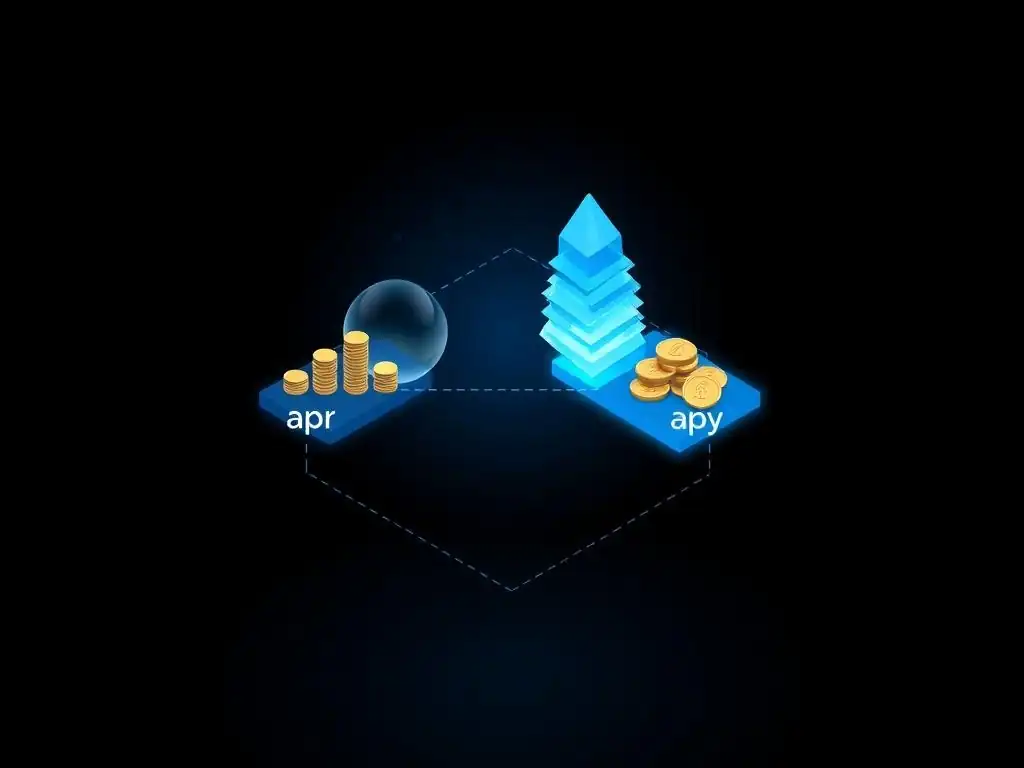
The core difference between APR and APY in DeFi yield farming is simple yet critical: APR is the simple annual rate, while APY is the effective annual rate that accounts for compounding. Think of APR as the raw return rate if you take your rewards out immediately. It's calculated by annualizing the rate earned over a short period. APY, conversely, shows the return if you reinvest those earnings, allowing them to generate further returns. This difference becomes more pronounced with higher rates and more frequent compounding.
| Feature | APR (Annual Percentage Rate) | APY (Annual Percentage Yield) |
|---|---|---|
| Compounding | Does not include compounding | Includes compounding |
| Calculation | Simple annualization of periodic rate | Effective rate considering compounding frequency |
| Represents | Return if earnings are not reinvested | Return if earnings are reinvested |
| Value Comparison | Always less than or equal to APY (n > 1) | Always greater than or equal to APR (n >= 1) |
| Use Case | Baseline comparison, simple rate estimation | True potential return with reinvestment strategy |
Understanding this table is fundamental for anyone navigating yield farming APR APY metrics. A protocol might prominently display a high APR to attract attention, but the actual return achievable through compounding (the APY) might be the more relevant figure for investors planning to reinvest their profits. It's not just about the rate itself, but how that rate translates into actual wealth accumulation over time through the power of compounding.
When to Use APR vs. APY for Evaluating Yield Farming Opportunities
Deciding whether to focus on APR or APY depends heavily on an investor's strategy and timeframe in yield farming. APR is most useful for:
- Short-term strategies: If an investor plans to enter and exit a position quickly (e.g., hours or days), the impact of compounding is minimal. APR provides a good estimate of the return over that short period, annualized for comparison.
- Comparing protocols with very different compounding mechanisms: If one protocol rewards are difficult to compound (e.g., manual claim with high gas fees), and another has automatic compounding, comparing their base APRs might be a starting point before factoring in the practical APY achievable after costs.
- Simple interest understanding: For a basic, non-compounded return figure, APR is the standard.
APY, on the other hand, is the preferred metric for:
- Long-term strategies: For investors planning to stake assets for weeks, months, or a year, compounding significantly boosts returns. APY provides a realistic projection of earnings assuming regular reinvestment.
- Protocols with automatic or low-cost compounding: If a protocol automatically compounds rewards or gas fees are low enough to make frequent manual compounding viable, APY accurately reflects the higher earning potential.
- Comparing opportunities where compounding is a core part of the strategy: If an investor intends to maximize returns by reinvesting, APY is the only metric that captures this.
Ultimately, savvy yield farming investors consider both yield farming APR APY. They use APR as a baseline and APY to understand the potential if they compound, always factoring in the practical costs and feasibility of compounding in the specific protocol and blockchain environment.
Real-World Examples: Comparing APR and APY in Specific DeFi Protocols [Uniswap, PancakeSwap]
Let's look at illustrative examples from prominent DEXs like Uniswap (on Ethereum or L2s) and PancakeSwap (on Binance Smart Chain, now BNB Chain) to highlight the difference between yield farming APR APY.
- Uniswap V3 (Illustrative): Uniswap V3 liquidity providers earn trading fees. These fees are added to their position and are not automatically compounded into the principal to earn more fees. The reported rate for a position is often an annualized percentage based on recent trading volume, which is akin to an APR. For example, a pool might show a "7-day APR" of 20%. This means based on the last week's volume, you would earn at a 20% annual rate if you didn't touch your position (and assuming volume stays constant). To achieve compounding, you'd have to manually withdraw earned fees and add them back to your liquidity position, incurring gas fees. Therefore, the displayed rate is essentially an APR, and the achievable APY depends on manual compounding frequency and gas costs. If gas costs are high on Ethereum mainnet, the practical APY might be only slightly higher than the APR for many users.
- PancakeSwap (Illustrative): PancakeSwap's "Syrup Pools" often display both APR and APY for staking CAKE or other tokens. For instance, a CAKE staking pool might show an APR of 50% and an APY of 64% (assuming daily compounding). This clearly shows the effect of compounding the CAKE rewards earned. For liquidity farming pools (earning CAKE by providing LP tokens), PancakeSwap might also display APR. To achieve APY, users need to manually "harvest" their CAKE rewards and "compound" them by adding them back to the staking pool or using them to provide more liquidity. While BSC (BNB Chain) historically had lower gas fees than Ethereum mainnet, making frequent compounding more feasible, it still requires manual action and cost. The difference between the shown APR and APY on platforms like PancakeSwap directly quantifies the benefit of compounding for yield farming.
These examples demonstrate that protocols present return metrics differently, and understanding whether a figure represents APR or APY, and how compounding works (or doesn't) in that specific protocol, is vital for accurate yield farming return estimation.
Beyond APR and APY: Other Factors Affecting Yield Farming Profitability
Impermanent Loss: A Critical Risk Factor in Yield Farming
Beyond the simple comparison of yield farming APR APY, investors must understand impermanent loss, a significant risk when providing liquidity to decentralized exchanges (DEXs). Impermanent loss occurs when the price of the assets in a liquidity pool changes relative to when you deposited them. The greater the divergence in price, the greater the impermanent loss.
If you had simply held the assets in your wallet (hodled), their combined value would be higher than the value of your share in the liquidity pool after experiencing impermanent loss. This loss is "impermanent" because it only becomes realized if you withdraw your liquidity. If the asset prices return to their original ratio, the impermanent loss disappears.
For example, suppose you provide $1000 worth of liquidity to a pool with 50% ETH ($500) and 50% DAI ($500), with ETH priced at $2000. If ETH price doubles to $4000 while DAI remains stable, an arbitrageur will rebalance the pool. When you withdraw, your share might now be worth $1414 (roughly 353 DAI and 0.177 ETH), whereas if you had just held the assets ($500 DAI + $1000 ETH), they would be worth $1500.
You've experienced an impermanent loss of $86. The yield earned from trading fees or token rewards must exceed this impermanent loss for the yield farming position to be profitable compared to simply holding the assets. Many high-APR/APY pools involve volatile assets, making impermanent loss a constant threat that can negate or significantly reduce advertised returns.
Gas Fees and Transaction Costs: Minimizing Impact on Returns
Gas fees, the transaction costs required to perform operations on a blockchain (like depositing liquidity, claiming rewards, or compounding), are another critical factor that directly impacts the net profitability of yield farming. On networks like Ethereum mainnet, gas fees can be substantial, especially during periods of high network congestion. Every interaction with a yield farming protocol – approving tokens, depositing, harvesting rewards, compounding, withdrawing – costs gas.
For instance, claiming and compounding rewards daily on Ethereum might cost $50-$200+ per transaction depending on gas prices. If a yield farmer has only $1000 invested and earns $5 per day in rewards, paying $100 to compound makes daily compounding unprofitable. In such cases, the theoretical APY based on daily compounding is unattainable.
Investors on networks with lower fees, like Polygon, Binance Smart Chain (BNB Chain), or Solana, face lower transaction costs, making frequent compounding more feasible and allowing them to potentially achieve an APY closer to the theoretical maximum calculated from the APR. Minimizing these costs, perhaps by timing transactions for off-peak hours or using Layer 2 solutions, is crucial for maximizing actual yield farming returns and making the APY figures more representative of reality.
Smart Contract Risks and Security Considerations in DeFi
Investing in yield farming protocols inherently involves smart contract risk. These protocols are built on complex code deployed on blockchains. Despite audits, smart contracts can contain vulnerabilities or bugs that could lead to the loss of deposited funds. Examples of such incidents include re-entrancy attacks, flash loan attacks, or simple coding errors that drain pool liquidity. The decentralized nature of DeFi means there is typically no central authority to recover lost funds in case of such an exploit.
Beyond coding risks, there are also risks associated with the protocol's governance, oracle dependencies, and potential rug pulls (where developers abandon a project and steal user funds). Evaluating the security posture of a protocol, checking for recent audits, understanding the team behind the project, and assessing the overall reputation and TVL can help mitigate these risks, though they cannot be entirely eliminated.
A high yield farming APR APY might sometimes reflect not just high demand or rewards, but also higher perceived risk, as investors demand greater compensation for potential security vulnerabilities. Due diligence on the protocol's security is as important as analyzing the return metrics.
Choosing the Right Metric: Making Informed Decisions in Yield Farming
Evaluating Risk-Adjusted Returns in DeFi
Making informed decisions in yield farming requires moving beyond just the headline yield farming APR APY figures and evaluating risk-adjusted returns. This means considering the potential return in relation to the various risks involved, such as impermanent loss, smart contract vulnerabilities, and token price volatility. A pool offering a 500% APY might seem attractive, but if it involves a highly volatile new token pair on an unaudited protocol, the risk of significant impermanent loss or even total loss of principal due to an exploit could make the true risk-adjusted return very low, or even negative.
Conversely, a pool offering a more modest 50% APY on blue-chip assets (like ETH/DAI) on a well-established, audited protocol might offer a higher risk-adjusted return. Tools or mental models that attempt to quantify potential impermanent loss based on historical price volatility can be helpful. Investors should ask themselves: "Given the potential downsides (impermanent loss, hacks, token price drops), is the advertised yield farming APR APY sufficient compensation for the risk I'm taking?" Focusing solely on maximizing the nominal return rate without accounting for risk is a common pitfall in DeFi.
Using APR and APY in Conjunction for a Comprehensive View
The most effective approach for yield farming investors is to use both APR and APY in conjunction, rather than choosing one over the other exclusively. APR provides the base rate of return, useful for understanding the raw earning potential and comparing it across different types of yield-generating activities. APY builds upon this by showing the potential uplift from compounding, which is crucial for strategies focused on long-term growth through reinvestment.
When evaluating an opportunity, first look at the APR to understand the simple annual rate. Then, look at the APY (if provided) or calculate it yourself based on the APR and the compounding frequency offered by the protocol. Compare the APR and APY figures: a large difference indicates a strong benefit from compounding.
Consider the practicalities of achieving that APY, factoring in gas fees and the effort required for manual compounding. Use the APR to estimate short-term gains and the APY to project long-term growth if you actively compound. This combined view gives a much richer understanding of the potential yield farming returns.
Tools and Resources for Tracking and Calculating Yield Farming Returns [DeFi Rate, Vfat.tools]
Several tools and resources exist to help yield farming investors track and calculate their returns, providing valuable insights beyond the raw yield farming APR APY figures advertised by protocols. Websites like DeFi Rate offer curated lists of DeFi protocols and their advertised rates, though users should always verify these directly with the protocol.
More advanced tools, such as Vfat.tools, allow users to connect their wallets and visualize their current positions across various yield farming protocols. These tools can often track earned rewards, calculate estimated daily earnings based on current rates, and sometimes project potential returns.
While they might display APR or APY, their real value lies in helping users monitor their actual performance, track the value of their LP tokens (which reflects impermanent loss), and estimate the potential impact of compounding or withdrawing rewards. Utilizing such resources helps investors move from theoretical yield farming APR APY figures to monitoring their real-world performance and making data-driven decisions about managing their yield farming portfolios.
Conclusion: Mastering APR and APY for Successful Yield Farming Investments
The Future of Return Metrics in Decentralized Finance
The landscape of return metrics in decentralized finance, particularly for yield farming, is likely to evolve as the space matures. While yield farming APR APY remain fundamental, there is a growing need for more standardized and transparent reporting that incorporates the complexities of DeFi yields. Future developments might include:
- Standardized APY calculations: Protocols may adopt more uniform methods for calculating and displaying APY, clearly stating the compounding frequency assumed.
- Risk-adjusted return metrics: Tools and protocols could start integrating metrics that factor in impermanent loss risk, smart contract audit scores, and token volatility to provide a more holistic "risk-adjusted APY."
- Net APY after costs: As gas fees remain a factor (especially on some chains), tools that project net APY after accounting for estimated compounding costs could become more prevalent.
- Real-time performance tracking: Improved dashboards and aggregators will offer real-time tracking of actual earnings, impermanent loss, and the effective APY achieved by individual users.
These advancements will help investors make even more informed decisions, moving beyond simple yield farming APR APY comparisons to a deeper understanding of the true profitability and risks of their positions.
Key Takeaways for DeFi Investors on Understanding APR and APY
For any investor venturing into yield farming, a solid understanding of yield farming APR APY is non-negotiable. Here are the key takeaways:
- APR is the simple rate: It represents the annual return without compounding. Use it as a baseline.
- APY includes compounding: It shows the effective annual return if rewards are reinvested. It's crucial for long-term strategies.
- APY is always >= APR: The difference highlights the power of compounding.
- Compounding frequency matters: More frequent compounding leads to a higher APY relative to APR.
- Practical APY vs. Theoretical APY: Gas fees and manual effort can reduce the achievable APY below the theoretical maximum.
- Look beyond the rate: Always factor in impermanent loss, gas fees, smart contract risks, and token volatility when evaluating yield farming opportunities.
- Use both metrics: Compare APR and APY to understand both the base rate and the compounding potential.
- Utilize tools: Leverage DeFi dashboards and calculators to track actual performance and potential impermanent loss.
By mastering these concepts and looking at the full picture of risks and costs alongside yield farming APR APY, investors can navigate the complex world of DeFi yield generation more effectively and make truly informed investment decisions.
Frequently Asked Questions
What are APR and APY, and how do they differ in the context of yield farming?
APR stands for Annual Percentage Rate and represents the simple interest earned in a year. APY, or Annual Percentage Yield, accounts for compounding interest, meaning you earn interest on your initial investment and the accumulated interest.
Why is understanding APR and APY crucial for DeFi investors involved in yield farming?
Understanding these metrics is vital because they help investors accurately compare returns across different yield farming opportunities. APY provides a more realistic picture of potential earnings due to the effect of compounding.
Which metric, APR or APY, provides a more accurate representation of potential returns in yield farming?
APY generally offers a more accurate representation of potential returns, especially over longer time horizons. This is because it factors in the impact of compounding, which APR does not consider.
How does the frequency of compounding affect the APY in yield farming?
The more frequently interest is compounded (e.g., daily vs. annually), the higher the APY will be. More frequent compounding leads to a faster growth of your investment.
Where can DeFi investors find reliable APR and APY information for yield farming platforms?
Reputable yield farming platforms and DeFi aggregators typically display both APR and APY figures. Always verify the source's credibility and understand the calculation methodology.
Okay, here's a final reflection designed to close your article "APR vs. APY in Yield Farming: Demystifying Return Metrics for DeFi Investors," optimized for the keyword "Yield farming APR APY," and following the structure you provided:
The intricacies of APR and APY, often overlooked in the fast-paced world of DeFi, are fundamental to making informed investment decisions in yield farming. Understanding these metrics is no longer a luxury, but a necessity for anyone seeking to navigate the complexities and potential pitfalls of this rapidly evolving landscape. Ignoring these nuances can lead to significant miscalculations and ultimately, diminished returns.
The impact of APR and APY extends beyond mere calculations; it shapes the entire DeFi ecosystem. The clarity and transparency surrounding these metrics directly influence investor confidence and the overall stability of yield farming platforms. In the world of yield farming, knowledge is power, and understanding the difference between APR and APY is the key to unlocking that power.
This understanding empowers investors to make strategic choices, fostering a more sustainable and equitable DeFi environment.
As you venture further into the world of yield farming, remember that informed decision-making is your greatest asset. Take the time to meticulously analyze the APR and APY of each opportunity, considering the compounding frequency and associated risks. By embracing this knowledge, you can confidently navigate the complexities of DeFi and unlock the true potential of yield farming.
Okay, here's a CTA for an article titled "APR vs. APY in Yield Farming: Demystifying Return Metrics for DeFi Investors," aimed at the readers of Blockchain Trends (blockchaintrends.org):
Dive Deeper: Unlock Your Yield Farming Potential!
Thank you for exploring the intricacies of APR and APY in yield farming. You now have a solid understanding of these crucial metrics, empowering you to make more informed decisions. Ready to put your knowledge into action?
Here's how you can level up your DeFi game:
- Start calculating your potential APY on different platforms! Don't just look at the advertised rates; factor in compounding frequency for a true comparison.
- Join our Blockchain Trends community forum and share your favorite yield farming strategies – let's learn from each other!
- Explore different DeFi calculators online to visualize the impact of APY compounding over time.
What's the first yield farming opportunity you're planning to analyze with your newfound APY expertise? Share your choice in the comments below!
Leave a Reply