
Choosing the Right Smart Contract Language for Your DeFi Project


Welcome to Blockchain Trends, your compass in the ever-evolving world of decentralized technologies! Dive deep into the transformative potential of blockchain, far beyond just cryptocurrencies.
Are you ready to unlock the power of smart contracts and build the next generation of decentralized applications? This week, we're focusing on a critical piece of the puzzle: choosing the right programming language. Our comprehensive Smart contract Solidity development guide will provide you with the foundational knowledge to make informed decisions and embark on your DeFi journey. But is Solidity really the best choice for your project? Let's explore the options and uncover the secrets to successful smart contract development!
- Alternatives to Solidity for Smart Contract Development
-
Frequently Asked Questions
- What are the primary factors to consider when choosing a smart contract language for a DeFi project?
- Why is Solidity often considered the dominant language for DeFi smart contract development?
- Are there viable alternatives to Solidity for developing smart contracts in the DeFi space?
- What are the key security considerations when developing smart contracts, regardless of the language used?
- How does the regulatory landscape impact the choice of smart contract language for DeFi projects?
- Final Reflection: Building the Future of Finance
- Ignite Your DeFi Vision: Build Smarter, Not Harder!
Alternatives to Solidity for Smart Contract Development
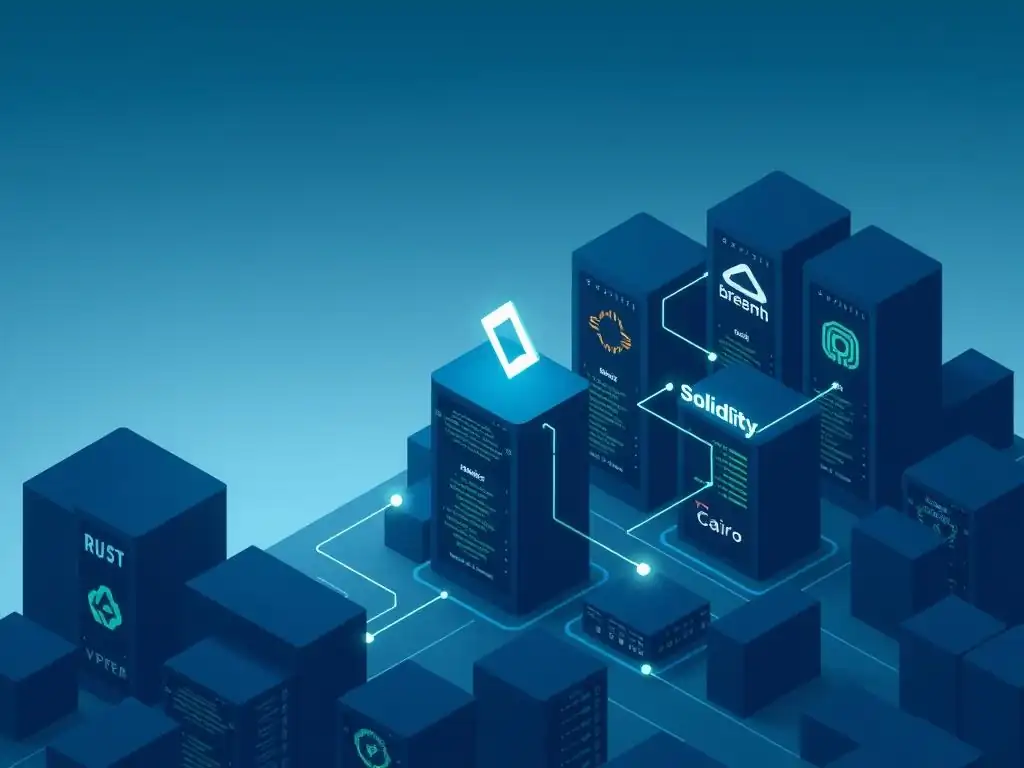
While Solidity has established itself as the de facto standard for smart contract development on the Ethereum Virtual Machine (EVM) and many other compatible blockchains, it is not the only language available. The blockchain ecosystem is constantly evolving, and with it, new languages designed with different priorities, such as enhanced security, performance, or resource management, are emerging or gaining prominence. Exploring these alternatives is crucial for developers and projects looking for the best fit for their specific needs, especially when building complex or high-value decentralized finance (DeFi) applications where security and efficiency are paramount.
Understanding the landscape beyond Solidity allows developers to make informed decisions. While a comprehensive smart contract Solidity development guide is essential for many platforms, considering languages like Vyper, Rust, or Move can unlock new possibilities, improve protocol safety, or enable deployment on non-EVM chains. Each language brings a unique set of features, trade-offs, and ecosystems, influencing everything from development speed and tooling support to potential vulnerabilities and execution costs. Evaluating these options requires a deep dive into their design philosophies, capabilities, and suitability for various DeFi use cases.
Vyper: A Security-Focused Smart Contract Language
Vyper is a Pythonic smart contract language specifically designed for the EVM, prioritizing security, auditability, and simplicity. Its design philosophy deliberately omits certain language features common in Solidity to reduce complexity and potential attack vectors, making it an attractive option for developers building critical DeFi infrastructure where robustness is key.
Vyper's Design Philosophy and Security Features
Vyper's core philosophy revolves around making smart contracts easier to read, write, and audit by minimizing complexity. It enforces clear, explicit code that prevents common Solidity pitfalls. For example, Vyper lacks function modifiers, inheritance, and infinite loops, features that can sometimes obscure control flow and introduce vulnerabilities in Solidity. All state variable access must be explicit ( self.variable_name), making it clear when state is being read or modified. Furthermore, Vyper includes built-in safety checks, such as overflow/underflow protection for integer arithmetic by default, which helps mitigate critical bugs that have historically plagued Solidity contracts, leading to significant financial losses in DeFi protocols.
The language is also designed to be more formally verifiable than Solidity, meaning it's easier to mathematically prove that a Vyper contract behaves as intended under all possible conditions. This auditability is enhanced by its limited feature set and explicit syntax. While it might feel restrictive to developers used to Solidity's flexibility, these constraints are intentional trade-offs aimed squarely at reducing the surface area for bugs and exploits. Vyper's focus on security by design makes it a compelling choice for core DeFi components handling substantial value.
Use Cases for Vyper in DeFi
Due to its emphasis on security and simplicity, Vyper is often chosen for foundational DeFi protocols and components where correctness and resilience are critical. While Solidity remains dominant, Vyper has found adoption in specific high-stakes applications. A notable example is its use within the Curve Finance ecosystem, a major decentralized exchange focused on stablecoins. Parts of Curve's core smart contracts, particularly those handling sensitive operations like swaps and liquidity provision, were written in Vyper. This decision reflects the team's prioritization of auditability and reduced risk surface for their critical liquidity pools, which manage billions in assets.
Beyond stablecoin exchanges, Vyper is suitable for implementing core DeFi primitives like simple token standards (though ERC-20 is typically Solidity), basic vaults, staking contracts, or governance modules where complex logic is less necessary than verifiable safety. While it may not be ideal for highly complex protocols with intricate interactions or novel financial engineering due to its limited feature set compared to Solidity, for core functions requiring maximum security assurance and straightforward logic, Vyper offers a strong alternative, complementing a developer's knowledge gained from any smart contract Solidity development guide.
Rust: A Systems Programming Language for Smart Contracts
Rust, originally designed as a systems programming language focused on memory safety and performance, has found a significant role in the blockchain space, particularly on platforms outside the EVM. Its capabilities make it well-suited for building performant and secure smart contracts, offering a different paradigm compared to Solidity or Vyper.
Rust's Performance and Safety Guarantees
Rust is renowned for its performance, often comparable to C++, while providing strong memory safety guarantees without needing a garbage collector. This safety is enforced by Rust's unique "borrow checker," which checks memory usage rules at compile time, preventing common bugs like null pointer dereferences, data races, and buffer overflows – issues that can be sources of critical vulnerabilities in other languages. For smart contract development, this compile-time safety significantly reduces the likelihood of runtime errors and security exploits related to memory management or concurrency.
The efficiency of Rust code translates directly to lower execution costs on blockchains that support it. Its fine-grained control over system resources allows developers to write highly optimized code. This is particularly beneficial for complex computations or high-throughput applications common in DeFi, where gas costs or transaction fees are a critical factor. While compiling Rust to WebAssembly (WASM) for blockchain execution introduces some overhead, the underlying performance characteristics of Rust code remain a significant advantage over languages like Solidity, which runs on the EVM, a stack-based virtual machine generally less efficient than WASM.
Building DeFi Applications with Rust
Rust is the primary language for smart contract development on several prominent blockchain platforms designed for high performance and scalability, including Solana, Polkadot (via Parity Substrate), and Near Protocol. These platforms host vibrant DeFi ecosystems leveraging Rust's capabilities. On Solana, for instance, major DeFi protocols like Serum (a decentralized exchange infrastructure) and lending protocols like Solend are built using Rust programs. The performance of Rust is a key enabler for Solana's high transaction throughput, supporting complex DeFi operations at scale.
Similarly, Polkadot's ecosystem, built on the Substrate framework which heavily uses Rust, allows for the creation of custom blockchains (parachains) with smart contract functionality often implemented in Rust. Projects like Acala (a DeFi hub on Polkadot) utilize Rust for their core logic. Near Protocol also supports Rust smart contracts, hosting various DeFi applications like lending protocols and stablecoin integrations. For developers familiar with a smart contract Solidity development guide but looking to build on these non-EVM chains, learning Rust is essential and offers access to different market segments and technical capabilities.
Move: A Resource-Oriented Programming Language
Move is a relatively newer programming language designed specifically for safe and secure management of digital assets. Initially developed by Meta (formerly Facebook) for the Diem project, it has since been adopted and further developed by new blockchain platforms focusing on high performance and asset security.
Exploring the Features and Capabilities of Move
Move's most distinctive feature is its resource-oriented type system. Unlike conventional programming languages where variables represent data that can be copied or discarded, Move treats digital assets (like tokens or NFTs) as "resources" that cannot be implicitly copied or dropped. Resources have structural integrity and are subject to strict linear typing rules enforced by the Move prover (a formal verifier).
This means a resource can only exist in one location at a time and must be explicitly stored, moved, or destroyed according to predefined rules. This design inherently prevents common asset-related bugs such as duplication, accidental loss, or double-spending at the language level, offering a powerful layer of security for DeFi applications.
Beyond resource safety, Move includes modules, similar to smart contracts, which encapsulate data and procedures, providing strong data abstraction and access control. It also features a flexible account model and supports formal verification of critical properties. The language is designed to be platform-agnostic, although its primary implementations are currently on new blockchains like Aptos and Sui. These platforms leverage Move's safety features to build highly scalable and secure environments for digital assets and DeFi, presenting a different approach to smart contract development compared to the EVM-centric model often covered in a smart contract Solidity development guide.
Frequently Asked Questions
What are the primary factors to consider when choosing a smart contract language for a DeFi project?
The main factors include the maturity of the language, the available tooling and community support, and its suitability for the specific use case of your DeFi project.
Why is Solidity often considered the dominant language for DeFi smart contract development?
Solidity benefits from its deep integration with the Ethereum ecosystem, a large developer community, and a wealth of resources and libraries designed for DeFi applications.
Are there viable alternatives to Solidity for developing smart contracts in the DeFi space?
Yes, languages like Vyper offer enhanced security features, and Rust is gaining traction due to its performance and safety. Choosing depends on project requirements and team expertise.
What are the key security considerations when developing smart contracts, regardless of the language used?
Implementing robust security audits, employing formal verification techniques, and adhering to secure coding practices are crucial to prevent vulnerabilities and exploits in DeFi smart contracts.
How does the regulatory landscape impact the choice of smart contract language for DeFi projects?
While regulations are still evolving, choosing a language that allows for transparency and auditability and facilitates compliance with evolving standards can be beneficial in the long run.
Final Reflection: Building the Future of Finance
The exploration of smart contract languages, particularly within the context of DeFi, is not merely a technical exercise; it's about shaping the very infrastructure of decentralized finance. The choices we make today regarding Solidity, Vyper, or other emerging languages will directly impact the security, scalability, and accessibility of the financial systems of tomorrow. This isn't just code; it's the foundation upon which trust and innovation are built.
The rise of DeFi has profoundly altered the financial landscape, and the smart contracts that power it are at the heart of this revolution. My own journey into understanding these languages has revealed the immense responsibility that comes with building on this technology. Code is law,
as often quoted, underscores the gravity of our decisions. The smart contracts we deploy are not just lines of code; they are binding agreements, and their integrity is paramount to the success of DeFi.
As you embark on your own journey into smart contract development, remember that the choice of language is just the first step. It's a journey of continuous learning, rigorous testing, and a deep commitment to security. Let us all strive to build a DeFi ecosystem that is not only innovative but also robust, transparent, and accessible to all. The future of finance is in our hands; let's build it wisely.
Ignite Your DeFi Vision: Build Smarter, Not Harder!
Thank you for exploring the crucial choices involved in selecting a smart contract language for your DeFi project. Now that you are equipped with the necessary knowledge, it's time to turn insights into action. Here's how you can start applying what you've learned:
- Begin prototyping your smart contract using your preferred language, such as Solidity, Vyper, or Rust. This hands-on approach will deepen your understanding and help identify practical considerations.
- Examine open-source DeFi projects developed in various languages. Analyze their code and architecture to discover best practices and innovative solutions.
- Share this article with fellow developers and blockchain enthusiasts to spark discussions about the advantages and challenges of different programming languages, fostering a collaborative learning environment.
What features are you most excited to incorporate into your DeFi project, and which language will you choose to bring it to life? Share your thoughts in the comments below!
Leave a Reply