
Vyper Programming for Beginners: Build Your First Secure Smart Contract


Welcome to Blockchain Trends, your guide to navigating the ever-evolving world of decentralized innovation!
Curious about moving beyond the hype and truly understanding blockchain's potential? Delve into our comprehensive exploration of the technology's transformative applications, from DeFi to enterprise solutions. Ready to build something real? Then you're in the right place. Let's start with the fundamentals! This article will walk you through the Vyper smart contract development basics, providing a solid foundation for creating secure and efficient decentralized applications. What are you waiting for?
Vyper Programming for Beginners: Build Your First Secure Smart Contract
- Introduction to Vyper for Smart Contract Development
- Vyper Smart Contract Basics: Syntax and Data Types
- Building Your First Vyper Smart Contract: A Step-by-Step Guide
- Ensuring Smart Contract Security with Vyper
- Deploying and Testing Your Vyper Smart Contract
- Advanced Vyper Concepts for Smart Contract Development
- Vyper vs. Solidity: A Comparison for Smart Contract Developers
- Resources for Learning Vyper Smart Contract Development
- Conclusion: The Future of Vyper in Blockchain Trends
-
Frequently Asked Questions
- What is Vyper and why is it used for smart contract development?
- How does Vyper differ from Solidity, the other popular smart contract language?
- What are the basic data types supported in Vyper smart contract development?
- Where can I find resources to learn Vyper smart contract development basics?
- What are some common security considerations when developing Vyper smart contracts?
- Final Reflection: Embracing the Future of Secure Smart Contracts
- Ignite Your Blockchain Journey: Start Building Securely!
Introduction to Vyper for Smart Contract Development
Understanding the Rising Popularity of Vyper in Blockchain Trends
Vyper is emerging as a significant language in the blockchain space, particularly for developing smart contracts on the Ethereum Virtual Machine (EVM). Its rising popularity is rooted in a deliberate design philosophy that prioritizes security, simplicity, and auditability over feature richness and flexibility. Unlike languages aiming for broad general-purpose use, Vyper is specifically tailored for writing secure and robust smart contracts. This focus has made it attractive for applications where safety is paramount, such as decentralized finance (DeFi) protocols that handle substantial user funds.
The adoption of Vyper, while smaller than Solidity's market share, is notable in high-value DeFi applications. For instance, Curve Finance, a major decentralized exchange focusing on stablecoins, has heavily utilized Vyper for its core smart contracts, managing billions of dollars in total value locked (TVL).
This demonstrates a real-world vote of confidence in Vyper's security guarantees for critical financial infrastructure. The language's commitment to reducing complexity and surface area for bugs aligns well with the increasing need for verifiable and secure code in the face of sophisticated attacks on smart contracts, driving interest among developers focused on Vyper smart contract development basics and advanced security.
Why Choose Vyper for Secure Smart Contracts?
Choosing Vyper for smart contract development offers distinct advantages, primarily centered around enhanced security. Vyper's design intentionally omits features present in other languages that can be sources of vulnerabilities, such as function modifiers, class inheritance, infinite loops, and general-purpose assembly. This restricted feature set makes the code easier to read, understand, and audit, significantly reducing the likelihood of introducing complex or subtle bugs. The language enforces explicit state changes and control flow, making the contract's behavior more predictable and reducing the risk of unexpected side effects.
Furthermore, Vyper includes built-in checks for common pitfalls. For example, it handles integer overflow and underflow more safely than some other languages, often reverting transactions when these occur by default or requiring explicit handling. The design encourages a "check-effects-interactions" pattern, which helps mitigate reentrancy vulnerabilities – a common attack vector that has led to significant losses in the past (e.g., the infamous DAO hack on Ethereum, though not a Vyper contract, highlighted this risk). By learning Vyper smart contract development basics, developers gain access to a language explicitly engineered to guide them towards writing safer code from the outset.
Setting Up Your Development Environment for Vyper Smart Contracts
Setting up a development environment for Vyper smart contracts is straightforward, primarily requiring a Python installation (Vyper is written in Python) and the Vyper compiler. The most common way to install the compiler is using pip, Python's package installer, via a command like pip install vyper. This command downloads and installs the latest version of the Vyper compiler onto your system, making the vyper executable available from your terminal.
Beyond the compiler, developers often use a local blockchain environment for testing and deployment simulations before interacting with public testnets or the mainnet. Tools like Ganache or Hardhat (which can be configured to use Vyper) provide personal blockchain instances running on your machine. These environments allow for rapid iteration, testing contract interactions, and debugging without incurring gas costs or waiting for block confirmations on a public network. Integrating an IDE with Vyper syntax highlighting (available as extensions for editors like VS Code) can also significantly improve the development experience when learning Vyper smart contract development basics.
Vyper Smart Contract Basics: Syntax and Data Types
Exploring Vyper Syntax: A Beginner's Guide
Vyper's syntax is heavily inspired by Python, emphasizing readability through indentation and clear structure. Unlike languages that rely on semicolons or curly braces to define blocks, Vyper uses whitespace for code structure, similar to Python. A basic contract is defined simply at the top level of a .vy file. Functions are defined using the def keyword, and their visibility and mutability are explicitly declared using decorators like @external, @internal, @view, and @pure. For instance, an external function callable by anyone would start with @external def my_function():.
State variables, which store data persistently on the blockchain, are declared at the contract level with their type annotations, like owner: address. There are no implicit type conversions; operations between different types often require explicit casting, another feature designed to prevent unexpected behavior and improve code auditability. Understanding this explicit, Python-like syntax is fundamental to mastering Vyper smart contract development basics. Comments are indicated using the # symbol, allowing developers to add explanations to their code, which is crucial for complex contracts.
Understanding Data Types in Vyper: Integers, Addresses, and Booleans
Vyper provides a set of fundamental data types essential for smart contract development. Integers come in signed ( int128) and unsigned ( uint256) variants, representing numbers up to 128 and 256 bits respectively. It's crucial to choose the correct type to avoid overflow or underflow issues, although Vyper often includes checks to prevent these. The address type is used to store Ethereum addresses, representing external accounts or other smart contracts. This type is fundamental for handling ownership, sending value, or interacting with other contracts.
The bool type represents boolean values ( True or False), used for conditional logic and flags within the contract. Other important basic types include bytes32 for fixed-size byte arrays (useful for hashes or short strings) and decimal for fixed-point numbers, which helps avoid floating-point inaccuracies in financial calculations. Understanding these core types and their specific uses and limitations is a critical part of learning Vyper smart contract development basics and writing correct contract logic. For example, handling token balances typically involves uint256, while ownership checks use the address type.
Working with Variables and Constants in Vyper
In Vyper, variables can be declared at the contract level as state variables or within functions as local variables. State variables are declared directly within the contract body and store data persistently on the blockchain, consuming gas upon modification. For example, a state variable to track a count might be declared as count: uint256. Local variables, declared within functions, are temporary and only exist for the duration of the function call; they do not consume storage gas but use execution gas.
Constants are values that are fixed at deployment time and cannot be changed. They are declared using the constant keyword and must be assigned a value immediately. For example, MAX_LIMIT: constant(uint256) = 100. Using constants is a best practice for values that don't change, as they improve readability and are more gas-efficient than using state variables for static values. Mastering the declaration and usage of state variables, local variables, and constants is key to organizing data effectively when tackling Vyper smart contract development basics.
Building Your First Vyper Smart Contract: A Step-by-Step Guide
Defining the Contract Structure and State Variables
Let's outline a simple "Storage" contract as an example for Vyper smart contract development basics. This contract will allow storing a single unsigned integer and retrieving it. First, you define the contract itself, which in Vyper is simply the content of the .vy file. You should start by specifying the Vyper compiler version using a pragma statement: #pragma version 0.3.0 (or the current version). Then, you declare the state variables that will hold the contract's data.
For our simple storage contract, we need one state variable to store the unsigned integer. Let's call it stored_value. We declare it with its type: stored_value: uint256. This variable will be accessible by the contract's functions and its value will persist on the blockchain. The contract structure at this point is minimal, just the pragma and the state variable declaration. This simple setup forms the foundation for adding functionality and is a core exercise in learning Vyper smart contract development basics.
Implementing Functions in Your Vyper Smart Contract
Next, we add functions to interact with the state variable. We'll need a function to set the value and a function to get the value. The set_value function will take a uint256 as input and update the stored_value state variable. Since this function modifies the state, it must be marked as external using @external so it can be called by external accounts or other contracts. The function definition would look like: @external def set_value(value: uint256): self.stored_value = value.
The get_value function will simply return the current stored_value. Since this function only reads state and doesn't modify it, it can be marked as a view function using @view. View functions are gas-free when called externally. The definition would be: @view def get_value() -> uint256: return self.stored_value. These two functions provide the basic interface for our simple storage contract, illustrating fundamental concepts in Vyper smart contract development basics: defining callable functions, handling input parameters, modifying state, and returning values.
Handling Events in Vyper for Enhanced Transparency
Events in Vyper are a way to log information on the blockchain that can be efficiently monitored by external applications or user interfaces. They do not affect the contract's state directly but provide a historical record of activity. For our storage contract, we could define an event to log when the stored_value is updated. First, define the event structure using the event keyword, specifying the data fields it will contain. For example: event ValueChanged(oldValue: uint256, newValue: uint256).
To emit the event, you use the log statement within a function, passing the event name and the values for its fields. In our set_value function, before updating stored_value, we could log the old and new values: log ValueChanged(self.stored_value, value). This adds transparency, allowing anyone monitoring the blockchain to see the history of value changes in the contract without needing to read the contract's state directly. Including events is a standard practice for providing visibility into smart contract operations and is an important part of learning Vyper smart contract development basics.
Ensuring Smart Contract Security with Vyper
Vyper's Security-Focused Design Principles
Vyper's architecture is fundamentally built around security. Its core design principles — simplicity, auditability, and security — directly influence the language features and restrictions. Simplicity is achieved by limiting complex features like inheritance and function overloading, making the code easier to reason about. Auditability is enhanced because the code flow is explicit and predictable; there are no hidden control flows introduced by modifiers or dynamic calls by default. This makes it significantly easier for security auditors to verify the contract's logic against its specifications.
The security principle is implemented through features that prevent common vulnerabilities. For instance, Vyper's strict type checking and explicit handling of integer operations help avoid overflows and underflows. The language encourages a secure interaction pattern by default. This intentional constraint on developer freedom is a deliberate trade-off to minimize the potential for security flaws, positioning Vyper as a strong choice for critical applications and making secure Vyper smart contract development basics more accessible.
Common Smart Contract Vulnerabilities and How Vyper Mitigates Them
Vyper is designed to mitigate several common smart contract vulnerabilities. Reentrancy, where an external call can recursively call back into the original contract before it finishes its execution, is a notorious vulnerability (responsible for the DAO hack, resulting in millions in losses). Vyper's default interaction pattern and lack of inline assembly make it harder to fall into this trap compared to languages that allow more flexible external calls. While not impossible to write reentrant code in Vyper, the language guides developers towards safer patterns.
Integer overflows and underflows, where arithmetic operations result in numbers outside the variable's range, are another significant risk. Vyper provides built-in checks for these operations, causing transactions to revert by default if an overflow or underflow occurs, preventing unexpected state changes. Unlike some other languages where these might wrap around silently, Vyper's explicit failure mechanism prevents catastrophic errors. These built-in safeguards are a key aspect of secure Vyper smart contract development basics, reducing the burden on developers to manually implement checks for every potential arithmetic issue.
Best Practices for Secure Vyper Smart Contract Development
Beyond the language's built-in security features, following best practices is crucial for secure Vyper smart contract development. Keep your contracts as simple as possible; complex logic increases the surface area for bugs. Thoroughly test your code using various inputs and scenarios, including edge cases and potential attack vectors. Utilize local development environments like Ganache for extensive testing before deploying to public networks.
Regularly review your code and, if possible, have other developers review it. Code audits by experienced security professionals are highly recommended for contracts handling significant value. Stay updated with the latest Vyper compiler versions and security best practices. While Vyper's design helps, it doesn't replace the need for diligent development practices. Combining Vyper's security features with rigorous testing and auditing is the most effective approach to building robust and secure smart contracts.
Deploying and Testing Your Vyper Smart Contract
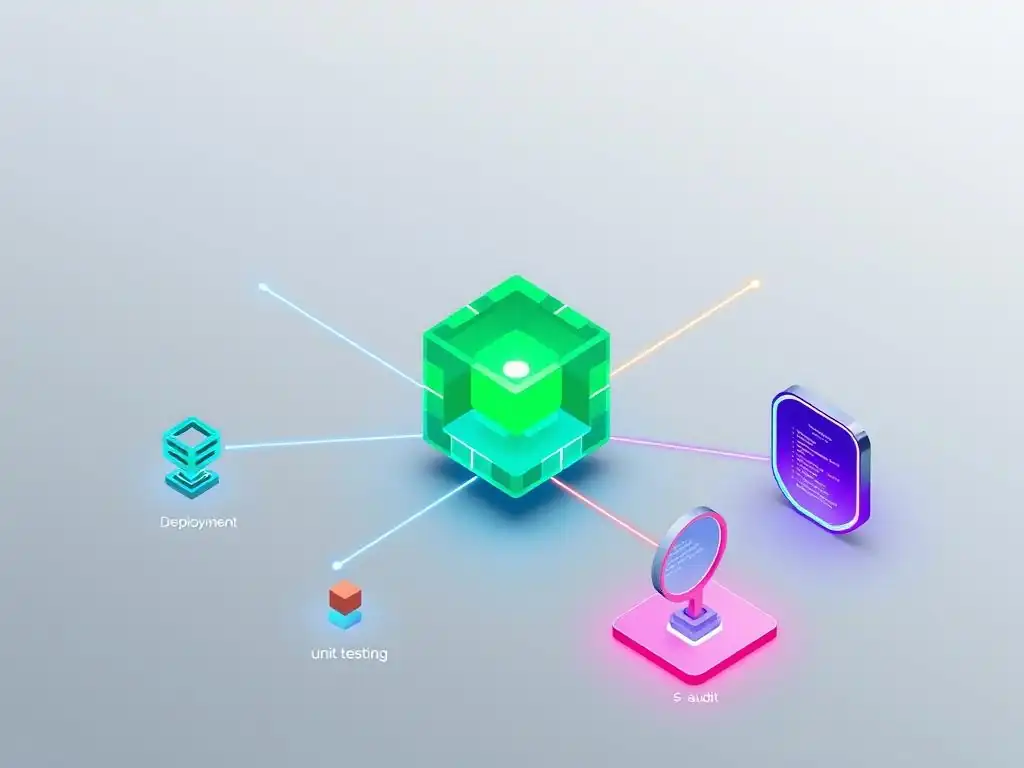
Compiling Your Vyper Code
Before a Vyper smart contract can be deployed to the blockchain, it must be compiled into bytecode that the Ethereum Virtual Machine (EVM) can understand. The Vyper compiler takes your .vy source file and translates it into two main outputs: the contract's bytecode (the executable code) and the Application Binary Interface (ABI). The bytecode is what gets deployed to the blockchain, while the ABI is a JSON array that describes the contract's functions, events, and state variables, allowing external applications to interact with the contract.
You typically compile a Vyper file from the command line using the vyper executable. For example, running vyper your_contract.vy might output the bytecode directly. To get the ABI as well, you might use flags like --abi. The compiler ensures your code adheres to Vyper syntax and performs basic type checks. Successful compilation is the first essential step after writing your code, transforming your human-readable Vyper smart contract development basics into machine-executable form.
Deploying to a Local Blockchain Environment (e.g., Ganache)
Deploying your compiled Vyper smart contract involves sending a transaction to the blockchain that contains the contract's bytecode. For learning and testing, deploying to a local blockchain environment like Ganache is ideal. Ganache provides a personal blockchain that runs on your computer, complete with accounts, private keys, and instant block confirmations.
To deploy, you need a tool that can connect to the local blockchain node and send transactions. Libraries like web3.py (Python) or ethers.js (JavaScript) are commonly used. You would typically write a script that connects to your Ganache instance (usually running on http://127.0.0.1:8545), loads the compiled bytecode and ABI, constructs a deployment transaction signed by one of your local accounts, and sends it. Upon successful deployment, the script will receive the newly deployed contract's address on the local network. This process allows you to repeatedly deploy and test your Vyper smart contract development basics without real costs.
Testing Your Smart Contract Functionality
Testing is a critical phase in Vyper smart contract development to ensure the contract behaves as expected and is free of bugs. After deploying to a local environment like Ganache, you use the same web3 library or tool to interact with the deployed contract via its address and ABI. Tests should cover all public and external functions, verifying that they correctly update state variables, return the expected values, and emit events.
You can write automated tests using testing frameworks (e.g., Python's unittest combined with web3.py, or specific blockchain testing frameworks). These tests can deploy the contract programmatically, call its functions with various parameters (valid, invalid, edge cases), and assert the outcomes. For example, after calling set_value(100) on our storage contract, a test would assert that get_value() now returns 100. Testing different scenarios, including potential error conditions, is vital for ensuring the security and reliability of your Vyper smart contract development basics.
Advanced Vyper Concepts for Smart Contract Development
Working with Arrays and Mappings in Vyper
Vyper supports complex data structures like arrays and mappings, which are essential for managing collections of data. Arrays in Vyper can be fixed-size (e.g., uint256[10] for an array of 10 unsigned integers) or dynamic (though dynamic arrays have more limitations compared to Solidity's). Accessing elements is done using square brackets, like my_array[0]. Fixed-size arrays are generally preferred in Vyper for their predictable gas costs and reduced complexity, aligning with the language's security focus.
Mappings (similar to hash maps or dictionaries in other languages) store key-value pairs. They are declared using HashMap followed by the key and value types in brackets, e.g., balances: HashMap[address, uint256] to map addresses to balances. Mappings are commonly used for things like token balances, permissions, or registry patterns. Accessing a value in a mapping uses square brackets with the key: balances[msg.sender]. Understanding how to effectively use arrays and mappings is crucial for building more complex applications beyond simple Vyper smart contract development basics.
Interacting with Other Smart Contracts Using Vyper
Smart contracts often need to interact with each other to build complex decentralized applications (dApps). Vyper allows contracts to call functions on other deployed contracts. To do this securely, you typically define an interface for the contract you want to interact with. An interface in Vyper is a contract definition that only includes function headers (signatures) and event definitions of the external contract, without any implementation details or state variables.
Once the interface is defined, you can create an instance of the external contract using its address and the interface type. For example, if you have an interface IERC20 and the address token_address, you can create an instance: token: IERC20 = IERC20(token_address). You can then call functions on this instance, like token.transfer(recipient, amount). Vyper's explicit casting and function calls make inter-contract communication clear and auditable, reinforcing the security principles important for Vyper smart contract development basics.
Implementing Access Control Mechanisms in Vyper
Access control is vital for restricting sensitive operations within a smart contract, such as administrative functions or the ability to modify critical parameters. A common pattern in Vyper is to store an 'owner' or 'admin' address as a state variable and check msg.sender against this address at the beginning of restricted functions.
Here's a conceptual example:
owner: address

@external
def __init__():
    self.owner = msg.sender

@external
def set_sensitive_value(value: uint256):
    assert msg.sender == self.owner, "Only owner can call this function"
    # ... sensitive logic ...
In this pattern, the assert statement ensures that only the address stored in self.owner can execute the sensitive logic. Vyper's lack of modifiers means this check must be explicitly included at the beginning of each restricted function, which improves auditability by making access control logic immediately visible within the function itself. Implementing robust access control is a key security consideration when moving beyond basic Vyper smart contract development basics.
Vyper vs. Solidity: A Comparison for Smart Contract Developers
Syntax Differences Between Vyper and Solidity
The most apparent difference between Vyper and Solidity lies in their syntax. Vyper boasts a Python-inspired syntax, characterized by indentation for code blocks, the def keyword for functions, and explicit type annotations without semicolons. Solidity, on the other hand, has a syntax more akin to JavaScript or C++, using curly braces {} for code blocks, semicolons ; to end statements, and the function keyword.
For example, a simple function definition in Solidity might look like function getValue() public view returns (uint256) { return storedValue; }, while the equivalent in Vyper is @view def get_value() -> uint256: return self.stored_value. Vyper's explicit decorators ( @external, @view) replace Solidity's keywords ( public, view). This fundamental syntactic divergence means developers familiar with Python might find Vyper easier to pick up, while those with JavaScript or C++ backgrounds might lean towards Solidity. Understanding these differences is crucial when choosing a language for smart contract development.
Security Considerations: Vyper vs. Solidity
Security is a primary differentiator often highlighted between the two languages. Vyper's design is deliberately restrictive, omitting features like inheritance, function modifiers, and dynamic calls by default to reduce the attack surface and complexity. This makes it harder to write insecure code inadvertently and simplifies security audits. For instance, Vyper's handling of integer overflows and reentrancy is generally considered safer by default.
Solidity offers greater flexibility and a richer feature set, including inheritance, libraries, and low-level calls. While powerful, this flexibility comes with increased responsibility for the developer to implement security best practices diligently. Many historical smart contract hacks have exploited nuances or complexities arising from these features in Solidity. While secure contracts can be written in both languages, Vyper's design nudges developers towards safer patterns, which can be particularly beneficial when learning Vyper smart contract development basics or working on high-security applications.
Performance and Gas Optimization in Vyper and Solidity
Both Vyper and Solidity compile down to EVM bytecode, so their fundamental performance and gas efficiency are largely dependent on the generated bytecode. In many cases, for equivalent logic, the gas costs can be comparable. However, the language design can influence how easily developers can write gas-efficient code. Vyper's simplicity and explicit nature can sometimes lead to slightly more predictable gas costs for basic operations.
Solidity's flexibility allows for more complex optimizations at the code level, but it also provides more ways to write inefficient code. Ultimately, gas optimization heavily relies on the developer's understanding of EVM mechanics, storage layouts, and algorithm efficiency, regardless of the language. While there are minor differences in the bytecode produced for specific operations, the choice between Vyper and Solidity for performance often comes down to which language allows the developer to write the most efficient logic for their specific use case, rather than inherent performance differences between the compilers themselves.
Resources for Learning Vyper Smart Contract Development
Online Courses and Tutorials for Vyper
For beginners looking to dive into Vyper smart contract development basics, a variety of online resources are available. While not as numerous as Solidity resources, dedicated courses and tutorials exist. Platforms like YouTube, specific blockchain education websites, and sometimes general e-learning sites offer introductions to Vyper's syntax, data types, and basic contract structure.
Look for tutorials that are hands-on and guide you through building simple contracts and deploying them locally. Some resources might be part of broader blockchain development bootcamps or courses focusing on specific ecosystems that use Vyper. Searching for "Vyper smart contract tutorial" or "learn Vyper programming" can yield relevant results. Engaging with interactive tutorials can significantly accelerate the learning process for Vyper smart contract development basics.
Vyper Documentation and Community Support
The official Vyper documentation is an invaluable resource for learning and referencing the language. It provides comprehensive details on syntax, data types, built-in functions, and compiler usage. The documentation is well-structured and serves as the ultimate source of truth for Vyper's features and behavior.
Beyond the documentation, the Vyper community is a great place to seek help and collaborate. Community channels, often found on platforms like Discord or Telegram, allow developers to ask questions, share insights, and learn from others' experiences. Engaging with the community is particularly helpful when encountering specific errors or seeking best practices beyond what is immediately obvious from the documentation. Participating in community discussions can deepen your understanding of Vyper smart contract development basics and advanced topics.
Useful Vyper Libraries and Tools
While Vyper emphasizes simplicity and has a smaller ecosystem of external libraries compared to Solidity, several tools support Vyper smart contract development. Development frameworks like ApeWorX are designed to be language-agnostic and provide tools for compiling, testing, and deploying Vyper contracts. These frameworks streamline the development workflow significantly.
Other useful tools include IDE extensions that provide syntax highlighting, linting, and basic error checking for Vyper code. Testing libraries and tools that integrate with web3.py or other Python libraries can help automate the testing process. While you won't find as many high-level abstraction libraries as in other ecosystems, the focus in Vyper tooling is often on providing a solid foundation for writing secure and auditable code from the ground up. Exploring these tools can enhance your productivity as you learn Vyper smart contract development basics.
Conclusion: The Future of Vyper in Blockchain Trends
Vyper's Role in Building Secure and Efficient Decentralized Applications
Vyper has carved out a significant niche for itself in the blockchain ecosystem, primarily as a language for building secure and auditable smart contracts. Its design philosophy, which prioritizes safety and simplicity, makes it particularly well-suited for applications where security breaches could have severe financial consequences, such as DeFi protocols. As the value locked in decentralized applications continues to grow (surpassing tens of billions of dollars across various chains), the demand for highly secure code becomes even more critical.
Vyper's role is likely to expand in areas requiring high assurance and formal verification due to its simpler structure. While it may not replace Solidity as the dominant language for all EVM development, its strengths position it as a preferred choice for core logic in financial primitives, governance contracts, and other critical infrastructure components. Mastering Vyper smart contract development basics is therefore a valuable skill for developers focusing on security-sensitive decentralized applications.
Staying Up-to-Date with the Latest Vyper Developments
The blockchain space is constantly evolving, and so is the Vyper language. Staying up-to-date with the latest developments is crucial for any developer. This includes following the official Vyper GitHub repository, monitoring release notes for new compiler versions and features, and participating in community discussions.
New versions of Vyper often introduce performance improvements, bug fixes, and sometimes new language features, always with a careful consideration of their impact on security and auditability. Keeping your development environment updated and understanding the changes in new releases ensures you are using the most secure and efficient version of the compiler and writing code that adheres to current best practices. Continuous learning is key in the dynamic field of Vyper smart contract development.
Future Trends for Vyper Smart Contract Development
Looking ahead, several trends are likely to influence Vyper smart contract development. Increased integration with formal verification tools is a strong possibility, leveraging Vyper's inherent auditability to provide mathematical proofs of contract correctness. As Layer 2 scaling solutions mature, Vyper will likely play a role in developing contracts for these environments, potentially requiring adaptations or new best practices.
The focus on security is expected to remain paramount, potentially leading to further language refinements that enhance safety. As more high-profile projects adopt Vyper, its ecosystem of tools and resources for Vyper smart contract development basics is also likely to grow, making it even more accessible to new developers. Vyper is poised to remain a vital language for building the secure foundations of the decentralized future.
Frequently Asked Questions
What is Vyper and why is it used for smart contract development?
Vyper is a contract-oriented, Pythonic programming language specifically designed for the Ethereum Virtual Machine (EVM). It's used for smart contract development because of its focus on security and auditability, aiming to reduce vulnerabilities common in other smart contract languages.
How does Vyper differ from Solidity, the other popular smart contract language?
Vyper prioritizes simplicity and security over feature richness, unlike Solidity. It achieves this by deliberately omitting features like inheritance modifiers and inline assembly, making code easier to audit and less prone to common security exploits.
What are the basic data types supported in Vyper smart contract development?
Vyper supports fundamental data types such as uint256 (unsigned integer), address (Ethereum address), bool (boolean), and string (limited string manipulation). It also offers complex data structures like arrays and structs for more sophisticated data management.
Where can I find resources to learn Vyper smart contract development basics?
Many online resources are available, including the official Vyper documentation, online courses, and tutorials. Look for materials specifically tailored to beginners to grasp the fundamental concepts and syntax of the language.
What are some common security considerations when developing Vyper smart contracts?
Common security concerns include integer overflow/underflow, reentrancy attacks, and front-running. Vyper's design helps mitigate some of these, but developers must still implement best practices for secure coding.
Final Reflection: Embracing the Future of Secure Smart Contracts
The journey into Vyper programming, as explored in this article, is not merely an academic exercise; it's a crucial step towards shaping the future of decentralized applications. The ability to write secure and efficient smart contracts is becoming increasingly vital in a world demanding transparency and trust. By understanding the Vyper smart contract development basics, we empower ourselves to build a more reliable and equitable digital landscape.
This exploration of Vyper has profoundly impacted my understanding of blockchain technology, moving beyond theoretical concepts to practical application. Witnessing the potential for Vyper to mitigate vulnerabilities inherent in other smart contract languages is truly inspiring. The future of smart contracts lies in security and simplicity. Vyper embodies both.
This quote encapsulates the essence of why mastering Vyper is not just a skill, but a responsibility we owe to the burgeoning decentralized world.
Now, armed with the knowledge of Vyper smart contract development basics, I encourage you to delve deeper into this powerful language. Experiment, build, and contribute to the growing Vyper ecosystem. The future of decentralized applications is being written today, and your contribution, however small, can help shape a more secure and trustworthy tomorrow.
Ignite Your Blockchain Journey: Start Building Securely!
Thank you for exploring Vyper and secure smart contract development with us! We hope this article has provided a strong foundation for your blockchain journey. Now, it's time to apply what you've learned. Here are some immediate steps you can take:
- Open your IDE and begin coding your first Vyper smart contract. Don't hesitate to experiment and refine your code—practice is the best way to learn.
- Consult the official Vyper documentation to explore advanced features and security best practices. This will help you write more robust and secure contracts.
- Share your progress and contract snippets on blockchain development forums and communities. Engaging with others is an excellent way to deepen your understanding.
What real-world problem do you plan to solve with your newfound Vyper skills? Share your exciting smart contract ideas in the comments below!
Leave a Reply