
MiCA and Blockchain Innovation in Europe: An Expert Analysis of the New Regulatory Framework


Welcome to Blockchain Trends, your compass in the rapidly evolving world of decentralized technology.
Ever wondered how Europe is shaping the future of blockchain? Dive into our expert interview and explore the intricacies of the new Blockchain regulation Europe compliance framework, specifically within the context of MiCA. Uncover its potential impact on innovation and discover what it means for the next generation of decentralized applications. Learn how these changes will impact developers, businesses, and even consumers.
MiCA and Blockchain Innovation in Europe: An Expert Analysis of the New Regulatory Framework
- Introduction: Understanding MiCA's Impact on European Blockchain Innovation
- MiCA's Key Provisions: A Deep Dive into the European Crypto Regulation
- Navigating MiCA Compliance
- The Impact of MiCA on Blockchain Innovation in Europe
- MiCA: Comparing to Global Standards
- Expert Analysis: Benefits and Challenges of the MiCA Framework
- The Future of Blockchain in Europe: A Post-MiCA Landscape
- Conclusion: Embracing Blockchain Regulation for a Sustainable Future
-
Frequently Asked Questions
- What is MiCA and what does it regulate?
- How does MiCA impact blockchain innovation in Europe?
- What are the key compliance requirements under MiCA for blockchain businesses operating in Europe?
- How does MiCA address DeFi (Decentralized Finance) and its unique challenges?
- What is the "Blockchain regulation Europe compliance framework" and how is it related to MiCA?
- Final Reflection: Navigating the Future of Blockchain in Europe
- Unlock Your Blockchain Future: Take Action Now!
Introduction: Understanding MiCA's Impact on European Blockchain Innovation
The Growing Need for Blockchain Regulation in Europe
The rapid expansion of blockchain technology across various sectors, from finance to supply chain management, has highlighted a significant gap in traditional regulatory frameworks. While blockchain promises efficiency, transparency, and decentralization, it also introduces new complexities and risks, particularly concerning consumer protection, market integrity, and financial stability.
Before the advent of a comprehensive framework, European Union member states had disparate approaches to crypto-assets and related services, leading to regulatory fragmentation and uncertainty for businesses operating across borders. This patchwork of rules hindered innovation and created opportunities for regulatory arbitrage, underscoring the urgent need for a harmonized, pan-European approach to blockchain regulation.
The lack of a clear and consistent legal landscape also posed challenges for investors and consumers, making it difficult to distinguish legitimate services from fraudulent schemes. Reports from various European consumer protection agencies indicated a rise in crypto-asset-related scams, further emphasizing the need for robust safeguards. Furthermore, institutions exploring enterprise blockchain solutions faced ambiguity regarding the legal status of tokenized assets and smart contracts. The absence of a unified blockchain regulation Europe compliance framework created friction points for adoption and scalability, necessitating a clear rulebook to foster trust and enable responsible growth within the digital asset space.
Introducing MiCA: A Comprehensive Regulatory Framework for Crypto-Assets
The Markets in Crypto-Assets Regulation (MiCA) represents a landmark legislative effort by the European Union to establish a unified legal framework for crypto-assets and their service providers across all 27 member states. Adopted in May 2023 and entering into full effect largely from December 2024, MiCA aims to provide legal certainty for the crypto market, support innovation, and protect consumers and investors. It classifies crypto-assets into distinct categories: asset-referenced tokens (ARTs), e-money tokens (EMTs), and other crypto-assets, applying specific rules to each based on their perceived risks and characteristics.
MiCA imposes significant obligations on crypto-asset service providers (CASPs), including exchanges, custodians, and advisors, requiring them to obtain authorization, adhere to strict operational requirements, and maintain robust governance structures. The regulation covers everything from the issuance of crypto-assets through initial coin offerings (ICOs) or other means, to their trading and safekeeping. By creating a single rulebook for blockchain regulation in Europe, MiCA is expected to facilitate cross-border operations for compliant businesses, reduce regulatory burdens compared to navigating multiple national regimes, and ultimately foster a more mature and trustworthy European crypto ecosystem.
Expert Insights: Dr. Clara Thompson on the Future of Blockchain Under MiCA
Dr. Clara Thompson, a leading expert in digital asset law and policy at a prominent European research institute, views MiCA as a critical step towards mainstream blockchain adoption. According to Dr. Thompson, "MiCA provides the much-needed legal rails for the crypto industry to integrate with traditional finance and enterprise.
While the compliance burden is significant, estimated by some industry bodies to require investments ranging from thousands to potentially millions of euros depending on the size and complexity of the business, the clarity it brings is invaluable. It shifts the focus from navigating fragmented national rules to implementing a standardized blockchain regulation Europe compliance framework."
She emphasizes that the framework's impact extends beyond just crypto trading platforms. "For enterprise blockchain applications involving tokenization of real-world assets, MiCA clarifies the regulatory status of these tokens, particularly if they fall under the ART or EMT categories. This clarity is crucial for fostering institutional confidence and investment," Dr. Thompson notes. "However, the devil will be in the details of implementation by national competent authorities (NCAs) and the interpretation of certain provisions, such as those relating to decentralized finance (DeFi), which still present challenges in applying a centralized regulatory model."
MiCA's Key Provisions: A Deep Dive into the European Crypto Regulation
A cornerstone of the MiCA framework is the mandatory licensing and authorization regime for Crypto-Asset Service Providers (CASPs) operating within the European Union. Under MiCA, any entity providing services such as exchange between crypto-assets and fiat or other crypto-assets, execution of orders for crypto-assets, placing of crypto-assets, transfer services, portfolio management, or advice on crypto-assets must obtain authorization from a national competent authority (NCA) in one of the EU member states.
Once authorized, a CASP can "passport" its services across the entire EU, significantly simplifying cross-border operations compared to the previous fragmented landscape. This requirement aims to ensure that only fit and proper entities with adequate capital, governance, and security measures can operate, thereby enhancing market integrity and consumer protection.
The authorization process is rigorous, requiring applicants to submit detailed information about their business model, governance arrangements, internal control mechanisms, risk management procedures, and compliance programs, particularly concerning anti-money laundering (AML) and counter-terrorist financing (CTF). CASPs must also demonstrate sufficient own funds, with minimum capital requirements varying based on the type of services provided, ranging from €50,000 for certain services like advice to €150,000 for operating trading platforms. This stringent licensing approach under the MiCA blockchain regulation Europe compliance framework is designed to build trust and stability in the market, mirroring requirements seen in traditional financial services.
Stablecoin Regulation Under MiCA: Ensuring Financial Stability
MiCA introduces specific and stringent regulations for stablecoins, categorized primarily as Asset-Referenced Tokens (ARTs) and E-Money Tokens (EMTs), reflecting concerns about their potential impact on financial stability if widely adopted. ARTs, which are backed by a pool of assets like fiat currencies, commodities, or other crypto-assets, face significant requirements.
Issuers of ARTs must be authorized by a national competent authority or the European Central Bank (ECB) and adhere to strict rules regarding reserve assets, including segregation, custody, and regular audits. The regulation imposes limits on the issuance volume of significant ARTs and EMTs, with thresholds triggering additional oversight from the European Banking Authority (EBA) and the ECB, such as exceeding a value of €100 million or 1 million users.
EMTs, which are pegged to a single fiat currency, are regulated similarly to traditional electronic money, requiring issuers to be authorized as credit institutions or e-money institutions. Issuers must hold reserve assets in segregated accounts, primarily in highly liquid and low-risk instruments, to ensure that holders can redeem their tokens at par value at any time.
These provisions are crucial for mitigating liquidity risks and ensuring the stability of stablecoins, addressing lessons learned from the volatility experienced by certain stablecoins in the past. By embedding stablecoins within a robust regulatory framework, MiCA aims to facilitate their use for payments while safeguarding against systemic risks, a key element of the overall blockchain regulation Europe compliance framework.
Consumer Protection Measures: Safeguarding Investors in the European Crypto Market
Protecting consumers and investors is a central pillar of the MiCA regulation. The framework imposes significant transparency and disclosure requirements on issuers of crypto-assets and CASPs. Issuers must publish a "crypto-asset white paper" containing detailed information about the project, the crypto-asset, the underlying technology, risks, and the rights attached to the asset. This white paper must be notified to the relevant NCA and must not contain misleading information. CASPs are also required to provide clear, fair, and not misleading information to clients, including details about the risks associated with investing in crypto-assets.
Furthermore, MiCA introduces rules on marketing communications, requiring them to be clearly identifiable and consistent with the information in the white paper. CASPs must implement robust internal procedures for handling client complaints and managing conflicts of interest. Specific provisions address suitability and appropriateness tests for clients, particularly for complex or high-risk crypto-assets, ensuring that services provided align with the client's knowledge, experience, and investment objectives. These measures aim to empower investors with sufficient information to make informed decisions and provide avenues for recourse in case of malpractice, reinforcing the protective aspect of the blockchain regulation Europe compliance framework.
Preparing for MiCA Compliance: A Step-by-Step Guide for Blockchain Businesses
Preparing for MiCA compliance is a complex undertaking that requires significant effort and resources from blockchain businesses operating in or targeting the European market. The process typically begins with a thorough assessment of the business model to determine which activities fall under MiCA's scope and which specific regulations apply (e.g., licensing as a CASP, requirements for stablecoin issuance).
This initial gap analysis helps identify areas where current operations, governance, and technical infrastructure need adjustment to meet the stringent requirements. Businesses must then develop comprehensive policies and procedures covering areas such as risk management, internal controls, cybersecurity, data protection, complaints handling, and conflict of interest management, all aligned with MiCA's mandates.
A critical step involves the formal application for authorization from a national competent authority (NCA). This requires compiling extensive documentation, including detailed business plans, legal structures, proof of sufficient capital, and information about the management team. Businesses must demonstrate that they have the necessary systems and controls in place to operate securely and compliantly.
For example, a crypto exchange might need to upgrade its trading engine, custody solutions, and know-your-customer (KYC)/anti-money laundering (AML) systems to meet MiCA standards. Engaging with legal and compliance experts specializing in the blockchain regulation Europe compliance framework is highly recommended throughout this process to navigate the intricacies and ensure a successful application and ongoing adherence.
Data Protection and Privacy Considerations Under MiCA
While MiCA primarily focuses on the regulation of crypto-assets and CASPs, it interacts significantly with existing data protection and privacy laws, most notably the General Data Protection Regulation (GDPR). CASPs, in the course of providing services, collect and process substantial amounts of personal data from their users, including identity verification documents, transaction history, and contact information.
Under GDPR, CASPs must ensure that this data is processed lawfully, fairly, and transparently, collected for specified and legitimate purposes, and protected with appropriate technical and organizational measures. This includes obtaining explicit consent where required, providing users with access to their data, and adhering to data minimization principles.
MiCA's requirements, such as enhanced KYC/AML procedures and record-keeping obligations for transactions, necessitate the collection and retention of sensitive personal data. CASPs must therefore carefully balance their regulatory obligations under MiCA with their data protection obligations under GDPR. This involves implementing robust data security measures, conducting Data Protection Impact Assessments (DPIAs) for high-risk processing activities, and establishing clear data retention policies that comply with both regulatory regimes. Ensuring compliance with both the blockchain regulation Europe compliance framework and GDPR requires a integrated approach to data management and privacy within the organization.
Anti-Money Laundering (AML) and Counter-Terrorist Financing (CTF) Obligations
MiCA reinforces and complements existing EU Anti-Money Laundering (AML) and Counter-Terrorist Financing (CTF) legislation as it applies to crypto-asset service providers. CASPs are designated as obliged entities under the EU's AML directives, meaning they must implement comprehensive AML/CTF programs. These programs include conducting customer due diligence (CDD), which involves verifying the identity of their clients and understanding the nature of their business relationship. For higher-risk clients or transactions, enhanced due diligence (EDD) is required.
CASPs must also monitor transactions for suspicious activity and report any suspected money laundering or terrorist financing to the relevant financial intelligence unit (FIU). This includes implementing transaction monitoring systems capable of identifying patterns and behaviors indicative of illicit activity. Furthermore, CASPs must maintain records of customer due diligence and transaction data for a specified period, typically five years. The implementation of robust AML/CTF controls is not just a legal requirement but a fundamental aspect of building trust and integrity within the crypto ecosystem, forming a critical component of the blockchain regulation Europe compliance framework for all authorized entities.
The Impact of MiCA on Blockchain Innovation in Europe
Fostering Innovation or Stifling Growth? Examining the Potential Effects of MiCA
The introduction of MiCA has sparked considerable debate regarding its potential impact on blockchain innovation within Europe. Proponents argue that a clear, harmonized regulatory framework is essential for fostering long-term, sustainable growth. By providing legal certainty and a predictable operating environment, MiCA can attract institutional investors and traditional financial players who have historically been hesitant due to regulatory ambiguity.
This influx of capital and expertise could accelerate the development and adoption of novel blockchain applications beyond speculative trading, such as tokenized securities, digital identity solutions, and supply chain finance platforms. The ability for authorized CASPs to passport their services across the EU is also seen as a significant boost for scalability and market reach, potentially leading to increased competition and innovation among service providers offering a blockchain regulation Europe compliance framework.
Conversely, critics express concerns that the stringent requirements, particularly the high compliance costs and the need for authorization, could disproportionately burden smaller startups and decentralized projects. They argue that the regulatory model, largely based on traditional financial regulation, may not be fully compatible with the decentralized nature of certain blockchain technologies, potentially stifling permissionless innovation. For instance, applying licensing requirements to entities that are truly decentralized autonomous organizations (DAOs) with no identifiable central control remains a challenge.
The initial cost of obtaining authorization, estimated to be potentially hundreds of thousands of euros, could be a barrier to entry for lean startups. The debate centers on finding the right balance between necessary oversight to protect consumers and maintain stability, and creating an environment where innovation can thrive freely within the boundaries of the blockchain regulation Europe compliance framework.
MiCA's Influence on DeFi (Decentralized Finance) Development in Europe
Decentralized Finance (DeFi) presents a unique challenge for regulators, including those implementing MiCA. DeFi applications often operate through smart contracts on public blockchains, aiming to remove intermediaries from financial services like lending, borrowing, and trading. MiCA's current structure is largely designed around identifiable entities providing services, making it difficult to directly apply to truly decentralized protocols or anonymous participants. While MiCA explicitly excludes certain activities like lending and borrowing from its scope unless conducted by a CASP, the regulatory status of many DeFi activities and the entities behind them remains somewhat ambiguous.
However, MiCA's provisions will likely impact the gateways to DeFi for European users. Entities providing services that connect users to DeFi protocols, such as platforms offering access to decentralized exchanges or wallets interacting with DeFi applications, may fall under the definition of a CASP and thus require authorization.
This could lead to increased scrutiny and compliance obligations for companies operating at the intersection of centralized access points and decentralized protocols. The European Securities and Markets Authority (ESMA) and the European Banking Authority (EBA) are expected to provide further guidance on the application of MiCA to DeFi in the future, but for now, the interaction between this innovative sector and the established blockchain regulation Europe compliance framework remains an evolving area.
Opportunities for Enterprise Blockchain Adoption Under the New Regulation
MiCA is widely expected to create significant opportunities for enterprise blockchain adoption in Europe. By providing a clear legal and regulatory framework for crypto-assets, including tokenized securities and other regulated tokens (ARTs, EMTs), the regulation reduces uncertainty for large corporations and financial institutions looking to leverage blockchain technology. Enterprises can now explore issuing tokenized bonds, shares, or real estate with greater confidence, knowing there is a defined regulatory path. For example, a company considering issuing a tokenized corporate bond under EU law can now refer to MiCA's provisions concerning ARTs and the requirements for issuers and trading platforms.
Furthermore, the clarity provided by MiCA concerning the legal status and requirements for operating digital asset platforms makes it easier for traditional financial institutions to enter the market. Major banks and investment firms are more likely to invest in building or utilizing blockchain infrastructure for clearing, settlement, or asset management when operating within a recognized blockchain regulation Europe compliance framework.
This institutional engagement is crucial for scaling enterprise blockchain solutions and integrating them with existing financial market infrastructure. While challenges remain, particularly regarding interoperability and the regulatory treatment of specific use cases not explicitly covered, MiCA lays a solid foundation for accelerated enterprise blockchain adoption across the continent.
MiCA: Comparing to Global Standards
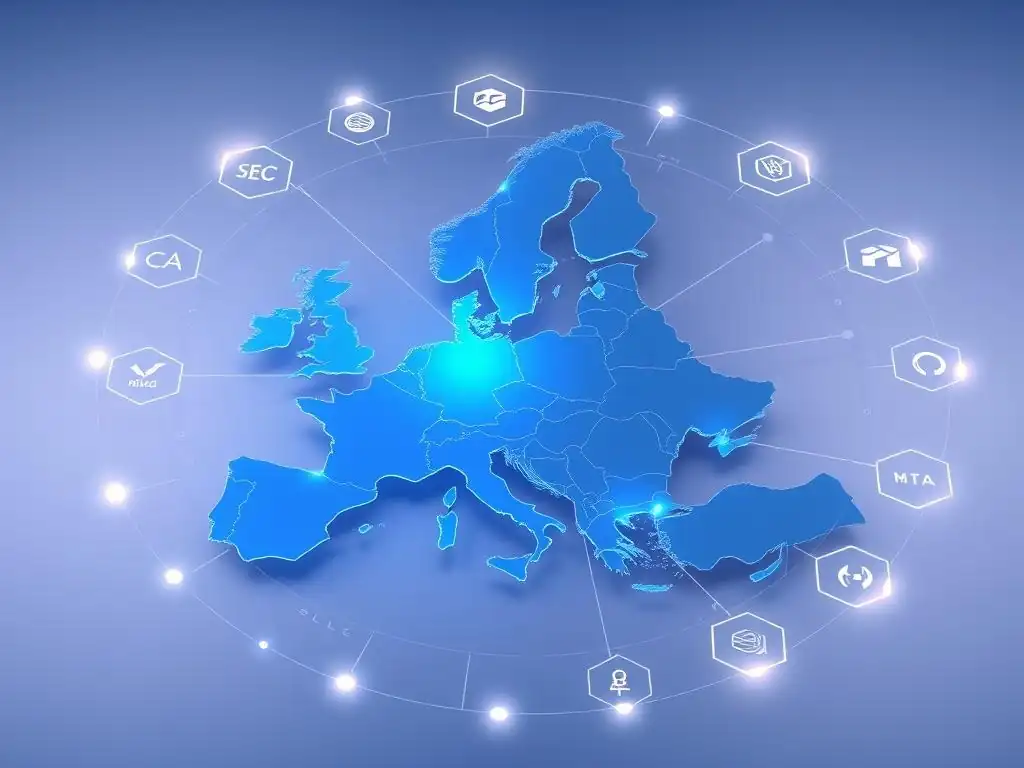
MiCA vs. US Regulatory Approaches to Crypto-Assets
Comparing MiCA to the regulatory approaches in the United States reveals significant differences. While the US has a complex landscape involving multiple federal and state regulators (such as the SEC, CFTC, FinCEN, and state-level bodies), there is no single, comprehensive federal framework equivalent to MiCA. US regulation of crypto-assets often relies on applying existing securities, commodities, or money transmission laws, leading to ongoing debates and litigation over classification (e.g., is a specific token a security or a commodity?). This sector-specific and often enforcement-led approach contrasts with MiCA's proactive, horizontal framework that establishes rules specifically for crypto-assets and CASPs.
For businesses, navigating the US landscape can mean dealing with varying requirements across states and facing potential regulatory actions based on interpretations of existing laws. In contrast, MiCA provides a single rulebook for the entire EU market, offering greater legal certainty and the ability to passport licenses. While both regions address core concerns like investor protection and AML/CTF, MiCA's structured classification of crypto-assets and its comprehensive licensing regime for service providers represent a distinct approach to establishing a blockchain regulation Europe compliance framework compared to the more fragmented and evolving US system.
The Global Race for Blockchain Regulation: Europe's Position
Europe, through MiCA, has positioned itself as a frontrunner in establishing a comprehensive, dedicated regulatory framework for crypto-assets. While other jurisdictions like the UK, Switzerland, Singapore, and others are also developing or refining their approaches, MiCA stands out due to its broad scope and harmonized application across a large economic bloc. This allows Europe to set a potential standard for how major economies regulate digital assets.
The implementation of MiCA could influence regulatory developments globally, as other countries study its effectiveness and consider similar approaches. By providing a clear blockchain regulation Europe compliance framework, the EU aims to attract innovative businesses while mitigating risks, potentially making Europe a more attractive hub for crypto-asset activities compared to regions with less clarity or more restrictive rules. This proactive stance in shaping the global regulatory landscape for blockchain technology is a key outcome of the MiCA initiative.
The Potential for Harmonization of Crypto Regulations Worldwide
The existence of a comprehensive framework like MiCA increases the potential for greater harmonization of crypto regulations worldwide, although significant challenges remain. As more jurisdictions develop their rules, there is a growing need for international cooperation to prevent regulatory arbitrage and ensure effective oversight of cross-border activities inherent in blockchain. Bodies like the Financial Stability Board (FSB) and the International Organization of Securities Commissions (IOSCO) are working on global standards and recommendations for crypto-asset activities.
MiCA's detailed provisions regarding stablecoins, CASP authorization, and market integrity can serve as a reference point for these international discussions. While full global harmonization is unlikely in the short term due to differing national priorities and legal traditions, frameworks like MiCA provide a common language and structure that can facilitate mutual recognition agreements or coordinated approaches to issues such as data sharing for AML purposes or the oversight of global stablecoin arrangements. The development of a robust blockchain regulation Europe compliance framework contributes to this global dialogue.
Expert Analysis: Benefits and Challenges of the MiCA Framework
Advantages of MiCA: Increased Trust, Stability, and Investor Confidence
Dr. Clara Thompson highlights several key advantages of the MiCA framework. "The most significant benefit is the increased legal certainty it provides," she states. "Businesses operating under a clear blockchain regulation Europe compliance framework can plan and invest with greater confidence, knowing the rules of engagement.
This clarity is crucial for attracting institutional capital and fostering the development of more sophisticated use cases beyond speculative trading." She adds that "MiCA's focus on licensing and operational requirements for CASPs directly addresses past concerns about scams and unregulated platforms, leading to increased trust among both retail and institutional investors. Knowing that a platform is authorized under MiCA provides a level of assurance regarding its legitimacy, governance, and security measures."
Furthermore, Dr. Thompson points to the potential for enhanced market stability, particularly through the stringent regulation of stablecoins. "By requiring issuers of ARTs and EMTs to maintain robust reserves and undergo regular audits, MiCA significantly reduces the risk of stablecoin failures that could have broader implications for the financial system," she explains.
"This focus on financial stability, combined with strong consumer protection measures like mandatory white papers and risk disclosures, builds overall confidence in the European crypto market." The ability to passport licenses also fosters a more integrated and competitive EU market, which can benefit consumers through potentially better services and lower fees.
Potential Drawbacks: Compliance Costs and Regulatory Uncertainty
Despite its benefits, MiCA also presents potential drawbacks, particularly concerning compliance costs and remaining areas of regulatory uncertainty. Dr. Thompson acknowledges that "the cost of obtaining authorization and maintaining ongoing compliance under MiCA is substantial, especially for smaller entities. Estimates vary, but setting up the necessary legal, compliance, IT security, and internal control systems can run into hundreds of thousands of euros. This could potentially lead to consolidation in the market or push smaller players to operate outside the EU." She notes that "the rigorous reporting and audit requirements, while necessary for oversight, also add to the operational burden."
Another challenge lies in the interpretation and application of MiCA to novel or rapidly evolving areas of blockchain technology, such as certain aspects of DeFi or non-fungible tokens (NFTs) which are largely outside MiCA's scope but may interact with regulated services. "While MiCA provides a framework, the specifics of how it applies in practice will depend on guidance from ESMA, EBA, and national competent authorities," says Dr. Thompson. "This leaves some lingering uncertainty, particularly at the edges of the regulation or for truly decentralized applications.
Ensuring consistent interpretation across 27 member states is also a significant undertaking." The balance between comprehensive oversight and supporting nascent innovation remains a key challenge in the ongoing implementation of the blockchain regulation Europe compliance framework.
Overcoming the Challenges: Strategies for Successful Implementation
Successfully navigating the challenges posed by MiCA requires proactive strategies from both businesses and regulators. For businesses, investing early in compliance infrastructure and engaging with legal and regulatory experts is crucial. "Companies should not view compliance as merely a checklist exercise but as an integral part of their business strategy," advises Dr. Thompson. "Building a strong internal compliance culture and leveraging technology to automate reporting and monitoring can help manage costs and complexities. Collaboration with industry associations can also help in advocating for clear guidance and sharing best practices for implementing the blockchain regulation Europe compliance framework."
From a regulatory perspective, clear and timely guidance from ESMA, EBA, and NCAs is essential to address ambiguities and ensure consistent application of MiCA across the EU. Dr. Thompson suggests that "regulators should engage actively with the industry to understand the nuances of new technologies and consider the potential for regulatory sandboxes or innovation hubs to test novel applications within a controlled environment. This iterative approach can help refine the application of MiCA and foster innovation." Furthermore, international cooperation is needed to address cross-border issues and prevent regulatory fragmentation on a global scale.
The Future of Blockchain in Europe: A Post-MiCA Landscape
Predictions for the Evolution of the European Blockchain Ecosystem
The implementation of MiCA is set to significantly reshape the European blockchain ecosystem. Experts predict a shift towards a more institutionalized and compliant market. We are likely to see consolidation among CASPs as smaller entities struggle with compliance costs, potentially leading to a market dominated by larger, well-capitalized players, including traditional financial institutions entering the crypto space. This could accelerate the integration of digital assets into mainstream finance.
Furthermore, the focus is expected to shift from purely speculative retail trading towards more sophisticated use cases like tokenized securities, regulated stablecoins for payments, and enterprise blockchain solutions. The clarity provided by MiCA on ARTs and EMTs, along with the ability to passport licenses, makes the EU an attractive jurisdiction for issuers and service providers in these areas. While retail participation will continue, the market structure is likely to mature, with a greater emphasis on regulated products and services operating within the blockchain regulation Europe compliance framework.
The Role of Innovation Hubs and Sandboxes in Supporting Blockchain Development
Recognizing the need to balance regulation with innovation, European regulators and member states are increasingly utilizing innovation hubs and regulatory sandboxes. Innovation hubs provide a platform for FinTech and blockchain companies to engage directly with regulators, asking questions and receiving informal guidance on how their business models fit within existing or upcoming regulations like MiCA. This dialogue helps companies understand regulatory expectations early on.
Regulatory sandboxes allow companies to test innovative products, services, or business models in a controlled environment with temporary regulatory relief and close supervision from competent authorities. This is particularly valuable for novel blockchain applications that may not fit neatly into existing rules or the current MiCA framework. For example, a company developing a decentralized identity solution using blockchain could potentially test it in a sandbox to understand its regulatory implications. These initiatives are vital for fostering innovation while ensuring consumer protection and market integrity, complementing the broader blockchain regulation Europe compliance framework by providing space for experimentation.
Long-Term Implications of MiCA for Blockchain Adoption and Growth
In the long term, MiCA is anticipated to be a net positive for blockchain adoption and growth in Europe, albeit with initial friction. The framework provides the necessary legal certainty and regulatory clarity for blockchain technology to move beyond its early, often unregulated stages into a mature, integrated part of the digital economy. By establishing clear rules for issuing and servicing crypto-assets, MiCA facilitates greater trust and participation from both retail and institutional players.
The ability to scale compliant businesses across the entire EU market without navigating 27 different national regimes is a significant advantage. This regulatory harmony is expected to attract investment, talent, and drive further innovation within Europe. While the initial compliance burden is high, the long-term benefits of operating within a predictable and reputable blockchain regulation Europe compliance framework are expected to outweigh the costs, positioning Europe as a key global player in the regulated digital asset space.
Conclusion: Embracing Blockchain Regulation for a Sustainable Future
Key Takeaways from the MiCA Expert Analysis
The expert analysis of MiCA reveals a complex yet ultimately transformative regulatory framework for blockchain in Europe. Key takeaways include the critical need for a harmonized approach to address regulatory fragmentation and protect consumers, which MiCA successfully provides. The regulation introduces stringent licensing requirements for CASPs, robust rules for stablecoins to ensure financial stability, and comprehensive measures for investor protection, all forming a crucial blockchain regulation Europe compliance framework.
While compliance costs and potential challenges in regulating decentralized models are significant hurdles, the benefits of increased legal certainty, market trust, and the potential for attracting institutional investment are substantial. MiCA positions Europe as a leader in establishing a dedicated regulatory regime for crypto-assets, contrasting with more fragmented approaches seen elsewhere. The long-term outlook suggests a more mature, compliant, and integrated European blockchain ecosystem focused on sophisticated use cases beyond speculative trading.
Moving Forward: Shaping the Future of Blockchain in Europe
Shaping the future of blockchain in Europe post-MiCA requires ongoing collaboration between regulators, industry participants, and innovators. Businesses must embrace the blockchain regulation Europe compliance framework, viewing compliance not as an obstacle but as a foundation for sustainable growth and market credibility. Investing in robust compliance systems and fostering a culture of regulatory adherence will be paramount.
Regulators, in turn, must remain adaptable and provide clear guidance as the technology evolves, particularly concerning areas like DeFi and NFTs. Utilizing innovation hubs and sandboxes can help foster experimentation within a controlled environment. By successfully implementing MiCA and remaining responsive to technological advancements, Europe has the potential to become a global leader in the regulated digital asset space, unlocking the full potential of blockchain technology for economic growth and societal benefit.
Frequently Asked Questions
What is MiCA and what does it regulate?
MiCA stands for Markets in Crypto-Assets and is a proposed European Union regulation designed to provide a comprehensive legal framework for crypto-assets, covering issuers and service providers. It aims to foster innovation while protecting investors and ensuring market integrity.
How does MiCA impact blockchain innovation in Europe?
MiCA aims to strike a balance between fostering innovation and managing risks. It introduces clear rules that can encourage responsible growth of the blockchain industry, but some worry about potential stifling effects if compliance is too burdensome.
What are the key compliance requirements under MiCA for blockchain businesses operating in Europe?
Key requirements include obtaining authorization as a crypto-asset service provider, adhering to strict capital requirements, implementing robust cybersecurity measures, and providing transparent and fair information to consumers.
How does MiCA address DeFi (Decentralized Finance) and its unique challenges?
MiCA's applicability to DeFi is still under discussion and interpretation. The regulation primarily targets centralized entities facilitating crypto-asset services, and its impact on truly decentralized protocols remains a complex issue requiring further clarification.
The "Blockchain regulation Europe compliance framework" refers broadly to the evolving legal landscape governing blockchain technology in Europe. MiCA is a central component of this framework, aiming to standardize and harmonize rules across EU member states.
The intricacies of the MiCA regulation, as explored throughout this analysis, highlight a pivotal moment for blockchain innovation in Europe. The framework's impact is already being felt, shaping investment strategies, business models, and the overall trajectory of the digital asset landscape. Understanding and adapting to these regulations is no longer optional; it's a prerequisite for participation in this rapidly evolving market.
This regulatory shift is profoundly influencing the cultural and social perception of blockchain technology. The need for clarity and compliance underscores the maturation of the industry, moving it from a fringe technology to a mainstream financial tool. This transition demands a responsible and informed approach from all stakeholders. Regulation is not the enemy of innovation, but rather a catalyst for its sustainable growth.
This sentiment perfectly encapsulates the delicate balance Europe is striving to achieve.
As we stand at the cusp of this new era, I invite you to reflect on the role you can play in shaping the future of blockchain in Europe. Embrace the challenge of compliance, champion innovation within the regulatory framework, and contribute to a responsible and thriving digital asset ecosystem. The future of blockchain in Europe is not just about technology; it's about building a future we can all trust.
Unlock Your Blockchain Future: Take Action Now!
Thank you for exploring our analysis of the recent European regulations affecting blockchain technology. We hope you gained valuable insights to help you navigate the evolving regulatory landscape. Now, it’s time to put that knowledge into practice.
- Review the official European regulatory documents and identify specific provisions that impact your projects or business strategies. This is essential for ensuring compliance and planning ahead.
- Share this article with your professional network on social platforms to foster discussions and raise awareness about the new regulations.
- Consider exploring emerging opportunities within the regulated environment, such as developing compliance solutions or offering consulting services tailored to new standards.
How do you plan to use this understanding to shape the future of blockchain innovation in Europe?
Leave a Reply