
Revolutionizing Healthcare: Verifiable Credentials and Blockchain for Patient Data Management


Welcome to Blockchain Trends, your compass in the ever-evolving landscape of decentralized innovation. Are you ready to discover how blockchain is moving beyond cryptocurrencies to reshape industries?
This article delves into a critical application: Blockchain patient data management security. Explore how verifiable credentials and blockchain technology can revolutionize healthcare, addressing crucial data privacy and security challenges. Intrigued? Read on to uncover the transformative potential of decentralized identity in safeguarding sensitive patient information.
- Introduction: The Urgent Need for Secure and Patient-Centric Healthcare Data
- The Challenges of Traditional Healthcare Data Management
- Blockchain Technology: A Paradigm Shift for Healthcare Data Security
- Verifiable Credentials: Empowering Patients with Data Ownership
- Blockchain and Verifiable Credentials in Action: Use Cases
- Implementing Blockchain and Verifiable Credentials: Overcoming the Hurdles
- The Future of Healthcare Data Management: Blockchain and Beyond
- Conclusion: Towards a More Secure, Transparent, and Patient-Centric Healthcare Ecosystem
-
Frequently Asked Questions
- How does blockchain enhance the security of patient data in healthcare?
- Can blockchain improve patient control over their own health information?
- What are the potential benefits of using blockchain for interoperability in healthcare data exchange?
- How does blockchain address the challenges of data privacy and compliance with regulations like HIPAA?
- What are some of the challenges hindering the wider adoption of blockchain in healthcare for patient data management?
- Final Reflection: Empowering Patients Through Secure Data
- Unlock the Future of Healthcare: Start Securing Your Data Today!
Introduction: The Urgent Need for Secure and Patient-Centric Healthcare Data
The healthcare industry sits on a vast and ever-growing ocean of patient data, encompassing everything from medical history and lab results to insurance information and genetic profiles. This data is not only critical for diagnosis and treatment but also holds immense potential for research, public health initiatives, and improving overall care quality. However, managing this sensitive information presents significant challenges, particularly concerning security, privacy, and patient access. Traditional systems often struggle to keep pace with the volume and complexity, leading to vulnerabilities that can compromise patient trust and safety.
Ensuring robust blockchain patient data management security is paramount in this digital age. With cyber threats becoming increasingly sophisticated, the healthcare sector is a prime target due to the high value and sensitivity of the information it holds. A single data breach can expose millions of patient records, leading to identity theft, insurance fraud, and severe reputational damage for healthcare providers.
Furthermore, patients often lack adequate control over their own health information, limiting their ability to share it securely with different providers or utilize it for personal health management. This necessitates a fundamental shift towards more secure, transparent, and patient-centric approaches to data handling.
The Challenges of Traditional Healthcare Data Management
Data Silos and Interoperability Issues in Healthcare
Traditional healthcare systems are often characterized by fragmented data stored in disparate systems across different providers, hospitals, clinics, and laboratories. These "data silos" make it incredibly difficult for healthcare professionals to access a patient's complete medical history quickly and efficiently, especially during emergencies or when a patient seeks care from multiple institutions. The lack of seamless interoperability between these systems results in delays, duplicated tests, increased costs, and potentially compromised patient care due to incomplete information.
For instance, a patient visiting a new specialist might have their primary care records stored in one EHR system, hospital records in another, and lab results in yet another, none of which communicate effectively. This fragmentation not only hinders coordinated care but also complicates efforts to compile comprehensive datasets needed for research or public health analysis.
Reports have consistently highlighted interoperability as a major hurdle, with estimates suggesting that poor data exchange costs the U.S. healthcare system billions of dollars annually due to administrative inefficiencies and medical errors. Addressing these data silos is a critical step towards enhancing overall healthcare efficiency and improving blockchain patient data management security if integrated solutions are considered.
Security Risks and Data Breaches in Existing Systems
Current healthcare data management systems, while often protected by various security measures, remain vulnerable to cyberattacks. The centralized nature of many databases makes them attractive targets for malicious actors seeking to exploit vulnerabilities for financial gain or other nefarious purposes. Phishing attacks, ransomware, malware, and insider threats pose constant risks, leading to significant data breaches that expose sensitive Protected Health Information (PHI).
According to various cybersecurity reports, healthcare consistently ranks among the most targeted sectors for data breaches. In recent years, breaches affecting millions of patient records have been reported annually. For example, the U.S. Department of Health and Human Services Breach Portal lists thousands of breaches affecting 500 or more individuals, with the total number of affected individuals often reaching into the tens of millions each year.
These incidents not only incur massive financial costs in terms of recovery, legal fees, and fines (potentially millions per breach depending on scale and jurisdiction) but also erode patient trust and can even put patients at risk if their health information is misused. Strengthening blockchain patient data management security is vital to mitigate these pervasive risks.
Patient Control and Data Ownership Limitations
In the current healthcare data landscape, patients typically have limited direct control or ownership over their health records. While regulations like HIPAA in the U.S. grant patients the right to access their information, the process can often be cumbersome, slow, and involve significant administrative hurdles. Patients rarely have the ability to easily aggregate their data from different sources, decide precisely who can access specific parts of their record, or track how their data is being used.
This lack of patient empowerment means individuals are often passive recipients of care rather than active participants in managing their health information. They cannot easily grant temporary access to a family member, share specific records with a researcher they trust, or benefit from the potential value of their aggregated data. Shifting towards a model that prioritizes blockchain patient data management security while simultaneously placing the patient at the center of data control is a fundamental goal for future healthcare systems.
Blockchain Technology: A Paradigm Shift for Healthcare Data Security
Understanding Blockchain's Role in Data Integrity and Immutability
Blockchain technology, at its core, is a distributed, immutable ledger that records transactions across many computers. In the context of data management, this means that once a record is added to the blockchain, it is extremely difficult, if not impossible, to alter or delete it without the consensus of the network. This inherent immutability ensures data integrity, providing a trustworthy and tamper-evident history of all transactions or data entries.
For healthcare data, this means that every interaction with a patient record—whether it's an update, an access request, or a consent grant—can be cryptographically linked and recorded on the blockchain. This creates a permanent audit trail, making it easy to verify the origin and history of any piece of data. This foundational aspect is critical for enhancing blockchain patient data management security, as it drastically reduces the risk of unauthorized modifications or fraudulent entries, providing a verifiable record of truth for patient information.
Decentralized Data Storage for Enhanced Security
Unlike traditional systems where data is often stored in single, centralized databases that represent a single point of failure and a prime target for hackers, blockchain utilizes a decentralized architecture. While the data itself (especially large files like medical images) might not be stored directly on the blockchain due to size constraints, the blockchain can securely store cryptographic hashes or pointers to the data's location, along with access permissions and transaction logs. The actual data can reside in distributed storage systems.
This decentralized approach enhances security by eliminating central honey pots of sensitive information. Even if one node or storage location is compromised, the vast majority of the network remains unaffected, and the integrity of the overall data record, as verified by the blockchain ledger, is maintained. This distribution of risk is a significant advantage for blockchain patient data management security compared to conventional models.
Enhancing Patient Privacy with Blockchain-Based Solutions
Blockchain technology can significantly enhance patient privacy through various mechanisms, primarily by separating identity from data and enabling fine-grained access control. Instead of directly storing sensitive patient information on the public ledger, the blockchain can be used to manage permissions and record transactions related to accessing data stored off-chain. Cryptographic techniques, such as zero-knowledge proofs, can potentially allow verification of data attributes without revealing the underlying data itself.
Furthermore, blockchain-based systems can empower patients to control who sees their data and under what conditions. Using digital identities and smart contracts, patients can grant or revoke access permissions instantly and transparently. Every access request and approval is recorded on the immutable ledger, providing patients with a clear, auditable history of who has viewed their information. This shift towards patient-controlled access, underpinned by strong blockchain patient data management security, represents a major step forward in protecting sensitive health information.
Verifiable Credentials: Empowering Patients with Data Ownership
What are Verifiable Credentials and How Do They Work?
Verifiable Credentials (VCs) are a tamper-evident way to express information about a subject. They are digital equivalents of physical credentials like a passport, driver's license, or university degree, but designed to be cryptographically secure and verifiable online. A VC consists of claims made by an issuer (e.g., a hospital) about a subject (e.g., a patient), digitally signed by the issuer.
The holder (the patient) receives and stores these VCs in a digital wallet. The holder can then present these VCs to a verifier (e.g., a new doctor), who can cryptographically verify the authenticity of the credential and the identity of the issuer using a decentralized identifier (DID) and a distributed ledger, such as a blockchain.
For healthcare, a VC could represent a patient's allergy information issued by their doctor, a list of medications issued by a pharmacy, or lab results issued by a laboratory. The patient holds these credentials in their digital wallet and chooses when and with whom to share them. The underlying infrastructure, often leveraging blockchain or other distributed ledgers for DID resolution and credential status checks (like revocation), ensures that the credentials are trustworthy and haven't been tampered with, significantly enhancing blockchain patient data management security and control.
The Benefits of Verifiable Credentials for Patient Data
Verifiable Credentials offer numerous benefits for managing patient data. Firstly, they place control directly into the hands of the patient. Instead of data being scattered across various institutions, the patient holds cryptographically secured copies of their health information as VCs. This empowers patients to manage their own health narratives and share specific, verified pieces of information as needed.
Secondly, VCs enhance privacy. Patients can share only the specific credentials required for a given interaction (e.g., just their vaccination history or a list of current medications) rather than their entire medical record. The verifier can trust the authenticity of the credential because it's signed by a known issuer and its status can be checked. This selective disclosure, combined with the underlying security mechanisms, significantly improves blockchain patient data management security and privacy compared to bulk data sharing methods.
Interoperability and Data Sharing Using Verifiable Credentials
Verifiable Credentials are designed with interoperability in mind. They follow open standards (like those defined by the W3C), meaning that credentials issued by one healthcare provider can be understood and verified by another provider, regardless of their underlying EHR system. This standard approach breaks down traditional data silos by enabling a patient-mediated exchange of verified information.
A patient can collect VCs representing their health data from different sources over time and present a comprehensive, yet selective, view of their health history to a new doctor, emergency room physician, or specialist. This contrasts sharply with the current situation where transferring records often involves faxing, mailing CDs, or complex system integrations. By facilitating secure, standardized, and patient-controlled data exchange, VCs, often built upon blockchain infrastructure, streamline interoperability and enhance blockchain patient data management security across the healthcare ecosystem.
Blockchain and Verifiable Credentials in Action: Use Cases
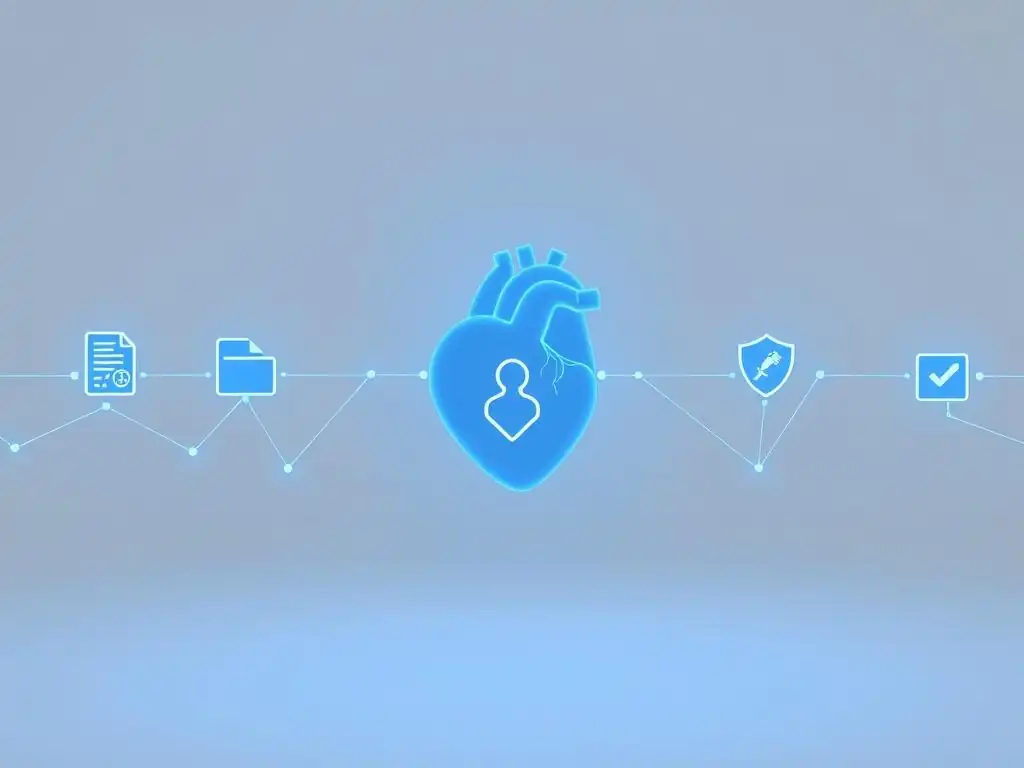
Secure Electronic Health Records (EHR) Management with Blockchain
One of the most promising applications of blockchain and VCs in healthcare is in the management of Electronic Health Records (EHRs). Instead of storing the entire, sensitive EHR directly on a blockchain (which is often impractical), the blockchain can serve as a secure, immutable index and access layer for EHR data stored off-chain. Each entry or update to a patient's record can be hashed and the hash stored on the blockchain, creating a verifiable audit trail.
Furthermore, Verifiable Credentials can represent specific components of the EHR, such as a patient's medication list, allergy information, or a summary of a hospital visit, issued and signed by the respective healthcare provider. The patient holds these VCs and uses their digital identity to grant or revoke access to different parts of their record, managed via smart contracts on the blockchain.
This approach enhances blockchain patient data management security by distributing data control and providing an immutable log of all access, making it harder for unauthorized parties to tamper with records. Several pilot projects and startups are exploring this model, aiming to give patients more control and improve data integrity.
Streamlining Clinical Trial Data with Verifiable Credentials
Clinical trials generate vast amounts of sensitive data, from patient consent forms and eligibility criteria to trial results and adverse event reports. Ensuring the integrity, security, and privacy of this data is paramount for the validity and regulatory approval of new treatments. Traditional methods often involve complex paper trails, centralized databases, and manual verification processes, which are prone to errors, delays, and potential data manipulation.
Using Verifiable Credentials, a patient's eligibility for a trial could be issued as a VC by their doctor, their informed consent recorded as another VC, and specific trial results issued by the research institution. These VCs, held by the patient and verifiable via a blockchain infrastructure, provide a secure, tamper-evident record of participation and data points. This streamlines data collection, enhances data integrity by creating an immutable audit trail on the blockchain, and allows for more efficient verification processes by regulatory bodies, ultimately improving blockchain patient data management security within the clinical trial lifecycle.
Improving Supply Chain Transparency in Pharmaceuticals
Beyond patient data, blockchain technology can significantly improve the transparency and security of the pharmaceutical supply chain. Counterfeit drugs are a major global health issue, estimated by some reports to represent a significant percentage of the global drug market, potentially causing harm or death to patients. Tracking and verifying the origin and journey of medications from manufacturer to patient is complex using traditional, fragmented systems.
A blockchain-based supply chain solution can record every transaction and transfer of ownership for a batch of pharmaceuticals on an immutable ledger. Each participant in the chain – manufacturer, distributor, pharmacy – can be verified, and every handling event (shipping, receiving, dispensing) logged. This creates a transparent and verifiable history for every drug package. While not directly patient data, this application of blockchain contributes to patient safety by ensuring the authenticity and integrity of the medications they receive, indirectly supporting the broader goal of secure healthcare operations.
Patient-Controlled Data Access for Research and Second Opinions
Blockchain and Verifiable Credentials empower patients to become active participants in how their health data is used, including for research and obtaining second opinions. Currently, contributing to medical research often involves complex consent processes and limited visibility into how data is utilized. Seeking a second opinion typically requires requesting and transferring large, physical or digital files of medical records.
With a VC-based system underpinned by blockchain, a patient could receive VCs representing specific health conditions, treatment histories, or diagnostic images. They could then use smart contracts on the blockchain to grant a researcher access to specific, anonymized VCs for a defined period, or easily share relevant VCs with a specialist for a second opinion, all while maintaining a transparent, immutable log of every access event. This granular, patient-controlled access model enhances both privacy and the utility of health data for valuable purposes, demonstrating a powerful application of blockchain patient data management security combined with patient empowerment.
Implementing Blockchain and Verifiable Credentials: Overcoming the Hurdles
Regulatory Considerations and Compliance
Implementing blockchain and Verifiable Credentials in healthcare faces significant regulatory hurdles. Healthcare data is subject to stringent privacy regulations such as HIPAA in the U.S., GDPR in Europe, and other regional laws. These regulations dictate how patient data must be collected, stored, accessed, and protected. While blockchain's security features align well with many privacy principles, challenges arise regarding the "right to be forgotten" or the ability to amend records, which can conflict with blockchain's immutability.
Solutions involve careful architectural design, such as storing sensitive data off-chain while using the blockchain for access control and audit trails, or implementing mechanisms for cryptographic key revocation without altering the core ledger. Navigating these complex legal and compliance landscapes requires close collaboration with regulators and legal experts to ensure that blockchain patient data management security implementations meet all necessary requirements while leveraging the technology's benefits.
Scalability Challenges and Solutions
Blockchain networks, particularly public ones, can face scalability issues related to transaction throughput and latency. Processing the potentially massive volume of transactions generated by a large healthcare system – including recording data updates, access requests, and VC issuances for millions of patients daily – can overwhelm some blockchain architectures. Traditional healthcare systems handle millions of transactions per day, and a blockchain solution must be able to match or exceed this capacity.
Research and development are actively addressing these scalability challenges. Solutions include using private or consortium blockchains designed for higher throughput, employing layer-2 scaling solutions, or optimizing the data structure by storing only hashes and metadata on the chain while managing the bulk data off-chain in distributed storage systems. Selecting the appropriate blockchain architecture and scaling strategy is crucial for ensuring that a blockchain patient data management security system can handle real-world healthcare demands.
Data Governance and Standardization
Effective data governance and standardization are essential for the successful implementation of blockchain and VCs in healthcare. Even with a secure ledger, inconsistent data formats, terminologies, and coding practices across different healthcare providers (e.g., different ways of coding diagnoses or medications) can hinder interoperability and the utility of the data. While VCs follow open standards, the content of the claims within the VCs still needs to adhere to healthcare data standards.
Establishing common data models, terminology standards (like SNOMED CT or LOINC), and governance frameworks for issuing and managing VCs is critical. This requires industry-wide collaboration and agreement. Implementing robust data governance policies that define roles, responsibilities, and processes for data entry, verification, and access within a blockchain-based system is equally important to maintain data quality and ensure effective blockchain patient data management security.
Interoperability with Existing Healthcare Systems
A major practical hurdle is integrating new blockchain and VC solutions with the vast array of legacy Electronic Health Record (EHR) systems and other IT infrastructure already in place within hospitals and clinics. Healthcare providers have made significant investments in their current systems, and a complete overhaul is often not feasible or desirable in the short term.
Achieving interoperability requires developing integration layers, APIs, and middleware that can connect existing EHRs and other systems to the blockchain and VC infrastructure. This allows healthcare providers to gradually adopt the new technology without immediately replacing their core systems. Focusing on creating bridges between the old and the new is key to facilitating the adoption of blockchain for enhanced patient data management security and achieving broader healthcare transformation.
The Future of Healthcare Data Management: Blockchain and Beyond
Emerging Trends in Blockchain-Based Healthcare Solutions
The field of blockchain in healthcare is rapidly evolving, with several emerging trends shaping its future. Beyond EHRs and supply chains, blockchain is being explored for managing patient consent for data sharing, tracking organ donations, securing medical device data, and even facilitating peer-to-peer health data marketplaces where patients can monetize their anonymized data for research.
Another trend is the integration of decentralized autonomous organizations (DAOs) to govern health data networks, allowing stakeholders (patients, providers, researchers) to collectively manage rules and access policies. Furthermore, the development of more efficient and scalable blockchain protocols, as well as privacy-preserving technologies built on blockchain, continues to push the boundaries of what's possible for blockchain patient data management security and utility.
The Role of AI and Machine Learning in Enhancing Data Security
The future of healthcare data management will likely involve the convergence of multiple advanced technologies. Artificial Intelligence (AI) and Machine Learning (ML) can play a crucial role in enhancing blockchain patient data management security. AI algorithms can be used to monitor blockchain networks and off-chain data storage for suspicious activity, detect potential security threats or anomalies in access patterns, and identify potential data integrity issues that require investigation.
ML models can also analyze audit trails recorded on the blockchain to identify patterns indicative of attempted breaches or policy violations. By combining the immutable record-keeping of blockchain with the predictive and analytical power of AI/ML, healthcare systems can create more proactive and resilient security postures, moving beyond reactive responses to data breaches towards preventative security measures.
The Long-Term Impact on Patient Outcomes and Healthcare Costs
The long-term impact of widespread adoption of blockchain and Verifiable Credentials in healthcare is expected to be profoundly positive for both patient outcomes and healthcare costs. Improved data access and interoperability, driven by patient-controlled VCs and secure blockchain infrastructure, can lead to more coordinated care, fewer medical errors due to incomplete information, and faster diagnoses and treatment.
Enhanced blockchain patient data management security reduces the costly impact of data breaches and fraud. Streamlined administrative processes related to data sharing and verification can lower operational costs for providers. Furthermore, secure, patient-consented access to aggregated, high-integrity data can accelerate medical research and the development of personalized medicine. While the initial implementation requires investment, the potential long-term benefits in terms of improved health, efficiency, and reduced waste are substantial.
Conclusion: Towards a More Secure, Transparent, and Patient-Centric Healthcare Ecosystem
Key Takeaways: Blockchain Patient Data Management Security and Verifiable Credentials
The journey towards a truly secure, transparent, and patient-centric healthcare system is complex, but blockchain technology and Verifiable Credentials offer a compelling path forward. The fundamental challenges of data silos, security vulnerabilities, and limited patient control in traditional systems highlight the urgent need for change. Blockchain provides a robust foundation for data integrity, immutability, and decentralized access control, significantly enhancing blockchain patient data management security.
Verifiable Credentials build upon this, empowering patients by enabling them to hold, manage, and selectively share verified health information. Together, these technologies promise to dismantle data silos, reduce the risk and impact of data breaches, and shift the paradigm from institutional data ownership to patient-centric control. Addressing regulatory, scalability, governance, and interoperability hurdles is crucial for successful implementation.
The Potential for Widespread Adoption and Transformation
While challenges remain, the potential for widespread adoption of blockchain and Verifiable Credentials in healthcare is significant, driven by the clear benefits for security, privacy, and efficiency. As pilot programs demonstrate success and industry standards evolve, we can anticipate a gradual but transformative shift. This shift won't happen overnight, requiring collaboration among technology providers, healthcare institutions, regulators, and patients.
Ultimately, the integration of blockchain and Verifiable Credentials holds the promise of creating a healthcare ecosystem where patient data is not only highly secure through advanced blockchain patient data management security measures but also readily accessible and fully controlled by the individual, leading to better health outcomes and a more trustworthy healthcare experience for everyone involved.
Frequently Asked Questions
How does blockchain enhance the security of patient data in healthcare?
Blockchain's decentralized and immutable nature makes it extremely difficult for unauthorized parties to alter or tamper with patient records. This improves data integrity and reduces the risk of data breaches.
Can blockchain improve patient control over their own health information?
Yes, blockchain-based systems can empower patients with greater control over their data through verifiable credentials. They can selectively share their information with different healthcare providers, maintaining data privacy.
What are the potential benefits of using blockchain for interoperability in healthcare data exchange?
Blockchain can facilitate seamless and secure data exchange between different healthcare providers and systems. This improves data accessibility and reduces the risk of errors caused by fragmented information.
How does blockchain address the challenges of data privacy and compliance with regulations like HIPAA?
Blockchain solutions can be designed to be HIPAA compliant by incorporating privacy-enhancing technologies. Verifiable credentials and permissioned blockchains allow for selective data sharing, maintaining patient confidentiality.
What are some of the challenges hindering the wider adoption of blockchain in healthcare for patient data management?
Challenges include scalability issues, the need for standardization, and the complexities of integrating blockchain with existing healthcare IT systems. Regulatory uncertainty also plays a significant role.
Final Reflection: Empowering Patients Through Secure Data
The journey through the potential of blockchain and verifiable credentials in healthcare reveals a powerful truth: patient empowerment is inextricably linked to data security and control. The promise of a future where individuals own and manage their health information, securely and transparently, is no longer a distant dream but a tangible possibility fueled by these innovative technologies.
This shift towards patient-centric data management has profound implications for the cultural and social landscape of healthcare. It's about more than just efficiency; it's about restoring trust and fostering a collaborative relationship between patients and providers. The ability to selectively share verifiable credentials, proving specific health information without revealing sensitive details, is a game-changer. Information is power. But like all power, there are those who want to keep it for themselves.
- Aaron Swartz. This quote resonates deeply as we strive to democratize access to health information and empower individuals to take control of their own well-being.
As you reflect on the potential of blockchain and verifiable credentials in healthcare, consider your own role in shaping this future. How can you advocate for patient-centric data management? How can you embrace technologies that prioritize security and transparency? The future of healthcare is not just about technological advancements; it's about a fundamental shift in power dynamics, empowering you to be the architect of your own health journey.
Unlock the Future of Healthcare: Start Securing Your Data Today!
Thank you for exploring how blockchain technology and verifiable credentials are transforming patient data management. We hope you've gained valuable insights into building a more secure and patient-centered healthcare system. Now, it’s time to take action and become part of this important movement.
Here’s how you can get involved:
- Take control of your health data: Reach out to your healthcare providers and ask about their plans to adopt secure credentialing systems that give you greater ownership of your medical records.
- Learn and share: Research current blockchain-based healthcare initiatives and share your findings on social media using relevant hashtags.
- Start conversations: Talk with friends, family, or healthcare professionals about the benefits of secure, patient-controlled health data and how blockchain can enhance transparency.
What specific step will you take this week to support a more secure, transparent, and patient-focused healthcare system?
Leave a Reply