
zkSTARKs Explained: Scalable and Transparent ZeroKnowledge Proofs


Welcome to Blockchain Trends, your guide to understanding the revolution beyond Bitcoin. Are you ready to delve into the intricate world of blockchain and its myriad applications? In this article, we unravel the complexities of zkSTARKs, exploring how these powerful zero-knowledge proofs are poised to unlock unprecedented scalability for decentralized systems. Curious to see how they work and what advantages they offer? Let's dive in and discover the potential!
zkSTARKs Explained: Scalable and Transparent Zero-Knowledge Proofs
- Introduction to zkSTARKs: Revolutionizing Blockchain Scalability
-
How zkSTARKs Work: A Technical Overview
- The Core Principles of zkSTARK Technology
- From Computation to Arithmetization: Transforming Problems for zkSTARKs
- Constructing Proofs with Polynomial IOPs (Interactive Oracle Proofs)
- The Role of the FRI (Fast Reed-Solomon Interactive Oracle Proof of Proximity) Protocol in zkSTARKs
- Verifying zkSTARK Proofs: Ensuring Transparency and Validity
- zkSTARKs vs. zkSNARKs: A Detailed Comparison
- Applications of zkSTARKs in the Blockchain Ecosystem
- The Future of zkSTARKs: Advancements and Potential
- zkSTARKs Scalability: Quantifiable Benefits and Performance Metrics
- Addressing Common Misconceptions About zkSTARKs
- Conclusion: Embracing zkSTARKs for a Scalable and Transparent Blockchain Future
-
Frequently Asked Questions
- How do zkSTARKs differ from other Zero-Knowledge proof systems like zkSNARKs?
- What are the main scalability benefits that zkSTARKs provide for blockchain applications?
- How does the transparency of zkSTARKs contribute to their security and adoption?
- Can zkSTARKs be used in enterprise applications beyond just blockchain and DeFi?
- What are some potential future developments or challenges facing the widespread adoption of zkSTARKs?
- Final Reflection: Unlocking Scalable Trust with zkSTARKs
- Unleash the Power of Zero-Knowledge: Start Building!
Introduction to zkSTARKs: Revolutionizing Blockchain Scalability
Understanding Zero-Knowledge Proofs (ZKPs) and Their Importance
Zero-Knowledge Proofs (ZKPs) are cryptographic protocols that allow one party (the prover) to prove to another party (the verifier) that a statement is true, without revealing any information beyond the validity of the statement itself. Imagine proving you know the solution to a complex math problem without revealing the solution itself, only demonstrating that you do possess it. This capability is profoundly important in blockchain technology, where privacy and scalability are paramount. ZKPs enable verification of transactions and computations without disclosing the underlying data, opening up possibilities for confidential transactions and efficient scaling solutions.
The significance of ZKPs in the blockchain space stems from their ability to address fundamental challenges. Traditional blockchains often struggle with privacy, as all transaction details are publicly recorded on the ledger. ZKPs offer a pathway to create privacy-preserving blockchains and applications, enabling confidential transactions and data sharing.
Furthermore, ZKPs are crucial for scalability solutions like rollups, where they are used to prove the validity of off-chain computations, allowing blockchains to process significantly more transactions without compromising security. The potential of ZKPs to enhance both privacy and scalability positions them as a cornerstone technology for the future evolution of blockchain.
Introducing zkSTARKs: A Scalable ZKP Solution
Among the various types of Zero-Knowledge Proofs, zkSTARKs (Zero-Knowledge Scalable Transparent ARguments of Knowledge) stand out due to their unique combination of scalability and transparency. Developed as an alternative to zkSNARKs, zkSTARKs address some of the limitations inherent in their predecessor. Specifically, zkSTARKs are designed to be more scalable in terms of proof generation and verification, particularly for complex computations. This scalability advantage is crucial for blockchain applications that require handling large volumes of transactions or intricate smart contract executions.
The "transparent" aspect of zkSTARKs refers to their reliance on publicly verifiable randomness for setup, eliminating the need for a trusted setup ceremony which is required in zkSNARKs. This transparency is a significant advantage in terms of security and trust, as it removes a potential point of vulnerability. zkSTARKs leverage cryptographic primitives that are considered post-quantum secure, meaning they are believed to be resistant to attacks from quantum computers, a growing concern in the cryptographic world. By offering scalability, transparency, and post-quantum security, zkSTARKs are emerging as a powerful tool for building robust and future-proof blockchain solutions.
zkSTARKs Scalability Benefits Explained: A Deep Dive
The scalability benefits of zkSTARKs are primarily derived from their efficient proof generation and verification processes, especially as the complexity of the computation increases. Unlike some other ZKP systems where proof size and verification time grow linearly or even super-linearly with computational complexity, zkSTARKs achieve quasi-linear scalability. This means that as the computation becomes more complex, the proof size and verification time increase at a rate that is only slightly faster than linear, making them significantly more efficient for large-scale applications.
This efficiency translates directly into tangible benefits for blockchain scalability. For instance, in the context of zkSTARK rollups, which are a layer-2 scaling solution for blockchains like Ethereum, the faster proof generation and verification times of zkSTARKs enable higher transaction throughput and lower latency. Independent benchmarks and real-world implementations have demonstrated that zkSTARK-based systems can achieve orders of magnitude improvement in transaction processing capacity compared to the base layer blockchain.
For example, StarkWare, a prominent company utilizing zkSTARKs, has facilitated significant transaction volume increases for platforms like Immutable X and dYdX, processing thousands of transactions per second which would be infeasible on Ethereum mainnet alone. This demonstrates the practical impact of zkSTARKs scalability in enhancing blockchain performance.
How zkSTARKs Work: A Technical Overview
The Core Principles of zkSTARK Technology
zkSTARKs operate on the fundamental principle of transforming computational integrity problems into mathematical problems that can be efficiently verified. At their core, zkSTARKs leverage advanced mathematical concepts, including polynomial commitments, Fast Fourier Transforms (FFTs), and error-correcting codes. These cryptographic tools are combined in a novel way to create proofs that are both succinct and efficiently verifiable. The underlying mathematical framework is based on collision-resistant hash functions and the hardness of the discrete logarithm problem, providing a strong foundation for security.
The process begins by representing the computation that needs to be proven as a series of algebraic constraints. These constraints are then encoded into polynomials. The prover constructs a proof by demonstrating that these polynomials satisfy certain properties related to the computation.
Crucially, zkSTARKs employ Interactive Oracle Proofs (IOPs), which involve a series of interactions between the prover and verifier. However, these interactions can be made non-interactive using the Fiat-Shamir heuristic, making zkSTARKs practical for real-world applications. The key advantage lies in the use of polynomials and efficient protocols like FRI (Fast Reed-Solomon Interactive Oracle Proof of Proximity) to achieve scalability and transparency.
From Computation to Arithmetization: Transforming Problems for zkSTARKs
The first crucial step in the zkSTARK process is arithmetization, which involves converting the computational problem into a set of algebraic equations or constraints. This transformation is essential because zkSTARKs operate on mathematical structures, specifically polynomials. Imagine you want to prove that you correctly executed a complex program. Arithmetization involves expressing each step of this program as a mathematical equation. For example, if a step involves adding two numbers, the arithmetized representation would be a simple addition equation.
Different arithmetization schemes exist, but a common approach is to use Rank-1 Constraint System (R1CS) or its variations. R1CS represents the computation as a series of constraints of the form (a⋅x) * (b⋅x) = (c⋅x), where a, b, and c are vectors of coefficients, and x is a vector of variables representing the inputs, outputs, and intermediate values of the computation. This arithmetization process effectively translates the computational problem into a language that zkSTARKs can understand and process. The efficiency of the arithmetization process directly impacts the overall performance of the zkSTARK proof system.
Constructing Proofs with Polynomial IOPs (Interactive Oracle Proofs)
Once the computation is arithmetized, zkSTARKs utilize Polynomial Interactive Oracle Proofs (IOPs) to construct the proof. IOPs involve a series of rounds of interaction between the prover and the verifier. In each round, the prover commits to a polynomial and the verifier sends a random challenge.
The prover responds by evaluating the polynomial at the challenge point and providing the result to the verifier. This interactive process is repeated multiple times. The crucial aspect is that the polynomials are constructed in such a way that if the original computation was performed correctly, then the polynomials will satisfy certain relationships that the verifier can check through these interactions.
The use of polynomials allows for efficient verification because instead of checking every step of the computation, the verifier only needs to perform a limited number of polynomial evaluations. The interactive nature of IOPs ensures that the prover cannot cheat without being detected with high probability. The number of rounds in the IOP protocol, and the degree of the polynomials used, are carefully chosen to balance proof size, verification time, and security. This sophisticated interplay of polynomials and interactions is what enables zkSTARKs to achieve scalability and soundness.
The Role of the FRI (Fast Reed-Solomon Interactive Oracle Proof of Proximity) Protocol in zkSTARKs
A key component of zkSTARKs is the FRI (Fast Reed-Solomon Interactive Oracle Proof of Proximity) protocol. FRI plays a crucial role in ensuring the "proximity" of the prover's claimed polynomial to a valid Reed-Solomon codeword. Reed-Solomon codes are error-correcting codes that are widely used in data storage and communication to detect and correct errors. In the context of zkSTARKs, FRI is used to verify that the polynomial provided by the prover is "close" to a polynomial that actually represents a valid execution of the computation.
The FRI protocol is itself an IOP that efficiently verifies polynomial proximity. It achieves this by recursively reducing the degree of the polynomial in each round, eventually leading to a very low-degree polynomial that can be checked directly. This recursive process makes FRI highly efficient, especially for high-degree polynomials which are common in complex computations.
The use of FRI is essential for the scalability of zkSTARKs because it allows for efficient verification of polynomial commitments without requiring the verifier to download and check the entire polynomial. By ensuring polynomial proximity, FRI contributes significantly to the soundness and efficiency of zkSTARK proofs.
Verifying zkSTARK Proofs: Ensuring Transparency and Validity
Verifying a zkSTARK proof is a process designed to be significantly faster than generating the proof itself. The verifier receives the proof from the prover and performs a series of checks based on the cryptographic protocols and mathematical properties underlying zkSTARKs. The verification process primarily involves polynomial evaluations and hash function computations. Crucially, the verification does not require re-executing the original computation; it only checks the mathematical proof generated by the prover.
The transparency of zkSTARKs is evident in the verification process. The verification algorithm relies on publicly known cryptographic primitives and parameters. There is no need for any secret keys or trusted setup during verification. Anyone with access to the zkSTARK proof can independently verify its validity. The verification time is typically logarithmic or polylogarithmic in the size of the computation, which is significantly faster than the computation itself, especially for large-scale applications. This efficient and transparent verification process is a key advantage of zkSTARKs, making them suitable for use in decentralized and trustless environments like blockchains.
zkSTARKs vs. zkSNARKs: A Detailed Comparison
zkSNARKs: Advantages and Disadvantages
zkSNARKs (Zero-Knowledge Succinct Non-Interactive ARguments of Knowledge) are another prominent type of Zero-Knowledge Proofs, known for their succinct proof sizes and non-interactive nature. One of the key advantages of zkSNARKs is their proof succinctness. zkSNARK proofs are typically very small, often just a few hundred bytes, making them efficient for transmission and storage on blockchains where block space is limited. Furthermore, zkSNARKs are non-interactive, meaning the prover can generate the proof and send it to the verifier without requiring further interaction. This non-interactivity simplifies the integration of zkSNARKs into various systems.
However, zkSNARKs also have disadvantages. A significant drawback is the requirement for a trusted setup ceremony. This ceremony is needed to generate the common reference string (CRS) which is essential for the security of zkSNARKs. If this setup is compromised, it could potentially allow for the generation of false proofs.
While multi-party computation techniques can mitigate the risk, the trusted setup remains a point of concern. Additionally, zkSNARKs are often considered less scalable in terms of proof generation compared to zkSTARKs, especially for complex computations. The cryptographic assumptions underlying some popular zkSNARK constructions are also considered less conservative than those of zkSTARKs.
zkSTARKs: Advantages and Disadvantages Compared to zkSNARKs
zkSTARKs, in direct comparison to zkSNARKs, offer distinct advantages in scalability and transparency. As previously discussed, zkSTARKs are designed to be more scalable, particularly in proof generation and verification for complex computations. This scalability edge makes them more suitable for applications requiring high throughput and handling large datasets, such as blockchain scaling solutions.
The transparent setup of zkSTARKs, eliminating the need for a trusted setup ceremony, is another major advantage. This removes a potential security vulnerability and simplifies deployment in scenarios where trust assumptions need to be minimized. Moreover, zkSTARKs rely on cryptographic primitives that are believed to be post-quantum secure, offering a degree of future-proofing against quantum computing threats.
However, zkSTARKs also have some disadvantages when compared to zkSNARKs. zkSTARK proofs are typically larger than zkSNARK proofs, which can be a concern in bandwidth-constrained environments or on blockchains with strict block size limits. While zkSTARK verification is efficient, it might be slightly slower than the ultra-fast verification of zkSNARKs in some cases.
Furthermore, the mathematical concepts underlying zkSTARKs can be perceived as more complex and less mature than those of zkSNARKs, although this is a rapidly evolving field. The choice between zkSTARKs and zkSNARKs often depends on the specific requirements of the application, balancing factors like scalability, proof size, transparency, and security assumptions.
Key Differences: Trust Assumptions, Scalability, and Security
The core differences between zkSTARKs and zkSNARKs can be summarized across three key dimensions: trust assumptions, scalability, and security. Regarding trust assumptions, zkSNARKs typically require a trusted setup, while zkSTARKs are transparent and do not. This difference is fundamental and impacts the level of trust required in the system. In terms of scalability, zkSTARKs generally offer better scalability for proof generation and verification, especially for complex computations, making them more suitable for large-scale applications. zkSNARKs, on the other hand, are known for their succinct proof sizes.
In terms of security, both zkSTARKs and zkSNARKs are based on strong cryptographic principles. However, they rely on different underlying assumptions. zkSTARKs rely on collision-resistant hash functions and the hardness of the discrete logarithm problem, which are considered well-established and conservative assumptions.
Furthermore, zkSTARKs are believed to be post-quantum secure. Some zkSNARK constructions rely on pairings and the hardness of related problems, which are also considered secure but are under more active research and could potentially be vulnerable to future advances. The choice between zkSTARKs and zkSNARKs often involves a trade-off between these factors, depending on the specific application and its security and performance requirements.
Choosing Between zkSTARKs and zkSNARKs for Your Blockchain Project
Selecting between zkSTARKs and zkSNARKs for a blockchain project hinges on the project's specific priorities and constraints. If transparency and minimizing trust assumptions are paramount, and the application involves complex computations or requires scalability, zkSTARKs are often the preferred choice. Projects prioritizing security against potential vulnerabilities in trusted setups and those concerned about future quantum computing threats might lean towards zkSTARKs due to their transparent setup and post-quantum security properties. Furthermore, for scaling solutions dealing with high transaction volumes or intricate smart contract executions, zkSTARKs scalability advantages become increasingly significant.
Conversely, if proof size is the most critical factor, for example, in bandwidth-constrained environments or blockchains with very limited block space, and if a trusted setup is deemed acceptable or manageable, zkSNARKs might be more suitable. Applications where verification speed is absolutely paramount and computational complexity is relatively low might also find zkSNARKs advantageous due to their potentially faster verification times in certain scenarios.
Ultimately, a thorough evaluation of the project's requirements, security considerations, and performance goals is necessary to make an informed decision between zkSTARKs and zkSNARKs. Often, the trade-offs between transparency, scalability, proof size, and security assumptions will guide the selection process.
Applications of zkSTARKs in the Blockchain Ecosystem
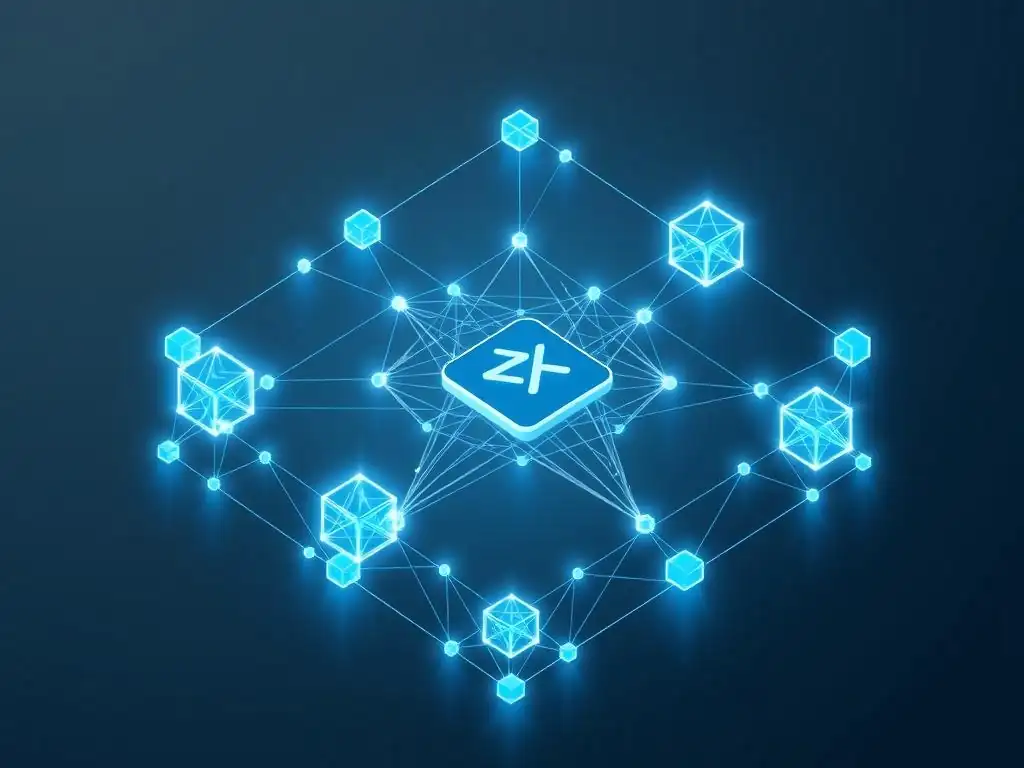
Enhancing Blockchain Scalability with zkSTARK Rollups
One of the most prominent applications of zkSTARKs in the blockchain ecosystem is in the development of zkSTARK rollups. Rollups are layer-2 scaling solutions that process transactions off-chain and then submit a summary of these transactions to the main blockchain. zkSTARK rollups leverage zkSTARKs to generate cryptographic proofs of the validity of these off-chain transactions. These proofs are then submitted to the main chain, allowing the blockchain to verify the correctness of a large batch of transactions efficiently without needing to re-execute them.
This approach significantly enhances blockchain scalability. For example, StarkNet, a permissionless decentralized ZK-Rollup on Ethereum, utilizes zkSTARKs to achieve substantial transaction throughput increases. Compared to Ethereum's mainnet which can process around 15-20 transactions per second, StarkNet, leveraging zkSTARKs, can handle thousands of transactions per second. This scalability boost is crucial for enabling blockchain to support mass adoption and complex decentralized applications. zkSTARK rollups are being actively deployed and explored by various projects as a key technology for scaling Ethereum and other blockchains, demonstrating the practical impact of zkSTARKs on addressing blockchain scalability challenges.
Privacy-Preserving Smart Contracts using zkSTARKs
zkSTARKs are also instrumental in enabling privacy-preserving smart contracts. Traditional smart contracts on public blockchains execute in a transparent manner, with all contract code and data publicly visible. zkSTARKs offer a mechanism to execute smart contracts privately, ensuring that sensitive data and computation logic remain confidential. By using zkSTARKs, smart contract computations can be performed off-chain, and a zkSTARK proof can be generated to demonstrate the correctness of the execution without revealing the underlying data or the contract's internal state.
This capability is particularly valuable for applications that handle sensitive information, such as decentralized finance (DeFi), supply chain management, and healthcare. For instance, in DeFi, zkSTARKs can enable confidential transactions and private lending/borrowing platforms, protecting users' financial data. In supply chain management, zkSTARKs can ensure the confidentiality of business-sensitive information while still allowing for verifiable data integrity. Projects are actively exploring and developing privacy-preserving smart contract platforms using zkSTARKs, aiming to unlock new use cases and enhance the privacy of blockchain applications.
zkSTARKs for Decentralized Identity and Authentication
Decentralized Identity (DID) and authentication are crucial aspects of the Web3 landscape, and zkSTARKs offer powerful tools to enhance privacy and security in this domain. zkSTARKs can be used to prove properties about a user's identity without revealing the identity itself or unnecessary personal information. For example, a user could prove that they are over a certain age without disclosing their exact date of birth, or prove that they possess certain credentials without revealing the credentials themselves.
This selective disclosure capability is highly valuable for privacy-preserving authentication and identity management. zkSTARKs can enable users to control what information they share and with whom, enhancing user privacy and reducing the risk of identity theft and data breaches. Furthermore, zkSTARK-based authentication systems can be more secure than traditional password-based systems, as they rely on cryptographic proofs rather than easily compromised passwords. The use of zkSTARKs in decentralized identity solutions is gaining traction, with projects exploring their application for secure and privacy-preserving authentication in various Web3 applications and services.
Exploring zkSTARKs in Supply Chain Management and Data Integrity
Beyond scalability and privacy, zkSTARKs are finding applications in ensuring data integrity and transparency in supply chain management. Supply chains often involve multiple stakeholders and complex data flows, making it challenging to track goods and verify their authenticity and provenance. zkSTARKs can be used to create verifiable audit trails for supply chain data, ensuring data integrity and transparency without compromising business confidentiality.
For example, zkSTARKs can be used to prove that a product has undergone certain quality checks or has been transported through a specific route, without revealing sensitive details about pricing or supplier relationships. This can enhance trust and accountability within the supply chain, reducing fraud and improving efficiency. Furthermore, zkSTARKs can be used to verify the authenticity of products and combat counterfeiting, which is a significant problem in many industries. The application of zkSTARKs in supply chain management is still in its early stages, but the potential to improve data integrity, transparency, and efficiency is substantial.
The Future of zkSTARKs: Advancements and Potential
Ongoing Research and Development in zkSTARK Technology
The field of zkSTARK technology is rapidly evolving, with ongoing research and development focused on improving efficiency, reducing proof sizes, and expanding the applicability of zkSTARKs. Researchers are actively working on optimizing the underlying cryptographic protocols, such as the FRI protocol, and exploring new arithmetization schemes to further enhance performance. One area of active research is reducing the proof size of zkSTARKs, which, while larger than zkSNARKs proofs, is still a factor in certain applications. Techniques like recursive zkSTARKs and advancements in polynomial commitment schemes are being explored to achieve more succinct proofs.
Another area of focus is improving the developer tooling and libraries for zkSTARKs. Making zkSTARK technology more accessible and easier to implement is crucial for wider adoption. Efforts are underway to create user-friendly programming languages and frameworks that simplify the process of building zkSTARK-based applications. Furthermore, research is exploring new applications of zkSTARKs beyond rollups and privacy-preserving smart contracts, investigating their potential in areas like verifiable machine learning, decentralized governance, and secure multi-party computation. The continuous advancements in zkSTARK technology are paving the way for even more powerful and versatile applications in the future.
zkSTARKs and the Evolution of Zero-Knowledge Proofs
zkSTARKs represent a significant step in the evolution of Zero-Knowledge Proofs. They address some of the key limitations of earlier ZKP systems, particularly in terms of scalability and transparency. zkSTARKs' transparent setup removes the need for trusted parties, enhancing security and trust. Their scalability advantages, especially for complex computations, make them more suitable for large-scale applications and blockchain scaling solutions. Furthermore, their post-quantum security properties position them as a future-proof cryptographic technology.
zkSTARKs are not only a technological advancement but also a conceptual evolution in ZKPs. They demonstrate the feasibility of building practical and efficient ZKP systems based on transparent and auditable cryptographic primitives. The development of zkSTARKs has spurred further innovation in the ZKP field, inspiring new research directions and the development of even more advanced ZKP techniques. As the ZKP landscape continues to evolve, zkSTARKs are likely to remain a cornerstone technology, influencing the future direction of zero-knowledge cryptography and its applications in blockchain and beyond.
Potential Impact of zkSTARKs on the Broader Blockchain Landscape
The potential impact of zkSTARKs on the broader blockchain landscape is transformative. Their scalability benefits are crucial for overcoming the scalability limitations of existing blockchains, enabling them to handle significantly higher transaction volumes and support mass adoption. zkSTARK rollups, in particular, are emerging as a leading solution for scaling Ethereum and other blockchains, potentially unlocking the full potential of decentralized applications and services. The privacy-preserving capabilities of zkSTARKs can also revolutionize blockchain applications, enabling confidential transactions, private smart contracts, and privacy-focused DeFi platforms.
Beyond scalability and privacy, zkSTARKs' transparency and robust security properties enhance the overall trustworthiness and resilience of blockchain systems. The elimination of trusted setups and the post-quantum security features contribute to building more secure and future-proof blockchain infrastructure. As zkSTARK technology matures and becomes more widely adopted, it is expected to play a central role in shaping the future of the blockchain landscape, driving innovation and enabling a new generation of scalable, private, and secure decentralized applications. The continued development and deployment of zkSTARKs will likely be a key factor in realizing the full potential of blockchain technology.
zkSTARKs Scalability: Quantifiable Benefits and Performance Metrics
Understanding the Scalability Limits of Traditional Blockchains
Traditional blockchains, especially those using proof-of-work consensus mechanisms, face inherent scalability limitations. These limitations stem from the fundamental trade-off between security, decentralization, and scalability, often referred to as the "blockchain trilemma". As transaction volume increases on a traditional blockchain, the time it takes to process and validate transactions also increases, leading to network congestion, higher transaction fees, and slower confirmation times. For example, Bitcoin's average transaction throughput is around 7 transactions per second (TPS), and Ethereum's pre-merge throughput was around 15-20 TPS. These figures are significantly lower than centralized payment systems like Visa, which can handle thousands of TPS.
These scalability bottlenecks hinder the widespread adoption of blockchain technology for applications requiring high transaction throughput, such as high-frequency trading, micropayments, and mainstream consumer applications. The limitations arise from factors such as block size limits, block creation time, and the computational overhead of consensus mechanisms. While various optimizations have been explored for traditional blockchains, achieving significant scalability improvements without compromising security or decentralization remains a major challenge. This is where layer-2 scaling solutions, like zkSTARK rollups, come into play, offering a way to overcome these inherent limitations.
How zkSTARKs Overcome Scalability Bottlenecks
zkSTARKs provide a powerful mechanism to overcome the scalability bottlenecks of traditional blockchains by enabling efficient off-chain computation and on-chain verification. zkSTARK rollups, in particular, leverage zkSTARKs to process a large number of transactions off the main blockchain and then generate a succinct proof of the validity of these transactions. This proof, which is significantly smaller and faster to verify than re-executing all the transactions, is then submitted to the main chain. By shifting the computational burden off-chain and relying on efficient zkSTARK proofs for verification, rollups dramatically reduce the load on the main blockchain.
This approach allows blockchains to process a far greater number of transactions than they could handle natively. Instead of each transaction being individually processed and validated on the main chain, a single zkSTARK proof can represent the validity of thousands or even millions of transactions processed off-chain. This drastically increases the effective transaction throughput of the blockchain.
Furthermore, by batching transactions off-chain, rollups can also reduce transaction fees, as the cost of submitting a single zkSTARK proof to the main chain is amortized over a large number of transactions. zkSTARKs' scalability benefits are directly translated into increased transaction throughput, lower latency, and reduced transaction costs for blockchain applications.
Benchmarking zkSTARKs Performance: Transaction Throughput and Latency
Benchmarking zkSTARKs performance in real-world implementations reveals significant improvements in transaction throughput and latency compared to traditional blockchains. Platforms utilizing zkSTARK rollups, such as StarkNet and Immutable X, have demonstrated transaction throughput capabilities in the range of thousands of transactions per second (TPS). For instance, Immutable X, a layer-2 scaling solution for NFTs built with zkSTARKs, has reported achieving over 9,000 TPS for NFT minting and trading, a substantial improvement over Ethereum's mainnet capacity. dYdX, a decentralized exchange also leveraging StarkWare's zkSTARK technology, has achieved significantly higher trading throughput compared to layer-1 decentralized exchanges.
In terms of latency, zkSTARK rollups also offer improvements. While finality on the main chain still depends on the main chain's block time, the time taken to process transactions and generate zkSTARK proofs off-chain is significantly faster than processing them directly on the main chain. This results in lower latency for users interacting with applications built on zkSTARK rollups.
Specific performance metrics vary depending on the implementation and the complexity of the computations being proven. However, benchmarks consistently show that zkSTARK-based systems achieve orders of magnitude improvement in transaction throughput and reduced latency compared to base layer blockchains, demonstrating the quantifiable scalability benefits of zkSTARKs.
Real-World Examples of zkSTARKs Achieving Scalability Improvements
Real-world examples of zkSTARKs in action vividly illustrate their scalability benefits. StarkWare, a leading company in zkSTARK technology, powers several prominent blockchain projects. Immutable X, built on StarkWare's StarkEx zk-rollup engine, has enabled massive scaling for NFT trading, allowing for gas-free NFT minting and trading with significantly increased throughput. This has facilitated the growth of NFT marketplaces and applications that would be infeasible on Ethereum mainnet due to gas fees and scalability limitations. dYdX, another platform leveraging StarkEx, has demonstrated significant improvements in trading throughput and reduced gas fees for decentralized derivatives trading.
Another example is Sorare, a fantasy sports game platform, which also utilizes StarkEx to enable millions of NFT transactions efficiently. These real-world deployments demonstrate the practical scalability achieved by zkSTARKs. They showcase how zkSTARK rollups can enable blockchain applications to handle large user bases and high transaction volumes, paving the way for wider adoption of blockchain technology. The success of these projects highlights the tangible benefits of zkSTARKs in addressing blockchain scalability challenges and unlocking new possibilities for decentralized applications.
Addressing Common Misconceptions About zkSTARKs
Myth: zkSTARKs are Too Complex to Implement
A common misconception surrounding zkSTARKs is that they are excessively complex to implement, requiring specialized cryptographic expertise and making them inaccessible to most developers. While the underlying mathematics of zkSTARKs are indeed advanced, the tools and libraries available for developers are rapidly improving, simplifying the implementation process. Frameworks and programming languages specifically designed for zero-knowledge proof development are emerging, making it easier for developers to build zkSTARK-based applications without needing to be cryptographic experts.
For instance, Cairo, a programming language developed by StarkWare, is specifically designed for writing provable programs for zkSTARKs. Cairo simplifies the process of defining computations that can be proven with zkSTARKs and provides tools for generating and verifying proofs. Furthermore, libraries and SDKs in languages like Rust and JavaScript are becoming more readily available, offering higher-level abstractions and simplifying the integration of zkSTARKs into existing software systems. While zkSTARK development is still a relatively nascent field, the increasing availability of developer-friendly tools and resources is making them more accessible and easier to implement than commonly perceived.
Reality: Emerging Tools and Libraries Simplify zkSTARK Development
The reality is that the ecosystem of tools and libraries for zkSTARK development is rapidly maturing, significantly simplifying the implementation process. As mentioned earlier, Cairo provides a dedicated programming language for writing provable programs. Beyond Cairo, other tools and libraries are emerging that abstract away much of the cryptographic complexity. For example, StarkWare provides comprehensive documentation, tutorials, and developer support to assist developers in building with zkSTARKs. Open-source communities are also contributing to the development of zkSTARK libraries and tools, further expanding the resources available to developers.
These emerging tools and libraries are making zkSTARK development increasingly accessible to a wider range of developers, not just cryptographic specialists. The focus is shifting towards providing higher-level abstractions and user-friendly interfaces that allow developers to leverage the power of zkSTARKs without needing to delve into the intricate cryptographic details. As these tools continue to evolve and mature, the barrier to entry for zkSTARK development will further decrease, fostering greater adoption and innovation in the zkSTARK ecosystem. The simplification of zkSTARK development is a key factor driving their increasing relevance and practical applicability in the blockchain space.
Myth: zkSTARKs are Less Secure Than Other ZKP Solutions
Another misconception is that zkSTARKs are less secure than other Zero-Knowledge Proof solutions, particularly zkSNARKs, due to their reliance on different cryptographic assumptions and their relatively newer nature. In reality, zkSTARKs offer robust security based on well-established and conservative cryptographic principles. They primarily rely on collision-resistant hash functions and the hardness of the discrete logarithm problem, both of which are widely accepted and extensively studied cryptographic assumptions. These assumptions are considered more conservative than some of the pairing-based assumptions used in certain zkSNARK constructions.
Furthermore, zkSTARKs' transparent setup eliminates the need for a trusted setup ceremony, removing a potential point of vulnerability associated with zkSNARKs. The absence of a trusted setup enhances the overall security and auditability of zkSTARK systems. Moreover, zkSTARKs are believed to be post-quantum secure, offering a degree of protection against potential future attacks from quantum computers, which is a growing concern for cryptographic systems. While zkSTARKs are a relatively newer technology compared to some other ZKP solutions, their security foundations are strong and continuously being rigorously analyzed and reviewed by the cryptographic community.
Reality: zkSTARKs Offer Robust Security Based on Established Cryptographic Principles
The reality is that zkSTARKs offer a high level of security grounded in established cryptographic principles. Their reliance on collision-resistant hash functions and the discrete logarithm problem provides a solid security foundation. These cryptographic primitives are widely used and well-understood in cryptography, and their security has been extensively scrutinized and validated by the cryptographic community. The transparent setup of zkSTARKs further enhances their security profile by eliminating the trusted setup vulnerability. The post-quantum resistance of zkSTARKs adds another layer of security, making them a future-proof cryptographic solution.
Independent security audits and formal verification efforts are being conducted on zkSTARK implementations and protocols, further bolstering confidence in their security. The cryptographic community continues to analyze and research zkSTARKs, contributing to their ongoing security evaluation and improvement. While no cryptographic system is entirely immune to all potential attacks, zkSTARKs are designed and built with robust security in mind, leveraging well-established cryptographic principles and undergoing continuous scrutiny and refinement. They are considered a secure and trustworthy Zero-Knowledge Proof solution for various applications, including those in the blockchain space.
Conclusion: Embracing zkSTARKs for a Scalable and Transparent Blockchain Future
zkSTARKs represent a groundbreaking advancement in Zero-Knowledge Proof technology, offering a powerful combination of scalability and transparency that is poised to revolutionize the blockchain landscape. Their ability to generate efficient and verifiable proofs for complex computations, coupled with their transparent setup and robust security, makes them a compelling solution for addressing key challenges in blockchain scalability, privacy, and trust. As the blockchain ecosystem continues to evolve and strive for wider adoption, zkSTARKs are emerging as a critical enabling technology.
The scalability benefits of zkSTARKs, particularly in the form of zkSTARK rollups, offer a pathway to overcome the transaction throughput limitations of traditional blockchains, paving the way for mass adoption and more complex decentralized applications. Their privacy-preserving capabilities open up new possibilities for confidential transactions and private smart contracts, enhancing user privacy and enabling new use cases in DeFi, supply chain management, and beyond.
The transparent and secure nature of zkSTARKs fosters greater trust and auditability in blockchain systems, contributing to a more robust and resilient decentralized future. Embracing zkSTARKs and continuing to invest in their development and adoption is crucial for realizing the full potential of blockchain technology and building a truly scalable and transparent decentralized web.
Frequently Asked Questions
How do zkSTARKs differ from other Zero-Knowledge proof systems like zkSNARKs?
zkSTARKs offer scalability and transparency advantages. Unlike zkSNARKs, they don't require a trusted setup, eliminating a potential security risk. They also generally offer faster proof verification, especially for complex computations.
What are the main scalability benefits that zkSTARKs provide for blockchain applications?
zkSTARKs significantly improve scalability by allowing off-chain computation and on-chain verification of proofs. This reduces the computational burden on the blockchain, allowing it to handle more transactions. Proof sizes remain relatively small even for large computations.
How does the transparency of zkSTARKs contribute to their security and adoption?
The transparency of zkSTARKs stems from the fact that they don't require a trusted setup. This eliminates the risk of the setup's secret parameters being compromised, which could potentially allow someone to forge proofs.
Can zkSTARKs be used in enterprise applications beyond just blockchain and DeFi?
Yes, zkSTARKs have broad applicability outside of blockchain and DeFi. They can be used in any scenario where privacy-preserving computation and data verification are required, such as supply chain management and secure data analytics.
What are some potential future developments or challenges facing the widespread adoption of zkSTARKs?
One challenge is the complexity of implementing zkSTARKs. Future developments will likely focus on making them easier to integrate into existing systems and optimizing performance for specific use cases.
Final Reflection: Unlocking Scalable Trust with zkSTARKs
The exploration of zkSTARKs reveals more than just a cryptographic marvel; it unveils a pathway towards a future where trust and scalability coexist harmoniously. The potential for zkSTARKs to revolutionize blockchain technology and beyond, by offering verifiable computation without revealing sensitive data, is now more relevant than ever. As data breaches and privacy concerns continue to dominate headlines, the need for solutions that prioritize both security and efficiency becomes paramount.
The impact of zkSTARKs extends far beyond the technical realm, influencing how we perceive and interact with data in a digital age. The ability to verify computations without revealing the underlying information fundamentally shifts the power dynamic, empowering individuals and fostering greater transparency in systems that were once opaque. Trust, but verify
takes on a whole new meaning when verification is mathematically guaranteed and privacy is inherently preserved. This paradigm shift has the potential to reshape industries ranging from finance to healthcare, creating a more equitable and trustworthy digital landscape.
Now, as you reflect on the power of zkSTARKs and their potential to unlock scalable trust, consider how you can champion this technology in your own sphere of influence. How can you advocate for the adoption of privacy-preserving solutions that empower individuals and foster greater transparency? The future of trust is being built today, and your understanding and advocacy can play a crucial role in shaping a more secure and equitable digital world for all.
Unleash the Power of Zero-Knowledge: Start Building!
Thank you for exploring the world of zkSTARKs with Blockchain Trends! We hope you now have a clearer understanding of these scalable and transparent zero-knowledge proofs. It's time to apply this knowledge and discover the exciting possibilities.
Ready to take the next step?
- Dive into the documentation and tutorials to understand practical implementation.
- Explore existing projects utilizing zkSTARKs. Consider the problems they address and how you might contribute or adapt their solutions.
- Share this article with fellow developers and blockchain enthusiasts to spread awareness about the potential of zkSTARKs.
What innovative use case do you envision for zkSTARKs in the near future? Share your ideas in the comments below!
Leave a Reply