
Beyond Solidity: Exploring Emerging Languages for Smart Contract Innovation


Welcome to Blockchain Trends, your compass in the rapidly evolving world of decentralized technologies. Forget just cryptocurrency – we're diving deep into the transformative power of blockchain across industries.
But what truly fuels this revolution? The code, of course! Ever wondered what lies beyond Solidity in the realm of blockchain development? Our insightful interview explores the exciting landscape of blockchain smart contract development languages, uncovering emerging tools and their potential to reshape the future of decentralized applications. Discover which languages experts are betting on and how they're pushing the boundaries of smart contract innovation. Ready to unlock the next generation of blockchain possibilities?
Beyond Solidity: Exploring Emerging Languages for Smart Contract Innovation
- Introduction: The Evolving Landscape of Blockchain Smart Contract Development
- Challenges with Solidity and the Case for New Languages
- Emerging Blockchain Smart Contract Development Languages: A Deep Dive
- Comparing Blockchain Smart Contract Languages: A Feature Matrix
- The Future of Smart Contract Development: Trends and Predictions
-
Expert Insights: Dr. Anya Sharma, Lead Blockchain Architect at Innovate Solutions on the Future of Smart Contract Languages
- "The evolution of blockchain smart contract development languages is not just a technical footnote; it's fundamental to the scalability, security, and ultimately, the widespread adoption of decentralized technology."
- "Embracing multiple languages presents challenges in tooling and developer expertise, but the long-term benefits in terms of system robustness and innovation potential are undeniable."
- Conclusion: Embracing Innovation in Blockchain Smart Contract Programming
-
Frequently Asked Questions
- What are some alternative blockchain smart contract development languages besides Solidity?
- How does Rust contribute to improved smart contract security?
- What advantages does Go offer for blockchain smart contract development?
- What is Vyper, and what are its key design goals for smart contract development?
- How might different blockchain smart contract development languages impact the future of decentralized applications?
- Final Reflection: Embracing the Future of Smart Contract Development
- Unveil Your Smart Contract Potential!
Introduction: The Evolving Landscape of Blockchain Smart Contract Development
Solidity's Dominance and the Need for Alternative Smart Contract Languages
For years, Solidity has stood as the undisputed heavyweight champion in the realm of blockchain smart contract development languages, particularly within the Ethereum ecosystem and its compatible networks like the BNB Chain and Polygon. Its C++ and JavaScript-like syntax made it relatively accessible for many developers venturing into decentralized application (dApp) creation.
This dominance led to a vast library of tools, extensive documentation, and a large, active community, solidifying its position as the default choice for building everything from simple tokens (like ERC-20) to complex decentralized finance (DeFi) protocols. The sheer volume of smart contracts written in Solidity currently deployed across various EVM-compatible chains is staggering, numbering in the millions and securing billions of dollars in digital assets.
However, this widespread adoption has also highlighted inherent limitations and challenges with Solidity, prompting a growing interest in alternative blockchain smart contract development languages. Issues surrounding security vulnerabilities, gas efficiency, and the complexity of formal verification for critical applications have become increasingly apparent as the technology matures and the stakes grow higher.
The need for languages designed with specific blockchain paradigms in mind, or those offering different trade-offs in terms of performance, security guarantees, or developer experience, is driving innovation in the smart contract programming space. This exploration beyond Solidity is not about replacing it entirely, but rather expanding the toolkit available to developers building the next generation of decentralized applications and protocols.
Setting the Stage: Exploring Novel Approaches to Smart Contract Programming
The blockchain landscape is diversifying rapidly, moving beyond the EVM-centric world into new architectures like account-based models, UTXO-based systems, and specialized execution environments. This diversification naturally necessitates or encourages the use of different blockchain smart contract development languages tailored to these unique environments. For instance, platforms built using the Substrate framework often leverage Rust, while enterprise solutions like Hyperledger Fabric commonly utilize Go chaincode. Newer chains focusing on high throughput and specific use cases are also pioneering their own domain-specific languages or adapting existing general-purpose languages.
Exploring these novel approaches involves understanding the design philosophies behind each language and how they address the challenges faced by Solidity. It means looking at how languages like Rust offer memory safety and performance benefits, how Go provides concurrency features suitable for certain blockchain architectures, how Vyper prioritizes security and auditability through syntax restrictions, and how leveraging established languages like JavaScript/TypeScript can lower the barrier to entry for web developers.
This deep dive into emerging blockchain smart contract development languages is crucial for developers and projects aiming to build more secure, efficient, and innovative decentralized applications in a multi-chain future.
Challenges with Solidity and the Case for New Languages
Security Vulnerabilities in Solidity Smart Contracts: A Persistent Threat
Security remains one of the most critical concerns in blockchain smart contract development, and Solidity's design, while powerful, has been associated with several classes of vulnerabilities. Issues like reentrancy, integer overflows/underflows, reliance on predictable block variables, and improper access control mechanisms have led to significant financial losses in the past.
The infamous DAO hack in 2016, resulting in the loss of millions of Ether due to a reentrancy vulnerability, stands as a stark reminder of the potential consequences. More recently, incidents involving logic errors or vulnerability exploits continue to occur, albeit less frequently for well-audited contracts, highlighting the ongoing risk.
The mutable nature of state variables and the complexity of control flow in Solidity can make reasoning about contract behavior challenging, increasing the likelihood of subtle bugs. While tools for static analysis, formal verification, and extensive testing have improved significantly, they require expertise and are not foolproof.
The inherent flexibility of Solidity, paradoxically, can also be a double-edged sword, allowing for complex logic but simultaneously introducing more potential attack vectors if not handled with extreme care. This persistent threat landscape makes the case for exploring blockchain smart contract development languages designed with security principles more deeply embedded, potentially through stricter type systems, built-in checks, or restricted language features that prevent common pitfalls.
Gas Optimization and Efficiency Limitations in Solidity-Based dApps
Ethereum's gas mechanism, while essential for preventing denial-of-service attacks, requires developers to be acutely aware of the computational cost of their smart contract operations. Solidity code, depending on its structure and complexity, can sometimes be inefficient in terms of gas consumption. Operations like loop iterations, state variable storage reads/writes, and external contract calls all incur gas costs, and poorly optimized contracts can become prohibitively expensive to interact with, especially during periods of high network congestion. For dApps requiring frequent, low-cost interactions, this can be a significant barrier to user adoption.
Achieving optimal gas efficiency in Solidity often requires deep knowledge of the EVM's opcode costs and employing specific coding patterns, which can sometimes compromise code readability or introduce new potential errors. While newer EVM upgrades aim to reduce certain costs, the fundamental challenge of writing gas-efficient code persists.
This limitation drives interest in blockchain smart contract development languages that might compile to more efficient bytecode, run on platforms with different execution models (like fee markets or different consensus mechanisms), or offer language features that naturally lead to more performant code. The pursuit of lower transaction costs and higher throughput is a key motivator for exploring alternative development environments.
The Quest for Improved Developer Experience in Smart Contract Development
Beyond security and performance, the developer experience (DX) for blockchain smart contract development is a crucial factor influencing productivity and adoption. While Solidity has a large community and tooling ecosystem, its unique syntax and the intricacies of the EVM can still present a steep learning curve for developers accustomed to traditional programming environments. Debugging complex smart contracts can be challenging, and the iterative deploy-and-test cycle on a blockchain testnet or mainnet is often slower than typical software development workflows.
Developers often express a desire for blockchain smart contract development languages that feel more familiar, offer better debugging capabilities, or integrate more seamlessly with existing development tools. Languages like Vyper aim for Pythonic simplicity, while the use of JavaScript/TypeScript in environments like CosmWasm leverages the massive web development community.
Rust, though initially challenging, offers a robust type system and tooling that many developers appreciate for building reliable systems. Improving the DX through clearer syntax, better tooling, faster iteration cycles, and more intuitive error handling is a significant driver behind the development and adoption of new blockchain smart contract development languages.
Emerging Blockchain Smart Contract Development Languages: A Deep Dive
Rust for Smart Contracts: Performance and Security Advantages
Rust has rapidly gained traction as a powerful and safe language for systems programming, and its characteristics make it particularly well-suited for blockchain smart contract development. Its emphasis on memory safety without a garbage collector, achieved through its ownership system, eliminates common bugs like null pointer dereferences and data races, which can translate directly to enhanced security in smart contracts. Furthermore, Rust code is known for its performance, often compiling to highly efficient native code, which is critical for resource-constrained blockchain environments.
The language's strong type system and expressive features allow developers to write code that is both performant and robust. While Rust has a steeper initial learning curve compared to Solidity or JavaScript, many developers find that the rigor enforced by the compiler ultimately leads to more reliable and secure code in the long run. Its growing ecosystem includes excellent tooling for testing, dependency management (Cargo), and code analysis, contributing to a more professional development workflow. These advantages position Rust as a strong contender among emerging blockchain smart contract development languages, especially for performance-critical applications.
Rust Smart Contract Examples: Aave Protocol V3 on Substrate: Decentralized Lending
A notable example of Rust's use in blockchain smart contract development is within the Polkadot and Kusama ecosystems, which are built using the Substrate framework. Substrate allows developers to build custom blockchains, and the logic for these chains, including runtime modules (often containing smart contract-like logic or core protocol features), is frequently written in Rust. While not traditional "smart contracts" in the EVM sense, these runtime modules serve similar purposes, defining the state transitions and core logic of the chain.
A specific illustration, though not a direct port of Aave V3 as a Substrate runtime module, is the development of sophisticated DeFi protocols within the Polkadot ecosystem that leverage Rust. Projects building on parachains often write their core logic, handling complex financial operations like lending, borrowing, and liquidations, in Rust due to its performance and safety guarantees.
This demonstrates how Rust is used for building complex, high-value applications akin to major DeFi protocols, but integrated directly into the chain's runtime or as specialized smart contracts on Rust-native platforms like Solana or NEAR, proving its capability for demanding blockchain smart contract development.
Integrating Rust with Blockchain Platforms: Polkadot and Substrate Integration Details
Rust's integration with blockchain platforms is most prominent in the Substrate framework, developed by Parity Technologies. Substrate is a modular toolkit for building application-specific blockchains. The core logic of a Substrate chain, known as the "runtime," is typically developed in Rust. This runtime includes components like the consensus mechanism, transaction queue, and the state transition logic – essentially, the rules that govern the blockchain. Smart contract functionality can be added to a Substrate chain in various ways.
One approach is using Substrate's FRAME (Framework for Runtime Aggregation of Modularized Entities), where developers write "pallets" (runtime modules) in Rust. These pallets define specific features and functionalities, acting like highly privileged smart contracts integrated directly into the chain's core. Another method is integrating a smart contract execution layer, such as the pallet-contracts which supports WebAssembly (Wasm). Developers can write smart contracts in languages like Rust (or C/C++) that compile to Wasm, and these contracts can then be deployed and executed on a Substrate chain. This deep integration at the runtime level, coupled with Wasm support, makes Rust a first-class citizen for blockchain smart contract development within the Substrate ecosystem.
Go for Smart Contracts: Concurrency and Scalability
Go (or Golang) is another general-purpose language that has found a significant role in the blockchain space, particularly in building blockchain infrastructure and, importantly, for developing smart contracts (often referred to as "chaincode") within enterprise blockchain frameworks. Go's strengths lie in its simplicity, strong standard library, fast compilation times, and excellent support for concurrency through goroutines and channels. These features make it well-suited for building performant network services and handling parallel operations, which are common requirements in blockchain environments.
While not typically used for public, permissionless chains like Ethereum, Go is a primary language for developing chaincode on platforms designed for enterprise or consortium use cases. Its familiarity to many backend developers and its robust tooling contribute to a productive development environment. The focus on readability and maintainability also makes Go a good choice for complex business logic that needs to be implemented as blockchain smart contract development.
Go Smart Contract Examples: Hyperledger Fabric Chaincode: Enterprise Blockchain Solutions
The most prominent example of Go being used for blockchain smart contract development is within Hyperledger Fabric, a leading enterprise blockchain platform hosted by the Linux Foundation. In Fabric, smart contracts are called "chaincode." Chaincode encapsulates the business logic that governs transactions and access to the ledger state. Developers writing chaincode for Hyperledger Fabric frequently use Go, although Java and Node.js are also supported.
Go chaincode interacts with the Fabric ledger via a shim API, allowing it to read and write state (key-value pairs) and interact with other chaincode. For instance, a supply chain application on Fabric might have chaincode written in Go to manage asset ownership, track provenance, and execute transfers based on predefined rules. The Go language's capabilities for handling concurrent requests are leveraged by the Fabric peer nodes to process multiple chaincode invocations efficiently, making it suitable for enterprise applications requiring high transaction throughput and complex logic encoded in their blockchain smart contract development.
Leveraging Go's Concurrency for High-Performance Blockchain Applications
Go's built-in support for concurrency is a major advantage when developing components for blockchain systems, including chaincode. Goroutines are lightweight, independently executing functions, and channels provide a safe way for goroutines to communicate. This concurrency model allows Go programs to perform multiple tasks simultaneously, efficiently utilizing multi-core processors.
In the context of Hyperledger Fabric chaincode, Go's concurrency can be leveraged to handle multiple incoming transaction proposals concurrently within a single chaincode container. This improves the throughput and responsiveness of the chaincode, enabling the platform to process a higher volume of transactions per second. For enterprise blockchain solutions where performance and scalability are critical, being able to write blockchain smart contract development code that naturally supports parallel execution is a significant benefit. This makes Go a powerful tool for building the backend logic of performant, permissioned blockchain networks.
Vyper: A Pythonic Approach to Smart Contract Security
Vyper is a Pythonic, opinionated blockchain smart contract development language designed specifically for the EVM. Unlike Solidity, which aims for flexibility, Vyper prioritizes security and auditability by intentionally limiting language features. It explicitly disallows features like inheritance, infinite loops, modifiers, and inline assembly, which are present in Solidity but can sometimes introduce complexity and security risks. The philosophy behind Vyper is to make smart contracts easier to read, write, and audit, thereby reducing the likelihood of vulnerabilities.
Vyper's syntax is heavily inspired by Python, making it potentially more accessible to the large community of Python developers. It enforces strict type checking and provides built-in functions for common operations, often with safety checks included. While it may be less flexible for certain complex patterns compared to Solidity, its constrained nature is a deliberate choice aimed at producing more secure and predictable smart contracts. This focus on safety and simplicity makes Vyper an attractive alternative for developers prioritizing security in their blockchain smart contract development.
Vyper Smart Contract Examples: Curve StableSwap Pools: Automated Market Makers
One of the most prominent examples of Vyper's use in production is within the Curve Finance protocol. Curve is a major decentralized exchange specifically designed for swapping stablecoins and other pegged assets with low slippage. The core smart contracts powering Curve's StableSwap pools are written in Vyper. These contracts manage the liquidity pools, handle deposits and withdrawals, and execute trades based on Curve's unique constant function market maker algorithm.
The choice of Vyper by the Curve team was largely driven by the language's focus on security and auditability. Given the large amounts of capital held within Curve's liquidity pools, minimizing the risk of smart contract vulnerabilities is paramount. Vyper's simpler syntax and restricted features made it easier for the Curve contracts to be rigorously audited and formally verified, providing a higher degree of confidence in their safety. This real-world adoption by a leading DeFi protocol demonstrates Vyper's viability as a secure blockchain smart contract development language for high-value applications.
Focusing on Auditability and Security with Vyper's Design
Vyper's design philosophy revolves around creating smart contracts that are inherently more secure and easier to audit than those written in more complex languages. By intentionally omitting features that can lead to unexpected behavior or make code difficult to analyze (like dynamic calls to arbitrary addresses via inline assembly), Vyper reduces the surface area for potential bugs and exploits.
The language's syntax is designed to be clear and unambiguous, making it easier for auditors and developers to reason about the contract's logic. For example, Vyper includes built-in functions for common arithmetic operations that handle overflow/underflow checks by default, preventing a class of vulnerabilities common in Solidity. The lack of inheritance prevents complex dependency trees that can obscure where functions or state variables are defined. This strong emphasis on security and auditability from the ground up is Vyper's key differentiator in the landscape of blockchain smart contract development languages.
Javascript/Typescript for Smart Contracts: Bridging the Gap for Web Developers
JavaScript and its superset, TypeScript, are ubiquitous in web development, boasting the largest developer community globally. Leveraging these languages for blockchain smart contract development significantly lowers the barrier to entry for millions of developers who are already proficient in this ecosystem. While not native to the EVM, environments like CosmWasm (used by chains in the Cosmos ecosystem, NEAR, and others) support smart contracts compiled to WebAssembly (Wasm), which can be generated from languages like Rust, C/C++, and also TypeScript via projects like AssemblyScript.
The appeal of using JavaScript/TypeScript lies in developer familiarity, extensive tooling (npm, webpack, VS Code integrations), and the ability to use a single language across the entire dApp stack (frontend, backend, and smart contracts). While AssemblyScript is a subset of TypeScript that compiles to Wasm and has certain limitations compared to full TypeScript, it provides a pathway for JavaScript developers to write performant smart contracts. This approach aims to onboard a massive pool of talent into the blockchain space, accelerating innovation and adoption.
Javascript/Typescript Smart Contract Examples: CosmWasm Contracts: Inter-Blockchain Communication
CosmWasm is a smart contract module that can be integrated into Cosmos SDK-based blockchains (and others). It allows developers to write smart contracts that compile to WebAssembly (Wasm). While Rust is a popular choice for CosmWasm development due to its performance and safety, AssemblyScript provides an avenue for JavaScript/TypeScript developers. Contracts deployed on chains like Terra Classic (before its collapse), Juno, Secret Network, and others in the Cosmos ecosystem utilize CosmWasm.
These contracts can perform various functions, from token management (like CW20 standard, analogous to ERC-20) to complex DeFi protocols and non-fungible tokens (CW721, analogous to ERC-721). The Inter-Blockchain Communication (IBC) protocol, fundamental to the Cosmos ecosystem, allows CosmWasm contracts on different chains to communicate and interact, enabling cross-chain applications. This demonstrates how JavaScript/TypeScript, via AssemblyScript and the Wasm standard, is being used to build interoperable blockchain smart contract development on non-EVM chains.
Utilizing Web Development Skills in Blockchain Development
The ability to use JavaScript/TypeScript for blockchain smart contract development is a powerful bridge for web developers looking to transition into the blockchain space. Instead of learning an entirely new language like Solidity or Rust from scratch, developers can leverage their existing knowledge of JavaScript syntax, asynchronous programming patterns, and tooling.
While AssemblyScript has specific requirements and differences from standard TypeScript, the core concepts, control flow, and data structures remain familiar. This reduces the cognitive load and allows developers to focus on understanding blockchain-specific concepts like state management, transaction processing, and security implications, rather than struggling with a new language. By enabling a smoother transition, the use of JavaScript/TypeScript in Wasm-based smart contract environments accelerates the growth of the developer community building decentralized applications.
Other Notable Smart Contract Languages: Cairo, Move
The innovation in blockchain smart contract development languages extends beyond the most widely adopted alternatives. Several other languages are emerging, often tied to specific blockchain platforms and designed to address unique requirements or offer novel features. Two prominent examples are Cairo, used for STARK-based validity rollups, and Move, initially developed for the Diem (formerly Libra) project and now adopted by chains like Aptos and Sui.
These languages represent different approaches to smart contract design, focusing on aspects like provability, formal verification, and asset safety. While their current adoption might be more niche compared to Rust or Vyper, they are crucial for the ecosystems they serve and represent the ongoing evolution of programming languages for decentralized systems. Exploring these languages provides insight into the diverse directions the field of blockchain smart contract development is taking.
Cairo: Key Features and Use Cases
Cairo is a Turing-complete programming language for writing STARK-provable programs. It was developed by StarkWare Industries and is primarily used for writing smart contracts on StarkNet, a permissionless decentralized ZK-rollup operating as a Layer 2 network over Ethereum. The core idea behind Cairo is to enable the computation of arbitrary programs off-chain and then generate a STARK proof that verifies the correctness of the computation. This proof is then verified on-chain, significantly reducing the gas cost and increasing throughput compared to executing the computation directly on Ethereum.
Key features of Cairo include its focus on provability, its unique memory model, and its integer-based arithmetic optimized for STARK proofs. Smart contracts written in Cairo on StarkNet can handle complex logic, such as decentralized exchanges, NFT minting, and gaming, all while benefiting from the scalability provided by the ZK-rollup architecture. While different from traditional smart contract languages in its structure and mental model, Cairo is vital for the growing ecosystem of verifiable computation and Layer 2 scaling solutions, representing a specialized yet important area of blockchain smart contract development.
Move: Key Features and Use Cases
Move is an open-source programming language for writing safe smart contracts. It was originally developed at Facebook (Meta) for the Diem blockchain project and is now being adopted by new Layer 1 blockchains like Aptos and Sui. Move is designed with a focus on digital assets as a first-class concept. The language's type system uses "resources," which can be thought of as digital assets that cannot be duplicated or implicitly discarded, preventing common programming errors like double-spending or losing assets.
Key features of Move include its resource-centric type system, static analysis to verify program properties offline, and modularity. The language aims to make it easier to write secure code that correctly handles digital assets. Use cases for Move include defining custom token standards, implementing complex DeFi protocols, and managing NFTs on platforms like Aptos and Sui. Its emphasis on asset safety and formal verification capabilities position Move as a strong contender among next-generation blockchain smart contract development languages, particularly for platforms built around the secure and efficient handling of digital assets.
Comparing Blockchain Smart Contract Languages: A Feature Matrix
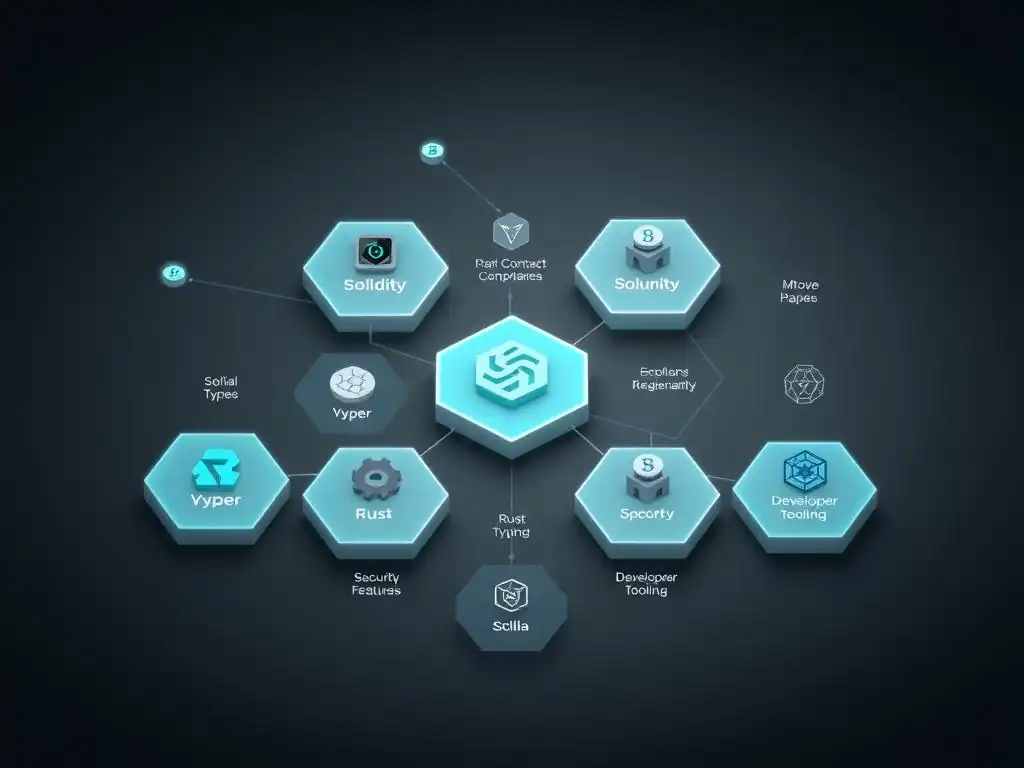
When evaluating different blockchain smart contract development languages, several key factors come into play. Security, performance, developer experience, and ecosystem maturity are among the most critical considerations for projects deciding which language to adopt. While a comprehensive matrix would be extensive, we can compare the prominent emerging languages against each other and Solidity based on these dimensions.
- Security: Languages like Vyper and Move are explicitly designed with security as a primary focus, incorporating features like restricted syntax (Vyper) or resource types and static analysis (Move) to prevent common errors. Rust's memory safety provides strong guarantees against a class of bugs. Solidity offers flexibility but requires rigorous auditing and specific patterns to mitigate risks. Go relies on its strong type system and standard library but doesn't have blockchain-specific security primitives built into the language itself. Wasm-based languages like AssemblyScript inherit some safety from Wasm but depend heavily on the source language and compiler.
- Performance: Rust is generally considered highly performant due to its compilation to native code and control over memory. Go is also known for good performance and excellent concurrency handling, suitable for specific architectures. Solidity's performance is tied directly to the EVM and gas costs, which can vary. Vyper, compiling to EVM bytecode, shares similar performance characteristics to Solidity but might be slightly more or less efficient depending on the specific code pattern. Wasm-based languages' performance depends on the Wasm runtime and the efficiency of the compiled code. Cairo is optimized for provable computation, offering performance benefits via off-chain execution and on-chain verification.
- Developer Experience: Solidity has the largest existing community and tooling ecosystem, making resources readily available. JavaScript/TypeScript leverages the massive web development community and familiar tooling. Go is also a widely used language with good tooling. Rust has a steeper learning curve but is highly appreciated by developers for its tooling and reliability once mastered. Vyper is designed for simplicity and Pythonic familiarity. Move and Cairo are newer and tied to specific ecosystems, meaning smaller communities and less mature tooling currently, though growing rapidly.
- Ecosystem & Adoption: Solidity dominates the EVM space. Rust is strong in Substrate/Polkadot, Solana, and NEAR. Go is primary for Hyperledger Fabric. Vyper has significant adoption in DeFi (Curve). JavaScript/TypeScript is growing in Wasm environments like CosmWasm. Move is central to Aptos and Sui. Cairo is specific to StarkNet. The choice of language often depends heavily on the target blockchain platform.
### Security Considerations: A Comparative Analysis of Language Vulnerabilities

Understanding the typical vulnerabilities associated with each blockchain smart contract development language is crucial for risk assessment. Solidity's common pitfalls include reentrancy, integer overflow/underflow, delegatecall issues, and access control flaws. While static analysis tools and best practices help, the language's flexibility requires developers to be constantly vigilant. The DAO hack (reentrancy) and various integer overflow exploits causing loss of funds serve as historical examples.

Languages like Vyper aim to mitigate these risks by design. Vyper's restrictions make reentrancy patterns harder to implement accidentally, and it includes built-in safe math operations to prevent overflows by default. Move's resource-centric type system is specifically designed to prevent common asset-related bugs like double-spending or loss. Rust's ownership system prevents memory-related errors that could potentially be exploited. While no language is entirely immune to logic errors, some languages offer stronger compile-time guarantees or fewer avenues for common exploits compared to Solidity, influencing their suitability for high-security applications in blockchain smart contract development.

### Performance Benchmarks: Evaluating Gas Efficiency and Execution Speed

Comparing performance across different blockchain smart contract development languages is complex because it's heavily dependent on the underlying blockchain's virtual machine or execution environment. For EVM-compatible chains, Solidity and Vyper compile to EVM bytecode, and their gas efficiency depends on how the compiler translates the code and the specific operations performed. Vyper is sometimes cited as potentially producing slightly more efficient or predictable bytecode for certain operations due to its constrained nature, but this can vary.

For non-EVM chains, performance is tied to their specific runtime. Rust, compiling to native code or highly optimized Wasm, often boasts high performance on platforms like Solana or Substrate. Go chaincode performance on Hyperledger Fabric benefits from Go's concurrency features and the Fabric architecture. Cairo's performance is measured by the efficiency of generating and verifying STARK proofs, enabling high transaction throughput off-chain. Benchmarking requires specific use cases and environments, but generally, languages compiling closer to native code or designed for specific high-performance VMs (like Rust, Go on suitable platforms) tend to offer better raw execution speed than interpreted or less optimized bytecode languages, impacting the overall cost and scalability of blockchain smart contract development.

### Developer Adoption and Community Support: Gauging the Ecosystem

The size and activity of a language's developer community and the maturity of its ecosystem (tooling, libraries, documentation, educational resources) are significant factors in its practical usability for blockchain smart contract development. Solidity currently has the largest ecosystem by a considerable margin, driven by its dominance in the EVM space. This means more developers are available, more questions have been answered online, and more pre-built libraries exist.

However, emerging languages are rapidly building their communities. Rust has a large general-purpose developer community that is increasingly active in blockchain, supported by robust tooling like Cargo. Go also benefits from a large existing developer base and mature tooling. JavaScript/TypeScript's ecosystem is arguably the largest in software development, and projects enabling its use for smart contracts tap directly into this. Vyper's community is smaller than Solidity's but dedicated, particularly within the DeFi space. Move and Cairo have smaller, more nascent communities tied closely to their respective platform ecosystems (Aptos/Sui and StarkNet), but they are growing alongside the platforms' adoption. The strength of the community directly impacts the ease of finding talent, getting help, and leveraging existing resources for blockchain smart contract development.
The Future of Smart Contract Development: Trends and Predictions
Multi-Language Smart Contract Platforms: Interoperability and Flexibility
The future of blockchain smart contract development is increasingly pointing towards multi-language platforms and environments that are not tied to a single programming language. This trend acknowledges that different languages have different strengths and that developers should ideally be able to choose the best tool for a specific task or integrate components written in various languages.
Platforms supporting WebAssembly (Wasm) are a prime example, allowing smart contracts written in any language that can compile to Wasm (like Rust, C/C++, AssemblyScript) to run on the same chain. This significantly expands the pool of potential developers and enables greater flexibility in design choices.
Another aspect of multi-language support is the development of frameworks or standards that allow smart contracts written in different languages (potentially on different chains) to interact seamlessly. Protocols like IBC in the Cosmos ecosystem enable cross-chain communication, and future advancements in interoperability could allow for more complex interactions between contracts regardless of their underlying language or blockchain. This move towards language agnosticism and interoperability is crucial for fostering a more diverse and resilient ecosystem of blockchain smart contract development.
Formal Verification and Advanced Security Tools for Emerging Languages
As blockchain smart contract development becomes more complex and secures increasing amounts of value, the need for rigorous security guarantees grows. Formal verification, a process of mathematically proving the correctness of a program's logic, is gaining importance. While formal verification tools exist for Solidity, applying them can be challenging due to the language's complexity.
Emerging languages are often designed with formal verification in mind. Move, for instance, has a built-in prover tool ( Move Prover) to verify critical properties of smart contracts. Vyper's simplicity and restricted feature set make it more amenable to formal analysis compared to Solidity. Research and development into formal verification tools and techniques for languages like Rust (e.g., using proof assistants or model checkers) are also ongoing. The future will likely see more sophisticated and accessible security tools, including formal verification frameworks, becoming standard practice for blockchain smart contract development across various languages, enhancing the overall security posture of decentralized applications.
The Impact of New Languages on Blockchain Innovation and Adoption
The emergence and adoption of new blockchain smart contract development languages are catalysts for innovation and broader adoption of blockchain technology. By offering different trade-offs in terms of security, performance, and developer experience, these languages enable the creation of new types of applications or make existing ones more efficient and secure. For example, Rust's performance enables high-throughput DeFi on Solana, while Cairo's provability is fundamental to scaling applications on StarkNet. Go's enterprise focus via Hyperledger Fabric facilitates blockchain adoption in traditional industries.
Furthermore, by lowering the barrier to entry for developers familiar with mainstream languages like JavaScript/TypeScript, new languages expand the potential workforce contributing to decentralized ecosystems. A larger, more diverse pool of developers can lead to more innovative ideas, faster development cycles, and ultimately, a wider range of practical and user-friendly dApps. This expansion of the toolkit for blockchain smart contract development is essential for the continued growth and maturation of the decentralized web.
Expert Insights: Dr. Anya Sharma, Lead Blockchain Architect at Innovate Solutions on the Future of Smart Contract Languages
"The evolution of blockchain smart contract development languages is not just a technical footnote; it's fundamental to the scalability, security, and ultimately, the widespread adoption of decentralized technology."
While Solidity provided the necessary foundation and ecosystem to bootstrap the initial wave of dApps, we've learned valuable lessons about its limitations, particularly concerning security and efficiency at scale,
states Dr. Anya Sharma, a veteran in the blockchain space. "The move towards languages like Rust, Vyper, and even domain-specific ones like Move or Cairo is a direct response to these challenges. Each offers a distinct approach – whether it's Rust's system-level performance and safety, Vyper's auditability-focused design, or Move's asset-centric security guarantees. This diversity is crucial because different blockchain architectures and use cases demand different tools. What works best for a high-frequency trading protocol might not be the optimal choice for a simple token contract or an enterprise supply chain solution."
"Embracing multiple languages presents challenges in tooling and developer expertise, but the long-term benefits in terms of system robustness and innovation potential are undeniable."
Dr. Sharma acknowledges the hurdles: "Moving beyond a single dominant language isn't without its difficulties. It requires developers to learn new paradigms, splits community focus, and necessitates the development of entirely new tooling ecosystems – compilers, debuggers, testing frameworks – for each language and platform combination. Interoperability between contracts written in different languages, even on the same chain via Wasm, adds complexity.
However, the payoff is significant. By having languages specifically designed for safety (like Move), performance (like Rust), or verifiability (like Cairo), we can build more reliable, secure, and efficient decentralized systems. This specialization and the ability to choose the right tool for the job will unlock new possibilities and accelerate the maturity of blockchain smart contract development, pushing the boundaries of what's possible in the decentralized world."
Conclusion: Embracing Innovation in Blockchain Smart Contract Programming
The Importance of Exploring Beyond Solidity for Long-Term Growth
Solidity has served the blockchain ecosystem remarkably well, enabling the creation of groundbreaking decentralized applications and the explosion of DeFi. However, relying solely on one language, especially one with known security pitfalls and performance limitations, could hinder the long-term growth and maturation of the decentralized web. The exploration and adoption of alternative blockchain smart contract development languages are not merely academic exercises; they are essential steps towards building more secure, efficient, and diverse decentralized systems capable of handling complex real-world use cases at scale.
Emerging languages like Rust, Go, Vyper, Move, and Cairo, along with the increasing support for Wasm-based languages like AssemblyScript, offer developers a richer palette of tools. Each language brings unique strengths, whether it's enhanced security features, better performance characteristics, or improved developer accessibility. Embracing this linguistic diversity allows projects to select the language best suited to their specific needs, security requirements, and target blockchain platform, ultimately leading to more robust and innovative solutions in blockchain smart contract development.
Choosing the Right Language for Your Smart Contract Project: Key Considerations
Selecting the appropriate blockchain smart contract development language for a project involves weighing multiple factors. It's not simply about picking the "best" language in isolation, but the best fit for the specific context.
- Target Platform: Is the project targeting an EVM-compatible chain, a Substrate-based chain, Hyperledger Fabric, a Move-based chain, or a Wasm-enabled environment? The platform often dictates the primary language options.
- Security Requirements: How critical is security? For high-value applications, languages designed with strong security guarantees or those more amenable to formal verification (like Vyper, Move, or Rust) might be preferred.
- Performance Needs: Does the application require high transaction throughput or extremely low gas costs? Languages like Rust or those optimized for specific high-performance VMs or Layer 2 solutions (like Cairo) could be better choices.
- Developer Expertise & Ecosystem: What languages are the development team already proficient in? How mature is the tooling and community support for the language on the target platform? Leveraging existing skills and a strong ecosystem can significantly impact development speed and quality.
- Project Complexity & Readability: Is the business logic highly complex? Some languages prioritize readability and simplicity (like Vyper) which can be beneficial for auditing and maintenance.
Ultimately, the choice involves a trade-off based on these considerations, and for many projects, it may even involve using multiple languages for different components or layers of their architecture.
[ ] Evaluate project's target platform
[ ] Assess security requirements
[ ] Determine performance needs
[ ] Consider team's language proficiency
[ ] Research language's ecosystem and tooling
[ ] Weigh project complexity and maintainability needs
[ ] Select the most suitable blockchain smart contract development language(s)
Resources for Learning Emerging Smart Contract Languages
For developers looking to explore beyond Solidity and delve into emerging blockchain smart contract development languages, numerous resources are available.
- Rust/Substrate: The official Substrate documentation (substrate.dev), Parity's Rust courses, and general Rust programming resources (rust-book.cs.brown.edu) are excellent starting points.
- Go/Hyperledger Fabric: The official Hyperledger Fabric documentation (hyperledger-fabric.readthedocs.io) includes tutorials and guides for writing Go chaincode. General Go language resources are also widely available.
- Vyper: The official Vyper documentation (vyper.readthedocs.io) is comprehensive, covering syntax, features, and examples.
- JavaScript/TypeScript/CosmWasm: The CosmWasm documentation (docs.cosmwasm.com) provides guides, and AssemblyScript resources (www.assemblyscript.org) help with the language subset.
- Move: The official Move documentation (move-language.github.io) and resources from Aptos (docs.aptos.dev) and Sui (docs.sui.io) are key.
- Cairo/StarkNet: StarkWare's documentation (docs.starknet.io) and Cairo resources (cairo-lang.org) offer in-depth information.
Many platforms also offer tutorials, workshops, and developer grants to encourage learning and building with their preferred blockchain smart contract development languages. Engaging with the communities around these languages on platforms like Discord or Telegram can also provide valuable support and insights.
Frequently Asked Questions
What are some alternative blockchain smart contract development languages besides Solidity?
Beyond Solidity, emerging languages include Rust, Go, and Vyper. These offer improvements in security, performance, and potentially, a smaller attack surface compared to Solidity.
How does Rust contribute to improved smart contract security?
Rust's memory safety features and strong type system help prevent common vulnerabilities like buffer overflows and null pointer dereferences, leading to more secure smart contracts. This reduces the risk of exploits.
What advantages does Go offer for blockchain smart contract development?
Go's concurrency features and efficient memory management make it suitable for building high-performance smart contract and blockchain applications. It's also known for its simplicity and readability.
What is Vyper, and what are its key design goals for smart contract development?
Vyper is a Python-like language designed for smart contract security and simplicity. Its key goals include auditability, preventing common smart contract vulnerabilities, and limiting complexity.
How might different blockchain smart contract development languages impact the future of decentralized applications?
Diverse language options foster innovation, allowing developers to choose tools best suited for specific needs. This can lead to more robust, efficient, and secure dApps, expanding the blockchain ecosystem.
Final Reflection: Embracing the Future of Smart Contract Development
The exploration of alternative languages for smart contract development, as highlighted throughout this article, isn't just an academic exercise; it's a critical imperative for the future of blockchain technology. Solidity, while dominant, faces limitations that these emerging languages actively address, paving the way for more secure, efficient, and versatile decentralized applications. The need for innovation in this space is now more pressing than ever as blockchain adoption continues to accelerate.
The shift towards diverse smart contract languages is not merely a technical evolution; it's a cultural one, fostering a more inclusive and robust ecosystem. This evolution resonates deeply, reminding us that progress hinges on challenging the status quo and embracing new perspectives. The future belongs to those who believe in the beauty of their dreams.
- Eleanor Roosevelt. This quote perfectly encapsulates the spirit of innovation driving the development of these alternative languages, each offering a unique approach to solving the inherent challenges of blockchain technology.
As we conclude this exploration, I invite you to consider the implications of these advancements for your own journey in the blockchain space. Whether you're a seasoned developer or a curious newcomer, the landscape of smart contract development is ripe with opportunity. Embrace the challenge, explore these emerging languages, and contribute to shaping a more decentralized and innovative future.
Unveil Your Smart Contract Potential!
Thank you for exploring the landscape of emerging smart contract languages with Blockchain Trends. We hope you've gained valuable insights into the future of decentralized application development and are ready to take the next step. Now, it's time to translate that knowledge into action!
Here's how you can further your smart contract journey:
- Dive Deeper: Choose one of the emerging languages discussed—such as Vyper, Scilla, or Cairo—and start a small personal project. Practical experience is the best way to learn!
- Engage with the community: Join forums or online groups dedicated to your chosen language to seek support and exchange ideas.
- Share your thoughts! Recommend this article to fellow blockchain enthusiasts.
What project will you pursue first to explore the capabilities of these innovative smart contract languages?
Leave a Reply