
Smart Contract Upgradeability: Implementing Flexible and FutureProof Systems


Welcome to Blockchain Trends, your guide to understanding the revolutionary potential of blockchain technology!
Ever wondered how blockchain smart contracts can evolve without compromising security? In this article, we delve into the crucial topic of Blockchain smart contract upgrades security, exploring the innovative strategies and best practices that enable flexible and future-proof decentralized systems. Discover how developers are addressing the challenges of upgradeability and building more robust, adaptable smart contracts. Read on to unlock the secrets of secure smart contract evolution!
Smart Contract Upgradeability: Implementing Flexible and Future-Proof Systems
- The Critical Need for Smart Contract Upgrades in Blockchain Development
- Challenges of Upgrading Smart Contracts: Risks and Considerations
- Smart Contract Upgrade Patterns: A Comparison of Common Approaches
- Implementing a Secure Upgrade Strategy: Best Practices
- Mitigating Risks Associated with Upgrades
- The Future of Smart Contract Upgradeability: Trends and Innovations
- Conclusion: Building Future-Proof Systems through Strategic Upgrades
-
Frequently Asked Questions
- What are the main challenges associated with upgrading smart contracts on a blockchain?
- How does immutability, a core feature of blockchain, complicate smart contract upgrades?
- What are some common upgrade patterns or techniques used for smart contracts?
- How can developers ensure the security of smart contract upgrades, especially concerning potential exploits?
- What role does proper governance play in the smart contract upgrade process within a decentralized system?
- Final Reflection: Embracing Evolution in the Blockchain
- Seize the Future: Evolve Your Smart Contracts Now!
The Critical Need for Smart Contract Upgrades in Blockchain Development
Understanding the Immutable Nature of Smart Contracts and its Limitations
Smart contracts, once deployed on a blockchain, are fundamentally designed to be immutable. This means the code cannot be altered or deleted. This characteristic is a cornerstone of blockchain technology, providing transparency, trust, and deterministic execution. Users can interact with a contract knowing its logic will not change unexpectedly.
For instance, a simple token contract or a basic escrow agreement might function perfectly well with this immutability. However, this strength becomes a significant limitation for complex, long-term projects like decentralized finance (DeFi) protocols, supply chain management systems, or decentralized autonomous organizations (DAOs). As these systems evolve, the inability to fix bugs, add new features, or adapt to changing regulatory environments presents substantial challenges.
The real world is dynamic, and software, especially complex software, is rarely perfect upon initial deployment. A critical bug discovered post-deployment in an immutable smart contract can lead to catastrophic losses. Consider the DAO hack in 2016, where a vulnerability in the smart contract code led to the siphoning of over 3.6 million Ether, valued at approximately $70 million at the time.
Since the contract was immutable, the only resolution involved a controversial hard fork of the Ethereum blockchain. This incident starkly highlighted the risks associated with immutable code in complex applications and underscored the potential need for mechanisms that allow for safe and controlled evolution, which is central to discussing Blockchain smart contract upgrades security.
Why Upgradeability is Essential for Long-Term Smart Contract Security and Functionality
While immutability offers certainty, upgradeability provides resilience and adaptability, crucial for the longevity and security of sophisticated blockchain applications. The ability to upgrade allows developers to respond to security vulnerabilities that were not apparent during initial audits. For example, a newly discovered exploit vector in the EVM or a specific coding pattern could render a previously audited contract vulnerable. Without an upgrade mechanism, fixing such a critical flaw might be impossible, leaving user funds or system integrity at risk. Implementing robust Blockchain smart contract upgrades security protocols is therefore paramount to protect users and the ecosystem from emergent threats.
Beyond security fixes, upgradeability is vital for adding new features, optimizing gas usage, or adapting to changes in blockchain protocols or external conditions. DeFi protocols, for instance, frequently need to introduce new yield farming strategies, integrate with new liquidity pools, or adjust parameters based on market conditions.
An immutable protocol would require deploying an entirely new set of contracts and migrating all users and assets, a costly, complex, and risky process. Upgradeability allows for phased improvements and feature rollouts, ensuring the protocol remains competitive and functional over time while maintaining a high standard of Blockchain smart contract upgrades security through careful implementation and governance.
Challenges of Upgrading Smart Contracts: Risks and Considerations
Immutability vs. Upgradeability: Balancing Security and Flexibility
The fundamental tension in smart contract design lies between the inherent security of immutability and the practical necessity of flexibility offered by upgradeability. Immutability guarantees that the code cannot be tampered with after deployment, providing a high degree of trust and predictability. However, this lack of flexibility means any bugs or needed improvements are permanent.
Upgradeability, conversely, allows for fixes and enhancements, making systems more resilient and adaptable. Yet, the very mechanism that permits upgrades introduces a potential attack vector. An unauthorized or malicious upgrade could fundamentally alter the contract's logic, potentially stealing funds, freezing assets, or introducing new vulnerabilities.
Striking the right balance requires careful consideration of the specific use case. A simple, low-value contract might prioritize immutability. A complex, high-value, long-term protocol demands upgradeability but must implement it with stringent security measures. The challenge lies in designing upgrade mechanisms that are secure, transparent, and governed in a way that minimizes the risk of malicious changes. This involves robust access control, time locks, multi-signature requirements, and decentralized governance structures, all contributing to the overall Blockchain smart contract upgrades security posture. The design must prevent a single point of failure or control from arbitrarily altering the contract's behavior.
Potential Security Vulnerabilities Introduced During Upgrades
While upgrades are intended to fix security flaws and add features, the upgrade process itself can introduce new vulnerabilities if not handled meticulously. A common risk lies in the upgrade logic itself – how is the new contract authorized? Who has the power to initiate an upgrade?
If the access control for the upgrade function is compromised, an attacker could deploy malicious code. Furthermore, the integration between the existing state (data) and the new contract logic is critical. If the new contract version does not correctly interpret or interact with the existing data structure, it can lead to data corruption or unexpected behavior, potentially locking funds or breaking protocol functionality.
Another significant vulnerability arises from the transition period. If the upgrade process is complex or requires pausing the contract, it can create windows of opportunity for attack. Errors in the deployment script, incorrect linking of proxy contracts to implementation contracts, or flaws in the new implementation logic itself can all lead to critical failures.
For instance, a bug in the upgradeable version of the Compound Finance protocol in 2020 caused a large unintended distribution of COMP tokens. While the bug was in the logic, the fact that it was deployed via an upgrade mechanism highlights the risks inherent in the process. Ensuring Blockchain smart contract upgrades security requires rigorous testing, formal verification of the upgrade logic, and careful management of the deployment pipeline.
Data Migration Challenges and Ensuring Data Integrity During Upgrades
One of the most complex aspects of smart contract upgrades, especially for stateful contracts, is managing the transition of data from the old version to the new one. Smart contract state includes all stored variables, user balances, configuration settings, etc. When deploying a new implementation contract in patterns like the Proxy Pattern, the state is typically stored in a separate storage contract or the proxy contract itself.
The new implementation contract must be compatible with this existing storage layout. If variable ordering or data types change, the new contract might read or write data incorrectly, leading to data corruption or loss.
For upgrade patterns involving data separation or full state migration, the challenge is even greater. Migrating large amounts of user data or complex state structures can be gas-intensive and time-consuming. It requires careful planning to ensure atomicity – either all data is successfully migrated, or none is.
Partial migration failures can leave the system in an inconsistent and potentially exploitable state. Projects often need to implement specific migration scripts or helper contracts to manage this process securely. Ensuring data integrity throughout this process is paramount for maintaining user trust and the functional reliability of the system, forming a critical part of Blockchain smart contract upgrades security.
Smart Contract Upgrade Patterns: A Comparison of Common Approaches
Proxy Pattern: Enhancing Smart Contract Flexibility
How the Proxy Pattern Enables Upgradeable Smart Contracts
The Proxy Pattern is one of the most widely adopted approaches for implementing upgradeable smart contracts on platforms like Ethereum. It works by separating the contract's address (its identity on the blockchain) from its implementation logic. A "proxy" contract is deployed, which holds the contract's state and delegates all incoming calls to a separate "implementation" contract.
When an upgrade is needed, a new implementation contract with the updated logic is deployed, and the proxy's pointer is simply updated to point to this new contract. Users continue interacting with the same proxy address, unaware that the underlying logic has changed. This pattern allows for seamless upgrades without requiring users to switch contract addresses or migrate their assets manually.
This pattern relies heavily on the DELEGATECALL opcode in the EVM. DELEGATECALL is similar to a regular function call, but crucially, it executes the code of the called contract in the context of the calling contract (the proxy). This means the state variables (storage) and msg.sender/ msg.value remain those of the proxy contract. The implementation contract only provides the logic. To upgrade, an authorized entity (often specified by a modifier in the proxy) calls a specific function on the proxy, providing the address of the new implementation contract. The proxy updates its internal storage variable holding the implementation address, and subsequent calls are routed to the new logic. Frameworks like OpenZeppelin Upgrades provide standardized implementations of this pattern, enhancing Blockchain smart contract upgrades security by using battle-tested code.
Security Considerations When Using the Proxy Pattern
While effective, the Proxy Pattern introduces several potential security pitfalls. A primary concern is the upgrade mechanism itself. The address authorized to perform the upgrade ( owner or a multi-sig) becomes a critical point of control. If this key/address is compromised, an attacker could deploy malicious code. Another risk is storage compatibility. The new implementation contract must have a storage layout compatible with the proxy's storage. Variables declared in the same order and with compatible types will occupy the same storage slots. If the layout changes incorrectly, the new contract will read or write data to the wrong slots, leading to state corruption.
Furthermore, initialization logic is a common source of bugs. The new implementation contract often needs an initialization function (instead of a constructor, which doesn't run when called via DELEGATECALL). This function must be called exactly once after the new implementation is linked, typically by the upgrade administrator. If this function is callable by anyone or can be called multiple times, it can lead to re-initialization vulnerabilities, potentially allowing an attacker to seize control or drain funds. For example, early versions of upgradeable contract patterns saw issues where implementation contracts could be initialized directly, bypassing the proxy and leading to exploits. Adhering to best practices and using audited libraries is crucial for Blockchain smart contract upgrades security with this pattern.
Data Separation: Decoupling Logic and Storage for Easier Upgrades
Implementing Data Separation in Smart Contract Architecture
Data Separation, sometimes referred to as "eternal storage," is an upgrade pattern where the contract's state (data) and its logic are explicitly separated into different contracts. A data contract is deployed, which primarily contains public getter and setter functions for accessing state variables.
The logic contract(s) contain the application logic and interact with the data contract by calling its functions to read from and write to storage. When an upgrade is needed, a new logic contract is deployed, and the reference to the logic contract stored in the data contract (or a separate controller contract) is updated to point to the new version.
In this pattern, the data contract is designed to be simpler and potentially immutable or less frequently upgraded than the logic contract. The logic contract focuses purely on computation and state transitions, delegating all persistent storage operations to the data contract. This architecture makes upgrading the logic contract relatively straightforward, as it doesn't directly manage storage layout. The data contract acts as the stable anchor, ensuring data persistence across logic upgrades. This approach is particularly suitable for applications where the data structure is expected to remain relatively stable, but the application logic will evolve significantly over time.
Benefits and Drawbacks of Data Separation for Upgradeability
A major benefit of Data Separation is the clear decoupling of concerns. Logic contracts are easier to write, audit, and upgrade because they don't need to worry about maintaining storage compatibility with previous versions. The data contract provides a consistent interface for state access. This can simplify the upgrade process and reduce certain classes of bugs related to storage layout mismatches, contributing positively to Blockchain smart contract upgrades security. Upgrading the logic contract is often less complex than upgrading the implementation in a Proxy Pattern, provided the interface with the data contract remains consistent.
However, this pattern introduces overhead. Every state read and write operation requires an external call from the logic contract to the data contract. These external calls consume more gas than direct storage access within a single contract. Furthermore, managing access control between the logic and data contracts adds complexity; the data contract must ensure that only authorized logic contracts can modify state. If the data contract's interface needs to evolve (e.g., adding new state variables), upgrading the data contract itself can be more challenging and potentially require a different migration strategy, offsetting some of the benefits.
State Migration: Migrating Data to New Smart Contract Versions
Strategies for Efficient and Secure State Migration
State migration is a necessary step when the upgrade involves significant changes to the data structure or when using upgrade patterns that don't inherently preserve state (like deploying an entirely new contract without a proxy). This process involves reading the state from the old contract and writing it into the new contract. For contracts with a large amount of state (e.g., thousands of user balances, complex mappings), migrating all data in a single transaction is often impossible due to gas limits.
Therefore, strategies must be employed to migrate data efficiently and securely. One common strategy is batch migration, where data is migrated in chunks over multiple transactions.
Another strategy involves a "pull" mechanism where users are incentivized or required to interact with the new contract, and their state is migrated upon their first interaction. This distributes the gas cost and effort. For large-scale migrations, a dedicated migration contract can be deployed to orchestrate the process, reading from the old contract and writing to the new one in a controlled manner.
Security is paramount: the migration process must ensure data integrity, prevent data loss or corruption, and verify that only the correct data is transferred. Access control on both the old and new contracts must be tightly managed to allow only the authorized migration process to read/write state during the transition. Thorough testing with realistic state data on a testnet is essential for Blockchain smart contract upgrades security during migration.
Minimizing Downtime During State Migration
Minimizing downtime is critical for user experience and protocol functionality, especially for applications requiring continuous operation like exchanges or lending platforms. A full system pause for state migration is often unacceptable. Strategies to minimize downtime include running the old and new contracts in parallel for a period, allowing users to interact with either while state is gradually migrated. Another approach is to use a proxy-like pattern for the transition, where a temporary contract routes calls either to the old or new contract based on whether the user's state has been migrated.
For batch migrations, designing the process to be pause-and-resumable is important to handle potential transaction failures or network congestion. Techniques like tracking migration progress using checkpoints in storage allow the process to pick up where it left off. The migration process should be thoroughly tested under simulated network conditions and load to identify bottlenecks and potential points of failure. Clear communication with users about the upgrade process and potential temporary limitations is also vital. Successfully executing a complex state migration with minimal disruption is a significant factor in maintaining Blockchain smart contract upgrades security and user trust.
The Diamond Pattern: A Modular Approach to Upgrades
Understanding the Benefits of the Diamond Standard for Upgradeability
The Diamond Pattern, formalized as the ERC-2535 Diamond Standard, offers a highly modular approach to building and upgrading smart contracts. Instead of a single implementation contract, a Diamond is composed of multiple "facets." Each facet is a separate contract containing a specific set of functions. The Diamond contract itself acts as a router, directing incoming calls to the appropriate facet based on the function selector (the first four bytes of the call data). This allows developers to build contracts as a collection of smaller, focused, and potentially independently upgradeable modules.
The primary benefit is enhanced modularity and flexibility. Functions can be added, replaced, or removed by adding, replacing, or removing facets from the Diamond. This granularity makes upgrades smaller and less risky than replacing an entire implementation contract.
Different teams can work on different facets, and facets can be reused across multiple Diamond implementations. This pattern addresses the contract size limit on some blockchains by allowing a single "contract" (the Diamond) to effectively contain more code than would fit in a single monolithic contract. It provides a powerful framework for complex, evolving systems, improving the manageability aspect of Blockchain smart contract upgrades security.
Implementing the Diamond Pattern for Complex Systems
Implementing the Diamond Pattern involves deploying a main Diamond contract, which contains the routing logic and state storage (often using a shared storage pattern similar to proxies). Then, individual facet contracts are deployed, each containing specific functions. An " loup" (French for wolf, referencing the standard's name) or Diamond management contract is used to add, replace, or remove facets from the Diamond. This is typically done by calling a specific function on the Diamond contract, providing the address of the facet and the function selectors it handles.
The complexity lies in managing shared storage across multiple facets and ensuring that facets do not interfere with each other's state incorrectly. The Diamond Standard provides guidelines for shared storage layouts. Access control for the loup functions is critical, as unauthorized facet changes could introduce malicious code. While modularity simplifies individual facet upgrades, the overall system's complexity increases due to managing multiple contracts and their interactions. Proper testing of inter-facet calls and shared storage access is essential. The Diamond Pattern, while powerful for complex systems, requires a deep understanding of its architecture to implement securely and ensure Blockchain smart contract upgrades security.
Implementing a Secure Upgrade Strategy: Best Practices
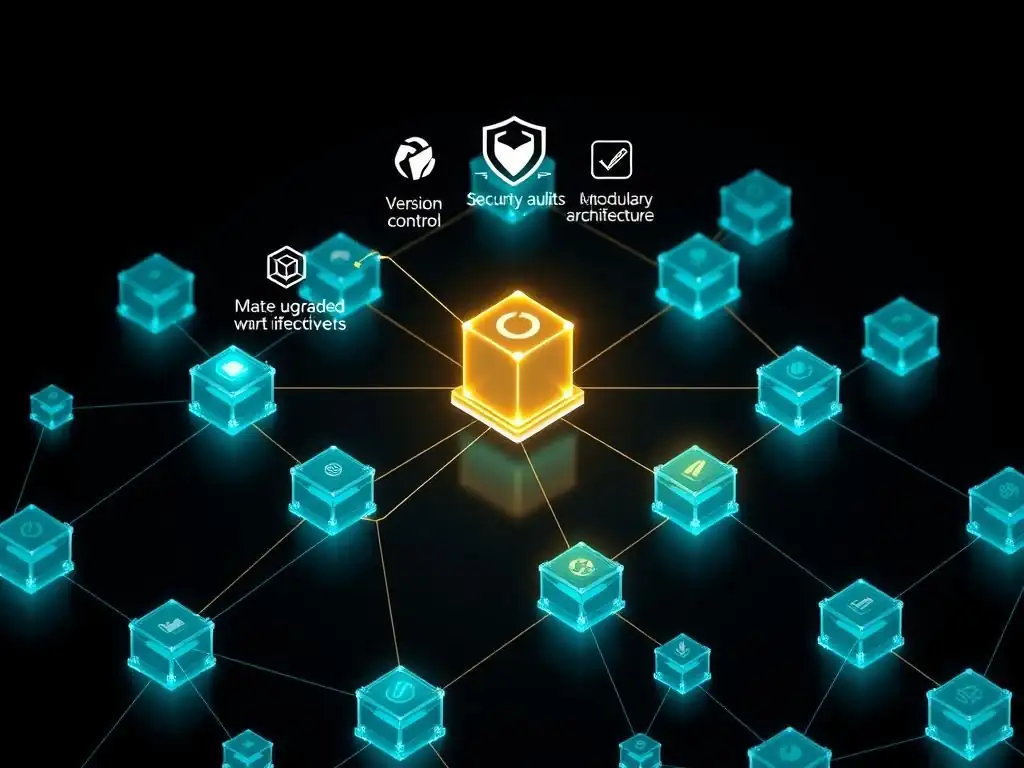
Formal Verification and Auditing of Upgradeable Smart Contracts
Formal verification and comprehensive security audits are non-negotiable best practices for upgradeable smart contracts. Given the inherent risks introduced by upgradeability, verifying the correctness and security of both the contract logic and the upgrade mechanism is critical. Formal verification uses mathematical methods to prove that the code behaves according to a specification, offering a higher degree of assurance against certain classes of bugs than testing alone. It can be particularly useful for verifying the upgrade logic itself – ensuring that only authorized parties can upgrade or that storage compatibility is maintained.
Security audits by reputable third parties provide an independent review of the code, looking for common vulnerabilities, logic errors, and potential attack vectors specific to upgradeable patterns. An audit should cover the proxy contract, all implementation/facet contracts, the upgrade logic, access control mechanisms, and storage compatibility. For instance, a major DeFi protocol like Aave undergoes extensive audits for each protocol version and upgrade. While audits are expensive and time-consuming (often costing tens of thousands of dollars or more and taking weeks), they are a vital investment in Blockchain smart contract upgrades security and user trust.
Using Upgradeable Smart Contract Frameworks and Libraries
Leveraging battle-tested frameworks and libraries designed for upgradeable smart contracts significantly enhances security and simplifies development. Frameworks like OpenZeppelin Upgrades provide standardized implementations of upgrade patterns (primarily Proxy patterns), secure proxy contracts, and tools for managing upgrades. These libraries are built by experienced blockchain security experts and have undergone extensive audits and real-world usage. Using them reduces the likelihood of introducing common errors associated with implementing upgrade logic from scratch.
These frameworks often include tools for managing the upgrade process, such as tracking deployed implementations, verifying storage layouts, and proposing/executing upgrades securely. For example, OpenZeppelin Upgrade plugins for Hardhat or Truffle automate checks for storage layout compatibility between versions, preventing a common source of errors. Relying on these established tools, rather than reinventing the wheel, allows developers to focus on their application logic while building upon a robust and secure foundation for Blockchain smart contract upgrades security.
Implementing a Robust Governance Process for Upgrades
For decentralized applications, centralizing the power to upgrade in a single key or small group is a significant security risk and contradicts the principles of decentralization. A robust governance process is essential for managing upgrades securely and transparently. This typically involves a decentralized autonomous organization (DAO) or a multi-signature wallet requiring a supermajority of trusted signers to approve and execute an upgrade. The process should be clearly defined, transparent, and potentially documented on-chain or via public proposals.
A typical governance process involves proposing an upgrade (e.g., via a forum post and then an on-chain proposal), a voting period where token holders or delegates vote on the proposal, and an execution phase if the proposal passes. For high-value protocols, requiring a high threshold for approval (e.g., 70% of staked tokens or 8 of 12 multi-sig signers) adds layers of security.
Implementing time lock mechanisms (discussed later) further enhances security by providing a delay between a proposal passing and its execution, allowing time for review or emergency action. A well-designed governance model is a cornerstone of Blockchain smart contract upgrades security in decentralized systems.
Testing and Simulation of Upgrades in Testnets
Thorough testing and simulation of the entire upgrade process on a testnet are absolutely critical before deploying to a live mainnet. This goes beyond unit testing individual contract functions; it involves simulating the exact upgrade steps that will be performed on mainnet, using realistic state data. Testing should include deploying the new implementation/facets, linking them via the upgrade mechanism (proxy pointer update, facet addition, etc. ), and verifying that the existing state is correctly interpreted by the new logic.
Simulations should cover various scenarios: upgrading from version A to B, potentially upgrading from A to C if A to B introduced an issue, and testing interactions between the new contract version and other protocols or user interfaces. Using tools that can fork the mainnet state onto a local development environment allows for testing with realistic data volumes and configurations. This level of rigorous testing helps identify subtle bugs related to storage compatibility, upgrade logic execution, or state migration before they can cause harm on mainnet, proving invaluable for Blockchain smart contract upgrades security.
Mitigating Risks Associated with Upgrades
Time Lock Mechanisms: Introducing Delays for Security
A time lock is a smart contract or mechanism that introduces a mandatory delay between the approval of an action (like an upgrade) and its actual execution. Once a proposal to upgrade has passed governance voting or been approved by the required multi-sig signers, the transaction is sent to the time lock contract. The time lock holds the transaction for a predefined period (e.g., 24 hours, 48 hours, or even longer) before it can be executed. This delay provides a critical window of opportunity.
If a malicious or buggy upgrade proposal somehow passes governance, the time lock allows the community, security experts, or protocol administrators to detect the issue during the delay period. They can then coordinate an emergency response, such as pausing the contract or initiating a counter-proposal to block the malicious upgrade. Time locks act as a crucial safety net, providing a last line of defense against compromised governance or undetected bugs, significantly enhancing Blockchain smart contract upgrades security by giving stakeholders time to react.
Using a multi-signature (multi-sig) wallet to control the upgrade function is a common and effective way to prevent a single point of failure. Instead of a single private key having the power to upgrade a contract, a multi-sig wallet requires a predefined number of signatures from a set of trusted parties to execute a transaction. For instance, a 3-of-5 multi-sig requires at least three out of five designated signers to approve an upgrade transaction.
The signers of the multi-sig should be reputable individuals or entities within the community or development team. This distributes control and requires collusion among multiple parties to execute a malicious upgrade, making it significantly harder than compromising a single key. While multi-sigs are more centralized than a full DAO governance, they offer a practical and secure solution for many projects, providing a strong layer of Blockchain smart contract upgrades security by dispersing authority.
Emergency Shutdown Mechanisms: Safeguarding Against Critical Vulnerabilities
Despite best efforts in testing and auditing, critical vulnerabilities can sometimes be discovered post-deployment or during an upgrade. An emergency shutdown mechanism is a crucial safety feature that allows a designated entity (e.g., a trusted multi-sig, a governance contract, or even potentially a specific emergency address) to pause or partially disable the smart contract's functionality in case of an active exploit or critical bug discovery.
This mechanism doesn't fix the bug but stops further damage, preventing attackers from draining funds or disrupting the protocol. Once the emergency is contained and a fix (via an upgrade) is ready, the same mechanism can be used to unpause the contract. While pausing a contract impacts usability, it is often necessary to protect user assets. The power to trigger an emergency shutdown must be carefully controlled and ideally subject to some form of checks and balances, but its availability is vital for Blockchain smart contract upgrades security in responding to unforeseen crises.
The Future of Smart Contract Upgradeability: Trends and Innovations
Decentralized Governance and Autonomous Upgrades
The trend towards greater decentralization in blockchain protocols is driving innovation in smart contract upgradeability. While multi-sigs are a step towards distributed control, fully decentralized governance via DAOs is becoming the standard for major protocols. The future will likely see more sophisticated on-chain governance mechanisms that manage the entire upgrade lifecycle, from proposal submission and voting to automated execution via time locks.
Further advancements might explore autonomous upgrades, where certain predefined, low-risk changes (e.g., updating an oracle address from a trusted list) could potentially be executed automatically based on specific on-chain conditions or pre-approved parameters, without requiring a full governance vote for every minor change. This requires extremely robust and formally verified logic governing the autonomous upgrade process itself to maintain Blockchain smart contract upgrades security. Research into more secure and efficient on-chain voting mechanisms and delegate systems will continue to shape this area.
Layer-2 Solutions for Faster and More Efficient Upgrades
Layer-2 scaling solutions (like rollups, sidechains, etc.) introduce new possibilities and challenges for smart contract upgradeability. Smart contracts deployed on Layer-2 networks might have different upgrade mechanisms compared to Layer-1. The interaction between Layer-1 and Layer-2 contracts during upgrades, especially concerning bridging assets or migrating state between layers, adds complexity.
However, Layer-2 solutions can also potentially facilitate faster and cheaper upgrade processes. The lower transaction costs on Layer-2 could make complex migration processes or multi-step upgrade executions more economically viable. Furthermore, the specific architecture of some Layer-2s might allow for different approaches to code updates or state management that could influence future upgrade patterns, potentially streamlining certain aspects of Blockchain smart contract upgrades security for applications running on these networks.
Evolving Standards for Upgradeable Smart Contract Architecture
The smart contract development community is continuously learning from past incidents and refining best practices. The evolution of standards like ERC-2535 (Diamond Standard) demonstrates a move towards more modular and flexible upgradeability patterns beyond the basic Proxy Pattern. Future innovations might include new EVM opcodes or protocol-level features that natively support upgradeability in a more secure and standardized way.
Research into formal methods for verifying upgrade logic, tools for simulating complex upgrade scenarios, and standardized patterns for managing state across versions will continue. As the complexity of decentralized applications grows, the need for robust, secure, and efficient upgrade mechanisms becomes ever more critical. The focus will remain on balancing flexibility with stringent security requirements, pushing the boundaries of what's possible while ensuring Blockchain smart contract upgrades security remains paramount.
Conclusion: Building Future-Proof Systems through Strategic Upgrades
Emphasizing the Importance of Planning for Upgradeability from the Outset
Designing smart contracts with upgradeability in mind from the very beginning is not merely an option but a necessity for any complex, long-term blockchain project. Retrofitting upgrade mechanisms into immutable contracts is often impossible or introduces significant risks. Developers must anticipate that code will need to evolve to fix bugs, add features, and adapt to changing environments. This involves choosing an appropriate upgrade pattern (like Proxy, Data Separation, or Diamond) based on the project's specific needs and complexity, and integrating it into the core architecture from day one.
This initial planning includes designing storage layouts that are compatible with future versions, establishing clear access control policies for upgrade functions, and outlining a governance process for approving and executing upgrades. Failing to plan for upgrades can lead to costly redeployments, fragmented user bases, or worse, leave critical vulnerabilities unfixable, undermining the project's credibility and security. Prioritizing Blockchain smart contract upgrades security in the initial design phase is an investment in the protocol's future resilience and sustainability.
Balancing Flexibility, Security, and Decentralization in Smart Contract Design
The core challenge in smart contract upgradeability lies in finding the right balance between flexibility, security, and decentralization. Flexibility, enabled by upgradeability, allows protocols to adapt and improve. Security is paramount to protect user assets and maintain system integrity, especially given the irreversible nature of blockchain transactions. Decentralization is a key value proposition of blockchain, aiming to remove central points of control.
Achieving this balance requires careful consideration of the chosen upgrade pattern, the implementation of robust security measures like audits, formal verification, and time locks, and the establishment of a transparent and decentralized governance model where appropriate. There is no one-size-fits-all solution; the optimal approach depends on the application's scale, value, and community's desired level of decentralization. By strategically implementing Blockchain smart contract upgrades security measures and planning for evolution, developers can build future-proof systems that are both adaptable and trustworthy.
Frequently Asked Questions
What are the main challenges associated with upgrading smart contracts on a blockchain?
Upgrading smart contracts presents several challenges, including data migration, security vulnerabilities during the upgrade process, and ensuring continuity of service for users.
How does immutability, a core feature of blockchain, complicate smart contract upgrades?
Blockchain's inherent immutability means existing smart contracts cannot be directly altered. Upgrade strategies involve deploying new contracts and migrating state from the old contract.
What are some common upgrade patterns or techniques used for smart contracts?
Common patterns include proxy contracts that delegate calls to implementation contracts, state migration, and diamond pattern which allows for modular contract upgrades.
How can developers ensure the security of smart contract upgrades, especially concerning potential exploits?
Rigorous auditing of new contract versions, formal verification methods, and implementing circuit breakers to halt operations if issues arise are crucial for secure upgrades.
What role does proper governance play in the smart contract upgrade process within a decentralized system?
Clear governance mechanisms define who can initiate and approve upgrades. These mechanisms must be transparent and resistant to manipulation to maintain trust and security.
Final Reflection: Embracing Evolution in the Blockchain
The journey through smart contract upgradeability underscores a critical truth: immutability, while a cornerstone of blockchain, cannot come at the expense of adaptability. The inherent rigidity of early smart contracts, once perceived as a strength, now presents a significant challenge in a rapidly evolving technological landscape. Recognizing the need for secure and flexible upgrades is not just a technical necessity; it's a fundamental requirement for the long-term viability and widespread adoption of blockchain technology.
The ability to evolve and adapt is deeply ingrained in the human experience, and it's only natural that our technological creations should reflect this same capacity. The ongoing debate surrounding upgradeability highlights the tension between the desire for absolute security and the pragmatic need for progress. This tension is not unique to blockchain; it echoes throughout history, where innovation has often required a willingness to challenge established norms. The only constant in life is change.
- Heraclitus. This ancient wisdom resonates profoundly with the challenges and opportunities presented by smart contract upgrades.
As we look to the future, let us remember that the true power of blockchain lies not just in its immutability, but in its potential to empower and transform. Consider how you can contribute to building more resilient and adaptable systems. Embrace the challenge of balancing security with flexibility, and strive to create smart contracts that not only meet the needs of today, but are also prepared to evolve and thrive in the face of tomorrow's uncertainties.
Seize the Future: Evolve Your Smart Contracts Now!
Thank you for exploring the world of smart contract upgradeability! We hope you now have a clearer understanding of how to design systems that can adapt and thrive in the constantly evolving blockchain environment. Now, let's turn that knowledge into action.
Here are some practical steps you can take today:
- Start by outlining an upgrade strategy for one of your existing smart contracts. Consider potential future requirements and the architectural changes needed to accommodate them.
- Investigate advanced patterns, such as using a proxy contract with a flexible data storage system, to ensure your smart contracts remain adaptable in the future.
- Share this article with colleagues or fellow developers in your online communities. Collaboration is essential for creating resilient and flexible blockchain solutions!
What are the main challenges you expect to face when implementing upgradeable smart contracts in your projects? Share your thoughts in the comments below!
Leave a Reply