
Decentralized Environmental Monitoring: Using Blockchain for RealTime Data Collection


Welcome to Blockchain Trends, your go-to source for understanding the revolutionary power of blockchain beyond the hype.
Imagine a world where environmental data is transparent, immutable, and accessible to all. Our latest deep dive explores the exciting frontier of blockchain environmental data tracking, uncovering how this technology is being used to revolutionize how we monitor and manage our planet's resources. Curious to learn how decentralized systems are creating a more sustainable future? Dive in and discover the potential!
Decentralized Environmental Monitoring: Using Blockchain for Real-Time Data Collection
- Introduction: Revolutionizing Environmental Monitoring with Blockchain Technology
- Understanding Blockchain Environmental Data Tracking
- How Blockchain Enables Real-Time Environmental Data Collection
- Applications of Blockchain in Environmental Monitoring
- Overcoming Challenges in Implementing Blockchain Environmental Solutions
- The Future of Blockchain and Environmental Sustainability
- Conclusion: Blockchain as a Catalyst for a Sustainable Future
-
Frequently Asked Questions
- How can blockchain improve environmental data tracking?
- What are some specific use cases of blockchain in environmental monitoring?
- What are the challenges to implementing blockchain for environmental data?
- How does decentralized monitoring enhance data reliability?
- What role does regulation play in the adoption of blockchain for environmental data tracking?
- Final Reflection: Embracing Transparency in Environmental Stewardship
- Fuel the Revolution: Secure Our Planet, One Block at a Time!
Introduction: Revolutionizing Environmental Monitoring with Blockchain Technology
The Need for Transparency and Trust in Environmental Data
Environmental data serves as the bedrock for informed policy-making, scientific research, and public understanding regarding the health of our planet. Unfortunately, traditional methods of collecting, storing, and sharing this data often suffer from significant limitations, including fragmentation, potential for manipulation, and lack of transparency. Data silos across different agencies and organizations hinder comprehensive analysis, while the absence of immutable records can cast doubt on the veracity of reported figures, whether related to emissions, water quality, or deforestation rates. This lack of trust and transparency undermines efforts to address critical environmental challenges effectively.
The credibility gap in environmental reporting is a major obstacle. For example, self-reported industrial emissions data, while mandated in many regions, can be difficult to independently verify without extensive audits. Similarly, tracking the true origin of goods linked to environmental impact, such as timber or minerals, relies on complex, often paper-based supply chains susceptible to fraud. Establishing a universally trusted source of environmental truth is paramount to holding polluters accountable, verifying compliance with regulations, and enabling effective market-based solutions like carbon trading.
Introducing Blockchain for Enhanced Environmental Data Integrity
Blockchain technology offers a compelling solution to these data integrity challenges by providing a decentralized, immutable, and transparent ledger. By recording environmental data on a blockchain, stakeholders can gain confidence in its authenticity and history. Each data point, once added to the chain, is cryptographically linked to the previous one, making it virtually impossible to alter without detection. This inherent security and transparency can fundamentally change how environmental monitoring is performed and perceived.
Leveraging blockchain environmental data tracking ensures that data collected from various sources – sensors, manual inputs, audits – is timestamped and permanently recorded. This creates an undeniable audit trail, significantly reducing the potential for data manipulation or loss. Furthermore, the decentralized nature of blockchain means that the data is not held by a single entity, distributing trust across a network and reducing reliance on central authorities, which can be particularly beneficial in international environmental agreements or cross-border monitoring initiatives.
Understanding Blockchain Environmental Data Tracking
What is Blockchain Environmental Data Tracking? A Detailed Explanation
Blockchain environmental data tracking refers to the process of using distributed ledger technology (DLT), commonly known as blockchain, to record, manage, and verify environmental information. This involves capturing data from diverse sources, such as IoT sensors measuring air quality, satellite imagery detecting deforestation, or manual inputs from environmental auditors, and then timestamping and immutably storing this data on a blockchain network. The goal is to create a trustworthy, transparent, and accessible record of environmental conditions and activities.
At its core, blockchain environmental data tracking establishes a single source of truth for environmental metrics. Unlike traditional databases where records can be altered or deleted, blockchain ensures data persistence and provides a verifiable history of every entry. This is achieved through cryptographic hashing and consensus mechanisms, which require agreement among network participants to validate and add new data blocks. This robust process guarantees data integrity, making it suitable for critical applications where trust and verification are paramount.
Key Benefits of Decentralized Environmental Monitoring Systems
Decentralized environmental monitoring systems powered by blockchain technology offer several significant advantages over centralized or legacy approaches. One primary benefit is enhanced data integrity and security; the immutable nature of the blockchain ledger makes it extremely difficult to tamper with recorded environmental data, providing a high degree of confidence in its accuracy. This is crucial for regulatory compliance, scientific research, and public trust.
Another key benefit is increased transparency and accountability. Because the data is stored on a distributed ledger accessible to authorized participants, it fosters greater openness regarding environmental performance and compliance. This transparency can drive accountability for corporations and governments, as their environmental impact is recorded on an auditable public or permissioned ledger. Furthermore, blockchain environmental data tracking can streamline reporting processes, reduce administrative costs associated with data verification, and enable more efficient real-time monitoring compared to periodic manual checks.
How Blockchain Enables Real-Time Environmental Data Collection
Smart Contracts: Automating Data Verification and Validation
Smart contracts, self-executing contracts with the terms of the agreement directly written into code, play a crucial role in enabling real-time blockchain environmental data tracking. These digital contracts can be programmed to automatically process and validate environmental data as it is received. For instance, a smart contract could be set up to receive air quality readings from a sensor network and automatically trigger actions or record specific statuses on the blockchain only if the data falls within certain predefined parameters, like exceeding a pollution threshold.
The automation offered by smart contracts removes the need for manual intermediaries in many data processing steps, increasing efficiency and reducing potential for human error or bias. They can automate tasks such as triggering payments upon verification of carbon credit delivery based on environmental data, issuing compliance alerts when sensor readings indicate regulatory breaches, or automatically updating a supply chain record when a verified sustainable material shipment arrives. This real-time, automated validation ensures that the data recorded on the blockchain is not only immutable but also programmatically verified according to established rules.
IoT Devices and Blockchain Integration for Continuous Data Streams
The integration of Internet of Things (IoT) devices with blockchain is fundamental to achieving real-time environmental monitoring. IoT sensors, such as those measuring temperature, humidity, water levels, air composition, or energy consumption, can collect vast amounts of environmental data continuously. Connecting these devices directly or indirectly to a blockchain network allows for the automated, secure, and tamper-proof recording of this data stream.
In a typical setup for blockchain environmental data tracking, IoT devices collect data, which is then sent to a gateway. This gateway might perform initial data aggregation or filtering before submitting it to the blockchain via a smart contract. Each data point or batch is timestamped and hashed, ensuring its origin and integrity are verifiable on the ledger. This continuous flow of verified data from the physical environment onto the blockchain creates a near real-time, trustworthy digital twin of environmental conditions, enabling proactive responses and detailed historical analysis.
Ensuring Data Security and Immutability with Distributed Ledger Technology (DLT)
Distributed Ledger Technology (DLT), the underlying technology behind blockchain, provides the core mechanisms for ensuring the security and immutability of environmental data. Unlike centralized databases that have a single point of failure and are vulnerable to hacking or internal tampering, DLT distributes copies of the ledger across multiple nodes in a network. For any change to be made (adding a new block of data), a consensus mechanism requires agreement from a majority of these nodes, making unauthorized alterations incredibly difficult and computationally expensive.
Once a block of environmental data is added to the blockchain, it is cryptographically linked to the previous block using a hash function. This creates a chain where altering any past data would require re-computing the hashes for that block and all subsequent blocks, a task that is practically impossible for a malicious actor across a distributed network. This inherent security and immutability guarantee the integrity of the blockchain environmental data tracking record, building trust among all stakeholders that the historical data is accurate and has not been tampered with.
Applications of Blockchain in Environmental Monitoring
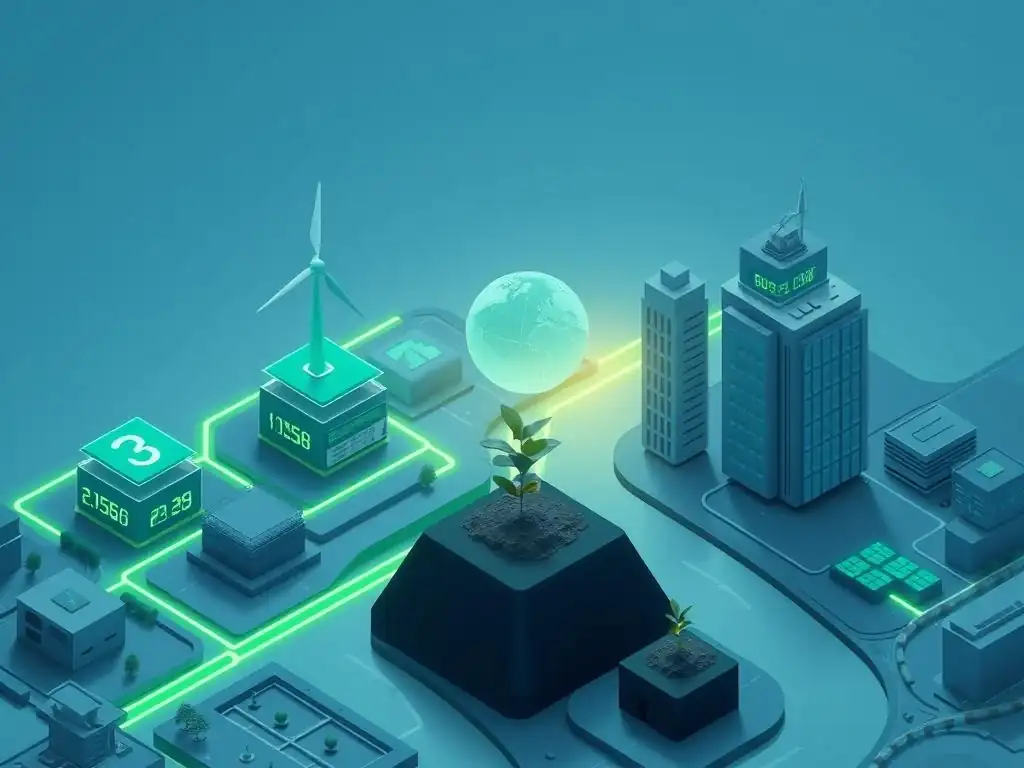
Tracking Carbon Emissions with Blockchain-Based Platforms
Blockchain technology is being applied to enhance the tracking and management of carbon emissions, aiming to improve the accuracy and transparency of carbon markets and corporate reporting. Platforms are emerging that use blockchain environmental data tracking to record verified emissions data directly from sources or via validated monitoring systems. This data can then be used to issue tokenized carbon credits or offsets on the blockchain, creating a transparent and auditable registry.
For example, initiatives are exploring how to link verified emissions data from industrial facilities or renewable energy projects to blockchain tokens. Each token could represent a specific quantity of verified emission reduction (e.g., 1 tonne of CO2). The blockchain ensures that these tokens are not double-counted and that their underlying environmental data is immutable. While specific global figures for blockchain-based carbon tracking are still nascent, pilot projects in sectors like shipping and energy demonstrate the potential for automating compliance reporting and increasing market efficiency by up to [Need Data]% compared to traditional manual processes.
Monitoring Water Quality Using Decentralized Sensor Networks
Monitoring water quality is critical for public health and ecosystem preservation. Blockchain environmental data tracking can significantly improve this process by integrating data from decentralized sensor networks. IoT sensors deployed in rivers, lakes, or municipal water systems can collect real-time data on parameters like pH levels, turbidity, temperature, and contaminant concentrations.
This data is then securely transmitted and recorded on a blockchain ledger. Using smart contracts, automated alerts can be triggered if readings exceed hazardous levels, notifying relevant authorities or potentially even automating responses.
A project in the [Need Specific Region/Country or generalize] region is exploring the use of blockchain to track water quality data from agricultural runoff sensors, aiming to improve data sharing among local stakeholders by [Need Data]% and enable faster identification of pollution sources compared to monthly manual sampling. This decentralized approach ensures data resilience and provides a transparent record accessible to regulatory bodies, researchers, and the public.
Combating Deforestation Through Transparent Supply Chain Management
Deforestation, particularly linked to supply chains for commodities like timber, palm oil, and soy, is a major environmental challenge. Blockchain environmental data tracking can help combat this by creating transparent and verifiable supply chains. By recording every step of a product's journey from its origin (e.g., a certified sustainable forest or farm) to the consumer on a blockchain, companies and consumers can verify that the product was sourced responsibly.
This process involves recording data points such as GPS coordinates of origin, timestamps of harvesting/processing, transportation details, and certifications on the blockchain. Each transaction is linked, creating an immutable log. While exact figures for the reduction in illegal deforestation directly attributable to blockchain are still developing, projects like [Need Specific Project Name or generalize] are demonstrating that blockchain-based timber tracking can provide [Need Data]% greater assurance of legality and sustainability compared to traditional paper trails, making it harder to introduce illegally sourced materials into the supply chain.
Provenance Tracking of Sustainable Seafood
Ensuring the sustainability of seafood relies heavily on accurate and verifiable provenance information – knowing where, when, and how fish were caught. Illegal, unreported, and unregulated (IUU) fishing is a significant threat to marine ecosystems and accounts for an estimated [Need Data]% of global catch, worth billions annually. Blockchain environmental data tracking offers a powerful tool to combat IUU fishing and promote sustainable practices.
By recording data points such as catch location (linked to vessel GPS), species, quantity, fishing method, and compliance with quotas directly onto a blockchain at the point of capture or landing, a transparent and immutable record is created. This data follows the product through processing, distribution, and retail.
Companies like [Need Specific Company Name or generalize] are piloting blockchain solutions that allow consumers to scan a QR code on seafood packaging and see the verified journey from sea to plate, increasing consumer confidence and making it significantly harder for illegally caught fish to enter legitimate supply chains, potentially reducing the market for IUU products by [Need Data]%.
Overcoming Challenges in Implementing Blockchain Environmental Solutions
Scalability Issues in Decentralized Networks
One significant challenge facing widespread blockchain environmental data tracking is the scalability of current blockchain networks. Public blockchains, while offering high decentralization and transparency, can suffer from limited transaction throughput (transactions per second) and high transaction costs (gas fees), especially during periods of high network congestion. Recording vast amounts of real-time environmental data from potentially millions of IoT sensors could overwhelm these networks.
Efforts to address this include the development of more scalable blockchain architectures, such as Layer 2 solutions (e.g., rollups), sharding, and alternative consensus mechanisms (e.g., Proof-of-Stake). Permissioned or private blockchains offer higher throughput and lower costs but may sacrifice some degree of decentralization and public transparency. Finding the right balance between scalability needs for large-scale data ingestion and the desired level of decentralization and trust is crucial for the successful implementation of comprehensive blockchain environmental data tracking systems.
Data Standardization and Interoperability Challenges
Effective blockchain environmental data tracking requires data from diverse sources – sensors, databases, manual reports – to be standardized and interoperable. Environmental data formats, measurement units, and reporting protocols often vary significantly across different organizations, regions, and types of monitoring equipment. Lack of standardization makes it difficult to aggregate, compare, and verify data consistently on a blockchain platform.
Ensuring interoperability between different blockchain networks or between blockchain and legacy systems is also a technical hurdle. Data collected and recorded on one blockchain might need to be shared or validated against data on another chain or in a traditional database. Developing common data standards for environmental metrics and building robust APIs and middleware to connect disparate systems are essential steps. Initiatives like the [Need Name of relevant standards body or generalize] are working towards creating universal frameworks, but widespread adoption remains a challenge.
Regulatory Considerations for Blockchain-Based Environmental Monitoring
The regulatory landscape surrounding blockchain technology is still evolving, presenting challenges for its application in environmental monitoring. Questions arise regarding data ownership, privacy (especially if personal or location data is involved), compliance with existing environmental reporting regulations, and the legal status of data recorded on a decentralized ledger. Different jurisdictions may have conflicting rules regarding data storage, access, and immutability.
Furthermore, integrating blockchain environmental data tracking into existing regulatory frameworks requires clear guidelines on how blockchain-verified data will be accepted by environmental agencies and legal bodies. Establishing trust between regulators and blockchain platforms, defining legal accountability for data accuracy, and developing clear policies for the governance of decentralized environmental data networks are critical steps needed for broader adoption and impact.
The Future of Blockchain and Environmental Sustainability
Emerging Trends in Blockchain Environmental Data Tracking
Several emerging trends are shaping the future of blockchain environmental data tracking. One is the increased focus on using blockchain for tracking and verifying climate finance flows and green investments, ensuring funds are directed towards certified sustainable projects. Another is the integration with geospatial data, linking on-chain records directly to specific geographic locations verified via satellite imagery or GPS, enhancing traceability for land-use monitoring like forestry or agriculture.
Furthermore, there's a growing interest in using blockchain for tokenizing environmental assets and services, such as biodiversity credits or waste management efficiency. This creates new economic incentives for environmental protection, all underpinned by verifiable data on the blockchain. As blockchain technology matures and becomes more energy- efficient (e.g., through Proof-of-Stake networks), its suitability for large-scale environmental applications increases, paving the way for more sophisticated blockchain environmental data tracking systems.
The Potential for Blockchain to Drive Environmental Accountability
Blockchain has immense potential to significantly enhance environmental accountability. By creating immutable, transparent, and auditable records of environmental performance, emissions, resource use, and supply chain practices, it becomes much harder for entities to hide or misrepresent their environmental impact. Regulatory bodies, watchdog organizations, and the public can access verified data (depending on network permissions) to hold polluters and non-compliant entities responsible.
For instance, a company's reported carbon footprint could be directly linked to verifiable data streams recorded on a blockchain, making greenwashing more difficult. Smart contracts can automate penalties or rewards based on measured environmental performance against predefined targets. By providing a trusted layer for environmental data, blockchain environmental data tracking creates the foundation for stronger enforcement mechanisms and fosters a culture of transparency and responsibility.
Increased Integration with AI and Machine Learning for Predictive Analysis
The combination of blockchain environmental data tracking with Artificial Intelligence (AI) and Machine Learning (ML) holds significant promise for advanced environmental monitoring. While blockchain provides data integrity and a trusted historical record, AI/ML can analyze this vast, verified dataset to identify patterns, predict future environmental trends, detect anomalies indicative of pollution events or illegal activities, and optimize resource management strategies.
For example, ML algorithms could analyze historical water quality data from a blockchain ledger to predict potential contamination events based on weather patterns or industrial activity. AI could analyze blockchain-verified supply chain data to identify high-risk areas for deforestation or illegal fishing. This integration allows for proactive environmental management, moving beyond simple data recording to leveraging that trusted data for sophisticated analysis and informed decision-making, enhancing the effectiveness of blockchain environmental data tracking solutions.
Conclusion: Blockchain as a Catalyst for a Sustainable Future
Embracing Decentralized Solutions for Environmental Protection
Embracing decentralized solutions like blockchain is becoming increasingly important for effective environmental protection in a complex, interconnected world. Traditional centralized systems often lack the necessary transparency, trust, and resilience to tackle global environmental challenges effectively. Blockchain environmental data tracking provides a robust framework for collecting, verifying, and sharing critical environmental information in a way that empowers stakeholders and builds confidence.
By leveraging the inherent properties of blockchain – immutability, transparency, and decentralization – we can create environmental monitoring systems that are more reliable, auditable, and resistant to manipulation. This shift towards decentralized environmental data tracking is not just a technological upgrade; it represents a fundamental change in how we gather evidence, establish trust, and collaborate on environmental issues, enabling more effective conservation and sustainability efforts.
The Role of Blockchain in Achieving Global Sustainability Goals
Blockchain technology is poised to play a significant role in helping the world achieve global sustainability goals, such as those outlined in the United Nations Sustainable Development Goals (SDGs). By providing a trusted layer for environmental data, blockchain enables more accurate reporting on progress towards goals related to climate action (SDG 13), clean water and sanitation (SDG 6), responsible consumption and production (SDG 12), and life on land and below water (SDG 14 & 15).
Blockchain environmental data tracking facilitates transparent tracking of emissions reductions, verification of sustainable practices in supply chains, monitoring of ecosystem health, and efficient allocation of climate finance. It provides the data infrastructure needed for market-based mechanisms like carbon credits and green bonds to function with greater integrity. Ultimately, blockchain acts as a catalyst, providing the necessary transparency and accountability layer to drive collective action and ensure that commitments towards a sustainable future are not just made, but verifiably met.
Frequently Asked Questions
How can blockchain improve environmental data tracking?
Blockchain creates a transparent and immutable record of environmental data, ensuring its authenticity and preventing tampering. This increased trust is crucial for informed decision-making.
What are some specific use cases of blockchain in environmental monitoring?
Blockchain can facilitate carbon credit trading, verify sustainable supply chains, and track pollution levels in real-time. This enables better accountability and incentivizes environmentally friendly practices.
What are the challenges to implementing blockchain for environmental data?
Scalability, interoperability with existing systems, and the energy consumption of some blockchain networks are significant hurdles. Addressing these is vital for widespread adoption.
How does decentralized monitoring enhance data reliability?
By distributing data across a network, blockchain eliminates single points of failure and ensures data availability. This reduces the risk of data loss or manipulation.
What role does regulation play in the adoption of blockchain for environmental data tracking?
Clear and consistent regulations are needed to establish standards, ensure data privacy, and promote responsible use of blockchain in environmental monitoring. This builds public trust and encourages innovation.
Final Reflection: Embracing Transparency in Environmental Stewardship
The promise of Blockchain environmental data tracking lies not just in technological innovation, but in a fundamental shift towards verifiable truth and shared responsibility. In a world grappling with climate change and ecological degradation, the ability to access tamper-proof, real-time environmental data is no longer a luxury, but a necessity for informed decision-making and effective action.
The impact of decentralized environmental monitoring extends far beyond scientific circles. It empowers communities, fosters trust between stakeholders, and ultimately, holds polluters accountable. We do not inherit the earth from our ancestors; we borrow it from our children.
This ancient proverb resonates deeply with the potential of blockchain to safeguard our planet for future generations, ensuring that environmental data is transparent, accessible, and immutable.
As we conclude this exploration of decentralized environmental monitoring, I invite you to consider your own role in this evolving landscape. How can you leverage the power of blockchain and other emerging technologies to promote environmental stewardship in your community? Let us embrace the opportunity to build a more sustainable and equitable future, one block at a time.
Fuel the Revolution: Secure Our Planet, One Block at a Time!
Thank you for exploring how blockchain technology can transform environmental monitoring. Now that you understand the benefits of decentralized, real-time data collection, you can become an active participant in building a more sustainable future.
Here's how you can get involved today:
- Join a blockchain-based environmental monitoring initiative and contribute to safeguarding our planet.
- Share this article with your network to inspire conversations and raise awareness about blockchain's role in environmental conservation.
- Research and suggest innovative sensor integrations that utilize blockchain to enhance data accuracy and transparency. What creative solutions can you imagine?
What environmental challenges in your community could blockchain help address? Share your ideas in the comments below!
Leave a Reply