
Architecting DApps for Data Privacy: Implementing PrivacyPreserving Decentralized Solutions


Welcome to Blockchain Trends, your go-to source for understanding the real-world impact of blockchain technology. Beyond the buzzwords, we delve into the innovations shaping the future of decentralized systems. Ever wondered how to build DApps that truly respect user privacy? This article explores the crucial aspects of privacypreserving decentralized application development, offering insights into architecting solutions that prioritize data security and anonymity. Discover the techniques and best practices that are redefining the landscape of DApps, and unlock the potential of a more secure and user-centric decentralized future. Ready to learn more?
Architecting DApps for Data Privacy: Implementing Privacy-Preserving Decentralized Solutions
- Introduction: The Growing Need for Privacy in Decentralized Applications
- Understanding Data Privacy Challenges in DApps
- Privacy-Preserving Technologies for DApp Architecture
-
Implementing Privacy-Preserving Techniques in DApp Development
- Choosing the Right Privacy Technology for Your DApp Use Case
- Integrating ZKPs into Smart Contracts: Practical Examples
- Utilizing Homomorphic Encryption for Private Data Processing in DApps
- Designing SMPC-Enabled DApps for Collaborative Data Analysis
- Applying Differential Privacy for Anonymized Data Sharing in Decentralized Networks
- Architectural Patterns for Privacy-Focused DApps
- Best Practices for Secure and Private DApp Development
- Case Studies: Privacy-Preserving DApp Implementations
- Future Trends in Privacy-Preserving Decentralized Applications
- Conclusion: Building a More Private and Secure Decentralized Future
-
Frequently Asked Questions
- How does blockchain technology inherently impact data privacy within decentralized applications (DApps)?
- What are some key techniques used in privacy-preserving decentralized application development?
- Why is privacy-preserving decentralized application development crucial beyond cryptocurrency applications?
- How can developers balance the need for transparency with the need for privacy in DApps?
- What are the regulatory considerations for building privacy-preserving decentralized applications, particularly concerning data governance?
- Final Reflection: Embracing Privacy in the Decentralized Future
- Seize Control of Your Decentralized Future!
Introduction: The Growing Need for Privacy in Decentralized Applications
Why Privacy Matters in DApp Development: Addressing User Concerns
While blockchain's transparency is a cornerstone of its trust model, it presents a significant challenge for user privacy. Every transaction, smart contract interaction, and address balance on public blockchains like Ethereum is typically visible to anyone. This inherent openness, while beneficial for auditability, clashes directly with the need for confidentiality in many real-world applications, from financial transactions and healthcare records to identity management and supply chain data. Users are increasingly aware of their digital footprint and expect control over their sensitive information, making privacy a non-negotiable requirement for widespread DApp adoption.
Addressing user privacy concerns is paramount for the evolution of decentralized applications beyond niche use cases. Without robust privacy safeguards, sensitive user data risks exposure, leading to potential identity theft, financial surveillance, or misuse of personal information. A user might hesitate to use a decentralized lending protocol if their entire borrowing history and asset portfolio are public, or a decentralized health application if their medical data is visible on a blockchain explorer. Effective privacypreserving decentralized application development is crucial to build trust and unlock the potential for DApps to handle sensitive information securely and privately.
Blockchain Trends: Focus on Privacy-Preserving Technologies
Recognizing the limitations of pure transparency, the blockchain ecosystem has seen a significant surge in research, development, and investment into privacy-preserving technologies. This trend signifies a maturing understanding that while decentralization and immutability are powerful, they must be complemented by mechanisms that allow for selective disclosure and confidential computation. Major blockchain protocols and Layer-2 solutions are actively integrating privacy features to make their platforms suitable for enterprise and consumer applications handling sensitive data.
This focus on privacy-preserving technologies is shaping the future of decentralized application architecture. We are witnessing the integration of advanced cryptography like Zero-Knowledge Proofs (ZKPs), Homomorphic Encryption (HE), and Secure Multi-Party Computation (SMPC) directly into blockchain protocols and DApp frameworks. Furthermore, architectural patterns that separate sensitive data from the public chain, such as off-chain storage with on-chain verification or hybrid chain models, are gaining prominence. This concerted effort across the industry underscores that robust privacypreserving decentralized application development is not just a feature, but a foundational requirement for the next wave of decentralized innovation.
Understanding Data Privacy Challenges in DApps
Inherent Transparency of Blockchains: A Privacy Paradox
The fundamental design of many public blockchains, such as Bitcoin or Ethereum, dictates that all transactional data and smart contract interactions are recorded on a public ledger accessible to anyone. For example, on Etherscan, one can view the entire transaction history, token balances, and contract calls associated with any public address. While addresses themselves are pseudonymous, sophisticated chain analysis techniques, often employed by analytics firms, can link public addresses to real-world identities, especially when users interact with regulated centralized exchanges or services that require KYC (Know Your Customer) information.
This inherent transparency creates a privacy paradox for developers aiming for widespread DApp adoption in domains requiring confidentiality. A decentralized finance (DeFi) DApp built directly on a transparent chain might reveal users' trading strategies, loan details, or asset holdings to competitors or malicious actors. A decentralized social network could expose user connections and activity patterns. Overcoming this transparency while maintaining the benefits of decentralization is the core challenge in privacypreserving decentralized application development.
Common Data Privacy Vulnerabilities in Existing DApps
Beyond the fundamental transparency of the underlying blockchain, many DApps introduce additional privacy vulnerabilities through their architecture and implementation. Storing even seemingly innocuous, but potentially identifiable, metadata on-chain can lead to de-anonymization. For instance, associating a specific DApp usage pattern or a sequence of interactions with a persistent public address can reveal user behavior. Furthermore, off-chain components interacting with the DApp might handle sensitive data insecurely or link on-chain activity to off-chain identities without adequate safeguards.
Consider a decentralized voting DApp built without privacy features. While votes might be recorded on-chain, the link between a voter's public address and their vote could be exposed. If voter registration data (linking addresses to identities) is ever compromised off-chain, the entire voting history of individuals becomes public. Another example is a decentralized gaming DApp where player statistics or in-game asset ownership tied to a public address reveal potentially sensitive information about user activity and wealth within the game's ecosystem. These vulnerabilities highlight the need for deliberate design choices focused on privacy in privacypreserving decentralized application development.
Regulatory Landscape: GDPR, CCPA, and Decentralized Systems
The global regulatory landscape is increasingly focused on data privacy, with landmark regulations like the European Union's General Data Protection Regulation (GDPR) and California's Consumer Privacy Act (CCPA) setting stringent requirements for handling personal data. These regulations grant users rights such as the right to access their data, the right to rectification, and crucially, the right to erasure ('right to be forgotten'). They also mandate principles like data minimization and require clear user consent for data processing.
Applying these regulations to decentralized, immutable blockchain systems presents significant legal and technical challenges. If personal data is stored directly on an immutable public ledger, how can a user exercise their right to erasure? Who is the 'data controller' or 'processor' in a decentralized network with no single entity in charge? DApp developers must navigate this complex environment, designing systems that either avoid storing personal data on-chain entirely or employ privacy-preserving techniques that can satisfy regulatory requirements, even within a decentralized context. This regulatory pressure is a key driver for advancing the field of privacypreserving decentralized application development.
Privacy-Preserving Technologies for DApp Architecture
Zero-Knowledge Proofs (ZKPs): Enabling Data Verification Without Revelation
Zero-Knowledge Proofs (ZKPs) are cryptographic protocols that allow one party (the prover) to prove to another party (the verifier) that a statement is true, without revealing any information beyond the validity of the statement itself. Imagine proving you know a secret password without ever saying the password aloud, or proving you are eligible for a service because you meet certain criteria (like age or location) without revealing your exact age or location. ZKPs enable this type of verifiable computation over private data.
In the context of DApps, ZKPs are transformative. They allow users to interact with smart contracts or other users while keeping sensitive input data confidential. For example, a user could prove they have a minimum required balance in their wallet to access a service without revealing their exact balance or even their address. Or, they could prove they meet the eligibility requirements for a loan without disclosing their full financial history. Implementing ZKPs is a cornerstone technique in modern privacypreserving decentralized application development.
ZK-SNARKs: Succinct Non-Interactive Arguments of Knowledge
ZK-SNARKs are a specific type of ZKP characterized by their "succinct" proof size and "non-interactive" nature after an initial setup. The succinctness means the proof is very small, making it efficient to verify on-chain, which is crucial for reducing gas costs. Non-interactive means the prover sends only one message to the verifier. A key feature (and sometimes a drawback) of ZK-SNARKs is the requirement for a "trusted setup" phase, where initial cryptographic parameters are generated. If this setup is compromised, it could potentially allow someone to generate fraudulent proofs.
Projects like Zcash pioneered the use of ZK-SNARKs for private transactions, allowing users to shield transaction details. More recently, ZK-SNARKs have become fundamental to Layer-2 scaling solutions like zkSync and Polygon Hermez (now Polygon zkEVM). These solutions bundle thousands of off-chain transactions into a single batch and generate a ZK-SNARK proof verifying the validity of the entire batch. This proof is then posted to the Layer-1 chain (e.g., Ethereum). While primarily focused on scalability, this architecture also offers significant privacy benefits as individual transactions are not published on the transparent Layer-1, showcasing their utility in privacypreserving decentralized application development.
ZK-STARKs: Scalable Transparent Arguments of Knowledge
ZK-STARKs are another type of ZKP that address some of the limitations of ZK-SNARKs. A major advantage of ZK-STARKs is their "transparency," meaning they do not require a trusted setup. Instead, they rely on publicly verifiable randomness, derived from cryptographic hash functions, making them potentially more trustless and easier to implement. While ZK-STARK proofs tend to be larger than ZK-SNARK proofs, the time it takes to generate a ZK-STARK proof can be faster, especially for complex computations, and they are considered quantum-resistant.
ZK-STARKs are being actively developed and deployed, notably by StarkWare in their Layer-2 scaling solutions StarkNet and StarkEx. These platforms use ZK-STARKs to prove the integrity of computations performed off-chain, enabling high-throughput, low-cost, and private transactions and smart contract interactions. Use cases range from decentralized exchanges and gaming to general computation. The transparency and scalability of ZK-STARKs make them a powerful tool for the future of privacypreserving decentralized application development.
Homomorphic Encryption: Performing Computations on Encrypted Data
Homomorphic Encryption (HE) is a remarkable cryptographic technique that allows computations to be performed directly on encrypted data without decrypting it first. The result of the computation is also encrypted, and when this encrypted result is decrypted, it is the same as the result would have been if the computation had been performed on the original, unencrypted data. This capability is incredibly powerful because it allows sensitive data to be processed by untrusted parties or systems (like a smart contract or an off-chain computation service) without ever exposing the plaintext data.
While fully homomorphic encryption (FHE), which allows arbitrary computations, is still computationally intensive and often impractical for real-time applications, partially homomorphic encryption (PHE) and somewhat homomorphic encryption (SHE), which support limited types of operations (e.g., only addition, or a limited number of additions and multiplications), are more feasible today. In DApp development, HE could enable use cases like private voting, where encrypted votes are tallied homomorphically, or decentralized analytics where computations are performed on encrypted user data without revealing individual contributions. As HE research advances, its role in privacypreserving decentralized application development is expected to grow significantly.
Secure Multi-Party Computation (SMPC): Distributed Computation Without Data Disclosure
Secure Multi-Party Computation (SMPC) is a cryptographic protocol that allows multiple parties to jointly compute a function over their private inputs without revealing any individual input to any other party or even to the final output. The parties only learn the result of the computation. Think of it as a group of people pooling their private numbers into a black box that computes their average, but no one (not even the box) ever sees any individual number.
SMPC is highly relevant for DApps that involve collaborative data analysis or computations requiring input from multiple sensitive sources. For instance, several hospitals could use SMPC to compute aggregate statistics on patient data (e.g., average age of patients with a certain condition) without any single hospital revealing its individual patient records to the others. Decentralized exchanges could potentially use SMPC for private order matching, where participants submit encrypted orders, and the matching engine finds matches without revealing the details of unmatched orders. SMPC provides a robust framework for collaborative privacypreserving decentralized application development.
Differential Privacy: Adding Noise to Datasets for Anonymization
Differential Privacy is a statistical technique used to share information about a dataset by adding carefully calculated noise to the data or the query results. The goal is to make it statistically impossible to determine whether any single individual's data is included in the dataset or influenced a particular query result, thereby protecting individual privacy while allowing for aggregate analysis. It provides a mathematical guarantee about the level of privacy preserved.
In decentralized networks or DApps dealing with aggregated user data, differential privacy can be applied to protect the privacy of individual data contributors. For example, a decentralized platform that collects user behavior data for market research could apply differential privacy to the aggregated reports or query outputs shared with researchers. This allows researchers to gain valuable insights from the collective data without being able to identify or infer information about any specific user. Differential privacy is a valuable tool for privacypreserving decentralized application development that involves data aggregation and analysis.
Implementing Privacy-Preserving Techniques in DApp Development
Choosing the Right Privacy Technology for Your DApp Use Case
Selecting the appropriate privacy-preserving technology is a critical architectural decision in privacypreserving decentralized application development. The choice depends heavily on the specific requirements of the DApp, the type of data being handled, and the nature of the operations needed. Factors to consider include: Do you need to prove a statement about private data (ZKPs)? Do you need to perform computations on encrypted data (HE)? Do multiple parties need to compute a function over their joint private inputs (SMPC)? Do you need to release aggregate data while protecting individual contributions (Differential Privacy)?
Performance considerations, implementation complexity, and the level of trust required (e.g., trusted setup for some ZK-SNARKs) are also crucial factors. Often, a single DApp might benefit from a combination of these technologies. For instance, a decentralized identity DApp might use DIDs and Verifiable Credentials for selective disclosure, ZKPs to prove attributes from credentials without revealing the credentials themselves, and off-chain storage for sensitive credential data. A careful analysis of the DApp's specific needs and constraints is essential for making the right technological choices.
Integrating ZKPs into Smart Contracts: Practical Examples
Integrating Zero-Knowledge Proofs into DApps typically involves performing the heavy cryptographic computation (proof generation) off-chain, often on the user's device or a dedicated server, and then submitting the resulting proof to a smart contract for verification. The smart contract contains a pre-deployed verifier contract or uses a native precompile that can efficiently check the validity of the ZKP without seeing the private data used to generate it.
Consider a decentralized access control DApp. Instead of requiring users to reveal their age on-chain to access age-restricted content, a user could generate a ZKP off-chain proving they are over 18 based on their private date of birth. They then send this proof to the smart contract. The smart contract calls a verifier function, perhaps using syntax like bool isValid = verifierContract.verifyProof(proof, publicInputs);. If isValid is true, the smart contract grants access without ever knowing the user's date of birth. Another example is a private token transfer DApp where a ZKP proves the sender has sufficient balance and the transaction is valid, allowing the transaction to be processed without revealing sender, receiver, or amount on the public ledger. This pattern is fundamental to many modern privacypreserving decentralized application development efforts.
Utilizing Homomorphic Encryption for Private Data Processing in DApps
Implementing Homomorphic Encryption in DApps often involves client-side encryption of sensitive data using an HE library before it is sent to any processing layer. This encrypted data can then be stored off-chain or potentially on a specialized chain designed to handle HE computations. The DApp's logic, or a dedicated computation service, performs the required operations (e.g., addition, multiplication) directly on the ciphertext.
For example, in a decentralized health research DApp, a user's blood pressure reading could be encrypted using HE on their device. This encrypted reading is then uploaded to a decentralized storage system. When a researcher wants to compute the average blood pressure of a group of users, the DApp's backend (or a network of nodes) retrieves the encrypted readings and performs the averaging computation homomorphically.
The result is an encrypted average, which only the researcher (with the appropriate decryption key, if authorized) can decrypt to reveal the plaintext average. While computationally demanding, HE is a powerful technique for privacypreserving decentralized application development requiring computation over sensitive inputs.
Designing SMPC-Enabled DApps for Collaborative Data Analysis
Designing DApps that leverage Secure Multi-Party Computation requires a different architectural approach, focusing on distributing the computation among the parties holding the data. This involves selecting an appropriate SMPC protocol suited for the specific computation (e.g., sum, average, comparison, machine learning model training). The DApp's logic coordinates the interaction between the parties, guiding them through the steps of the protocol where they perform operations on their local data shares and exchange intermediate results.
Consider a decentralized credit scoring DApp involving multiple banks. Each bank holds a portion of a user's financial data. Instead of pooling all data into one location, an SMPC protocol is used. Each bank contributes its encrypted share of the data to the computation.
The SMPC protocol ensures that the credit score is computed collaboratively, with each bank performing calculations on its share and exchanging intermediate results, but without any bank (or an external observer) ever seeing the private data shares of the other banks. Only the final credit score is revealed. This is a complex but effective strategy for privacypreserving decentralized application development in multi-party data scenarios.
Applying Differential Privacy for Anonymized Data Sharing in Decentralized Networks
Integrating differential privacy into decentralized networks or DApps involves identifying the points where privacy needs to be preserved during data aggregation or querying. This typically occurs when releasing statistics, reports, or query results derived from sensitive user data. The implementation requires choosing a specific differential privacy mechanism (like adding Laplace or Gaussian noise) and carefully calibrating the amount of noise to add based on the desired level of privacy and the sensitivity of the data.
In a decentralized usage analytics platform, users might opt-in to share anonymized data about their DApp interactions. Instead of sharing raw interaction logs, the DApp could process this data locally or in a secure enclave and then contribute differentially private summaries or statistics to the network.
For example, when querying the total number of users who performed a specific action, the query result would have noise added before being returned. This noise makes it difficult to determine if a specific user's action contributed to the count, thereby protecting individual privacy while allowing for useful aggregate analysis, a practical application in privacypreserving decentralized application development.
Architectural Patterns for Privacy-Focused DApps
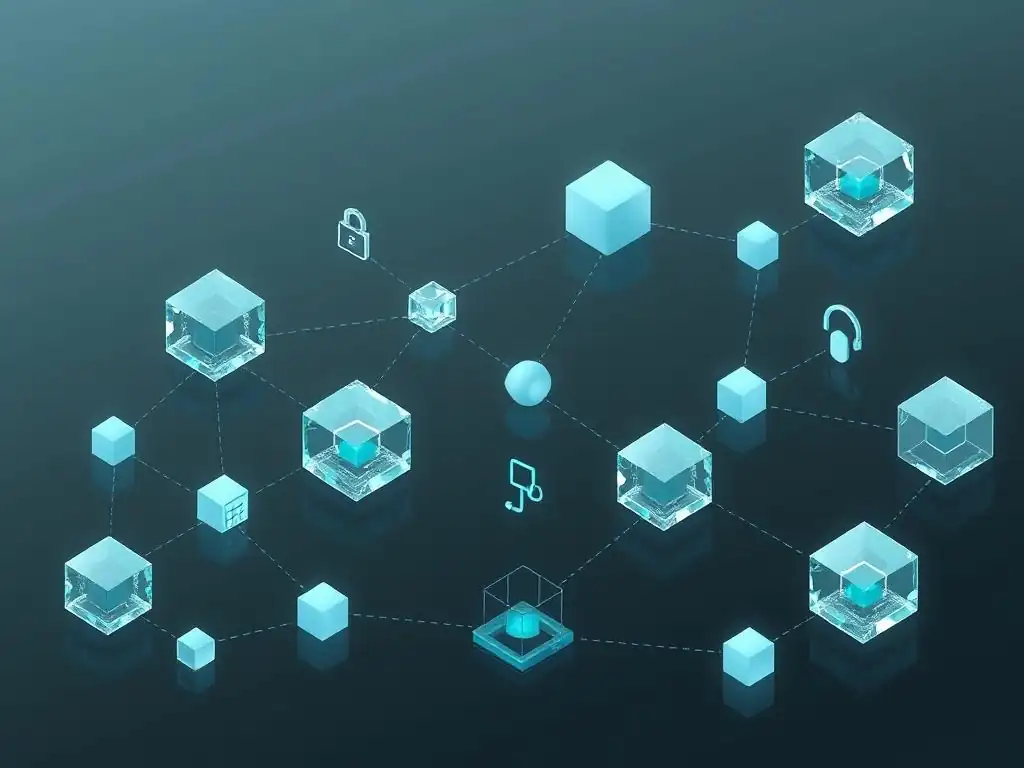
Off-Chain Data Storage and Processing with On-Chain Verification
One of the most common architectural patterns for achieving privacy in DApps is to keep sensitive data off-chain while using the blockchain for integrity checks, verification, and trustless coordination. In this pattern, large or private datasets are stored in decentralized storage systems like IPFS, Filecoin, or even traditional databases if appropriate for the trust model. Only a hash or a cryptographic commitment to the data is stored on the public blockchain within a smart contract.
Privacy is enhanced because the raw data is not exposed on the transparent public ledger. The on-chain smart contract can then use the stored hash or commitment to verify the integrity of the off-chain data.
More advanced implementations leverage ZKPs, allowing the smart contract to verify complex properties about the off-chain data (e.g., "this document contains a valid signature," "this dataset aggregates to a specific value") without ever needing to access or reveal the data itself. This hybrid approach balances blockchain's trust and immutability with the need for off-chain privacy and scalability, making it a fundamental pattern in privacypreserving decentralized application development.
Hybrid Architectures: Combining Public and Private Blockchains
Hybrid blockchain architectures combine the benefits of public, permissionless blockchains (like Ethereum or Polkadot) with private or consortium, permissioned blockchains. Sensitive data and transactions are handled on the private chain, where access is restricted to authorized participants and data visibility can be controlled. Less sensitive interactions, asset transfers, or proofs of state changes are recorded or anchored on the public chain to leverage its security, transparency (where appropriate), and decentralization.
An example is a decentralized supply chain DApp where product provenance and ownership transfers between major parties (e.g., manufacturers, distributors) are recorded on a public chain for transparency. However, sensitive information like pricing agreements, specific customer details, or internal manufacturing processes are managed and shared only among authorized participants on a connected private chain. This allows for controlled information flow and enhanced privacy for confidential business operations while still benefiting from the public chain's security guarantees. Hybrid models offer flexibility for complex privacypreserving decentralized application development scenarios involving both public trust and private confidentiality.
Layer-2 Solutions for Enhanced Privacy and Scalability
Layer-2 scaling solutions, built on top of Layer-1 blockchains, offer significant benefits for both scalability and privacy. Solutions like Rollups (ZK-Rollups and Optimistic Rollups), State Channels, and Plasma process transactions and computations off-chain, reducing the data footprint on the Layer-1. While their primary goal is scaling, this off-chain processing inherently provides a degree of privacy compared to executing everything directly on a transparent Layer-1.
For instance, in a ZK-Rollup, thousands of transactions are executed off-chain, and only a single, compressed batch of state changes and a ZKP verifying the validity of the batch are posted to the Layer-1. The details of individual transactions within the batch are not published on the Layer-1, making them less visible to the public compared to standard Layer-1 transactions. This aggregation and off-chain processing pattern makes Layer-2 solutions a key component in designing scalable and privacypreserving decentralized application development architectures.
State Channels for Private Transactions
State channels enable two or more participants to conduct multiple transactions or state updates off-chain without involving the main blockchain for each interaction. They work by locking an initial state (e.g., funds) on the Layer-1 blockchain. Participants then update the state off-chain by signing transactions. Only the final state needs to be broadcast and settled on the Layer-1.
The privacy benefit comes from the fact that all intermediate transactions within the state channel occur directly between the participants and are not broadcast to the entire public network. Only the initial and final on-chain transactions are visible. This makes state channels suitable for applications requiring frequent, low-cost, and private interactions between a limited set of parties, such as payment channels or decentralized games where players make many moves off-chain before settling the final game state on-chain. They are a specific pattern useful in privacypreserving decentralized application development for high-interaction scenarios.
Plasma for Scalable and Private Data Management
Plasma is a framework for building child blockchains that are anchored to a root blockchain (like Ethereum). The child chain processes transactions, and periodically commits a hash of its state to the root chain. This allows the child chain to handle a high volume of transactions off the main chain. Users can exit the child chain and recover their assets on the root chain if the child chain operator misbehaves or becomes unresponsive, leveraging the root chain's security.
While Plasma's main focus is scalability, the fact that detailed transaction data resides on the child chain and is not broadcast to the public Layer-1 provides a degree of privacy for transactions occurring within the Plasma chain. Only the periodic state root commitments and exit transactions are visible on the root chain. Although newer Layer-2 solutions like Rollups have become more prominent, Plasma illustrates the architectural pattern of off-chain processing and data management for enhanced privacy and scalability in privacypreserving decentralized application development.
Decentralized Identity (DID) and Verifiable Credentials for Selective Disclosure
Decentralized Identity (DID) systems and Verifiable Credentials (VCs) are emerging standards that empower users to control their digital identities and personal data. DIDs are self-sovereign identifiers controlled by the user, often anchored on a blockchain or decentralized ledger. VCs are tamper-evident digital credentials (like a driver's license, degree, or proof of employment) issued by trusted parties and held securely by the user, typically in a digital wallet.
This model fundamentally enhances privacy by enabling selective disclosure. Instead of revealing a full, static identity profile or sharing copies of physical documents, a user can present specific VCs to prove only the necessary attributes. For example, to prove they are over 18, a user presents a VC issued by a trusted authority confirming their age, potentially combined with a ZKP to prove the age attribute without revealing their exact date of birth. This allows users to share minimal, relevant information while keeping the rest private, a crucial component for privacypreserving decentralized application development involving user identity and attributes.
Best Practices for Secure and Private DApp Development
Data Minimization: Collecting Only Necessary User Data
A fundamental principle in privacy-conscious design, and a key requirement of regulations like GDPR, is data minimization. In the context of privacypreserving decentralized application development, this means designing DApps to collect, process, and store the absolute minimum amount of user data required to provide the service. Every piece of unnecessary data collected represents a potential privacy risk.
Developers should critically evaluate what information is truly essential for the DApp's functionality. Can a user prove eligibility for something without revealing the underlying sensitive data (e.g., using a ZKP)? Can a unique identifier be used instead of personal details? By reducing the volume and sensitivity of data handled, the attack surface for privacy breaches is significantly reduced. This proactive approach to data handling is more effective than trying to retroactively apply privacy measures to an overly data-hungry DApp.
Secure Key Management: Protecting Private Keys and Credentials
In decentralized systems, control over assets and identity is tied directly to private keys. Compromised private keys lead not only to financial loss but also to a complete loss of privacy, as an attacker can then act as the user, revealing their history or accessing sensitive data. Therefore, implementing robust and secure key management practices is paramount for privacypreserving decentralized application development.
This includes educating users on the importance of self-custody and secure storage methods like hardware wallets. For DApps that manage keys or credentials on behalf of users (e.g., in a custodial or semi-custodial model), implementing industry-standard security measures like encryption, multi-factor authentication, and secure enclaves is essential. Furthermore, any private keys or secrets used in privacy technologies like ZKPs or HE must also be protected with the same level of rigor. A DApp is only as private as its weakest link, and often, that link is key management.
Regular Security Audits: Identifying and Mitigating Privacy Risks
Given the complexity of combining blockchain technology with privacy-preserving techniques, regular and thorough security audits are indispensable. Audits should not only focus on general smart contract security and business logic vulnerabilities but also specifically examine potential privacy leaks and the correct implementation of privacy technologies.
A privacy-focused audit would scrutinize how data flows through the DApp's on-chain and off-chain components, looking for instances where sensitive data might be unintentionally exposed or linked to identifiable information. It would verify that cryptographic primitives like ZKPs or HE are correctly implemented according to established standards and protocols. Audits help identify subtle vulnerabilities that could undermine the privacy guarantees promised by the DApp. Engaging reputable security firms specializing in blockchain and cryptography is a critical step in building trustworthy and privacypreserving decentralized application development.
User Consent and Transparency: Providing Clear Data Usage Policies
Even with advanced privacy technologies, ethical and legal requirements necessitate transparency and obtaining informed user consent regarding data handling. Users interacting with a DApp, especially one handling sensitive information, need to understand what data is processed, how privacy is protected, what the limitations are, and who is responsible (to the extent applicable in a decentralized system).
Developers should provide clear, accessible, and comprehensive privacy policies. This policy should explain the DApp's architecture from a privacy perspective, detailing which data is on-chain vs. off-chain, how privacy technologies are used, and what data minimization steps are taken. Providing users with granular control over their data and privacy settings where possible, and being transparent about the inherent privacy characteristics of the underlying blockchain, builds trust and aligns with the decentralized ethos while ensuring responsible privacypreserving decentralized application development.
Case Studies: Privacy-Preserving DApp Implementations
Several projects are actively implementing privacy-preserving techniques in their DApps and protocols, showcasing the practical application of these concepts. For instance, the Aztec Network is a Layer-2 ZK-Rollup on Ethereum focused on private DeFi. It allows users to deposit assets from Layer-1 into a private Layer-2 pool and then perform private transfers and interactions (like swapping or providing liquidity) within the pool using ZK-SNARKs.
Users can prove properties about their private balance (e.g., "I have at least 1000 DAI") without revealing their exact balance or transaction history. This is a prime example of privacypreserving decentralized application development in the DeFi space.
Another area seeing significant privacy innovation is decentralized identity. Projects like Polygon ID leverage Iden3's zero-knowledge identity system (using ZK-SNARKs) to enable users to prove facts about themselves without revealing the underlying sensitive data. For example, a user can prove they are a resident of a specific country or meet an age requirement for a service by presenting a Verifiable Credential and a ZKP, rather than sharing their passport or driver's license details. This pattern of combining DIDs, VCs, and ZKPs is becoming standard for privacy-focused identity and access control in privacypreserving decentralized application development.
Layer-2 scaling solutions themselves, while primarily focused on throughput, inherently offer privacy benefits. zkSync and StarkNet, both ZK-Rollups, batch transactions and verify their correctness using ZKPs (SNARKs for zkSync, STARKs for StarkNet). Since only the validity proof and state delta are posted to Ethereum Layer-1, the details of individual transactions within the rollup are not publicly broadcast on the main chain, providing a significant privacy improvement for users transacting on these networks compared to Layer-1. These platforms serve as foundational infrastructure for building scalable and privacypreserving decentralized application development.
Finally, while more nascent, research projects and proofs-of-concept are exploring the use of SMPC and Homomorphic Encryption. For example, some initiatives are looking into using SMPC for decentralized credit scoring or private auctions, while others explore HE for secure data analysis platforms where computations are performed on encrypted data contributed by users. These case studies demonstrate that privacypreserving decentralized application development is moving from theoretical concepts to practical implementations across various domains.
Future Trends in Privacy-Preserving Decentralized Applications
Advanced Cryptographic Techniques for Enhanced Privacy
The field of cryptography is constantly evolving, and advancements in areas like Fully Homomorphic Encryption (FHE), more efficient and specialized ZKP schemes, and post-quantum cryptography hold significant promise for the future of DApp privacy. Current HE implementations are often too slow for complex computations, but ongoing research aims to make FHE practical, potentially enabling entirely private smart contract logic where computation occurs on encrypted state.
Furthermore, new ZKP schemes are being developed that are more efficient for specific types of computations or offer better scalability properties. As these techniques mature and become more performant, they will allow for more complex and nuanced privacy guarantees within DApps. The integration of quantum-resistant cryptography is also becoming relevant as the threat of quantum computing looms, ensuring that privacy solutions built today remain secure in the future. These cryptographic frontiers are driving innovation in privacypreserving decentralized application development.
Integration of AI and Privacy-Preserving Technologies
The intersection of artificial intelligence (AI) and decentralized technologies presents exciting opportunities, but also significant privacy challenges, particularly when AI models require access to sensitive data. Future trends will increasingly focus on integrating AI/ML with privacy-preserving technologies like SMPC and Differential Privacy within decentralized architectures.
This could manifest as decentralized federated learning platforms where AI models are trained collaboratively across multiple parties holding sensitive data (e.g., medical images, financial records) without the data ever leaving their local environment. SMPC can be used to aggregate model updates securely, and Differential Privacy can protect the privacy of individual data points contributing to the training set or model outputs. This integration will be crucial for unlocking AI use cases in sensitive domains within a decentralized and privacy-respecting framework, pushing the boundaries of privacypreserving decentralized application development.
Standardization and Interoperability of Privacy Solutions
Currently, the landscape of privacy-preserving technologies is somewhat fragmented, with different ZKP implementations, HE libraries, and SMPC protocols. For widespread adoption and ease of development, there is a growing need for standardization and interoperability. Establishing common standards for how privacy proofs are generated and verified, how encrypted data is handled, or how SMPC protocols are implemented will make it easier for developers to integrate these features into their DApps and for different privacy-preserving systems to interact.
Efforts by organizations like the Decentralized Identity Foundation (DIF) in standardizing DIDs and VCs, or ongoing academic and industry collaboration on ZKP circuits and proving systems, are steps in this direction. Increased standardization will lower the barrier to entry for privacypreserving decentralized application development, foster a more interconnected ecosystem of privacy-preserving services, and ultimately lead to more robust and user-friendly private DApps.
The Evolution of Privacy Regulations and Their Impact on DApps
The regulatory landscape surrounding data privacy is dynamic and will continue to evolve, increasingly addressing the unique characteristics of decentralized systems. Regulators are grappling with how concepts like the 'right to erasure' or 'data controller responsibility' apply to blockchains. Future regulations may provide clearer guidance or even specific frameworks for decentralized technologies.
This evolution will directly impact privacypreserving decentralized application development. Developers will need to stay abreast of these changes and proactively design their systems to be compliant. This might involve architectural choices that ensure user data can be managed or pseudonymized in accordance with regulations, even if not truly 'erased' from an immutable ledger. The interplay between technological innovation in privacy and the development of regulatory frameworks will be a key trend shaping the future of the decentralized web.
Conclusion: Building a More Private and Secure Decentralized Future
The Importance of Prioritizing Data Privacy in DApp Architecture
The journey towards a truly decentralized and widely adopted web hinges significantly on addressing the challenge of data privacy. While the inherent transparency of many blockchains offers valuable benefits like auditability and trust, it is fundamentally incompatible with the confidentiality required for a vast array of real-world applications, from personal finance and healthcare to enterprise data management and identity. Prioritizing data privacy is not merely a technical hurdle but a foundational requirement for building user trust, enabling new use cases, and navigating the complex global regulatory landscape.
Effective privacypreserving decentralized application development requires a shift in mindset, integrating privacy considerations from the initial architectural design phase rather than attempting to bolt them on later. Recognizing that transparency is not a one-size-fits-all solution and actively designing systems that minimize data exposure, manage keys securely, and incorporate robust privacy measures is essential for the long-term success and adoption of decentralized technologies.
The Role of Privacy-Preserving Technologies in Shaping the Future of Blockchain
The array of privacy-preserving technologies available today—from the transformative power of Zero-Knowledge Proofs and Homomorphic Encryption to the collaborative capabilities of Secure Multi-Party Computation and the statistical guarantees of Differential Privacy—are actively shaping the future of blockchain. These technologies, combined with architectural patterns like off-chain data handling, hybrid chains, and Layer-2 solutions, provide the tools necessary to overcome the privacy paradox of public blockchains.
These advancements enable the development of DApps that can handle sensitive information securely and privately, unlocking potential in regulated industries and consumer applications that were previously out of reach for purely transparent decentralized systems. The ongoing research and development in these areas are paving the way for more sophisticated, efficient, and user-friendly privacy solutions, making robust privacypreserving decentralized application development increasingly feasible and powerful.
Call to Action: Embrace Privacy-Conscious Development Practices
For developers, architects, and project teams working in the decentralized space, the call to action is clear: embrace privacy-conscious development practices. Educate yourselves on the available privacy-preserving technologies and architectural patterns. Design your DApps with data minimization and secure key management as core principles. Subject your systems to rigorous privacy-focused security audits. Be transparent with your users about data handling and privacy guarantees.
By making privacy a non-negotiable priority in privacypreserving decentralized application development, we can collectively build a decentralized future that is not only secure and censorship-resistant but also respects user confidentiality and earns the trust required for mainstream adoption. The tools and knowledge are increasingly available; it is now up to the builders to integrate them effectively and responsibly.
Frequently Asked Questions
How does blockchain technology inherently impact data privacy within decentralized applications (DApps)?
Blockchain's immutability and transparency, while beneficial for security, can pose challenges to data privacy. All transactions are permanently recorded on the ledger, making it difficult to ensure confidentiality of sensitive information. This necessitates specific architectural considerations for privacy-preserving DApps.
What are some key techniques used in privacy-preserving decentralized application development?
Several techniques exist, including zero-knowledge proofs, secure multi-party computation (SMPC), and homomorphic encryption. These methods allow for data processing and verification without revealing the underlying sensitive data itself.
Why is privacy-preserving decentralized application development crucial beyond cryptocurrency applications?
While cryptocurrencies have highlighted blockchain's potential, its applications extend far beyond. In areas like healthcare, finance, and supply chain management, data privacy is paramount for regulatory compliance and maintaining user trust.
How can developers balance the need for transparency with the need for privacy in DApps?
Achieving this balance requires careful architectural design. Developers can selectively disclose information using access control mechanisms and differential privacy techniques, ensuring transparency where needed while protecting sensitive data.
What are the regulatory considerations for building privacy-preserving decentralized applications, particularly concerning data governance?
Regulations like GDPR and CCPA impose strict requirements on data handling. Developers must ensure their DApps comply with these regulations by implementing data minimization techniques and providing users with control over their data.
Final Reflection: Embracing Privacy in the Decentralized Future
The exploration of privacy-preserving decentralized application development highlights a critical juncture in the evolution of technology. The urgent need for solutions that safeguard user data within decentralized systems is no longer a futuristic aspiration, but a present-day imperative. As we've seen, the inherent transparency of blockchain technology, while revolutionary, poses significant challenges to individual privacy, demanding innovative architectural approaches and cryptographic techniques to mitigate these risks.
The impact of privacy-preserving DApps extends far beyond mere technological advancement; it shapes the very fabric of our digital society. The ability to control our own data, to participate in decentralized ecosystems without sacrificing personal information, is fundamental to individual autonomy and a truly democratic digital landscape. Privacy is not an option, and it shouldn't come with the services we actually decide to use. Privacy is a requirement.
- Tim Cook's words resonate deeply, emphasizing the ethical responsibility we bear to prioritize user privacy in all technological endeavors.
As we stand on the cusp of a decentralized future, let us not forget the lessons learned in architecting DApps for data privacy. Consider how you can champion privacy in your own digital interactions, whether through supporting privacy-focused projects, advocating for stronger data protection regulations, or simply being more mindful of the information you share online. The future of a truly decentralized and empowering internet hinges on our collective commitment to building a world where privacy is not a privilege, but a fundamental right.
Seize Control of Your Decentralized Future!
Thank you for exploring the world of privacy-preserving decentralized applications. We hope you've gained valuable insights into designing solutions that protect user data while harnessing the power of blockchain technology. Now, it's time to put that knowledge into practice!
Here are some steps you can take to deepen your understanding and contribute to creating a more privacy-focused decentralized ecosystem:
- Start experimenting! Implement a basic privacy-preserving technique, such as zero-knowledge proofs, in a small side project. Hands-on experience is the most effective way to learn.
- Explore and contribute to open-source projects focused on privacy in decentralized applications. Find a project that interests you and see how you can get involved.
- Share this article with fellow developers and blockchain enthusiasts who are passionate about data privacy. Spark discussions and collaborate on innovative solutions.
What specific privacy challenges in decentralized application development excite you the most? Share your thoughts in the comments below!
Leave a Reply