
ZeroKnowledge Proofs in DApps: Enhancing Privacy and Security


Welcome to Blockchain Trends, your guide to understanding the revolutionary applications of blockchain technology.
Dive deep into the world of decentralized innovation and discover how blockchain is reshaping industries beyond cryptocurrency. Are you ready to unravel the complexities of securing Decentralized Applications (DApps)? This article explores the vital role of Zero Knowledge Proofs in bolstering DApp security and enhancing privacy, offering a glimpse into the future of decentralized systems. Intrigued? Keep reading to learn how this powerful technology is transforming the landscape.
Zero-Knowledge Proofs in DApps: Enhancing Privacy and Security
- Introduction to Zero-Knowledge Proofs and Decentralized Applications (DApps)
- Understanding the Fundamentals of Zero-Knowledge Proofs
- Applications of Zero-Knowledge Proofs in DApps
- Advantages of Integrating Zero-Knowledge Proofs into DApps
- Challenges and Considerations When Implementing ZKPs in DApps
- The Future of Zero-Knowledge Proofs in DApp Development
- Conclusion: Zero-Knowledge Proofs – A Cornerstone for Secure and Private DApps
-
Frequently Asked Questions
- What are Zero-Knowledge Proofs (ZKPs) and how do they relate to DApps?
- How do Zero-Knowledge Proofs enhance the security of DApps?
- What are some practical applications of Zero-Knowledge Proofs in decentralized applications?
- What are the main challenges in implementing Zero-Knowledge Proofs within DApps?
- How might regulations impact the use of Zero-Knowledge Proofs in DApps?
- Final Reflection: Embracing Privacy in Decentralized Applications
- Unveil the Power of Privacy: Take Action Now!
Introduction to Zero-Knowledge Proofs and Decentralized Applications (DApps)
The Growing Need for Privacy in DApps
Decentralized Applications (DApps) operate on blockchain technology, often leveraging its transparency and immutability. While this transparency is crucial for verifying transactions and smart contract execution, it inherently exposes sensitive data, including transaction amounts, participant identities, and even application logic details. This lack of privacy creates significant hurdles for mass adoption, particularly in enterprise use cases, financial services (Decentralized Finance or DeFi), and applications involving personal or regulated data. Users and businesses require the assurance that their interactions within DApps do not compromise their confidentiality.
The open nature of public blockchains means that anyone can view the ledger, potentially linking addresses to real-world identities or inferring sensitive business information. For instance, a competitor could analyze transaction patterns on a supply chain DApp to deduce business volumes, or a user's entire transaction history on a DeFi platform could be publicly scrutinized. Addressing this privacy gap is paramount to building trust and enabling DApps to handle sensitive operations, making the integration of privacy-enhancing technologies like zero knowledge proofs DApps security a critical area of development.
What are Zero-Knowledge Proofs (ZKPs)? A Simple Explanation
Zero-Knowledge Proofs (ZKPs) are a cryptographic method where one party (the Prover) can prove to another party (the Verifier) that a statement is true, without revealing any information beyond the validity of the statement itself. Imagine proving you know the solution to a complex puzzle without showing the solution or giving any hints about how you found it. The Verifier becomes convinced you know the solution, but learns nothing that would help them solve it themselves. This concept is revolutionary for privacy-preserving applications.
In the context of blockchain and DApps, ZKPs allow a user to prove they meet certain criteria (e.g., owning a specific asset, having sufficient funds, being over 18) or that a computation was performed correctly, all without revealing the underlying data. This capability is foundational for building DApps that respect user privacy while maintaining the verifiable integrity of decentralized systems. The application of zero knowledge proofs DApps security is focused on enabling verifiable, private interactions.
Zero-Knowledge Proofs and DApp Security: A Symbiotic Relationship
The relationship between Zero-Knowledge Proofs and DApp security is deeply intertwined. While ZKPs are primarily known for privacy, they also significantly enhance security by allowing complex computations or validations to occur off-chain, with only a succinct proof verified on-chain. This reduces the amount of data transmitted and stored publicly, minimizing the attack surface related to data exposure. Furthermore, ZKPs enable DApps to enforce rules and constraints without requiring participants to reveal sensitive information that could be exploited.
By enabling private verification of conditions or computations, ZKPs help prevent exploits that rely on public knowledge of sensitive data or system states. For example, in a private transaction system, ZKPs ensure that only valid transactions (e.g., inputs equal outputs) can occur, without revealing the amounts or participants. This cryptographic enforcement strengthens the security guarantees of the DApp, ensuring that privacy does not come at the cost of integrity. The integration of zero knowledge proofs DApps security is thus a dual benefit, providing both confidentiality and robust verification.
Understanding the Fundamentals of Zero-Knowledge Proofs
Core Principles of ZKPs: Completeness, Soundness, and Zero-Knowledge
Zero-Knowledge Proofs are defined by three essential properties: Completeness, Soundness, and Zero-Knowledge. Completeness ensures that if the statement is true, an honest Prover can always convince an honest Verifier. Soundness guarantees that if the statement is false, a dishonest Prover cannot convince an honest Verifier, except with a negligible probability. These two properties establish the reliability of the proof system – it correctly validates true statements and rejects false ones.
The third property, Zero-Knowledge, is what gives ZKPs their unique power. It states that if the statement is true, the Verifier learns absolutely nothing about the statement from the proof beyond its validity. This is the core privacy-preserving aspect. The Verifier receives cryptographic assurance that the statement holds, but gains no information about the "secret" that makes it true. These three principles together form the bedrock upon which zero knowledge proofs DApps security and privacy features are built.
Types of Zero-Knowledge Proofs: zk-SNARKs, zk-STARKs, Bulletproofs
Several types of Zero-Knowledge Proofs have been developed, each with different characteristics regarding proof size, verification time, trust assumptions, and scalability. zk-SNARKs (Zero-Knowledge Succinct Non-Interactive Arguments of Knowledge) are known for their small proof sizes and fast verification times, making them efficient for on-chain verification. However, many early zk-SNARK constructions require a "trusted setup" phase, where secret parameters are generated and then destroyed, posing a potential trust vulnerability if not handled correctly.
zk-STARKs (Zero-Knowledge Scalable Transparent Arguments of Knowledge) emerged to address the trusted setup issue. They are "transparent," meaning they do not require a trusted setup. zk-STARKs are also highly scalable, with verification time growing logarithmically with the computation size.
Their proofs are generally larger than zk-SNARKs, leading to higher on-chain gas costs for verification. Bulletproofs are another type, notable for their particularly small proof sizes, especially for range proofs (proving a number is within a certain range) and aggregatable proofs, and they do not require a trusted setup. The choice among these types impacts the specific implementation of zero knowledge proofs DApps security and performance.
How Zero-Knowledge Proofs Work: A Technical Overview
At a high level, a Zero-Knowledge Proof involves the Prover transforming a statement and its associated secret information (the "witness") into a compact proof using complex polynomial commitments, cryptographic hashes, and interactive or non-interactive protocols. For example, in a non-interactive ZKP like zk-SNARKs, the Prover uses the statement and witness to compute a proof string. This involves encoding the problem into a mathematical circuit, performing polynomial computations, and committing to these polynomials in a way that reveals nothing about the underlying data.
The Verifier receives this proof string and uses publicly available parameters (and potentially parameters from a trusted setup for zk-SNARKs) to perform a quick verification computation. This computation checks the cryptographic properties of the proof against the public statement. If the proof is valid, the Verifier is cryptographically convinced that the Prover knows the witness for the statement, without ever learning what the witness is. This process is fundamental to implementing zero knowledge proofs DApps security features privately and verifiably.
Applications of Zero-Knowledge Proofs in DApps
Enhancing Transaction Privacy with ZKPs in DApps
One of the most direct applications of ZKPs in DApps is enabling private transactions. On public blockchains like Ethereum, transaction details (sender, receiver, amount) are transparent. By integrating ZKPs, DApps can allow users to transact without revealing this sensitive information on the public ledger. A user could prove they have sufficient funds and that the transaction is valid (e.g., inputs equal outputs) using a ZKP, without revealing the exact amounts or the recipient's address.
Projects like Zcash were pioneers in using ZKPs (specifically zk-SNARKs) for private cryptocurrency transactions. In the DApp space, protocols like Aztec Network have leveraged ZKPs to enable private transfers of ERC-20 tokens and private interactions with DeFi protocols on Ethereum. This allows users to maintain financial confidentiality while still operating within a decentralized framework, significantly enhancing the appeal and utility of DApps for users concerned about privacy and contributing directly to zero knowledge proofs DApps security and confidentiality.
Securing Identity and Authentication in Decentralized Applications
ZKPs are also transformative for managing identity and authentication in DApps. Instead of revealing sensitive personal information or linking a public wallet address to an identity, a user can use a ZKP to prove they meet certain identity requirements. For instance, a DApp might require users to be over 18 or reside in a specific country. A user could prove this using a ZKP derived from a verified identity credential, without revealing their date of birth, full address, or name to the DApp or the public.
This approach decouples identity verification from data exposure, allowing for pseudonymous or anonymous interactions where appropriate, while still enforcing necessary access controls and compliance checks. Decentralized identity solutions are actively exploring ZKPs to allow users to selectively disclose verified attributes about themselves without revealing the underlying identity documents. This enhances user control over personal data and strengthens zero knowledge proofs DApps security related to identity management.
Enabling Private Data Sharing and Computation within DApps
Many real-world applications require sharing and processing sensitive data. DApps built on transparent blockchains struggle with this. ZKPs offer a solution by enabling private data sharing and computation. Participants can prove that they have correctly processed or aggregated data according to specific rules, or that their data meets certain criteria, without revealing the raw data itself.
Consider a decentralized machine learning DApp where participants contribute private data for training. ZKPs could allow participants to prove their data was included and processed correctly, or that their model updates are valid, without exposing their individual datasets. Similarly, in a supply chain DApp, parties could prove compliance with regulations or product authenticity using ZKPs without revealing proprietary details about their operations. This capability is vital for fostering zero knowledge proofs DApps security in complex, multi-party interactions involving confidential information.
Use Case: Zero-Knowledge Proofs for Decentralized Voting Systems
Decentralized voting systems face a significant challenge: ensuring votes are counted correctly and transparently while preserving voter privacy and preventing coercion or vote buying. A fully transparent system reveals who voted for whom, undermining privacy. A completely private system might lack verifiability, raising concerns about fraud. ZKPs offer a compelling middle ground.
In a ZKP-based voting DApp, voters could cast encrypted votes. A ZKP could be used to prove that the encrypted vote is valid (i.e., it corresponds to one of the allowed choices) and that the voter is eligible to vote (e.g., they haven't voted before, they are registered), without revealing the voter's identity or their specific vote.
The votes could then be tallied privately, with a final ZKP generated to prove that the tally was performed correctly based on all valid encrypted votes. This ensures both the integrity of the election and the privacy of individual votes, showcasing the power of zero knowledge proofs DApps security and privacy integration.
Use Case: Implementing ZKPs for Private DeFi Transactions
Decentralized Finance (DeFi) DApps have seen explosive growth, but their transparency exposes users' financial activities. Large transactions, trading strategies, and even simple transfers are visible on the blockchain, potentially leading to front-running or loss of competitive edge for institutional users. Implementing ZKPs can make DeFi transactions private.
Protocols like Aztec Network, mentioned earlier, allow users to deposit assets into a private state using ZKPs. Transactions within this private state (like transfers or interactions with shielded smart contracts) are validated using ZKPs, revealing only that a valid state transition occurred, not the details. For example, a user could withdraw funds from a private pool, proving they owned the assets privately without revealing which specific deposit corresponds to the withdrawal. This enhances user privacy and security in DeFi, making zero knowledge proofs DApps security a key differentiator for privacy-focused financial applications.
Advantages of Integrating Zero-Knowledge Proofs into DApps
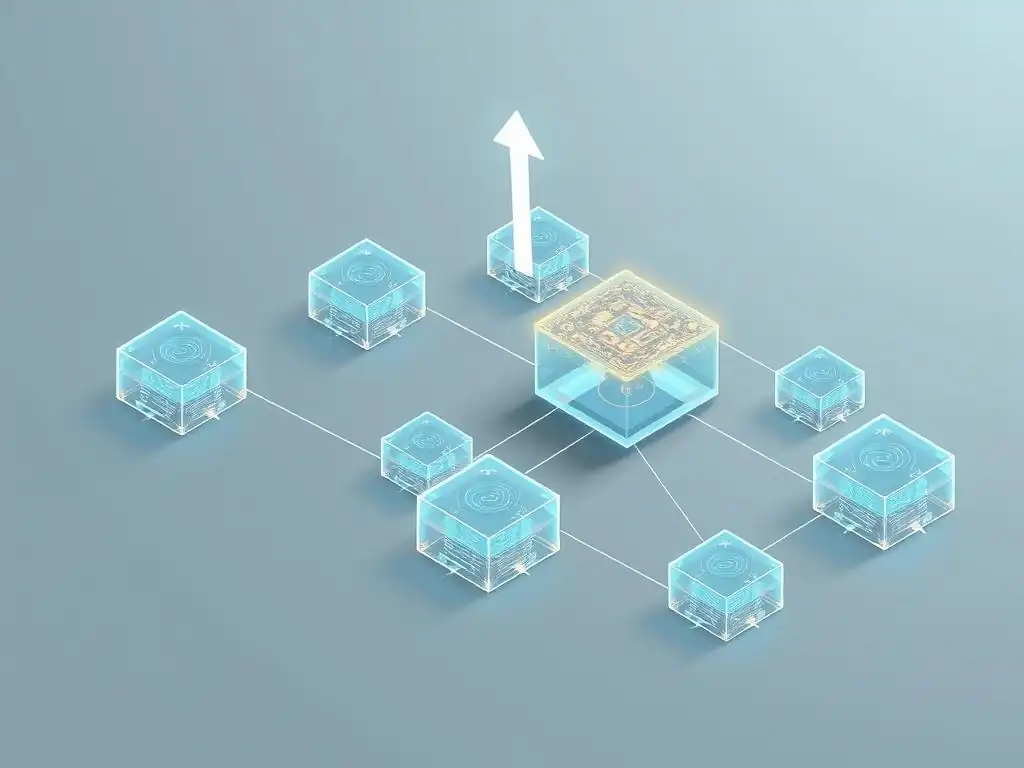
Improved Data Security and Confidentiality in DApps
Integrating Zero-Knowledge Proofs directly enhances data security and confidentiality within DApps. By allowing users to prove the truth of a statement without revealing the underlying data, ZKPs drastically reduce the amount of sensitive information exposed on public blockchains. This minimizes the risk of data breaches, surveillance, or exploitation of private information by malicious actors.
Instead of storing or transmitting sensitive data in plaintext or easily decipherable formats, ZKPs enable a paradigm where only cryptographic proofs are shared publicly. This means that even if a public blockchain is compromised or subject to analysis, the sensitive data validated by ZKPs remains confidential. This is a fundamental shift that strengthens zero knowledge proofs DApps security posture significantly compared to transparent alternatives.
Enhanced User Privacy and Control over Personal Data
A major advantage of ZKPs is the empowerment of users regarding their privacy. Users gain greater control over their personal data, deciding what to prove (e.g., eligibility, solvency) without being forced to reveal how they prove it (e.g., specific age, exact balance). This moves away from the current model where participation in DApps often requires revealing more information than necessary.
For individuals, this means participating in decentralized communities, financial activities, or identity verification processes without fear of exposing their entire digital footprint. For businesses, it means leveraging the benefits of decentralization and blockchain without compromising proprietary information or customer data privacy. This enhanced user privacy is a core benefit of employing zero knowledge proofs DApps security solutions.
Reduced Trust Assumptions in Decentralized Systems
While some ZKPs (like certain zk-SNARKs) require a trusted setup, the technology generally reduces the need for trust in other parties or systems. By cryptographically proving the correctness of computations or the validity of data without revealing the data itself, DApps can rely on mathematical certainty rather than trusting intermediaries or even other participants not to misuse sensitive information.
For instance, in a private computation scenario, participants don't need to trust the party performing the computation with their raw data; they only need to trust the verifiability of the ZKP that the computation was done correctly. This shift towards cryptographic trust minimizes reliance on potentially vulnerable human or institutional actors, bolstering the overall integrity and security of DApps leveraging zero knowledge proofs DApps security features.
Scalability Benefits of Zero-Knowledge Proofs
Beyond privacy and security, ZKPs offer significant scalability benefits for DApps, particularly through constructions like ZK-Rollups. ZK-Rollups execute transactions and smart contract computations off-chain, batching thousands of transactions together. A ZKP is then generated to prove the validity of all transactions in the batch. Only this compact proof is posted to the main chain (like Ethereum L1).
This approach drastically reduces the amount of data that needs to be processed and stored on the main chain, increasing transaction throughput by orders of magnitude (potentially thousands of transactions per second compared to dozens). The main chain smart contract only needs to verify the single ZKP, which is much cheaper and faster than processing each transaction individually. This scalability aspect, powered by ZKPs, is crucial for enabling DApps to handle large user bases and complex operations efficiently, demonstrating the multi-faceted impact of zero knowledge proofs DApps security and performance.
Challenges and Considerations When Implementing ZKPs in DApps
Computational Complexity and Performance Overheads
Implementing Zero-Knowledge Proofs introduces significant computational overhead, primarily for the Prover. Generating a ZKP can be a computationally intensive process, requiring substantial processing power and time, especially for complex statements or large datasets. While verification is typically much faster, the proof generation step can be a bottleneck for DApps requiring real-time or low-latency interactions.
For example, generating a zk-SNARK proof for a complex circuit might take several seconds or even minutes on standard hardware, consuming significant CPU resources. zk-STARKs can be even more computationally demanding for the Prover, although verification is faster and scales better. DApp developers must carefully consider these performance implications and potentially offload proof generation to powerful servers or specialized hardware, which adds complexity and infrastructure costs to zero knowledge proofs DApps security implementations.
ZKP Implementation Complexity and Development Costs
Developing and implementing ZKP-based features within DApps is technically challenging and requires specialized cryptographic expertise. Building ZKP circuits, writing the necessary code for proof generation and verification, and integrating these components into existing DApp architectures is complex. The availability of skilled ZKP developers is limited, and the tooling and development frameworks are still maturing, although improving rapidly.
The complexity translates into higher development costs and longer development cycles compared to building standard DApps without ZKP features. Developers must understand the nuances of different ZKP schemes, potential pitfalls in circuit design, and how to securely handle sensitive parameters (especially for zk-SNARKs with trusted setups). This steep learning curve and resource requirement are significant hurdles for wider adoption of zero knowledge proofs DApps security features.
The Importance of Secure Parameter Generation in ZKPs
For certain ZKP schemes, most notably zk-SNARKs, a "trusted setup" phase is required to generate public parameters used for proof generation and verification. If the secret randomness used in this setup is not truly destroyed afterwards, the party retaining this secret could potentially forge valid proofs for false statements, completely breaking the soundness property and undermining the security of the system.
Ensuring the integrity of this trusted setup is critical. This is often addressed through multi-party computation (MPC) ceremonies involving numerous participants, where the secret is distributed among them, and the ceremony is designed such that the secret is destroyed if even one participant is honest. While zk-STARKs and Bulletproofs avoid this issue by being transparent (no trusted setup needed), many existing and efficient ZKP systems rely on it, highlighting a key consideration for maintaining zero knowledge proofs DApps security.
Potential Vulnerabilities and Mitigation Strategies for ZKP-Based DApps
Despite their security benefits, ZKP implementations are not immune to vulnerabilities. Issues can arise from errors in the cryptographic circuit design, flaws in the implementation code (e.g., side-channel attacks, improper handling of inputs), or vulnerabilities in the underlying cryptographic primitives used. A single bug in the ZKP circuit could potentially allow a dishonest Prover to create a valid proof for an invalid statement.
Mitigation strategies include rigorous formal verification of ZKP circuits, extensive testing, code audits by security experts, and relying on established, well-vetted ZKP libraries and frameworks rather than building from scratch. Furthermore, the security of the overall DApp architecture integrating ZKPs must be considered, ensuring that the ZKP layer interacts securely with other components like smart contracts and off-chain services. Addressing these potential vulnerabilities is essential for realizing robust zero knowledge proofs DApps security.
The Future of Zero-Knowledge Proofs in DApp Development
Advancements in ZKP Technology and Tooling
The field of Zero-Knowledge Proofs is experiencing rapid innovation. Researchers are continuously developing new ZKP schemes that are more efficient, require less computation, have smaller proof sizes, or are more developer-friendly. Efforts are also focused on improving the tooling and frameworks available to developers, making it easier to design, implement, and debug ZKP circuits.
New proof systems, like Plonk and Halo2, are improving upon earlier zk-SNARKs, often allowing for universal or updatable trusted setups, reducing the reliance on a single, large ceremony per application. Libraries and compilers are being developed to abstract away some of the low-level cryptographic complexity, enabling more developers to build ZKP-powered applications. These advancements are lowering the barrier to entry and accelerating the adoption of zero knowledge proofs DApps security features.
The Role of ZKPs in Web3 and Decentralized Identity Solutions
ZKPs are poised to play a central role in the broader Web3 ecosystem and the development of decentralized identity solutions. As the internet moves towards a more decentralized model, users will require methods to interact, transact, and authenticate themselves privately and securely without relying on centralized authorities. ZKPs provide the cryptographic primitive to achieve this.
Decentralized identity frameworks are leveraging ZKPs to allow users to selectively prove attributes about themselves derived from Verifiable Credentials, without revealing the underlying sensitive data. This enables privacy-preserving compliance checks, access control, and personalized experiences in Web3 DApps. The integration of zero knowledge proofs DApps security and privacy into identity layers is fundamental for a user-centric, decentralized future.
Zero-Knowledge Proofs and DApp Security: Driving Mass Adoption
The ability of Zero-Knowledge Proofs to simultaneously enhance privacy, security, and scalability is critical for driving mass adoption of DApps. Current DApps, often built on transparent blockchains, face significant limitations in handling sensitive data and scaling to millions of users. ZKPs offer a path forward by enabling use cases previously impossible or impractical on public blockchains.
Enterprises can explore DApps for supply chain management, inter-company data sharing, or regulated financial services when assured that sensitive business logic and data remain confidential. Individual users are more likely to engage with DApps for finance, healthcare, or identity management if they trust that their privacy is protected. By providing essential security and privacy guarantees, zero knowledge proofs DApps security features are paving the way for mainstream adoption.
Future Trends: ZK-Rollups, Recursive Proofs, and Hardware Acceleration
Several key trends are shaping the future of ZKPs in DApp development. ZK-Rollups are rapidly maturing as a leading Layer 2 scaling solution for Ethereum and other blockchains, with projects like zkSync, StarkNet, and Polygon zkEVM making significant progress towards supporting general-purpose smart contracts. These rollups rely entirely on ZKPs for security and validity.
Recursive ZKPs, where a ZKP verifies the correctness of another ZKP (or even a batch of ZKPs), are enabling even greater scalability and efficiency by allowing proofs from different chains or time periods to be aggregated into a single, succinct proof. Furthermore, research and development into hardware acceleration for ZKP computation (using GPUs, FPGAs, or ASICs) aims to reduce the computational burden of proof generation, making ZKPs more practical for a wider range of DApps and bolstering zero knowledge proofs DApps security performance.
Conclusion: Zero-Knowledge Proofs – A Cornerstone for Secure and Private DApps
Zero-Knowledge Proofs represent a pivotal technology for the evolution of decentralized applications. By offering robust methods for proving statements without revealing underlying data, ZKPs address fundamental challenges related to privacy, security, and scalability that have hindered the widespread adoption of DApps. From enabling confidential transactions and secure identity management to facilitating private data sharing and powering efficient scaling solutions like ZK-Rollups, the impact of ZKPs is transformative.
While challenges related to computational complexity, implementation difficulty, and the nuances of trusted setups (where applicable) remain, ongoing research and development are continuously improving ZKP technology and tooling. As these advancements mature, the integration of zero knowledge proofs DApps security features will become increasingly seamless and essential. ZKPs are not merely an optional add-on but are emerging as a cornerstone technology required to build DApps that are not only decentralized and verifiable but also private, secure, and capable of serving a global user base and diverse range of real-world applications.
Frequently Asked Questions
What are Zero-Knowledge Proofs (ZKPs) and how do they relate to DApps?
Zero-Knowledge Proofs are a cryptographic method allowing one party to prove the truth of a statement to another without revealing any information beyond the truth of the statement itself. In DApps, ZKPs enhance privacy and security by enabling users to interact with applications without disclosing sensitive data.
How do Zero-Knowledge Proofs enhance the security of DApps?
ZKPs enhance security by allowing users to verify data and execute transactions without revealing the underlying information. This reduces the risk of data breaches and manipulation because sensitive data is never exposed on the blockchain or to the DApp provider.
What are some practical applications of Zero-Knowledge Proofs in decentralized applications?
ZKPs can be used in DApps for private voting systems, anonymous payments, and verifiable credentials. They also enable confidential data sharing and secure identity management within decentralized environments.
What are the main challenges in implementing Zero-Knowledge Proofs within DApps?
Implementing ZKPs can be complex and resource-intensive. Challenges include the computational overhead associated with generating and verifying proofs, as well as the need for specialized expertise to develop and integrate ZKP-based solutions.
How might regulations impact the use of Zero-Knowledge Proofs in DApps?
Regulations surrounding data privacy and security could both encourage and restrict ZKP adoption. While ZKPs can aid in compliance with privacy laws like GDPR, regulators may also scrutinize their use in obscuring illicit activities, requiring careful consideration of their ethical implications.
Final Reflection: Embracing Privacy in Decentralized Applications
The journey through the intricacies of Zero-Knowledge Proofs (ZKPs) and their application in Decentralized Applications (DApps) reveals a profound truth: privacy is no longer a luxury, but a necessity in the digital age. As we've explored the potential of ZKPs to enhance security and user autonomy within the DApp ecosystem, it becomes clear that these technologies are not just theoretical concepts, but practical tools shaping the future of decentralized interactions.
The impact of ZKPs extends far beyond mere technical improvements; it fundamentally alters the power dynamic between users and applications. The ability to prove the validity of information without revealing the information itself is a transformative concept, fostering trust and empowering individuals to control their own data. This shift is particularly crucial in a world increasingly concerned with data breaches and surveillance. As the saying goes: Privacy is not something that I'm merely entitled to, it's an absolute prerequisite.
- Marlon Brando. This quote underscores the fundamental human right that ZKPs help to protect within the digital realm.
Now, as you reflect on the potential of Zero-Knowledge Proofs, consider how you can champion the adoption of privacy-enhancing technologies in your own interactions with DApps and the broader digital landscape. Explore the DApps that prioritize privacy, demand transparency from the platforms you use, and advocate for policies that protect your digital rights. The future of a truly decentralized and secure web depends on our collective commitment to embracing and implementing these powerful tools.
Unveil the Power of Privacy: Take Action Now!
Thank you for exploring the world of Zero-Knowledge Proofs and their potential to revolutionize privacy and security in decentralized applications. We hope this article has highlighted the possibilities and provided you with valuable insights. Now, it's time to turn that knowledge into action.
Here’s how you can get started:
- Experiment with Zero-Knowledge Proof protocols like ZK-SNARKs and ZK-STARKs in your next project to experience their capabilities firsthand. This is your chance to contribute to the development of private, secure decentralized applications.
- Join the discussion! Share this article with colleagues and the broader community to raise awareness about the importance of privacy in blockchain technology. Let’s work together to educate and inspire innovation.
- Explore open-source libraries and frameworks available for implementing Zero-Knowledge Proofs. You might find a new tool to incorporate or even contribute to ongoing projects.
What is the first step you will take to explore Zero-Knowledge Proofs and incorporate them into your work or conversations?
Leave a Reply