
Quantum Attacks on Blockchain: Understanding the Vulnerabilities and Risks

Welcome to Blockchain Trends, your go-to source for deciphering the revolutionary world of blockchain technology!
Are quantum computers poised to crack the code of blockchain security? Dive into our in-depth analysis of blockchain quantum attacks vulnerabilities risks and discover the potential threats – and the innovative solutions – shaping the future of decentralized systems. Explore the critical vulnerabilities and the risks we face in this new era of cybersecurity. Ready to unravel the complexities? Let's begin.
Quantum Attacks on Blockchain: Understanding the Vulnerabilities and Risks
- Introduction: The Looming Threat of Quantum Computing to Blockchain Security
- Understanding Blockchain's Vulnerabilities to Quantum Computing
- Types of Quantum Attacks on Blockchain Technology
- Assessing the Risks: The Potential Impact of Blockchain Quantum Attacks
- Quantum-Resistant Blockchain Solutions: Fortifying Against Future Threats
- Strategies for Mitigating Blockchain Quantum Attack Vulnerabilities
- The Future of Blockchain Security in the Quantum Era
- Conclusion: Staying Ahead of the Quantum Threat to Blockchain
-
Frequently Asked Questions
- How does quantum computing pose a threat to blockchain technology?
- What specific vulnerabilities in blockchain are most susceptible to quantum attacks?
- What are the main risks associated with quantum attacks on blockchain?
- What mitigation strategies are being developed to protect blockchains from quantum attacks?
- How far away are we from quantum computers posing a real threat to blockchain security?
- Final Reflection: Navigating the Quantum Threat to Blockchain Security
- Defend Your Digital Future: Take Action Against Quantum Threats!
Introduction: The Looming Threat of Quantum Computing to Blockchain Security
The Rise of Quantum Computing and its Implications for Cryptography
Quantum computing, once a theoretical concept, is rapidly transitioning into a tangible reality. Companies like Google, IBM, and Microsoft are heavily invested in developing increasingly powerful quantum computers. Unlike classical computers that store information as bits representing 0 or 1, quantum computers leverage qubits.
Qubits can exist in a superposition, representing 0, 1, or both simultaneously. This, along with phenomena like entanglement, allows quantum computers to perform certain calculations exponentially faster than the most powerful classical computers. The implications for cryptography are profound, as many of our current encryption methods rely on the computational difficulty of problems that are believed to be intractable for classical computers but potentially solvable by quantum computers.
This burgeoning field of quantum computing presents both immense opportunities and significant challenges. While quantum computers promise breakthroughs in medicine, materials science, and artificial intelligence, their computational power poses a direct threat to the security of existing cryptographic systems.
The timeframe for widespread, cryptographically relevant quantum computers is still debated, but estimates range from within the next decade to a few decades. Regardless of the exact timeline, the potential for quantum computers to break current encryption standards necessitates a proactive approach to understanding and mitigating the risks they pose, particularly to blockchain technology, which underpins a vast array of digital assets and applications.
Why Blockchain's Current Cryptography is Vulnerable to Quantum Attacks
Blockchain technology, at its core, relies heavily on cryptographic primitives for security. These primitives, including hash functions and digital signature algorithms, are crucial for ensuring the integrity, authenticity, and confidentiality of blockchain transactions and data. Currently, most blockchains, including Bitcoin and Ethereum, utilize classical cryptographic algorithms like Elliptic Curve Digital Signature Algorithm (ECDSA) for digital signatures and SHA-256 or Keccak-256 for hashing. These algorithms are considered secure against attacks from classical computers due to the immense computational resources required to break them using known classical algorithms.
However, the emergence of quantum computers and specifically, Shor's algorithm, changes this security landscape dramatically. Shor's algorithm, a quantum algorithm, is designed to efficiently factor large numbers and solve the discrete logarithm problem – mathematical problems that form the foundation of widely used public-key cryptosystems like RSA and ECDSA. While SHA-256 and Keccak-256 are considered somewhat more resistant to known quantum attacks, Grover's algorithm, another quantum algorithm, can still reduce their effective security level.
The vulnerability stems from the fact that blockchain's cryptographic foundations were designed and assessed against classical computational threats, not the fundamentally different computational capabilities of quantum computers. This mismatch creates a significant security gap, making blockchain networks potentially susceptible to blockchain quantum attacks vulnerabilities risks in the future.
Understanding Blockchain's Vulnerabilities to Quantum Computing
Examining the Cryptographic Algorithms Used in Blockchain: ECDSA, SHA-256, and Keccak-256
Blockchain technology leverages a suite of cryptographic algorithms to ensure its security and functionality. Among the most prominent are the Elliptic Curve Digital Signature Algorithm (ECDSA), and hash functions like SHA-256 and Keccak-256. ECDSA is predominantly used for securing transactions through digital signatures, verifying the sender's identity and ensuring data integrity. For instance, Bitcoin and Ethereum both employ ECDSA based on the secp256k1 curve. This algorithm relies on the mathematical hardness of the Elliptic Curve Discrete Logarithm Problem for its security.
SHA-256 (Secure Hash Algorithm 256-bit) and Keccak-256 are cryptographic hash functions. SHA-256 is widely used in Bitcoin's Proof-of-Work (PoW) consensus mechanism and for hashing transaction data. Keccak-256 is the hash function standard chosen for Ethereum. Hash functions are designed to produce a unique, fixed-size "fingerprint" (hash) of any input data.
These functions are crucial for maintaining data integrity within the blockchain, ensuring that any alteration to the data will result in a different hash, thus easily detectable. They are also designed to be one-way functions, meaning it’s computationally infeasible to reverse the process and derive the original input from the hash. The security of these algorithms, however, is challenged by the advent of quantum computing, making blockchain quantum attacks vulnerabilities risks a serious concern.
Quantum Computing's Ability to Break Current Encryption Methods: Shor's Algorithm and Grover's Algorithm
Quantum computers pose a significant threat to blockchain security primarily due to two powerful quantum algorithms: Shor's algorithm and Grover's algorithm. Shor's algorithm, developed by Peter Shor in 1994, is particularly concerning for public-key cryptography. It can efficiently solve integer factorization and discrete logarithm problems, which are the mathematical foundations of widely used algorithms like RSA and ECDSA.
For example, breaking ECDSA with Shor's algorithm would allow an attacker to derive private keys from public keys, enabling them to forge digital signatures and gain unauthorized control over cryptocurrency funds. Considering Bitcoin's market capitalization fluctuating around $1 trillion in recent years, the potential financial implications of such attacks are immense.
Grover's algorithm, developed by Lov Grover in 1996, presents a different type of threat, primarily against symmetric-key cryptography and hash functions. While Grover's algorithm does not break hash functions entirely, it significantly speeds up brute-force attacks. For an n-bit hash function, a classical brute-force attack requires approximately 2 n operations in the worst case. Grover's algorithm reduces this to roughly √2 n or 2 n/2 operations. For SHA-256, this effectively reduces the security level from 256 bits to 128 bits against quantum adversaries. While 128-bit security is still considered reasonably strong for classical computers, the accelerated search capability of Grover's algorithm increases the feasibility of hash collision attacks and preimage attacks on blockchain systems, contributing to blockchain quantum attacks vulnerabilities risks.
Identifying Key Vulnerability Points in Blockchain Networks
Blockchain networks possess several key vulnerability points susceptible to quantum attacks. The most critical vulnerability lies within the public-key cryptography used for transaction authorization. Specifically, the ECDSA algorithm, used in many prominent blockchains, is highly vulnerable to Shor's algorithm. If a sufficiently powerful quantum computer becomes available, it could potentially break ECDSA, allowing attackers to steal cryptocurrency by forging signatures and gaining control of wallets. Wallets holding large amounts of cryptocurrency, often referred to as "hot wallets" due to their online accessibility, are particularly at risk.
Another vulnerability point lies in the hash functions used for various aspects of blockchain operation. While SHA-256 and Keccak-256 are more resistant to quantum attacks than ECDSA, Grover's algorithm still reduces their security margin. This could potentially facilitate hash collision attacks, which could be exploited to disrupt blockchain consensus mechanisms or manipulate transaction records. Furthermore, the initial key generation process and key exchange mechanisms in some blockchain implementations might also be vulnerable if they rely on algorithms susceptible to quantum attacks.
The longevity of blockchain data also exacerbates the risk. Transactions recorded today, even if considered secure currently, could become vulnerable retroactively if quantum computers become powerful enough to break the underlying cryptography in the future. Therefore, understanding and addressing these blockchain quantum attacks vulnerabilities risks is crucial for the long-term security of decentralized systems.
Types of Quantum Attacks on Blockchain Technology
Quantum Attacks on Key Generation and Digital Signatures
Exploiting ECDSA Weaknesses with Quantum Algorithms
Quantum attacks targeting key generation and digital signatures represent a direct and significant threat to blockchain security. The Elliptic Curve Digital Signature Algorithm (ECDSA), widely used for securing blockchain transactions, is a prime target due to its susceptibility to Shor's algorithm. Shor's algorithm, as discussed earlier, can efficiently solve the Elliptic Curve Discrete Logarithm Problem, which is the foundation of ECDSA's security. Exploiting ECDSA weaknesses with quantum algorithms would enable an attacker to derive the private key corresponding to a public key.
Once a private key is compromised, an attacker can forge digital signatures, effectively impersonating the legitimate owner of a cryptocurrency address. This allows for the unauthorized transfer of funds, potentially draining wallets and disrupting the integrity of the blockchain. Consider a scenario where an attacker targets a Bitcoin address that has been used in past transactions, for which the public key is publicly available on the blockchain.
Using a powerful quantum computer running Shor's algorithm, the attacker could potentially compute the private key associated with that public key. With the private key in hand, the attacker could then create fraudulent transactions, transferring the Bitcoin from that address to their own. Given that billions of dollars worth of cryptocurrencies are secured by ECDSA, the potential financial losses from blockchain quantum attacks vulnerabilities risks exploiting ECDSA are substantial.
Quantum Attacks on Hash Functions Used in Blockchain
Grover's Algorithm and Hash Collision Attacks on Blockchain
Hash functions, such as SHA-256 and Keccak-256, are integral to blockchain technology, used for creating block hashes, Merkle trees, and in Proof-of-Work consensus mechanisms. While these functions are considered relatively robust against classical collision attacks, Grover's algorithm introduces a quantum advantage. Grover's algorithm can speed up the search for collisions in hash functions, although it doesn't break them entirely in the way Shor's algorithm breaks public-key cryptography.
A hash collision occurs when two different inputs produce the same hash output. While finding collisions for cryptographically secure hash functions is computationally infeasible for classical computers, Grover's algorithm reduces the complexity. For an n-bit hash function, finding a collision classically requires approximately 2 n/2 operations in the birthday paradox attack. Grover's algorithm can potentially improve this to roughly 2 n/3 operations in some scenarios, making collision attacks more feasible, especially if quantum computers become sufficiently powerful. In the context of blockchain, hash collision attacks could potentially be used to disrupt consensus mechanisms, create fraudulent blocks, or manipulate transaction data. Although the threat posed by Grover's algorithm to hash functions is less severe than Shor's algorithm's threat to ECDSA, it still contributes to the overall blockchain quantum attacks vulnerabilities risks landscape.
Quantum Attacks on Consensus Mechanisms
Disrupting Proof-of-Work (PoW) with Quantum Computing
Proof-of-Work (PoW) is a consensus mechanism used by blockchains like Bitcoin to validate transactions and secure the network. PoW relies on miners solving computationally intensive cryptographic puzzles, which currently involves finding a nonce that, when hashed with the block data, results in a hash below a certain target value. While quantum computers are unlikely to drastically speed up the hashing process itself in a way that fundamentally breaks SHA-256, they could still impact PoW by improving the efficiency of nonce searching.
Grover's algorithm could potentially provide a quadratic speedup in searching for the correct nonce. This means a quantum miner could potentially find valid blocks faster than classical miners for the same energy expenditure. While this doesn't immediately break PoW, it could lead to a centralization of mining power in the hands of those who possess quantum computers, disrupting the decentralized nature of PoW-based blockchains.
Furthermore, if quantum computers become significantly more powerful, and if algorithms more efficient than Grover's for nonce searching are discovered, the security of PoW could be further compromised. The economic implications of controlling block creation through quantum advantage mining could be substantial, highlighting the blockchain quantum attacks vulnerabilities risks affecting PoW systems.
Impact on Proof-of-Stake (PoS) and other Consensus Algorithms
Proof-of-Stake (PoS) and other alternative consensus mechanisms, like Delegated Proof-of-Stake (DPoS) or Proof-of-Authority (PoA), are often considered as potential alternatives to PoW, partly due to PoW's energy consumption concerns. However, these mechanisms are not immune to quantum threats, although the nature of the threat differs from that faced by PoW. While PoS doesn't directly rely on computationally intensive hashing puzzles, it still uses cryptography for various aspects, including staking, voting, and transaction validation.
The vulnerabilities in PoS systems to quantum attacks are less about directly breaking the consensus mechanism itself and more about undermining the cryptographic security of the underlying operations. For example, if the digital signatures used for staking or voting are based on ECDSA, they are vulnerable to Shor's algorithm. Compromising these signatures could allow attackers to manipulate staking pools, gain undue influence in governance, or even potentially forge votes, disrupting the integrity of the PoS consensus process.
Similarly, if the random number generation used in some PoS variants for validator selection is cryptographically weak and susceptible to quantum analysis, it could introduce biases and vulnerabilities. Therefore, while PoS and other consensus algorithms offer different advantages over PoW, they still need to be evaluated and fortified against blockchain quantum attacks vulnerabilities risks to ensure long-term security in a quantum era.
Assessing the Risks: The Potential Impact of Blockchain Quantum Attacks
Financial Losses and Theft of Cryptocurrency
The most immediate and quantifiable risk associated with blockchain quantum attacks vulnerabilities risks is the potential for significant financial losses through the theft of cryptocurrency. As discussed earlier, Shor's algorithm poses a direct threat to the ECDSA algorithm used to secure the private keys of cryptocurrency wallets. If quantum computers become capable of running Shor's algorithm effectively, attackers could potentially derive private keys from publicly available public keys, gaining control of vast amounts of cryptocurrency.
The scale of potential financial losses is staggering. The cryptocurrency market capitalization has fluctuated in the trillions of dollars. Even a successful attack on a fraction of this market could result in billions, if not trillions, of dollars stolen.
Beyond direct theft, the mere anticipation or occurrence of successful quantum attacks could trigger market panic and a massive devaluation of cryptocurrencies, leading to further financial losses across the entire ecosystem. The lack of quantum-resistant cryptography in many current blockchains represents a significant financial vulnerability that needs to be addressed proactively to safeguard the value and stability of the cryptocurrency market.
Disruption of Decentralized Applications (dApps) and DeFi Platforms
Beyond cryptocurrency theft, quantum attacks pose a broader risk to the functionality and stability of decentralized applications (dApps) and Decentralized Finance (DeFi) platforms built on blockchain technology. DeFi platforms, in particular, often manage substantial amounts of digital assets and rely heavily on smart contracts secured by the underlying blockchain's cryptography. If quantum computers can break this cryptography, the security of these smart contracts and the DeFi platforms built upon them could be compromised.
Quantum attacks could potentially allow attackers to manipulate smart contracts, exploit vulnerabilities in DeFi protocols, or even halt the operation of entire dApps. For example, if a DeFi lending platform relies on ECDSA for user authentication and transaction authorization, a quantum attack could enable attackers to bypass security measures, drain liquidity pools, or manipulate loan agreements.
The interconnected nature of DeFi and the vast sums of assets locked in these platforms make them particularly attractive targets for quantum attacks. Disruptions to dApps and DeFi platforms due to blockchain quantum attacks vulnerabilities risks could severely undermine trust in these emerging technologies and hinder their adoption.
Damage to Trust and Confidence in Blockchain Technology
Perhaps the most pervasive and long-lasting impact of successful quantum attacks on blockchain could be the erosion of trust and confidence in the technology itself. Blockchain's appeal and value proposition are fundamentally built on its perceived security and immutability. If this security is demonstrably broken by quantum computers, it could severely damage public and institutional trust in blockchain as a secure foundation for digital assets, applications, and systems.
A successful quantum attack leading to widespread cryptocurrency theft or DeFi platform collapses could trigger a "crisis of confidence" in blockchain. Users might become hesitant to hold cryptocurrencies, businesses might reconsider blockchain implementations, and investors might withdraw funding from blockchain-related projects. Rebuilding trust after such a crisis could be a long and arduous process, potentially hindering the broader adoption and development of blockchain technology. Therefore, proactively addressing blockchain quantum attacks vulnerabilities risks is not just about preventing immediate financial losses, but also about safeguarding the long-term viability and trustworthiness of the entire blockchain ecosystem.
Implications for Enterprise Blockchain Implementations
The risks of quantum attacks extend beyond public blockchains and cryptocurrencies to encompass enterprise blockchain implementations. Many businesses are exploring or implementing blockchain solutions for supply chain management, digital identity, data security, and other applications. These enterprise blockchains often handle sensitive data and critical business processes. If the cryptographic foundations of these systems are vulnerable to quantum attacks, the confidentiality, integrity, and availability of enterprise blockchain applications could be at risk.
For instance, a supply chain blockchain used to track sensitive product information could be compromised, allowing attackers to tamper with records or gain unauthorized access to confidential business data. Similarly, blockchain-based digital identity systems could be undermined, leading to identity theft and fraudulent transactions. The potential consequences for enterprises implementing vulnerable blockchain solutions include financial losses, reputational damage, regulatory penalties, and disruption of business operations. Therefore, businesses considering or deploying blockchain technology need to be acutely aware of blockchain quantum attacks vulnerabilities risks and proactively implement quantum-resistant security measures to protect their investments and operations.
Quantum-Resistant Blockchain Solutions: Fortifying Against Future Threats
Quantum-Resistant Cryptography: Introduction to Post-Quantum Cryptography (PQC)
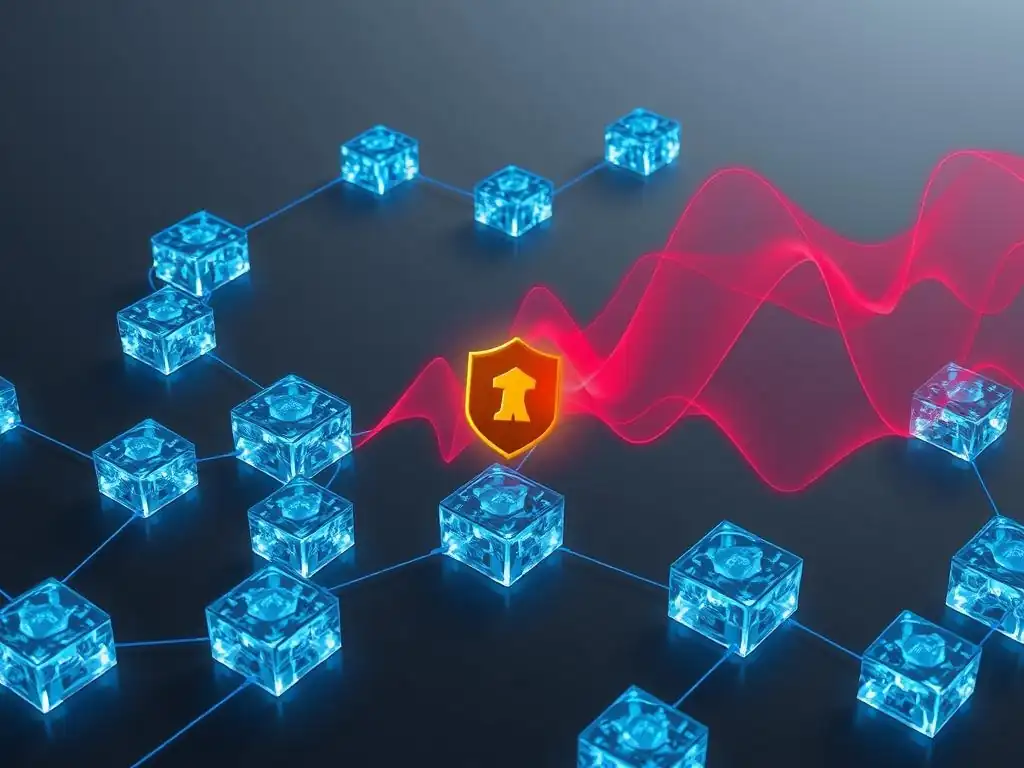
To mitigate the threat posed by quantum computers, the field of Post-Quantum Cryptography (PQC) has emerged. PQC focuses on developing cryptographic algorithms that are believed to be secure against attacks from both classical and quantum computers. These algorithms are designed to replace current cryptographic standards that are vulnerable to Shor's algorithm and Grover's algorithm. The National Institute of Standards and Technology (NIST) in the United States has been leading a global effort to standardize PQC algorithms, with several promising candidates in various stages of evaluation and standardization.
PQC algorithms generally fall into several categories, including lattice-based cryptography, multivariate cryptography, hash-based signatures, code-based cryptography, and isogeny-based cryptography. These approaches rely on different mathematical problems that are currently believed to be hard for both classical and quantum computers. Integrating PQC algorithms into blockchain protocols is a crucial step in fortifying them against blockchain quantum attacks vulnerabilities risks and ensuring their long-term security in the quantum era. The transition to PQC is a complex undertaking, requiring careful algorithm selection, implementation, and testing to ensure both security and performance.
Lattice-based Cryptography for Blockchain
Lattice-based cryptography is considered one of the most promising families of PQC algorithms for blockchain applications. It relies on the mathematical hardness of problems related to lattices, which are regular arrangements of points in space. These problems, such as the Shortest Vector Problem (SVP) and Learning With Errors (LWE) problem, are believed to be computationally intractable for both classical and quantum computers, making lattice-based cryptography a strong candidate for quantum resistance.
Lattice-based algorithms offer several advantages for blockchain, including relatively good performance, versatility, and mathematical maturity. Schemes like CRYSTALS-Kyber (for key exchange) and CRYSTALS-Dilithium (for digital signatures), which are lattice-based algorithms, have been selected by NIST for standardization in the PQC process. These algorithms are being actively explored for integration into blockchain protocols to replace vulnerable algorithms like ECDSA and potentially enhance key exchange mechanisms. The robustness and efficiency of lattice-based cryptography make it a key component in building quantum-resistant blockchain solutions to address future threats.
Multivariate Cryptography for Blockchain
Multivariate cryptography is another branch of PQC that relies on the difficulty of solving systems of multivariate polynomial equations over finite fields. These systems can be designed to be easy to solve in one direction but computationally hard to reverse, forming the basis for cryptographic primitives. Multivariate cryptography offers potential advantages in terms of signature size and computational efficiency in certain scenarios.
Algorithms like Rainbow, which is a multivariate signature scheme, have been considered for PQC standardization. While multivariate cryptography offers potential benefits, it has also faced some security challenges and requires careful parameter selection and implementation. Research and development in multivariate cryptography are ongoing, and while it might not be as widely adopted as lattice-based cryptography for blockchain in the immediate future, it remains a valuable area of exploration for building diverse quantum-resistant blockchain solutions and mitigating risks.
Hash-based Signatures for Blockchain
Hash-based signatures are a conceptually different approach to PQC, relying solely on the security of cryptographic hash functions. They are considered highly conservative in terms of security assumptions, as they are believed to be secure as long as the underlying hash function remains collision-resistant. Algorithms like the Merkle Signature Scheme and the SPHINCS+ signature scheme are examples of hash-based signatures.
Hash-based signatures offer strong quantum resistance and have relatively simple and well-understood security properties. SPHINCS+ is a stateless hash-based signature scheme standardized by NIST in the PQC process. While hash-based signatures can have larger signature sizes and potentially slower signature generation compared to other PQC schemes, their strong security foundation makes them attractive for certain blockchain applications, particularly where long-term security and simplicity are paramount. Exploring and implementing hash-based signatures is another important avenue for developing quantum-resistant blockchain solutions and addressing potential vulnerabilities.
Quantum Key Distribution (QKD) and its Role in Blockchain Security
Quantum Key Distribution (QKD) is a fundamentally different approach to cryptographic key exchange that leverages the principles of quantum mechanics to ensure secure communication. Unlike PQC, which relies on mathematical hardness assumptions, QKD's security is based on the laws of physics. QKD protocols, such as BB84, allow two parties to establish a shared secret key with information-theoretic security, meaning that any eavesdropping attempt would be detectable.
While QKD is not a replacement for PQC algorithms, it can play a complementary role in enhancing blockchain security, particularly for key exchange and secure communication channels within blockchain networks. QKD systems typically require specialized quantum hardware and fiber optic infrastructure, which can limit their widespread deployment in all blockchain scenarios.
However, for high-security blockchain applications, such as those handling highly sensitive data or large value transactions, integrating QKD for key exchange could provide an additional layer of security against both classical and quantum attacks. Exploring the integration of QKD within specific blockchain architectures is a promising direction for further strengthening quantum-resistant blockchain solutions.
Hybrid Approaches: Combining Classical and Quantum-Resistant Cryptography
A practical and effective strategy for mitigating blockchain quantum attacks vulnerabilities risks is to adopt hybrid cryptographic approaches. Hybrid cryptography involves combining classical cryptographic algorithms with quantum-resistant algorithms. This approach allows for a gradual transition to full quantum resistance while maintaining compatibility with existing systems and leveraging the strengths of both classical and PQC algorithms.
For example, a hybrid signature scheme could use both ECDSA and a lattice-based signature algorithm like CRYSTALS-Dilithium. Transactions could be signed using both algorithms, providing both backward compatibility and quantum resistance. Initially, the classical signature (ECDSA) would be used for compatibility, while the quantum-resistant signature would provide forward security against future quantum attacks.
As quantum computing threats materialize, the reliance on ECDSA could be gradually phased out, with the quantum-resistant signature becoming the primary authentication mechanism. Hybrid approaches offer a flexible and pragmatic way to enhance blockchain security incrementally and prepare for the quantum era without requiring immediate and disruptive overhauls of existing systems.
Strategies for Mitigating Blockchain Quantum Attack Vulnerabilities
Upgrading to Quantum-Resistant Cryptographic Algorithms
The most fundamental strategy for mitigating blockchain quantum attacks vulnerabilities risks is to upgrade blockchain protocols and applications to use quantum-resistant cryptographic algorithms. This involves replacing vulnerable algorithms like ECDSA with PQC algorithms such as lattice-based, multivariate, or hash-based schemes. The transition to PQC is a complex process that requires careful planning, testing, and coordination within the blockchain ecosystem.
For public blockchains, upgrading cryptographic algorithms typically requires community consensus and hard forks or soft forks to implement protocol changes. For enterprise blockchains, organizations need to assess their cryptographic dependencies and plan for a phased migration to PQC. The NIST PQC standardization process provides a valuable resource for selecting standardized and vetted quantum-resistant algorithms.
However, algorithm selection is just the first step. Proper implementation, integration, and testing are crucial to ensure that PQC algorithms are deployed securely and effectively in blockchain environments. This upgrade process also needs to consider the performance implications of PQC algorithms, as some PQC schemes may have different performance characteristics compared to classical algorithms.
Implementing Regular Security Audits and Vulnerability Assessments
Proactive security measures are essential for mitigating blockchain quantum attacks vulnerabilities risks. Regular security audits and vulnerability assessments should be conducted to identify potential weaknesses in blockchain systems, including those related to quantum threats. These audits should encompass code reviews, cryptographic analysis, and penetration testing to assess the overall security posture of blockchain protocols and applications.
Vulnerability assessments should specifically focus on identifying cryptographic algorithms used in blockchain systems and evaluating their susceptibility to quantum attacks. Tools and methodologies are being developed to assess the quantum resistance of cryptographic implementations. Regular audits and assessments can help identify potential weaknesses before they can be exploited, allowing developers and operators to implement timely security patches and upgrades. In the context of quantum threats, these audits should not only focus on current vulnerabilities but also anticipate future risks and prepare for the eventual transition to quantum-resistant cryptography.
Developing Robust Key Management Practices
Robust key management practices are crucial for maintaining the security of blockchain systems, regardless of the cryptographic algorithms used. Effective key management is particularly important in the context of quantum threats, as compromised keys are a primary target for quantum attacks. Developing and implementing secure key generation, storage, distribution, and revocation procedures is essential.
Key generation processes should utilize strong random number generators and avoid any predictable patterns. Key storage should employ secure hardware security modules (HSMs) or secure enclaves to protect private keys from unauthorized access. Key distribution mechanisms should be designed to minimize the risk of interception or compromise.
Key revocation procedures should be in place to quickly invalidate compromised keys. In the context of quantum resistance, key management practices should also consider the potential impact of quantum computers on key exchange protocols and ensure that key management systems are prepared for the eventual transition to quantum-resistant key exchange mechanisms. Strong key management is a foundational element in mitigating blockchain quantum attacks vulnerabilities risks.
Exploring Quantum-Resistant Consensus Mechanisms
While the primary focus of quantum threat mitigation in blockchain is on cryptography, exploring quantum-resistant consensus mechanisms is also a relevant area of research and development. While consensus mechanisms themselves are not directly broken by quantum computers in the same way as cryptography, quantum computing could still impact their security and efficiency, as discussed with PoW. Exploring consensus mechanisms that are inherently more resilient to quantum computational advantages or that incorporate quantum-resistant cryptographic primitives is a proactive approach.
Research is ongoing into developing consensus algorithms that are less reliant on computationally intensive cryptographic puzzles or that utilize PQC algorithms for various aspects of consensus, such as validator selection or voting. Hybrid consensus mechanisms that combine classical and quantum-resistant elements could also be explored. While the immediate priority is upgrading cryptography, considering the long-term evolution of blockchain security also involves investigating and developing quantum-resistant blockchain solutions at the consensus layer.
The Future of Blockchain Security in the Quantum Era
The Ongoing Research and Development in Post-Quantum Cryptography
The field of Post-Quantum Cryptography (PQC) is a rapidly evolving area of research and development. Significant efforts are underway globally to develop, analyze, and standardize PQC algorithms. The NIST PQC standardization process, expected to continue for several years, is driving innovation and rigor in the field. Researchers are constantly working on improving the security, efficiency, and usability of PQC algorithms.
Beyond the NIST process, academic and industry research labs are exploring new PQC approaches, analyzing the security of existing candidates, and developing optimized implementations for various platforms. The ongoing research and development in PQC are crucial for ensuring that robust and practical quantum-resistant cryptographic solutions are available to address the long-term threat posed by quantum computers to blockchain and other cryptographic systems. Staying abreast of the latest advancements in PQC is essential for blockchain developers and security professionals to effectively mitigate blockchain quantum attacks vulnerabilities risks.
The Importance of Collaboration Between Blockchain Developers and Quantum Computing Experts
Addressing the quantum threat to blockchain requires close collaboration between blockchain developers and quantum computing experts. Blockchain developers need to understand the potential impact of quantum computing on their systems and the available mitigation strategies. Quantum computing experts can provide valuable insights into the capabilities and limitations of quantum computers and help assess the quantum resistance of cryptographic algorithms.
Collaboration between these communities is essential for developing effective quantum-resistant blockchain solutions. This collaboration can take various forms, including joint research projects, workshops, conferences, and open-source initiatives. Sharing knowledge and expertise across these domains is crucial for accelerating the development and adoption of quantum-safe blockchain technologies and ensuring a smooth transition to the quantum era. Building strong bridges between blockchain and quantum computing communities is a key factor in securing the future of decentralized systems.
Preparing for the Transition to Quantum-Safe Blockchain Systems
Preparing for the transition to quantum-safe blockchain systems is a proactive and strategic imperative for the blockchain industry. This transition involves several key steps, including raising awareness of the quantum threat, assessing vulnerabilities in existing systems, developing and testing PQC implementations, and planning for phased upgrades and deployments.
Organizations and blockchain communities need to start planning for this transition now, even though cryptographically relevant quantum computers may not be available immediately. Procrastination could lead to significant security vulnerabilities and potential disruptions in the future. A phased approach to transitioning to quantum-safe blockchain systems is recommended, starting with pilot projects and gradual integration of PQC algorithms. This proactive preparation will ensure that blockchain technology remains secure and resilient in the face of quantum computing advancements and effectively mitigates blockchain quantum attacks vulnerabilities risks.
Conclusion: Staying Ahead of the Quantum Threat to Blockchain
The Need for Proactive Measures to Ensure Blockchain Security
The quantum threat to blockchain is a real and evolving challenge that demands proactive measures. While the widespread availability of cryptographically relevant quantum computers is still some years away, the potential consequences of quantum attacks on blockchain are significant. Ignoring this threat is not an option. Blockchain developers, businesses, and the broader blockchain community must take proactive steps to assess and mitigate blockchain quantum attacks vulnerabilities risks.
Proactive measures include investing in research and development of quantum-resistant technologies, upgrading cryptographic algorithms, implementing robust security practices, and fostering collaboration between blockchain and quantum computing experts. Early action and preparedness are crucial for ensuring the long-term security and viability of blockchain technology in the quantum era. Waiting until quantum computers become a direct and immediate threat will likely be too late to effectively safeguard blockchain systems.
Embracing Innovation and Adaptation in the Face of Quantum Computing Advancements
The quantum computing era presents both challenges and opportunities for blockchain technology. While quantum computers pose a threat to current cryptographic systems, they also drive innovation and adaptation in the field of cryptography and blockchain security. Embracing innovation and actively adapting to the evolving threat landscape is essential for the continued success and evolution of blockchain technology.
The development of Post-Quantum Cryptography and quantum-resistant blockchain solutions is a testament to the innovative spirit of the cryptographic and blockchain communities. By embracing innovation, fostering research, and adapting to new challenges, the blockchain ecosystem can not only mitigate the quantum threat but also emerge stronger and more secure in the quantum era. This proactive and adaptive approach is crucial for ensuring the long-term relevance and resilience of blockchain technology in the face of technological advancements.
Securing the Future of Decentralized Systems Against Quantum Vulnerabilities
Securing the future of decentralized systems against quantum vulnerabilities is a shared responsibility. It requires the collective effort of blockchain developers, researchers, businesses, governments, and the broader community. By working together, sharing knowledge, and investing in quantum-resistant technologies, we can ensure that blockchain technology remains a secure and trustworthy foundation for decentralized systems in the quantum era and beyond.
Addressing blockchain quantum attacks vulnerabilities risks is not just a technical challenge, but also a strategic imperative for the future of decentralized systems. By prioritizing security, fostering innovation, and embracing collaboration, we can navigate the quantum transition successfully and unlock the full potential of blockchain technology while safeguarding its security and integrity for generations to come.
Frequently Asked Questions
How does quantum computing pose a threat to blockchain technology?
Quantum computers, with their immense processing power, could potentially break the cryptographic algorithms currently used to secure blockchain networks. This could compromise the integrity and security of transactions.
What specific vulnerabilities in blockchain are most susceptible to quantum attacks?
The Elliptic Curve Cryptography (ECC) used for signing transactions and hashing algorithms like SHA-256 are considered vulnerable. Quantum computers could potentially reverse these processes, allowing attackers to forge transactions.
What are the main risks associated with quantum attacks on blockchain?
The risks include theft of cryptocurrencies, manipulation of transaction records, and disruption of decentralized applications (dApps). The trust in the blockchain system would be severely undermined.
What mitigation strategies are being developed to protect blockchains from quantum attacks?
Researchers are exploring quantum-resistant cryptography, also known as post-quantum cryptography (PQC). This involves developing new algorithms that are resistant to attacks from both classical and quantum computers. Another strategy is to upgrade the existing blockchain protocols to incorporate these new algorithms.
How far away are we from quantum computers posing a real threat to blockchain security?
While fully functional, fault-tolerant quantum computers capable of breaking current blockchain cryptography are still under development, experts predict the threat is within the next 5-10 years. Early preparation and adoption of quantum-resistant solutions are crucial to mitigating future risks.
The exploration of quantum attacks on blockchain, as detailed in this article, underscores a critical reality: the future of blockchain security is inextricably linked to our ability to anticipate and mitigate quantum threats. The vulnerabilities we've examined are not merely theoretical; they represent a tangible risk that demands proactive measures from developers, researchers, and policymakers alike. Ignoring this potential disruption could have devastating consequences for the decentralized systems we increasingly rely upon.
This looming quantum threat has profoundly influenced the way we perceive the long-term viability of blockchain technology. It forces us to move beyond a purely deterministic view of security and embrace a more probabilistic and adaptable approach. The urgency of this shift is captured perfectly in the words of Niels Bohr: Prediction is very difficult, especially about the future.
This quote reminds us that while we cannot know precisely when quantum computers will pose a significant threat, we must prepare diligently for that eventuality, ensuring that blockchain remains a secure and trustworthy foundation for future innovation.
As you consider the implications of these quantum vulnerabilities, I invite you to reflect on your own role in shaping the future of blockchain. What steps can you take to contribute to the development of quantum-resistant algorithms and protocols? How can you advocate for greater awareness and investment in this critical area of research? The security of our decentralized future depends on our collective commitment to addressing these challenges head-on. Let us embrace the opportunity to build a more resilient and secure blockchain ecosystem for generations to come.
Defend Your Digital Future: Take Action Against Quantum Threats!
Thank you for exploring the quantum vulnerabilities facing blockchain technology. You've gained critical insights into the risks and potential impact. Now, let's translate that knowledge into action!
- Dive deeper into quantum-resistant cryptography: Start researching and understanding the various algorithms designed to protect blockchain from quantum attacks. Prioritize learning about lattice-based cryptography and hash-based signatures.
- Share this vital information with your network on social media. Help spread awareness about the impending quantum threat to blockchain security.
- Participate in online forums and communities dedicated to blockchain security. Contribute your thoughts and engage in discussions about the future of quantum-resistant blockchain solutions.
What steps will you take today to prepare for the quantum era and safeguard the future of blockchain? Share your thoughts in the comments below!
Leave a Reply