
Securing Medical IoT Devices: Blockchain for HIPAA Compliance and Patient Safety


Welcome to Blockchain Trends, your trusted source for understanding the revolutionary power of blockchain beyond digital currencies.
Are you ready to delve into the intersection of healthcare, IoT, and blockchain? In this article, we unravel the complexities of achieving Blockchain HIPAA compliance in medical IoT, exploring how this groundbreaking technology can safeguard patient data and enhance the security of connected medical devices. Discover the innovative solutions that are shaping the future of healthcare and the critical role blockchain plays in maintaining patient safety. Intrigued? Read on to unlock the potential!
- The Growing Threat Landscape of Medical IoT Devices
- Blockchain Technology: A Paradigm Shift for Medical IoT Security
- Blockchain and HIPAA Compliance: A Synergistic Approach
- Implementing Blockchain for Medical IoT: Practical Applications
- Overcoming Challenges in Blockchain Adoption for Healthcare IoT
- The Future of Blockchain in Medical IoT: Trends and Predictions
- Case Study: Guardtime's KSI Blockchain for Medical Device Integrity
- Conclusion: Blockchain as a Cornerstone for Secure and HIPAA-Compliant Medical IoT
-
Frequently Asked Questions
- How can blockchain technology contribute to HIPAA compliance in the context of medical IoT devices?
- What are the key benefits of using blockchain to secure medical IoT devices?
- What challenges need to be addressed when implementing blockchain solutions for medical IoT and HIPAA compliance?
- How does blockchain help improve patient safety when used with medical IoT devices?
- What role do smart contracts play in managing access to patient data stored on a blockchain for medical IoT applications?
- Final Reflection: Bridging Trust and Technology in Healthcare
- Strengthen Healthcare Security: Take Action Now!
The Growing Threat Landscape of Medical IoT Devices
Vulnerabilities in Medical IoT: A Critical Overview
Medical IoT devices, ranging from wearable health monitors to sophisticated surgical robots, have revolutionized healthcare delivery. However, this interconnected ecosystem presents a significantly expanded attack surface for cybercriminals. Many medical IoT devices are designed with a primary focus on functionality and ease of use, often overlooking robust security measures. Common vulnerabilities include outdated software susceptible to known exploits, weak or default passwords, and a lack of encryption for sensitive patient data transmitted over networks. Furthermore, the long lifespan of many medical devices means that vulnerabilities discovered years after deployment may remain unpatched, creating persistent security risks.
The complexity of medical IoT environments further exacerbates these vulnerabilities. Hospitals and clinics often manage a diverse array of devices from different manufacturers, each with its own security profile and update schedule. This fragmentation makes it challenging to implement consistent security policies and monitor for threats effectively. A study by cybersecurity firm Palo Alto Networks found that 83% of medical imaging devices were running outdated operating systems, making them vulnerable to known cyberattacks. This widespread use of legacy systems, combined with the increasing sophistication of cyber threats, creates a perfect storm for security breaches in healthcare.
Data Breaches and Patient Safety Risks in Healthcare IoT
The consequences of vulnerabilities in medical IoT extend beyond data breaches to directly impact patient safety. Compromised medical devices can be manipulated to alter treatment dosages, disable critical monitoring functions, or even cause direct harm to patients. For example, researchers have demonstrated the feasibility of remotely altering the insulin dosage delivered by insulin pumps, potentially leading to life-threatening situations. Similarly, vulnerabilities in pacemakers or implantable defibrillators could be exploited to disrupt cardiac function.
Beyond direct device manipulation, data breaches in healthcare IoT can expose vast amounts of sensitive patient information, including medical history, diagnoses, treatment plans, and personal details. The healthcare sector is a prime target for cyberattacks due to the high value of protected health information (ePHI) on the black market.
According to the HIPAA Journal, in 2023, there were 725 healthcare data breaches reported to the Department of Health and Human Services (HHS) Office for Civil Rights, affecting over 51 million patient records. These breaches can lead to identity theft, financial fraud, reputational damage for healthcare providers, and a loss of trust in the healthcare system.
The Urgent Need for Enhanced Security in Connected Healthcare
The escalating threat landscape necessitates a paradigm shift in how security is approached in connected healthcare. Traditional security measures, often implemented as afterthoughts, are insufficient to protect the complex and interconnected nature of medical IoT. A proactive, security-by-design approach is crucial, embedding security considerations into every stage of device development, deployment, and maintenance. This includes robust authentication mechanisms, strong encryption protocols for data in transit and at rest, regular security updates and patching, and comprehensive vulnerability management programs.
Furthermore, a holistic security strategy requires collaboration across the healthcare ecosystem, involving device manufacturers, healthcare providers, regulators, and cybersecurity experts. Standardization efforts to establish baseline security requirements for medical IoT devices are essential to ensure a minimum level of protection across the industry. Increased investment in cybersecurity infrastructure and training for healthcare professionals is also vital to equip organizations with the necessary tools and expertise to defend against evolving threats. The integration of innovative technologies like blockchain is emerging as a promising approach to bolster security and address the unique challenges of securing medical IoT.
Blockchain Technology: A Paradigm Shift for Medical IoT Security
Understanding Blockchain's Role in Securing IoT Networks
Blockchain technology, originally conceived as the foundation for cryptocurrencies, offers a compelling solution for enhancing the security and integrity of IoT networks, particularly within the healthcare domain. At its core, blockchain is a distributed, immutable ledger that records transactions in blocks linked cryptographically. This decentralized and tamper-proof nature makes it inherently resilient to single points of failure and malicious alterations, addressing many of the security shortcomings prevalent in traditional centralized systems.
In the context of medical IoT, blockchain can serve as a secure and transparent platform for managing device identities, authenticating data sources, and tracking data provenance. By registering medical devices on a blockchain network, each device gains a unique and verifiable digital identity. This identity can be used to ensure that only authorized devices can communicate with the network and exchange data. Furthermore, blockchain's cryptographic hashing and consensus mechanisms ensure the integrity of data transmitted by medical IoT devices, preventing unauthorized modifications and ensuring data authenticity.
Key Benefits of Blockchain for Healthcare Data Security
The application of blockchain technology to healthcare data security offers several significant advantages. Firstly, it enhances data integrity by creating an auditable and tamper-proof record of all data transactions. Once data is recorded on the blockchain, it cannot be altered or deleted, providing a high degree of assurance about data accuracy and reliability. This is particularly critical in healthcare, where the integrity of patient data is paramount for accurate diagnoses, effective treatments, and regulatory compliance.
Secondly, blockchain improves data security through decentralization and cryptographic encryption. Data is not stored in a single, vulnerable location but distributed across a network of nodes, making it significantly harder for attackers to compromise the entire system. Cryptographic techniques further secure data by ensuring that only authorized parties with the appropriate cryptographic keys can access and decrypt sensitive information. This multi-layered security approach strengthens the protection of ePHI against unauthorized access and breaches.
Decentralization, Immutability, and Transparency: Core Blockchain Advantages
Decentralization, immutability, and transparency are the core tenets of blockchain technology that make it particularly well-suited for securing medical IoT. Decentralization eliminates single points of failure, making the system more resilient to attacks and outages. If one node in the network is compromised, the rest of the network remains operational and secure. This distributed architecture is a significant improvement over traditional centralized systems, where a single point of failure can cripple the entire system.
Immutability ensures that once data is recorded on the blockchain, it cannot be altered or deleted. This provides a permanent and auditable record of all transactions, crucial for maintaining data integrity and complying with regulatory requirements like HIPAA. Transparency, while sometimes perceived as a concern, can be selectively applied in blockchain networks. While the ledger itself is transparent, access to the data recorded on the blockchain can be controlled through permissioned blockchain networks and access control mechanisms, ensuring that only authorized parties can view sensitive information while still maintaining auditability.
Blockchain and HIPAA Compliance: A Synergistic Approach
Demystifying HIPAA Requirements for Electronic Protected Health Information (ePHI)
The Health Insurance Portability and Accountability Act (HIPAA) sets the standard for protecting sensitive patient data, known as electronic Protected Health Information (ePHI), in the United States. HIPAA comprises several rules, including the Privacy Rule, Security Rule, and Breach Notification Rule. The Security Rule is particularly relevant to medical IoT and blockchain, outlining administrative, physical, and technical safeguards that covered entities and their business associates must implement to ensure the confidentiality, integrity, and availability of ePHI.
Key HIPAA Security Rule requirements include implementing access controls to limit access to ePHI to authorized individuals, audit controls to track activity related to ePHI, integrity controls to prevent unauthorized alteration or destruction of ePHI, and transmission security to protect ePHI during electronic transmission. Covered entities must conduct risk assessments to identify potential threats and vulnerabilities to ePHI and implement security measures commensurate with those risks. Failure to comply with HIPAA can result in significant financial penalties and reputational damage.
How Blockchain Addresses HIPAA Security Rule Requirements
Blockchain technology offers a robust framework for addressing many of the HIPAA Security Rule requirements for medical IoT. Blockchain's inherent security features align directly with the principles of confidentiality, integrity, and availability of ePHI. For example, blockchain's access control mechanisms, based on cryptographic keys and permissions, can ensure that only authorized devices and users can access sensitive patient data transmitted by medical IoT devices, directly addressing HIPAA's access control requirements.
Blockchain's immutability and audit trail capabilities satisfy HIPAA's integrity and audit control requirements. The tamper-proof nature of blockchain ensures that ePHI remains unaltered, and the transparent ledger provides a comprehensive audit trail of all data transactions, facilitating compliance audits and investigations. Furthermore, blockchain's encryption capabilities can be leveraged to protect ePHI during transmission and storage, fulfilling HIPAA's transmission security requirements.
Achieving HIPAA Compliance with Blockchain-Based Medical IoT Solutions
Implementing blockchain-based solutions for medical IoT can significantly contribute to achieving HIPAA compliance. By leveraging blockchain's security features, healthcare organizations can strengthen their defenses against data breaches and ensure the confidentiality, integrity, and availability of ePHI. For instance, a blockchain-based system for managing medical device data can provide a secure and auditable record of device readings, ensuring data integrity and facilitating compliance with HIPAA's data integrity requirements.
Moreover, blockchain can streamline HIPAA compliance processes by automating audit trails and providing verifiable evidence of security controls. The transparent and immutable nature of blockchain simplifies compliance audits, reducing the administrative burden and costs associated with demonstrating HIPAA compliance. However, it is crucial to note that blockchain alone does not guarantee HIPAA compliance. Healthcare organizations must implement a comprehensive security program that incorporates blockchain as part of a broader strategy, addressing all aspects of the HIPAA Security Rule and other relevant regulations.
Implementing Blockchain for Medical IoT: Practical Applications
Use Case 1: Securing Remote Patient Monitoring Data with Blockchain
Remote patient monitoring (RPM) devices are increasingly used to collect patient health data outside of traditional clinical settings. These devices, ranging from wearable sensors to home-based medical equipment, generate vast amounts of sensitive patient data that needs to be securely transmitted and stored. Blockchain can provide a secure and private platform for managing RPM data, ensuring data integrity and patient confidentiality.
In a blockchain-based RPM system, patient data collected by IoT devices can be encrypted and securely recorded on a blockchain network. Access to this data can be controlled through cryptographic keys, allowing patients and authorized healthcare providers to access and share data securely. Blockchain's immutability ensures that RPM data cannot be tampered with, providing a reliable and auditable record of patient health information.
This is particularly valuable for managing chronic conditions, monitoring post-operative recovery, and enabling proactive healthcare interventions. For example, companies like Chronicled are exploring blockchain solutions for pharmaceutical supply chain and patient data management, demonstrating the real-world applicability of blockchain in securing sensitive healthcare data.
Use Case 2: Blockchain-Based Access Control for Medical Devices
Access control is a critical security requirement for medical IoT devices, particularly those used in hospitals and clinics. Unauthorized access to medical devices can lead to device malfunction, data breaches, and potentially harm patients. Blockchain can be used to implement robust and decentralized access control mechanisms for medical devices, ensuring that only authorized personnel can access and operate these devices.
A blockchain-based access control system can assign unique digital identities to medical devices and healthcare professionals. Access permissions can be managed on the blockchain, defining who can access which devices and what actions they are authorized to perform. When a user attempts to access a medical device, their credentials are verified against the blockchain-based access control system.
If authorized, access is granted; otherwise, access is denied. This decentralized approach eliminates reliance on centralized access control servers, reducing the risk of single points of failure and enhancing the overall security of medical device access management. For example, companies like MedCrypt are focusing on cybersecurity solutions for medical devices, including access control and data protection, highlighting the industry's growing focus on securing connected medical devices.
Use Case 3: Enhancing Supply Chain Security for Pharmaceuticals and Medical Equipment
The supply chain for pharmaceuticals and medical equipment is complex and vulnerable to counterfeiting and tampering. Counterfeit drugs and medical devices pose a significant threat to patient safety and can undermine public trust in the healthcare system. Blockchain can provide a transparent and auditable platform for tracking pharmaceuticals and medical equipment throughout the supply chain, enhancing security and combating counterfeiting.
By recording each step of the supply chain process on a blockchain, from manufacturing to distribution and delivery, a transparent and immutable record of product provenance is created. This allows stakeholders to verify the authenticity and origin of pharmaceuticals and medical equipment at any point in the supply chain. Blockchain-based tracking systems can also help detect and prevent counterfeit products from entering the legitimate supply chain.
For instance, pharmaceutical companies are exploring blockchain to track drugs from manufacturing to patient dispensation, aiming to combat the estimated \$200 billion global counterfeit drug market, according to the World Health Organization. This enhanced supply chain visibility and security directly contributes to patient safety and regulatory compliance.
Overcoming Challenges in Blockchain Adoption for Healthcare IoT
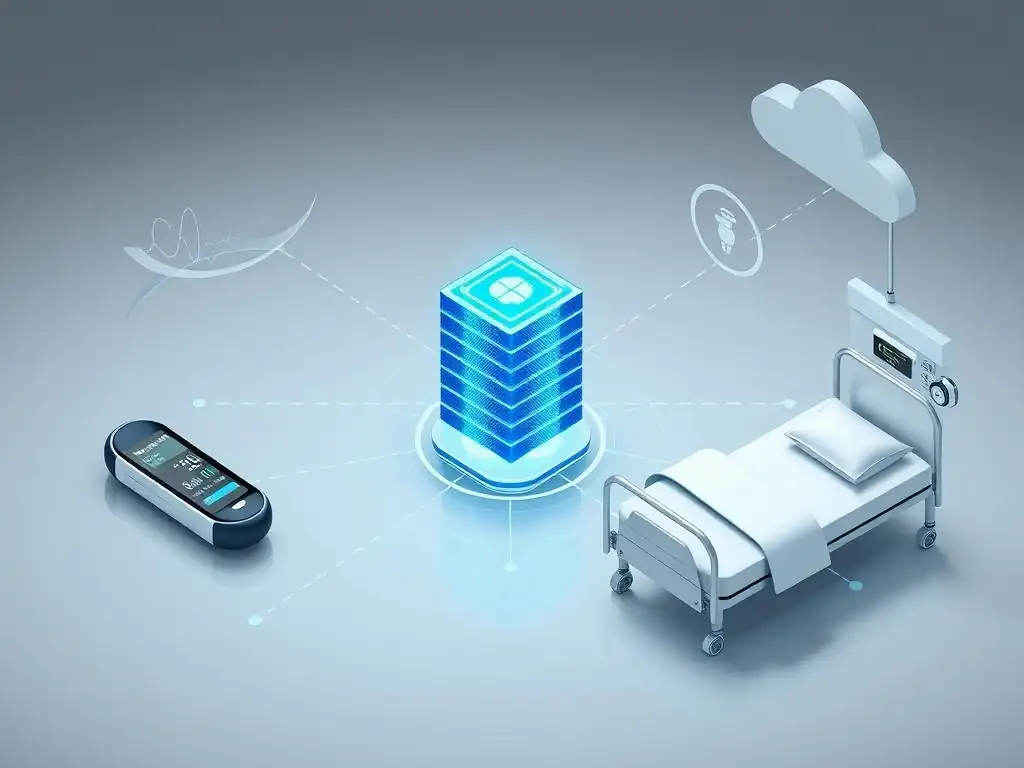
Scalability Issues in Blockchain-Based Medical IoT Systems
While blockchain offers significant security advantages for medical IoT, scalability remains a key challenge for widespread adoption. Traditional blockchain networks, like Bitcoin and Ethereum, have limited transaction throughput, which may not be sufficient to handle the high volume of data generated by large-scale medical IoT deployments. The number of medical devices and the frequency of data transmission can quickly overwhelm the capacity of some blockchain platforms.
To address scalability concerns, various solutions are being explored, including layer-2 scaling solutions, sharding, and permissioned blockchain networks. Layer-2 solutions, such as state channels and rollups, process transactions off-chain, reducing the burden on the main blockchain. Sharding divides the blockchain into smaller, more manageable shards, increasing transaction processing capacity. Permissioned blockchain networks, designed for enterprise use cases, often employ more efficient consensus mechanisms that can achieve higher transaction throughput compared to public blockchains. Choosing the right blockchain platform and scaling solution is crucial for ensuring that blockchain-based medical IoT systems can handle the demands of real-world healthcare environments.
Interoperability Challenges Between Blockchain Platforms and Existing Healthcare Systems
Interoperability is another significant hurdle in implementing blockchain for healthcare IoT. Healthcare systems are characterized by a complex ecosystem of legacy systems, proprietary data formats, and diverse communication protocols. Integrating blockchain-based solutions with these existing systems can be challenging and requires careful planning and execution. Different blockchain platforms may also lack interoperability with each other, creating silos of data and hindering seamless data exchange across healthcare organizations.
Addressing interoperability requires adopting open standards and developing interoperability frameworks that enable seamless communication and data exchange between blockchain platforms and existing healthcare systems. Standards organizations like HL7 and FHIR are working on developing standards for blockchain interoperability in healthcare. APIs and middleware solutions can also facilitate integration between blockchain and legacy systems. Achieving interoperability is essential for realizing the full potential of blockchain in healthcare IoT and ensuring that blockchain-based solutions can seamlessly integrate into existing healthcare workflows.
Regulatory Uncertainty and the Need for Clear Guidelines
Regulatory uncertainty surrounding blockchain technology in healthcare also poses a challenge to its widespread adoption. While HIPAA provides a framework for protecting ePHI, specific guidelines on the use of blockchain for healthcare data security are still evolving. Healthcare organizations are seeking clarity from regulatory bodies regarding the legal and compliance implications of using blockchain to manage patient data. Uncertainty about regulatory requirements can create hesitancy among healthcare providers to invest in and deploy blockchain-based solutions.
Clear regulatory guidelines and frameworks are needed to provide healthcare organizations with the confidence to adopt blockchain technology for medical IoT. Regulators need to address issues such as data privacy, data ownership, and liability in the context of blockchain-based healthcare systems. Collaborative efforts between regulators, industry stakeholders, and blockchain experts are essential to develop clear and practical guidelines that foster innovation while ensuring patient safety and data protection. As regulatory clarity emerges, it will pave the way for wider adoption of blockchain in healthcare IoT and unlock its transformative potential.
The Future of Blockchain in Medical IoT: Trends and Predictions
The Rise of Decentralized Identity Management in Healthcare
Decentralized identity management (DID) is emerging as a crucial trend in healthcare, and blockchain is poised to play a central role in its development. Traditional identity management systems in healthcare are often fragmented and centralized, creating inefficiencies and security risks. DID, powered by blockchain, offers a patient-centric approach to identity management, giving individuals greater control over their digital identities and health data.
In a blockchain-based DID system, patients can create and manage their own digital identities, stored securely on a blockchain. These identities can be used to access healthcare services, share medical records with providers, and control who has access to their health data. DID can streamline patient registration processes, improve data privacy and security, and empower patients to actively participate in their own healthcare management. Companies like Civic are developing blockchain-based DID solutions that are being explored for use cases in healthcare and other sectors, indicating the growing momentum behind decentralized identity in digital ecosystems.
The Convergence of Blockchain, AI, and IoT for Predictive Healthcare Security
The convergence of blockchain, artificial intelligence (AI), and IoT is creating new opportunities for predictive healthcare security. IoT devices generate vast amounts of data, AI can analyze this data to identify patterns and anomalies, and blockchain can secure the data and ensure its integrity. This synergy can lead to more proactive and effective security measures in healthcare.
AI algorithms can be trained on medical IoT data secured by blockchain to detect potential security threats and vulnerabilities in real-time. For example, AI can analyze network traffic patterns from medical devices to identify anomalous behavior that may indicate a cyberattack. Blockchain can provide a secure and auditable record of security events and responses, enhancing incident response capabilities. This convergence of technologies can enable predictive security measures that anticipate and prevent threats before they materialize, significantly enhancing the security posture of healthcare IoT environments.
The Potential of Blockchain for Secure and Auditable Clinical Trials
Clinical trials are essential for developing new medical treatments and therapies, but they are often complex, expensive, and prone to data integrity issues. Blockchain technology has the potential to transform clinical trials by enhancing data security, transparency, and auditability. Blockchain can create a secure and immutable record of clinical trial data, ensuring data integrity and preventing data manipulation.
Smart contracts on blockchain can automate various aspects of clinical trials, such as patient enrollment, data collection, and regulatory reporting. Blockchain can also improve transparency in clinical trials by providing a public and auditable record of trial protocols, data, and results. This enhanced transparency can increase trust in clinical trial outcomes and accelerate the development of new medical breakthroughs. Companies like Embleema are developing blockchain-based platforms for clinical trials, demonstrating the growing interest in leveraging blockchain to improve the efficiency and integrity of clinical research.
Case Study: Guardtime's KSI Blockchain for Medical Device Integrity
Guardtime and its Keyless Signature Infrastructure (KSI) Blockchain
Guardtime is a cybersecurity company specializing in blockchain-based solutions for data integrity and security. Their Keyless Signature Infrastructure (KSI) blockchain is a unique, hash-chain based blockchain technology designed for high-volume data integrity applications. Unlike traditional blockchains that rely on computationally intensive consensus mechanisms, KSI blockchain uses a mathematical function to create cryptographic signatures, enabling extremely fast and scalable data verification. This makes KSI blockchain particularly well-suited for applications requiring real-time data integrity assurance, such as securing medical IoT devices.
KSI blockchain is "keyless" because it does not rely on private keys for signing data. Instead, it uses a distributed system of hash functions to create digital signatures that are mathematically linked to a global timeline. This approach eliminates the risk of private key compromise, a significant security vulnerability in traditional public key infrastructure (PKI) systems. KSI blockchain's speed, scalability, and keyless security model make it a compelling technology for securing data integrity in critical infrastructure and healthcare environments.
Using KSI Blockchain to Ensure Data Integrity and Device Security in Medical Devices
Guardtime's KSI blockchain can be effectively used to ensure data integrity and device security in medical devices. By integrating KSI blockchain into medical devices, manufacturers can create a tamper-proof audit trail of device operations and data transmissions. Every event or data point generated by the medical device can be cryptographically signed and anchored to the KSI blockchain, providing verifiable proof of data integrity and origin.
This approach enables real-time monitoring of medical device integrity and detection of any unauthorized modifications or tampering. If a device is compromised or data is altered, the KSI blockchain will immediately reveal the discrepancy, alerting healthcare providers to potential security breaches or device malfunctions. KSI blockchain can be embedded directly into medical devices or integrated into backend systems that manage and process medical device data, providing a flexible and robust solution for enhancing medical device security.
Improved Data Provenance and Reduced Risk of Tampering
The use of KSI blockchain in medical devices significantly improves data provenance and reduces the risk of tampering. Data provenance refers to the ability to trace the origin and history of data, which is crucial for establishing trust and accountability in healthcare data management. KSI blockchain provides an immutable and verifiable record of data origin, ensuring that healthcare providers can confidently rely on the accuracy and authenticity of medical device data.
By cryptographically signing and timestamping data on the KSI blockchain, it becomes virtually impossible to tamper with data without detection. Any attempt to alter data would invalidate the cryptographic signature, immediately revealing the tampering. This enhanced data provenance and tamper-evidence provided by KSI blockchain strengthens the security and reliability of medical IoT devices, contributing to improved patient safety and data integrity in healthcare. Guardtime's KSI blockchain is being utilized in various sectors, including government and finance, demonstrating its applicability and effectiveness in securing critical data infrastructure.
Conclusion: Blockchain as a Cornerstone for Secure and HIPAA-Compliant Medical IoT
Key Takeaways: Blockchain's Transformative Potential in Healthcare
Blockchain technology holds immense transformative potential for securing medical IoT and enhancing HIPAA compliance. Its core features – decentralization, immutability, and transparency – address critical security challenges in connected healthcare, offering robust solutions for data integrity, access control, and auditability. By leveraging blockchain, healthcare organizations can strengthen their defenses against cyber threats, improve patient safety, and streamline HIPAA compliance processes.
Blockchain's ability to secure remote patient monitoring data, enhance medical device access control, and improve pharmaceutical supply chain security demonstrates its practical applicability in various healthcare use cases. While challenges such as scalability, interoperability, and regulatory uncertainty remain, ongoing innovation and collaborative efforts are paving the way for wider blockchain adoption in healthcare IoT. The convergence of blockchain with AI and IoT further amplifies its potential to revolutionize healthcare security and enable predictive and proactive threat management.
Call to Action: Embracing Blockchain for a More Secure and Patient-Centric Healthcare Ecosystem
Embracing blockchain technology is no longer a futuristic vision but a strategic imperative for healthcare organizations seeking to build a more secure and patient-centric ecosystem. Healthcare providers, device manufacturers, and technology developers should actively explore and implement blockchain-based solutions to enhance the security and integrity of medical IoT devices and data. Investing in blockchain expertise, participating in industry collaborations, and engaging with regulatory bodies are crucial steps towards realizing the full potential of blockchain in healthcare.
By proactively adopting blockchain, the healthcare industry can move towards a future where patient data is more secure, medical devices are more resilient to cyber threats, and healthcare delivery is more efficient and trustworthy. This proactive approach to blockchain adoption will not only strengthen HIPAA compliance but also foster a more secure and patient-centric healthcare ecosystem, ultimately benefiting patients, providers, and the entire healthcare industry.
Frequently Asked Questions
How can blockchain technology contribute to HIPAA compliance in the context of medical IoT devices?
Blockchain can enhance HIPAA compliance by providing immutable audit trails for data access and modification, ensuring data integrity and traceability, which are crucial for HIPAA's accountability requirements.
What are the key benefits of using blockchain to secure medical IoT devices?
Blockchain offers improved data security through cryptographic hashing, enhanced data integrity via its immutable ledger, and better access control using smart contracts, thus safeguarding sensitive patient information.
What challenges need to be addressed when implementing blockchain solutions for medical IoT and HIPAA compliance?
Challenges include scalability issues with some blockchain networks, regulatory uncertainties surrounding blockchain technology, and the complexity of integrating blockchain with existing healthcare systems.
How does blockchain help improve patient safety when used with medical IoT devices?
By ensuring data accuracy and integrity, blockchain can prevent errors in medical data that could lead to incorrect diagnoses or treatments, thereby directly improving patient safety and reducing medical errors.
What role do smart contracts play in managing access to patient data stored on a blockchain for medical IoT applications?
Smart contracts can automate and enforce access control policies, ensuring that only authorized individuals or devices can access specific patient data, thereby strengthening data security and HIPAA compliance.
Final Reflection: Bridging Trust and Technology in Healthcare
The convergence of medical IoT devices and blockchain technology, as explored in this article, isn't just a theoretical exercise; it's a critical imperative for safeguarding patient data and ensuring the integrity of healthcare systems. The challenges of HIPAA compliance in a world increasingly reliant on interconnected devices demand innovative solutions, and blockchain offers a promising path towards achieving both security and transparency.
This intersection of technology and ethics profoundly impacts the cultural landscape of healthcare. The promise of secure, patient-centric data management is not just a technical advancement; it's a fundamental shift in how we perceive and protect personal health information. As we navigate this evolving landscape, it's crucial to remember the human element at the heart of it all. The best way to predict the future is to create it.
- Peter Drucker. This quote reminds us that we have the power to shape the future of healthcare through responsible innovation.
Now, consider the implications of this discussion for your own life and the lives of those around you. How can you advocate for responsible adoption of blockchain technology in healthcare? How can you ensure that patient privacy remains paramount as we embrace the potential of interconnected medical devices? The future of healthcare security rests on our collective commitment to ethical innovation and unwavering dedication to patient well-being. Let us strive to build a future where technology empowers, protects, and ultimately enhances the lives of all.
Strengthen Healthcare Security: Take Action Now!
Thank you for exploring the importance of securing medical IoT devices with blockchain technology. You've gained valuable insights into how this innovation can protect patient data and ensure compliance with healthcare regulations. Now, it's time to turn that knowledge into meaningful actions.
You can help create a safer and more reliable healthcare environment by:
- Championing the adoption of blockchain solutions within your organization to safeguard sensitive patient information. This is a crucial step in building a strong defense against cyber threats.
- Exploring pilot initiatives that use blockchain for medical device security and data tracking—small experiments can provide valuable lessons and pave the way for broader implementation.
- Sharing this article with your colleagues, IT professionals, and policymakers to raise awareness and promote industry-wide change.
What innovative strategies are you considering to leverage blockchain for improved healthcare security in your practice or organization? Share your thoughts in the comments below!
Leave a Reply