
Manufacturing 4.0: How Blockchain & IoT are Driving the Next Industrial Revolution
Explore how blockchain and the Internet of Things are transforming connected technology 🔗📡. Discover practical applications, secure IoT data management, smart contract automation, and innovative solutions for trusted device communication. Learn how decentralized systems improve IoT security, data integrity, scalability, and enterprise efficiency, while uncovering the key challenges shaping the future of blockchain-powered connected devices.
572 articles
Securing IoT Networks: How Blockchain's Decentralization Changes the Game
Healthcare IoT Data Secured: Blockchain's Transformative Impact on Patient Monitoring
Boost IoT Data Integrity: Leveraging Blockchain for Unbreakable Trust
Smart Contracts for IoT Security: Automating Trust and Response
Building a BlockchainBased IoT Data Management System: Key Considerations
The Evolution of IoT Security: Blockchain as the Cornerstone
The Impact of Blockchain & IoT on the Insurance Industry: New Opportunities and Business Models
Energy Consumption Concerns: Addressing Blockchain's Footprint in IoT Deployments
Designing Smart Contracts for Scalable IoT Applications
Protecting IoT from ManintheMiddle Attacks: Blockchain's Unbreakable Chain
The Immutable Shield: Fortifying IoT Devices with Blockchain Technology
Comparison: Evaluating the Performance of BlockchainBased IoT Security Solutions
Blockchain vs. Traditional Databases for IoT Data Management: A Detailed Comparison
Interoperability Hurdles: Bridging the Gaps in Blockchain & IoT Ecosystems
Technological Thresholds: Are Current Technologies Ready for BlockchainIoT Fusion?
Privacy Paradox: Can Blockchain Truly Safeguard IoT Data in a Decentralized World?
Deep Dive into Smart Manufacturing: Specific Blockchain & IoT Applications and Benefits
How Smart Contracts Are Transforming the Logistics Industry with IoT
Implementation Guide: Getting Started with Blockchain for IoT Security in Your Business
Blockchain for Secure Location Data Management in IoT Applications
Data Breaches in IoT: Can Blockchain Be the Ultimate Shield?
Implementation Guide: Integrating Blockchain Security into Existing IoT Infrastructure
Asset Tracking Reinvented: Blockchain & IoT for RealTime Visibility and Control
Unlocking the Potential of Industrial IoT: Blockchain for Enhanced Efficiency and Security
Data Privacy in the Age of Smart Devices: Blockchain's Role in Protecting IoT Data
Balancing Act: Weighing the Risks and Rewards of BlockchainIoT Convergence
Blockchain for IoT Security: Unlocking a New Era of Trust and Protection
Smart Contracts vs. Traditional Contracts: A Comparison for IoT Solutions
Data Privacy by Design in Blockchain & IoT: Protecting Sensitive Information in Connected Ecosystems
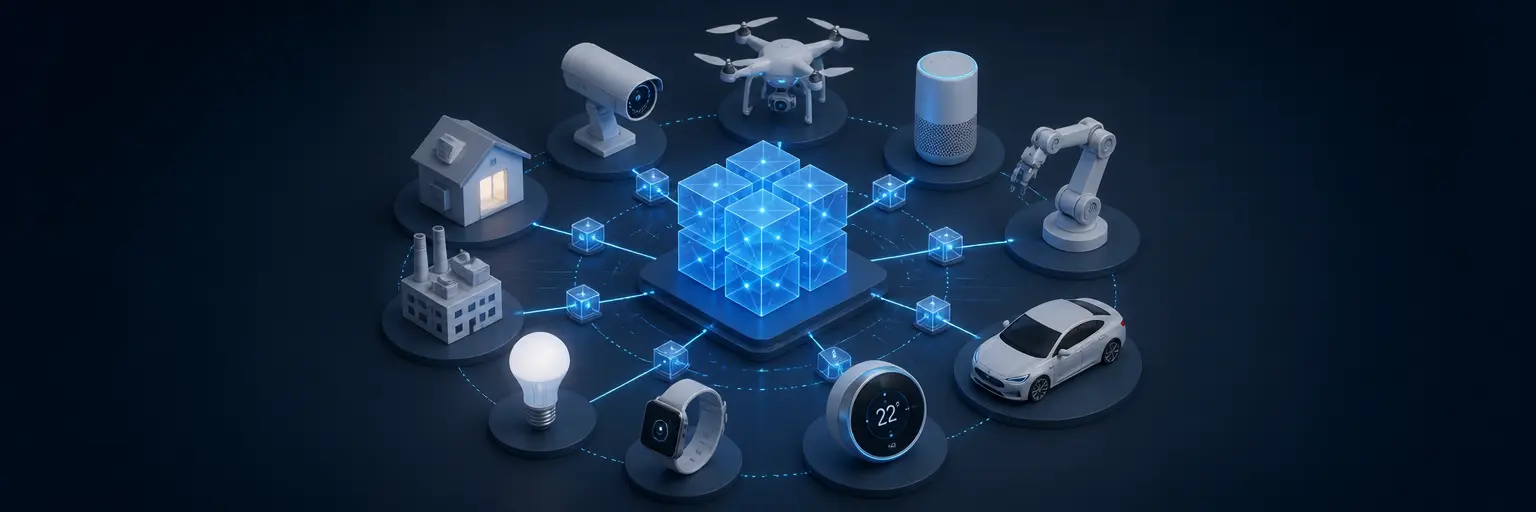
Blockchain and IoT (Internet of Things) are converging to create more secure, transparent, and intelligent connected ecosystems. From smart factories and supply chains to connected vehicles, healthcare devices, and smart cities, blockchain technology for IoT can help organizations verify device identities, protect data integrity, automate transactions, and coordinate machine-to-machine interactions without relying on a single central authority.
At Blockchain Trends, this category explores how decentralized networks and connected devices are reshaping enterprise technology. Discover practical blockchain and IoT use cases, decentralized IoT data management strategies, smart contracts for automation, security solutions, scalability considerations, privacy requirements, and the real-world challenges businesses must address before deploying these technologies at scale.
🔗 Blockchain & IoT Use Cases
This subcategory examines real-world blockchain and IoT applications across industries. Readers can explore how distributed ledger technology supports supply chain traceability, industrial IoT, connected vehicles, energy grids, agriculture, healthcare monitoring, logistics, and smart city infrastructure.
Expect practical examples, enterprise case studies, and analysis of how blockchain can establish trust between devices, organizations, and users. Articles also explain the benefits of decentralized IoT networks, including improved transparency, verifiable records, automated coordination, and new business models for connected devices.
📊 Blockchain for IoT Data Management
IoT environments generate enormous volumes of data from sensors, machines, applications, and edge devices. This section explores how blockchain for IoT data management can improve data provenance, integrity, access control, and auditability throughout the information lifecycle.
Readers will learn how blockchain can complement cloud computing, edge computing, and traditional databases rather than replace them entirely. Topics include secure data sharing, permissioned blockchain networks, IoT data verification, privacy-preserving architectures, interoperability, and methods for managing high-volume sensor data efficiently.
⚙️ Smart Contracts for IoT Automation
Smart contracts allow connected devices and business systems to execute predefined actions when verified conditions are met. This subcategory explores smart contracts for IoT automation, including machine-to-machine payments, automated maintenance, supply chain events, energy trading, insurance claims, and equipment monitoring.
Expect clear explanations of how sensor data can trigger trusted workflows without manual intervention. Articles cover oracle design, event verification, programmable transactions, contract security, gas costs, and the importance of ensuring that real-world IoT inputs are accurate before they activate automated blockchain processes.
⚠️ Challenges of Blockchain & IoT
Although blockchain and IoT offer significant opportunities, combining them introduces technical, operational, and regulatory challenges. This section addresses IoT blockchain scalability, network performance, energy consumption, storage limitations, latency, interoperability, governance, compliance, and the complexity of integrating legacy systems.
Readers will also find analysis of privacy risks, unreliable sensors, flawed data inputs, smart contract vulnerabilities, and the limitations of placing large datasets directly on a blockchain. The goal is to provide a balanced view that helps organizations evaluate whether a blockchain-based IoT architecture is practical for their specific needs.
🛡️ Securing IoT with Blockchain
Connected devices are frequent targets for malware, identity theft, unauthorized access, botnets, and data manipulation. This subcategory explores how blockchain can improve IoT security through decentralized identity, tamper-evident records, device authentication, access permissions, and transparent security auditing.
Articles explain how blockchain may strengthen device-to-device and device-to-platform trust while working alongside encryption, secure hardware, zero-trust architecture, network monitoring, and regular firmware updates. Readers can discover practical strategies for building resilient secure IoT ecosystems without assuming that blockchain alone solves every cybersecurity problem.
❓ Frequently Asked Questions About Blockchain and IoT
What is blockchain and IoT integration?
Blockchain and IoT integration combines connected devices and sensors with a distributed ledger. Blockchain can record device events, verify data integrity, manage identities, and support trusted coordination between devices, businesses, and applications.
How can blockchain improve IoT security?
Blockchain can provide tamper-evident records, decentralized device identity, and transparent access histories. It may reduce dependence on a single central server, but effective IoT security also requires encryption, secure hardware, authentication, monitoring, and software updates.
What are the main blockchain and IoT use cases?
Common use cases include supply chain tracking, industrial automation, smart energy markets, connected vehicles, healthcare data management, predictive maintenance, agriculture monitoring, logistics, and smart city services.
Can blockchain handle large volumes of IoT data?
Most blockchain networks are not designed to store every IoT data point directly. A more practical approach is to store large datasets off-chain while recording hashes, permissions, timestamps, or important events on a blockchain for verification and auditability.
What are the biggest challenges of using blockchain with IoT?
Major challenges include scalability, latency, energy usage, device limitations, privacy, interoperability, unreliable sensor data, regulatory compliance, and integration with existing infrastructure. Careful architecture and the right choice of public or permissioned blockchain are essential.