
Blockchain and IoT: Powering the Autonomous Supply Chain of Tomorrow


Welcome to Blockchain Trends, your compass in the rapidly evolving world of decentralized technology.
Are you ready to unlock the secrets of a truly autonomous supply chain? Dive into our latest article, "Blockchain and IoT: Powering the Autonomous Supply Chain of Tomorrow," and discover how the convergence of these groundbreaking technologies is revolutionizing logistics, traceability, and efficiency. Explore the potential of a Blockchain IoT supply chain and how it's shaping the future of enterprise. Curious to learn more? Let's begin!
Blockchain and IoT: Powering the Autonomous Supply Chain of Tomorrow
- Introduction: The Convergence of Blockchain and IoT in Supply Chain Management
- The Current Challenges in Traditional Supply Chains
- How Blockchain IoT Solutions Address Supply Chain Pain Points
- Key Applications of Blockchain IoT in the Supply Chain
- Real-World Examples of Blockchain IoT Implementation in Supply Chains
- The Benefits of an Autonomous Supply Chain Powered by Blockchain and IoT
- Overcoming the Challenges of Blockchain IoT Adoption in Supply Chains
- The Future of Blockchain IoT in Supply Chain Management
- Conclusion: Embracing the Autonomous Supply Chain Revolution
-
Frequently Asked Questions
- What is the core synergy between Blockchain and IoT in the context of supply chain management?
- How does Blockchain IoT supply chain technology reduce fraud and counterfeiting?
- What are the main benefits of implementing a Blockchain IoT supply chain for businesses?
- What are the current challenges hindering widespread adoption of Blockchain IoT supply chain solutions?
- What are some potential future applications of Blockchain IoT in the supply chain beyond tracking and tracing?
- Final Reflection: Embracing the Decentralized Future of Supply Chains
- Reimagine Your Supply Chain: Start Innovating Today!
Introduction: The Convergence of Blockchain and IoT in Supply Chain Management
Understanding the Potential of Blockchain IoT Integration
The convergence of blockchain technology and the Internet of Things (IoT) presents a transformative opportunity for supply chain management. At its core, this integration links the physical world, where goods move and sensors collect data, with a secure, transparent, and immutable digital ledger. IoT devices, such as sensors for tracking location, temperature, humidity, or vibration, generate vast amounts of real-time data about products and assets as they traverse the supply chain.
By recording this sensor data directly onto a blockchain, organizations create a verifiable, tamper-proof history of a product's journey and condition. This eliminates reliance on manual data entry or disparate, easily altered databases. The result is a single source of truth accessible to all authorized participants, from manufacturers and logistics providers to distributors and retailers. This foundational layer of trusted data is essential for building highly efficient and automated processes within a Blockchain IoT supply chain.
Defining the Autonomous Supply Chain: A New Era of Efficiency
An autonomous supply chain represents a future state where processes are largely self-managing and self-optimizing, driven by real-time data and automated execution. In this vision, decisions are made and actions are triggered automatically based on predefined rules and conditions, minimizing human intervention. This level of automation moves beyond simple automation to encompass self-regulation and adaptive capabilities.
Blockchain and IoT are key enablers of this autonomy. IoT sensors provide the necessary real-time visibility into the physical state of goods and assets, while blockchain provides the trusted, shared ledger for this data. Smart contracts, executed on the blockchain, can automatically trigger events like payments upon verified delivery, initiate replenishment orders when stock levels are low (as reported by IoT), or even flag maintenance needs for equipment based on sensor readings. This interconnected, data-driven, and automated system forms the basis of the next generation autonomous supply chain.
The Current Challenges in Traditional Supply Chains
Lack of Transparency and Traceability in Existing Systems
Traditional supply chains often suffer from a significant lack of end-to-end transparency and traceability. Information about a product's origin, handling, and current location is frequently siloed within different organizations or recorded manually in disparate systems. This makes it incredibly difficult, and often time-consuming, to accurately track goods from their source to the final consumer.
This opacity has serious consequences. In sectors like food or pharmaceuticals, tracing the source of contamination or a counterfeit product can take days or even weeks, potentially impacting public safety and costing companies millions in recalls and reputational damage. Reports suggest that inefficient tracing processes contribute significantly to waste and increased costs across various industries, hindering effective supply chain management.
Inefficiencies and Delays in Logistics and Operations
Manual processes, extensive paperwork, and poor communication between different parties are endemic issues in many traditional supply chains, leading to substantial inefficiencies and delays. Handing off goods between carriers, customs clearance, and verifying documentation are often time-consuming bottlenecks. A single shipment can involve dozens of documents and multiple intermediaries, each adding potential points of failure or delay.
These operational inefficiencies result in increased lead times, higher logistics costs, and a greater risk of errors. For example, estimates suggest that administrative costs related to documentation can account for up to 20% of total shipping costs. The lack of real-time visibility means that stakeholders often react to problems rather than proactively preventing them, further exacerbating delays and impacting delivery schedules.
Security Vulnerabilities and Data Breaches
Centralized databases and manual record-keeping systems in traditional supply chains are susceptible to security vulnerabilities, data breaches, and tampering. A single point of failure can compromise sensitive information about shipments, inventory, or trading partners. Fraud, including the introduction of counterfeit goods, theft, and manipulation of records to conceal losses, is a persistent and costly problem.
The lack of immutable records makes it challenging to verify the authenticity of goods or the integrity of data. The global trade in counterfeit goods is estimated to be worth hundreds of billions of dollars annually, highlighting the scale of this security challenge. Protecting sensitive supply chain data and ensuring the authenticity of products are critical needs that traditional systems often struggle to adequately address.
How Blockchain IoT Solutions Address Supply Chain Pain Points
Enhanced Transparency and Real-Time Tracking with Blockchain IoT
Blockchain IoT supply chain solutions revolutionize transparency by creating a shared, immutable ledger of all relevant events and data points. IoT devices attached to goods, vehicles, or locations continuously collect data – such as GPS coordinates, temperature readings, or status updates (e.g., package opened). This data is then securely timestamped and recorded onto a blockchain ledger.
Every participant in the supply chain with appropriate permissions can access this real-time, verified information. This eliminates information silos and provides unprecedented visibility into the location, condition, and handling history of goods at any point in their journey. For instance, a food distributor can instantly verify the temperature history of a refrigerated shipment from farm to warehouse, ensuring cold chain compliance and reducing spoilage risk.
Improved Security and Data Integrity Through Decentralization
The decentralized nature of blockchain inherently enhances security and data integrity compared to traditional centralized systems. Instead of storing data in a single, vulnerable database, copies of the ledger are distributed across multiple nodes in the network. To alter a record, an attacker would need to compromise a majority of these nodes simultaneously, a computationally infeasible task.
Furthermore, cryptographic hashing ensures that any attempt to tamper with recorded IoT data is immediately detectable. Once sensor data is written to the blockchain, it is virtually impossible to alter without breaking the cryptographic links that connect blocks. This immutability provides a high level of trust in the data, guaranteeing its integrity and significantly reducing the risk of fraud or unauthorized modifications within the Blockchain IoT supply chain.
Streamlining Processes and Reducing Costs with Smart Contracts
Smart contracts are self-executing contracts with the terms of the agreement directly written into code. In a Blockchain IoT supply chain, these smart contracts can be programmed to automatically trigger actions based on the verified data received from IoT devices on the blockchain. For example, a smart contract could release payment to a supplier as soon as IoT sensors confirm that a shipment has arrived at its destination and met specified conditions (e.g., temperature range maintained).
This automation eliminates manual verification steps, reduces the need for intermediaries, and significantly speeds up transaction settlements. Beyond payments, smart contracts can automate inventory updates, trigger reorders, manage quality control checks, and even handle customs documentation processing. By automating these complex, often manual processes, Blockchain IoT solutions can lead to substantial reductions in administrative overhead and operational costs, potentially cutting costs by 15% or more in specific logistics functions.
Key Applications of Blockchain IoT in the Supply Chain
Food Safety and Traceability: From Farm to Table
Ensuring food safety and providing rapid traceability is a critical challenge globally. Blockchain IoT supply chain solutions offer a powerful way to address this. IoT sensors can monitor conditions like temperature and humidity during transport and storage, while blockchain records the immutable history of a food item's journey, including origin, processing steps, and distribution points.
Walmart's initiative, for instance, demonstrated the ability to trace a package of mangoes from farm to store in seconds using blockchain, a process that previously took days or weeks with traditional methods. This capability is invaluable during foodborne illness outbreaks, allowing for rapid identification of the source and targeted recalls, minimizing public health risks and economic impact. Estimates suggest improved traceability could save the food industry billions annually.
Pharmaceutical Supply Chain: Ensuring Authenticity and Preventing Counterfeiting
The pharmaceutical supply chain requires the highest levels of security and traceability to ensure patient safety and prevent the proliferation of counterfeit drugs. Blockchain IoT supply chain technology is uniquely positioned to tackle this. IoT sensors can monitor environmental conditions crucial for drug efficacy (like temperature for vaccines), while blockchain provides a secure, verifiable ledger of a drug's chain of custody from manufacturing to pharmacy.
By serializing products and recording each change of ownership on a blockchain, combined with sensor data verifying handling conditions, the authenticity and integrity of pharmaceuticals can be guaranteed. The World Health Organization estimates that up to 10% of medical products in low- and middle-income countries are counterfeit, a problem costing the industry billions and endangering lives. Blockchain IoT offers a robust defense against this global threat.
Manufacturing and Industrial IoT: Optimizing Production and Maintenance
In manufacturing, the integration of Industrial IoT (IIoT) and blockchain can optimize production processes and asset management. IoT sensors on machinery collect real-time performance data, vibration levels, temperature, and other critical parameters. This data, securely logged on a blockchain, provides a reliable source of truth for monitoring asset health and production efficiency.
Smart contracts can leverage this data for predictive maintenance, automatically scheduling service calls or ordering replacement parts when sensor readings indicate potential equipment failure. Furthermore, tracking components and raw materials using Blockchain IoT ensures provenance and quality control throughout the manufacturing process. This can lead to reduced downtime, lower maintenance costs (potentially a 10-15% reduction), and improved overall equipment effectiveness (OEE).
Logistics and Shipping: Real-Time Tracking and Automated Delivery
Logistics and shipping are prime candidates for Blockchain IoT supply chain transformation. IoT devices on containers, pallets, or individual packages provide real-time data on location, route deviations, and environmental conditions. This data is recorded on a blockchain, creating an immutable audit trail visible to all relevant parties.
This real-time visibility allows for more accurate estimated times of arrival (ETAs), better route optimization, and faster response to disruptions. Smart contracts can automate critical steps, such as triggering payment or transfer of ownership upon physical delivery confirmation verified by GPS data on the blockchain. This reduces administrative burden and speeds up cash flow. Companies leveraging this technology report significant reductions in paperwork and faster transit times for international shipments.
Real-World Examples of Blockchain IoT Implementation in Supply Chains
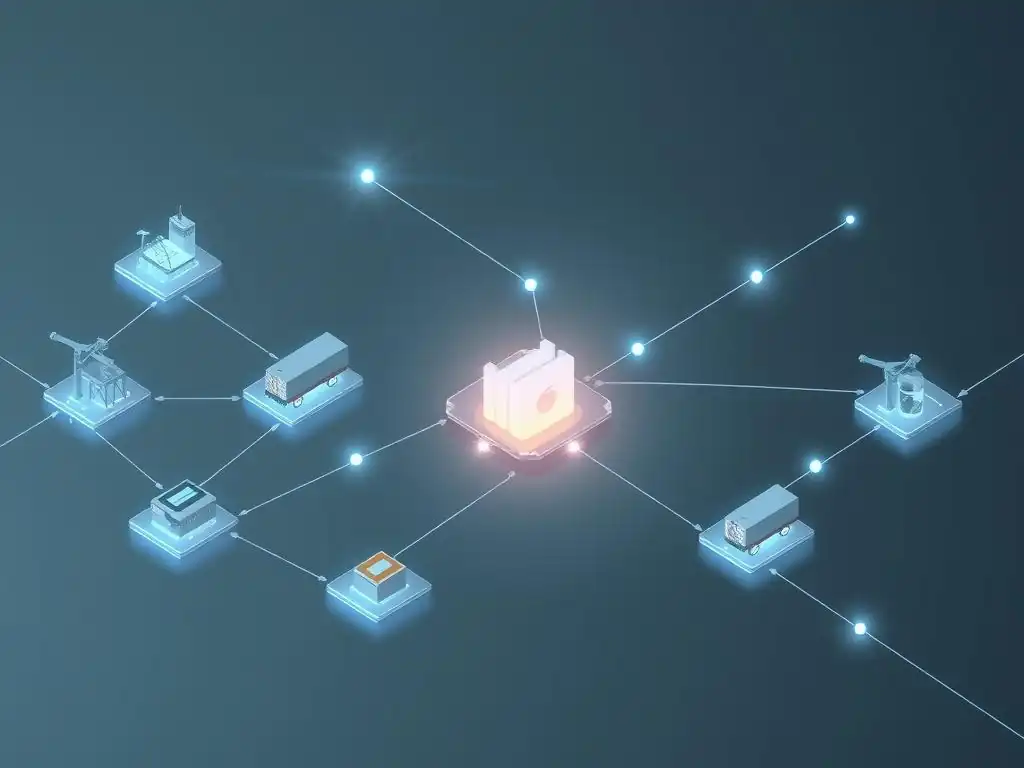
Maersk and IBM's TradeLens: Digitizing Global Trade
One of the most prominent real-world examples of a Blockchain IoT supply chain solution is TradeLens, a platform developed by Maersk and IBM. Designed to digitize and streamline global trade, TradeLens uses blockchain technology to provide a shared, immutable record of shipping transactions and documentation. While not solely focused on IoT, it integrates data from various sources, including ports, customs authorities, and logistics providers, which can include sensor data from smart containers.
TradeLens aims to replace paper-based processes and disparate systems with a single, secure platform, providing unprecedented visibility into the movement of cargo. As of recent reports, the platform is handling millions of shipping events per week and involves hundreds of organizations across the global supply chain ecosystem. The goal is to reduce the time and cost associated with trade documentation, which can account for a significant portion of overall shipping expenses.
Walmart's Blockchain Initiative: Tracking Produce from Farm to Store
Walmart's well-documented use of blockchain (specifically Hyperledger Fabric) for tracking leafy greens is a compelling example demonstrating the power of rapid traceability in a food Blockchain IoT supply chain context. Faced with the need for quicker response during food safety recalls, Walmart mandated its suppliers of leafy greens to upload data about their produce onto the blockchain.
This initiative, while not strictly integrating IoT data at scale initially, laid the groundwork for a future where IoT sensors could feed real-time conditions directly into this traceable system. The key takeaway from Walmart's project is the dramatic reduction in trace time – from an average of nearly seven days to just seconds – showcasing the potential for blockchain to provide near-instantaneous, verifiable traceability critical for consumer safety and efficient recall management.
Analyzing the Impact of Blockchain IoT on Supply Chain Efficiency
The examples of TradeLens and Walmart, among others, highlight the tangible impact of integrating blockchain and IoT in supply chains. TradeLens demonstrates how digitizing and sharing data on a blockchain can reduce the administrative friction and delays inherent in complex global logistics. While specific global efficiency metrics are still emerging, pilot programs and early adopters report significant improvements in documentation processing times and overall shipment visibility.
Walmart's case provides a clear metric: a reduction in tracing time from days to seconds. This dramatic improvement in a critical process like traceability directly impacts efficiency, safety, and cost reduction during crises. Across various pilots and studies, the combined application of blockchain and IoT is projected to yield efficiency gains of 15-30% in specific areas like tracking, documentation, and payment processing within complex supply chains.
The Benefits of an Autonomous Supply Chain Powered by Blockchain and IoT
Increased Efficiency and Reduced Operational Costs
An autonomous supply chain leveraging Blockchain IoT technology offers substantial improvements in efficiency. Automation powered by smart contracts minimizes manual tasks, reduces paperwork, and accelerates processes like customs clearance and payment settlements. Real-time data from IoT, recorded on a blockchain, enables better inventory management, reduces waste from spoilage or obsolescence, and optimizes logistics routes dynamically.
By eliminating intermediaries and automating transactions, companies can significantly lower operational costs. Estimates suggest that administrative costs could be reduced by 10-25% in areas heavily reliant on documentation and verification. Furthermore, faster dispute resolution, fewer errors, and reduced need for manual oversight contribute directly to a leaner, more cost-effective supply chain operation.
Improved Transparency and Traceability for Consumers
The enhanced transparency provided by a Blockchain IoT supply chain extends beyond business partners to consumers. With a secure, verifiable record of a product's journey, companies can offer consumers the ability to access information about where their product came from, how it was handled, and its environmental impact. This can be achieved, for instance, by scanning a QR code linked to the blockchain data.
This level of transparency builds trust and meets growing consumer demand for ethically sourced and safe products. Studies show that a significant percentage of consumers (often cited around 70-80%) prefer brands that offer transparency regarding their supply chain practices. Providing verifiable proof of origin and handling builds brand loyalty and differentiates products in the market.
Enhanced Security and Reduced Risk of Fraud
The combination of blockchain's inherent security features – decentralization and immutability – with secure IoT data logging creates a highly resilient system against fraud and tampering. Counterfeit goods are much harder to introduce into a system where each item's authenticity and chain of custody are immutably recorded and verifiable at multiple points.
The risk of data breaches and manipulation is significantly reduced compared to centralized systems. The cost of fraud and theft in global supply chains runs into the billions annually. Implementing a Blockchain IoT supply chain provides a robust defense mechanism, protecting both the integrity of the goods and the sensitive data associated with their movement, thereby reducing financial losses and reputational damage.
Greater Collaboration and Trust Among Supply Chain Partners
A key benefit of a shared, immutable ledger is the fostering of trust and collaboration among disparate supply chain partners who may not traditionally have strong relationships. By providing a single source of truth for all participants, disagreements over data accuracy or event verification are significantly reduced. All parties are working from the same verified information.
This shared visibility and trust enable smoother handoffs between different stages of the supply chain, faster issue resolution, and improved coordination. Partners can collaborate more effectively on optimizing processes, sharing relevant data securely, and working towards common goals like sustainability or efficiency improvements, ultimately strengthening the entire supply chain ecosystem.
Overcoming the Challenges of Blockchain IoT Adoption in Supply Chains
Scalability Issues and Network Congestion
One of the significant hurdles for widespread Blockchain IoT supply chain adoption is the sheer volume of data generated by potentially millions or billions of connected IoT devices. Public blockchains, while offering high decentralization, can face scalability issues and network congestion, leading to slow transaction speeds and high fees if not designed appropriately.
Handling and storing this massive influx of real-time data on a distributed ledger requires robust infrastructure and efficient consensus mechanisms. Solutions are emerging, such as using private or permissioned blockchains better suited for enterprise throughput, leveraging layer 2 scaling solutions, and employing data filtering techniques to ensure only essential, validated IoT data is recorded on-chain. Ongoing research and development are crucial for addressing these scalability concerns.
Data Privacy and Regulatory Compliance
Integrating sensitive supply chain data onto a blockchain raises important questions about data privacy and compliance with regulations like GDPR. While blockchain provides transparency, businesses are often reluctant to share proprietary information with competitors or even partners. The immutability of blockchain also presents challenges regarding the 'right to be forgotten'.
Permissioned blockchains, where participation and data visibility are restricted to authorized parties, offer a solution for privacy concerns. Techniques like zero-knowledge proofs allow verification of data without revealing the underlying details. Addressing regulatory compliance requires careful architectural design, potentially storing sensitive data off-chain and using the blockchain only for hashing or verifying data integrity pointers, ensuring legal requirements are met.
Interoperability and Standardization Challenges
The supply chain ecosystem is complex, involving diverse legacy systems, various IoT device manufacturers, and different blockchain protocols. Ensuring seamless interoperability between these disparate technologies is a significant challenge. Data formats, communication protocols, and blockchain standards need to be harmonized for a truly integrated Blockchain IoT supply chain to function effectively across multiple partners.
Lack of industry-wide standards can lead to fragmented solutions that work only within specific consortia or limited sections of the supply chain. Efforts by industry bodies and open-source initiatives are underway to develop standards and frameworks for Blockchain IoT integration in supply chains, but achieving broad adoption requires significant collaboration and agreement across the industry.
The skills and training gap
Implementing and managing complex Blockchain IoT supply chain solutions requires a specialized skillset that combines expertise in blockchain technology, IoT platforms, data analytics, and traditional supply chain management. There is currently a significant gap in the workforce with this multidisciplinary knowledge.
Companies face challenges in finding, hiring, and training personnel capable of designing, deploying, and maintaining these advanced systems. Bridging this skills gap requires investment in education, training programs, and potentially collaboration with external experts or technology providers to ensure organizations have the necessary human capital to leverage the full potential of Blockchain IoT in their operations.
The Future of Blockchain IoT in Supply Chain Management
The Rise of Decentralized Supply Chain Platforms
Looking ahead, the evolution of Blockchain IoT in supply chain management is likely to see the rise of more fully decentralized platforms. These platforms could move beyond simply using blockchain as a shared database to enable peer-to-peer interactions and transactions directly between supply chain participants without reliance on a central orchestrator.
Decentralized autonomous organizations (DAOs) could potentially govern aspects of these future supply chains, with rules embedded in smart contracts and decisions made collectively by stakeholders. This shift towards decentralization could further reduce costs, increase resilience, and distribute value more equitably among all parties involved in the Blockchain IoT supply chain network.
Integration with AI and Machine Learning for Predictive Analytics
The combination of the trusted, real-time data stream provided by Blockchain IoT and the analytical power of Artificial Intelligence (AI) and Machine Learning (ML) is set to unlock new levels of optimization. The clean, verifiable data from IoT sensors logged on an immutable blockchain provides an ideal dataset for AI/ML algorithms.
AI and ML can analyze this data to predict potential disruptions (e.g., equipment failure based on sensor anomalies), forecast demand more accurately, optimize routes dynamically based on real-time conditions, and identify patterns indicative of fraud or inefficiency. This integration will enable supply chains to become not just autonomous in execution but also predictive and self-optimizing, proactively addressing issues before they impact operations.
The Role of Blockchain IoT in Sustainable Supply Chains
Sustainability is becoming an increasingly important factor for businesses and consumers. Blockchain IoT supply chain technology can play a crucial role in building more sustainable practices. IoT sensors can monitor environmental parameters like energy consumption or emissions at various stages, with this data immutably recorded on a blockchain.
This provides verifiable proof of sustainable sourcing, ethical labor practices, and compliance with environmental regulations. Consumers and regulators can trust the data, enabling informed choices and holding companies accountable. Tracking waste streams, verifying the use of recycled materials, and optimizing logistics to reduce carbon footprint are all areas where Blockchain IoT can drive significant improvements in supply chain sustainability.
Conclusion: Embracing the Autonomous Supply Chain Revolution
Leveraging Blockchain and IoT for a More Efficient and Secure Future
The convergence of blockchain and IoT is not just a technological trend; it represents a fundamental shift towards building truly autonomous supply chains. By providing unprecedented transparency, traceability, and security through immutable, real-time data, this combined technology addresses long-standing pain points in traditional systems. The automation capabilities of smart contracts, triggered by verified IoT data, promise significant gains in efficiency and cost reduction.
Businesses that strategically leverage Blockchain IoT supply chain solutions stand to gain a competitive advantage. From improving food safety and preventing pharmaceutical counterfeiting to optimizing manufacturing and streamlining global logistics, the applications are vast and impactful. While challenges related to scalability, interoperability, and data privacy remain, ongoing innovation is continuously addressing these hurdles.
The Transformative Potential of Blockchain IoT for Businesses and Consumers
Ultimately, the autonomous supply chain powered by Blockchain and IoT holds transformative potential for everyone involved. For businesses, it means increased resilience, reduced risk, lower operational costs, and enhanced profitability. For consumers, it translates to greater trust in the products they purchase, verifiable information about origin and quality, and increased safety.
Embracing this revolution requires investment in technology, infrastructure, and human capital. However, the benefits of a more efficient, secure, transparent, and ultimately autonomous supply chain powered by Blockchain IoT are clear and compelling, pointing towards a future where goods move seamlessly, reliably, and intelligently across the globe.
Frequently Asked Questions
What is the core synergy between Blockchain and IoT in the context of supply chain management?
The synergy lies in enhanced transparency and data integrity. IoT devices provide real-time data, while blockchain ensures this data is tamper-proof and auditable, creating a reliable record for all parties involved.
How does Blockchain IoT supply chain technology reduce fraud and counterfeiting?
Blockchain's immutable ledger allows for tracking product provenance. Coupled with IoT sensors verifying conditions, it provides unparalleled evidence against fraudulent activities and counterfeit goods.
What are the main benefits of implementing a Blockchain IoT supply chain for businesses?
Businesses benefit from improved efficiency, reduced costs, and increased trust. Real-time tracking and automated processes streamline operations, while blockchain's security minimizes risks and builds confidence among stakeholders.
What are the current challenges hindering widespread adoption of Blockchain IoT supply chain solutions?
Challenges include scalability issues with blockchain, the high cost of implementation, and the lack of standardized protocols for data exchange between different IoT devices and blockchain platforms.
What are some potential future applications of Blockchain IoT in the supply chain beyond tracking and tracing?
Future applications include smart contracts automating payments upon delivery, predictive maintenance based on IoT sensor data analyzed on the blockchain, and sustainable supply chain management with carbon footprint tracking.
Final Reflection: Embracing the Decentralized Future of Supply Chains
The convergence of Blockchain and IoT, as explored throughout this article, isn't just a technological trend; it's a fundamental shift in how we conceive of and manage supply chains. The promise of a transparent, secure, and autonomous supply chain is no longer a distant dream, but a rapidly approaching reality. The potential to revolutionize industries, from food and pharmaceuticals to manufacturing and logistics, is immense, and the time to understand and embrace this transformation is now.
This integration is more than just efficiency; it's about building trust and resilience in a world increasingly reliant on complex global networks. The ability to trace products from origin to consumer, ensuring authenticity and ethical sourcing, resonates deeply with a growing demand for transparency and accountability. As we navigate an era of increasing uncertainty, the decentralized nature of blockchain offers a powerful antidote to vulnerabilities. The future of supply chain isn't about predicting the next disruption, it's about building systems that can adapt and overcome them.
Ultimately, the power of Blockchain and IoT in the supply chain lies in its ability to empower individuals and organizations alike. It invites us to reimagine how we interact with the products we consume and the systems that deliver them. Consider how you can champion transparency and efficiency in your own sphere of influence. Let us all strive to build a future where supply chains are not just efficient, but also ethical, sustainable, and truly connected.
Reimagine Your Supply Chain: Start Innovating Today!
Thank you for exploring how blockchain and IoT can transform the future of supply chain management. We hope this article inspired your thinking and offered valuable insights into this exciting technological frontier. Now, it's time to turn that knowledge into action.
Here are a few ways to get started:
- Begin piloting a small-scale integration of IoT and blockchain within one specific part of your supply chain. This allows for controlled testing and data collection.
- Share this article with your network on LinkedIn or Twitter to foster discussions and gather diverse perspectives on autonomous supply chains.
- Brainstorm an innovative and unconventional application of blockchain and IoT within your industry. Challenge the status quo!
What is the biggest obstacle your organization faces in implementing a truly autonomous supply chain? Share your thoughts below!
Leave a Reply