
The Future of Logistics Efficiency: Blockchain's NextGen Innovations


Welcome to Blockchain Trends, your definitive guide to understanding the real-world impact of blockchain technology!
Ever wondered how blockchain can revolutionize industries beyond just cryptocurrencies? Dive into "The Future of Logistics Efficiency: Blockchain's NextGen Innovations" and discover how blockchain logistics supply chain tracking is poised to reshape global trade, enhancing transparency, security, and efficiency like never before. Uncover the cutting-edge applications and the transformative potential that awaits. Ready to explore the future of supply chain management?
The Future of Logistics Efficiency: Blockchain's Next-Gen Innovations
- Introduction: Revolutionizing Supply Chain Management with Blockchain
- Understanding Blockchain Logistics Supply Chain Tracking
- Blockchain-Based Solutions for Enhanced Logistics Efficiency
- Next-Gen Blockchain Innovations Transforming Logistics
- Use Cases: Blockchain in Action for Supply Chain Optimization
- Overcoming Challenges in Blockchain Logistics Implementation
- The Future of Blockchain Logistics Supply Chain Tracking
- Conclusion: Embracing Blockchain for a More Efficient Logistics Ecosystem
-
Frequently Asked Questions
- How does blockchain improve supply chain visibility?
- What are the key benefits of using blockchain for logistics beyond tracking?
- What challenges are associated with implementing blockchain in logistics supply chains?
- How does blockchain address the issue of counterfeit goods in the supply chain?
- How is blockchain impacting the future of decentralized systems in logistics?
- Final Reflection: Embracing Transparency in the Supply Chain
- Uncover Your Logistics Potential: Start Innovating Now!
Introduction: Revolutionizing Supply Chain Management with Blockchain
Blockchain's Growing Role in Logistics: Setting the Stage
Blockchain technology is rapidly moving beyond its origins in cryptocurrency to become a foundational element in the transformation of various industries, with logistics and supply chain management being prime candidates for disruption. The inherent characteristics of blockchain – immutability, transparency, and decentralization – address many long-standing inefficiencies and trust issues within complex global supply networks.
As businesses seek greater visibility, security, and automation in their operations, blockchain offers a compelling solution to track goods, verify transactions, and manage relationships across numerous stakeholders, ranging from manufacturers and carriers to distributors and end consumers. Early adoption in pilot programs and increasingly in production systems demonstrates a clear trajectory for blockchain becoming a standard tool for managing intricate logistics flows.
The integration of blockchain in logistics is poised to unlock significant value, estimated by some reports to contribute billions in cost savings and efficiency gains over the next decade. This growth is driven by the need for better data accuracy, reduced administrative overhead, and enhanced trust among parties who may not have pre-existing relationships.
The focus is shifting from merely recording transactions to creating a shared, tamper-evident ledger that provides a single source of truth for the movement and status of goods. This fundamental shift is paving the way for more agile, resilient, and cost-effective supply chains globally, making effective blockchain logistics supply chain tracking a strategic imperative for competitive advantage.
The Current Challenges in Traditional Logistics and Supply Chains
Traditional logistics and supply chain operations are plagued by several systemic challenges that lead to inefficiencies, delays, and increased costs. A primary issue is the lack of end-to-end visibility. Information about a product's journey is often siloed within individual companies or passed along through disparate, often paper-based, systems.
This fragmentation makes it difficult to pinpoint the exact location or condition of goods at any given time, leading to delays, inventory inaccuracies, and difficulty in responding to disruptions. According to various industry analyses, a significant percentage of shipping and logistics costs are attributed to administrative overhead and data reconciliation efforts due to these disconnected systems.
Furthermore, traditional supply chains suffer from a lack of trust and transparency among participants. Each party maintains its own records, which can lead to disputes over shipment details, payment terms, and product authenticity. Resolving these discrepancies is time-consuming and expensive.
Fraud, counterfeiting, and cargo theft remain persistent problems, exacerbated by the difficulty in verifying the provenance and chain of custody of goods. The reliance on manual processes for documentation and verification also introduces human error and slows down the flow of goods and information. These challenges highlight the urgent need for a more robust, secure, and transparent system for blockchain logistics supply chain tracking.
Understanding Blockchain Logistics Supply Chain Tracking
How Blockchain Enhances Supply Chain Visibility and Transparency
Blockchain technology fundamentally enhances supply chain visibility and transparency by creating a shared, immutable ledger accessible to authorized participants. As goods move through the supply chain, each significant event – such as manufacturing completion, shipment origin, customs clearance, transfer of ownership, and final delivery – can be recorded as a transaction on the blockchain.
Because each block of transactions is cryptographically linked to the previous one, creating a chain, and this chain is distributed across multiple nodes, it becomes virtually impossible to alter historical data without the consensus of the network. This ensures the integrity and authenticity of the tracking information.
This distributed, tamper-evident record provides all authorized parties with a single, consistent view of the product's journey from origin to destination. This eliminates information silos and reduces reliance on manual data entry and reconciliation between disparate systems. For example, a manufacturer, carrier, customs agent, and distributor can all access the same real-time status updates and historical data about a specific shipment or product batch.
This unprecedented level of transparency allows for quicker identification of bottlenecks, more accurate demand forecasting, and the ability to verify compliance and ethical sourcing claims with greater confidence. Effective blockchain logistics supply chain tracking provides an indisputable history of every product interaction.
Core Principles of Blockchain Technology for Logistics Applications
Several core principles of blockchain technology make it particularly well-suited for transforming logistics and supply chain management. Decentralization is a key principle, meaning that the ledger is not controlled by a single entity but is distributed across a network of participants. This reduces reliance on central intermediaries, lowers the risk of single points of failure, and promotes trust among parties who may not fully trust each other but trust the network's protocol. For blockchain logistics supply chain tracking, decentralization ensures that no single company can manipulate or lose the entire tracking history.
Immutability is another critical principle. Once a transaction (like recording a shipment milestone) is added to the blockchain and validated, it cannot be altered or deleted. This provides a permanent, auditable record of all activities, which is invaluable for verifying authenticity, resolving disputes, and meeting regulatory compliance requirements.
The transparency principle, depending on the type of blockchain (public or permissioned), allows authorized participants to view transactions on the ledger. While sensitive commercial data can be kept private, the existence of the transaction and key related details can be verified by others. Combined with cryptography, which secures transactions and links blocks, these principles create a robust framework for verifiable, secure, and transparent blockchain logistics supply chain tracking.
Blockchain-Based Solutions for Enhanced Logistics Efficiency
Smart Contracts: Automating Processes and Reducing Delays in Logistics
Smart contracts are self-executing contracts with the terms of the agreement directly written into lines of code. They reside on the blockchain and automatically execute predefined actions when specific conditions are met and verified by the network. In logistics, smart contracts can automate numerous manual processes, significantly reducing administrative overhead and potential delays. For instance, a smart contract could automatically trigger payment release to a carrier upon verifiable proof of delivery at the destination, as recorded on the blockchain.
Beyond payments, smart contracts can automate quality checks, insurance claims processing, and even regulatory compliance steps. If a sensor reading (integrated via IoT) indicates a temperature deviation for a temperature-sensitive shipment, a smart contract could automatically notify relevant parties, initiate an insurance claim, or trigger a specific handling protocol. This automation minimizes human intervention, reduces paperwork, and speeds up transactions, leading to faster cash flow and more efficient operations. Implementing smart contracts within a blockchain logistics supply chain tracking system streamlines the entire process from order to settlement.
IoT Integration with Blockchain: Real-Time Tracking and Monitoring
The integration of Internet of Things (IoT) devices with blockchain technology creates a powerful synergy for real-time tracking and monitoring in logistics. IoT sensors attached to goods, containers, or vehicles can collect a wealth of data, including location (GPS), temperature, humidity, shock, and light exposure. This data is then securely recorded onto the blockchain. Because blockchain provides a secure, immutable ledger, the integrity of the sensor data is protected from tampering, ensuring that the recorded conditions are accurate and verifiable.
This combination allows for granular, real-time visibility into the condition and location of goods throughout their journey. Instead of relying on periodic manual checks or estimated transit times, stakeholders can access continuous, verifiable data streams. This is particularly crucial for transporting sensitive goods like pharmaceuticals or fresh produce, where maintaining specific environmental conditions is paramount. The immutable record of conditions provided by blockchain logistics supply chain tracking, powered by IoT data, can be used for quality assurance, compliance reporting, and dispute resolution, leading to fewer losses and improved product quality upon arrival.
Decentralized Data Sharing: Secure and Efficient Information Exchange
Traditional supply chains often struggle with inefficient and insecure data sharing practices. Information is frequently exchanged via emails, faxes, or proprietary Electronic Data Interchange (EDI) systems, which can be slow, expensive, and vulnerable to errors or security breaches. Blockchain facilitates decentralized data sharing, allowing authorized participants to access and share information directly on a secure, distributed ledger without needing a central intermediary or relying on point-to-point connections between every pair of participants.
This decentralized model ensures that data is consistent across the network and that all participants are working with the same version of the truth. Access controls can be implemented to ensure that only relevant parties can view specific types of data, preserving commercial privacy while enabling necessary collaboration. This efficiency in information exchange speeds up customs clearance, reduces delays caused by missing or incorrect documentation, and improves overall coordination among supply chain partners. Secure and efficient decentralized data sharing is a cornerstone of effective blockchain logistics supply chain tracking.
Next-Gen Blockchain Innovations Transforming Logistics
Permissioned Blockchains: Optimizing Security and Control in Supply Chains
While public blockchains like Bitcoin or Ethereum are open to anyone, permissioned blockchains (also known as private or consortium blockchains) are becoming the preferred model for enterprise logistics applications. In a permissioned blockchain, participation is restricted to known and authorized entities. This allows companies to maintain greater control over who can join the network, validate transactions, and access data, which is crucial for businesses handling sensitive commercial information. Validation is typically performed by a limited set of trusted nodes.
Permissioned blockchains offer significant advantages for logistics. They are generally faster and more scalable than public blockchains because they involve fewer participants and have different consensus mechanisms. They also provide enhanced privacy features, as data access can be strictly controlled via granular permissions. This model addresses concerns about exposing proprietary business data on a public ledger while still providing the core benefits of blockchain: immutability, transparency among authorized parties, and security. Leading blockchain logistics supply chain tracking platforms often utilize a permissioned or hybrid blockchain architecture to balance enterprise needs with decentralized benefits.
Blockchain Interoperability: Connecting Disparate Logistics Systems
The global logistics landscape is characterized by a complex web of disparate systems, platforms, and technologies used by different companies and across various modes of transport (ocean, air, road, rail). A major challenge for widespread blockchain adoption in this sector is achieving interoperability between different blockchain networks and legacy systems. Next-generation blockchain innovations are focusing on developing protocols, standards, and middleware solutions that enable different blockchains to communicate and share data seamlessly.
Projects are exploring cross-chain communication protocols that allow assets or information to move between distinct blockchain networks. Additionally, integration layers are being developed to connect blockchain platforms with existing enterprise resource planning (ERP) systems, warehouse management systems (WMS), and transport management systems (TMS). This interoperability is essential for creating truly end-to-end visibility across multi-modal and multi-party supply chains. The ability to connect different blockchain logistics supply chain tracking initiatives is key to unlocking their full potential.
AI-Powered Blockchain for Predictive Logistics and Risk Management
Combining Artificial Intelligence (AI) with blockchain technology is an emerging innovation with significant potential for logistics. While blockchain provides a reliable, immutable data layer, AI can analyze this data to extract insights and make predictions. AI algorithms can process the vast amount of historical and real-time tracking data recorded on the blockchain to identify patterns, predict potential disruptions, optimize routes, and forecast demand more accurately.
For example, AI could analyze blockchain-recorded data on past shipment delays, weather patterns, and port congestion to predict potential issues for future shipments, allowing logistics managers to take proactive measures. AI can also be used to detect anomalies in the blockchain data that might indicate fraud or tampering attempts, even within a secure ledger. This integration moves blockchain logistics supply chain tracking from reactive reporting to proactive management and predictive analytics, enhancing overall efficiency and resilience.
Use Cases: Blockchain in Action for Supply Chain Optimization
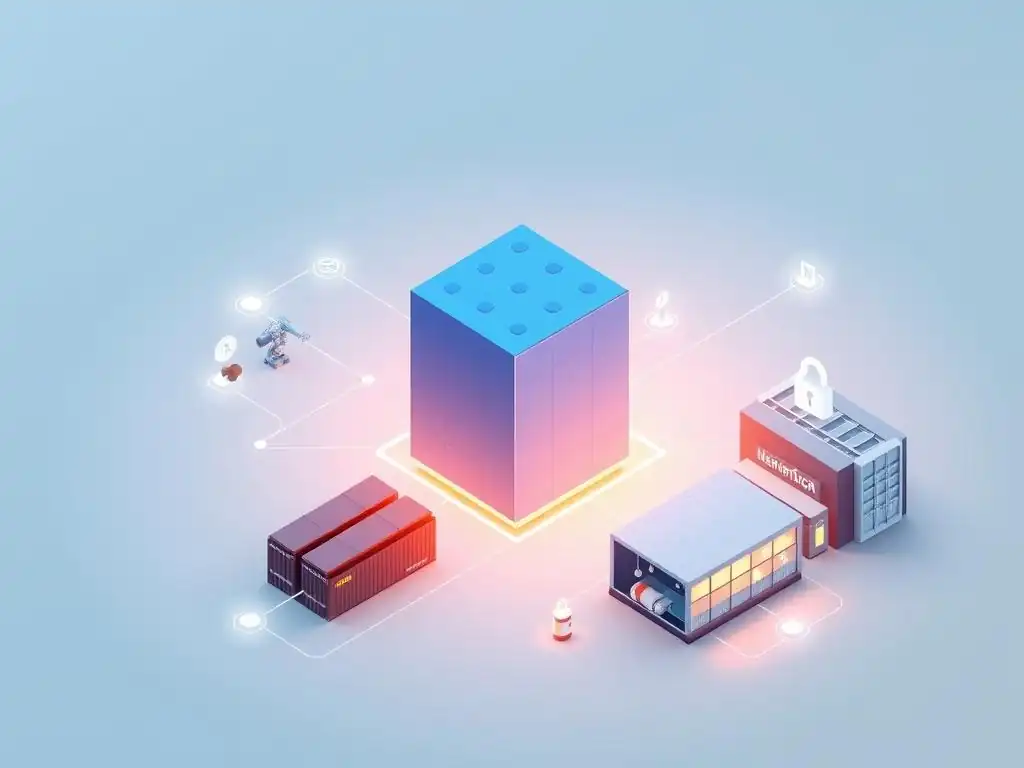
Case Study 1: Maersk and IBM's TradeLens Platform for Global Trade
One of the most prominent examples of blockchain adoption in logistics is the TradeLens platform, a collaboration between shipping giant A.P. Moller–Maersk and IBM. Launched in 2018, TradeLens is a permissioned blockchain-based platform designed to digitize and streamline global container shipping. It connects shippers, ports and terminals, ocean carriers, customs authorities, and logistics providers onto a single platform, providing a shared, immutable record of transactions and events related to container movements.
The platform provides end-to-end visibility of the container journey, from booking to arrival, including information about customs documents and status. By replacing paper-based processes and disparate systems with a shared digital ledger, TradeLens aims to reduce the time and cost associated with processing trade documentation and improve cargo flow. Reports indicate that the platform has the potential to reduce transit times by up to 40% and significantly lower administrative costs by digitizing workflows and enhancing trust among participants involved in blockchain logistics supply chain tracking for global trade.
Case Study 2: Walmart's Use of Blockchain for Food Traceability
Walmart has been a pioneer in using blockchain technology for food traceability, initially focusing on tracing pork products imported from China and later expanding to leafy green vegetables in the United States. Faced with the challenge of quickly identifying the source of contaminated food during outbreaks, Walmart mandated that its suppliers of leafy greens upload their data to a blockchain-based system built on Hyperledger Fabric.
Before implementing blockchain, tracing the origin of a food item could take days or even weeks, involving manual calls and searching through paper records. With the blockchain system, Walmart demonstrated that they could trace a product from store back to farm in a matter of seconds. This capability is crucial for ensuring food safety, enabling rapid recalls, and building consumer trust by providing verifiable provenance information. This case highlights the power of blockchain logistics supply chain tracking for critical applications like food safety and recall management.
Real-World Examples of Improved Efficiency and Reduced Costs
Beyond these high-profile cases, numerous companies are implementing blockchain solutions to achieve tangible improvements in logistics efficiency and cost reduction. For instance, companies in the automotive sector are using blockchain to track parts from manufacturers to assembly plants, improving inventory management and reducing the risk of counterfeit components. This allows for faster audits and verification, potentially reducing the time spent on reconciliation by 20-30%.
In the pharmaceutical industry, blockchain is being piloted to improve the tracking and tracing of medicines to combat counterfeiting and ensure compliance with regulations like the Drug Supply Chain Security Act (DSCSA). Pilot programs have shown the ability to reduce verification times from hours to minutes. Furthermore, blockchain is being used in freight auditing and payment, automating invoice matching against verified shipment records on the blockchain, leading to faster payment cycles and reducing payment processing costs by an estimated 15-25%. These examples underscore the practical benefits being realized through blockchain logistics supply chain tracking implementations.
Overcoming Challenges in Blockchain Logistics Implementation
Addressing Scalability Issues in Blockchain Logistics Networks
Scalability remains a significant challenge for widespread blockchain adoption in logistics, especially when dealing with the massive volume of transactions generated by global supply chains. Public blockchains can be slow and costly due to their consensus mechanisms. While permissioned blockchains offer better performance, even they can face limitations as the number of participants and transactions grows exponentially.
Addressing scalability involves several approaches. One is the development of more efficient consensus mechanisms tailored for enterprise use cases, such as Proof-of-Authority (PoA) or Byzantine Fault Tolerance variations. Another is the use of off-chain transactions and state channels for processing high volumes of data, with only essential or final transactions being recorded on the main blockchain. Furthermore, ongoing research into sharding and other layer 2 scaling solutions aims to increase transaction throughput. Choosing the right blockchain architecture and implementing appropriate scaling techniques are critical for building a functional blockchain logistics supply chain tracking system that can handle real-world volumes.
Data Privacy and Security Considerations in Blockchain Supply Chains
While blockchain offers enhanced security through cryptography and immutability, data privacy is a key concern, particularly in permissioned networks where competitive business data is shared. Companies are often hesitant to place sensitive information, such as pricing, customer details, or proprietary manufacturing processes, onto a shared ledger, even if it's permissioned. Ensuring that only authorized parties can access specific data, or that data is shared without revealing its underlying value (e.g., using zero-knowledge proofs), is crucial.
Implementing robust access control mechanisms and careful data architecture design are essential. Not all data needs to reside on the blockchain; often, the blockchain is used to record hashes of documents or key transaction metadata, with the actual sensitive data stored securely off-chain in encrypted databases, accessible only via permissions granted on the blockchain. Tokenization and differential privacy techniques are also being explored to protect sensitive information while still allowing for verification and analysis within blockchain logistics supply chain tracking.
Regulatory Landscape and Compliance for Blockchain-Based Logistics
The regulatory landscape for blockchain technology in logistics is still evolving and varies significantly across different jurisdictions. Issues such as data ownership, legal status of smart contracts, cross-border data flow regulations (like GDPR), and compliance with industry-specific mandates (like pharmaceutical serialization laws) present complex challenges. Companies implementing blockchain solutions must navigate this uncertain environment to ensure legal compliance.
Collaboration between industry stakeholders, regulators, and technology providers is necessary to establish clear guidelines and standards. Pilot programs and sandboxes allow companies to test blockchain applications within a regulatory framework. As governments and international bodies gain a better understanding of blockchain's capabilities and implications, clearer regulations are expected to emerge, which will facilitate broader adoption. Staying abreast of these developments is vital for successful blockchain logistics supply chain tracking deployments.
The Future of Blockchain Logistics Supply Chain Tracking
Predictions for the Adoption of Blockchain in Logistics
Industry analysts predict significant growth in the adoption of blockchain technology within the logistics and supply chain sector over the next few years. Estimates vary, but many forecasts suggest the market for blockchain in supply chain management could reach tens of billions of dollars by the mid-2020s. This growth will be driven by increasing awareness of blockchain's benefits, falling implementation costs, and the development of more user-friendly platforms.
Adoption is expected to accelerate first in areas with high-value goods, complex multi-party interactions, and critical compliance requirements, such as pharmaceuticals, food and beverage, and high-tech electronics. As success stories become more common and standardized solutions emerge, smaller players are also likely to adopt blockchain technology, either by joining existing consortia or utilizing Software-as-a-Service (SaaS) blockchain platforms. The move towards digitized trade documentation and electronic bills of lading, often facilitated by blockchain, will also push adoption rates. Effective blockchain logistics supply chain tracking is poised to become a standard competitive advantage.
The Impact of Blockchain on the Future of Global Trade and Supply Chains
Blockchain is set to profoundly impact the future of global trade and supply chains by creating a more interconnected, transparent, and efficient ecosystem. By providing a shared, immutable record of trade transactions and logistics events, blockchain can significantly reduce friction in international commerce. It can streamline customs processes, reduce the incidence of fraud and errors in documentation, and improve the speed and security of cross-border payments.
The technology facilitates the creation of digital trade corridors where information flows as smoothly as goods. This increased efficiency can lower the cost of trade, making global markets more accessible, particularly for small and medium-sized enterprises (SMEs). Furthermore, blockchain enables enhanced ethical sourcing and sustainability tracking by providing verifiable proof of origin and journey, meeting growing consumer and regulatory demands. The future of global supply chains will be characterized by greater collaboration and trust built upon the foundation of blockchain logistics supply chain tracking.
Emerging Trends and Opportunities in Blockchain Logistics
Several emerging trends are shaping the future of blockchain logistics. One is the increasing use of digital twins, where a virtual replica of a physical asset or supply chain is created, with real-time data fed from IoT sensors and recorded on the blockchain. This allows for advanced simulation, monitoring, and predictive maintenance. Another trend is the tokenization of assets on the blockchain, representing physical goods as digital tokens that can be easily tracked, transferred, or financed.
The integration of AI and Machine Learning with blockchain is becoming more sophisticated, moving beyond simple analytics to autonomous decision-making within smart contracts. Furthermore, the exploration of decentralized autonomous organizations (DAOs) for managing logistics networks could lead to entirely new models of supply chain governance. These emerging trends represent exciting opportunities for further optimizing efficiency, creating new business models, and enhancing the capabilities of blockchain logistics supply chain tracking.
Conclusion: Embracing Blockchain for a More Efficient Logistics Ecosystem
Key Takeaways: The Transformative Power of Blockchain in Logistics
The transformative power of blockchain technology in logistics lies in its ability to provide unprecedented levels of transparency, security, and efficiency across complex supply chains. By creating a shared, immutable ledger, blockchain eliminates information silos, reduces reliance on manual processes, and builds trust among disparate parties. Core principles like decentralization and immutability fundamentally address long-standing challenges in traditional logistics, such as lack of visibility and data integrity issues.
Key applications like smart contracts automate transactions and workflows, while integration with IoT enables real-time, verifiable tracking. Innovations such as permissioned blockchains, interoperability solutions, and AI integration are further extending blockchain's capabilities, making it suitable for diverse and demanding enterprise environments. Real-world cases like TradeLens and Walmart demonstrate tangible benefits, including reduced costs, faster processes, and enhanced traceability, proving the value proposition of effective blockchain logistics supply chain tracking.
Call to Action: Explore Blockchain Solutions for Enhanced Supply Chain Management
As the logistics landscape continues to evolve, driven by the demands for speed, transparency, and resilience, embracing innovative technologies like blockchain is no longer optional but essential for maintaining competitiveness. Companies across all sectors involved in the movement of goods should actively explore how blockchain can be applied to their specific supply chain challenges.
Whether the goal is to improve traceability, automate processes, reduce disputes, or enhance collaboration with partners, blockchain offers a robust and secure foundation. Engaging with blockchain logistics supply chain tracking solutions, whether through joining existing consortia, partnering with technology providers, or developing custom applications, is a critical step towards building a more efficient, transparent, and future-proof logistics ecosystem. The time to investigate and implement blockchain for enhanced supply chain management is now.
Frequently Asked Questions
How does blockchain improve supply chain visibility?
Blockchain provides a shared, immutable ledger that allows all participants to track goods in real-time, creating end-to-end transparency and reducing discrepancies. This enhanced visibility leads to faster problem resolution.
What are the key benefits of using blockchain for logistics beyond tracking?
Beyond tracking, blockchain facilitates smart contracts for automated payments, improved security against counterfeiting, and streamlined customs processes, all contributing to greater efficiency.
What challenges are associated with implementing blockchain in logistics supply chains?
Challenges include the lack of standardization across different systems, the high initial investment required for implementation, and the need for collaboration among various stakeholders.
How does blockchain address the issue of counterfeit goods in the supply chain?
Blockchain's immutable record makes it significantly harder to introduce counterfeit goods, as any tampering is easily detectable. This creates a trustworthy audit trail and verifies product authenticity.
How is blockchain impacting the future of decentralized systems in logistics?
Blockchain is fostering decentralized logistics networks where participants can directly interact, reducing reliance on intermediaries. This can lead to greater efficiency and reduced costs in the long run.
Final Reflection: Embracing Transparency in the Supply Chain
The exploration of blockchain's potential in revolutionizing logistics efficiency, particularly in blockchain logistics supply chain tracking, reveals a paradigm shift that is not just theoretical but actively reshaping global commerce. The promise of enhanced transparency, security, and traceability is no longer a distant aspiration; it's a tangible reality being implemented and refined across diverse industries, offering a competitive edge to those who embrace its transformative power.
This journey into the intricacies of blockchain's impact on logistics has underscored the profound influence technology has on our interconnected world. Witnessing the potential for reduced fraud, improved inventory management, and streamlined processes has solidified my belief in the power of innovation to create a more equitable and efficient global marketplace. The supply chain is the only thing that matters. It's the only thing.
- Thomas Friedman, highlighting the critical role logistics plays in our modern economy.
As we stand on the cusp of a new era in logistics, I invite you to consider the implications of these advancements in your own sphere of influence. How can you leverage the principles of transparency and collaboration, fostered by blockchain technology, to optimize your processes, build trust with your partners, and contribute to a more resilient and sustainable future? The future of logistics is not just about efficiency; it's about creating a more connected and accountable world, and your participation is crucial in shaping that future.
Uncover Your Logistics Potential: Start Innovating Now!
Thank you for exploring the world of blockchain and logistics efficiency with us. We hope you've gained valuable insights into how innovative technologies are transforming the industry. Now, it's time to put that knowledge into action!
Here are a few steps you can take to further explore the possibilities:
- Schedule a consultation with our blockchain logistics experts. They can help you evaluate your current systems and identify opportunities for implementing blockchain solutions tailored to your specific needs.
- Dive deeper by researching emerging blockchain projects in the logistics space to stay ahead of the curve and discover new potential applications.
- Share this article with your network and spark a conversation about how blockchain can revolutionize logistics efficiency. The more we collaborate, the faster we innovate.
What is the first small step you'll take this week to explore blockchain solutions for your logistics challenges? Let us know in the comments below!
Leave a Reply