
Comparing AI Smart Contracts to Traditional RuleBased Smart Contracts


Welcome to Blockchain Trends, your premier source for understanding the real-world impact of blockchain technology!
Dive into the fascinating world where blockchain meets artificial intelligence. Are you ready to explore the next evolution of smart contracts? This article delves into a critical comparison: AI smart contracts vs. rules. Discover how AI-powered contracts are poised to revolutionize automation and efficiency, and what this means for the future of decentralized systems. Intrigued? Let's unravel the complexities together!
AI Smart Contracts vs. Traditional Rule-Based Smart Contracts: A Deep Dive
- Introduction: The Evolution of Smart Contracts with AI
- Key Differences: AI Smart Contracts vs. Rule-Based Smart Contracts
- Advantages and Disadvantages: A Comparative Analysis
- Use Cases: Real-World Applications of AI and Rule-Based Smart Contracts
- The Future of Smart Contracts: AI Integration and Beyond
- Conclusion: Navigating the Smart Contract Landscape – AI or Rules?
-
Frequently Asked Questions
- What is the fundamental difference between AI smart contracts and rule-based smart contracts?
- How do AI smart contracts enhance automation compared to traditional smart contracts?
- What are the potential risks associated with using AI in smart contracts?
- In what situations are rule-based smart contracts preferable to AI smart contracts?
- How does regulation impact the development and deployment of AI smart contracts?
- Final Reflection: Embracing the Evolution of Trust
- Elevate Your Blockchain Acumen: Start Building Smarter Contracts Now!
Introduction: The Evolution of Smart Contracts with AI
Understanding the Basics: Traditional Rule-Based Smart Contracts
Traditional rule-based smart contracts are the foundational building blocks of decentralized agreements on blockchain. These contracts operate on a deterministic "if-this-then-that" logic, meaning their execution is predetermined by a set of predefined rules coded into the contract. For instance, a simple escrow service smart contract might stipulate, "If payment is received and goods are delivered, then release funds to the seller." These contracts are characterized by their transparency and predictability. Every step of their execution is auditable on the blockchain, and the outcome is entirely dependent on whether the coded conditions are met.
The strength of rule-based smart contracts lies in their straightforwardness and reliability for scenarios where conditions and outcomes are well-defined and static. They excel in automating processes that follow a clear, linear path. Examples abound in areas like token transfers, simple supply chain tracking, and basic voting mechanisms. These contracts are the workhorses of the early blockchain era, enabling trustless automation in a wide range of applications. However, their rigidity becomes a limitation when dealing with complex, dynamic, or uncertain real-world scenarios.
The Rise of Artificial Intelligence in Blockchain: Introducing AI Smart Contracts
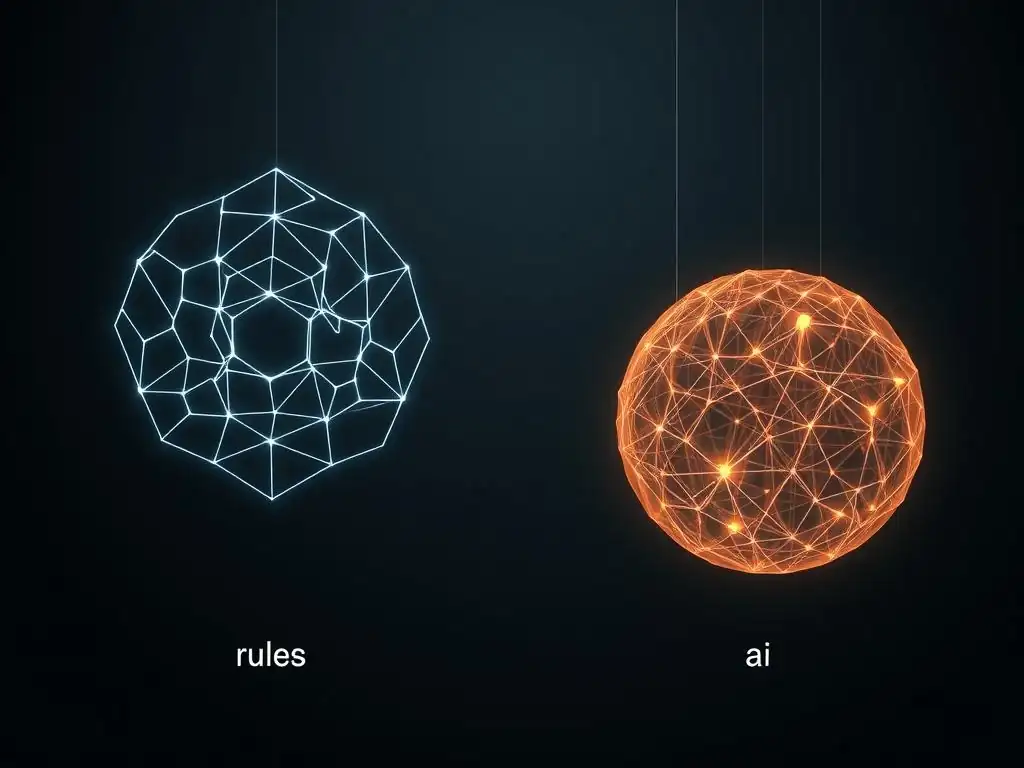
The emergence of Artificial Intelligence (AI) is poised to revolutionize the capabilities of smart contracts, giving rise to what are known as AI smart contracts. These advanced contracts integrate AI, particularly machine learning, to move beyond the rigid logic of traditional rule-based systems.
AI smart contracts leverage algorithms to analyze data, learn from patterns, and make decisions autonomously, allowing for a level of adaptability and complexity previously unattainable in blockchain agreements. Imagine a smart contract for insurance claims that can analyze real-time weather data, sensor readings from IoT devices, and historical claim patterns to automatically assess and process claims, rather than relying solely on predefined rules.
The integration of AI opens up possibilities for smart contracts to handle nuanced situations, adapt to changing circumstances, and even predict future outcomes within the contract's scope. This shift represents a significant leap from deterministic automation to intelligent automation.
AI smart contracts are not simply executing pre-programmed instructions; they are capable of learning, evolving, and making context-aware decisions, potentially unlocking a new wave of sophisticated and dynamic blockchain applications. This evolution is driven by the need for smart contracts to interact with the complexities of the real world, where data is often messy, situations are fluid, and decisions require more than just simple rule following.
Key Differences: AI Smart Contracts vs. Rule-Based Smart Contracts
Data Handling and Analysis: AI's Advantage
Rule-Based Contracts: Limited Data Processing Capabilities
Rule-based smart contracts are inherently limited in their data processing capabilities. They primarily react to predefined data inputs that are explicitly coded into their logic. These contracts are designed to process structured data that fits neatly into the "if-then" framework. For instance, a rule-based contract might check if a payment amount matches a predetermined figure. However, they struggle with unstructured data like text, images, or complex datasets, and they lack the ability to derive insights or patterns from data.
The data handling in rule-based contracts is essentially reactive. They can verify data against predefined conditions but cannot perform sophisticated analysis, learn from data, or adapt their behavior based on data patterns. This limitation stems from their deterministic nature; they are designed to execute specific instructions based on specific inputs, not to interpret or analyze data in a dynamic way. This makes them less suitable for applications requiring complex data analysis or decision-making based on large or varied datasets.
AI Smart Contracts: Advanced Data Analysis and Predictive Modeling
AI smart contracts, in contrast, are designed to excel in data handling and analysis. Leveraging machine learning algorithms, these contracts can process vast amounts of structured and unstructured data from diverse sources. They can analyze text, images, sensor data, market trends, and more, enabling them to understand context, identify patterns, and derive meaningful insights. For example, an AI smart contract in supply chain management could analyze real-time shipment data, weather conditions, and geopolitical events to predict potential disruptions and proactively adjust logistics.
Furthermore, AI empowers these contracts with predictive modeling capabilities. By learning from historical data, AI algorithms can forecast future outcomes and inform contract execution. In decentralized finance (DeFi), an AI smart contract could analyze market data to predict price fluctuations and automatically adjust trading strategies or lending rates. This advanced data analysis and predictive modeling capability represents a significant advantage of AI smart contracts, enabling them to handle complex, data-rich scenarios and make more informed, proactive decisions compared to their rule-based counterparts.
Adaptability and Flexibility: The Learning Capacity of AI
Rigid Logic in Rule-Based Smart Contracts
Rule-based smart contracts are characterized by their rigid logic, a direct consequence of their deterministic nature. Once deployed, the rules of these contracts are fixed and immutable, unless a complex and potentially risky upgrade process is undertaken. This lack of adaptability means they are ill-equipped to handle unforeseen circumstances or changes in the environment they operate in. If the initial conditions or assumptions upon which the contract was built change, the contract may become inefficient, ineffective, or even fail to achieve its intended purpose.
This inflexibility can be a major drawback in dynamic environments. Consider a rule-based smart contract designed for agricultural insurance that relies on predefined weather thresholds. If climate change causes weather patterns to shift outside of those predefined ranges, the contract might fail to accurately assess risk or provide appropriate payouts. The rigid logic of rule-based contracts, while ensuring predictability in stable conditions, becomes a significant limitation when dealing with the inherent uncertainty and changeability of the real world.
Dynamic and Adaptive AI-Powered Contracts
AI smart contracts, on the other hand, offer dynamic adaptability and flexibility due to their machine learning foundation. These contracts can learn and evolve over time as they are exposed to new data and experiences. Machine learning algorithms enable them to adjust their parameters, refine their decision-making processes, and adapt to changing circumstances without requiring manual reprogramming of the core contract logic. This learning capacity is crucial for applications operating in complex and evolving environments.
For instance, an AI-powered decentralized autonomous organization (DAO) could use machine learning to analyze community proposals, voting patterns, and external market conditions to dynamically adjust governance rules or resource allocation strategies. This adaptive capability allows AI smart contracts to remain relevant and effective even as the context in which they operate changes. They can automatically optimize their performance, improve their accuracy, and enhance their resilience over time, making them far more robust and versatile than traditional rule-based smart contracts in dynamic and uncertain scenarios.
Decision-Making and Complexity: Handling Intricate Scenarios
Simple Logic vs. Complex Algorithms
Rule-based smart contracts are inherently limited to simple logic. Their decision-making is confined to evaluating predefined conditions against input data and executing predetermined actions. This simple "if-then" logic is effective for straightforward tasks but falls short when dealing with complex scenarios requiring nuanced judgment, interpretation of ambiguous information, or consideration of multiple interacting factors. They are essentially programmed to follow instructions linearly, lacking the capacity for sophisticated reasoning or complex problem-solving.
Consider a rule-based contract for automated trading. It might be programmed to execute a trade if a price threshold is reached. However, it cannot assess broader market sentiment, analyze news events, or consider complex technical indicators to make more informed trading decisions. The simplicity of their logic restricts their applicability to scenarios where decisions are clear-cut and based on easily quantifiable criteria.
Complex Algorithms
AI smart contracts leverage complex algorithms, particularly from the field of machine learning, to handle intricate scenarios and make sophisticated decisions. These algorithms enable contracts to process vast amounts of information, identify complex patterns, and make decisions based on probabilistic reasoning and learned experiences. AI algorithms can handle ambiguity, uncertainty, and non-linear relationships, allowing AI smart contracts to tackle problems that are far beyond the scope of rule-based systems.
For example, an AI smart contract for fraud detection in insurance claims could analyze a multitude of factors – claim history, user behavior, network patterns, and external data sources – using complex machine learning algorithms to identify potentially fraudulent claims with a high degree of accuracy. This ability to handle complexity and make nuanced decisions based on intricate data analysis is a key differentiator and a significant advantage of AI smart contracts, opening up possibilities for blockchain applications in areas requiring advanced decision-making capabilities.
Security Considerations: Vulnerabilities and Mitigation Strategies
Security Risks in Traditional Smart Contracts
Traditional rule-based smart contracts, while often perceived as secure due to blockchain's inherent security features, are not immune to vulnerabilities. A primary security risk stems from flaws in the contract code itself. Bugs, vulnerabilities, or poorly written code can be exploited by malicious actors to manipulate contract execution, drain funds, or disrupt operations.
The immutability of deployed contracts means that once a vulnerability is discovered, it can be challenging and sometimes impossible to fix without complex and potentially disruptive upgrade mechanisms. The infamous DAO hack in 2016, which resulted in the theft of millions of dollars in Ether, serves as a stark reminder of the security risks inherent in even rule-based smart contracts.
Another security concern arises from oracle vulnerabilities. Smart contracts often rely on external data feeds provided by oracles to trigger contract execution. If these oracles are compromised or provide inaccurate data, the smart contract's behavior and outcomes can be manipulated. Ensuring the security and reliability of oracles is crucial for the overall security of rule-based smart contracts that depend on external data. Formal verification methods and rigorous auditing are essential to mitigate these security risks in traditional smart contracts.
Security Challenges and Solutions for AI Smart Contracts
AI smart contracts introduce a new set of security challenges, alongside potential solutions. One significant challenge is the "black box" nature of some AI algorithms, particularly deep learning models. Understanding why an AI makes a particular decision can be difficult, making it harder to identify and address potential vulnerabilities or biases in the AI's decision-making process. This lack of transparency can raise concerns about fairness, accountability, and predictability, especially in sensitive applications.
Furthermore, AI models can be susceptible to adversarial attacks. Malicious actors could attempt to manipulate the data used to train or operate the AI, leading to biased or compromised outcomes. Data poisoning attacks, where malicious data is injected into the training dataset, and adversarial examples, which are carefully crafted inputs designed to fool the AI, are potential threats.
To mitigate these risks, researchers are exploring techniques like explainable AI (XAI) to improve transparency, robust AI training methods to enhance resilience against adversarial attacks, and decentralized AI architectures to reduce single points of failure. Ongoing research and development are crucial to address the evolving security landscape of AI smart contracts and ensure their safe and reliable deployment.
Advantages and Disadvantages: A Comparative Analysis
Benefits of AI Smart Contracts
Enhanced Automation and Efficiency
AI smart contracts offer a significant leap in automation and efficiency compared to rule-based systems. AI algorithms can automate complex tasks that would be impractical or impossible to codify with simple rules. For example, AI can automate fraud detection, risk assessment, and personalized service delivery within a smart contract framework.
This enhanced automation reduces the need for manual intervention, speeds up processes, and lowers operational costs. Imagine an AI-powered supply chain smart contract that automatically optimizes routes, schedules deliveries, and manages inventory based on real-time data analysis, significantly increasing efficiency compared to a rule-based system that relies on predefined schedules and manual adjustments.
Improved Accuracy and Reduced Errors
By leveraging machine learning, AI smart contracts can achieve improved accuracy and reduce errors in decision-making and execution. AI algorithms can analyze large datasets to identify patterns and make predictions with greater precision than rule-based systems relying on fixed thresholds or simple logic.
This is particularly beneficial in scenarios where accuracy is critical, such as financial transactions, healthcare applications, or complex logistical operations. For instance, an AI smart contract for credit scoring can analyze a wider range of data points and use sophisticated algorithms to assess creditworthiness more accurately than a rule-based system relying on a limited set of predefined criteria, leading to fewer errors in lending decisions.
Proactive Risk Management
AI smart contracts enable proactive risk management by continuously monitoring data, identifying potential risks, and triggering preventative actions automatically. AI algorithms can detect anomalies, predict potential failures, and adapt contract behavior to mitigate risks in real-time. This proactive approach is a significant advantage over rule-based contracts that are typically reactive and only respond to predefined risk triggers. Consider an AI smart contract for infrastructure monitoring that analyzes sensor data from bridges, pipelines, or power grids to predict potential failures before they occur and automatically trigger maintenance alerts or safety protocols, enabling proactive risk management and preventing costly disruptions.
Drawbacks of AI Smart Contracts
Complexity and Implementation Challenges
AI smart contracts are inherently more complex to develop and implement compared to rule-based contracts. They require expertise in both blockchain technology and AI/machine learning, which can be a barrier to entry. Designing, training, and deploying AI models within a smart contract environment requires specialized skills and tools. Furthermore, integrating AI models with blockchain infrastructure can present technical challenges related to data access, computational resources, and interoperability. The complexity of AI smart contracts can lead to longer development cycles, higher development costs, and increased risk of implementation errors.
Data Dependency and Bias Concerns
AI smart contracts are heavily dependent on data, and the quality, quantity, and representativeness of the data directly impact their performance and fairness. If the training data is biased, incomplete, or inaccurate, the AI model will likely perpetuate or amplify these biases in its decision-making. This can lead to unfair or discriminatory outcomes, particularly in sensitive applications like lending, hiring, or criminal justice.
Ensuring data quality, mitigating bias, and addressing data privacy concerns are critical challenges for the responsible development and deployment of AI smart contracts. For example, an AI smart contract trained on biased historical loan data might unfairly discriminate against certain demographic groups, perpetuating existing societal inequalities.
Explainability and Transparency Issues: The "Black Box" Problem
One of the major drawbacks of AI smart contracts, particularly those using complex machine learning models like deep learning, is the "black box" problem. These models can be difficult to interpret, making it challenging to understand why they make specific decisions. This lack of explainability can hinder transparency, accountability, and trust, especially in applications where understanding the reasoning behind a decision is crucial.
In regulated industries or applications with high ethical stakes, the inability to explain AI decisions can be a significant obstacle to adoption. For instance, in a healthcare AI smart contract that diagnoses medical conditions, the lack of explainability could make it difficult for doctors and patients to trust the AI's recommendations.
Benefits of Rule-Based Smart Contracts
Simplicity and Transparency
Rule-based smart contracts are characterized by their simplicity and transparency. Their logic is straightforward and easily auditable, making it clear how the contract will behave under different conditions. This simplicity enhances trust and predictability, as all parties involved can readily understand the contract's rules and execution logic. The code is typically concise and easier to review, reducing the likelihood of hidden vulnerabilities or unintended consequences. The transparent nature of rule-based contracts makes them well-suited for applications where clarity and audibility are paramount, such as simple escrow services or token transfers.
Predictable Outcomes
Due to their deterministic nature, rule-based smart contracts offer predictable outcomes. Given the same inputs, they will always produce the same outputs, ensuring consistent and reliable execution. This predictability is a key advantage in scenarios where certainty and consistency are essential, such as financial transactions or supply chain tracking. The deterministic behavior of rule-based contracts minimizes ambiguity and reduces the risk of unexpected results, making them suitable for applications requiring high levels of reliability and predictability.
Established Security Practices
Security practices for rule-based smart contracts are well-established and mature. Developers have a solid understanding of common vulnerabilities and effective mitigation techniques for this type of contract. Formal verification methods, rigorous auditing processes, and best practices for secure coding are widely available and applied to rule-based smart contract development. The relatively simpler code base of rule-based contracts also makes them easier to audit and verify for security vulnerabilities compared to the more complex code of AI-powered contracts. This established security landscape provides a degree of confidence in the security and reliability of rule-based smart contracts.
Drawbacks of Rule-Based Smart Contracts
Lack of Adaptability
The lack of adaptability is a significant drawback of rule-based smart contracts. Their rigid logic makes them inflexible and unable to respond effectively to changing circumstances or unforeseen events. Once deployed, the rules are fixed, and adapting the contract to new situations requires complex and potentially risky upgrade procedures. This inflexibility limits their applicability in dynamic environments where conditions are constantly evolving or where unforeseen events are likely to occur. In scenarios requiring adaptability and responsiveness to change, rule-based contracts fall short compared to AI-powered alternatives.
Limited Scope and Functionality
Rule-based smart contracts are limited in their scope and functionality due to their simple logic. They are best suited for automating straightforward tasks with well-defined conditions and outcomes. They struggle to handle complex scenarios, nuanced decision-making, or tasks requiring analysis of unstructured data. Their limited functionality restricts their applicability to a subset of potential blockchain use cases, particularly those that are relatively simple and deterministic in nature. For applications requiring advanced capabilities like data analysis, predictive modeling, or complex decision-making, rule-based contracts are insufficient.
Inability to Handle Uncertainty
Rule-based smart contracts are inherently unable to handle uncertainty. Their deterministic logic relies on clear-cut conditions and predefined rules, making them ill-equipped to deal with ambiguous situations, incomplete information, or probabilistic outcomes. In real-world scenarios where uncertainty is prevalent, rule-based contracts may fail to function effectively or produce suboptimal results.
Their inability to handle uncertainty limits their applicability in areas where decisions must be made under conditions of ambiguity or where outcomes are not entirely predictable. For applications operating in uncertain or unpredictable environments, AI-powered contracts, with their ability to learn and adapt, offer a more robust and versatile solution.
Use Cases: Real-World Applications of AI and Rule-Based Smart Contracts
AI Smart Contracts in Action: Decentralized Autonomous Organizations (DAOs) with Adaptive Governance
Decentralized Autonomous Organizations (DAOs) are a prime use case for AI smart contracts, particularly in the realm of adaptive governance. Traditional DAO governance often relies on static rules and voting mechanisms, which can be slow, inefficient, and inflexible in responding to dynamic community needs or external changes. AI smart contracts can revolutionize DAO governance by enabling adaptive and intelligent decision-making. For instance, an AI-powered DAO could analyze community sentiment from forums and social media, track on-chain voting patterns, and monitor market conditions to dynamically adjust proposal thresholds, voting periods, or even resource allocation strategies.
Imagine a DAO managing a decentralized investment fund. An AI smart contract could continuously analyze market data, portfolio performance, and risk metrics to automatically rebalance the portfolio, adjust investment strategies, or even propose new investment opportunities to the DAO members based on data-driven insights.
This adaptive governance model, powered by AI smart contracts, can lead to more efficient, responsive, and ultimately more successful DAOs that can evolve and thrive in dynamic environments. Early examples are emerging, such as projects exploring AI-driven token distribution mechanisms and adaptive voting systems within DAOs, though widespread real-world implementation is still in its nascent stages.
Rule-Based Smart Contracts in Action: Supply Chain Management for Traceability
Supply chain management is a well-established and highly practical use case for rule-based smart contracts, particularly for enhancing traceability and transparency. Rule-based contracts can automate the tracking of goods as they move through the supply chain, ensuring provenance and authenticity. For example, a rule-based smart contract can be triggered when a shipment reaches a specific milestone, automatically updating the product's location and status on the blockchain. This provides an immutable and transparent record of the product's journey, from origin to consumer.
Consider a food supply chain using rule-based smart contracts to track the origin and handling of produce. Each step, from farm to processing facility to distribution center to retailer, can be recorded on the blockchain via smart contracts. When a product arrives at each stage and conditions like temperature and handling are verified, the smart contract automatically updates the record.
Consumers can then scan a QR code on the product to access this transparent history, verifying its authenticity and provenance. Walmart, for instance, has used blockchain-based systems, leveraging rule-based smart contract principles, to track food products like mangoes and pork in their supply chains, demonstrating the real-world applicability and benefits of rule-based smart contracts in enhancing supply chain traceability.
Comparing Use Case Suitability: When to Choose AI vs. Rules
The choice between AI smart contracts and rule-based smart contracts depends heavily on the specific use case and its requirements. Rule-based contracts are best suited for applications that are well-defined, deterministic, and require simplicity, transparency, and predictability. Examples include simple escrow services, token transfers, supply chain traceability (for basic tracking), and voting systems with fixed rules. These use cases benefit from the reliability, audibility, and established security practices associated with rule-based contracts.
AI smart contracts, conversely, are more appropriate for complex, dynamic, and data-rich applications that require adaptability, advanced decision-making, and the ability to handle uncertainty. Use cases like decentralized finance (DeFi) platforms with dynamic risk management, adaptive DAO governance, personalized insurance products, and intelligent supply chain optimization are better suited for AI-powered contracts. When the application requires analyzing large datasets, making predictions, adapting to changing conditions, or handling nuanced scenarios, AI smart contracts offer a significant advantage.
However, the increased complexity, data dependency, and explainability challenges of AI smart contracts must be carefully considered before choosing this approach. The decision ultimately hinges on balancing the need for advanced capabilities with the practical considerations of complexity, security, and transparency.
The Future of Smart Contracts: AI Integration and Beyond
Hybrid Approaches: Combining AI and Rule-Based Systems
The future of smart contracts is likely to involve hybrid approaches that combine the strengths of both AI and rule-based systems. Rather than viewing them as mutually exclusive, a more pragmatic approach is to integrate AI components into rule-based contracts to enhance specific functionalities while retaining the core benefits of simplicity and transparency where appropriate. For example, a rule-based supply chain smart contract could incorporate an AI module for predictive demand forecasting to optimize inventory management or routing, while still relying on rule-based logic for basic tracking and verification steps.
This hybrid model allows developers to leverage AI for complex tasks like data analysis, prediction, and adaptive decision-making, while maintaining the predictability and auditability of rule-based logic for core contract functions. It offers a balanced approach that can address a wider range of use cases and mitigate some of the drawbacks associated with purely AI-driven smart contracts, such as explainability and complexity. We may see architectures emerge where rule-based contracts act as the foundational layer for core deterministic functions, while AI modules are integrated as "intelligent agents" to enhance specific aspects of contract behavior and decision-making.
The Role of Machine Learning in Smart Contract Development
Machine learning will play an increasingly crucial role in the development and evolution of smart contracts. As AI smart contracts mature, machine learning will be essential for tasks such as automated contract generation, vulnerability detection, and performance optimization. Machine learning algorithms can be used to analyze existing smart contract codebases to identify patterns, detect potential vulnerabilities, and even automatically generate code templates or suggest improvements. This can significantly enhance the efficiency and security of smart contract development processes.
Furthermore, machine learning will be instrumental in optimizing the performance of smart contracts, particularly AI smart contracts. Algorithms can be used to analyze contract execution data, identify bottlenecks, and optimize gas consumption, leading to more efficient and cost-effective smart contract deployments. The integration of machine learning into the smart contract development lifecycle will not only improve the quality and security of contracts but also accelerate the development process and reduce costs, paving the way for wider adoption and innovation in the field.
Regulatory Landscape and Ethical Considerations for AI Smart Contracts
The regulatory landscape for AI smart contracts is still evolving, and significant ethical considerations need to be addressed to ensure responsible development and deployment. Regulators are grappling with how to adapt existing legal frameworks to accommodate the unique characteristics of AI-driven decentralized agreements. Issues such as liability, accountability, data privacy, and consumer protection are becoming increasingly relevant as AI smart contracts become more sophisticated and widely adopted. The "black box" nature of some AI models raises concerns about transparency and fairness, requiring new approaches to auditability and explainability in regulatory contexts.
Ethical considerations are equally important. Bias in training data, potential for discriminatory outcomes, and the lack of human oversight in AI-driven decisions raise ethical questions that need careful consideration. Developing ethical guidelines, standards for responsible AI development in smart contracts, and mechanisms for accountability and redress are crucial to ensure that AI smart contracts are used in a fair, transparent, and beneficial manner. Collaboration between technologists, regulators, ethicists, and legal experts is essential to navigate the complex regulatory and ethical landscape of AI smart contracts and foster responsible innovation in this rapidly evolving field.
Choosing the Right Approach: Factors to Consider
Choosing between AI smart contracts and rule-based smart contracts is not a binary decision but rather a strategic choice based on the specific requirements of the application. Several factors should be considered when making this decision. The complexity of the task is paramount; simple, deterministic tasks are well-suited for rule-based contracts, while complex, data-driven tasks may necessitate AI.
The need for adaptability is another crucial factor; dynamic environments benefit from AI's learning capabilities, while stable environments may be adequately served by rule-based systems. Data availability and quality are critical for AI smart contracts, as they rely heavily on data for training and operation. Transparency and explainability requirements should also be considered, as rule-based contracts offer greater clarity, while AI models can be "black boxes."
Security considerations are essential for both types of contracts, but AI introduces new challenges related to adversarial attacks and model vulnerabilities. Finally, development complexity and cost should be weighed; rule-based contracts are generally simpler and cheaper to develop, while AI smart contracts require specialized expertise and resources. A careful evaluation of these factors will guide developers in choosing the most appropriate smart contract approach for their specific use case, potentially even leading to hybrid solutions that combine the strengths of both AI and rule-based systems.
The Potential of AI to Revolutionize Smart Contracts
Despite the challenges, the potential of AI to revolutionize smart contracts is undeniable. AI integration promises to unlock a new generation of smart contracts that are more intelligent, adaptable, and capable of handling complex real-world scenarios. AI smart contracts can move beyond simple automation to enable intelligent automation, opening up possibilities for blockchain applications in areas previously deemed too complex or dynamic for traditional rule-based systems. From adaptive governance in DAOs to personalized financial services in DeFi, AI has the potential to significantly expand the scope and impact of smart contract technology.
As AI technology continues to advance and mature, and as research addresses the current challenges related to explainability, security, and bias, AI smart contracts are poised to become a transformative force in the blockchain landscape. They represent a significant step towards creating truly intelligent and autonomous decentralized systems that can adapt, learn, and evolve, paving the way for a future where smart contracts play an even more integral role in our digital and physical lives.
Frequently Asked Questions
What is the fundamental difference between AI smart contracts and rule-based smart contracts?
The core difference lies in their decision-making process. Rule-based smart contracts follow pre-defined fixed rules, whereas AI smart contracts utilize machine learning algorithms to make dynamic decisions. This allows for greater adaptability and complexity.
How do AI smart contracts enhance automation compared to traditional smart contracts?
AI smart contracts can automate more complex processes by learning from data and adapting to changing circumstances. Traditional smart contracts are limited to pre-programmed scenarios, while AI-powered contracts can handle unforeseen events and optimize performance over time.
What are the potential risks associated with using AI in smart contracts?
Key risks include algorithmic bias and a lack of transparency. If the training data is biased, the AI smart contract may produce unfair or discriminatory outcomes. Additionally, the "black box" nature of some AI algorithms can make it difficult to understand how decisions are made.
In what situations are rule-based smart contracts preferable to AI smart contracts?
Rule-based contracts are preferable when predictability and auditability are paramount. Situations requiring strict compliance with predefined regulations or when transparency is critical benefit from the deterministic nature of rule-based systems.
How does regulation impact the development and deployment of AI smart contracts?
Regulatory frameworks are still evolving, but they are likely to focus on accountability, transparency, and fairness. These regulations will impact data governance, algorithmic auditing, and the need for explainable AI to ensure responsible development and deployment of AI smart contracts.
Final Reflection: Embracing the Evolution of Trust
The exploration of AI smart contracts vs. rules-based systems reveals more than just a technological comparison; it highlights a fundamental shift in how we perceive and implement trust in decentralized environments. The potential for AI to dynamically adapt and learn within contractual agreements, while still nascent, promises a future where agreements are not just executed, but intelligently optimized and proactively managed. This is a paradigm shift with profound implications for industries ranging from finance to supply chain management.
The ongoing evolution of smart contracts, particularly with the integration of AI, has deeply influenced the digital landscape, pushing us to reconsider the very nature of agreements and their enforcement. Witnessing this transformation firsthand underscores the importance of embracing innovation while carefully considering the ethical and societal implications. The future is already here – it's just not evenly distributed.
- William Gibson. This quote resonates deeply as we navigate the uncharted waters of AI-driven contracts, striving to ensure equitable access and responsible development.
As we stand at the cusp of this technological revolution, let us not merely be passive observers. Consider how you can contribute to shaping the future of smart contracts, ensuring that they are not only efficient and intelligent but also aligned with our shared values of transparency, fairness, and accountability. Reflect on the potential of AI to augment human capabilities and build a more trustworthy and collaborative digital world. The future of trust is in our hands – let us build it wisely.
Elevate Your Blockchain Acumen: Start Building Smarter Contracts Now!
Thank you for exploring the evolution of smart contracts with us. We hope this comparison of AI-powered and traditional approaches has highlighted the exciting possibilities for the future of blockchain. Now, it’s time to put that knowledge into action!
Here are a few next steps you can take:
- Dive deeper: Experiment with creating a simple AI smart contract using a popular framework like TensorFlow or PyTorch.
- Share your insights: Discuss the advantages and challenges of AI-driven smart contracts versus traditional methods with your network on social media, using a designated hashtag.
- Explore the community: Visit a blockchain forum to see how other developers are addressing the challenges and opportunities involved in integrating AI into smart contracts.
What specific use case excites you most about the potential of AI-enabled smart contracts, and how would you go about implementing it? Share your thoughts in the comments below!
Leave a Reply