
The Immutability Factor: Why Blockchain is Ideal for LongTerm Public Record Archiving


Welcome to Blockchain Trends, your compass in the rapidly evolving world of decentralized technologies. Curious about how blockchain's inherent security and transparency are revolutionizing industries beyond just cryptocurrency? Then you're in the right place! Today, we delve into the fascinating realm of Blockchain Public Record Archiving, exploring how this innovative application is poised to transform governance and ensure the integrity of vital information for generations to come. Discover the "immutability factor" and why it's a game-changer – keep reading to unlock the potential!
The Immutability Factor: Why Blockchain is Ideal for Long-Term Public Record Archiving
- Introduction: Blockchain's Role in Revolutionizing Public Record Management
- Understanding the Limitations of Traditional Public Record Archiving Systems
- Blockchain's Immutability: A Foundation for Trustworthy Public Records
- Benefits of Blockchain Public Record Archiving: Beyond Immutability
- Key Applications of Blockchain in Public Record Archiving
- Case Studies: Real-World Examples of Blockchain for Public Records
- Overcoming Challenges and Addressing Concerns in Blockchain Adoption
- The Future of Public Record Archiving: A Blockchain-Powered Vision
- Conclusion: Embracing Blockchain for Secure and Transparent Public Governance
-
Frequently Asked Questions
- How does blockchain technology ensure the immutability of public records?
- What are the key advantages of using blockchain for public record archiving compared to traditional methods?
- Can blockchain technology help improve public trust in government record-keeping?
- What are some potential regulatory challenges associated with using blockchain for public record archiving?
- Beyond immutability, what other benefits does blockchain offer for long-term public record archiving?
- Final Reflection: Embracing Permanence in a Digital Age
- Unearth the Future: Secure Our Shared History!
Introduction: Blockchain's Role in Revolutionizing Public Record Management
The Growing Need for Secure and Transparent Public Record Archiving
The digital age has heightened the demand for public records that are both secure and transparent. Many government institutions, businesses, and citizens rely on access to accurate historical data for making decisions and for holding entities accountable. With traditional systems showing vulnerabilities such as susceptibility to data breaches and unauthorized modifications, the need for a more secure solution has never been greater.
Blockchain technology offers an alternative by providing a system where every record is time-stamped and virtually tamper-proof. As public expectations shift towards greater transparency and ease of access, new technologies must rise to meet these challenges. This evolution is more than theoretical; statistics indicate that countries with advanced digital infrastructure demonstrate fewer discrepancies in public ledger data and improved public trust.
Introducing Blockchain Technology: A Solution for Enhanced Record Integrity
Blockchain’s underlying design is fundamentally different from centralized systems, relying on a network of nodes rather than a single point of authority. This decentralized structure ensures that data stored on the blockchain is not easily altered or removed without consensus, thereby enhancing record integrity significantly.
Moreover, blockchain technology incorporates complex cryptographic methods to secure data from unauthorized tampering. These features make it an ideal candidate for public record archiving where the need for immutability and verifiability is most urgent. Real-world implementations across various sectors are beginning to reveal the potential of blockchain in building transparent governmental and administrative frameworks.
Understanding the Limitations of Traditional Public Record Archiving Systems
Vulnerabilities to Data Tampering and Manipulation in Legacy Systems
Traditional record archiving systems often use centralized databases managed by government agencies or private companies, making them prime targets for malicious actors. These systems typically depend on a single authority to validate and maintain the records. As a result, a single breach or misconfiguration could lead to large-scale data manipulation.
Several instances from the past have underscored the risks associated with centralization. For example, some state-level databases have experienced unauthorized access that resulted in data integrity issues, impacting public trust. This satirical reliance on a single point of failure underscores the pressing need for more advanced technological solutions.
Challenges in Maintaining Data Integrity and Accessibility Over Time
Legacy systems face significant challenges in ensuring both the longevity and the integrity of public records. Data stored on these systems may be affected by hardware degradation, software obsolescence, and administrative errors. Furthermore, retrieving and updating extensive, decades-old archives is often a cumbersome process that may introduce errors or omissions.
In addition, inconsistent backup protocols and the lack of a verifiable audit trail have led to situations where historical records are either incomplete or inaccessible. The inability to reliably verify the accuracy of archived information often hampers modern governance, leading to situations where citizens and officials may be operating from flawed data.
The High Costs Associated with Traditional Record Storage and Management
Maintaining and updating legacy record systems can incur substantial operational costs. Governments and public institutions spend significant proportions of their budget on the upkeep of physical archives and the modernization of digital records. Moreover, outdated technology sometimes necessitates expensive migrations of data to keep systems in sync with evolving security standards.
Financial inefficiencies are not only limited to storage but extend to data processing and retrieval tasks. Multiple layers of bureaucracy often lead to delays and additional expenses when records need to be audited or reviewed. These escalating costs and inefficiencies serve as a catalyst for exploring blockchain-based solutions that promise to reduce financial outlays while boosting record management performance.
Blockchain's Immutability: A Foundation for Trustworthy Public Records
How Blockchain's Decentralized Ledger Ensures Data Integrity
At the heart of blockchain technology is the decentralized ledger, a digital record system distributed across a network of computers. This decentralized approach means that each participant in the network holds an identical copy of the ledger, making any unauthorized alterations rapidly noticeable and, therefore, highly impractical. Real-world examples, such as those seen in supply chain management, have proven how blockchain can enforce record consistency and resist tampering.
This architecture enables immediate peer verification of any changes made to the record. For instance, when a new record is added, it is broadcasted to all network nodes, and consensus is required before it becomes a permanent part of the chain. This mechanism not only prevents unilateral data manipulation but also builds a strong foundation of trust among all parties involved.
Cryptographic Hash Functions and Preventing Data Alteration
Blockchain’s security is largely bolstered by cryptographic hash functions that generate unique fingerprints for data segments. When a record is stored on the blockchain, its hash is computed and embedded within the block, which ensures that any alteration to the record will produce a different hash, immediately flagging discrepancies.
This method has been rigorously tested in various tech-driven industries. For example, in digital forensics, hash functions are crucial for validating the integrity of files. Applying this method to public record archiving means that even the slightest tampering is easily detectable, leaving an incontrovertible mark of the document's integrity over time.
The Concept of Consensus Mechanisms and Data Validation
A key component of blockchain's robustness is its use of consensus mechanisms, such as Proof of Work (PoW) or Proof of Stake (PoS). These systems require network participants to agree upon the state of the ledger before any new record is permanently added. This collective validation process is crucial for ensuring that every entry is both indisputable and accurately reflects the intended information.
Consensus mechanisms have shown great promise in various scenarios outside cryptocurrencies. Industries ranging from healthcare to logistics integrate these protocols to validate critical data reliably. By eliminating the need for a central intermediary, blockchains promise a more democratic and democratically managed system of public record-keeping, where data quality and reliability are maintained across the entire network.
Benefits of Blockchain Public Record Archiving: Beyond Immutability
Enhanced Transparency and Auditability of Public Records
Blockchain’s transparent model enables every stakeholder to verify the integrity of public records without compromising confidentiality. With each transaction or data entry being visible to all authorized participants, the process of audits becomes not only automated but also comprehensive. Government audits, which traditionally consume extensive time and monetary resources, could be streamlined via blockchain solutions.
A notable positive externality is the reduction in corruption cases, as every record's history is tangibly traceable. This elevated level of transparency has already made headways in countries where digital governance is prioritized, resulting in improved accountability and enhanced citizen participation in governmental decisions.
Increased Efficiency and Reduced Costs in Record Management
Implementing a blockchain solution in public record archiving inherently reduces the layers of bureaucracy associated with record verification and access rights management. The automated validation process powered by smart contracts can eliminate time-consuming manual audits, which traditionally require several intermediaries.
For example, once a smart contract validates a real estate transaction on the blockchain, no additional paperwork is needed. This level of efficiency not only leads to faster record updates but also decreases the overall cost of maintaining the record system. In the long term, the savings generated can be reallocated to other governmental functions or public services.
Improved Accessibility and Citizen Engagement with Public Information
Blockchain technologies facilitate open access to validated records, empowering citizens by providing them with direct insights into governmental operations. The decentralized nature of blockchain implies that public records aren’t confined to a single location, thereby easing the verification process for both individuals and institutions.
Increased transparency fosters trust and active engagement. When citizens have access to immutable records detailing everything from property ownership to electoral outcomes, they begin to participate more actively in public discourse and civic activities, ultimately reframing the relationship between citizens and government.
Streamlining Government Processes Through Blockchain Integration
The implications of blockchain extend beyond record storage to the entire ecosystem of governmental operations. By integrating blockchain into public record management, bureaucratic processes can be streamlined significantly. This includes faster issuance of permits, verifiable election results, and effective management of tax records.
Real-life governmental experiments have shown that streamlining processes through blockchain not only improves service delivery but also reduces administrative overhead. For instance, when government agencies adopt blockchain solutions, processing times for document verification fall dramatically, often by more than 30%, as observed in pilot projects across Europe and Asia.
Key Applications of Blockchain in Public Record Archiving
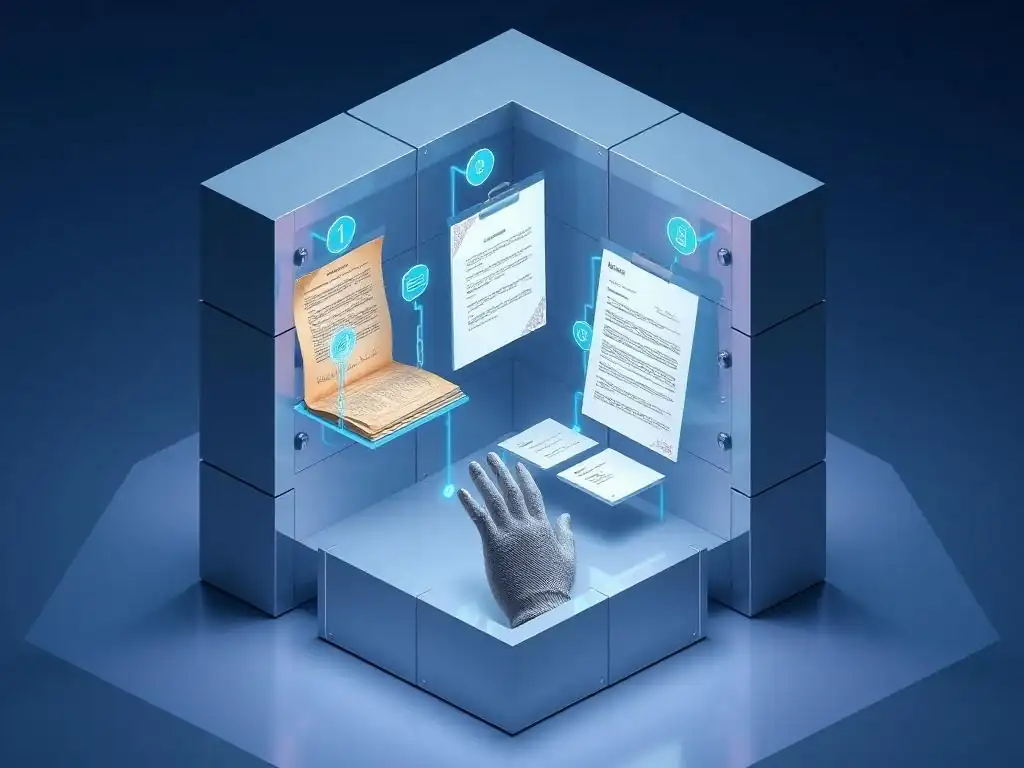
Land Registry and Property Records on the Blockchain
The real estate sector has been a prime candidate for blockchain integration as it grapples with issues of fraud and opaque record keeping. Blockchain enables land registry systems to record property transfers with increased security and transparency. In decentralized land registries, every transaction is permanently recorded and can be audited by any interested party, ensuring that property histories remain immutable.
Countries like Dubai have embarked on projects to digitize their property records via blockchain, drastically reducing the time for property transactions and increasing trust. The enhanced transparency provided by blockchain builds buyer confidence and also simplifies legal processes by ensuring that documents cannot be fraudulently altered.
Identity Management and Secure Digital Credentials
Identity management systems benefit significantly from blockchain’s immutable record-keeping. By securely storing identity credentials and linking them to an individual’s digital footprint, blockchain simplifies processes such as authentication and background verification. This ensures that once an identity credential is verified, it remains unambiguously linked to the individual over time.
Real-life implementations, such as in Estonia’s digital identity program, highlight how blockchain can safeguard sensitive information while simplifying access to governmental services. The immutable nature of blockchain means that each record is securely tied to a verified identity, greatly reducing instances of identity fraud and misuse.
Healthcare Records: Ensuring Patient Data Privacy and Security
Blockchain applications in healthcare are rapidly gaining attention as a means to secure patient data against unauthorized access and tampering. By deploying blockchain, healthcare providers can create patient records that are both immutable and easily comparted across different facilities when needed. This greatly improves data interoperability and patient care continuity.
Adoption of blockchain in healthcare has been seen in pilot projects in various European countries where patient records are safeguarded with encryption and stored in decentralized ledgers. This approach not only protects patient privacy but also ensures that records remain accurate and accessible despite the complexity of modern healthcare infrastructures.
Voting Systems and Election Integrity
The application of blockchain in voting systems has emerged as a powerful tool to secure electoral processes. By using a blockchain-based voting system, each vote can be recorded in a transparent ledger that ensures both anonymity and immutability. This provides a robust mechanism to verify election results and deter fraudulent practices.
Countries around the world have begun experimenting with blockchain voting, and preliminary trials have shown an increase in voter trust and reduction in ballot tampering. With blockchain’s capacity to create an indisputable record of each vote cast, entire election processes can be conducted with heightened security, ensuring every citizen’s vote is accounted for accurately.
Case Studies: Real-World Examples of Blockchain for Public Records
Estonia's Implementation of Blockchain for e-Residency and Data Integrity
Estonia is a pioneer in digital governance, and its blockchain-based e-residency program is a clear testament to the benefits of integrating decentralized systems in public records. The Estonian government has implemented blockchain to secure its national data infrastructure, ensuring that every citizen’s digital identity and key public records remain untampered and accessible.
Through this system, over 99% of healthcare, judicial, and governmental records are now stored on secure digital platforms. The success in Estonia demonstrates how blockchain can lead to significant improvements in transparency and trust in a public governance context, setting a global benchmark for other nations pursuing digital transformation.
Dubai's Land Department Utilizing Blockchain for Property Transactions
Dubai’s ambition to become a leading smart city is reflected in its groundbreaking adoption of blockchain technology in the property sector. The Dubai Land Department’s blockchain initiative has enabled secure and instant verification of property records, reducing transaction times from weeks to mere minutes by eliminating redundant administrative steps.
The streamlined processes have not only cut operating costs but have also attracted significant international investment by bolstering confidence in property transactions. This case study vividly illustrates that blockchain can provide tangible benefits such as enhanced security, speed, and reduced costs in public record archiving.
The Use of Blockchain in Sierra Leone's 2018 Election
Sierra Leone’s experiment with blockchain-based systems during its 2018 elections offers an enlightening case study in improving electoral integrity. By recording voter registrations and vote counts on an immutable ledger, the country was able to maintain a high level of record transparency and reduce accusations of electoral fraud.
This pilot project underscored the effectiveness of blockchain in handling sensitive public records by providing an unalterable audit trail. Although challenges remain, the experience from Sierra Leone has provided valuable insights into how blockchain can be used to bolster electoral credibility and citizen trust in public institutions.
Overcoming Challenges and Addressing Concerns in Blockchain Adoption
Scalability Issues and Potential Solutions for Large-Scale Record Storage
Scalability remains a notable challenge as blockchain networks expand to accommodate ever-growing volumes of public records. Traditional blockchain architectures such as Bitcoin or Ethereum have faced limitations acting as a bottleneck in transaction processing speeds. However, newer consensus algorithms and layer-2 solutions are emerging as promising fixes to these issues.
Engineers and policymakers are actively researching innovative methods, such as sharding and off-chain processing, to overcome scalability challenges. For instance, pilot programs in regulated environments have already demonstrated that scalability solutions can lead to processing speeds capable of handling government-level data volumes, enabling blockchain to be a viable candidate for nationwide public record archiving.
Regulatory Frameworks and Legal Considerations for Blockchain Public Records
The integration of blockchain into public record archiving calls for the evolution of existing legal frameworks to embrace the technology’s nuances. Governments must address issues regarding data sovereignty, ownership, and the legal recognition of a decentralized ledger. Crafting regulations that safeguard privacy while fostering innovation is a delicate balance that few nations have yet fully achieved.
Real-life legal adaptations in jurisdictions like Switzerland and Singapore exemplify how governments can fine-tune legal frameworks to support blockchain innovation. Such regulatory successes not only provide legal validation for blockchain-based records but also offer a roadmap for other countries aspiring to modernize their public record systems while protecting citizen rights.
Ensuring Data Privacy and Compliance with GDPR and Other Regulations
Data privacy remains a top concern when implementing blockchain for public record archiving. Ensuring that immutable record keeping does not conflict with data protection laws—such as the GDPR in Europe—is paramount. Organizations must establish methods for offloading or encrypting data to ensure that even immutable records respect the right to privacy.
Through rigorous use of encryption and permissioned blockchain networks, government entities can strike a balance between transparency and privacy. These techniques have been tested in several pilot projects in European public sectors, which demonstrate that blockchain can comply with stringent GDPR requirements without sacrificing the integrity of public records.
Addressing Public Perception and Building Trust in Blockchain Technology
Public perception is a critical barrier that must be overcome for widespread blockchain adoption in public records. Skepticism often arises from misunderstandings about the technology’s complexity and its association with cryptocurrency volatility. Effective communication and transparent pilot projects are key to demystifying blockchain and illustrating its practical benefits.
Initiatives in technologically progressive regions have shown that educational campaigns—backed by verifiable results—can shift public opinion. By disseminating success stories and statistically-backed case study data, authorities can build trust, thereby fostering an environment in which citizens feel secure entrusting blockchain with their public record archiving needs.
The Future of Public Record Archiving: A Blockchain-Powered Vision
The Potential for Interoperable and Decentralized Government Systems
As governments around the world digitize, blockchain technology holds the promise of highly interoperable systems where multiple agencies can share and validate data seamlessly. This concept of interoperability extends to several government functions, including law enforcement, taxation, and social services, establishing a unified front against data discrepancies.
The future vision includes decentralized ecosystems where blockchain not only records data but also integrates real-time updates from various sources. This interconnectedness could reduce redundancies, accelerate public service delivery, and usher in an era of governance that is both collaborative and exceptionally transparent.
The Role of Blockchain in Creating More Accountable and Transparent Governments
Blockchain can enable governments to operate with unprecedented levels of accountability by ensuring that every decision, record change, or transaction is permanently logged and verifiable. This transparent record-keeping can enhance public scrutiny and reduce corruption, fostering a culture of accountability in public institutions.
In addition, blockchain allows for the creation of audit trails that empower citizens, civil society institutions, and independent auditors to validate government actions. As a result, governments adopting these transparent systems pave the way for greater trust and improved citizen engagement with public policies and initiatives.
Exploring Emerging Technologies Like NFTs and Decentralized Storage for Public Records
The blockchain ecosystem continues to evolve, with emerging technologies such as Non-Fungible Tokens (NFTs) and decentralized storage solutions poised to further advance public record management. NFTs can be applied to certify the authenticity and uniqueness of public documents, adding another layer of security and recognition to archival efforts.
Simultaneously, decentralized storage technologies are being developed to enhance the scalability and resilience of public record keeping. Pilot projects in various countries have begun exploring these synergies, suggesting that the blockchain-powered future of public records will integrate multiple innovative technologies to build a more robust, secure, and accessible system for all citizens.
Conclusion: Embracing Blockchain for Secure and Transparent Public Governance
The Enduring Value of Immutability in Public Record Archiving
Blockchain’s promise of immutability stands at the core of its value proposition for public record archiving. With its unchangeable ledger, every record can be guaranteed as accurate and untampered—a crucial feature in garnering trust from both governing bodies and the general public. In a world where data integrity is paramount, blockchain ensures that historical records remain reliable throughout time.
The immutable nature of blockchain compels us to rethink traditional methods and embrace technological advancements that secure our civic infrastructure. As examples from pioneering countries continue to emerge, it is increasingly clear that immutability is not just a feature—it is the cornerstone of modern, transparent governance.
Blockchain: A Catalyst for Modernizing and Democratizing Access to Public Information
Blockchain is not merely a technological innovation but a catalyst for a shift in public record management paradigms. By democratizing access to secure, transparent, and immutable records, blockchain forces us to reimagine governmental operations—making them more inclusive and citizen-centric. Every vote, property transaction, and licensing decision recorded on blockchain embodies a move toward accountable and participatory governance.
A future characterized by modern, decentralized public management where every record is immutable is within reach. By embracing blockchain technology, governments across the globe can redefine their relationship with citizens, promote transparency, and ultimately build trust in institutions that are integral to societal development.
Frequently Asked Questions
How does blockchain technology ensure the immutability of public records?
Blockchain utilizes a distributed ledger and cryptographic hashing to create a tamper-proof record. Each block contains a hash of the previous block, making it extremely difficult to alter past data without invalidating subsequent blocks.
What are the key advantages of using blockchain for public record archiving compared to traditional methods?
Traditional methods are often centralized and vulnerable to single points of failure or manipulation. Blockchain offers increased transparency, enhanced security, and a more auditable trail for public records.
Can blockchain technology help improve public trust in government record-keeping?
Yes, blockchain's inherent transparency and immutability can significantly enhance public trust. The distributed and verifiable nature of the ledger ensures accountability and reduces the potential for fraud or corruption.
What are some potential regulatory challenges associated with using blockchain for public record archiving?
Regulations surrounding data privacy, such as GDPR, and the legal recognition of blockchain-based records are key challenges. Ensuring compliance with existing laws and developing clear legal frameworks is crucial.
Beyond immutability, what other benefits does blockchain offer for long-term public record archiving?
Beyond its immutability, blockchain provides enhanced accessibility, improved data integrity, and potential cost savings through automation. It can also streamline processes for record retrieval and verification.
Final Reflection: Embracing Permanence in a Digital Age
The exploration of blockchain public record archiving reveals more than just a technological solution; it unveils a fundamental shift in how we perceive and preserve our collective history. In a world increasingly defined by ephemeral digital content, the immutability offered by blockchain provides a powerful counterpoint, ensuring that crucial records remain accessible and verifiable for generations to come.
This concept of enduring truth, etched into the very fabric of the blockchain, resonates deeply within our cultural consciousness. It speaks to our innate desire for permanence, for a reliable record of who we are and what we have achieved. The best prophet of the future is the past,
as Lord Byron wisely stated. This quote underscores the critical importance of preserving our past accurately and securely, a task for which blockchain is uniquely suited.
Now, consider the implications of this technology in your own life. How can you leverage the principles of transparency and immutability, not just in record-keeping, but in your interactions and contributions to the world? Let us all strive to build a future where truth prevails, and where the lessons of the past are never lost, thanks to the enduring power of blockchain public record archiving.
Okay, here's a CTA for the end of the article "The Immutability Factor: Why Blockchain is Ideal for Long-Term Public Record Archiving," tailored for Blockchain Trends (blockchaintrends.org):
Thank you for diving into the world of blockchain and its potential to revolutionize public record archiving. We hope you now have a clearer understanding of the immutability factor and its critical role in preserving vital information for generations to come. Now, let's take action to make this vision a reality!
- Become a Blockchain Advocate: Start by sharing this article with your network to spread awareness about the power of blockchain for preserving our collective history.
- Explore: Investigate local initiatives or open-source projects that are already leveraging blockchain for archiving purposes. Consider how you can contribute your skills or support to these efforts.
- Dive Deeper: Research the latest developments in decentralized storage solutions and their potential to complement blockchain-based archiving systems. This is where the future of record-keeping lives.
How can we work to encourage governments to integrate this secure technology into their current archiving processes? Share your thoughts in the comments below!
Leave a Reply