
Decentraland NFTs: A Deep Dive into Virtual Land Ownership

Welcome to Blockchain Trends, your guide to understanding the revolutionary impact of blockchain beyond just cryptocurrencies. Ever wondered how blockchain is reshaping the metaverse? In this article, we're diving deep into the fascinating world of Decentraland NFT virtual land, exploring its unique ownership model and what it means for the future of digital real estate. Curious to learn more about navigating this exciting space? Read on to discover the ins and outs of virtual land in Decentraland!
Decentraland NFTs: A Deep Dive into Virtual Land Ownership
- Understanding Decentraland and its Virtual Real Estate
- Decentraland LAND NFTs: The Foundation of Virtual Ownership
- Buying and Selling Decentraland LAND NFTs
- The Utility of Decentraland Virtual Land: Beyond Ownership
- Exploring the Decentraland Metaverse Economy
- Risks and Challenges of Investing in Decentraland LAND NFTs
- Decentraland vs. Other Metaverse Platforms: A Comparison
- Optimizing Your Decentraland LAND for Maximum Value
- The Long-Term Potential of Decentraland LAND NFTs
-
Frequently Asked Questions
- What exactly are Decentraland NFTs, and what do they represent?
- How does one acquire LAND in Decentraland?
- What can you actually do with virtual land in Decentraland?
- What factors influence the value of Decentraland LAND NFTs?
- What are some of the risks associated with investing in Decentraland LAND NFTs?
- Final Reflection: Cultivating Digital Frontiers
- Unveil Your Metaverse Empire: Start Building Today!
Understanding Decentraland and its Virtual Real Estate
What is Decentraland? A Brief Overview
Decentraland stands as a pioneering example of a decentralized virtual world, built on the Ethereum blockchain. Launched to the public in February 2020, it distinguishes itself by granting users genuine ownership of virtual land and assets through non-fungible tokens (NFTs). Imagine a digital realm where users can explore, interact, play games, create experiences, and even trade virtual real estate – all governed by a decentralized autonomous organization (DAO).
This unique structure empowers the community to shape the platform's future, moving away from centralized control and towards a user-driven metaverse. Decentraland's core concept revolves around providing a persistent, shared digital space where interactions and creations are permanently recorded on the blockchain, fostering a sense of true digital ownership and community.
The platform utilizes two primary tokens: MANA, an ERC-20 token used as the in-world currency for transactions, and LAND, an ERC-721 token representing parcels of virtual land. Users can purchase LAND NFTs to own sections of the Decentraland world, upon which they can build and host a variety of content, from art galleries and virtual stores to interactive games and social hubs.
This ownership is not merely symbolic; LAND owners have complete control over their digital plots and can monetize them in various ways, contributing to a burgeoning virtual economy. Decentraland represents a significant step towards realizing the vision of a truly open and user-controlled metaverse, where digital assets have real-world value and utility.
The Decentraland Metaverse: Exploring the Virtual World
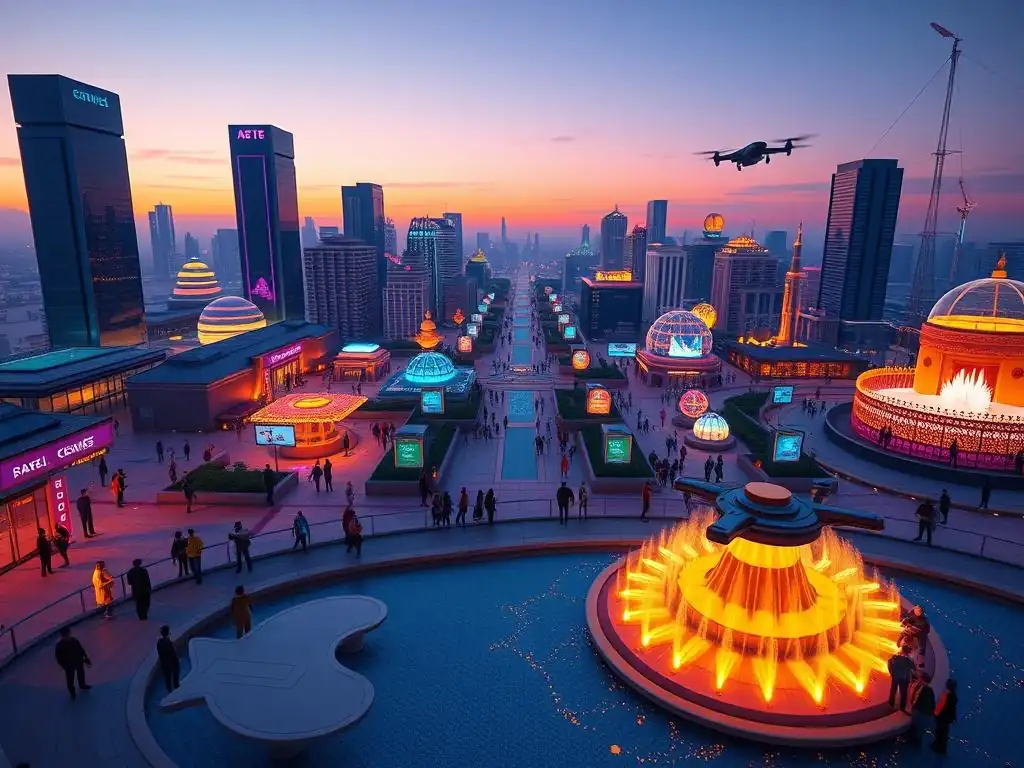
Stepping into the Decentraland metaverse is akin to entering a vibrant, ever-evolving digital city. Users navigate this 3D world through avatars, exploring diverse districts and interacting with others in real-time. From bustling virtual plazas and art districts to serene parks and themed entertainment zones, Decentraland offers a wide array of experiences. Unlike traditional gaming platforms, Decentraland is not defined by pre-set narratives or objectives. Instead, it thrives on user-generated content and experiences, making each visit potentially unique and unpredictable.
Currently, Decentraland boasts approximately 90,000 parcels of LAND, each represented by a unique NFT. These parcels are organized into districts and plazas, some community-curated and others privately owned. Users can attend virtual concerts, participate in online conferences, gamble in virtual casinos, explore interactive art installations, or simply socialize with other avatars.
The platform’s open and decentralized nature encourages creativity and innovation, resulting in a constantly expanding universe of experiences. Estimates suggest that daily active users fluctuate, but on average, thousands of users explore Decentraland daily, participating in various events and activities, highlighting its active and engaged community. The metaverse is accessible through web browsers and dedicated desktop applications, making it relatively easy for anyone to join and explore this burgeoning digital frontier.
Decentraland LAND NFTs: The Foundation of Virtual Ownership
Defining LAND NFTs in Decentraland
At the heart of Decentraland’s virtual real estate system are LAND NFTs. These are unique, non-fungible tokens on the Ethereum blockchain that represent ownership of a specific parcel of virtual land within the Decentraland metaverse. Each LAND NFT is essentially a digital certificate of ownership, immutably recorded on the blockchain, ensuring verifiable and transparent ownership. Think of them as digital deeds to virtual property. Each LAND parcel is 16 meters by 16 meters in size within the Decentraland world and is identified by unique coordinates.
Owning a LAND NFT grants the holder complete control over the content and experiences hosted on that parcel. This means landowners can build structures, create interactive environments, display NFTs or other digital art, host games, or even rent out their land to others. The crucial aspect is that this ownership is absolute and decentralized; no central authority can revoke or alter a user's LAND ownership.
The scarcity and unique nature of each LAND NFT, coupled with the utility it provides within the Decentraland metaverse, are the key factors driving its value. The ERC-721 standard ensures that each LAND NFT is distinct and tradable, forming the foundation of Decentraland’s virtual economy and property market.
Scarcity and Value: Why Decentraland Virtual Land Matters
The value proposition of Decentraland virtual land stems primarily from its scarcity and utility within a growing metaverse. There is a finite supply of LAND in Decentraland – exactly 90,000 parcels. This fixed supply, mirroring real-world land scarcity, creates inherent value as demand increases. As the Decentraland metaverse grows in popularity and user base, the demand for LAND, particularly in strategically located districts or near popular hubs, tends to rise. This demand is fueled by the potential to monetize LAND through various means, such as hosting experiences, advertising, renting, or simply reselling at a higher price.
Location plays a significant role in the value of Decentraland LAND, similar to real estate in the physical world. Parcels located in prime districts, near virtual roads, plazas, or popular attractions, command higher prices due to increased foot traffic and visibility. For instance, parcels in the Fashion District or Vegas City district have historically traded at premiums compared to less central locations.
Furthermore, the perceived utility of LAND – its potential for generating income or providing access to valuable virtual spaces – directly influences its market value. The limited supply combined with increasing demand driven by metaverse growth and utility makes Decentraland LAND NFTs valuable digital assets with potentially appreciating value over time.
Buying and Selling Decentraland LAND NFTs
How to Purchase Decentraland LAND: A Step-by-Step Guide
Purchasing Decentraland LAND involves a few key steps, primarily centered around using a cryptocurrency wallet and navigating NFT marketplaces. First, you'll need an Ethereum-compatible cryptocurrency wallet, such as MetaMask, which allows you to interact with decentralized applications and hold cryptocurrencies like ETH and MANA (Decentraland's native token). Fund your wallet with ETH, which will be needed for transaction fees (gas fees) on the Ethereum network, and MANA, the currency used to purchase LAND.
Next, navigate to a Decentraland NFT marketplace, such as the official Decentraland Marketplace, OpenSea, or LooksRare. Connect your cryptocurrency wallet to the marketplace. Browse available LAND parcels. You can filter by location, district, price, and other criteria. Once you've found a LAND parcel you wish to purchase, click on it to view details and pricing.
Most marketplaces will display the price in MANA and sometimes ETH. If you decide to proceed, click the "Buy" or "Purchase" button. Your wallet will prompt you to confirm the transaction and pay the MANA for the LAND and ETH for the gas fee. After confirming and the transaction is processed on the Ethereum blockchain (which may take a few minutes), the LAND NFT will be transferred to your wallet, and you will officially own that parcel of virtual real estate in Decentraland.
Marketplaces for Decentraland NFTs: OpenSea, LooksRare, Decentraland Marketplace
Several marketplaces facilitate the trading of Decentraland LAND NFTs, each offering different features and user experiences. The official Decentraland Marketplace, accessible directly through the Decentraland website, is a primary platform for buying and selling LAND. It provides a dedicated interface for browsing LAND parcels, viewing their locations on the Decentraland map, and directly purchasing them using MANA. This marketplace is specifically tailored for Decentraland assets, making it a straightforward option for users familiar with the platform.
OpenSea, a leading general NFT marketplace, also supports the trading of Decentraland LAND NFTs. OpenSea offers a broader range of NFTs from various projects, providing a larger user base and potentially greater liquidity. Users can buy and sell LAND using ETH or other cryptocurrencies accepted on OpenSea.
LooksRare is another prominent NFT marketplace that has gained traction, also supporting Decentraland LAND. LooksRare distinguishes itself with a focus on rewarding traders through its native token LOOKS, potentially offering incentives for users to trade LAND on their platform. Each marketplace has its own fee structure and user interface, so comparing them based on your needs and preferences is advisable before engaging in LAND NFT trading.
Factors Influencing the Price of LAND in Decentraland
The price of LAND in Decentraland is dynamic and influenced by a combination of factors, mirroring real-world real estate markets. Location is a paramount factor; LAND parcels situated in high-traffic districts, near popular plazas, or adjacent to well-known virtual venues generally command higher prices. For instance, LAND near Genesis Plaza, the central hub of Decentraland, or within the Fashion District, known for virtual fashion events, is typically more expensive than LAND in less frequented areas. Proximity to virtual roads and accessibility also contribute to higher valuations.
District membership can also significantly impact price. LAND within established and popular districts, often community-curated and themed, tends to be more valuable due to the built-in community and potential for shared benefits. For example, districts focused on gaming, entertainment, or art might attract specific user groups and businesses, driving up LAND demand within those districts. Market trends and overall sentiment towards NFTs and the metaverse also play a crucial role.
Broader market fluctuations in the cryptocurrency and NFT space can directly affect LAND prices. Speculation, hype around metaverse projects, and general economic conditions can all contribute to price volatility. Finally, the size and configuration of LAND parcels, including contiguous parcels or strategically shaped plots, can influence their desirability and price, particularly for developers looking to build larger or uniquely shaped experiences.
The Utility of Decentraland Virtual Land: Beyond Ownership
Developing Experiences on Your LAND: Games, Events, and More
Owning Decentraland LAND unlocks a vast array of possibilities for creating and hosting interactive experiences within the metaverse. Landowners have the freedom to develop anything from simple static displays to complex, interactive environments. Games are a popular application, with developers building everything from mini-golf courses and puzzle rooms to full-fledged role-playing games on their LAND. These games can attract visitors, generate engagement, and offer opportunities for monetization through in-game purchases or entry fees.
Events are another key utility of Decentraland LAND. Landowners can host virtual concerts, art exhibitions, conferences, meetups, and parties. These events can draw crowds, foster community interaction, and provide platforms for artists, businesses, and communities to connect within the metaverse. Art galleries and virtual showrooms are also common uses, allowing creators to showcase and sell digital art, NFTs, and virtual products.
Businesses can establish virtual storefronts to promote real-world or digital goods and services. Educational institutions can create virtual campuses for online learning and virtual gatherings. The possibilities are virtually limitless, constrained only by creativity and technical skill, making LAND a versatile digital canvas for innovation and community building.
Monetization Strategies for Decentraland LAND Owners: Advertising, Renting, Selling Experiences
Decentraland LAND ownership presents diverse avenues for monetization, enabling landowners to generate income from their virtual real estate. Advertising is a prominent strategy; landowners can sell advertising space on their LAND, similar to billboards in the physical world, to businesses or projects looking to reach the Decentraland user base. High-traffic locations are particularly valuable for advertising purposes. Renting out LAND is another viable option. Landowners can lease their parcels to individuals or businesses who want to host temporary events, build experiences, or establish a presence in Decentraland without purchasing LAND outright. Rental income can provide a steady revenue stream.
Selling experiences directly to users is a further monetization path. Landowners who develop games, events, or attractions on their LAND can charge users for access or offer in-game purchases. For example, a virtual casino might charge an entry fee or take a cut of winnings, while a game developer could sell in-game items or upgrades.
Sponsorships and partnerships can also be lucrative. Landowners can collaborate with brands or projects to create sponsored experiences or events on their LAND, receiving fees or revenue sharing in return. Finally, simply reselling LAND at a higher price as the metaverse grows and demand increases remains a straightforward monetization strategy, capitalizing on the potential appreciation of virtual real estate value.
Decentraland LAND is not just about ownership and monetization; it’s also a crucial element for fostering community and social interaction within the metaverse. LAND parcels serve as gathering places for users to connect, socialize, and build communities around shared interests. Districts, often formed by groups of landowners with common themes or goals, exemplify this community aspect. These districts create themed neighborhoods within Decentraland, attracting users with specific interests, such as art enthusiasts in the Art District or gamers in the Vegas City district.
Landowners often use their parcels to host social events, meetups, and community gatherings, fostering a sense of belonging and shared experience among Decentraland users. Virtual clubs, bars, and social hubs built on LAND provide spaces for users to interact, chat, and build relationships.
Community-driven initiatives, such as virtual town halls or district meetings, often take place on LAND, enabling decentralized governance and decision-making within Decentraland's ecosystem. The ability to create personalized and interactive social spaces on owned LAND is a key driver for community building and social engagement within the Decentraland metaverse, making LAND more than just virtual property but a foundation for digital social life.
Exploring the Decentraland Metaverse Economy
The Role of MANA: Decentraland's Native Cryptocurrency
MANA is the lifeblood of the Decentraland metaverse economy, serving as the primary currency for all transactions within the virtual world. As an ERC-20 token on the Ethereum blockchain, MANA facilitates the purchase of LAND NFTs, wearables for avatars, in-world goods and services, and access to various experiences within Decentraland. It acts as the medium of exchange for the entire ecosystem, enabling a functioning virtual economy. Users need MANA to participate fully in Decentraland's marketplace and engage in economic activities.
Beyond transactional utility, MANA also plays a role in governance. While not directly a governance token, MANA holders can participate in DecentralandDAO proposals and vote on key decisions affecting the platform. This influence is indirectly linked through LAND ownership, as LAND owners are key stakeholders in the DAO, and MANA is required to acquire LAND.
The limited supply of MANA, coupled with its central role in all economic activities within a growing metaverse, contributes to its value and potential for appreciation. As Decentraland's user base and economic activity expand, the demand for MANA is expected to increase, further solidifying its position as the core cryptocurrency of the Decentraland economy. Currently, MANA is widely traded on major cryptocurrency exchanges, allowing users to easily acquire it to participate in the Decentraland metaverse.
Decentralized Governance: The Decentraland DAO and LAND Ownership
Decentraland distinguishes itself through its decentralized governance model, primarily managed by the Decentraland DAO (Decentralized Autonomous Organization). The DAO empowers LAND owners and MANA holders to collectively govern the platform, moving away from centralized control and towards a community-driven approach. LAND ownership is intrinsically linked to governance power within the DAO. Each LAND parcel grants voting power, allowing landowners to participate in proposals and decisions that shape the future of Decentraland. The more LAND a user owns, the greater their voting influence.
The Decentraland DAO is responsible for managing key aspects of the metaverse, including the LAND smart contract, the marketplace, and the world content server. Proposals submitted to the DAO can range from policy changes and feature requests to allocation of grants and treasury management. MANA holders also have voting rights, though typically less weighted than LAND owners.
This decentralized governance structure aims to ensure that Decentraland evolves in a way that benefits its community and aligns with the interests of its users, fostering a more democratic and transparent metaverse environment. The DAO’s operations are transparent and recorded on the blockchain, further enhancing trust and accountability within the Decentraland ecosystem.
The Future of the Decentraland Economy: Predictions and Trends
The Decentraland economy is still in its nascent stages, but projections and current trends suggest significant growth potential. As metaverse adoption increases and virtual worlds become more integrated into daily life, the demand for virtual real estate like Decentraland LAND is expected to rise. Predictions suggest that the metaverse economy, including virtual land, digital assets, and related services, could become a multi-billion dollar market in the coming years. Decentraland, as one of the pioneering and established metaverse platforms, is well-positioned to capitalize on this growth.
Trends indicate increasing diversification of the Decentraland economy. Beyond LAND trading and basic virtual experiences, we can expect to see more sophisticated virtual businesses, financial services operating within Decentraland, and integration with real-world brands and economies. The rise of virtual tourism, virtual events, and virtual commerce within Decentraland is likely to drive further economic activity and create new opportunities for LAND owners and users.
Furthermore, advancements in blockchain technology and interoperability between metaverses could further enhance the utility and value of Decentraland assets. The ongoing development of the metaverse and the increasing interest in digital ownership suggest a promising future for the Decentraland economy and its core asset, LAND NFTs.
Risks and Challenges of Investing in Decentraland LAND NFTs
Volatility of the NFT Market: Understanding the Risks
Investing in Decentraland LAND NFTs, like any NFT investment, carries inherent risks, primarily stemming from the volatility of the NFT market. The NFT market, while experiencing periods of rapid growth and high valuations, is also subject to significant price swings and market corrections. The value of NFTs, including virtual land, can fluctuate dramatically based on market sentiment, broader cryptocurrency trends, and hype cycles. A LAND NFT purchased at a high price may decrease significantly in value if market interest wanes or if the overall NFT market experiences a downturn.
Liquidity risk is another factor. While marketplaces like OpenSea facilitate NFT trading, the liquidity of LAND NFTs can vary. Selling LAND quickly at a desired price may not always be possible, especially during market downturns or for less desirable parcels. The relatively nascent nature of the metaverse and NFT space also introduces regulatory uncertainty.
Future regulations concerning NFTs and virtual assets could potentially impact the value and legality of owning and trading Decentraland LAND. Investors should be prepared for potential financial losses and understand that the value of LAND NFTs is not guaranteed and can be highly unpredictable. Thorough research, risk management, and investing only what one can afford to lose are crucial when considering investing in Decentraland LAND NFTs.
Competition and Saturation in the Decentraland Metaverse
While Decentraland is a leading metaverse platform, it faces increasing competition from other virtual world projects, which introduces risks related to potential saturation. Numerous metaverse platforms are emerging, each vying for users and developers. Platforms like The Sandbox, Somnium Space, and others offer similar or alternative virtual land ownership models and metaverse experiences. This increasing competition could potentially dilute user attention and investment across multiple platforms, impacting the value and demand for Decentraland LAND.
Saturation within Decentraland itself is also a consideration. With 90,000 LAND parcels available, while finite, it's a substantial amount. If user growth doesn't keep pace with the available land supply, or if user activity concentrates in specific areas, some LAND parcels, particularly in less desirable locations, may struggle to attract value or utility.
The success of Decentraland and the value of its LAND NFTs are contingent on its continued growth, user adoption, and ability to attract and retain a vibrant community in the face of increasing competition. Investors should assess the competitive landscape and the potential for saturation when evaluating the long-term prospects of Decentraland LAND investments.
Security Considerations for Owning Virtual Land: Protecting Your Assets
Owning virtual land in Decentraland, like any digital asset, necessitates careful attention to security to protect your investments. Since LAND NFTs are stored in cryptocurrency wallets, securing your wallet is paramount. Using strong passwords, enabling two-factor authentication, and storing seed phrases securely offline are essential security practices. Phishing scams and social engineering attacks are common in the crypto space, so vigilance is required to avoid clicking on suspicious links or revealing sensitive information.
Smart contract risks are also relevant. While Decentraland's smart contracts are audited, vulnerabilities can still exist in any code. Interacting with decentralized applications and NFT marketplaces inherently carries some smart contract risk. It's advisable to use reputable and well-established marketplaces and to exercise caution when interacting with new or unfamiliar platforms.
Furthermore, consider the security practices of the platforms you use to access and manage your LAND. Regularly review security settings and stay informed about potential security threats in the NFT and metaverse space. Proper security measures are crucial to safeguard your Decentraland LAND NFTs and prevent loss or theft.
Decentraland vs. Other Metaverse Platforms: A Comparison
Decentraland LAND vs. The Sandbox Virtual Land
Decentraland and The Sandbox are two prominent metaverse platforms offering virtual land ownership, but they differ in several key aspects. Decentraland is known for its decentralized governance and open, browser-based accessibility, while The Sandbox emphasizes user-generated gaming and voxel-based aesthetics. In terms of LAND, Decentraland LAND parcels are 16x16 meters and finite in supply at 90,000. The Sandbox LAND, represented as NFTs called SAND, varies in size (typically 96x96 meters, representing 3x3 Decentraland parcels in area comparison) and has a larger total supply, currently planned to reach 408,000 LANDs.
Gameplay and content creation also differ. Decentraland is more focused on diverse experiences, social interactions, and virtual events, with content built using its SDK (Software Development Kit). The Sandbox is heavily geared towards user-generated gaming experiences, utilizing its Game Maker tool to create and share interactive games within the metaverse.
Aesthetically, Decentraland has a more varied visual style, while The Sandbox employs a distinctive voxel art style. Economically, both use native cryptocurrencies (MANA for Decentraland, SAND for The Sandbox) and facilitate NFT trading. Choosing between Decentraland and The Sandbox LAND depends on individual preferences, whether prioritizing open decentralization and diverse experiences (Decentraland) or gaming-centric content creation and voxel aesthetics (The Sandbox).
Decentraland LAND vs. Somnium Space Virtual Land
Comparing Decentraland LAND to Somnium Space virtual land reveals further distinctions in metaverse approaches. Somnium Space emphasizes a more immersive and visually realistic metaverse experience, accessible through VR headsets and desktop. Decentraland, while also 3D, is primarily browser-based and has a more stylized aesthetic. Somnium Space LAND, known as PARCELs, is also finite but significantly smaller in total supply compared to Decentraland, with approximately 5,000 PARCELs. PARCEL sizes in Somnium Space are variable, offering different plot sizes and orientations, including waterfront and hilltop locations, adding to their perceived uniqueness and value.
Governance models also differ. Decentraland is governed by a DAO, emphasizing community control, while Somnium Space, while incorporating decentralized elements, retains more centralized control through its founders and company. Content creation in Somnium Space utilizes a Unity-based SDK, allowing for more complex and visually rich experiences, often favoring a more realistic and detailed aesthetic.
Economically, Somnium Space uses its native token CUBE and focuses on a premium virtual real estate market, with PARCELs generally commanding higher prices than Decentraland LAND on average, reflecting its smaller supply and emphasis on visual fidelity and VR immersion. The choice between Decentraland and Somnium Space LAND depends on whether one prioritizes browser accessibility and community governance (Decentraland) or VR immersion and visually rich, premium virtual real estate (Somnium Space).
Key Differences and Similarities in Virtual Real Estate Ownership
Despite their differences, Decentraland, The Sandbox, and Somnium Space share fundamental similarities in virtual real estate ownership. All three platforms utilize NFTs to represent ownership of virtual land parcels, ensuring verifiable and decentralized digital property rights on the blockchain. This NFT-based ownership model is a core commonality, distinguishing them from traditional virtual worlds where digital assets are typically controlled by platform operators. Scarcity is also a shared principle; all three platforms have a limited supply of virtual land, aiming to create value through scarcity, mirroring real-world land economics.
However, key differences exist in platform governance, accessibility, content focus, and aesthetics. Decentraland champions decentralized governance and browser-based access, focusing on diverse experiences and community-driven content. The Sandbox emphasizes user-generated gaming and voxel art. Somnium Space prioritizes VR immersion and visually realistic environments, with a smaller supply of premium virtual land.
These differences cater to different user preferences and investment strategies. The optimal choice of virtual land platform depends on individual priorities, whether focusing on decentralization, gaming, VR immersion, or specific aesthetic and community preferences. Understanding these nuances is crucial for navigating the virtual real estate landscape and making informed investment decisions.
Optimizing Your Decentraland LAND for Maximum Value
Designing Engaging Experiences: Tips and Tricks
Maximizing the value of Decentraland LAND often hinges on creating engaging and attractive experiences that draw visitors and users. Start by defining a clear purpose and theme for your LAND. Whether it's a game, art gallery, virtual store, or social hub, a focused concept will help attract a specific audience. Invest in visually appealing and interactive design. Utilize Decentraland's SDK to create compelling 3D environments, incorporating interactive elements, animations, and engaging visuals. Consider hiring experienced Decentraland developers or utilizing community resources for design and development assistance.
Optimize for user experience. Ensure your experience is easy to navigate, loads quickly, and is bug-free. Test your LAND thoroughly and gather user feedback to refine and improve the experience. Incorporate social features to encourage interaction and community building. Consider adding chat functionality, multiplayer elements, or social events to foster engagement.
Collaborate with other LAND owners or districts to create interconnected experiences and cross-promote each other's LAND. Regularly update and refresh your content to keep visitors returning. Introduce new features, events, or content updates to maintain interest and engagement over time. By focusing on design, user experience, and community engagement, you can create valuable and sought-after experiences on your Decentraland LAND.
Community Building and Networking within Decentraland
Building a strong community and actively networking within Decentraland are crucial strategies for enhancing the value and visibility of your LAND. Engage with the Decentraland community actively. Participate in events, join district communities, and interact with other users. Building relationships and establishing a presence within the community can increase awareness of your LAND and attract potential visitors and collaborators. Create a community around your LAND. Host regular events, meetups, or social gatherings on your parcel to foster a sense of community and attract repeat visitors.
Collaborate with other LAND owners and districts. Partnering with neighboring LAND owners or joining established districts can increase foot traffic and create synergistic experiences. Cross-promote your LAND and events with other community members and districts. Utilize social media and Decentraland community channels to promote your LAND and experiences.
Share updates, event announcements, and engaging content to attract attention and build a following. Actively participate in the Decentraland DAO and governance discussions. Contributing to the community's governance and development can enhance your reputation and influence within the ecosystem. By prioritizing community building and networking, you can amplify the reach and value of your Decentraland LAND within the metaverse.
Marketing Your LAND to Attract Visitors and Investors
Effectively marketing your Decentraland LAND is essential for attracting visitors, users, and potential investors, ultimately maximizing its value. Develop a marketing strategy that aligns with your LAND's purpose and target audience. If you're hosting games, target gaming communities; if it's an art gallery, reach out to art enthusiasts. Utilize social media platforms to promote your LAND and experiences. Share engaging visuals, videos, and event announcements on platforms like Twitter, Discord, and metaverse-focused communities. Create a website or landing page for your LAND. Provide details about your experiences, events, and unique features to attract visitors from outside of Decentraland.
Leverage Decentraland's in-world advertising opportunities. Consider placing billboards or utilizing in-world promotion channels to increase visibility within the metaverse. Collaborate with metaverse influencers and content creators. Partnering with popular Decentraland personalities can significantly boost your LAND's visibility and attract a wider audience. Participate in Decentraland events and festivals.
Showcasing your LAND or experiences during major Decentraland events can generate significant exposure. Track your marketing efforts and analyze visitor data to optimize your strategies. Understand what attracts users to your LAND and refine your marketing approach accordingly. Consistent and targeted marketing efforts are key to increasing the visibility, user engagement, and ultimately the value of your Decentraland LAND.
The Long-Term Potential of Decentraland LAND NFTs
The Future of Virtual Real Estate in the Metaverse
The long-term potential of virtual real estate in the metaverse, including Decentraland LAND NFTs, is intrinsically linked to the broader growth and adoption of the metaverse itself. As metaverse technologies mature, and virtual worlds become more integrated into social, economic, and cultural life, the demand for virtual land is projected to increase significantly. Virtual real estate is envisioned as the foundation for future digital economies, virtual businesses, social spaces, and entertainment hubs within the metaverse. Predictions indicate a substantial growth trajectory for the metaverse market, with virtual real estate being a key component.
Virtual land could evolve beyond simple ownership and development, potentially becoming collateral for virtual loans, subject to virtual mortgages, and integrated into more complex financial instruments within the metaverse economy. Interoperability between different metaverses could further enhance the utility and value of virtual land, allowing users to potentially transport assets or experiences across different virtual worlds.
The evolution of augmented reality (AR) and virtual reality (VR) technologies will likely play a crucial role, making metaverse experiences more immersive and accessible, further driving demand for virtual land and related digital assets. While still early in its development, virtual real estate in the metaverse represents a potentially transformative asset class with significant long-term growth potential.
Decentraland's Role in the Evolution of the Metaverse
Decentraland, as one of the pioneering and most established metaverse platforms, is poised to play a significant role in the ongoing evolution of the metaverse. Its decentralized and community-driven approach positions it uniquely within the metaverse landscape. Decentraland's commitment to user ownership, decentralized governance, and open accessibility aligns with the core principles of Web3 and the vision of a more user-centric internet. Its early mover advantage and established community provide a strong foundation for continued growth and innovation.
Decentraland is likely to influence the development of metaverse standards and interoperability protocols. As a leading platform, its technological choices and community practices can set precedents for the broader metaverse ecosystem. Its ongoing development and adaptation to emerging technologies, such as advancements in VR/AR and blockchain, will be crucial in shaping the future of metaverse experiences.
Decentraland's success and evolution will serve as a case study and blueprint for other metaverse projects, contributing to the overall maturation and mainstream adoption of virtual worlds and virtual real estate. Its commitment to decentralization and user empowerment positions it as a potentially influential force in the metaverse's trajectory.
Investing in Decentraland LAND: A Long-Term Perspective
Investing in Decentraland LAND NFTs should be approached with a long-term perspective, considering the nascent stage of the metaverse and the inherent risks and potential rewards. Treating LAND as a long-term investment, rather than a get-rich-quick scheme, is crucial. The value of LAND is likely to be realized over years, as the metaverse ecosystem matures and adoption increases. Conduct thorough research and due diligence before investing. Understand the risks associated with NFT volatility, competition, and regulatory uncertainty. Diversify your investment portfolio and avoid allocating an unsustainable portion of your capital to virtual real estate.
Focus on LAND with long-term utility and potential. Consider location, district membership, and development potential when evaluating LAND parcels. Engage with the Decentraland community and actively participate in the metaverse ecosystem. Long-term success in virtual real estate often involves active participation and community building.
Stay informed about metaverse trends, technological advancements, and regulatory developments. The metaverse landscape is constantly evolving, and continuous learning is essential for navigating this emerging asset class. While investing in Decentraland LAND carries risks, its long-term potential as a foundational asset within a growing metaverse economy warrants consideration for those with a long-term investment horizon and a thorough understanding of the space.
Frequently Asked Questions
What exactly are Decentraland NFTs, and what do they represent?
Decentraland NFTs are unique, non-fungible tokens representing ownership of virtual land parcels (LAND) within the Decentraland metaverse. They are stored on the Ethereum blockchain, ensuring verifiable and immutable proof of ownership.
How does one acquire LAND in Decentraland?
LAND can be acquired through the Decentraland Marketplace, secondary NFT marketplaces like OpenSea, or potentially through direct purchases from other landowners. Transactions typically involve the MANA cryptocurrency.
What can you actually do with virtual land in Decentraland?
LAND owners can build experiences on their parcels, ranging from games and art galleries to virtual shops and social hubs. They can monetize their land through various means, including advertising, rentals, and in-world events.
What factors influence the value of Decentraland LAND NFTs?
Location is a major determining factor, similar to real-world real estate. Proximity to popular districts, roads, and plazas, as well as the overall activity level in the area, all play a role.
What are some of the risks associated with investing in Decentraland LAND NFTs?
The value of LAND is speculative and subject to market volatility. The long-term viability and popularity of Decentraland itself are also factors to consider, as is the potential for regulatory changes affecting the metaverse.
Final Reflection: Cultivating Digital Frontiers
The exploration of Decentraland NFT virtual land reveals more than just digital real estate; it unveils a burgeoning metaverse economy with tangible implications for how we interact, invest, and build communities online. The principles of ownership and decentralization, once confined to theoretical discussions, are now being actively tested and refined within this immersive digital world, shaping the future of digital asset ownership and online interaction.
The rise of Decentraland and its NFT virtual land has profoundly influenced the cultural landscape, blurring the lines between physical and digital existence. This shift demands a re-evaluation of our understanding of property, community, and identity in the digital age, forcing us to consider the long-term implications of these virtual spaces on our social fabric. The metaverse is coming, and it will be big. It's going to be the next big thing after the mobile internet.
- Mark Zuckerberg. This quote encapsulates the potential scale and impact of platforms like Decentraland, urging us to understand and participate in shaping its future.
As we stand at the cusp of this digital revolution, I invite you to reflect on your own role in shaping the metaverse. How can you leverage the opportunities presented by Decentraland NFT virtual land to create value, foster community, and contribute to a more decentralized and equitable digital future? The possibilities are limitless, and the future of the metaverse is being written now. Embrace the challenge, explore the potential, and become an architect of this new digital frontier.
Unveil Your Metaverse Empire: Start Building Today!
Thank you for exploring the exciting world of virtual land ownership with Blockchain Trends! We hope this deep dive has highlighted the incredible potential of digital assets and inspired you to think differently about virtual worlds. Now, it's time to turn your newfound knowledge into action.
Here are a few steps you can take to begin your journey into the metaverse:
- Purchase your first parcel of land in the virtual universe! Explore the marketplace to find the perfect location to bring your virtual dreams to life.
- Join the community forums to connect with other landowners, share ideas, and discover innovative building strategies.
- Consider creating a proposal for a new experience or district within the virtual world and submit it to the governing council to help shape its future.
What innovative concept will you bring to life in the metaverse, and how will you use your virtual land to influence its development? Share your ideas in the comments below!
Leave a Reply