
Gaming in the Metaverse: Blockchain's PlaytoEarn Revolution and Virtual Worlds

Welcome to Blockchain Trends, your source for understanding the future of decentralized technology! Intrigued by how blockchain is reshaping industries beyond just cryptocurrencies? Dive in to explore the exciting potential of DeFi, enterprise applications, and the evolving regulatory landscape. This week, we're unlocking the secrets behind the blockchain gaming playtoearn revolution, showing how virtual worlds are being transformed by decentralized economies. Are you ready to discover how to earn while you play? Read on!
- Understanding the Blockchain Gaming Play-to-Earn Revolution
- The Metaverse as a Gaming Platform: Opportunities and Challenges
- Play-to-Earn Mechanics: Earning Real Value in Virtual Worlds
- Popular Blockchain Games and Metaverse Platforms
- The Role of NFTs in Blockchain Gaming
- Future Trends in Blockchain Gaming and the Metaverse
- Addressing Concerns and Criticisms of Blockchain Gaming
- The Impact of Blockchain Gaming on the Broader Metaverse Ecosystem
- Conclusion: The Future of Gaming is Decentralized and Immersive
-
Frequently Asked Questions
- What is the "PlaytoEarn" revolution in blockchain gaming?
- How does blockchain technology facilitate PlaytoEarn gaming in the metaverse?
- Beyond cryptocurrencies, what other applications of blockchain are important in PlaytoEarn gaming?
- What are some potential regulatory challenges facing the growth of PlaytoEarn blockchain gaming?
- How might the future of decentralized systems impact the evolution of PlaytoEarn gaming?
- Final Reflection: Embracing the Play-to-Earn Paradigm
- Ignite Your Metaverse Gaming Journey!
Understanding the Blockchain Gaming Play-to-Earn Revolution
What is Play-to-Earn Gaming and How Does Blockchain Enhance It?
Play-to-Earn (P2E) gaming represents a paradigm shift in the digital entertainment landscape, moving away from traditional models where players pay for entertainment and receive little to no tangible return beyond enjoyment. In essence, P2E empowers players to earn real-world value through gameplay, typically in the form of cryptocurrencies or Non-Fungible Tokens (NFTs).
Unlike conventional gaming systems where in-game assets are confined within the game's ecosystem and controlled by the game developers, P2E leverages blockchain technology to grant players true ownership of their digital assets. This fundamental change is facilitated by the decentralized and transparent nature of blockchain, which acts as a secure ledger for tracking ownership and transactions of in-game items.
Blockchain enhances P2E gaming by providing the infrastructure for creating and managing digital scarcity and ownership through NFTs. These unique digital tokens can represent anything from characters and weapons to virtual land and cosmetic items within a game. Because NFTs are recorded on the blockchain, their ownership is verifiable and immutable, meaning players truly own these assets and can trade, sell, or use them as they see fit, potentially outside of the game itself.
Furthermore, blockchain facilitates the integration of cryptocurrencies into game economies, allowing players to earn tokens through gameplay that can be exchanged for other cryptocurrencies or fiat currencies on exchanges. This creates a tangible link between in-game achievements and real-world financial rewards, incentivizing participation and investment in these virtual worlds.
The Rise of Virtual Worlds in Blockchain Gaming: A Synergistic Relationship
The emergence of virtual worlds, often referred to as metaverses, provides a fertile ground for the blockchain gaming play-to-earn revolution to flourish. A virtual world, in this context, is a persistent, shared, and interactive digital environment where users can socialize, play, work, and even conduct business. These virtual worlds are not merely game settings; they are evolving into interconnected ecosystems with their own economies and social structures. Blockchain gaming integrates seamlessly into these virtual worlds, leveraging the metaverse's immersive and interactive nature to enhance the play-to-earn experience.
The synergistic relationship between virtual worlds and blockchain gaming stems from the metaverse's capacity to provide a rich and engaging context for P2E mechanics. Within these virtual environments, players can explore, build, interact, and participate in complex economies fueled by blockchain-based assets. For instance, virtual land in metaverse platforms like Decentraland or The Sandbox, represented as NFTs, becomes not just a visual space but a valuable asset within the game's economy.
Players can develop their land, create experiences for others, and even rent or sell their virtual real estate, generating income within the metaverse. This convergence creates more than just games; it fosters digital economies and communities where players can earn a living, own digital property, and participate in the evolution of these virtual worlds.
Key Components of Blockchain Gaming Ecosystems
Blockchain gaming ecosystems are intricate networks comprised of several key components that work in concert to deliver the play-to-earn experience. At the core lies the blockchain technology itself, serving as the foundational infrastructure for recording transactions, ensuring asset ownership, and providing transparency and security. Different blockchains, such as Ethereum, Polygon, or Solana, are employed, each with varying characteristics in terms of transaction speed, fees, and scalability, impacting the overall efficiency and accessibility of the game.
Non-Fungible Tokens (NFTs) are another crucial component, acting as the digital representation of unique in-game assets. These NFTs can range from characters, weapons, and virtual land to cosmetic items and collectibles, each possessing distinct attributes and scarcity. Marketplaces are essential platforms within blockchain gaming ecosystems, facilitating the buying, selling, and trading of these NFTs.
Examples like OpenSea or in-game specific marketplaces allow players to exchange their earned or acquired assets, creating a player-driven economy. Cryptocurrencies are the lifeblood of P2E games, serving as the primary medium of exchange and reward. These tokens, often native to the game's ecosystem, are earned through gameplay and can be used within the game for various purposes or traded on cryptocurrency exchanges for other digital or fiat currencies.
Finally, the gaming platforms themselves, whether they are browser-based, desktop applications, or mobile apps, provide the interface for players to interact with the game world, engage in gameplay, and manage their blockchain-based assets. These components, working in harmony, form the backbone of the blockchain gaming play-to-earn revolution.
The Metaverse as a Gaming Platform: Opportunities and Challenges
Immersive Experiences: Building the Future of Gaming in the Metaverse
The metaverse presents an unprecedented opportunity to elevate gaming experiences to new levels of immersion and engagement. Beyond traditional 2D or even 3D gaming, the metaverse envisions persistent virtual worlds that offer a sense of presence and social interaction previously unattainable.
Technologies like Virtual Reality (VR) and Augmented Reality (AR) are poised to play a pivotal role in realizing this vision, allowing players to physically step into these digital realms and interact with them in more intuitive and embodied ways. Imagine playing a blockchain-based role-playing game where you physically move through a virtual forest, interact with other players' avatars using natural gestures, and experience the game world through a VR headset – this level of immersion is becoming increasingly feasible.
Building the future of gaming in the metaverse also involves creating richer and more interactive social experiences. Metaverses are inherently social spaces, designed for users to connect, collaborate, and compete. Blockchain gaming within these environments can leverage this social fabric to create more dynamic and engaging gameplay.
For example, imagine massively multiplayer online role-playing games (MMORPGs) within the metaverse where guilds and communities are not just in-game factions but decentralized autonomous organizations (DAOs) managing in-game economies and governing virtual territories. This combination of immersive technologies and social interaction promises to redefine gaming, transforming it from a solitary or limited multiplayer pastime into a deeply engaging and socially rich metaverse experience.
Economic Models and Ownership in Metaverse Gaming
The metaverse, powered by blockchain technology, is fostering revolutionary economic models in gaming, centered around digital ownership and player empowerment. Unlike traditional gaming economies where assets are centralized and controlled by game developers, metaverse gaming leverages blockchain and NFTs to grant players true ownership of their in-game items and even virtual land. This fundamental shift in ownership dynamics opens up a plethora of new economic opportunities and empowers players to participate in and benefit from the virtual economies they contribute to.
Economic models in metaverse gaming are increasingly built around the concept of decentralized economies. Players can earn cryptocurrency and NFTs through gameplay, which they can then trade, sell, or utilize within the metaverse ecosystem. Virtual land ownership, facilitated by NFTs, allows players to develop and monetize their digital real estate, creating businesses, hosting events, or renting out space to other players.
This fosters a creator economy where users are not just consumers of game content but active participants in building and shaping the metaverse economy. Furthermore, decentralized autonomous organizations (DAOs) are emerging as governance structures in metaverse games, allowing players to collectively manage in-game resources, make decisions about game development, and share in the economic success of the platform. This move towards player-owned and player-governed economies represents a significant departure from traditional gaming models and promises to create more equitable and engaging virtual worlds.
Challenges to Widespread Adoption of Metaverse Gaming
Despite the immense potential, widespread adoption of metaverse gaming faces several significant challenges. One major hurdle is accessibility and cost of entry. Currently, participating in many blockchain games and metaverse platforms often requires initial investments in cryptocurrencies or NFTs, which can be prohibitive for mainstream gamers. The technical complexities associated with cryptocurrency wallets, blockchain transactions, and NFT management can also be daunting for users unfamiliar with these technologies, creating a steep learning curve.
Another challenge lies in technological limitations and infrastructure. Metaverses require robust and scalable infrastructure to support large numbers of concurrent users, complex virtual environments, and seamless interactions. Current blockchain technology, while rapidly evolving, still faces scalability challenges that can impact the performance and user experience in large-scale metaverse games. Furthermore, the interoperability between different metaverse platforms and blockchain games is still limited, creating fragmented experiences and hindering the seamless movement of assets and identities across virtual worlds.
Finally, user experience and content quality are crucial for mainstream adoption. Many early blockchain games have prioritized earning mechanics over engaging gameplay and compelling content. To attract a wider audience, metaverse gaming needs to deliver high-quality, immersive experiences that are both fun and rewarding, bridging the gap between blockchain technology and mainstream gaming expectations.
Play-to-Earn Mechanics: Earning Real Value in Virtual Worlds
Earning Crypto and NFTs Through Gameplay: A Deep Dive
Play-to-earn mechanics in blockchain gaming offer diverse pathways for players to earn real value in virtual worlds, primarily through the acquisition of cryptocurrencies and Non-Fungible Tokens (NFTs). The specific methods of earning vary across different games, but common mechanisms include completing in-game quests and challenges, participating in player-versus-player (PvP) battles, and engaging in in-game economies through activities like resource gathering, crafting, and trading. For instance, in Axie Infinity, players earn Smooth Love Potion (SLP) tokens by winning battles and completing daily quests, which can then be sold on cryptocurrency exchanges.
Beyond direct gameplay rewards, many P2E games incorporate yield farming and staking mechanisms. Players can stake their in-game cryptocurrencies or NFTs to earn passive income, similar to earning interest in traditional finance. For example, a player might stake their virtual land NFT to earn a yield in the game's native token, generating passive income from their digital asset.
Furthermore, some games reward players for contributing to the game ecosystem through activities like content creation, community building, or providing liquidity to in-game marketplaces. The combination of active gameplay rewards and passive income opportunities creates a multifaceted earning ecosystem, incentivizing player engagement and participation in the virtual world's economy. This deep integration of earning mechanics into the core gameplay loop distinguishes P2E games from traditional models, fundamentally altering the player experience.
The Impact of Play-to-Earn on Traditional Gaming Models
The advent of play-to-earn gaming is causing a significant ripple effect across traditional gaming models, challenging established norms and potentially reshaping the future of the industry. Traditional gaming models primarily revolve around "pay-to-play" or "free-to-play" structures, where players spend money for access, in-game items, or enhanced experiences, with limited or no opportunity to recoup their investment or earn real-world value. P2E disrupts this paradigm by introducing a player-centric economic model where gamers can actively participate in the game's economy and earn tangible rewards for their time and skill.
The impact of P2E is multifaceted. Firstly, it shifts the power dynamic from game developers to players, granting them ownership of in-game assets and a stake in the game's success. This can lead to increased player engagement and loyalty, as players are more invested in games where their time and effort translate into real-world value. Secondly, P2E introduces new revenue streams for both players and developers.
Players can earn income by playing, while developers can benefit from increased player participation, transaction fees from NFT marketplaces, and potentially new monetization models built around decentralized economies. Finally, P2E is forcing traditional gaming companies to reconsider their economic models and explore the integration of blockchain and NFTs. While some traditional companies are cautiously entering the P2E space, the long-term impact of this disruptive innovation is likely to be transformative, potentially leading to a convergence of traditional and blockchain gaming models.
Sustainable Play-to-Earn Economies: Avoiding Inflation and Exploitation
Creating sustainable play-to-earn economies is a critical challenge for the long-term viability of blockchain gaming. A key concern is token inflation, where the uncontrolled issuance of in-game cryptocurrencies can lead to a devaluation of the token and erode the earning potential for players. If the supply of tokens earned through gameplay outpaces the demand, the value of these tokens can plummet, rendering the P2E mechanics unsustainable. Carefully designed tokenomics, including mechanisms for token burning, scarcity controls, and balanced reward systems, are crucial to mitigate inflation.
Another challenge is economic exploitation and imbalances. P2E models can be susceptible to exploitation by players who game the system or use bots to automate gameplay and accumulate rewards, potentially disrupting the game economy and disadvantaging legitimate players. Furthermore, the influx of players solely motivated by earning can detract from the intrinsic fun and community aspects of gaming, potentially creating an unsustainable environment.
Designing balanced gameplay mechanics that reward skill and engagement, implementing anti-bot measures, and fostering a healthy player community are essential to mitigate exploitation and ensure a sustainable and enjoyable P2E experience. Ultimately, the success of P2E economies hinges on finding a delicate balance between rewarding players for their participation and maintaining a stable and engaging game environment that attracts and retains a diverse player base.
Popular Blockchain Games and Metaverse Platforms
Axie Infinity: Breeding, Battling, and Earning SLP
Axie Infinity stands as a pioneering example of a successful blockchain game that popularized the play-to-earn model. Built on the Ethereum blockchain (primarily using the Ronin sidechain for scalability), Axie Infinity centers around collecting, breeding, and battling creatures called Axies, which are represented as NFTs. Players acquire Axies, each with unique attributes and abilities, and assemble teams to compete in battles against other players or computer-controlled opponents. The core gameplay loop revolves around strategic turn-based combat, where players utilize their Axies' abilities to defeat opponents and earn rewards.
The play-to-earn mechanics in Axie Infinity are primarily driven by earning Smooth Love Potion (SLP) tokens. SLP is earned by winning battles in Adventure mode (player-versus-environment) and Arena mode (player-versus-player), as well as completing daily quests. SLP serves a crucial utility within the Axie Infinity ecosystem, as it is required for breeding new Axies.
This creates a demand for SLP, as players need it to expand their Axie collections and potentially breed more powerful and valuable creatures. Furthermore, Axie Infinity also features its governance token, AXS, which players can earn through staking and by participating in ecosystem governance. Axie Infinity's success demonstrates the potential of combining engaging gameplay with robust P2E mechanics to create a thriving blockchain gaming ecosystem, although its economic model has faced challenges related to sustainability and token inflation over time, highlighting the complexities of maintaining balanced P2E economies.
Decentraland: Virtual Land Ownership and User-Generated Content
Decentraland is a decentralized virtual world platform built on the Ethereum blockchain, emphasizing user-generated content and virtual land ownership. Unlike traditional games with pre-defined environments, Decentraland is a metaverse where users can purchase, develop, and experience virtual land parcels represented as NFTs, known as LAND. These LAND parcels are finite and permanently owned by the purchasers, granting them full control over their digital real estate. Within their LAND, users can build anything from virtual homes and art galleries to interactive games and commercial spaces, fostering a diverse and user-driven metaverse experience.
The core concept of Decentraland revolves around virtual land ownership and user-generated content. LAND owners have the freedom to create and monetize their virtual spaces, attracting visitors and generating revenue through various means, such as hosting events, selling virtual goods, or renting out their LAND. Decentraland encourages creativity and entrepreneurship, empowering users to build their own experiences and contribute to the overall metaverse ecosystem.
The platform is governed by a decentralized autonomous organization (DAO), giving LAND owners a voice in the platform's development and direction. Decentraland represents a significant step towards a user-owned and user-created metaverse, where blockchain technology enables true digital ownership and empowers users to shape the virtual world according to their imagination.
The Sandbox: Creating and Monetizing Voxel Assets
The Sandbox is another prominent metaverse platform leveraging blockchain technology, particularly focused on user-generated content and voxel-based assets. Similar to Decentraland, The Sandbox allows users to own virtual land (LAND NFTs) and create experiences within their parcels. However, The Sandbox distinguishes itself with its emphasis on voxel art and its user-friendly tools for creating and monetizing in-game assets. Users can utilize VoxEdit, a free voxel-based modeling and animation software, to create 3D assets, characters, and items, which can then be minted as NFTs and used within The Sandbox metaverse or traded on NFT marketplaces.
The Sandbox ecosystem revolves around creating and monetizing voxel assets. Users can create a wide range of assets, from avatars and creatures to furniture and interactive game elements, all using voxels – 3D pixels. These assets can be used in The Sandbox's Game Maker, a no-code game creation tool, allowing users to build interactive experiences and games within their LAND parcels without requiring programming knowledge.
The Sandbox fosters a creator economy by enabling users to sell their voxel assets on The Sandbox Marketplace and monetize their LAND by creating and sharing experiences. The platform's accessible creation tools and focus on user-generated content have attracted a large community of creators and players, making The Sandbox a significant player in the blockchain gaming and metaverse space.
The Role of NFTs in Blockchain Gaming
NFTs as In-Game Assets: Ownership and Interoperability
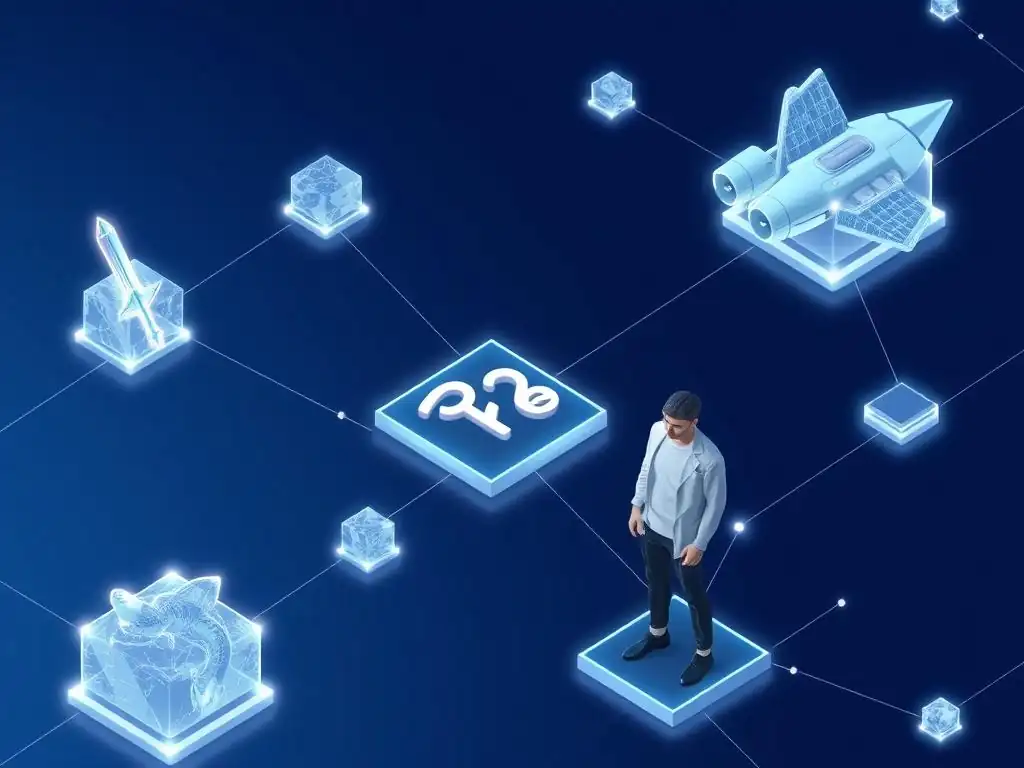
Non-Fungible Tokens (NFTs) are fundamental to the play-to-earn revolution in blockchain gaming, acting as the digital cornerstone for true ownership and potential interoperability of in-game assets. Unlike traditional gaming where in-game items are confined to the game's ecosystem and controlled by developers, NFTs represent digital assets on the blockchain, granting players verifiable and immutable ownership.
This means that when a player acquires an NFT representing a sword, a character skin, or a piece of virtual land, they genuinely own that digital item, similar to owning a physical collectible. This ownership extends beyond the game itself, as NFTs can be traded, sold, or potentially used across different platforms, depending on interoperability initiatives.
The significance of NFTs extends beyond mere ownership; they pave the way for interoperability in gaming, a concept that has long been a dream within the industry. Imagine owning a powerful sword NFT earned in one blockchain game and being able to use it in another compatible game. While true interoperability is still in its early stages, NFTs provide the technological foundation for this to become a reality.
By standardizing digital asset representation through NFTs, game developers can potentially create ecosystems where in-game items are not siloed within individual games but can be utilized and valued across a broader network of interconnected virtual worlds. This potential for interoperability could revolutionize the gaming experience, allowing players to build persistent digital identities and asset collections that transcend individual games.
Trading and Investing in Gaming NFTs
The emergence of NFTs in gaming has created a vibrant new market for trading and investing in digital assets. NFT marketplaces, such as OpenSea, Rarible, and in-game specific marketplaces, have become hubs for buying, selling, and trading gaming NFTs. These marketplaces facilitate the exchange of in-game items, characters, virtual land, and other digital collectibles, creating a player-driven economy around gaming NFTs. The value of gaming NFTs is determined by various factors, including scarcity, utility within the game, aesthetic appeal, and the overall popularity and demand for the game itself.
Trading and investing in gaming NFTs presents both opportunities and risks. On the one hand, successful gaming NFTs can appreciate in value, offering potential returns for investors and traders. Rare or highly sought-after NFTs can command significant prices on marketplaces.
On the other hand, the NFT market can be volatile, and the value of gaming NFTs is inherently tied to the success and longevity of the underlying game. Investing in gaming NFTs requires careful research, understanding of the game ecosystem, and awareness of market trends. Furthermore, the nascent nature of the NFT market means that risks such as scams, rug pulls, and market manipulation are present, requiring due diligence and caution from participants.
NFT Gaming Risks and Considerations
While NFTs offer transformative potential for gaming, it's crucial to acknowledge the associated risks and considerations. One primary concern is the volatility and speculative nature of the NFT market. The value of gaming NFTs can fluctuate dramatically based on market sentiment, hype cycles, and the overall performance of the cryptocurrency market. Investing in NFTs carries inherent risks, and there is no guarantee of returns, with the potential for significant financial losses. Players and investors should approach NFT gaming with a clear understanding of these risks and avoid investing more than they can afford to lose.
Another important consideration is the security of NFTs and blockchain platforms. While blockchain technology is inherently secure, vulnerabilities in smart contracts, phishing scams, and inadequate security practices can lead to the theft or loss of NFTs. Players need to be vigilant about security, use secure wallets, and exercise caution when interacting with NFT marketplaces and blockchain games.
Furthermore, the environmental impact of certain blockchains, particularly proof-of-work based blockchains like Ethereum (although Ethereum has transitioned to proof-of-stake), has raised concerns about the sustainability of NFT gaming. While more environmentally friendly blockchain solutions are emerging, the environmental footprint of NFTs remains a topic of discussion and development. Finally, regulatory uncertainty surrounding NFTs and cryptocurrencies adds another layer of complexity, as regulations are still evolving and vary across jurisdictions, potentially impacting the legal status and taxation of gaming NFTs.
Future Trends in Blockchain Gaming and the Metaverse
The Evolution of Metaverse Gaming Experiences
The future of metaverse gaming experiences is poised for significant evolution, driven by technological advancements and increasing user adoption. We can expect to see more immersive and visually stunning virtual worlds, leveraging advancements in graphics rendering, VR/AR technologies, and haptic feedback to create truly engaging and sensory-rich gaming experiences. Imagine metaverse games with photorealistic graphics, seamless transitions between virtual and physical reality through AR, and tactile feedback that allows you to feel the impact of in-game actions – these advancements are on the horizon.
Furthermore, artificial intelligence (AI) is expected to play an increasingly prominent role in metaverse gaming, enhancing gameplay and creating more dynamic and personalized experiences. AI-powered NPCs (non-player characters) could become more intelligent and responsive, creating richer and more believable virtual worlds. AI could also personalize game content and difficulty based on individual player preferences and skill levels, leading to more tailored and engaging gameplay.
The evolution of metaverse gaming experiences will likely also involve greater social interaction and community building, with metaverses becoming increasingly integrated social platforms where gaming is just one facet of a broader digital social life. We may see metaverse games evolving into persistent virtual societies with their own economies, governance structures, and social norms, blurring the lines between gaming and digital living.
Decentralized Autonomous Organizations (DAOs) in Gaming
Decentralized Autonomous Organizations (DAOs) are emerging as a significant trend in blockchain gaming, promising to revolutionize game governance and player empowerment. DAOs are community-led entities governed by rules encoded on a blockchain, enabling decentralized decision-making and resource management without traditional hierarchical structures. In the context of gaming, DAOs can be used to govern game economies, manage in-game assets, and even influence game development decisions, giving players a greater stake and voice in the games they play.
DAOs can empower players by shifting control from centralized game developers to the player community. For instance, a DAO could manage the treasury of a game, distributing rewards to players based on community-defined rules. DAOs can also be used to govern in-game marketplaces, ensuring fair and transparent trading of assets.
Furthermore, DAOs can facilitate community-driven game development, allowing players to vote on new features, game updates, and even the direction of the game's storyline. This move towards decentralized governance through DAOs has the potential to create more equitable and player-centric gaming ecosystems, fostering stronger communities and more sustainable play-to-earn economies. Examples of DAOs in gaming are still evolving, but their potential to transform game governance and player participation is undeniable.
The Convergence of AR/VR and Blockchain Gaming
The convergence of Augmented Reality (AR), Virtual Reality (VR), and blockchain gaming represents a powerful synergy with the potential to unlock entirely new dimensions of immersive and interactive gaming experiences. AR and VR technologies provide the visual and sensory immersion needed to fully realize the metaverse vision, while blockchain technology enables the digital ownership, decentralized economies, and play-to-earn mechanics that are transforming the gaming landscape. Combining these technologies can create metaverse games that are not only visually captivating but also economically empowering and truly owned by their players.
Imagine playing a blockchain-based strategy game in AR, where virtual armies and battlefields are overlaid onto your real-world environment, allowing you to command troops and strategize in a physically interactive way. Or envision exploring a virtual metaverse world in VR, interacting with other players' avatars, building virtual structures, and earning cryptocurrency rewards for your in-game achievements, all within a fully immersive digital realm.
The convergence of AR/VR and blockchain gaming has the potential to blur the lines between the physical and digital worlds, creating hybrid gaming experiences that are both engaging and economically rewarding. As AR/VR technology becomes more accessible and affordable, and as blockchain gaming continues to evolve, this convergence is likely to drive the next wave of innovation in the gaming and metaverse industries.
Addressing Concerns and Criticisms of Blockchain Gaming
Scalability Issues and Solutions in Blockchain Gaming
Scalability remains a significant challenge for blockchain gaming, particularly as games become more complex and player bases grow. Traditional blockchain networks, especially those utilizing proof-of-work consensus mechanisms, can suffer from slow transaction speeds and high transaction fees, hindering the smooth and efficient operation of blockchain games. For games with frequent in-game transactions, such as trading NFTs or earning cryptocurrency rewards, scalability limitations can negatively impact user experience and create bottlenecks.
However, various scalability solutions are being developed and implemented to address these issues. Layer-2 scaling solutions, such as sidechains (e.g., Ronin used by Axie Infinity), rollups (e.g., Optimistic Rollups, zk-Rollups), and state channels, are designed to process transactions off the main blockchain, significantly increasing transaction throughput and reducing fees. These solutions allow blockchain games to handle a larger volume of transactions more efficiently, improving performance and user experience.
Furthermore, alternative blockchain platforms specifically designed for gaming, such as Flow and Immutable X, are emerging, offering higher transaction speeds and lower fees compared to general-purpose blockchains. As blockchain technology continues to evolve, scalability solutions are becoming increasingly sophisticated, paving the way for more scalable and user-friendly blockchain gaming experiences.
Security Risks and Mitigation Strategies
Security is paramount in blockchain gaming, as players are dealing with valuable digital assets and financial transactions. Several security risks are inherent in blockchain gaming ecosystems, including smart contract vulnerabilities, phishing scams, and private key security. Smart contracts, which govern the rules and logic of blockchain games, can contain vulnerabilities that hackers can exploit to steal assets or manipulate game mechanics.
Phishing scams target players to steal their private keys or login credentials, granting access to their wallets and in-game assets. Poor private key security practices, such as storing private keys insecurely or falling victim to keyloggers, can also lead to asset loss.
To mitigate these security risks, several strategies are essential. Smart contract audits by reputable security firms are crucial to identify and fix vulnerabilities before games are launched. User education on phishing scams and best security practices is vital to prevent players from falling victim to social engineering attacks.
Secure wallet practices, such as using hardware wallets or multi-signature wallets, can significantly enhance the security of private keys. Game developers and platform providers should prioritize security at every stage of development and operation, implementing robust security measures and providing players with the tools and knowledge to protect their assets. A strong focus on security is essential to build trust and ensure the long-term viability of blockchain gaming.
Regulatory Landscape and Compliance for Play-to-Earn Games
The regulatory landscape for play-to-earn games and blockchain-based assets is still evolving and varies significantly across different jurisdictions. Governments and regulatory bodies worldwide are grappling with how to classify and regulate cryptocurrencies, NFTs, and blockchain-based activities, including P2E gaming. The legal status of in-game tokens, NFTs, and play-to-earn earnings can be unclear and subject to change, creating uncertainty for game developers and players. Compliance with existing regulations, such as anti-money laundering (AML) and know-your-customer (KYC) requirements, can also be complex for P2E game platforms.
Navigating the regulatory landscape requires careful attention to legal developments and proactive compliance measures. Game developers and platform providers need to stay informed about evolving regulations in their target markets and seek legal counsel to ensure compliance.
Implementing KYC and AML procedures, providing clear terms of service and disclosures, and engaging with regulators are important steps towards responsible and compliant operation in the P2E gaming space. The regulatory landscape is likely to continue to evolve as blockchain gaming matures, and proactive engagement with regulators and a commitment to compliance are crucial for the long-term sustainability and legitimacy of the industry.
The Impact of Blockchain Gaming on the Broader Metaverse Ecosystem
Driving Innovation and Adoption of Metaverse Technologies
Blockchain gaming is proving to be a significant catalyst for innovation and adoption of metaverse technologies, acting as a compelling use case that attracts users, developers, and investment to the broader metaverse ecosystem. The play-to-earn model, enabled by blockchain and NFTs, provides a powerful incentive for users to engage with metaverse platforms, driving user growth and adoption. The economic opportunities within P2E games, such as earning cryptocurrency and owning valuable digital assets, are attracting a diverse audience to the metaverse, including gamers, creators, and investors.
Blockchain gaming is also driving innovation in metaverse technologies by pushing the boundaries of what is possible in virtual worlds. Game developers are at the forefront of experimenting with new metaverse features, such as interoperable NFTs, decentralized governance models, and immersive VR/AR integrations. The demands of blockchain gaming are driving advancements in blockchain scalability, security, and user experience, benefiting the entire metaverse ecosystem.
Furthermore, the success of blockchain games is attracting significant investment to the metaverse space, fueling further development and innovation across various metaverse applications, beyond just gaming. Blockchain gaming is serving as a crucial onramp for mainstream adoption of metaverse technologies, paving the way for a more interconnected and immersive digital future.
Creating New Economic Opportunities in Virtual Worlds
Blockchain gaming is not just transforming the gaming industry; it is also creating entirely new economic opportunities within virtual worlds, fostering digital economies and empowering individuals to earn a living in the metaverse. The play-to-earn model is generating new income streams for players, allowing them to earn cryptocurrency and NFTs by participating in games, creating content, and contributing to virtual economies. This is particularly impactful in developing countries, where P2E gaming has emerged as a significant source of income for some individuals and communities.
Beyond individual earnings, blockchain gaming is also creating new business opportunities within the metaverse. Entrepreneurs are building businesses around gaming NFTs, such as NFT marketplaces, rental services for gaming assets, and guilds that manage and monetize player communities in P2E games. Virtual land ownership in metaverse platforms like Decentraland and The Sandbox is creating new opportunities for virtual real estate development, commerce, and entertainment.
The growth of blockchain gaming is contributing to the development of robust digital economies within virtual worlds, creating new jobs, businesses, and economic value in the metaverse. This economic empowerment within virtual worlds is a defining characteristic of the metaverse and a significant driver of its growth and potential.
Shaping the Future of Digital Ownership and Identity
Blockchain gaming is playing a pivotal role in shaping the future of digital ownership and identity, challenging traditional notions of digital property and empowering individuals with greater control over their digital assets and online identities. NFTs, as the foundation of blockchain gaming assets, are redefining digital ownership by providing verifiable and immutable proof of ownership for digital items. This concept of true digital ownership, enabled by blockchain, is extending beyond gaming to other areas of the metaverse, such as digital art, virtual real estate, and digital collectibles.
Blockchain gaming is also influencing the future of digital identity by enabling players to build persistent and portable digital identities that transcend individual games and platforms. NFT-based avatars and digital identities can be used across different metaverse experiences, creating a more cohesive and interoperable digital identity for users.
Furthermore, decentralized identity solutions, built on blockchain, are emerging, giving users greater control over their personal data and online identities in the metaverse. Blockchain gaming is at the forefront of these developments, demonstrating the potential of blockchain technology to empower individuals with greater control over their digital assets and identities, shaping a future where digital ownership and identity are more decentralized, secure, and user-centric.
Conclusion: The Future of Gaming is Decentralized and Immersive
The Potential of Blockchain Gaming to Transform the Industry
Blockchain gaming possesses the transformative potential to fundamentally reshape the gaming industry, moving beyond traditional models towards decentralized, player-centric, and economically empowering ecosystems. The play-to-earn revolution is disrupting established gaming paradigms by granting players ownership of in-game assets, enabling them to earn real-world value through gameplay, and fostering player-driven economies. NFTs are revolutionizing digital ownership, providing verifiable and immutable proof of ownership for in-game items and paving the way for interoperability across games and platforms.
The integration of blockchain gaming with the metaverse is creating immersive and socially rich gaming experiences, blurring the lines between gaming and digital living. Decentralized governance models, such as DAOs, are empowering players with greater control over game development and economies, fostering stronger communities and more equitable gaming ecosystems. While challenges such as scalability, security, and regulatory uncertainty remain, the momentum behind blockchain gaming is undeniable. The industry is rapidly evolving, with continuous innovation in technology, game design, and economic models, pointing towards a future where gaming is more decentralized, immersive, and economically rewarding for players.
Investing in the Future of Play-to-Earn and the Metaverse
Investing in the future of play-to-earn gaming and the metaverse presents both exciting opportunities and inherent risks. The blockchain gaming and metaverse space is still nascent and rapidly evolving, offering significant growth potential for early adopters and informed investors. Investing in blockchain gaming projects, metaverse platforms, and gaming NFTs can potentially yield substantial returns as the industry matures and adoption increases. However, it's crucial to acknowledge the risks associated with this emerging market, including market volatility, technological uncertainties, regulatory changes, and project-specific risks.
Investing in this space requires thorough research, due diligence, and a long-term perspective. Understanding the underlying technology, game mechanics, tokenomics, and team behind a project is essential before making investment decisions. Diversifying investments across different projects and asset classes can help mitigate risk. Furthermore, staying informed about market trends, regulatory developments, and technological advancements is crucial for navigating this dynamic and rapidly changing landscape. Investing in the future of play-to-earn and the metaverse is a long-term game, requiring patience, informed decision-making, and an understanding of both the potential and the risks involved.
Frequently Asked Questions
What is the "PlaytoEarn" revolution in blockchain gaming?
The "PlaytoEarn" revolution refers to a new gaming model where players can earn real-world value through in-game activities. This is facilitated by blockchain technology and NFTs.
How does blockchain technology facilitate PlaytoEarn gaming in the metaverse?
Blockchain enables the tokenization of in-game assets as NFTs, giving players true ownership. These NFTs can then be traded or used within the metaverse environment, allowing for economic activity.
Beyond cryptocurrencies, what other applications of blockchain are important in PlaytoEarn gaming?
Smart contracts are crucial for automating reward distribution and ensuring fair gameplay. Blockchain also enhances security and transparency in transactions within the virtual world.
What are some potential regulatory challenges facing the growth of PlaytoEarn blockchain gaming?
Regulations concerning digital asset ownership, data privacy, and taxation are key challenges. Clear legal frameworks are needed to support the sustainable growth of this industry.
How might the future of decentralized systems impact the evolution of PlaytoEarn gaming?
Decentralized systems offer greater player autonomy and control over their assets. This could lead to more community-driven game development and innovative gaming experiences.
Final Reflection: Embracing the Play-to-Earn Paradigm
The exploration of blockchain gaming and the play-to-earn revolution within the metaverse reveals a landscape ripe with potential, yet also fraught with challenges. The convergence of gaming, blockchain technology, and virtual worlds is not merely a trend, but a fundamental shift in how we perceive ownership, value, and community within digital spaces. This revolution is actively reshaping the gaming industry, empowering players in unprecedented ways and challenging traditional models of game development and monetization.
This burgeoning ecosystem has profoundly impacted the cultural understanding of digital assets and online economies. Witnessing the rise of play-to-earn has been a testament to the human desire for agency and ownership, even within virtual realms. The potential for individuals to earn a living through engaging gameplay is a powerful concept, one that resonates deeply in an increasingly digital world. The future of work is play, and the future of play is work.
This sentiment captures the essence of the play-to-earn revolution, blurring the lines between leisure and livelihood.
As we stand on the cusp of this new era, it's crucial to consider the ethical implications and potential pitfalls of the play-to-earn model. Let us not only embrace the opportunities presented by blockchain gaming but also strive to build a sustainable and equitable metaverse for all. Reflect on how you can contribute to a future where gaming empowers individuals, fosters genuine community, and unlocks new avenues for creativity and economic opportunity. The future of the metaverse, and the play-to-earn revolution, is in our hands.
Ignite Your Metaverse Gaming Journey!
Thank you for exploring the exciting world of blockchain gaming and virtual worlds. We hope you've gained valuable insights into the Play-to-Earn revolution and the innovative platforms shaping the future of gaming. Now, it's time to take action and discover these virtual environments for yourself.
Here's how to get started:
- Dive into a Play-to-Earn game! Research different platforms, create your avatar, and begin earning real rewards.
- Explore emerging metaverse gaming platforms. Seek out innovative projects and early adoption opportunities that are pushing the boundaries of digital entertainment.
- Join the conversation! Share this article with friends who love gaming or discuss your favorite virtual worlds on social media using a dedicated hashtag.
Which virtual world are you most excited to explore first, and what in-game asset are you eager to acquire? Share your plans in the comments below!
Leave a Reply