
Building a Decentralized Marketplace with Smart Contracts: A Tutorial


Welcome to Blockchain Trends, your guide to understanding the revolutionary impact of blockchain technology beyond the headlines.
Dive into the world of decentralized innovation and uncover the potential that lies within distributed ledgers. Ever wondered how to build a truly decentralized marketplace? This week, we're cracking open the code with our in-depth smart contract marketplace development tutorial. Discover the step-by-step process and unlock the power to create your own decentralized applications. Ready to build the future? Let's get started!
Building a Decentralized Art Marketplace on Ethereum: A Step-by-Step Guide
- Introduction to Decentralized Art Marketplaces and Smart Contracts
- Setting Up Your Development Environment for Ethereum Smart Contract Development
- Designing the Smart Contract Architecture for the Decentralized Art Marketplace
-
Writing the Smart Contracts for the Art Marketplace
- Creating the ERC721Token Smart Contract for Art NFT Management
- Implementing the ArtMarketplace Smart Contract for Listing and Purchasing NFTs
- Writing Functions for Listing Art NFTs on the Marketplace
- Developing Functions for Purchasing Art NFTs with ETH
- Implementing Royalty Payments and Artist Attribution in Smart Contracts
- Deploying the Smart Contracts to a Test Network
- Building the User Interface (UI) for the Decentralized Art Marketplace
- Testing and Auditing the Smart Contract Art Marketplace
- Deploying the Smart Contract Art Marketplace to the Mainnet
- Best Practices for Smart Contract Art Marketplace Development
- Conclusion: Empowering Artists and Collectors with Decentralized Art Marketplaces
-
Frequently Asked Questions
- What are the core components needed for Smart contract marketplace development?
- How does blockchain technology enhance the security of a marketplace?
- What are the key considerations when designing smart contracts for a marketplace?
- Beyond cryptocurrencies, what other applications can benefit from a decentralized marketplace?
- What are the regulatory challenges facing decentralized marketplaces built with smart contracts?
- Final Reflection: Embracing the Decentralized Future
- Unleash Your Inner Web3 Developer!
Introduction to Decentralized Art Marketplaces and Smart Contracts
Understanding the Core Concepts of Blockchain-Based Art Platforms
Decentralized art platforms leverage blockchain technology to revolutionize how digital and physical art is created, bought, sold, and authenticated. Unlike traditional art marketplaces that often involve intermediaries, centralized control, and opaque processes, blockchain-based platforms offer transparency, security, and direct interaction between artists and collectors. At their core, these platforms utilize the immutable nature of blockchain to establish provenance and ownership of artworks, often represented as Non-Fungible Tokens (NFTs). This fundamental shift empowers artists by giving them greater control over their work and allows collectors to directly engage with creators and verify the authenticity of their acquisitions.
These platforms are built upon the principles of decentralization, meaning that no single entity controls the marketplace. Instead, the platform's operations and rules are encoded in smart contracts and distributed across a network of computers. This distributed nature enhances security, reduces censorship risks, and fosters a more democratic and accessible art ecosystem.
The use of blockchain also streamlines transactions, often reducing fees associated with traditional art sales and offering new monetization models for artists, such as royalty structures embedded directly within the smart contracts. This opens up new avenues for artists to benefit from secondary market sales, something that is often difficult to enforce in traditional art markets.
The Benefits of Decentralized Platforms for Artists and Collectors
Decentralized art marketplaces present a compelling value proposition for both artists and collectors, addressing many of the pain points inherent in traditional art markets. For artists, these platforms offer greater autonomy and control over their creations. By minting their art as NFTs, artists can establish irrefutable proof of ownership and authenticity, directly combatting issues of art forgery and copyright infringement.
Moreover, decentralized platforms often feature lower transaction fees compared to traditional galleries or auction houses, maximizing the artist's earnings from each sale. The ability to program royalties into smart contracts ensures that artists can automatically receive a percentage of future sales, creating a continuous revenue stream from their work, even as it changes hands in the secondary market.
Collectors also benefit significantly from decentralized art marketplaces. The blockchain's transparent and immutable ledger provides verifiable proof of authenticity and ownership, enhancing trust and confidence in art acquisitions. NFTs simplify the process of buying, selling, and trading digital art, making it more accessible to a wider audience.
Collectors can directly support artists they admire and participate in a more democratic and community-driven art ecosystem. Furthermore, the fractional ownership capabilities offered by some NFT platforms allow for shared investment in high-value artworks, democratizing access to art investment and collection, which was previously limited to a select few. This democratization of access and ownership is a key advantage of decentralized art platforms.
Smart Contracts: Enabling Secure and Transparent Art Transactions
Smart contracts are self-executing agreements written in code and deployed on a blockchain, such as Ethereum. They are fundamental to the operation of decentralized art marketplaces, automating and securing various aspects of art transactions. These contracts define the rules and conditions of art sales, ownership transfers, and royalty distributions, ensuring that transactions are executed automatically and transparently once predefined conditions are met. For instance, a smart contract can automatically transfer ownership of an NFT to a buyer and release payment to the seller when a purchase is made, all without the need for intermediaries.
The transparency and immutability of smart contracts are crucial for building trust and security in art transactions. All the terms of the agreement and transaction history are recorded on the blockchain, publicly auditable, and cannot be altered. This eliminates the opacity often associated with traditional art deals and reduces the risk of fraud or disputes.
Smart contracts also enable complex functionalities, such as escrow services, automated royalty payments, and fractional ownership, all of which enhance the efficiency and security of decentralized art marketplaces. By encoding the rules of the marketplace directly into code, smart contracts create a more equitable and transparent system for art transactions, benefiting both artists and collectors.
Setting Up Your Development Environment for Ethereum Smart Contract Development
Installing Prerequisites: Node.js, Truffle, and Ganache
To embark on smart contract marketplace development, setting up the correct development environment is crucial. The first step involves installing Node.js, a JavaScript runtime environment essential for running development tools. Node.js comes with npm (Node Package Manager), which will be used to install Truffle and Ganache. Node.js can be downloaded from the official website (nodejs.org) and installed following the platform-specific instructions. Ensure you download a stable version recommended for general users.
Once Node.js is installed, open your command-line interface (terminal or command prompt) and proceed to install Truffle and Ganache globally using npm. Truffle is a development framework for Ethereum that simplifies smart contract development, testing, and deployment. Install it by running the command npm install -g truffle. Ganache is a personal blockchain for Ethereum development, allowing you to deploy and test smart contracts in a local, isolated environment without using real Ether. Install Ganache with the command npm install -g ganache-cli. After successful installation, you can verify the installation by running truffle version and ganache-cli --version in your terminal, which should display the installed versions of Truffle and Ganache respectively.
Configuring Your Development Environment for Solidity Development
With the prerequisites installed, the next step is configuring your environment for Solidity development. Solidity is the primary programming language for writing smart contracts on Ethereum. While you can write Solidity code in any text editor, using a code editor specifically designed for Solidity development can significantly improve your workflow. Visual Studio Code (VS Code) is a popular and highly recommended code editor for Solidity development, owing to its extensive features and extensions.
Install VS Code from its official website (code.visualstudio.com). After installation, enhance VS Code with Solidity-specific extensions. The "Solidity" extension by Juan Blanco is highly recommended, providing syntax highlighting, code completion, linting, and debugging support for Solidity. To install extensions in VS Code, navigate to the Extensions view (Ctrl+Shift+X or Cmd+Shift+X) and search for "Solidity" and install the desired extension. Configuring your editor with these tools makes writing, reading, and debugging Solidity code much more efficient, streamlining the smart contract development process.
Creating a New Truffle Project for the Art Marketplace
To start building the decentralized art marketplace, you'll initiate a new Truffle project. Truffle provides a structured project directory and configuration files that simplify smart contract development. Open your command-line interface and navigate to the directory where you want to create your project. Use the mkdir command to create a new project directory, for example, mkdir decentralized-art-marketplace, and then navigate into this directory using cd decentralized-art-marketplace.
Inside your project directory, initialize a new Truffle project using the command truffle init. This command sets up the basic project structure, including directories for contracts ( contracts/), migrations ( migrations/), tests ( test/), and a configuration file ( truffle-config.js). The truffle-config.js file is crucial for configuring your development environment, specifying network settings, compiler versions, and other project-specific configurations. With the Truffle project initialized, you are now ready to begin designing and writing your smart contracts for the art marketplace within the contracts/ directory.
Designing the Smart Contract Architecture for the Decentralized Art Marketplace
Defining the Art Marketplace Smart Contract Functionality
Designing the smart contract architecture is a critical step in building a decentralized art marketplace. The core functionality revolves around enabling artists to list their artwork as NFTs and collectors to purchase these NFTs securely and transparently. Key functionalities include creating and managing Art NFTs, listing NFTs for sale at a specified price, enabling users to purchase listed NFTs, handling ownership transfers, and implementing royalty payments to artists on secondary sales. The smart contract should also manage user accounts, allowing artists to register and collectors to manage their purchased NFTs.
Beyond basic buying and selling, the marketplace could incorporate features like auction functionality, where NFTs can be auctioned off to the highest bidder. Consideration should be given to implementing a bidding system with time limits and mechanisms to prevent sniping. Additionally, features like curation and featured artworks could be incorporated, possibly through a governance mechanism or administrator role within the smart contract. The design should prioritize security, gas efficiency, and user experience, ensuring the marketplace is robust and user-friendly. Thinking about future scalability and potential feature expansions from the outset is also crucial for a well-designed smart contract architecture.
Structuring Data: Art NFTs, Listings, and User Accounts
Efficient data structuring is essential for the smart contract's performance and functionality. For Art NFTs, each NFT needs to store metadata such as the artwork's title, description, artist information, and a link to the artwork's digital asset, often stored on decentralized storage like IPFS. This metadata is typically associated with the NFT token using a URI (Uniform Resource Identifier) that points to the metadata file.
Listings need to store information about the NFT being listed, the listing price, the seller, and the listing status (active or sold). User accounts, at a basic level, need to store user addresses and potentially profile information.
To manage these data structures within the smart contract, Solidity structs and mappings are commonly used. A struct can define the data structure for an Art NFT, a Listing, or a User. Mappings can then be used to associate NFTs with their owners, listings with NFTs, and user addresses with user accounts.
For example, a mapping could link an NFT's token ID to its metadata struct, another mapping could link an NFT's token ID to its listing struct (if it is listed for sale), and yet another mapping could link user addresses to their user profile data. Careful consideration of data structures ensures efficient storage and retrieval of information within the smart contract, optimizing gas costs and performance.
Implementing Access Control and Ownership Verification
Security and access control are paramount in a decentralized art marketplace. Smart contracts must implement robust mechanisms to control who can perform certain actions, such as listing NFTs, purchasing NFTs, or updating marketplace settings. Ownership verification is also crucial to ensure that only the rightful owner of an NFT can list or sell it. Solidity provides modifiers like onlyOwner to restrict function access to specific addresses, such as the contract owner or the NFT owner.
For access control, roles can be defined within the smart contract, such as 'admin', 'artist', and 'collector'. Modifiers can then be created to restrict functions to users with specific roles. For example, only an 'admin' role might be able to update marketplace fees, while only an 'artist' role might be able to list their own NFTs.
Ownership verification for NFTs is typically handled by the ERC721 standard, which includes functions to check the owner of a specific token ID. The marketplace contract can interact with the ERC721 contract to verify that the user attempting to list or sell an NFT is indeed the current owner. Implementing these access control and ownership verification mechanisms is vital to ensure the security and integrity of the decentralized art marketplace.
Writing the Smart Contracts for the Art Marketplace
Creating the ERC721Token Smart Contract for Art NFT Management
The foundation of our art marketplace is the ERC721Token smart contract, responsible for managing the creation, ownership, and transfer of Art NFTs. ERC721 is a standard interface for Non-Fungible Tokens on Ethereum, ensuring interoperability and compatibility with various NFT marketplaces and wallets. This contract will inherit from the ERC721 contract provided by OpenZeppelin, a widely trusted library for secure smart contract development, which simplifies the implementation of ERC721 functionalities.
The ERC721Token contract will include functionalities for minting new Art NFTs, transferring ownership, and retrieving NFT metadata. A mintArtNFT function will allow authorized users (artists, or potentially the marketplace contract itself) to create new NFTs, associating them with unique metadata URIs that point to the artwork's details. The contract will also manage token ownership using the ERC721 standard's internal mappings. It's crucial to consider metadata storage; while the metadata URI is stored on-chain, the actual artwork data is typically stored off-chain on decentralized storage solutions like IPFS to manage gas costs. This ERC721Token contract forms the core of the NFT asset management within the marketplace.
Implementing the ArtMarketplace Smart Contract for Listing and Purchasing NFTs
The ArtMarketplace smart contract is the central hub for all marketplace operations, handling NFT listings, purchases, and royalty payments. This contract will interact with the ERC721Token contract to manage the lifecycle of Art NFTs within the marketplace. It will define functions for artists to list their NFTs for sale, for collectors to purchase listed NFTs, and for handling the transfer of funds and NFT ownership. The contract will also manage marketplace fees, if applicable, and implement the logic for royalty payments to artists on secondary sales.
Key functionalities within the ArtMarketplace contract include listNFTForSale, purchaseNFT, and potentially functions for canceling listings or updating prices. The contract will maintain a mapping of listed NFTs and their associated details, such as price and seller. When a purchase is made, the contract will verify that the NFT is indeed listed for sale, transfer the purchase price from the buyer to the seller (minus marketplace fees), transfer ownership of the NFT from the seller to the buyer by interacting with the ERC721Token contract, and trigger royalty payments if implemented. This contract orchestrates the buying and selling process, ensuring secure and transparent transactions within the decentralized art marketplace.
Writing Functions for Listing Art NFTs on the Marketplace
The function listNFTForSale is crucial for artists to make their NFTs available for purchase on the marketplace. This function will reside within the ArtMarketplace smart contract and will take parameters such as the tokenId of the NFT being listed and the price at which the artist wants to sell it. Before listing, the function should verify that the caller is indeed the owner of the NFT using the ERC721Token contract's ownership functions. It should also ensure that the NFT is not already listed for sale.
Upon successful verification, the listNFTForSale function will create a new listing record within the marketplace contract, associating the tokenId, price, and the seller's address. This listing information can be stored in a mapping where the key could be the tokenId and the value could be a struct containing listing details (price, seller, listing status). The function should also emit an event, such as NFTListedForSale, to notify off-chain applications and users that a new NFT has been listed. This event can include details like the tokenId, price, and seller address, enabling the UI to update and display the newly listed artwork.
Developing Functions for Purchasing Art NFTs with ETH
The purchaseNFT function enables collectors to buy listed NFTs using Ether (ETH). This function, residing in the ArtMarketplace contract, will take the tokenId of the NFT to be purchased as a parameter. Upon invocation, the function must first verify that the NFT is indeed listed for sale and that the listing is still active. It should also check if the amount of ETH sent by the buyer is equal to or greater than the listed price.
If these checks pass, the purchaseNFT function will proceed with the purchase process. It will transfer the listed price (minus any marketplace fees) from the buyer to the seller. Then, it will transfer ownership of the NFT from the seller to the buyer by calling the transferFrom function of the ERC721Token contract. Crucially, it needs to handle the transfer of ETH securely, ensuring that the correct amount is transferred to the seller and any marketplace fees are correctly collected. Finally, the function should emit an event, such as NFTSold, to signal the successful purchase and include details like the tokenId, buyer, and seller addresses.
Implementing Royalty Payments and Artist Attribution in Smart Contracts
To fairly compensate artists for secondary market sales, royalty payments can be implemented within the smart contracts. This ensures that artists automatically receive a percentage of the sale price each time their NFT is resold. Royalty logic can be integrated into the purchaseNFT function within the ArtMarketplace contract. When an NFT is purchased, the contract will calculate the royalty amount based on a predefined royalty percentage (e.g., 5% or 10%) and transfer this amount to the original artist.
Artist attribution is also important. The ERC721Token contract can store artist information, potentially within the NFT metadata or through a separate mapping. The ArtMarketplace contract can access this artist information when processing sales and ensure that royalties are correctly attributed to the original creator. Implementing royalties and artist attribution directly in the smart contracts provides transparency and automation, ensuring artists are fairly compensated and recognized for their work throughout the NFT's lifecycle, fostering a more sustainable ecosystem for digital artists.
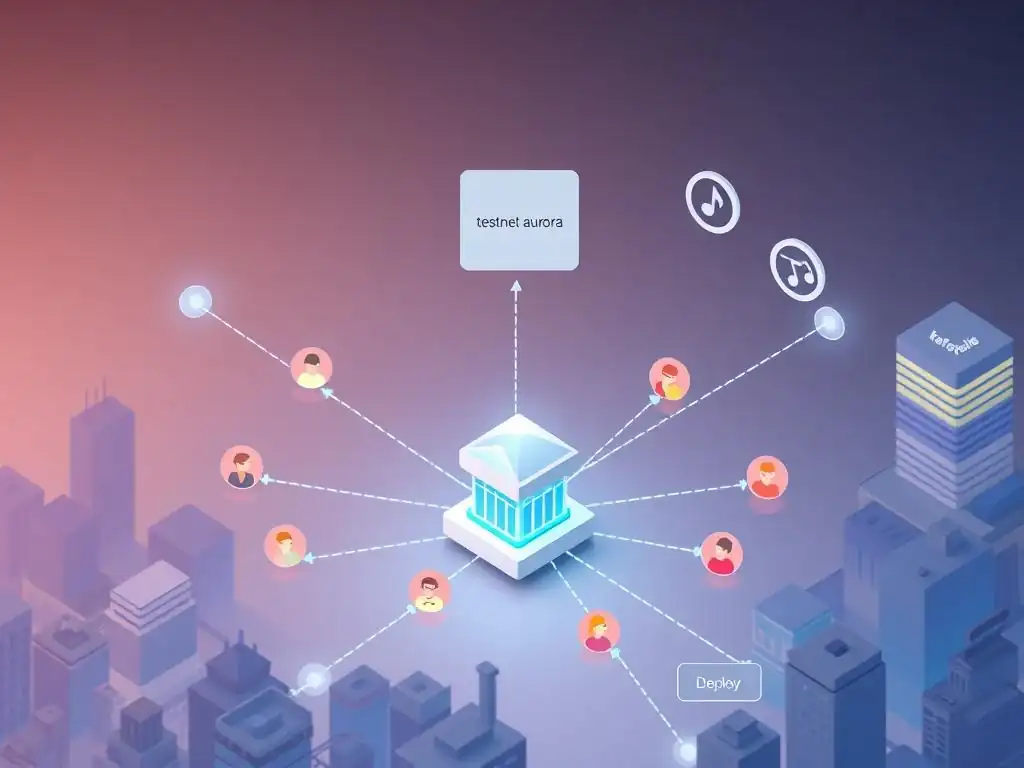
Deploying the Smart Contracts to a Test Network
Compiling the Smart Contracts using Truffle
Before deploying smart contracts, they must be compiled into bytecode that the Ethereum Virtual Machine (EVM) can understand. Truffle simplifies this compilation process. Navigate to your Truffle project directory in the command-line interface. To compile your smart contracts ( ERC721Token.sol and ArtMarketplace.sol located in the contracts/ directory), run the command truffle compile.
Truffle will use the Solidity compiler specified in your truffle-config.js file to compile all .sol files in the contracts/ directory. Upon successful compilation, Truffle will create a build/contracts directory containing JSON files for each compiled contract. These JSON files contain the contract's Application Binary Interface (ABI), bytecode, and other deployment artifacts, which are necessary for deploying and interacting with the smart contracts. If compilation errors occur, Truffle will display detailed error messages in the console, helping you identify and fix issues in your Solidity code.
Migrating the Smart Contracts to Ganache or the Ropsten Testnet
Once compiled, the smart contracts need to be deployed to a blockchain network. For development and testing, Ganache provides a local, private blockchain, while Ropsten is a public Ethereum test network. Ensure Ganache is running in your development environment. In your Truffle project directory, configure the truffle-config.js file to connect to Ganache or Ropsten. For Ganache, the default network configuration in truffle-config.js usually works without modification. For Ropsten, you'll need to configure a provider (e.g., using Infura) and your wallet's private key for deployment.
To deploy the compiled contracts, run the command truffle migrate. Truffle will execute the migration scripts located in the migrations/ directory. These scripts, typically written in JavaScript, define the deployment order and parameters for your smart contracts. During migration, Truffle will deploy your ERC721Token and ArtMarketplace contracts to the specified network (Ganache or Ropsten) and record the deployment information, such as contract addresses, in the migration files. After successful migration, Truffle will display the contract addresses in the console, which are essential for interacting with the deployed contracts from your frontend application.
Verifying the Smart Contracts on Etherscan
For deployments to public test networks like Ropsten or the Ethereum mainnet, verifying your smart contracts on Etherscan is a best practice. Etherscan is a block explorer and analytics platform for Ethereum. Verification allows users to view the source code of your deployed contracts directly on Etherscan, enhancing transparency and trust. To verify your contracts, you'll need to flatten your Solidity code into a single file and provide the compiler version and optimization settings used during compilation.
Truffle provides plugins like truffle-plugin-verify to automate the verification process. Install the plugin using npm install truffle-plugin-verify. Configure the plugin in your truffle-config.js file with your Etherscan API key. Then, run the command truffle run verify <ContractName> --network <network-name> (e.g., truffle run verify ArtMarketplace --network ropsten). Truffle will automatically submit your contract code to Etherscan for verification. Once verified, users can view the source code of your ERC721Token and ArtMarketplace contracts directly on Etherscan by searching for their contract addresses, increasing the transparency and credibility of your decentralized art marketplace.
Building the User Interface (UI) for the Decentralized Art Marketplace
Designing the Front-End Interface Using React
A user-friendly front-end interface is crucial for the adoption of the decentralized art marketplace. React, a popular JavaScript library for building user interfaces, is well-suited for developing dynamic and interactive web applications for blockchain platforms. React's component-based architecture allows for modular and maintainable UI development, making it efficient to build complex applications like decentralized marketplaces.
When designing the front-end with React, consider the key user flows: browsing art listings, viewing NFT details, connecting wallets, listing NFTs for sale, and purchasing NFTs. The UI should be intuitive and visually appealing, showcasing the art NFTs effectively. Components can be created for displaying NFT cards, listing forms, user profiles, and transaction histories.
State management libraries like Redux or Context API can be used to manage the application's state, including user authentication, connected wallet information, and marketplace data. React's ecosystem provides a wealth of libraries and tools that can be leveraged to create a robust and engaging user experience for the decentralized art marketplace.
Connecting the UI to the Smart Contracts using Web3.js
To interact with the deployed smart contracts from the React front-end, Web3.js, a JavaScript library for interacting with the Ethereum blockchain, is essential. Web3.js allows your front-end application to send transactions to the smart contracts, read data from the blockchain, and listen for events emitted by the contracts. Install Web3.js in your React project using npm install web3.
In your React components, instantiate a Web3.js provider connected to the user's MetaMask wallet or another Web3-enabled browser. Use the contract ABIs (from the compiled contract JSON files) and contract addresses (from deployment) to create contract instances in Web3.js. These contract instances provide methods to call functions on your smart contracts. For example, to list an NFT, you would call the listNFTForSale function of your ArtMarketplace contract instance, sending a transaction from the user's connected wallet. Web3.js acts as the bridge between your React UI and the Ethereum blockchain, enabling seamless interaction with your decentralized art marketplace smart contracts.
Implementing User Authentication and MetaMask Integration
User authentication in a decentralized application differs from traditional web applications. Instead of usernames and passwords, users authenticate using their Ethereum wallet addresses. MetaMask is a popular browser extension wallet that allows users to manage their Ethereum accounts and interact with dApps. Integrating MetaMask into your React front-end enables users to connect their wallets and authenticate with your decentralized art marketplace.
Use Web3.js to detect if MetaMask is installed and to request user account access. When a user connects their wallet, retrieve their Ethereum address using Web3.js. This address serves as their identity within the dApp. You can store user addresses and associated profile information in your application's state. For signing transactions, MetaMask will prompt users to approve transactions initiated by your application. This wallet-based authentication approach aligns with the decentralized nature of blockchain applications, giving users control over their identity and data.
Displaying Art NFT Listings and Managing User Profiles
The UI should effectively display available Art NFT listings and allow users to manage their profiles. For displaying listings, fetch listing data from your smart contracts using Web3.js. You can retrieve all listed NFTs or implement filtering and sorting options based on price, artist, or other criteria. Display NFT information, including metadata, price, and artist, in an appealing format, such as NFT cards in a grid layout.
For user profile management, allow users to view their owned NFTs, NFTs they have listed for sale, and their transaction history. This information can be retrieved from the smart contracts and your application's backend (if you are using one for off-chain data storage). Implement features for users to update their profile information (if applicable), and to manage their NFTs within the marketplace. A well-designed UI for displaying listings and managing user profiles is crucial for user engagement and overall marketplace usability.
Testing and Auditing the Smart Contract Art Marketplace
Writing Unit Tests for Smart Contract Functions
Thorough testing is essential to ensure the correctness and reliability of smart contracts. Unit tests focus on testing individual functions of your smart contracts in isolation. Truffle provides a testing environment based on JavaScript and Chai assertion library, making it convenient to write and run unit tests for Solidity smart contracts. Create test files in the test/ directory of your Truffle project.
Write test cases for each function in your ERC721Token and ArtMarketplace contracts. Test various scenarios, including successful function executions, edge cases, and error conditions. For example, test minting NFTs, transferring ownership, listing NFTs for sale, purchasing NFTs, and royalty payments. Use assertions to verify that function outputs and contract state changes are as expected. Run tests using the command truffle test. Aim for high test coverage to ensure that all critical functionalities are thoroughly tested and function correctly under different conditions.
Performing Security Audits to Identify Vulnerabilities
Security is paramount for smart contracts, especially those handling valuable assets like NFTs. A security audit is a systematic evaluation of your smart contract code to identify potential vulnerabilities. Ideally, engage a professional smart contract auditing firm to conduct a comprehensive audit before deploying to the mainnet. Auditors will analyze your code for common vulnerabilities like reentrancy attacks, integer overflows, gas limit issues, and access control flaws.
Even before a professional audit, perform self-audits and peer reviews. Use static analysis tools like Slither and Mythril to automatically detect potential vulnerabilities in your Solidity code. Carefully review your code for any logical errors or security weaknesses. Consider common attack vectors and how your smart contracts are protected against them. Addressing security vulnerabilities early in the development process is crucial to prevent potential exploits and protect user funds and assets in your decentralized art marketplace.
Addressing Potential Security Risks and Optimizing Gas Costs
After identifying potential security risks through audits and testing, prioritize addressing these vulnerabilities. Refactor your smart contract code to mitigate identified risks, following secure coding practices. For example, implement checks-effects-interactions pattern to prevent reentrancy attacks, use SafeMath library to prevent integer overflows, and enforce strict access control mechanisms.
Gas optimization is also crucial for smart contracts deployed on Ethereum, as gas costs directly impact transaction fees. Optimize your Solidity code to reduce gas consumption. Minimize on-chain storage, use efficient data structures, avoid unnecessary loops, and optimize function logic. Tools like the Solidity gas profiler can help identify gas-intensive parts of your code. Balancing security and gas efficiency is essential for creating a robust and cost-effective decentralized art marketplace. Iteratively test and audit your contracts after making security and gas optimizations to ensure continued functionality and security.
Deploying the Smart Contract Art Marketplace to the Mainnet
Preparing for Production Deployment
Deploying to the Ethereum mainnet requires careful preparation, as it involves real Ether and real users. Before mainnet deployment, ensure that your smart contracts have undergone thorough testing, security audits, and gas optimization. Finalize your front-end application and ensure it is robust and user-friendly. Set up monitoring and logging systems to track contract performance and identify any issues after deployment.
Secure your deployment environment and private keys. Use secure key management practices and consider using hardware wallets for storing private keys. Thoroughly test the deployment process on test networks like Ropsten to identify and resolve any potential issues before deploying to mainnet. Prepare documentation for your smart contracts and front-end application, including user guides and developer documentation. A well-planned and prepared deployment process minimizes risks and ensures a smoother transition to the production environment.
Migrating the Smart Contracts to the Ethereum Mainnet
Once you are confident in your smart contracts and application, you can proceed with mainnet deployment. Update your truffle-config.js file to configure the mainnet network. You will need to use a provider like Infura or Alchemy to connect to the mainnet and provide your wallet's private key for deployment. Exercise extreme caution when handling your mainnet private key.
Run the truffle migrate --network mainnet command to deploy your smart contracts to the Ethereum mainnet. Truffle will execute your migration scripts, deploying your ERC721Token and ArtMarketplace contracts to the mainnet. This process will cost real Ether, so ensure you have sufficient Ether in your deployment wallet. After successful migration, record the mainnet contract addresses. Verify your deployed contracts on Etherscan on the mainnet to enhance transparency and trust for your users.
Monitoring and Maintaining the Decentralized Art Marketplace
After deploying to the mainnet, ongoing monitoring and maintenance are crucial for the long-term success of your decentralized art marketplace. Implement monitoring tools to track contract performance, gas usage, transaction volume, and user activity. Monitor for any errors or unexpected behavior in your smart contracts. Set up alerts to notify you of critical issues.
Regularly update your front-end application with new features, bug fixes, and security improvements. Stay informed about potential vulnerabilities and security best practices in the smart contract space. Be prepared to address any security incidents promptly. Engage with your user community and gather feedback to continuously improve the marketplace. Long-term monitoring and maintenance ensure the stability, security, and continued growth of your decentralized art marketplace on the Ethereum mainnet.
Best Practices for Smart Contract Art Marketplace Development
Security Considerations for Decentralized Applications (dApps)
Security should be a top priority throughout the development lifecycle of a decentralized art marketplace. Adopt secure coding practices when writing smart contracts, such as the checks-effects-interactions pattern, input validation, and access control mechanisms. Thoroughly test your smart contracts and conduct security audits to identify and mitigate vulnerabilities. Stay updated on common smart contract vulnerabilities and security best practices.
Securely manage private keys used for contract deployment and administration. Educate users about security best practices for interacting with dApps, such as protecting their private keys and being cautious of phishing attacks. Consider implementing security features within your dApp, such as transaction confirmations and alerts for suspicious activity. A robust security posture is essential for building trust and protecting users and assets in your decentralized art marketplace.
Optimizing Smart Contracts for Gas Efficiency
Gas optimization is crucial for making your decentralized art marketplace cost-effective and user-friendly. Write efficient Solidity code to minimize gas consumption. Use gas profiling tools to identify gas-intensive operations and optimize them. Minimize on-chain storage by storing data off-chain when appropriate (e.g., using IPFS for artwork metadata). Use efficient data structures and algorithms within your smart contracts.
Consider using gas-optimized Solidity patterns and libraries. Test gas costs throughout development and iterate on your code to reduce gas usage. Gas efficiency not only reduces transaction fees for users but also improves the overall scalability and sustainability of your decentralized art marketplace on the Ethereum network.
Future Trends in Decentralized Art Marketplaces and NFTs
The decentralized art marketplace and NFT space is rapidly evolving. Future trends include advancements in NFT standards, such as ERC-1155 and ERC-4907, which offer new functionalities and efficiencies. Expect to see increased integration of NFTs with the metaverse and virtual worlds, creating new use cases for digital art. Interoperability between different blockchain platforms and NFT marketplaces will become increasingly important.
Fractional NFTs and decentralized autonomous organizations (DAOs) for art curation and investment are emerging trends that could shape the future of decentralized art. Explore layer-2 scaling solutions for Ethereum to address gas fee concerns and improve transaction throughput. Staying informed about these trends and adapting your decentralized art marketplace to incorporate new technologies and features will be crucial for staying competitive and innovative in this dynamic space.
Conclusion: Empowering Artists and Collectors with Decentralized Art Marketplaces
Decentralized art marketplaces, powered by smart contracts and NFTs, are revolutionizing the art world. They empower artists with greater control, transparency, and new revenue streams, while offering collectors verifiable ownership, authenticity, and direct access to art. By following this step-by-step guide, developers can build their own decentralized art marketplaces on Ethereum, contributing to a more equitable and accessible art ecosystem. As the NFT space continues to evolve, decentralized art marketplaces are poised to play an increasingly significant role in the future of art creation, collection, and appreciation, fostering a direct connection between artists and their global audience.
Frequently Asked Questions
What are the core components needed for Smart contract marketplace development?
The core components typically include smart contracts for handling transactions and logic, a front-end interface for user interaction, and a decentralized storage solution for data.
How does blockchain technology enhance the security of a marketplace?
Blockchain's immutable ledger and cryptographic hashing make it extremely difficult to tamper with transaction records, enhancing transparency and reducing fraud.
What are the key considerations when designing smart contracts for a marketplace?
Considerations should include security audits, gas optimization for cost-effectiveness, and clear logic for dispute resolution and handling edge cases.
Beyond cryptocurrencies, what other applications can benefit from a decentralized marketplace?
Various industries such as supply chain management, digital art (NFTs), and real estate can leverage decentralized marketplaces for increased transparency and efficiency.
What are the regulatory challenges facing decentralized marketplaces built with smart contracts?
Navigating legal frameworks surrounding decentralized finance (DeFi), data privacy, and consumer protection are significant hurdles that require careful consideration.
Final Reflection: Embracing the Decentralized Future
The journey of building a decentralized marketplace, as outlined in this tutorial, is more than just a technical exercise; it's a step towards reclaiming control and fostering transparency in online commerce. In a world increasingly dominated by centralized platforms, the potential of smart contracts to empower individuals and create fairer marketplaces is becoming undeniably relevant. This tutorial serves as a practical guide, but its true value lies in its contribution to a broader movement towards a more equitable and decentralized future.
The impact of decentralized marketplaces extends far beyond the realm of code. It touches upon fundamental questions of ownership, trust, and accessibility. Witnessing the evolution of this technology firsthand has been incredibly inspiring, reminding us that innovation can be a powerful force for positive change. The future is already here – it's just not evenly distributed.
- William Gibson. This quote perfectly encapsulates the current state of decentralized technology; while still nascent, its potential to reshape our world is undeniable, and tutorials like this aim to bridge the gap and democratize access to this transformative power.
Now, as you embark on your own journey of smart contract marketplace development, remember that you are not just building a platform; you are contributing to a paradigm shift. Consider the ethical implications of your work, prioritize user privacy, and strive to create marketplaces that truly benefit all participants. The future of commerce is being written today, and your code can help shape a more decentralized, transparent, and equitable world for everyone.
Unleash Your Inner Web3 Developer!
Thanks for exploring the world of decentralized marketplaces! You now have a solid foundation for building your own applications on the blockchain. Are you ready to take the next step?
Here’s how you can continue your journey:
- Deploy your own marketplace smart contract on a test network to practice deploying and interacting with blockchain applications.
- Explore different consensus mechanisms beyond Proof-of-Work. Consider Proof-of-Stake or Delegated Proof-of-Stake to improve your marketplace’s efficiency.
- Share this article with a friend interested in Web3 development and collaborate on a blockchain project.
What’s the first feature you would add to your decentralized marketplace to make it unique? Share your ideas in the comments below!
Leave a Reply