
Developing ERC1155 MultiTokens: Smart Contracts for Versatile Assets


Welcome to Blockchain Trends, your compass in the rapidly evolving world of decentralized innovation! Are you ready to unlock the power of blockchain beyond the hype?
Dive deep into the transformative applications reshaping industries, from decentralized finance to groundbreaking enterprise solutions. In this article, we'll unravel the intricacies of ERC1155 multitoken smart contracts, exploring how these versatile assets are revolutionizing digital ownership. But that's just the beginning... What possibilities will you discover as you explore the potential of these innovative tokens? Let's find out!
Developing ERC1155 MultiTokens: Smart Contracts for Versatile Assets
- Introduction to ERC1155 MultiToken Smart Contracts
- Setting Up Your Development Environment for ERC1155
-
Implementing an ERC1155 MultiToken Smart Contract
- Defining the Contract Structure and State Variables
- Implementing the mint Function: Creating New MultiTokens
- Implementing the safeTransferFrom and safeBatchTransferFrom Functions: Transferring Tokens
- Implementing the balanceOf and balanceOfBatch Functions: Checking Token Balances
- Implementing the setApprovalForAll and isApprovedForAll Functions: Managing Token Approvals
- Advanced ERC1155 Features and Implementation
- Testing and Deploying Your ERC1155 Contract
- Interacting with Your ERC1155 MultiToken Contract
- Use Cases for ERC1155 MultiTokens
- Conclusion: The Future of Versatile Assets with ERC1155
-
Frequently Asked Questions
- What are ERC1155 multi-token smart contracts, and how do they differ from ERC721 NFTs?
- What are the primary use cases for ERC1155 multi-token smart contracts beyond digital collectibles?
- How do batch transfers in ERC1155 multi-token smart contracts enhance efficiency?
- What are some of the key considerations when developing ERC1155 multi-token smart contracts for enterprise applications?
- How might regulatory landscapes impact the future adoption and development of ERC1155 multi-token smart contracts?
- Final Reflection: Embracing the Future of Asset Versatility
- Unleash Your Creative Power: Craft Your First MultiToken!
Introduction to ERC1155 MultiToken Smart Contracts
Understanding the Need for Versatile Asset Representation on Blockchain
The blockchain space initially saw the rise of cryptocurrencies, primarily fungible tokens like those defined by the ERC20 standard. These tokens are interchangeable and represent a uniform asset, ideal for currencies or utility tokens. However, as blockchain technology matured, the need to represent a broader spectrum of assets became apparent. Non-fungible tokens (NFTs), defined by ERC721, emerged to represent unique digital items like collectibles or digital art. Yet, both ERC20 and ERC721 standards presented limitations when dealing with scenarios requiring a mix of fungibility and non-fungibility, or when managing large quantities of diverse asset types efficiently.
The complexity of managing different token types separately became a significant hurdle for applications like gaming, supply chain management, and real-world asset tokenization. Imagine a game with thousands of different in-game items, from swords and shields to potions and resources. Using ERC721 for each unique item type would lead to an explosion of smart contracts and cumbersome management. Similarly, in supply chains, tracking individual units of various product types using separate ERC721 or ERC20 contracts would be inefficient and costly. This need for a unified and versatile approach to asset representation paved the way for the ERC1155 MultiToken standard.
What are ERC1155 Tokens and Why are They Important?
ERC1155 tokens, also known as MultiTokens, offer a revolutionary approach to tokenization by allowing a single smart contract to govern both fungible and non-fungible tokens. Unlike ERC20, which is designed for only fungible tokens, and ERC721, which is tailored for non-fungible tokens, ERC1155 provides a flexible framework capable of handling multiple token types within the same contract.
This is achieved through the concept of token IDs. In an ERC1155 contract, each token type is identified by a unique ID, and these IDs can represent either a single unique item (like an NFT) or a class of fungible items (like ERC20 tokens).
The importance of ERC1155 tokens lies in their efficiency and versatility. By consolidating multiple token types into a single contract, ERC1155 significantly reduces deployment costs and simplifies contract management. Transaction efficiency is also improved, especially for batch operations. For example, a user can receive or send multiple types of tokens in a single transaction, saving gas costs and reducing network congestion. This is particularly beneficial for applications that involve numerous types of digital assets, making ERC1155 a cornerstone for the development of advanced blockchain-based systems.
ERC1155 vs. ERC721 and ERC20: A Comparative Analysis
To fully appreciate the value of ERC1155, it's crucial to compare it with its predecessors, ERC721 and ERC20. ERC20 tokens are fundamentally fungible, meaning each token is identical and interchangeable. They are designed for scenarios where uniformity is key, like currencies or voting rights. ERC721 tokens, on the other hand, are non-fungible, each representing a unique asset. NFTs for digital art, collectibles, or virtual land are prime examples of ERC721 use cases. However, both standards have limitations when dealing with diverse asset types within a single system.
ERC1155 bridges the gap by offering a unified standard. It combines the functionalities of both ERC20 and ERC721, allowing developers to create both fungible and non-fungible tokens within the same smart contract. This is achieved through the use of token IDs and balances. Each token ID can represent either a unique item (non-fungible, balance typically 1) or a batch of identical items (fungible, balance greater than 1).
Furthermore, ERC1155 introduces batch transfer functionalities, enabling efficient transfers of multiple token types in a single transaction. This contrasts with ERC721 and ERC20, which typically require separate transactions for each token type or item, leading to higher gas costs and complexity, especially when dealing with a large number of diverse assets. In essence, ERC1155 offers a more scalable and efficient solution for managing a wide range of digital assets within a blockchain ecosystem.
Setting Up Your Development Environment for ERC1155
Prerequisites: Tools and Libraries for Smart Contract Development
Developing ERC1155 MultiToken smart contracts requires a robust development environment equipped with the right tools and libraries. Firstly, Node.js and npm (Node Package Manager) are essential. Node.js is a JavaScript runtime environment that allows you to run JavaScript code outside of a web browser, while npm is used to manage packages and dependencies for your JavaScript projects. These are fundamental for installing and managing development tools and libraries. You should ensure you have a recent and stable version of both installed on your system.
Secondly, Hardhat or Truffle are popular development frameworks for Ethereum smart contracts. These frameworks provide tools for compiling, testing, and deploying smart contracts. Hardhat is known for its speed, flexibility, and built-in plugins, making it a favorite among developers. Truffle, on the other hand, is a more mature framework with a large community and extensive documentation.
Choosing between Hardhat and Truffle often comes down to personal preference and project requirements. Both frameworks simplify the development workflow significantly. Additionally, you will need a code editor like Visual Studio Code (VS Code) with Solidity extensions installed. VS Code provides excellent syntax highlighting, debugging tools, and integration with development frameworks, enhancing the coding experience for Solidity smart contract development.
Installing and Configuring the Development Environment
Once you have Node.js and npm installed, the next step is to set up your chosen development framework. For instance, to install Hardhat, you would open your terminal and run the command npm install --save-dev hardhat. This command downloads and installs Hardhat as a development dependency in your project. After installation, you can create a Hardhat project by running npx hardhat in your terminal and following the prompts to initialize a basic project structure. This process will create a directory with necessary files and folders, including a contracts folder for your Solidity smart contracts, a scripts folder for deployment scripts, and a test folder for unit tests.
Configuring your environment also involves setting up your preferred testing environment. Hardhat, for example, comes with a built-in local Ethereum network called Hardhat Network, which is ideal for rapid testing and development. You can also configure Hardhat to connect to other test networks like Goerli or Sepolia, or even to the main Ethereum network for deployment. This configuration is typically done in the hardhat.config.js file, where you can specify network settings, compiler versions, and other project-specific configurations. Similarly, if you choose Truffle, the installation and configuration process is slightly different but equally straightforward, involving npm installation and project initialization commands. The key is to ensure your environment is properly configured and that you can compile and deploy a basic smart contract to a local or test network before moving on to more complex ERC1155 implementations.
Creating a New Project and Initializing Dependencies
To start developing your ERC1155 MultiToken smart contract, begin by creating a new project directory. Navigate to your desired location in the terminal and use the command mkdir ERC1155Project followed by cd ERC1155Project to create and enter the new project directory. Once inside the project directory, initialize a Node.js project using npm init -y. This command creates a package.json file, which tracks project dependencies and scripts.
Next, install the necessary dependencies. Assuming you are using Hardhat, you would install Hardhat itself and the OpenZeppelin Contracts library, which provides secure and audited implementations of common smart contract standards, including ERC1155. Run the command npm install --save-dev hardhat @openzeppelin/contracts. This command installs Hardhat and the OpenZeppelin Contracts library as development dependencies. OpenZeppelin Contracts is particularly valuable as it provides a ready-to-use ERC1155 contract implementation, which you can extend and customize for your specific needs. Initializing these dependencies at the outset sets the foundation for a well-structured and efficient development process, allowing you to focus on the unique logic of your ERC1155 MultiToken contract.
Implementing an ERC1155 MultiToken Smart Contract
Defining the Contract Structure and State Variables
An ERC1155 MultiToken smart contract, at its core, is a Solidity contract that adheres to the ERC1155 standard. The basic structure typically begins with specifying the Solidity compiler version, for example, pragma solidity ^0.8.0;. Following this, import the necessary contracts from the OpenZeppelin Contracts library. Specifically, you'll need to import ERC1155.sol and potentially ERC1155Supply.sol if you require supply tracking functionalities. The import statement would look like: import "@openzeppelin/contracts/token/ERC1155.sol"; and import "@openzeppelin/contracts/token/ERC1155Supply.sol";.
Within your contract definition, which might be contract MyMultiToken is ERC1155, ERC1155Supply { ... }, you will need to define state variables. A crucial state variable in ERC1155 is the URI, which points to the metadata for your tokens. This is typically a string variable, for example, string public uri;. You'll also need a constructor to initialize this URI. The constructor will be executed only once when the contract is deployed and will set the initial URI value. For example: constructor(string memory _uri) ERC1155(_uri) ERC1155Supply() { uri = _uri; }. This structure lays the groundwork for your ERC1155 contract, setting up the inheritance from OpenZeppelin's implementation and defining essential state variables like the URI for token metadata.
Implementing the mint Function: Creating New MultiTokens
The mint function is fundamental for creating new ERC1155 MultiTokens. This function allows you to generate tokens with specific IDs and amounts and assign them to a designated address. In a basic implementation, the mint function might take parameters such as _to (the address receiving the tokens), _id (the token ID), and _amount (the quantity of tokens to mint). Within the function, you would use the _mint function provided by the OpenZeppelin ERC1155 contract. A simple mint function could look like this:
function mint(address _to, uint256 _id, uint256 _amount) public onlyOwner {
    _mint(_to, _id, _amount, "");
}
Here, _mint(_to, _id, _amount, "") is the core logic, where _to is the recipient address, _id is the token ID, _amount is the quantity, and the empty string "" represents optional data (often left empty or used for specific metadata updates during minting). The onlyOwner modifier ensures that only the contract owner (deployer) can mint new tokens, adding a layer of access control. This basic mint function provides the essential capability to create and distribute ERC1155 MultiTokens.
Minting Multiple Tokens in a Single Transaction
ERC1155's efficiency truly shines when minting multiple tokens in a single transaction. Instead of minting tokens one by one, you can implement a mintBatch function that mints multiple token IDs and amounts in a single call, significantly reducing gas costs. This function would typically take arrays as parameters: _to (recipient address), _ids (an array of token IDs), and _amounts (a corresponding array of amounts). Inside the function, you would use the _mintBatch function from OpenZeppelin. A mintBatch function example is:
function mintBatch(address _to, uint256[] memory _ids, uint256[] memory _amounts) public onlyOwner {
    _mintBatch(_to, _to, _ids, _amounts, "");
}
In this mintBatch function, _mintBatch(_to, _to, _ids, _amounts, "") mints multiple tokens to the _to address. The first _to is the recipient address, the second _to is the operator (in this case, we are minting on behalf of the recipient, so it's the same address), _ids and _amounts are the arrays of token IDs and amounts, and "" is again for optional data. Using mintBatch is highly recommended for scenarios where you need to mint multiple token types or quantities efficiently, as it drastically reduces the gas cost compared to multiple individual mint calls.
Implementing the safeTransferFrom and safeBatchTransferFrom Functions: Transferring Tokens
Token transfers are fundamental to any token standard. ERC1155 provides two primary functions for transferring tokens: safeTransferFrom for single token transfers and safeBatchTransferFrom for batch transfers. The safeTransferFrom function allows a user to transfer a specific amount of a single token ID from their account to another account. It takes parameters like _from (sender address), _to (receiver address), _id (token ID), _amount (amount to transfer), and _data (optional data). The function ensures secure transfers by checking for receiver contract compliance with the ERC1155Receiver interface if the receiver is a contract.
The safeBatchTransferFrom function extends this capability to batch transfers, allowing a user to transfer multiple token types in a single transaction. It takes similar parameters but uses arrays for token IDs and amounts: _from (sender address), _to (receiver address), _ids (array of token IDs), _amounts (array of amounts), and _data (optional data). Both functions are crucial for enabling users to move their ERC1155 MultiTokens between accounts securely and efficiently. These transfer functions are inherited from the OpenZeppelin ERC1155 contract, providing robust and secure token transfer mechanisms.
Handling Single and Batch Transfers of ERC1155 Tokens
When implementing ERC1155 transfers, it's important to understand the difference between single and batch transfers and when to use each. safeTransferFrom is ideal for scenarios where a user is transferring a single type of ERC1155 token. For example, in a gaming context, if a player wants to send a specific in-game item (represented by a single token ID) to another player, safeTransferFrom is the appropriate function. The function call might look something like: contractInstance.safeTransferFrom(playerAAddress, playerBAddress, tokenIdForItemX, amountForItemX, "0x00").
On the other hand, safeBatchTransferFrom is designed for situations where a user needs to transfer multiple types of ERC1155 tokens simultaneously. Imagine a user in a game wanting to send a bundle of items to another player, including a sword, a shield, and some potions. Using safeBatchTransferFrom, this can be done in a single transaction, significantly reducing gas costs. The function call would involve arrays of token IDs and amounts, like: contractInstance.safeBatchTransferFrom(playerAAddress, playerBAddress, [tokenIdForSword, tokenIdForShield, tokenIdForPotion], [amountForSword, amountForShield, amountForPotion], "0x00"). Choosing between single and batch transfers depends on the specific use case and the number of token types being transferred. Batch transfers are generally more gas-efficient when dealing with multiple token types in a single operation.
Implementing the balanceOf and balanceOfBatch Functions: Checking Token Balances
Retrieving token balances is a fundamental operation in any token contract. ERC1155 provides two functions for this purpose: balanceOf to check the balance of a single token ID for a specific account and balanceOfBatch to check balances for multiple token IDs and accounts in a single call. The balanceOf function takes two parameters: _account (the address to check the balance for) and _id (the token ID). It returns the balance of the specified token ID for the given account. This function is essential for users and applications to query how many tokens of a particular type an account holds.
The balanceOfBatch function is designed for efficiency when retrieving multiple balances. It takes two arrays as parameters: _accounts (an array of addresses) and _ids (an array of token IDs). It returns an array of balances, where each balance corresponds to the account and token ID at the same index in the input arrays. This function is particularly useful for applications that need to display multiple token balances for multiple users or token types simultaneously, as it reduces the number of calls needed to the contract, thereby saving gas costs and improving performance. Both balanceOf and balanceOfBatch are read-only functions, meaning they do not modify the contract state and can be called without incurring gas costs for users when querying balances.
Retrieving the Balance of a Single Token ID for a Specific Account
To retrieve the balance of a single token ID for a specific account using the balanceOf function, you would call the function with the account address and the token ID as parameters. For example, if you want to check the balance of token ID 123 for the account 0x123..., you would call balanceOf(0x123..., 123). This function call will return a uint256 value representing the balance of token ID 123 held by the account 0x123....
In a practical scenario, consider a gaming application where token ID 123 represents a "Legendary Sword." To check how many "Legendary Swords" a player with address 0x456... owns, you would use balanceOf(0x456..., 123). The returned value would indicate the quantity of "Legendary Swords" in that player's inventory. This functionality is crucial for displaying user inventories, verifying ownership, and implementing game logic that depends on token balances. The balanceOf function provides a straightforward way to query individual token balances within an ERC1155 MultiToken contract.
Retrieving the Balances of Multiple Token IDs for Multiple Accounts
The balanceOfBatch function significantly enhances efficiency when you need to retrieve balances for multiple token IDs and accounts simultaneously. Imagine a scenario where you want to display the balances of three different token IDs (e.g., IDs 1, 2, and 3, representing "Gold Coins", "Silver Coins", and "Bronze Coins" respectively) for two different player accounts (e.g., 0x789... and 0xABC...). Instead of making six separate balanceOf calls (three token IDs for each of the two accounts), you can use a single balanceOfBatch call.
You would construct two arrays: one for accounts [0x789..., 0xABC..., 0x789..., 0xABC..., 0x789..., 0xABC...] and one for token IDs [1, 1, 2, 2, 3, 3]. Then, call balanceOfBatch([0x789..., 0xABC..., 0x789..., 0xABC..., 0x789..., 0xABC...], [1, 1, 2, 2, 3, 3]). The function will return an array of balances in the same order, such as [balanceOfCoinsForAccount1, balanceOfCoinsForAccount2, balanceOfSilverForAccount1, balanceOfSilverForAccount2, balanceOfBronzeForAccount1, balanceOfBronzeForAccount2]. This batch retrieval method is considerably more gas-efficient and faster, especially when dealing with a large number of queries, making it invaluable for applications that require frequent balance checks for multiple tokens and users.
Implementing the setApprovalForAll and isApprovedForAll Functions: Managing Token Approvals
ERC1155 includes approval mechanisms to allow operators (third-party contracts or addresses) to manage tokens on behalf of users. The setApprovalForAll function enables a user to grant or revoke approval for a specific operator to manage all of their tokens. It takes two parameters: _operator (the address of the operator being approved or disapproved) and _approved (a boolean value indicating whether to approve or disapprove). When a user calls setApprovalForAll(operatorAddress, true), they are granting the operator full control over their ERC1155 tokens within that contract.
The isApprovedForAll function is used to check if an operator is approved to manage tokens for a given owner. It takes two parameters: _owner (the token owner's address) and _operator (the operator's address). It returns a boolean value: true if the operator is approved, and false otherwise. These functions are essential for enabling decentralized marketplaces, custodial services, and other applications where users need to authorize third parties to interact with their tokens. The approval mechanism in ERC1155 provides a secure and flexible way to delegate token management.
Allowing Operators to Manage Tokens on Behalf of Users
The operator approval system in ERC1155 is crucial for creating more complex interactions with tokens, especially in decentralized applications (dApps). Consider a decentralized marketplace where users can list their ERC1155 tokens for sale. Instead of requiring users to manually transfer tokens each time a sale occurs, they can use setApprovalForAll to grant the marketplace contract operator status. Once approved, the marketplace contract can automatically transfer tokens from the seller to the buyer when a sale is made, streamlining the trading process.
For example, a user listing their in-game item on a marketplace would call setApprovalForAll(marketplaceContractAddress, true). This allows the marketplace contract to execute safeTransferFrom or safeBatchTransferFrom on behalf of the user when the item is sold. Before executing a transfer, the marketplace contract can use isApprovedForAll(userAddress, marketplaceContractAddress) to verify that the user has granted approval. This operator approval model enhances user experience by automating token management and enabling more sophisticated functionalities within dApps that utilize ERC1155 MultiTokens.
Advanced ERC1155 Features and Implementation
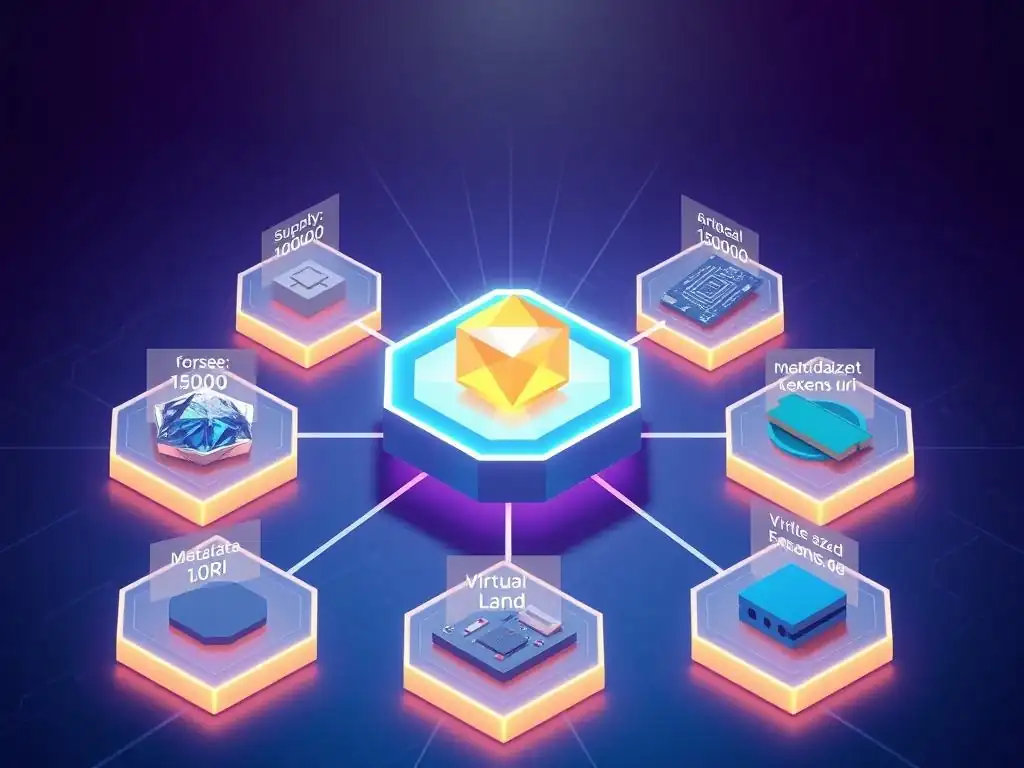
Implementing the URI Function: Setting Metadata for Tokens
Metadata is crucial for providing context and information about ERC1155 tokens. The ERC1155 standard includes a uri(uint256 _id) function that allows you to associate metadata with each token ID. This function should return a URI string, which is typically a URL pointing to a JSON file containing metadata for the specified token ID. The base URI for the contract is often set in the constructor, but the uri(uint256 _id) function allows for dynamic URI construction based on the token ID.
The URI can point to off-chain storage solutions like IPFS or centralized servers. The metadata JSON file usually includes attributes like name, description, image, and other properties relevant to the token. For example, for a token ID representing an in-game sword, the metadata might include the sword's name, a description of its properties, and a link to an image of the sword. Implementing the URI function correctly is essential for making ERC1155 tokens visually appealing and informative in marketplaces and applications.
Dynamically Generating Metadata for Each Token ID
Dynamically generating metadata for each token ID allows for greater flexibility and customization in how token information is presented. Instead of having a static base URI for all tokens, you can implement logic within the uri(uint256 _id) function to construct URIs based on the specific token ID. This is particularly useful when token metadata is not uniform or when you want to personalize metadata based on token attributes.
For instance, you could use a template URI and replace placeholders with token ID-specific information. Consider a scenario where the base URI is https://example.com/metadata/{id}.json. In the uri(uint256 _id) function, you would construct the full URI by replacing {id} with the actual _id value. This can be achieved using string manipulation libraries or by concatenating strings and converting the token ID to a string within the Solidity code. Alternatively, for more complex metadata generation, you might use an off-chain service or a decentralized storage solution that supports dynamic content retrieval based on token IDs. This dynamic approach enables richer and more context-aware metadata for ERC1155 MultiTokens.
Implementing Custom Logic and Extensions for ERC1155
ERC1155's design allows for significant customization and extension beyond the basic standard functionalities. You can implement custom logic to add unique features and behaviors to your MultiToken contract. This could include adding royalty mechanisms, implementing game-specific logic, or integrating with other smart contracts or off-chain systems. Custom logic can be implemented by overriding functions from the base ERC1155 contract or by adding new functions and state variables to your contract.
For example, you could implement a burning mechanism to reduce the supply of certain token types, or create a staking system where users can stake their ERC1155 tokens to earn rewards. The flexibility of ERC1155 makes it a powerful foundation for building complex and feature-rich blockchain applications. By carefully designing and implementing custom logic, you can tailor your ERC1155 MultiToken contract to meet the specific requirements of your project.
Adding Royalties to ERC1155 Tokens
Royalties are a common feature in NFTs, allowing creators to earn a percentage of secondary sales. While ERC1155 doesn't natively include royalties, you can implement this functionality by extending your ERC1155 contract. One approach is to create a royalty registry contract and integrate it with your ERC1155 contract. When a token is transferred, your contract would query the royalty registry to determine if a royalty should be paid and to whom.
For example, you could implement a function that is called during token transfers (e.g., by overriding _beforeTokenTransfer) to check for royalties. This function would look up the token ID in the royalty registry, retrieve the royalty percentage and recipient address, and then execute a payment to the recipient before completing the token transfer. Alternatively, you could use existing royalty standards or libraries, like those proposed by the EIP-2981 NFT Royalty Standard, to streamline the royalty implementation in your ERC1155 contract. Adding royalties can incentivize creators and foster a more sustainable ecosystem around ERC1155 MultiTokens, especially for digital art, collectibles, and gaming assets.
Implementing Game Logic using ERC1155 Tokens
ERC1155 is particularly well-suited for implementing game logic due to its efficiency and versatility in managing diverse in-game assets. You can use token IDs to represent different types of game items, characters, or resources, and leverage ERC1155 functions for in-game actions and interactions. For example, you could implement functions for crafting, trading, or using items, all governed by your ERC1155 smart contract.
Consider a game where players can craft new items by combining existing ones. You could implement a craftItem function that takes token IDs and amounts as input, representing the ingredients. The function would then check if the player has sufficient quantities of the required ingredients using balanceOf or balanceOfBatch. If the requirements are met, the function would burn the ingredient tokens (using _burn or _burnBatch) and mint the newly crafted item token (using _mint or _mintBatch). Similarly, game mechanics like item durability, levels, or special abilities can be encoded into the metadata associated with each token ID, and game logic can be designed to interact with and modify these metadata attributes. ERC1155 provides a robust and efficient framework for building complex on-chain game economies and mechanics.
Security Considerations for ERC1155 Smart Contracts
Security is paramount when developing smart contracts, especially those managing valuable digital assets like ERC1155 MultiTokens. Several security considerations are crucial to address to prevent vulnerabilities and protect user funds. Firstly, ensure your contract code is thoroughly audited by security professionals. Audits can identify potential vulnerabilities and logic errors that might be missed during development. Secondly, use well-tested and audited libraries like OpenZeppelin Contracts. OpenZeppelin provides secure implementations of ERC standards, reducing the risk of introducing common vulnerabilities.
Thirdly, implement proper access control mechanisms. Use modifiers like onlyOwner or role-based access control to restrict sensitive functions like mint and burn to authorized addresses only. Fourthly, be cautious about reentrancy attacks, especially when interacting with external contracts or handling token transfers. OpenZeppelin's ReentrancyGuard contract can help mitigate reentrancy risks. Finally, stay updated with the latest security best practices and vulnerability patterns in smart contract development, and continuously monitor your contract for any suspicious activity after deployment.
Preventing Common Vulnerabilities in ERC1155 Implementations
Several common vulnerabilities can affect ERC1155 smart contracts if not properly addressed. Reentrancy attacks occur when a malicious contract calls back into your contract during a function execution, potentially leading to unexpected state changes. To prevent this, use reentrancy guards and follow the checks-effects-interactions pattern in your code. Integer overflow and underflow vulnerabilities, while less common in Solidity versions 0.8.0 and above due to default safe math, can still be a concern in older versions or if using unchecked arithmetic. Always use safe math libraries or ensure your Solidity version has built-in overflow/underflow protection.
Access control vulnerabilities can arise if sensitive functions are not properly protected, allowing unauthorized users to mint, burn, or transfer tokens. Implement robust access control using modifiers and consider role-based access control for more complex permission management. Denial of Service (DoS) attacks can target smart contracts by exploiting gas limits or creating loops that consume excessive gas. Design your contract logic to avoid unbounded loops and carefully manage gas costs for all functions. Unhandled exceptions can lead to unexpected contract behavior. Use error handling mechanisms and require statements to validate inputs and conditions, ensuring that your contract behaves predictably even in error scenarios. By proactively addressing these common vulnerabilities and following security best practices, you can significantly enhance the security of your ERC1155 MultiToken smart contracts.
Testing and Deploying Your ERC1155 Contract
Writing Unit Tests for Your ERC1155 MultiToken Contract
Thorough unit testing is crucial to ensure the correctness and reliability of your ERC1155 MultiToken contract. Use a testing framework like Hardhat or Truffle to write unit tests that cover all critical functionalities of your contract. Test cases should include verifying the behavior of functions like mint, mintBatch, safeTransferFrom, safeBatchTransferFrom, balanceOf, balanceOfBatch, setApprovalForAll, and isApprovedForAll. Write tests for both success scenarios and failure scenarios (e.g., attempting to transfer more tokens than available balance, or minting tokens by an unauthorized address).
Use assertion libraries (built into Hardhat or libraries like Chai) to check that the contract's state changes as expected after each function call. For example, after minting tokens, verify that the recipient's balance has increased correctly. Test edge cases and boundary conditions, such as minting zero tokens or transferring tokens to the zero address. Aim for high test coverage to ensure that all parts of your contract logic are adequately tested. Well-written unit tests provide confidence in your contract's functionality and help prevent regressions as you make changes or add new features.
Deploying the ERC1155 Contract to a Test Network
Once you have written comprehensive unit tests and are confident in your contract's functionality, the next step is to deploy it to a test network. Test networks like Goerli, Sepolia, or Rinkeby (deprecated) are public Ethereum networks that use test ether, allowing you to deploy and interact with your contract without spending real funds. Configure your development environment (e.g., Hardhat or Truffle) to connect to your chosen test network. This typically involves setting up a provider URL (e.g., from Infura or Alchemy) and configuring your deployer account with test ether.
Write a deployment script using your chosen framework. The script will compile your ERC1155 contract and deploy it to the specified test network. After deployment, the script should output the contract address on the test network. Record this address, as you will need it to interact with your deployed contract. Deploying to a test network allows you to test your contract in a realistic blockchain environment, interacting with it using wallets and blockchain explorers, before deploying to the main Ethereum network.
Verifying the Contract on Block Explorers
After deploying your ERC1155 contract to a test network (or mainnet), it's highly recommended to verify the contract on a block explorer like Etherscan. Verification allows users to see the source code of your contract directly on the block explorer, increasing transparency and trust. To verify your contract, you will typically need to provide the flattened source code of your contract, the compiler version used, and the optimization settings. Hardhat and Truffle provide plugins and tools to simplify the verification process.
Once verified, the contract page on the block explorer will display a green checkmark and show the verified source code. This allows anyone to inspect the contract's code and confirm that it matches the code you intended to deploy. Verification is a crucial step for building trust and credibility, especially for smart contracts that manage valuable assets. For ERC1155 MultiToken contracts, verification on block explorers is essential for users and applications to confidently interact with and utilize your tokens.
Interacting with Your ERC1155 MultiToken Contract
Using Web3.js or Ethers.js to Interact with the Contract
To interact with your deployed ERC1155 MultiToken contract from a web application or backend service, you will need to use a JavaScript library that can communicate with the Ethereum blockchain. Web3.js and Ethers.js are two popular choices. Both libraries provide APIs to connect to an Ethereum provider (e.g., MetaMask, Infura, Alchemy), send transactions, and call contract functions. Ethers.js is often favored for its smaller size, cleaner API, and better TypeScript support, while Web3.js is a more mature library with wider adoption in some legacy systems.
To interact with your contract, you will need the contract's ABI (Application Binary Interface) and its deployed address. The ABI is a JSON file that describes the contract's functions and events, allowing the JavaScript library to understand how to interact with the contract. Using either Web3.js or Ethers.js, you can create a contract instance using the ABI and address, and then call functions like balanceOf, safeTransferFrom, or mint (if you want to interact with a locally deployed instance for testing). These libraries provide the bridge between your JavaScript code and your deployed ERC1155 MultiToken smart contract, enabling you to build user interfaces and applications that leverage your tokens.
Building a Simple Frontend to Display and Manage ERC1155 Tokens
A frontend application provides a user-friendly interface for interacting with your ERC1155 MultiToken contract. Using JavaScript frameworks like React, Vue.js, or Angular, you can build a web application that allows users to view their token balances, send tokens to other users, and interact with other functionalities of your contract. Integrate Web3.js or Ethers.js into your frontend application to connect to the user's Web3 wallet (e.g., MetaMask) and interact with your deployed contract.
The frontend can display user balances fetched using balanceOf or balanceOfBatch, allowing users to see their inventory of ERC1155 tokens. Implement forms and buttons to trigger token transfers using safeTransferFrom or safeBatchTransferFrom, allowing users to send tokens to other addresses. You can also display token metadata fetched using the uri function, showing images, descriptions, and other attributes associated with each token ID. A well-designed frontend makes your ERC1155 MultiToken contract accessible and usable for non-technical users, enabling broader adoption and interaction with your tokens.
Integrating ERC1155 Tokens into Marketplaces and Applications
The true power of ERC1155 MultiTokens is unlocked when they are integrated into marketplaces and various blockchain applications. Marketplaces can support trading of ERC1155 tokens, allowing users to buy, sell, and exchange diverse digital assets represented by your contract. Integration involves developing marketplace smart contracts or platforms that can interact with ERC1155 contracts, enabling users to list, bid on, and trade tokens. Marketplaces need to handle token approvals using setApprovalForAll to facilitate secure and automated trading.
Beyond marketplaces, ERC1155 tokens can be integrated into a wide range of applications. Gaming platforms can use ERC1155 to represent in-game items, characters, and resources, enabling true ownership and interoperability of game assets. Supply chain management systems can use ERC1155 to track diverse products with unique attributes throughout the supply chain. Real-world asset tokenization platforms can leverage ERC1155 to represent fractional ownership of various assets, from real estate to commodities. Integrating ERC1155 MultiTokens into diverse applications expands their utility and unlocks their transformative potential across various industries.
Use Cases for ERC1155 MultiTokens
Gaming: Representing In-Game Items and Assets
The gaming industry is a prime use case for ERC1155 MultiTokens. Games often feature a wide variety of in-game items, currencies, and assets, ranging from common resources to rare and unique collectibles.
ERC1155's ability to handle both fungible and non-fungible tokens within a single contract makes it ideal for representing this diverse range of in-game assets efficiently. Common resources like gold or potions can be represented as fungible tokens with a single token ID and varying balances, while unique items like legendary swords or rare skins can be represented as non-fungible tokens with unique token IDs and a balance of 1.
Games can leverage ERC1155 to create truly player-owned in-game economies. Players can trade, sell, and exchange their in-game assets on decentralized marketplaces, fostering a more vibrant and engaging gaming experience. For example, games like "The Sandbox" and "Enjin" utilize ERC1155 to represent virtual land, in-game items, and characters, allowing players to own and control their digital assets and participate in player-driven economies. ERC1155 empowers game developers to create richer and more engaging gaming experiences with true digital ownership for players.
NFTs: Combining Fungible and Non-Fungible Token Functionality
ERC1155 blurs the lines between fungible and non-fungible tokens, offering a powerful combination of both functionalities. While ERC721 is primarily used for NFTs representing unique digital collectibles or art, ERC1155 can extend NFT capabilities by allowing for semi-fungible NFTs or collections with both unique and multiple edition items. For example, an artist could release a limited edition NFT collection where each NFT is unique (like ERC721), but also offer multiple editions of certain NFTs within the same collection (leveraging ERC1155's multi-token capability).
This hybrid approach can be beneficial for creating tiered NFT collections, where some NFTs are extremely rare and unique, while others are more common but still valuable. ERC1155 also simplifies the management of NFT marketplaces, as a single contract can handle both unique and multiple edition NFTs, streamlining trading and management of diverse NFT assets within a single platform. The versatility of ERC1155 in combining fungible and non-fungible token functionalities opens up new possibilities for NFT creators and platforms.
Supply Chain Management: Tracking Multiple Products with Unique Attributes
Supply chain management is another area where ERC1155 MultiTokens offer significant advantages. Modern supply chains involve tracking a vast array of products, each with potentially unique attributes, batch numbers, or serial numbers. Using separate ERC20 or ERC721 contracts for each product type or individual item would be inefficient and complex. ERC1155 provides a unified and efficient solution for tracking diverse products within a single smart contract.
Each product type can be represented by a unique token ID, and individual units of a product can be tracked using serial numbers or batch identifiers as unique token IDs within the same ERC1155 contract. This allows for granular tracking of products throughout the supply chain, from manufacturing to delivery. For example, a pharmaceutical company could use ERC1155 to track different types of medications, batch numbers, and expiration dates, ensuring transparency and traceability throughout the distribution process. ERC1155's efficiency and versatility make it a valuable tool for enhancing transparency and accountability in complex supply chains.
Real-World Asset Tokenization using ERC1155
Real-world asset tokenization involves representing ownership of physical assets on the blockchain. ERC1155 MultiTokens can be effectively used for tokenizing diverse real-world assets, ranging from fractional ownership of real estate to tokenizing commodities or collectibles. For fractional ownership, an ERC1155 token ID can represent a share of a real estate property, with multiple fungible tokens representing different fractions of ownership. For tokenizing collectibles or commodities, unique token IDs can represent individual items or units, allowing for transparent and verifiable ownership tracking.
For instance, a company tokenizing fine art could use ERC1155 to represent ownership shares of valuable paintings. Each share could be a fungible ERC1155 token, allowing multiple investors to own fractions of the artwork. Similarly, ERC1155 can be used to tokenize gold bars, with each token ID representing a specific bar with its serial number and weight. ERC1155's ability to handle both fungible and non-fungible representations within a single contract makes it a flexible and efficient standard for tokenizing a wide range of real-world assets, bridging the gap between traditional assets and the blockchain ecosystem.
Conclusion: The Future of Versatile Assets with ERC1155
The Benefits of Using ERC1155 for Diverse Applications
ERC1155 MultiToken smart contracts offer a multitude of benefits for developers and users across diverse applications. Their primary advantage lies in their versatility, allowing for the representation of both fungible and non-fungible tokens within a single contract. This unified approach simplifies smart contract development, reduces deployment costs, and enhances transaction efficiency, especially for batch operations. Efficiency is another key benefit, as ERC1155's batch transfer and balance query functionalities significantly reduce gas costs and network congestion compared to using separate ERC20 and ERC721 contracts.
Flexibility is also a major advantage. ERC1155's customizable metadata, operator approval system, and extensibility allow developers to tailor their token implementations to specific application requirements. Furthermore, ERC1155 promotes scalability by consolidating multiple token types into a single contract, making it easier to manage and scale blockchain-based systems with diverse digital assets. These benefits make ERC1155 a compelling choice for a wide range of applications, from gaming and NFTs to supply chain management and real-world asset tokenization.
Exploring the Potential of MultiToken Standards in the Blockchain Ecosystem
MultiToken standards like ERC1155 represent a significant step forward in the evolution of the blockchain ecosystem. They unlock the potential for more complex and efficient decentralized applications by providing a versatile and scalable framework for managing diverse digital assets. As blockchain technology matures and expands beyond cryptocurrencies, the need for standards that can handle a wider range of asset types becomes increasingly critical. ERC1155 addresses this need by offering a unified solution for representing both fungible and non-fungible tokens, paving the way for more sophisticated use cases and wider adoption of blockchain technology.
The continued development and adoption of MultiToken standards will likely drive innovation in various sectors. We can expect to see more applications leveraging ERC1155 and similar standards to create richer and more interconnected digital ecosystems. From metaverse platforms and decentralized gaming economies to tokenized real-world assets and advanced supply chain solutions, MultiToken standards are poised to play a crucial role in shaping the future of the blockchain landscape.
Further Resources for Learning More About ERC1155 Development
For developers eager to delve deeper into ERC1155 development, numerous resources are available to enhance their understanding and skills. The official EIP-1155 specification on the Ethereum GitHub repository is the definitive source for understanding the standard's technical details and requirements. OpenZeppelin Contracts library provides well-audited and readily usable ERC1155 implementations in Solidity, along with comprehensive documentation and examples, serving as an excellent starting point for practical development. Ethereum.org offers a wealth of educational resources on Ethereum development, including tutorials, documentation, and community forums, covering various aspects of smart contract development, including token standards.
Online platforms like ConsenSys Academy and Chainlink Academy offer blockchain development courses and workshops that often include modules on ERC1155 and MultiToken development. Community forums and developer communities on platforms like Stack Overflow, Reddit (r/ethereumdev), and Discord provide valuable opportunities to ask questions, share knowledge, and learn from experienced developers. By leveraging these resources, aspiring ERC1155 developers can gain the knowledge and practical skills necessary to build innovative and impactful blockchain applications utilizing the power of versatile MultiToken standards.
Frequently Asked Questions
What are ERC1155 multi-token smart contracts, and how do they differ from ERC721 NFTs?
ERC1155 contracts allow for representing both fungible and non-fungible tokens in a single contract, unlike ERC721 which is strictly for unique NFTs. This improved efficiency is a key difference.
What are the primary use cases for ERC1155 multi-token smart contracts beyond digital collectibles?
ERC1155s are ideal for game assets, supply chain management, and scenarios requiring representation of diverse asset types. Their efficiency makes them suitable for applications with high transaction volumes.
How do batch transfers in ERC1155 multi-token smart contracts enhance efficiency?
Batch transfers allow for sending multiple tokens of different types to multiple recipients in a single transaction, significantly reducing gas costs. This optimized functionality is a major benefit.
What are some of the key considerations when developing ERC1155 multi-token smart contracts for enterprise applications?
Security audits, scalability, and compliance with relevant regulations are crucial. Robust design and thorough testing are essential for enterprise adoption.
How might regulatory landscapes impact the future adoption and development of ERC1155 multi-token smart contracts?
Clearer regulatory frameworks surrounding tokenized assets will likely foster increased adoption. Lack of clarity could hinder growth and market uncertainty is a concern.
Final Reflection: Embracing the Future of Asset Versatility
The journey into ERC1155 MultiToken smart contracts reveals not just a technical innovation, but a fundamental shift in how we perceive and interact with digital assets. These contracts, far from being mere lines of code, represent a powerful tool for creating dynamic and versatile ecosystems, impacting everything from gaming and collectibles to supply chain management and beyond. Their relevance today lies in their ability to streamline asset management, reduce gas costs, and unlock unprecedented levels of flexibility for creators and users alike.
The ongoing influence of ERC1155 MultiTokens on the digital landscape is undeniable. They are not just a trend, but a foundational building block for the next generation of decentralized applications. The ability to represent multiple asset types within a single contract opens up possibilities we are only beginning to explore. As the digital world continues to merge with the physical, the need for versatile and efficient asset management will only grow stronger. The future of asset ownership is not about scarcity, but about access and utility. ERC1155 MultiTokens are a key enabler of this future.
As you delve deeper into the world of blockchain and decentralized technologies, consider the potential of ERC1155 MultiTokens to revolutionize your own projects and ideas. How can you leverage their versatility to create more engaging experiences, more efficient systems, and more valuable assets? The power to shape the future of digital ownership is in your hands. Embrace the challenge, explore the possibilities, and contribute to the evolution of this transformative technology.
Unleash Your Creative Power: Craft Your First MultiToken!
Thanks for diving into the world of ERC1155 MultiTokens! We hope you've gained a solid understanding of how these versatile assets can revolutionize your blockchain projects. Now it's time to turn that knowledge into action.
- Dive into the code: Start building your own ERC1155 contract using a simple template. Experiment with different token types and functionalities to truly grasp the power of MultiTokens.
- Share your newfound knowledge: Write a blog post or create a tutorial explaining a specific aspect of ERC1155 tokens that you found particularly interesting.
- Brainstorm innovative use cases: How could MultiTokens be applied to areas like gaming, NFTs, or supply chain management? Let your imagination run wild!
What amazing MultiToken creations will you bring to life?
Leave a Reply