
Breaking Down the Silos: How SSI Can Unify Digital Identities Across Platforms


Welcome to Blockchain Trends, your go-to source for understanding the real-world impact of blockchain technology. Forget just cryptocurrencies – we delve into the fascinating applications shaping our future. Are you ready to unlock the potential of a truly decentralized web?
Today, we're exploring a critical piece of that puzzle: Self-Sovereign Identity Blockchain Integration. What if you could control your digital identity across all platforms, eliminating data silos and enhancing privacy? Dive in to discover how SSI is poised to revolutionize the way we interact online and the challenges that lie ahead...
Breaking Down the Silos: How SSI Can Unify Digital Identities Across Platforms
- Introduction: The Fragmentation of Digital Identity and the Need for Self-Sovereign Solutions
- The Core Principles of Self-Sovereign Identity (SSI)
- Self-Sovereign Identity Blockchain Integration: A Technical Overview
- Benefits of Integrating SSI with Blockchain for Unified Digital Identities
- Use Cases: Real-World Applications of SSI Across Platforms
- Overcoming Challenges in Implementing Self-Sovereign Identity Blockchain Integration
- The Future of Digital Identity: SSI and Blockchain as Key Enablers
- Conclusion: Towards a Unified and Secure Digital Identity Ecosystem with SSI and Blockchain
-
Frequently Asked Questions
- What exactly is Self-Sovereign Identity (SSI) and how does it relate to the overall blockchain landscape?
- How can Self-Sovereign Identity Blockchain Integration benefit users compared to traditional identity systems?
- What are some real-world applications of SSI beyond cryptocurrencies, particularly in enterprise or government contexts?
- What are the main challenges hindering the widespread adoption of Self-Sovereign Identity Blockchain Integration?
- How might regulation impact the future development and implementation of SSI solutions that utilize blockchain technology?
- Final Reflection: Embracing a Future of Unified Identity
- Unveil Your SSI Potential: Take Control Now!
Introduction: The Fragmentation of Digital Identity and the Need for Self-Sovereign Solutions
Understanding the Current Challenges of Managing Digital Identities Across Multiple Platforms
The modern digital landscape requires individuals and organizations to manage a proliferating number of digital identities across disparate platforms and services. Each online service, from social media sites and banking portals to healthcare providers and e-commerce platforms, typically requires users to create a unique account with its own set of credentials. This results in a fragmented identity ecosystem where users must remember numerous usernames and passwords, often leading to password fatigue and the risky practice of reusing credentials across multiple sites. This fragmentation not only creates inconvenience but significantly elevates security risks.
Furthermore, this siloed approach means that personal data is scattered across numerous databases, each controlled by a different entity. Users have limited visibility into or control over which entities hold their data, how it is being used, or with whom it is being shared. According to various cybersecurity reports, millions of data records are compromised annually due to breaches targeting these centralized identity stores. The lack of a unified, user-centric identity system makes it difficult for individuals to assert control over their digital footprint and for businesses to verify identities efficiently and securely without relying on vulnerable, centralized repositories.
Introducing Self-Sovereign Identity (SSI) as a Solution to Identity Fragmentation
Self-Sovereign Identity (SSI) emerges as a paradigm shift in how digital identities are managed, fundamentally challenging the traditional model of centralized control. At its core, SSI empowers individuals to own and control their digital identities, deciding what information they share, with whom, and when. Instead of relying on third-party identity providers or service providers to manage their credentials, users become the central authority over their own identity data. This model moves away from silos, proposing a unified approach where an individual's identity attributes are held securely by the individual themselves, verifiable by others without needing a central intermediary.
SSI achieves this by enabling users to collect verifiable credentials from trusted issuers (like a university issuing a degree credential or a government issuing a driver's license credential) and store them securely in a digital wallet. When a service provider (a verifier) needs to confirm an attribute (like age or qualification), the user can selectively present the relevant credential from their wallet.
This process minimizes the data shared – often only confirming a specific attribute rather than revealing the entire underlying identity document – thereby enhancing privacy and reducing the attack surface compared to systems requiring full identity disclosure or relying on centralized identity stores. SSI offers a path toward a more secure, private, and user-controlled digital existence, directly addressing the fragmentation issues inherent in current systems.
How Blockchain Enhances Self-Sovereign Identity (SSI) for Cross-Platform Use
While SSI principles can be implemented using various technologies, integrating Self-Sovereign Identity with blockchain technology provides a robust and secure foundation, particularly for enabling trust and verifiability across different platforms. Blockchain's decentralized and immutable ledger acts as a trust anchor, providing a secure and transparent way to register and verify the authenticity of Decentralized Identifiers (DIDs) – unique identifiers controlled by the individual – and the schemas or public keys associated with verifiable credentials.
The blockchain doesn't store sensitive personal data or the credentials themselves; rather, it stores cryptographic proofs or references that allow verifiers to cryptographically confirm the validity of a credential presented by a user.
The inherent properties of blockchain technology, such as its distributed nature and resistance to tampering, make it an ideal infrastructure for supporting a global, interoperable SSI framework. By providing a shared, verifiable layer for identity components like DIDs and public keys, blockchain ensures that identities and credentials issued and verified on one platform can be trusted and accepted on another, without requiring bilateral agreements between every possible issuer and verifier.
This fundamental capability is what enables SSI to unify digital identities across platforms, facilitating seamless and secure interactions in a decentralized manner. The SelfSovereign Identity Blockchain Integration is therefore critical for building a truly interoperable and trustworthy digital identity ecosystem.
The Core Principles of Self-Sovereign Identity (SSI)
User Control and Data Ownership in SSI Systems
A cornerstone principle of Self-Sovereign Identity is placing the individual firmly in control of their digital identity and personal data. Unlike traditional identity systems where companies or governments act as custodians of user data, SSI posits that individuals should be the ultimate owners and managers of their identity attributes. This means users decide which pieces of information they share, with whom, and for what purpose. They hold their verifiable credentials in a personal digital wallet, which could be an application on their smartphone or a secure cloud service, giving them direct access and authority over their identity portfolio.
This shift in control empowers individuals to move away from relying on single, centralized identity providers. For example, instead of logging into a service using a social media giant's identity platform (which gives that giant insight into the user's activity on the service), an SSI user can present a specific, verifiable credential directly from their wallet.
This minimizes data sharing and prevents the creation of comprehensive profiles by third parties without explicit, granular user consent. Estimates suggest that centralized identity breaches cost organizations billions annually; by distributing control and minimizing data held by third parties, SSI significantly reduces this risk, returning power and privacy to the user.
Decentralization and the Role of Blockchain in SSI
Decentralization is a foundational element of SSI, ensuring that no single entity has unilateral control over the identity system or the ability to censor or revoke identities. This is where the integration of Self-Sovereign Identity with blockchain technology becomes particularly powerful. While SSI can conceptually exist without blockchain, blockchain provides a robust, decentralized infrastructure that aligns perfectly with SSI principles. The blockchain acts as a public, immutable ledger for registering Decentralized Identifiers (DIDs) and potentially the cryptographic hashes or public keys associated with verifiable credentials and their schemas.
The blockchain does not store the sensitive personal data contained within credentials. Instead, it stores minimal, non-personally identifiable information necessary to verify the integrity and authenticity of the identity components. This decentralized approach prevents a single point of failure or control that could be exploited or could lead to censorship.
For instance, if a government or corporation controls a centralized identity system, they could potentially deny access or revoke identities. In a blockchain-based SSI system, the decentralized nature of the ledger ensures that the core identity layer remains available and verifiable as long as the network exists, providing resilience and preventing single-party control over identity infrastructure.
Enhanced Privacy and Security with SSI Solutions
Self-Sovereign Identity significantly enhances both user privacy and security compared to traditional models. Privacy is improved because users share only the minimum necessary information required for a specific transaction or interaction, often using privacy-preserving techniques like Zero-Knowledge Proofs (ZKPs). Instead of revealing their date of birth to prove they are over 18, a user can use a ZKP to simply prove the statement "I am over 18" is true, without revealing the actual date. This selective disclosure minimizes the exposure of sensitive personal data, drastically reducing the privacy risks associated with oversharing.
Security is also bolstered through several mechanisms. First, by minimizing the amount of sensitive data stored in centralized databases, SSI reduces the attractiveness and impact of data breaches. If there's less data to steal, breaches are less catastrophic.
Second, the cryptographic nature of verifiable credentials and the use of a decentralized ledger for anchoring trust make credentials highly resistant to forgery and tampering. The SelfSovereign Identity Blockchain Integration provides a strong cryptographic proof that a credential hasn't been altered since it was issued by a trusted party. Furthermore, users are less reliant on remembering multiple passwords, reducing the risk associated with weak or reused credentials, which are implicated in a large percentage of security incidents annually.
Self-Sovereign Identity Blockchain Integration: A Technical Overview
Leveraging Blockchain for Identity Verification and Trust
Blockchain technology serves as a critical trust layer in Self-Sovereign Identity systems. Its primary role is not to store identity data, but to provide a decentralized, immutable, and transparent mechanism for verifying the integrity and authenticity of identity components. Specifically, blockchain is used to anchor Decentralized Identifiers (DIDs) and related public keys.
When an entity (an individual or organization) creates a DID, the public key associated with that DID, along with other relevant metadata, is typically registered on a compatible blockchain or distributed ledger technology (DLT). This registration process creates a public, verifiable record linking the DID to the cryptographic keys needed to verify signatures made by the DID controller.
When a user presents a verifiable credential, the verifier needs to confirm two things: that the credential was issued by a trusted issuer and that it hasn't been tampered with. The issuer's DID and its associated public key are registered on the blockchain. The verifier can look up the issuer's public key using their DID on the blockchain.
The verifiable credential itself contains cryptographic proofs (like digital signatures) made by the issuer using their private key. The verifier uses the issuer's public key (retrieved from the blockchain) to cryptographically verify these signatures. This process, facilitated by the blockchain's immutable record of public keys linked to DIDs, establishes a high level of trust in the authenticity of the credential and the identity of the issuer, without requiring a centralized authority.
The Architecture of an SSI System Based on Blockchain Technology
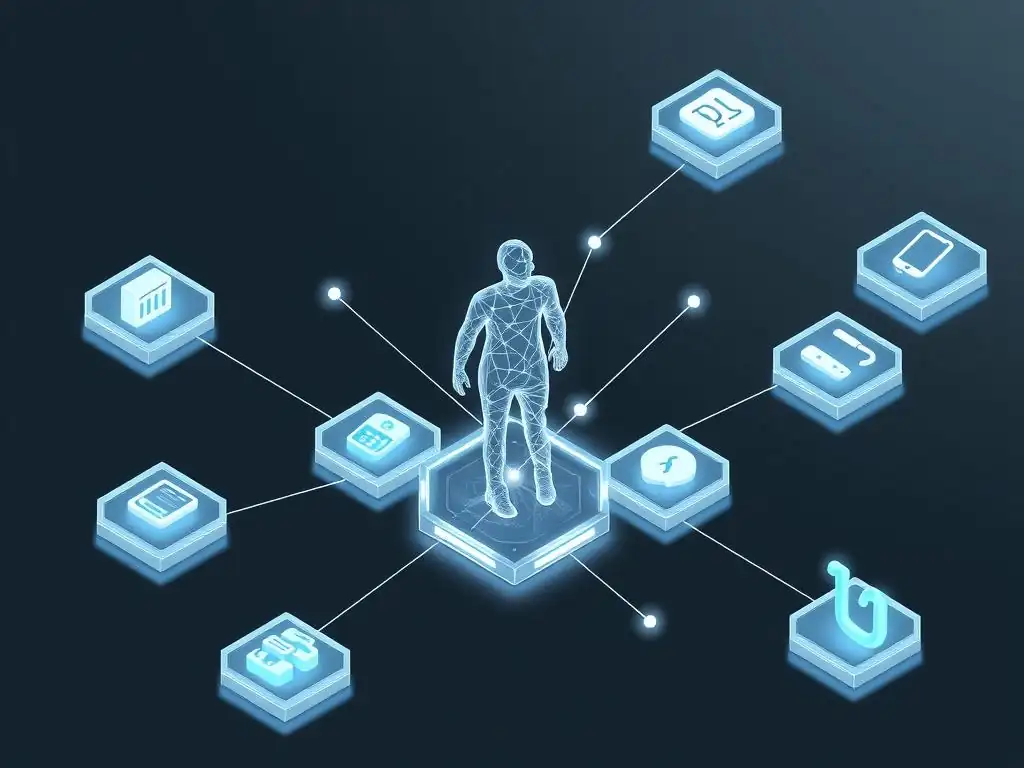
A typical Self-Sovereign Identity system leveraging blockchain technology involves several key components interacting within a decentralized ecosystem. At the center is the Holder (the individual or entity whose identity is being managed), who uses a digital Wallet application. This wallet securely stores the Holder's private keys, DIDs, and received Verifiable Credentials. Issuers (entities like universities, governments, or companies) issue Verifiable Credentials signed with their private key to the Holder's wallet. Verifiers (service providers, relying parties) request proof of certain attributes from the Holder.
The underlying infrastructure involves a decentralized network, often a blockchain or DLT. This network is used primarily as a DID Registry, where DIDs and their associated DID Documents (containing public keys and service endpoints) are registered and resolved.
The process flow for SelfSovereign Identity Blockchain Integration typically involves: 1) Issuer creating a Verifiable Credential and signing it; 2) Holder receiving and storing the credential in their wallet; 3) Holder creating a Verifiable Presentation (a collection of one or more credentials or proofs) in response to a Verifier's request; 4) Verifier receiving the Verifiable Presentation and using the blockchain-based DID Registry to resolve the Issuer's DID and retrieve their public key; 5) Verifier using the public key to cryptographically verify the signatures on the credential(s) within the presentation. This architecture ensures that trust is established through cryptography and decentralized verification, rather than relying on centralized identity providers.
Key Components: DIDs (Decentralized Identifiers) and Verifiable Credentials
Two fundamental building blocks underpin Self-Sovereign Identity systems, especially those benefiting from SelfSovereign Identity Blockchain Integration: Decentralized Identifiers (DIDs) and Verifiable Credentials (VCs). DIDs are a new type of globally unique identifier designed to enable verifiable, decentralized digital identity. Unlike traditional identifiers (like usernames, email addresses, or government IDs) that are controlled by centralized authorities, DIDs are controlled by the entity they identify (an individual, organization, or even an object).
A DID is typically linked to a DID Document, which contains public keys and service endpoints necessary for interacting with the DID subject. The registration of DIDs and their associated DID Documents on a blockchain provides a secure, decentralized, and tamper-evident method for resolving DIDs and retrieving the necessary information to verify interactions.
Verifiable Credentials are tamper-evident assertions about a subject (the Holder), issued by a trusted party (the Issuer), and cryptographically signed. Think of them as digital equivalents of physical credentials like a driver's license, degree certificate, or membership card. A Verifiable Credential contains claims (e.g., "John Doe is over 18", "Jane Smith holds a Bachelor's degree from XYZ University") and cryptographic proof that ties the claims to the Issuer and the Holder.
The structure and format of VCs are standardized (e.g., by W3C), allowing for interoperability. The combination of DIDs (as the decentralized identity handle) and VCs (as verifiable claims about that identity) forms the core mechanism by which SSI enables users to control and selectively share verified aspects of their identity across different platforms, leveraging the blockchain as the trust anchor for DID resolution and public key verification.
Benefits of Integrating SSI with Blockchain for Unified Digital Identities
Enhanced Interoperability Between Platforms and Services
A significant advantage of Self-Sovereign Identity Blockchain Integration is the substantial enhancement of interoperability across diverse platforms and services. In the current fragmented landscape, identity systems are often proprietary, requiring complex integrations or relying on centralized identity providers that can become bottlenecks or single points of failure. SSI, built upon open standards like DIDs and VCs and leveraging a decentralized ledger like blockchain, provides a common framework for identity verification that is not tied to any single platform or provider.
This means that a verifiable credential issued by one entity (say, a university) and stored in a user's wallet can be seamlessly presented and verified by any other entity (say, a potential employer or another educational institution) that supports the SSI standards and can access the relevant public keys or DID information on the blockchain. This eliminates the need for custom integrations between every pair of services that need to exchange identity information.
For instance, a user could use the same set of verified credentials to apply for a loan, rent an apartment, or prove eligibility for a service, regardless of the underlying technology stack of the service provider. This level of seamless, secure identity flow is a direct result of SSI's decentralized architecture and the universal trust layer provided by blockchain.
Streamlined User Experience and Reduced Friction
Self-Sovereign Identity Blockchain Integration promises a dramatically improved user experience, significantly reducing the friction associated with managing digital identities and accessing online services. Users are freed from the burden of creating and remembering numerous usernames and passwords for every single platform. Instead, they manage their verified credentials securely within a single digital wallet. Logging into a service can become as simple as responding to a request from a verifier by selecting and sharing the necessary credential(s) from their wallet, often authenticated by a simple action like a fingerprint scan or face ID on their device.
Consider the current process of signing up for a new service, which often involves filling out lengthy forms and potentially uploading documents for verification. With SSI, a user could simply present a pre-verified credential containing the required information (e.g., name, address, age) directly from their wallet. This drastically reduces the time and effort required for onboarding.
Furthermore, managing profile updates becomes simpler; if a user's address changes, they get an updated credential from the issuing authority and store it in their wallet, ready to be shared with multiple services, rather than having to update their profile individually on dozens of different platforms. This streamlined approach makes digital interactions faster, easier, and more intuitive for the end-user.
Increased Security and Reduced Risk of Identity Theft
The security benefits offered by Self-Sovereign Identity Blockchain Integration are substantial, particularly in combating identity theft and data breaches. By shifting control of identity data from centralized service providers to the individual, SSI drastically reduces the amount of sensitive information stored in large, vulnerable databases. This decentralized model means there are fewer attractive targets for malicious actors seeking to compromise millions of records in a single attack. While a user's wallet could potentially be targeted, the impact is limited to that individual, not a massive pool of users, and wallets are designed with strong cryptographic security measures.
Moreover, the use of verifiable credentials and the blockchain as a trust anchor makes it incredibly difficult for attackers to forge identities or credentials. Any attempt to alter a verifiable credential would break the cryptographic signature, which can be easily detected by the verifier using the public key recorded on the blockchain.
The immutability of the blockchain ensures that the link between a DID and its public key cannot be maliciously altered. This cryptographic security, combined with selective disclosure (sharing only minimal data), significantly hardens the digital identity infrastructure against common attack vectors like phishing, credential stuffing, and large-scale data exfiltration, leading to a safer online environment for users.
Cost Savings Through Automated Identity Management
Implementing Self-Sovereign Identity Blockchain Integration can lead to significant cost savings for organizations across various sectors. Traditional identity verification processes are often manual, time-consuming, and require significant human resources to review documents, cross-reference databases, and handle customer support inquiries related to identity issues. By leveraging SSI, organizations can automate a large portion of their identity verification workflows. When a user presents a verifiable credential, the verification process is primarily cryptographic and can be performed instantly by a machine referencing the blockchain.
For instance, financial institutions spend considerable resources on Know Your Customer (KYC) and Anti-Money Laundering (AML) procedures. With SSI, a customer could obtain a verified KYC credential from a trusted issuer (perhaps a government agency or a specialized identity verification service) and present it to multiple financial institutions.
This eliminates the need for each institution to repeat the full KYC process from scratch, leading to estimated cost reductions of up to 80% in some use cases. Similarly, reduced helpdesk costs associated with password resets and account recovery, along with decreased liability from data breaches (which can cost millions per incident), contribute to the overall economic benefits of adopting SSI and its integration with blockchain technology.
Use Cases: Real-World Applications of SSI Across Platforms
SSI for Secure Login and Authentication Across Web Applications
One of the most immediate and impactful use cases for Self-Sovereign Identity Blockchain Integration is replacing traditional username/password logins and single sign-on (SSO) systems with a more secure and user-centric approach. Instead of creating a new account with each website or relying on a large tech company's SSO, users can authenticate using a verifiable credential from their SSI wallet. This credential could simply be a proof of identity issued once and stored securely.
When logging into a website, the site acts as a verifier requesting a specific proof (e.g., "Are you the owner of DID:example:123?"). The user responds by cryptographically signing a challenge using the private key associated with that DID, which the website verifies using the public key registered on the blockchain.
This method eliminates passwords entirely, removing the risk of weak or compromised credentials. It also provides a more private alternative to current SSO methods, as the relying party (the website) doesn't gain access to the user's activity across other sites linked through the SSO provider. Major identity foundations and consortia are actively developing standards and pilot programs for SSI-based authentication, aiming to provide a universal, phishing-resistant login method. This application of SSI and blockchain is poised to revolutionize web security and user convenience, moving towards a future where users authenticate with self-owned identity rather than platform-owned accounts.
SSI in Healthcare: Managing Patient Data Across Different Providers
The healthcare industry suffers significantly from siloed patient data, leading to inefficiencies, increased costs, and potentially compromised care quality. Patient records are often fragmented across different hospitals, clinics, labs, and specialists, making it difficult for healthcare providers to get a complete view of a patient's medical history, especially in emergency situations or when patients switch providers. Self-Sovereign Identity Blockchain Integration offers a powerful solution by empowering patients to control their own medical records.
In an SSI-based healthcare system, hospitals, labs, and doctors could issue verifiable credentials representing patient data (e.g., lab results, diagnoses, prescriptions). The patient holds these credentials in their secure digital wallet. When visiting a new specialist, the patient can grant that specific provider temporary, granular access to the relevant medical credentials from their wallet.
The provider can verify the authenticity of these credentials using the issuer's DID and the blockchain. This ensures data is shared securely, only with explicit patient consent, and provides a unified, patient-controlled view of medical history across different providers, improving care coordination and patient outcomes while maintaining strict privacy standards like HIPAA.
SSI in Supply Chain: Verifying the Authenticity of Products
Ensuring the authenticity and provenance of goods is a critical challenge in global supply chains, plagued by counterfeiting and lack of transparency. Self-Sovereign Identity Blockchain Integration can be applied to products and entities within the supply chain to create a verifiable, end-to-end record. Manufacturers, distributors, and even individual products can be assigned DIDs. As a product moves through the supply chain, each entity handling it (e.g., manufacturer, shipper, customs) can issue verifiable credentials asserting specific facts (e.g., "Product X was manufactured on Date Y," "Shipment Z left Port A on Date B").
These credentials are held by the product itself (perhaps via an NFC tag or QR code linked to a digital identity) or associated with its DID on a distributed ledger. Consumers can then use an SSI wallet application to scan a product's code, retrieve its DID, and verify the associated credentials on the blockchain. This allows them to see the product's journey, verify its origin, confirm it hasn't been tampered with, and authenticate its legitimacy. This application of SSI and blockchain provides unprecedented transparency and trust in supply chains, combating counterfeiting and enabling ethical sourcing verification.
SSI in Education: Managing Credentials and Academic Records
The traditional system of issuing and verifying academic credentials like degrees and transcripts is often cumbersome, prone to fraud, and difficult for individuals to share and manage effectively across their careers. Educational institutions can leverage Self-Sovereign Identity Blockchain Integration to issue verifiable credentials for degrees, diplomas, certifications, and transcripts directly to students' digital wallets. The institution acts as the Issuer, and the student is the Holder.
When a student applies for a job or further education, they can share these official, tamper-evident digital credentials directly from their wallet with the potential employer or institution (the Verifier). The verifier can instantly and cryptographically verify the authenticity of the credential using the issuing institution's DID and the blockchain.
This eliminates the need for paper certificates, reduces the time and cost associated with manual verification requests, and significantly lowers the risk of credential fraud. Projects in various countries are piloting blockchain-based digital diplomas, demonstrating the practical application of SSI in creating a portable, verifiable record of academic achievement controlled by the student.
Overcoming Challenges in Implementing Self-Sovereign Identity Blockchain Integration
Addressing Scalability Concerns with Blockchain-Based SSI
One of the primary challenges in implementing Self-Sovereign Identity Blockchain Integration on a global scale is addressing the inherent scalability limitations of many public blockchain networks. Traditional blockchains like Bitcoin or Ethereum (prior to Eth2 upgrades) have limited transaction throughput, which could become a bottleneck if every DID registration, DID document update, or credential status check were to occur directly on the main chain. A system designed to handle millions or billions of identities and daily verification requests requires an underlying infrastructure capable of processing a high volume of transactions quickly and affordably.
To overcome this, SSI implementations often leverage various scaling solutions. This includes using permissioned or consortium blockchains specifically designed for higher throughput, or utilizing Layer 2 scaling solutions on public blockchains. Additionally, SSI protocols are designed to minimize on-chain operations; typically, only the initial DID registration and crucial updates (like key rotations or revocations) occur on the ledger.
Credential issuance and verification primarily happen off-chain, relying on the blockchain only for resolving DIDs and confirming the issuer's public key or revocation status. This architecture, combined with advancements in blockchain technology and related protocols, is crucial for ensuring that SSI systems can scale to meet the demands of widespread adoption.
Ensuring Regulatory Compliance and Data Privacy
Navigating the complex landscape of data privacy regulations, such as GDPR in Europe, CCPA in California, and similar laws globally, presents a significant challenge for Self-Sovereign Identity Blockchain Integration. While SSI is designed to enhance privacy by giving users control and minimizing data sharing, the use of blockchain technology raises specific questions regarding the "right to be forgotten" and the immutability of data stored on a ledger. Since data on a blockchain is generally immutable, directly storing personally identifiable information (PII) on-chain is incompatible with privacy regulations that require the ability to erase personal data.
SSI architectures address this by strictly avoiding the storage of sensitive PII or credential content on the blockchain. As discussed, the blockchain typically only stores DIDs, public keys, and cryptographic hashes or proofs – data that is not personally identifiable in itself or is essential for the functioning of the identity system and compatible with regulatory requirements.
Verifiable credentials containing PII are stored off-chain, in the user's secure wallet, where they are under the user's control and can be deleted. Furthermore, SSI frameworks are being developed with privacy-by-design principles, incorporating features like selective disclosure and zero-knowledge proofs to ensure compliance with data protection laws while leveraging the benefits of decentralization and verifiability provided by blockchain.
Educating Users About the Benefits and Functionality of SSI
A critical, non-technical challenge for the widespread adoption of Self-Sovereign Identity Blockchain Integration is user education. The concepts of SSI, DIDs, verifiable credentials, and the role of blockchain represent a significant departure from familiar username/password or even centralized SSO models. Users are accustomed to relying on third parties to manage their digital identities, and the idea of taking full control, managing private keys, and understanding concepts like digital wallets and verifiable presentations can seem daunting. Lack of understanding can lead to hesitation in adoption, potential misuse (e.g., losing private keys), and failure to appreciate the privacy and security benefits.
Overcoming this requires clear, accessible communication and intuitive user interface design for SSI wallet applications and related services. The technology needs to be abstracted away from the user as much as possible, focusing instead on the practical benefits: enhanced privacy, improved security, and reduced friction. Educational initiatives are needed to explain why SSI is better and how to use it safely and effectively.
This involves collaboration between technology providers, identity foundations, businesses, and potentially governments to build trust and familiarity with this new paradigm for digital identity management. Successful user education is paramount for SSI to move from niche applications to a mainstream solution for unifying digital identities.
The Future of Digital Identity: SSI and Blockchain as Key Enablers
The Potential for a Universal, User-Centric Identity System
The convergence of Self-Sovereign Identity principles with blockchain technology holds the potential to create a truly universal, user-centric digital identity system. Such a system would allow individuals to possess a single, portable digital identity that works seamlessly across national borders, industry sectors, and online/offline interactions. Instead of country-specific or platform-specific identities, users would control a set of globally recognized verifiable credentials issued by various trusted authorities (governments, employers, universities, etc.) and stored securely in their personal wallets.
This vision contrasts sharply with the current fragmented landscape. A universal SSI system, underpinned by the interoperability and trust layer of blockchain, could facilitate everything from opening a bank account in a new country and proving eligibility for social services to interacting securely in the metaverse or participating in decentralized governance. The focus shifts entirely to the individual, who becomes the hub for their identity information, granting permission to access specific verified attributes as needed. This move towards a unified, user-controlled digital identity ecosystem promises greater efficiency, security, and empowerment for individuals worldwide.
The Role of SSI in the Metaverse and Web3
As the digital world evolves towards more immersive and decentralized environments like the metaverse and Web3, Self-Sovereign Identity Blockchain Integration becomes increasingly crucial. In these emerging spaces, users will need persistent, portable identities that are not tied to a single platform or corporate entity. SSI is perfectly positioned to provide this foundation. A user's SSI wallet could hold credentials proving ownership of digital assets (like NFTs), participation in decentralized autonomous organizations (DAOs), gaming achievements, or even verifiable attributes of their avatar.
These SSI-based identities would allow users to move between different metaverse platforms or Web3 applications while carrying their reputation, assets, and verified attributes with them. Authentication would occur via SSI proofs, ensuring secure and private interactions. For example, a user could prove they are over 18 to access certain content in a virtual world without revealing their exact age, or prove ownership of a specific digital item to use it across different games.
SSI provides the necessary framework for identity, authenticity, and trust in decentralized virtual environments, ensuring that the future of online interaction remains user-controlled and interoperable. The successful SelfSovereign Identity Blockchain Integration is foundational for realizing the full potential of Web3 and the metaverse.
Advancements in Zero-Knowledge Proofs for Enhanced Privacy in SSI
Ongoing advancements in cryptographic techniques, particularly Zero-Knowledge Proofs (ZKPs), are set to further enhance the privacy capabilities of Self-Sovereign Identity systems. ZKPs allow one party (the prover) to prove to another party (the verifier) that a statement is true, without revealing any information beyond the validity of the statement itself.
In the context of SSI, this means a user could prove they meet a certain criterion (e.g., "I am over 21", "I am a resident of Country X", "I have a specific professional certification") without disclosing the underlying sensitive data (date of birth, address, certificate details) contained in their verifiable credential.
Integrating ZKPs into SSI verification flows drastically minimizes the amount of data shared during an interaction, adhering strictly to the principle of least privilege. This provides an even stronger layer of privacy compared to simply sharing the full credential. As ZKP technology matures and becomes more efficient and easier to implement, its integration into SelfSovereign Identity Blockchain Integration will become standard, making digital interactions significantly more private while still maintaining verifiability and trust anchored by the blockchain. This ongoing innovation underscores the potential for SSI to set a new standard for privacy-preserving digital identity.
Conclusion: Towards a Unified and Secure Digital Identity Ecosystem with SSI and Blockchain
Recap of the Benefits of Self-Sovereign Identity Blockchain Integration
The fragmentation of digital identities across countless platforms presents significant challenges for individuals and organizations alike, including inconvenience, security risks, and lack of user control. Self-Sovereign Identity (SSI), particularly when enhanced by SelfSovereign Identity Blockchain Integration, offers a compelling solution. By enabling users to control their own digital identities and verifiable credentials, SSI fundamentally shifts the paradigm from centralized, siloed identity management to a user-centric, decentralized model.
The key benefits of this integration are manifold: enhanced interoperability allows users to seamlessly use their identity across disparate platforms; a streamlined user experience eliminates password fatigue and simplifies interactions; increased security and reduced risk of identity theft result from minimized data exposure and cryptographic verification; and significant cost savings are achieved through the automation of verification processes. SSI, leveraging the trust and immutability provided by blockchain, creates a foundation for a more secure, private, and efficient digital world.
Call to Action: Embracing the Future of Digital Identity
The shift towards a user-controlled, decentralized digital identity ecosystem is not just a technological possibility but a necessary evolution to address the inherent flaws of current identity systems. Self-Sovereign Identity Blockchain Integration is at the forefront of this movement, offering a clear path towards unifying digital identities in a way that respects user privacy, enhances security, and fosters interoperability.
Organizations across all sectors – from healthcare and finance to education and e-commerce – should explore and embrace SSI solutions. Investing in pilot programs, understanding the underlying technology standards (DIDs, VCs), and preparing for the transition away from traditional, centralized identity models are crucial steps. For individuals, becoming familiar with SSI concepts and the potential of digital wallets is key to reclaiming control over their digital lives. By collaboratively building and adopting this new infrastructure, we can move towards a future where digital identity is unified, secure, and truly self-sovereign.
Frequently Asked Questions
What exactly is Self-Sovereign Identity (SSI) and how does it relate to the overall blockchain landscape?
SSI is a decentralized approach to identity management that gives individuals control over their digital identities. It leverages blockchain technology to create verifiable credentials and eliminates reliance on centralized authorities.
How can Self-Sovereign Identity Blockchain Integration benefit users compared to traditional identity systems?
SSI empowers users with greater privacy and security by allowing them to selectively share information. It also reduces the risk of data breaches and identity theft associated with centralized databases.
What are some real-world applications of SSI beyond cryptocurrencies, particularly in enterprise or government contexts?
SSI can streamline processes like employee onboarding, supply chain management, and cross-border travel. It can also improve access to government services and enhance data interoperability across different systems.
What are the main challenges hindering the widespread adoption of Self-Sovereign Identity Blockchain Integration?
Challenges include lack of standardization, scalability issues with some blockchain platforms, and the need for user education to understand and manage their digital identities effectively.
How might regulation impact the future development and implementation of SSI solutions that utilize blockchain technology?
Clear and consistent regulations are crucial for fostering trust and accelerating adoption. Well-defined frameworks can provide legal certainty and address concerns around data privacy and security within SSI ecosystems.
Final Reflection: Embracing a Future of Unified Identity
The journey towards Self-Sovereign Identity (SSI) Blockchain Integration isn't just a technological advancement; it's a fundamental shift in how we perceive and manage our digital selves. The potential to break down the silos that currently fragment our online existence, as explored throughout this article, is not a distant dream, but a pressing need in an increasingly interconnected world. The power to control our data, to present verifiable credentials across diverse platforms, and to reclaim ownership of our digital identities is within reach, promising a future where trust and security are built into the very fabric of the internet.
The impact of SSI extends far beyond mere convenience; it's about empowering individuals and fostering a more equitable digital landscape. The ability to selectively share verified information, without relying on centralized authorities, resonates deeply with the growing desire for privacy and autonomy in the digital age. This paradigm shift mirrors a broader societal yearning for greater control over personal data, a sentiment powerfully captured by the words of Andreas Antonopoulos: The future of identity is self-sovereign. You own it. You control it. It expresses who you are, not who someone else thinks you are.
As we stand on the cusp of this transformative era, let us not be passive observers. Consider the implications of SSI for your own digital footprint. Reflect on the power you could wield by controlling your data, and the trust you could build by presenting verifiable credentials. Embrace the possibilities of a future where your digital identity is truly yours, and actively participate in shaping a more secure, private, and empowered digital world. The future of identity is in our hands; let's build it together.
Okay, I understand. Here's a CTA designed for the end of a web article titled "Breaking Down the Silos: How SSI Can Unify Digital Identities Across Platforms," published on Blockchain Trends (blockchaintrends.org):
Unveil Your SSI Potential: Take Control Now!
Thanks for exploring the power of Self-Sovereign Identity (SSI) and its potential to revolutionize digital identity management. You've now gained a deeper understanding of how SSI can break down silos and create a more unified and secure online experience. Ready to put this knowledge into action?
Here are a few ways you can start exploring SSI today:
- Implement a personal digital wallet that supports SSI. Start experimenting with controlling your own data and verifying your credentials. This is your primary action, and it puts you in the driver's seat of your identity.
- Research SSI standards and frameworks like DID (Decentralized Identifiers) and Verifiable Credentials to deepen your understanding of the underlying technology. Discover how these components fit together to enable seamless and secure identity verification.
- Share this article with colleagues or on social media to spark conversation and promote the adoption of SSI. Help spread the word and contribute to building a more user-centric digital future.
What initial steps will you take to embrace SSI and reclaim control over your digital identity?
Leave a Reply