
The Security Advantages of Using Blockchain for Verifiable Credentials

Welcome to Blockchain Trends, your trusted source for unraveling the revolutionary power of blockchain technology.
Dive into a world beyond cryptocurrencies and discover how blockchain is reshaping industries. Are you ready to uncover the security benefits offered by blockchain verifiable credentials, a key component in shaping the future of digital identity? This article explores how this innovative approach enhances data integrity and strengthens trust in a decentralized world. Curious to learn more? Let's explore the transformative potential together!
Security Advantages of Blockchain for Verifiable Credentials
- Introduction: Blockchain's Role in Enhancing Verifiable Credentials Security
- Blockchain Verifiable Credentials Security Benefits
- Blockchain vs. Traditional Methods for Verifiable Credentials Security
- Security Features of Blockchain for Verifiable Credentials
- Use Cases: Blockchain Verifiable Credentials in Practice
- Security Challenges and Mitigation Strategies
- The Future of Blockchain Verifiable Credentials Security
- Conclusion: Blockchain for Secure Verifiable Credentials
-
Frequently Asked Questions
- How does blockchain enhance the security of verifiable credentials?
- What are the primary security advantages of using blockchain for verifiable credentials compared to traditional methods?
- How do blockchain verifiable credentials improve data privacy and control for users?
- What role does cryptography play in securing blockchain verifiable credentials?
- What are some potential security challenges associated with implementing blockchain-based verifiable credentials systems?
- Final Reflection: Securing Trust in a Digital World
- Unlock Next-Level Trust: Start Securing Your Credentials Today!
Introduction: Blockchain's Role in Enhancing Verifiable Credentials Security
The Importance of Secure Digital Credentials
In today's increasingly digital world, the reliance on digital credentials – such as academic degrees, professional certifications, government IDs, and medical records – has grown exponentially. These credentials serve as fundamental proofs of identity, qualifications, and rights, enabling access to services, employment, and educational opportunities.
The integrity and security of these digital documents are paramount; any compromise can lead to identity theft, fraud, unauthorized access, and significant financial or reputational damage for individuals and institutions alike. Ensuring that these digital proofs are genuinely issued by the stated authority, have not been altered since issuance, and can only be verified by authorized parties is a critical challenge.
Traditional systems for managing digital credentials often rely on centralized databases or paper-based processes with digital overlays, both of which present inherent security vulnerabilities. Centralized databases are attractive targets for cybercriminals, susceptible to single points of failure, data breaches, and unauthorized modifications. The Equifax data breach in 2017, affecting approximately 147 million consumers, highlighted the devastating impact of compromising a centralized repository of sensitive personal data, including information often linked to credentials.
Similarly, verifying paper-based credentials can be cumbersome, prone to forgery, and lack the efficiency required for modern digital interactions. The need for a more robust, secure, and privacy-preserving method for issuing, managing, and verifying digital credentials has become undeniable.
Blockchain: A Security Enhancer for Verifiable Credentials
Blockchain technology offers a paradigm shift in how digital credentials can be secured and managed. By providing a decentralized, immutable, and transparent ledger, blockchain inherently addresses many of the security weaknesses found in traditional credentialing systems. Instead of storing sensitive data directly on the blockchain, which could raise privacy concerns, blockchain is typically used to anchor cryptographic proofs (hashes) of the credentials issued off-chain.
This process ensures that the credential data, held securely by the user, has not been tampered with since its issuance. The distributed nature of the blockchain means there is no single point of failure for the verification system; the record of issuance is replicated across numerous nodes in the network, making it extremely difficult and costly for malicious actors to alter or delete.
The application of blockchain technology to verifiable credentials, often following standards like those developed by the W3C, creates a system where individuals can hold their credentials securely in a digital wallet, share them selectively with verifiers, and allow those verifiers to cryptographically confirm the credential's authenticity and integrity against the public record on the blockchain. This model empowers individuals with greater control over their personal data while providing verifiers with a highly reliable method for trustlessly confirming the validity of a credential.
The inherent security features of blockchain, such as cryptographic hashing, immutability, and the consensus mechanism, collectively contribute to significant blockchain verifiable credentials security benefits, establishing a new baseline for digital trust.
Blockchain Verifiable Credentials Security Benefits
Enhanced Data Integrity and Tamper-Proofing
One of the most significant blockchain verifiable credentials security benefits is the guarantee of data integrity. When a verifiable credential is issued, a cryptographic hash of the credential's data is created and recorded on the blockchain. This hash acts as a unique digital fingerprint of the data at that specific moment.
Because of the nature of hashing algorithms, even a minor alteration to the original credential data will result in a completely different hash value. The blockchain's immutability ensures that once this hash is recorded in a block and added to the chain through the network's consensus mechanism, it is practically impossible to alter or remove without recalculating the hashes of all subsequent blocks – a computationally infeasible task for a public blockchain like Bitcoin or Ethereum.
This tamper-proofing mechanism provides verifiers with a high degree of confidence that the credential presented by the holder is exactly as it was originally issued by the issuer. For instance, in the context of academic degrees, a university could issue a digital diploma as a verifiable credential. A cryptographic hash of this diploma's data (including student name, degree, date, etc.) would be anchored on a blockchain.
If a potential employer later receives this digital diploma from the graduate, they can independently verify its integrity by recalculating the hash of the received document and comparing it to the hash recorded on the blockchain. If the hashes match, the employer knows the diploma hasn't been altered. This process drastically reduces the risk of credential fraud compared to relying solely on physical documents or easily modifiable digital files.
Decentralized Control and Reduced Points of Failure
Traditional credentialing systems often rely on central authorities or databases to store, manage, and verify credentials. This centralization creates single points of failure, making the system vulnerable to targeted attacks, outages, or data breaches. If the central database is compromised or goes offline, the entire system for issuing and verifying credentials can be disrupted, potentially affecting millions of users. Furthermore, central authorities hold significant power over the data, which can raise concerns about privacy, censorship, and the potential for misuse of information.
Blockchain technology, by its very design, is decentralized. The ledger recording the hashes of verifiable credentials is not stored in one location but is distributed across a network of computers (nodes). To alter the record, an attacker would need to gain control over a significant portion of the network's computing power (e.g., over 50% in a Proof-of-Work system), which is prohibitively expensive and difficult for large, established blockchains.
This distributed architecture eliminates the single point of failure, making the system far more resilient to attacks and outages. Control over the credential data itself is shifted from a central authority to the individual holder, who stores the credential securely in their digital wallet and chooses when and with whom to share it. This decentralized control over data is a key aspect of the blockchain verifiable credentials security benefits, enhancing both security and user privacy.
Improved Transparency and Auditability
While the content of verifiable credentials themselves (like a passport number or medical diagnosis) is kept private and off-chain, the record of their issuance and the anchoring of their cryptographic proofs on a public or permissioned blockchain can provide enhanced transparency and auditability for the system of credential issuance and verification. Every transaction that adds a credential hash to the blockchain is recorded and timestamped, creating an immutable log of activity.
This public or permissioned ledger allows authorized parties to audit the issuance process, verify the volume of credentials issued by a specific authority, and confirm the timestamps of critical events without needing access to the sensitive credential data itself.
This level of transparency in the issuance process can help build trust in the system and deter fraudulent activities by issuers. For example, a regulatory body could monitor the blockchain to ensure that only accredited institutions are issuing specific types of professional licenses.
Furthermore, in the event of a dispute regarding the issuance or validity of a credential, the blockchain provides an indisputable audit trail that can be used to verify the sequence of events and confirm the integrity of the recorded hash. This enhanced auditability is a significant blockchain verifiable credentials security benefit, providing a robust mechanism for accountability and verification within the credential ecosystem.
Blockchain vs. Traditional Methods for Verifiable Credentials Security
Addressing Vulnerabilities of Centralized Systems
Traditional systems for managing verifiable credentials often rely on centralized databases maintained by issuers (like universities, employers, or government agencies) or third-party verification services. These systems concentrate vast amounts of sensitive personal data in one or a few locations, making them high-value targets for cyberattacks. A successful breach can expose millions of records, leading to identity theft, fraud, and significant privacy violations.
The OPM data breach in 2015, which compromised records of over 21 million federal employees and contractors, including sensitive background investigation data, illustrates the severe consequences of centralized credential data vulnerability. Attackers exploited known weaknesses to gain access to the central database.
Blockchain-based verifiable credentials mitigate these risks by decentralizing the storage of sensitive data. The credential itself is stored securely by the individual holder, not in a large, centralized database controlled by the issuer or a third party. Only a non-sensitive cryptographic hash or identifier is placed on the blockchain.
This distributed model eliminates the single, lucrative target for attackers that centralized databases represent. While a holder's digital wallet could still be targeted, the impact of such a breach is limited to that individual's credentials, not a massive database affecting millions. This fundamental shift in data architecture is a core aspect of the blockchain verifiable credentials security benefits, moving away from honeypots of personal information.
Mitigating Data Breach and Fraud Risks
The risk of large-scale data breaches, where attackers steal vast quantities of personal information from a single source, is significantly reduced with blockchain verifiable credentials. Since individuals store their credentials in their own digital wallets, there is no central repository for attackers to exploit to gain access to millions of credentials simultaneously. While individual wallets could potentially be compromised (often due to poor key management by the user), this doesn't expose the entire system or other users' data. This model inherently limits the blast radius of any potential security incident.
Furthermore, blockchain's immutability and the use of cryptographic proofs make credential fraud extremely difficult. Unlike paper certificates or easily editable digital documents (like PDFs), a verifiable credential anchored on the blockchain cannot be altered without invalidating its cryptographic proof. Any attempt to modify the credential data would result in a hash mismatch when verified against the blockchain record.
This makes forging or tampering with credentials practically impossible for anyone without control of the original issuer's private key and the ability to rewrite the blockchain ledger (which is infeasible for public blockchains). This robust defense against fraud is a key blockchain verifiable credentials security benefit, enhancing trust in digital interactions.
Cryptography's Role in Securing Blockchain Credentials
Cryptography is the bedrock upon which the security of both blockchain and verifiable credentials is built. In the context of verifiable credentials, cryptography is used in several key ways: First, digital signatures, typically using public-key cryptography (like ECDSA), are used by the issuer to sign the credential, proving its authenticity and origin. The verifier can use the issuer's public key to confirm the signature's validity. Second, hashing algorithms (like SHA-256) create unique, fixed-size digital fingerprints of the credential data. This hash is then anchored on the blockchain.
Third, zero-knowledge proofs (ZKPs) are an advanced cryptographic technique increasingly being explored for use with verifiable credentials. ZKPs allow a credential holder to prove to a verifier that they possess a certain attribute (e.g., being over 18, having a specific degree) without revealing any unnecessary underlying information about the credential itself (like their exact birth date or GPA). This significantly enhances privacy while maintaining verifiability. These cryptographic techniques, combined with the distributed and immutable nature of the blockchain, provide a powerful suite of tools that deliver superior blockchain verifiable credentials security benefits compared to less cryptographically intensive traditional methods.
Security Features of Blockchain for Verifiable Credentials
Immutable Records and Hashing
The core security feature enabling blockchain verifiable credentials security benefits is the concept of immutability, achieved through cryptographic hashing and the chaining of blocks. Each block in the blockchain contains a hash of the previous block, creating a chronological chain. If any data within a block is altered, its hash changes.
Since the next block contains the hash of the previous block, this change would break the chain, as the stored hash would no longer match the recalculated hash of the altered block. To successfully tamper with a record, an attacker would need to recalculate the hashes of the altered block and all subsequent blocks, and then convince the majority of the network participants that their altered chain is the correct one.
When a verifiable credential's hash is included in a block, it becomes part of this immutable chain. For instance, a university issuing 5,000 digital diplomas in a year might batch the hashes of these diplomas and include them in blockchain transactions. Once these transactions are confirmed and included in blocks, the record of these issuances is permanently etched into the ledger.
Any attempt to claim a fraudulent diploma or alter a legitimate one would be immediately detectable by comparing its hash against the immutable record on the chain. This cryptographic linking provides an incredibly strong guarantee that the data associated with the recorded hash has not been changed since its inclusion.
Distributed Ledger Technology (DLT) for Resilience
Blockchain is a specific type of Distributed Ledger Technology (DLT). The security advantage derived from DLT for verifiable credentials lies in its inherent resilience and availability. Unlike a centralized database that resides on a single server or cluster, a distributed ledger is replicated across numerous nodes in a network.
If one or even many nodes fail or are attacked, the network as a whole continues to operate, and the data (the record of credential hashes) remains accessible and verifiable from other nodes. This redundancy ensures that the system for verifying credentials is highly resistant to denial-of-service attacks or hardware failures that could cripple a centralized system.
Consider a scenario where a company needs to verify the professional certifications of hundreds of job applicants daily. If the certifying body's traditional online verification portal goes down due to a server issue or cyberattack, the company's hiring process could be halted.
With a blockchain-based system, the verification process relies on accessing the distributed ledger. As long as a sufficient number of nodes in the decentralized network are operational, the company can still query the blockchain to verify the integrity of the credential hashes presented by applicants, ensuring continuous operation and demonstrating the practical blockchain verifiable credentials security benefits in maintaining service availability.
Smart Contracts for Automated Validation
Smart contracts are self-executing contracts with the terms of the agreement directly written into code. Deployed on a blockchain, they automatically execute predefined actions when specific conditions are met. In the context of verifiable credentials, smart contracts can play a crucial role in automating and securing the issuance and verification processes. For example, a smart contract could be programmed to automatically issue a digital certificate credential once a student successfully completes all required course modules and their grades are recorded in an associated system, triggering the contract.
Smart contracts can also enhance the security and privacy of verification. Instead of a verifier needing to access the full credential data, a smart contract could be used to perform specific checks based on the credential's properties and the rules defined within the contract.
For instance, a smart contract could verify that a presented credential proves the holder is over 21 without revealing their exact birth date, using cryptographic techniques like zero-knowledge proofs integrated with the contract logic. This automation reduces human error, ensures consistent application of verification rules, and adds a layer of programmable security, contributing significantly to the overall blockchain verifiable credentials security benefits.
Use Cases: Blockchain Verifiable Credentials in Practice
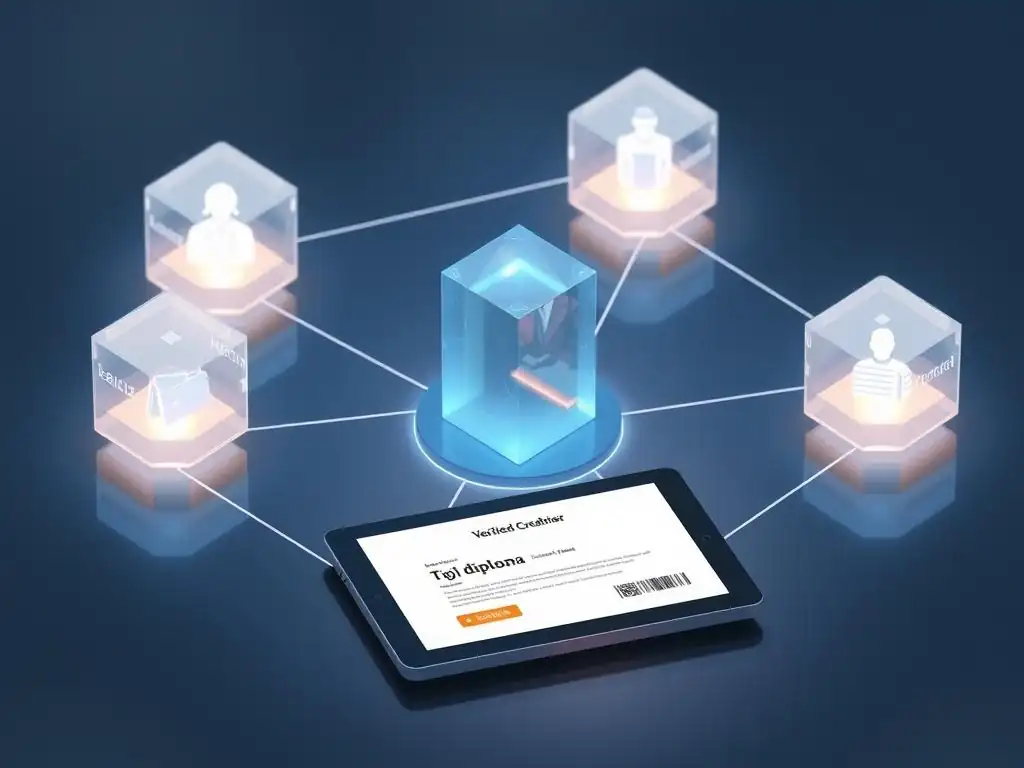
Secure Identity Verification in Healthcare
The healthcare sector deals with highly sensitive patient data and requires rigorous identity verification for accessing records, prescribing medications, and ensuring treatment accuracy. Blockchain verifiable credentials offer a secure and privacy-preserving way to manage patient identities and professional licenses for healthcare providers. For instance, a hospital could issue verifiable credentials to its medical staff proving their credentials, certifications, and privileges. These credentials, anchored on a permissioned blockchain, allow administrators to quickly and securely verify a doctor's qualifications without relying on manual checks or centralized, potentially vulnerable databases.
Furthermore, patients could potentially manage verifiable credentials related to their health records, granting specific healthcare providers access to relevant parts of their medical history for a limited time using granular permissions encoded within the credential or associated smart contract. This puts the patient in control of their data while providing healthcare professionals with verifiable, tamper-evident access to necessary information. Piloting projects in several regions, including parts of Europe and North America, are exploring how blockchain verifiable credentials can streamline patient identity management and provider credentialing, aiming to reduce administrative overhead and enhance data security and patient privacy.
Academic and Employment Verification
Verifying academic degrees and professional employment history is a time-consuming and often fraud-prone process. Traditional methods involve contacting institutions directly, which can take weeks and are still susceptible to forged documents. Blockchain verifiable credentials provide a near-instantaneous and highly secure alternative. Universities or employers can issue digital credentials (e.g., diplomas, transcripts, employment records) signed with their private key and anchored on a blockchain.
When a student or former employee applies for a new job or further education, they can share their verifiable credential directly from their digital wallet. The receiving institution or employer can then verify the credential's authenticity and integrity in seconds by checking the issuer's digital signature and the credential's hash against the immutable blockchain record.
Companies like Accredible and platforms utilizing standards from organizations like Velocity Network Foundation are already facilitating the issuance and verification of millions of such credentials globally, drastically reducing verification time from days or weeks to minutes and significantly mitigating the risk of credential fraud, showcasing clear blockchain verifiable credentials security benefits in action.
Supply Chain Management and Authentication
Ensuring the authenticity and provenance of goods is critical in supply chain management to combat counterfeiting and ensure compliance. Verifiable credentials, powered by blockchain, can be used to create digital passports for products, components, or even raw materials. Manufacturers, suppliers, and certifying bodies can issue verifiable credentials at each stage of the supply chain, documenting origin, quality inspections, certifications (e.g., organic, fair trade), and handling history. These credentials can be linked to physical items via QR codes or NFC tags.
As a product moves through the supply chain, new verifiable credentials can be added to its digital history, all anchored on a blockchain. A consumer or regulator can then scan the product's tag and verify the entire chain of custody and all associated claims by checking the integrity of the verifiable credentials against the blockchain.
This makes it extremely difficult to introduce counterfeit goods or falsify claims about a product's origin or quality. Projects in industries ranging from luxury goods to pharmaceuticals are leveraging blockchain verifiable credentials to build transparent and secure supply chains, enhancing consumer trust and providing robust authentication capabilities.
Security Challenges and Mitigation Strategies
Scalability Solutions
While blockchain offers significant security advantages, public blockchains, especially older ones like Bitcoin and Ethereum (prior to Eth2), have faced challenges with scalability – the ability to handle a large volume of transactions quickly and cheaply. Issuing millions or billions of verifiable credentials would require a highly scalable infrastructure. If the underlying blockchain cannot process transactions efficiently, the issuance and verification of credentials could become slow and expensive, hindering adoption.
Fortunately, significant progress has been made in blockchain scalability. Solutions include Layer 2 scaling protocols (like rollups on Ethereum) that process transactions off-chain and periodically anchor proofs on the main chain, significantly increasing throughput.
Other approaches involve using different consensus mechanisms (like Proof-of-Stake or delegated Proof-of-Stake) that are inherently more scalable than Proof-of-Work. Furthermore, purpose-built permissioned blockchains or distributed ledger technologies designed for high transaction volumes and specific enterprise use cases are being developed and deployed for verifiable credentials, offering millions of transactions per second in some cases, addressing the scalability concern while maintaining core blockchain verifiable credentials security benefits.
Private Key Management Best Practices
The security of verifiable credentials held by individuals in a digital wallet hinges on the secure management of their private keys. The private key is essential for accessing and controlling the credentials. If a private key is lost, the credentials associated with it may become inaccessible. If a private key is stolen, an attacker could potentially impersonate the credential holder and misuse their credentials. This risk shifts the security burden from a centralized authority to the individual user, which can be challenging for non-technical users.
Mitigation strategies focus on user education and the development of user-friendly, secure wallet technologies. Best practices for individuals include using strong, unique passwords for wallets, enabling two-factor authentication where available, storing backup recovery phrases securely offline, and being wary of phishing attempts.
Wallet providers are developing solutions like hardware wallets (physical devices that store keys offline), social recovery mechanisms (allowing trusted contacts to help regain access), and multi-signature wallets (requiring multiple keys to authorize actions), all aimed at making private key management more secure and less daunting for the average user, thereby preserving the blockchain verifiable credentials security benefits at the user level.
Data Privacy and Regulatory Compliance
While blockchain provides security through immutability and decentralization, the public nature of some blockchains can pose privacy challenges, as transaction data (even just hashes) is publicly visible. Furthermore, regulations like GDPR in Europe or CCPA in California grant individuals rights over their personal data, including the right to erasure. The immutable nature of public blockchains conflicts with the 'right to be forgotten' if sensitive personal data were directly stored on-chain (which is why sensitive data is stored off-chain).
Solutions and strategies for data privacy and regulatory compliance when using blockchain for verifiable credentials include: storing sensitive credential data off-chain in secure, encrypted storage controlled by the user; anchoring only non-sensitive hashes or identifiers on the blockchain; using permissioned blockchains where network access and data visibility are restricted to authorized participants; employing cryptographic techniques like zero-knowledge proofs to enable verification without revealing underlying data; and designing systems that allow for the revocation or updating of credentials off-chain, with the blockchain record reflecting the current status.
Adhering to these practices ensures that the use of blockchain for verifiable credentials security benefits aligns with global privacy regulations.
The Future of Blockchain Verifiable Credentials Security
Emerging Trends and Innovations
The field of blockchain verifiable credentials security is continuously evolving with new trends and innovations. One significant trend is the increased adoption of decentralized identifiers (DIDs) and verifiable credentials standards (like W3C VC 1.1), which provide a framework for self-sovereign identity and secure credential exchange independent of centralized authorities. Another area of innovation is the integration of advanced cryptography, such as zero-knowledge proofs, which allow for selective disclosure and verification of credential attributes without revealing the full data, significantly enhancing privacy while maintaining security.
Further developments include the exploration of specialized blockchain platforms optimized for identity and credential management, offering higher throughput, lower transaction costs, and features specifically designed for this use case. Research into post-quantum cryptography is also underway to ensure that blockchain security remains robust against potential future threats from quantum computing. These emerging technologies and standards are set to further enhance the blockchain verifiable credentials security benefits, making the system more private, efficient, and resilient.
Interoperability and Standardization
For blockchain verifiable credentials to achieve widespread adoption and deliver their full security potential, interoperability between different systems and platforms is crucial. Users need to be able to receive a credential from one issuer (e.g., a university) and share it with a verifier using a different wallet application or platform (e.g., an employer's HR system). Lack of standardization can lead to fragmented ecosystems where credentials issued on one platform cannot be verified on another, hindering usability and limiting the network effect that enhances security through broad participation.
Efforts by organizations like the W3C (working on Verifiable Credentials and Decentralized Identifiers specifications) and the Decentralized Identity Foundation (DIF) are driving the development of open standards. These standards ensure that verifiable credentials and the underlying identity infrastructure are built on common protocols, promoting interoperability across various blockchain networks and traditional systems. Achieving broad adoption of these standards is key to building a truly global, secure, and interoperable digital identity and credential ecosystem, maximizing the blockchain verifiable credentials security benefits across different domains.
Long-Term Impact on Digital Trust
The long-term impact of blockchain verifiable credentials security benefits extends to fundamentally transforming digital trust. By providing a secure, tamper-evident, and privacy-preserving method for proving claims about oneself, verifiable credentials anchored on blockchain can replace reliance on easily forged documents and vulnerable centralized databases. This shift empowers individuals with control over their digital identity and data, fostering a more trustworthy online environment for interactions ranging from online education and employment applications to accessing financial services and participating in civic processes.
As these systems mature and gain wider acceptance, the baseline of trust in digital transactions and identity verification will be significantly elevated. The inherent security properties of blockchain – immutability, decentralization, and cryptographic integrity – establish a new standard for how credentials are issued, managed, and verified. This evolution is poised to reduce identity fraud, streamline administrative processes, and enable new forms of secure digital interaction, ultimately building a more reliable and trustworthy digital future based on verifiable credentials secured by blockchain technology.
Conclusion: Blockchain for Secure Verifiable Credentials
Summarizing Security Advantages
The integration of blockchain technology with verifiable credentials offers a compelling suite of security advantages that significantly improve upon traditional methods. Key blockchain verifiable credentials security benefits include enhanced data integrity and tamper-proofing through cryptographic hashing and immutability, ensuring that credentials cannot be altered once issued and recorded.
The decentralized nature of blockchain eliminates single points of failure, making the system resilient to attacks and outages while shifting control over sensitive data from central authorities to individual users. Furthermore, the inherent transparency and auditability of the blockchain provide a clear, immutable record of credential issuance, fostering trust and accountability within the ecosystem.
These advantages directly address the critical vulnerabilities of centralized systems, such as susceptibility to large-scale data breaches and the ease with which physical or easily editable digital documents can be forged. By leveraging robust cryptography, including digital signatures, hashing, and potentially zero-knowledge proofs, blockchain verifiable credentials provide a higher level of assurance regarding authenticity and integrity. While challenges related to scalability, key management, and privacy compliance exist, ongoing innovations and adherence to best practices and open standards are effectively mitigating these issues.
Exploring Blockchain for Enhanced Credential Security
Exploring blockchain for enhanced credential security is not merely an academic exercise but a practical necessity in a world increasingly reliant on digital proofs of identity and qualifications. The verifiable credentials framework, underpinned by blockchain's security features, offers a path towards a future where individuals have greater control over their digital lives and where institutions can rely on a highly secure, efficient, and trustworthy method for verifying claims. From streamlining academic and employment verification to securing sensitive data in healthcare and ensuring product authenticity in supply chains, the applications are vast and impactful.
As standards mature and technology evolves, the implementation of blockchain verifiable credentials is set to become more widespread, fundamentally changing how we issue, manage, and verify digital identity and credentials. The inherent blockchain verifiable credentials security benefits position this technology as a cornerstone for building the next generation of secure, privacy-preserving, and user-centric digital identity systems, paving the way for a more trusted and efficient digital world.
Frequently Asked Questions
How does blockchain enhance the security of verifiable credentials?
Blockchain provides a tamper-proof and decentralized ledger, ensuring that credentials cannot be altered or forged. This immutability is a key security benefit.
What are the primary security advantages of using blockchain for verifiable credentials compared to traditional methods?
Traditional methods are often centralized and vulnerable to single points of failure. Blockchain offers increased transparency, reduced risk of fraud, and enhanced data integrity, all leading to greater security.
How do blockchain verifiable credentials improve data privacy and control for users?
Users gain greater control over their data by selectively sharing verifiable credentials without exposing unnecessary personal information. This ensures privacy and limits data breaches.
What role does cryptography play in securing blockchain verifiable credentials?
Cryptographic techniques, such as digital signatures and hashing, are essential for verifying the authenticity and integrity of credentials stored on the blockchain. This ensures secure verification and trust.
What are some potential security challenges associated with implementing blockchain-based verifiable credentials systems?
Challenges include scalability issues, potential vulnerabilities in smart contracts, and the need for robust key management practices to prevent unauthorized access to credentials.
Final Reflection: Securing Trust in a Digital World
The exploration of blockchain's role in securing verifiable credentials highlights a crucial intersection: the convergence of trust and technology in our increasingly digital lives. As we've seen, the inherent security features of blockchain, combined with the immutability and transparency it offers, present a compelling solution to the vulnerabilities plaguing traditional credentialing systems. This isn't just about technological advancement; it's about safeguarding identity and fostering confidence in online interactions.
The impact of blockchain verifiable credentials extends far beyond mere data protection. It promises to reshape how we interact with institutions, access services, and manage our personal information, empowering individuals with greater control and ownership. This shift is particularly poignant in an era marked by data breaches and identity theft. Trust is the glue of society, and verifiable credentials built on blockchain offer a new, stronger adhesive.
This quote encapsulates the potential of this technology to rebuild trust in a world where it's increasingly fragile.
Now, consider the implications for yourself. How can you advocate for the adoption of blockchain verifiable credentials in your own community or industry? What steps can you take to educate others about the blockchain verifiable credentials security benefits and the potential for a more secure and trustworthy digital future? The power to shape this future rests, in part, on our collective understanding and willingness to embrace innovative solutions. Let us strive to build a world where identity is secure, verifiable, and truly belongs to the individual.
Unlock Next-Level Trust: Start Securing Your Credentials Today!
Thank you for exploring the benefits of blockchain-secured verifiable credentials. We hope you've gained a clear understanding of how this technology enhances security and trust. Now, it’s time to take action and discover how you can implement blockchain solutions to improve data integrity and user control.
Here’s how to get started:
- Launch a pilot project using a blockchain-based verifiable credential platform. This is your primary step—go ahead and make it happen!
- Explore decentralized identity solutions to give users greater control and privacy over their credentials.
- Share this article with colleagues and industry contacts to foster discussion on the future of secure credentialing. Consider sharing your insights on professional networks like LinkedIn!
What specific use case for verifiable credentials excites you most for your organization? Share your thoughts in the comments below!
Leave a Reply