
Smart Contracts for Smarter Healthcare Security: Automating Data Protection with Blockchain


Welcome to Blockchain Trends, your gateway to understanding the revolutionary impact of blockchain technology. Beyond the buzz surrounding cryptocurrencies, we delve into its transformative potential across various sectors. Are you ready to discover how blockchain is reshaping industries?
In this issue, we're exploring a critical application: blockchain healthcare data security. Learn how smart contracts can automate data protection and revolutionize patient privacy. Intrigued? The future of secure and decentralized healthcare starts here. Dive in and uncover the power of blockchain!
Decentralized Identity and Access Management for Healthcare: Enhancing Security with Blockchain
- Introduction: The Imperative of Secure Data Access in Modern Healthcare
- Understanding Decentralized Identity (DID) in Healthcare
- Implementing Blockchain-Based Decentralized Identity for Healthcare
- Use Cases: DID in Action for Healthcare Security and Interoperability
- Addressing Challenges and Considerations for DID Implementation in Healthcare
- The Future of Healthcare Identity Management: DID Leading the Way
- Conclusion: DID - A Foundation for Secure and Patient-Centric Healthcare
-
Frequently Asked Questions
- How can smart contracts improve healthcare data security?
- What role does blockchain play in securing healthcare data?
- What are the key benefits of using blockchain for healthcare data security compared to traditional methods?
- What are the challenges to implementing blockchain solutions for healthcare data security?
- How can smart contracts automate compliance with healthcare data privacy regulations like HIPAA?
- Final Reflection: Securing Healthcare's Future with Blockchain
- Unlock Secure Healthcare: Implement Smart Contracts Today!
Introduction: The Imperative of Secure Data Access in Modern Healthcare
The Critical Need for Robust Identity Management in Healthcare
The healthcare sector holds some of the most sensitive personal data imaginable, including medical histories, treatment plans, and financial information. Protecting this data is not just a regulatory requirement but a fundamental ethical obligation. Traditional centralized identity and access management systems in healthcare organizations often struggle with inherent vulnerabilities, including single points of failure, susceptibility to credential theft, and complex, fragmented access controls. These weaknesses pose significant risks, leading to data breaches that can compromise patient privacy, erode trust, and incur substantial financial penalties.
Estimates from recent years consistently place the cost of a healthcare data breach significantly higher than in any other industry. For example, reports from IBM Security and the Ponemon Institute have shown the average cost per compromised record in healthcare to be upwards of \$400, dwarfing the cross-industry average. Furthermore, the number of affected individuals in major breaches can reach into the millions, highlighting the scale of the problem. The sheer volume and sensitivity of healthcare data necessitate a paradigm shift towards more resilient and secure identity management solutions to bolster blockchain healthcare data security.
Decentralized Identity (DID): A Paradigm Shift in Access Control
Decentralized Identity (DID) represents a fundamental departure from traditional centralized models where identity data is owned and controlled by a single entity, such as a hospital or insurer. In a DID framework, individuals (patients, providers, researchers) own and control their own digital identities. This self-sovereignty means that identity attributes (like medical licenses, patient IDs, or insurance details) are verified by trusted issuers but stored by the individual, typically in a secure digital wallet. Access to these attributes and associated data is then granted directly by the individual, not mediated solely by a central authority.
This model shifts the power over identity and access from institutions to the individuals themselves, offering enhanced privacy and control. For healthcare, this translates into patients having explicit control over who accesses their medical records and under what conditions. Providers can manage their credentials more securely, and researchers can obtain verifiable consent for data use directly from participants. This shift is crucial for improving overall blockchain healthcare data security by reducing reliance on vulnerable central databases and empowering data owners.
Blockchain's Role in Secure and Transparent Identity Verification
Blockchain technology provides a robust foundation for decentralized identity systems, particularly in healthcare. While the identity data itself isn't typically stored on the blockchain due to privacy concerns and data volume, the blockchain serves as a tamper-evident ledger for recording key events and anchors related to identity. This includes registering unique Decentralized Identifiers (DIDs), anchoring Verifiable Credentials (VCs) issued by trusted parties (like a hospital verifying a patient's identity or a medical board verifying a doctor's license), and logging consent directives.
By using blockchain, the verification process for DIDs and VCs becomes highly secure and transparent. The cryptographic properties of blockchain ensure that once an entry is recorded, it cannot be altered or deleted without being detected, providing an immutable audit trail. This transparency is critical for verifying the authenticity of credentials and tracking permissions granted. The distributed nature of blockchain also eliminates single points of failure associated with centralized identity registries, significantly enhancing the resilience and trustworthiness of the identity system, thereby contributing directly to stronger blockchain healthcare data security.
Understanding Decentralized Identity (DID) in Healthcare
What is Decentralized Identity and How Does it Work?
Decentralized Identity, at its core, is a system where users own and control their digital identities without reliance on a central authority. It typically involves three main components: Decentralized Identifiers (DIDs), Verifiable Credentials (VCs), and a distributed ledger or blockchain. A DID is a globally unique identifier that does not require a centralized registration authority.
It's essentially an address controlled cryptographically by the individual. Verifiable Credentials are tamper-evident digital attestations about an individual's attributes (e.g., "is a licensed physician," "is the patient John Doe," "has received vaccine X"). These VCs are issued by trusted entities (like licensing boards, hospitals, or labs) and cryptographically signed.
The workflow generally involves an issuer creating a VC for a holder (the individual) and anchoring a reference or cryptographic proof of this VC on a blockchain or distributed ledger. The holder stores the VC securely, often in a digital wallet. When the holder needs to prove an attribute (e.g., their identity to a clinic), they present the VC to a verifier.
The verifier uses the information in the VC and the anchor on the blockchain to cryptographically verify that the credential was issued by the claimed issuer and has not been tampered with. This process ensures trust and authenticity without the verifier needing to query a central database owned by the issuer, significantly enhancing privacy and blockchain healthcare data security.
Key Characteristics of DID Relevant to Healthcare
Several characteristics of Decentralized Identity make it particularly relevant and beneficial for the healthcare sector. Firstly, Self-Sovereignty: Patients and providers gain control over their identity information and how it is shared, moving away from institutional control. This aligns with patient privacy rights and regulations like HIPAA and GDPR. Secondly, Trust Minimization: Verification relies on cryptography and the distributed ledger, reducing the need to trust intermediaries for identity validation. This minimizes the attack surface compared to systems relying on centralized databases.
Thirdly, Interoperability: DIDs and VCs are designed to be interoperable across different systems and organizations using open standards (like those from the W3C). This is crucial for breaking down data silos in healthcare, enabling seamless and secure sharing of patient information across disparate providers and systems, improving blockchain healthcare data security while facilitating care coordination. Finally, Granular Control: Individuals can share specific pieces of information (e.g., just proof of vaccination status, not their full medical history) rather than monolithic identity profiles, enhancing privacy and control over sensitive health data.
Benefits of DID for Enhanced Healthcare Data Security and Patient Privacy
The adoption of Decentralized Identity offers substantial benefits for enhancing blockchain healthcare data security and patient privacy. By giving patients control over their identity and data access, DID minimizes the risk of unauthorized access and breaches originating from compromised centralized systems. Instead of hospitals holding large databases of patient identity attributes, patients hold and manage their own, only sharing what is necessary with explicit consent. This significantly reduces the attractive target presented by large, centralized identity repositories.
Furthermore, DID improves patient privacy by enabling selective disclosure of information. A patient can prove their identity or a specific health status (like vaccination) without revealing unrelated sensitive details. This is a marked improvement over current systems that often require oversharing of personal information for simple transactions. The use of blockchain ensures that the history of credential issuance and verification is transparent and auditable, making it easier to detect fraudulent activity and ensuring accountability. This robust framework is essential for building trust in digital healthcare interactions and strengthening blockchain healthcare data security against evolving threats.
Implementing Blockchain-Based Decentralized Identity for Healthcare
Secure Patient Onboarding and Identity Verification using Blockchain
Implementing blockchain-based Decentralized Identity begins with secure patient onboarding and identity verification. Traditionally, this involves manual checks, paper documents, and database lookups, which are prone to error and fraud. With DID, the process can be streamlined and secured.
A healthcare provider or trusted third party acts as an issuer, verifying the patient's identity using existing trusted methods (e.g., government ID). Upon successful verification, the issuer creates a Verifiable Credential containing attested identity attributes (like name, date of birth, unique patient ID) and cryptographically signs it. A reference or proof of this VC is anchored on a permissioned blockchain accessible to participating healthcare organizations.
The patient receives this VC in their secure digital wallet. When the patient interacts with another healthcare provider, they can present this VC from their wallet. The new provider, acting as a verifier, can instantly and cryptographically verify the authenticity and integrity of the VC by checking the issuer's signature and referencing the anchor on the blockchain.
This process is faster, more secure, and respects patient privacy, as the verifying provider doesn't need to query a centralized database or store the full identity data themselves. This approach significantly enhances the security of the initial patient interaction and contributes to overall blockchain healthcare data security.
Fine-Grained Access Control with DID: Empowering Patients and Providers
Decentralized Identity enables sophisticated, fine-grained access control over healthcare data, moving beyond simple username/password or role-based access. With DID, patients can use their identity wallet to explicitly grant and revoke permissions for specific healthcare providers or applications to access particular types of their health data (e.g., allowing a specialist access only to cardiology records). This consent can be managed dynamically by the patient through their wallet interface, putting them in the driver's seat of their health information.
Providers also benefit from DID for managing their own credentials and access rights. A doctor can use VCs to prove their medical license, board certifications, and hospital affiliations, simplifying credentialing across different institutions. Access to hospital systems or specific patient records can be tied to these verifiable credentials, ensuring that only authorized and currently credentialed personnel can access sensitive data. This level of granular control, managed through cryptographically secured identities anchored on a blockchain, drastically improves the precision and security of access, which is fundamental to robust blockchain healthcare data security.
Auditable and Transparent Access Logs via Blockchain
A critical component of any secure healthcare system is the ability to audit data access. Traditional systems often have fragmented or incomplete audit trails, making it difficult to detect or investigate unauthorized access. By integrating DID with a blockchain, a highly secure, transparent, and immutable audit log of access requests and permissions can be created. Whenever a healthcare provider requests access to a patient's data using their verified DID and the patient grants permission via their wallet, a record of this interaction (excluding sensitive data itself) can be logged on the blockchain.
This blockchain-based log serves as a tamper-evident record of who accessed what data, when, and with whose permission. Because blockchain entries are immutable, this log cannot be altered or deleted by malicious actors attempting to cover their tracks. This level of transparency and auditability is invaluable for compliance purposes (meeting requirements like HIPAA's audit controls) and for investigating security incidents. It provides a trustworthy historical record that significantly enhances accountability and strengthens blockchain healthcare data security by making all access events transparently trackable by authorized parties.
Use Cases: DID in Action for Healthcare Security and Interoperability
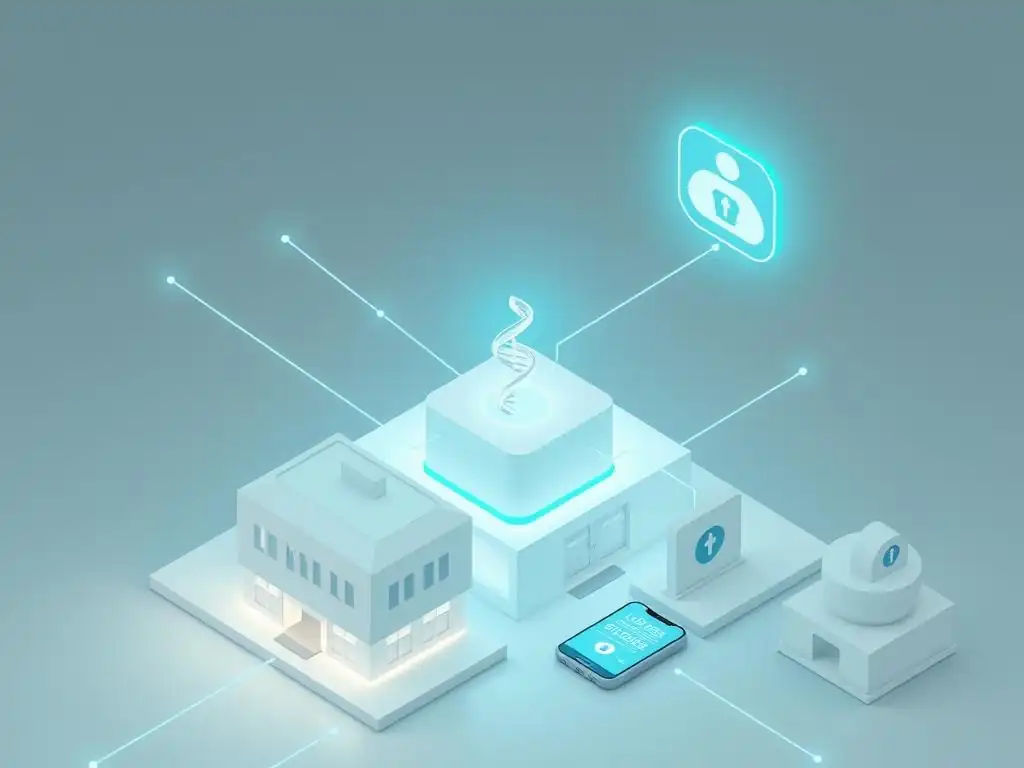
Use Case 1: Patient-Controlled Data Sharing across Healthcare Providers
Consider a patient seeing multiple specialists across different hospital systems. Currently, sharing records often involves cumbersome processes like faxing, mailing CDs, or using insecure patient portals that aren't interoperable. With a DID system, the patient holds their health records (or pointers to them) linked to their DID. When visiting a new specialist, the patient presents their DID and relevant VCs (e.g., confirming their identity and insurance). The specialist system verifies these credentials via the blockchain.
The patient can then use their digital wallet to grant the specialist temporary or specific access to relevant past records held by other providers. The consent and the access event are logged on the blockchain.
This empowers the patient, streamlines care coordination, and significantly enhances blockchain healthcare data security by eliminating insecure data transfer methods and providing an auditable trail of all data access initiated and approved by the patient. A pilot program in [Region/Country - e.g., Estonia's e-Health system principles, though not pure DID, illustrate the goal] demonstrates the potential for cross-provider data sharing, and DID can build upon this with enhanced patient control.
Use Case 2: Secure and Efficient Telemedicine Consultations with Verified Identities
Telemedicine is rapidly expanding, but verifying the identities of both patient and provider remotely can be challenging, raising security and fraud concerns. A DID framework provides a robust solution. Before a telemedicine consultation, both the patient and the provider can use their digital wallets to present verifiable credentials confirming their identities and professional standing (for the provider). The telemedicine platform, acting as a verifier, checks these VCs against the blockchain anchor.
This ensures that the patient is indeed the person they claim to be and that the provider is a licensed medical professional, all verified cryptographically without exchanging sensitive identity documents over potentially insecure channels. The verification process is fast and seamless, improving efficiency while drastically reducing the risk of identity spoofing or unauthorized practice. This secure identity layer is critical for building trust in virtual care environments and is a key application for enhancing blockchain healthcare data security in the context of remote healthcare delivery.
Use Case 3: Streamlining Clinical Trial Recruitment and Data Management with DID
Clinical trials require rigorous identity verification for participants and researchers, strict consent management, and secure handling of sensitive trial data. DID can significantly streamline and secure these processes. Potential trial participants can use their DID wallet to present verifiable credentials proving their eligibility criteria (e.g., age range, specific condition diagnosis) without revealing excessive personal information. Their consent to participate and share specific health data for the trial can be managed as a verifiable credential, dynamically updated and revoked by the participant.
Researchers can use their DIDs and VCs to prove their credentials and authorization to access trial data. All interactions – participant enrollment, consent updates, researcher data access – can be logged immutably on a blockchain, providing a transparent and auditable history for regulatory compliance. This system minimizes administrative overhead, reduces the risk of participant identity fraud, ensures robust consent management, and secures access to sensitive trial data, thereby significantly improving blockchain healthcare data security within clinical research. Early explorations by pharmaceutical companies into blockchain for clinical trials highlight the value proposition.
Addressing Challenges and Considerations for DID Implementation in Healthcare
Interoperability with Existing Healthcare Systems
One of the primary challenges in implementing DID in healthcare is ensuring interoperability with the vast and complex landscape of existing legacy systems, such as Electronic Health Records (EHRs), Laboratory Information Systems (LIS), and billing systems. These systems often use proprietary data formats, communication protocols (like HL7 and FHIR, though FHIR is improving), and identity management approaches. Integrating a new, decentralized identity layer requires careful planning and the development of integration layers or adapters that can translate between the DID framework and these diverse systems.
Achieving seamless data flow and access control will necessitate industry-wide collaboration on standards and potentially significant investment in updating or replacing existing infrastructure. While DID standards (like W3C DIDs and VCs) provide a foundation, their practical implementation needs to account for the realities of healthcare IT. Successful deployment will likely involve phased rollouts and pilot projects focused on specific use cases before attempting broad integration across an entire healthcare enterprise, ensuring that the benefits to blockchain healthcare data security are realized without disrupting critical operations.
Scalability and Performance Considerations for Blockchain-Based DID Solutions
The healthcare industry generates massive volumes of data and requires systems that can handle millions of transactions daily, from patient registrations to data access requests. The choice of blockchain or distributed ledger technology for anchoring DID components is critical for scalability and performance. Public, proof-of-work blockchains may not be suitable due to transaction costs and throughput limitations. Permissioned blockchains or distributed ledgers specifically designed for enterprise use cases, offering higher transaction speeds and lower costs, are more viable options.
Solutions must be able to process identity verifications and consent updates rapidly to avoid delays in patient care or administrative processes. The underlying infrastructure must be designed to scale as more patients, providers, and organizations adopt the system. Performance testing and optimization are essential to ensure that the benefits of enhanced blockchain healthcare data security are not negated by system slowness or inability to handle peak loads. Careful architectural design, potentially involving off-chain data storage linked to on-chain proofs, is necessary to meet healthcare's performance demands.
Regulatory Compliance and Data Governance in a Decentralized Environment
Navigating the complex regulatory landscape is paramount for any new technology in healthcare, and DID is no exception. Regulations like HIPAA in the United States and GDPR in Europe impose strict requirements on the privacy, security, and handling of Protected Health Information (PHI) and personal data. While DID enhances privacy by giving individuals control and enabling selective disclosure, implementers must ensure the system architecture and data flows fully comply with these rules.
Key considerations include ensuring that sensitive PHI is not stored directly on the blockchain, managing consent in a legally compliant manner (especially regarding the right to withdraw consent), and establishing clear data governance policies for issuers, holders, and verifiers within the DID ecosystem. The distributed nature of DID requires careful legal and technical frameworks to define responsibilities and ensure accountability. Collaboration with legal experts and regulatory bodies is crucial to design DID solutions that not only enhance blockchain healthcare data security but also meet all necessary legal obligations.
The Future of Healthcare Identity Management: DID Leading the Way
Emerging Standards and Technologies in Decentralized Identity
The field of Decentralized Identity is rapidly evolving, with ongoing work on standards and the development of new technologies that will further enhance its applicability in healthcare. The World Wide Web Consortium (W3C) has published recommendations for DIDs and Verifiable Credentials, providing a foundational framework. Initiatives like the Decentralized Identity Foundation (DIF) and the Trust Over IP Foundation (ToIP) are developing open standards and governance frameworks specifically designed for trustworthy exchange of digital credentials.
Future developments include more sophisticated methods for key management within digital wallets, enhanced privacy-preserving technologies (such as Zero-Knowledge Proofs, which allow verification of attributes without revealing the attribute itself), and standardized protocols for secure communication between DID wallets, issuers, and verifiers. These advancements will make DID systems more user-friendly, secure, and capable of handling the nuanced requirements of healthcare, paving the way for more robust blockchain healthcare data security solutions.
The Potential for Widespread Adoption of DID in Healthcare
The potential for widespread adoption of Decentralized Identity in healthcare is significant, driven by the increasing need for stronger data security, patient empowerment, and interoperability. As pilot projects demonstrate the tangible benefits – reduced administrative costs, improved patient satisfaction, fewer data breaches, and enhanced care coordination – healthcare organizations are likely to accelerate exploration and adoption. Government initiatives focused on digital health and data exchange could also mandate or incentivize the use of DID standards.
Adoption will likely be phased, starting with specific high-value use cases like secure patient onboarding, clinical trial management, or provider credentialing before expanding to full patient record access control. Collaboration among technology providers, healthcare institutions, regulators, and patient advocacy groups will be essential to build the necessary infrastructure and trust ecosystem. The global push for better data privacy and control aligns perfectly with the core principles of DID, positioning it as a leading contender for the future of blockchain healthcare data security.
Integration with Wearable Devices and IoT for Continuous Identity Validation
Looking further ahead, Decentralized Identity could integrate with the growing ecosystem of wearable health devices and Internet of Medical Things (IoMT) devices. These devices collect vast amounts of sensitive health data, and ensuring that this data is securely linked to the correct patient and only accessed by authorized entities is paramount. DID can provide a secure identity layer for these devices and the data they generate.
A wearable device could authenticate itself using a DID linked to the patient, ensuring data streams are correctly attributed. Access to data from these devices by healthcare providers or AI analysis platforms could be managed through patient-controlled verifiable credentials. Furthermore, continuous identity validation could be performed using biometric data processed locally on a device and attested to via a VC, enhancing security for remote monitoring or critical health interventions. This integration would extend the principles of blockchain healthcare data security beyond traditional IT systems into the realm of connected health.
Conclusion: DID - A Foundation for Secure and Patient-Centric Healthcare
Key Takeaways: The Transformative Power of Decentralized Identity in Healthcare
Decentralized Identity, built upon blockchain technology, offers a transformative approach to identity and access management in healthcare. By shifting control of identity from institutions to individuals, DID enhances patient privacy, reduces the risk of data breaches from centralized vulnerabilities, and enables fine-grained access control over sensitive health information. Key benefits include secure patient onboarding, streamlined provider credentialing, immutable audit trails for access, and significantly improved interoperability for data sharing across disparate systems.
The integration of verifiable credentials anchored on a distributed ledger provides a cryptographically secure and transparent method for verifying identities and permissions. This model addresses critical challenges facing modern healthcare, including the escalating costs of data breaches and the imperative to provide patients with greater control over their personal data. DID lays a robust foundation for building a more secure, efficient, and patient-centric healthcare ecosystem by fundamentally rethinking how identities are managed and verified, thereby strengthening blockchain healthcare data security at its core.
Call to Action: Embracing DID for a More Secure, Efficient, and Patient-Empowered Healthcare System
The path towards a more secure and patient-empowered healthcare future requires proactive adoption of innovative technologies like Decentralized Identity. Healthcare organizations, technology providers, and policymakers must collaborate to explore, pilot, and implement DID solutions that adhere to open standards and regulatory requirements. Investing in education and infrastructure to support this shift is crucial.
Embracing Decentralized Identity is not just about adopting a new technology; it's about fundamentally changing the relationship between patients, providers, and their data. It's about building trust through transparency, enhancing security through decentralization, and empowering individuals to be active participants in managing their health information. By moving towards DID, the healthcare sector can build a more resilient framework for blockchain healthcare data security, ensuring that patient data remains private, secure, and truly serves the patient's best interests.
Frequently Asked Questions
How can smart contracts improve healthcare data security?
Smart contracts automate data access control, ensuring only authorized individuals can access sensitive patient information. This reduces the risk of unauthorized data breaches and improves overall data integrity.
What role does blockchain play in securing healthcare data?
Blockchain provides a decentralized and immutable ledger for storing healthcare data. This makes it incredibly difficult for hackers to alter or tamper with records, enhancing data security and transparency.
What are the key benefits of using blockchain for healthcare data security compared to traditional methods?
Blockchain offers enhanced security and transparency over traditional databases. It also provides improved data interoperability between different healthcare providers, streamlining data sharing while maintaining security.
What are the challenges to implementing blockchain solutions for healthcare data security?
Challenges include scalability issues, the need for interoperability standards between different blockchain systems, and navigating complex regulatory landscapes surrounding patient data privacy.
How can smart contracts automate compliance with healthcare data privacy regulations like HIPAA?
Smart contracts can be programmed to automatically enforce HIPAA compliance rules, such as audit logging and access controls. This reduces the risk of non-compliance penalties and streamlines the regulatory reporting process.
Final Reflection: Securing Healthcare's Future with Blockchain
The insights explored throughout this article highlight the critical need for enhanced data security in healthcare, and the potential of blockchain technology and smart contracts to revolutionize this landscape is undeniable. The current climate of increasing cyber threats and data breaches necessitates innovative solutions, and the automation of data protection through blockchain offers a compelling path forward for safeguarding sensitive patient information.
This exploration of blockchain's application in healthcare data security has profoundly underscored the importance of trust and transparency in an increasingly digital world. The ability to create immutable records and automate access control through smart contracts offers a powerful tool for building a more secure and patient-centric healthcare ecosystem. The future of healthcare is not just about better medicine, it's about better data management and security.
This quote encapsulates the core challenge and opportunity we face in leveraging technology to improve patient outcomes and protect their privacy.
As we conclude, consider the implications of this technology for your own role in the healthcare system, whether as a patient, provider, or innovator. How can you champion the adoption of blockchain solutions to enhance data security and build a more trustworthy healthcare future? Let us all strive to embrace these advancements and work towards a world where patient data is protected with the utmost diligence and respect, ensuring that the benefits of technology are harnessed for the good of all.
Unlock Secure Healthcare: Implement Smart Contracts Today!
Thank you for exploring how smart contracts can enhance security in healthcare. You've gained valuable insights into automating data protection with blockchain technology. Now, it's time to take action and be part of the solution!
Here are a few steps you can take right now:
- Begin researching potential smart contract solutions that align with your organization's specific needs and regulatory requirements. This is a critical step in ensuring data security.
- Explore related blockchain applications within healthcare beyond data security, such as supply chain management or patient identity verification.
- Share this article with your network! Help spread awareness about the transformative potential of smart contracts in healthcare.
What specific data security challenge in healthcare do you believe smart contracts could address most effectively? Share your thoughts in the comments below!
Leave a Reply