
The Evolution of Real Estate Contracts: From Paper to Smart Contracts on the Blockchain

Welcome to Blockchain Trends, where we delve into the transformative potential of blockchain technology beyond the world of cryptocurrencies. In this enlightening journey, we explore cutting-edge innovations such as blockchain real estate smart contracts—a pivotal shift in how properties are bought and sold. Ever wondered how this technology is revolutionizing the real estate landscape? Join us as we unpack the evolution of real estate contracts, transitioning from traditional paper methods to the seamless efficiency of smart contracts on the blockchain. Your exploration of the future of decentralized systems starts here—let's dive deeper!
The Evolution of Real Estate Contracts: From Paper to Smart Contracts on the Blockchain
- Introduction: Revolutionizing Real Estate with Blockchain and Smart Contracts
- The Traditional Real Estate Contract: A Historical Perspective
- Blockchain Real Estate Smart Contracts: A Modern Solution
- How Blockchain Smart Contracts Work in Real Estate
- Use Cases: Blockchain Smart Contracts in Real Estate Applications
- Overcoming Challenges and Addressing Concerns
- The Future of Real Estate Contracts: A Blockchain-Powered Ecosystem
- Conclusion: Embracing the Future of Real Estate with Blockchain Technology
-
Frequently Asked Questions
- What are smart contracts in the context of real estate?
- How do blockchain technology and real estate contracts intersect?
- What are the benefits of using blockchain for real estate transactions?
- How do decentralized systems impact the real estate market?
- What regulatory challenges do blockchain real estate smart contracts face?
- Final Reflection: Embracing Transparency in Property Transactions
- Unlock Your Future: Embrace Smart Contract Real Estate!
Introduction: Revolutionizing Real Estate with Blockchain and Smart Contracts
The Current State of Real Estate Transactions: Challenges and Inefficiencies
Real estate transactions, from buying and selling to leasing and managing properties, have historically been plagued by complexity and inefficiency. The process typically involves numerous intermediaries – brokers, lawyers, escrow agents, title companies – each adding layers of cost and time. A single transaction can take weeks or even months to complete, involving extensive paperwork, manual verification steps, and coordination across multiple parties.
These inefficiencies stem from the inherent trust requirements in traditional systems. Each step, from verifying ownership to securing funds in escrow and executing the final transfer, relies on trusted third parties to mediate and validate the process. This not only increases transaction costs, often amounting to 6-10% of the property value in some markets, but also introduces potential points of failure, delays, and opportunities for fraud or error due to the manual nature of many tasks.
Blockchain's Potential to Transform Real Estate: A New Paradigm
Blockchain technology offers a decentralized and transparent ledger that can fundamentally alter how real estate transactions are conducted. By providing an immutable record of ownership and transaction history, blockchain can reduce the reliance on traditional intermediaries and streamline processes. This distributed ledger technology allows for greater transparency among verified participants and significantly enhances security by making records tamper-proof.
The potential impact of blockchain extends beyond just recording transactions. It can enable fractional ownership of high-value assets, making real estate investment more accessible. Furthermore, by automating processes through smart contracts, blockchain can drastically cut down on transaction times and costs, potentially reducing settlement periods from weeks to mere days or even hours, and lowering associated fees by potentially several percentage points.
Understanding Smart Contracts: The Building Blocks of Decentralized Real Estate
Smart contracts are self-executing contracts with the terms of the agreement directly written into code. They run on a blockchain, meaning they are decentralized, transparent, and immutable once deployed. These digital agreements automatically execute predefined actions when specific conditions are met, eliminating the need for manual intervention or trust in a third party to enforce the terms.
In the context of real estate, smart contracts can automate various parts of a transaction, such as releasing funds from escrow once property ownership is verified on the blockchain, or automatically distributing rental income to fractional owners. They represent a significant leap forward from static paper agreements, offering dynamic, programmable contracts that can react to real-world events or data feeds, paving the way for sophisticated Blockchain real estate smart contracts.
The Traditional Real Estate Contract: A Historical Perspective
Paper-Based Contracts: The Legacy System
For centuries, real estate transactions have been formalized through paper contracts. These legally binding documents outline the terms and conditions of the sale, lease, or transfer of property ownership. They require physical signatures from all involved parties and are typically stored in physical form or as scanned digital copies, often across various locations and institutions.
The process of creating, negotiating, signing, and managing these paper contracts is labor-intensive. It involves multiple rounds of drafting and review by legal professionals, physical meetings for signing, and often requires notarization. Storing and retrieving these documents can also be cumbersome, and their authenticity relies heavily on physical security and the integrity of record-keeping institutions.
Inefficiencies of Traditional Real Estate Agreements: Delays, Costs, and Risks
Traditional real estate agreements are notorious for introducing significant delays into the transaction process. Negotiating terms, securing financing, conducting title searches, and coordinating closing logistics can stretch timelines considerably. The reliance on manual processes for verification and transfer means that each step adds days or weeks to the overall duration.
Beyond delays, these traditional methods incur substantial costs. Legal fees for drafting and reviewing contracts, title insurance premiums, escrow service fees, and brokerage commissions all contribute to the high expense of buying or selling property. Furthermore, paper-based systems are vulnerable to errors, loss, or even fraud, as verifying the authenticity of documents and signatures across different parties can be challenging and time-consuming.
The Need for Modernization: Addressing the Pain Points
The persistent inefficiencies, high costs, and inherent risks associated with traditional paper-based real estate contracts highlight a clear need for modernization. The current system is not only slow and expensive but also lacks transparency for the parties involved, who often have limited visibility into the status of the transaction until key milestones are reached.
Modernizing real estate transactions requires leveraging technology to automate processes, enhance security, and increase transparency. The goal is to move away from a system reliant on fragmented paper trails and multiple intermediaries towards a more streamlined, secure, and cost-effective method that benefits both buyers and sellers, making transactions faster and more reliable.
Blockchain Real Estate Smart Contracts: A Modern Solution
What are Blockchain Smart Contracts for Real Estate?
Blockchain real estate smart contracts are digital agreements deployed on a blockchain network that automatically execute the terms of a real estate transaction when predefined conditions are met. Instead of relying on traditional legal text interpreted by humans and enforced by courts, the rules of the transaction are embedded directly into code. This code resides on an immutable, distributed ledger, providing transparency and security.
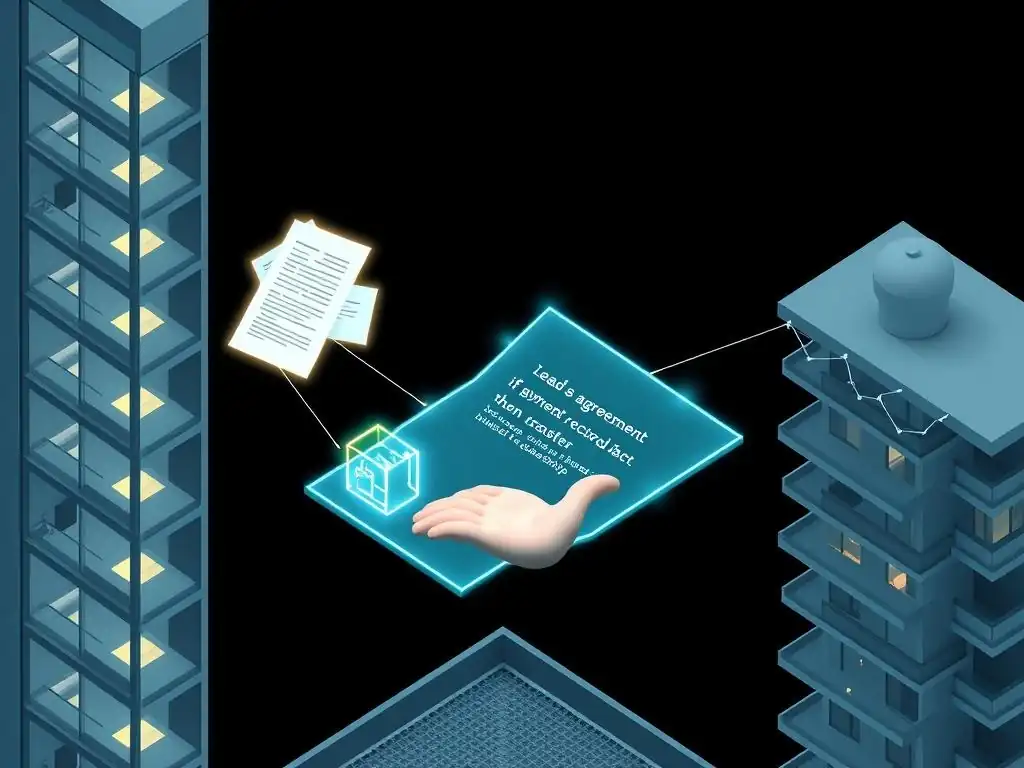
These smart contracts can represent various aspects of a real estate deal, from the initial offer and acceptance to the transfer of funds and property rights. For instance, a smart contract could be programmed to hold the buyer's funds in escrow and automatically release them to the seller only after the blockchain verifies that the digital representation of the property title has been successfully transferred to the buyer's digital wallet.
Key Features of Smart Contracts in Real Estate Transactions: Automation, Security, and Transparency
One of the primary features of Blockchain real estate smart contracts is automation. Once the conditions written into the contract code are met – such as the successful funding of an escrow account or the digital signing of a document – the contract automatically triggers the next action, like initiating a payment or transferring a tokenized asset. This eliminates manual steps and reduces the potential for human error or delay.
Security is another critical feature. Because smart contracts reside on a blockchain, their code and execution history are immutable and transparent to authorized participants. This makes it extremely difficult for malicious actors to tamper with the agreement or the transaction record. Furthermore, the decentralized nature of the blockchain enhances security by removing single points of failure often present in traditional centralized databases. Transparency is also baked in; all parties can view the contract's code and track its execution in real-time on the public or permissioned ledger.
Benefits of Using Smart Contracts in Real Estate: Enhanced Efficiency and Reduced Costs
Implementing Blockchain real estate smart contracts offers significant benefits, primarily in terms of enhanced efficiency. By automating key stages of the transaction process, from escrow management to title transfer, smart contracts can dramatically reduce the time it takes to complete a real estate deal. This acceleration can shrink transaction timelines from weeks or months down to days or even hours, depending on the complexity and regulatory environment.
The reduction in intermediaries and manual processes also leads to substantial cost savings. Fewer third parties mean fewer fees for services like escrow, legal review (for standard contracts), and title processing. While precise figures vary, estimates suggest that transaction costs could be reduced by 1-3% of the property value in some cases. Moreover, the increased security and transparency offered by blockchain and smart contracts can mitigate risks, potentially lowering insurance costs and reducing the likelihood of expensive legal disputes arising from errors or fraud.
How Blockchain Smart Contracts Work in Real Estate
Digitizing Property Ownership: Tokenization and Fractional Ownership
A fundamental step in leveraging blockchain for real estate is digitizing property ownership, often achieved through tokenization. This involves issuing digital tokens on a blockchain, where each token represents ownership rights or a share in a specific property or portfolio of properties. These tokens can represent full ownership or, more commonly, fractional ownership, allowing investors to buy and sell small percentages of a property.
Tokenization makes real estate assets more liquid and accessible. Instead of requiring significant capital to purchase an entire property, investors can buy tokens representing small fractions, much like buying shares in a company. This opens up investment opportunities to a wider range of individuals and facilitates easier transfer of ownership through peer-to-peer transactions on a blockchain network, governed by smart contracts.
Automating Escrow and Payments with Smart Contracts
Smart contracts are particularly well-suited for automating the escrow process in real estate transactions. Traditionally, a neutral third party holds the buyer's funds until all conditions of the sale are met. With a smart contract, the buyer's cryptocurrency or stablecoin can be locked within the contract code. The contract is programmed to release the funds to the seller automatically only when verifiable conditions are met, such as the successful recording of the title transfer on the blockchain or confirmation from a trusted oracle.
This automated escrow eliminates the need for a traditional escrow company, reducing fees and potential delays. Similarly, recurring payments, such as rental income distribution for tokenized properties or mortgage payments, can be automated using smart contracts. The contract can be programmed to automatically transfer funds from the tenant's or borrower's digital wallet to the owner's or lender's wallet on specified dates, provided sufficient funds are available.
Streamlining the Title Transfer Process Using Blockchain
Streamlining the title transfer process is a critical application for blockchain in real estate. By creating a secure, immutable, and transparent digital record of property ownership on a blockchain, the need for extensive and time-consuming manual title searches and verification processes can be significantly reduced. Each transfer of ownership is recorded as a transaction on the ledger, creating a clear and verifiable chain of title.
While fully replacing traditional land registries with blockchain is a complex undertaking requiring regulatory changes, blockchain can work in parallel or augment existing systems. A smart contract can be used to facilitate the digital transfer of a tokenized property title. Once the contract verifies that all conditions (like payment) are met, it automatically executes the transfer of the property token from the seller's digital wallet to the buyer's, recording this change of ownership instantly on the blockchain ledger.
Use Cases: Blockchain Smart Contracts in Real Estate Applications
Case Study 1: Propy's Platform for International Real Estate Transactions
Propy is a real estate technology company that has pioneered the use of blockchain for property transactions, particularly focusing on international deals. Their platform utilizes blockchain to provide a secure and transparent way to manage offers, purchase agreements, and title transfers. Propy has facilitated several notable transactions on its platform.
One significant example occurred in 2017 when Propy facilitated the first-ever blockchain-based real estate sale in Ukraine, involving an apartment purchase. More recently, in 2021, they sold a property in Florida as an NFT (Non-Fungible Token), representing ownership recorded on the blockchain. Propy leverages smart contracts to automate parts of the transaction workflow, such as managing offer submissions and executing aspects of the transfer process, aiming to reduce fraud and streamline cross-border deals which are typically fraught with complexities.
Case Study 2: Tokenized Real Estate Investment in the St. Regis Aspen Resort
A prominent example of leveraging blockchain for fractional real estate ownership is the tokenization of the St. Regis Aspen Resort in Colorado. In 2018, security tokens representing equity ownership in the resort were issued on the Ethereum blockchain. This initiative allowed investors to purchase digital tokens, making it possible to invest in a share of a luxury commercial property for a lower entry point than traditional methods.
The tokens represented shares in the limited partnership that owns the resort. Smart contracts were utilized to manage aspects related to these tokens, such as potential future dividend distributions to token holders based on the resort's performance. This case demonstrated how blockchain and tokenization, powered by smart contracts, could democratize access to high-value real estate investments and provide liquidity options previously unavailable to smaller investors.
Real-World Applications: Decentralized Real Estate Marketplaces
The concepts demonstrated by platforms like Propy and tokenization projects are leading to the development of decentralized real estate marketplaces. These platforms aim to connect buyers, sellers, and investors directly on a blockchain network, minimizing the need for traditional intermediaries. Properties can be listed as tokenized assets, and transactions are executed using Blockchain real estate smart contracts.
These marketplaces facilitate various activities, including buying and selling tokenized property shares, managing rental agreements via smart contracts that automatically collect and distribute rent, and even potentially handling property management tasks through decentralized autonomous organizations (DAOs) linked to the property tokens. While still evolving, these platforms represent a tangible shift towards a more open, efficient, and accessible real estate ecosystem powered by blockchain technology.
Overcoming Challenges and Addressing Concerns
Regulatory Considerations for Blockchain Real Estate Smart Contracts
One of the most significant hurdles for widespread adoption of Blockchain real estate smart contracts is the lack of clear and consistent regulatory frameworks across different jurisdictions. Real estate law is typically localized and complex, and current regulations were not designed with decentralized ledgers or smart contracts in mind. Questions surrounding the legal validity of smart contracts as binding agreements, the status of tokenized property ownership, and compliance with anti-money laundering (AML) and know-your-customer (KYC) regulations need to be addressed.
Governments and regulatory bodies are slowly starting to explore these issues. Some jurisdictions are piloting blockchain-based land registries, while others are grappling with how to classify and regulate tokenized real estate assets – are they securities, property interests, or something else? Legal clarity and harmonization across regions will be crucial for enabling the seamless and secure use of blockchain and smart contracts in real estate transactions on a global scale.
Security Risks and Mitigation Strategies
While blockchain is inherently secure due to its cryptographic nature and immutability, Blockchain real estate smart contracts are not entirely without security risks. The code within a smart contract, if not meticulously written and audited, can contain vulnerabilities or bugs that could be exploited by malicious actors. Such exploits could lead to loss of funds, incorrect execution of terms, or even unauthorized access to sensitive transaction data if not properly handled.
Mitigation strategies involve rigorous auditing and testing of smart contract code by independent security experts before deployment. Using established and battle-tested smart contract templates or development frameworks can also reduce the risk of introducing new vulnerabilities. Furthermore, ensuring that the data fed into smart contracts from external sources (via oracles) is accurate and reliable is crucial, as a compromised data feed could trigger unintended actions within the contract.
Scalability Issues and Potential Solutions
Current blockchain networks, particularly public ones like Ethereum (prior to significant upgrades), have faced scalability challenges, characterized by slow transaction speeds and high transaction fees (gas costs) during periods of high network congestion. For real estate transactions, which can involve large values and potentially high frequency on decentralized marketplaces, scalability is a critical concern. Slow transaction processing times and unpredictable costs could undermine the efficiency benefits offered by blockchain.
Potential solutions include migrating to or utilizing more scalable blockchain platforms designed for higher throughput, such as layer-2 scaling solutions built on top of existing blockchains, or newer blockchain architectures specifically optimized for enterprise or high-volume applications. Research and development in sharding, different consensus mechanisms (like Proof-of-Stake), and specialized real estate blockchain networks are ongoing efforts aimed at addressing these scalability limitations and enabling the widespread adoption of Blockchain real estate smart contracts.
The Future of Real Estate Contracts: A Blockchain-Powered Ecosystem
The Growth of Decentralized Real Estate Marketplaces
The trend towards tokenization and the adoption of Blockchain real estate smart contracts is a significant driver behind the anticipated growth of decentralized real estate marketplaces. These platforms are poised to evolve beyond simple listing sites into full-fledged ecosystems where properties are represented as digital assets, and entire transactions, from negotiation to closing, are facilitated and automated by smart contracts on a blockchain.
As regulatory clarity improves and technology matures, these marketplaces could become the preferred method for certain types of real estate transactions, particularly for fractional ownership, international investments, and potentially even standard residential sales. Their growth will depend on user adoption, the development of user-friendly interfaces, and the ability to integrate with traditional financial and legal systems where necessary, paving the way for a truly decentralized real estate market.
The Convergence of Blockchain, IoT, and Real Estate
The future of real estate contracts will likely involve the convergence of blockchain technology with other emerging technologies, most notably the Internet of Things (IoT). IoT devices, such as smart locks, sensors, and utility meters, can collect real-world data about a property. This data can then be securely fed into blockchain networks via oracles to trigger actions within smart contracts.
For example, a smart lease agreement powered by a smart contract could automatically release a security deposit back to a tenant based on data from IoT sensors confirming the property is undamaged upon move-out. Similarly, rental payments could be adjusted based on utility usage data recorded by smart meters and processed by a smart contract. This convergence creates opportunities for highly automated, data-driven property management and transaction processes, enhancing efficiency and creating 'smart properties' that interact directly with their digital contracts.
Predictions for the Future of Smart Contracts in Real Estate: Increased Adoption and Innovation
Predictions for the future of Blockchain real estate smart contracts point towards increased adoption, driven by their potential to reduce costs, increase speed, and improve transparency and security in real estate transactions. While full replacement of traditional systems is a long-term prospect, the use of smart contracts for specific functions like escrow, fractional ownership management, and rental agreements is expected to become more commonplace in the next 5-10 years, particularly in forward-thinking markets and for specific asset classes.
Innovation will continue to refine smart contract capabilities, potentially leading to more complex agreements that handle aspects like property maintenance scheduling based on sensor data, automated insurance payouts triggered by predefined events, or even decentralized property financing mechanisms integrated directly into the transaction smart contract. The legal and technical frameworks supporting these innovations will need to evolve, but the trajectory indicates a significant shift towards a blockchain-enabled future for real estate contracts.
Conclusion: Embracing the Future of Real Estate with Blockchain Technology
The Transformative Power of Blockchain Real Estate Smart Contracts
The journey from manual, paper-based real estate contracts to automated, transparent, and secure Blockchain real estate smart contracts represents a profound transformation of the industry. By leveraging the unique capabilities of blockchain technology, particularly its immutability, transparency, and decentralized nature, smart contracts have the power to dismantle long-standing inefficiencies, reduce exorbitant costs, and mitigate risks associated with traditional real estate transactions.
This shift promises a future where buying, selling, and managing property is faster, cheaper, and more accessible to a wider range of participants. From enabling fractional ownership and increasing liquidity to automating complex processes like escrow and title transfer, smart contracts are not just digitizing existing contracts; they are redefining the fundamental mechanisms by which real estate is transacted and managed, opening up new models for investment and ownership.
Preparing for the Shift: Understanding and Adopting Blockchain Solutions
As the real estate industry moves towards this blockchain-powered future, stakeholders – including buyers, sellers, investors, brokers, lawyers, and developers – must prepare for the shift. This involves understanding the potential of technologies like blockchain and smart contracts, exploring pilot programs and platforms that utilize these innovations, and advocating for regulatory environments that support secure and legal implementation.
Adopting Blockchain real estate smart contracts and related technologies will require education and investment in new infrastructure and expertise. However, the long-term benefits in terms of efficiency, cost savings, security, and accessibility are significant. Embracing these solutions is not just about staying current with technology; it's about participating in the creation of a more efficient, transparent, and equitable real estate market for the future.
Frequently Asked Questions
What are smart contracts in the context of real estate?
Smart contracts are self-executing contracts with the terms of the agreement directly written into code on the blockchain. They automate transactions and reduce the need for intermediaries.
How do blockchain technology and real estate contracts intersect?
Blockchain technology enhances real estate contracts by providing transparency, security, and efficiency, allowing for quick verification and execution of agreements without traditional paperwork.
What are the benefits of using blockchain for real estate transactions?
Utilizing blockchain in real estate transactions offers reduced costs, faster processing times, and improved security through immutable records, which mitigate the risk of fraud.
How do decentralized systems impact the real estate market?
Decentralized systems can disrupt the real estate market by enabling peer-to-peer transactions, reducing reliance on traditional financial institutions, and providing greater access to property ownership.
What regulatory challenges do blockchain real estate smart contracts face?
Blockchain real estate smart contracts encounter regulatory challenges such as compliance with local real estate laws and ensuring legality in digital transactions, which vary across jurisdictions.
Final Reflection: Embracing Transparency in Property Transactions
The journey from cumbersome paper-based real estate contracts to streamlined, secure smart contracts on the blockchain highlights a profound shift in how we approach property transactions. This evolution, driven by the promise of increased transparency and efficiency, is no longer a futuristic concept but a tangible reality reshaping the industry. The potential to reduce fraud, eliminate intermediaries, and accelerate the closing process makes blockchain real estate smart contracts a compelling solution for a sector often plagued by complexity and opacity.
This transition isn't just about technological advancement; it's about fostering trust and accessibility in a market that significantly impacts individuals and communities. The ability to trace every transaction, verify ownership, and automate contract execution offers a level of security and clarity previously unimaginable. The future of real estate is not about bricks and mortar, it's about data and trust.
This quote encapsulates the essence of this transformation, emphasizing the critical role of blockchain in building a more reliable and equitable system for all stakeholders.
As we stand at the cusp of widespread adoption, it's crucial to embrace the opportunities presented by blockchain real estate smart contracts. Consider how this technology can empower you, whether you're a buyer, seller, investor, or industry professional. Explore the possibilities, educate yourself on the benefits, and contribute to shaping a future where property transactions are seamless, secure, and transparent for everyone. The power to revolutionize real estate is in our hands; let's use it wisely.
Unlock Your Future: Embrace Smart Contract Real Estate!
Thank you for exploring the fascinating evolution of real estate contracts with us. Now that you understand the power and potential of smart contracts on the blockchain, it's time to take action and become a pioneer in this groundbreaking field.
Here are a few steps you can take today:
- Dive deep: Start exploring existing blockchain-based real estate platforms and identify one that aligns with your interests. This hands-on research will solidify your understanding and reveal practical applications.
- Consider taking an introductory course to enhance your blockchain knowledge.
- Share this article with friends and colleagues and start a discussion on its transformative potential.
What innovative use case for blockchain in real estate excites you the most, and what steps will you take to learn more?
Leave a Reply