
Smart Contracts and the Internet of Things (IoT) in Real Estate: Smart Home Integration

Welcome to Blockchain Trends, your compass in the rapidly evolving world of decentralized technologies!
Delve into the exciting intersection of smart contracts, the Internet of Things (IoT), and the future of property ownership in our featured article: " Smart Contracts and the Internet of Things (IoT) in Real Estate: Smart Home Integration". Discover how blockchain is revolutionizing real estate, moving beyond simple transactions towards truly intelligent and automated property management. Curious about how smart contracts can unlock seamless, secure, and efficient real estate experiences? Let's explore the possibilities together...
Smart Contracts and the Internet of Things (IoT) in Real Estate: Smart Home Integration
- Introduction: Revolutionizing Real Estate with Smart Contracts and IoT
- Smart Contracts and IoT Integration: Transforming Smart Homes
- Benefits of Smart Contracts and IoT in Real Estate Smart Homes
-
Use Cases: Real-World Applications of Smart Contracts and IoT in Smart Homes
- Smart Locks and Automated Access Control Powered by Blockchain
- Predictive Maintenance for Smart Home Appliances via IoT Data and Smart Contracts
- Automated Property Valuation and Management Based on Real-Time IoT Data
- Decentralized Energy Trading within Smart Home Communities
- Case Study: Integrating Smart Contracts and IoT for Automated Lease Agreements
- Challenges and Considerations for Implementing Smart Contracts and IoT in Real Estate
- The Future of Smart Home Integration: Smart Contracts and IoT
- Conclusion: Embracing the Potential of Smart Contracts, IoT, and Blockchain in Real Estate
-
Frequently Asked Questions
- What are smart contracts, and how can they be used in the context of IoT and real estate?
- How can IoT devices, like smart locks and sensors, be integrated with smart contracts to improve real estate management?
- What are the potential benefits of using smart contracts and IoT together for real estate transactions?
- What are some of the challenges and regulatory considerations when implementing smart contracts and IoT in the real estate sector?
- How might the integration of smart contracts and IoT reshape the future of the real estate industry, especially for smart home integration?
- Final Reflection: Building Trust in the Connected Home
- Envision Your Smart Home Future: Start Building Today!
Introduction: Revolutionizing Real Estate with Smart Contracts and IoT
The Convergence of Blockchain, IoT, and Real Estate: A New Paradigm
The real estate sector, traditionally slow to adopt technological advancements, is poised for a significant transformation driven by the convergence of blockchain technology and the Internet of Things (IoT). This powerful combination promises to redefine how properties are managed, transactions are executed, and smart homes function. At its core, this paradigm shift leverages the decentralized, immutable nature of blockchain, specifically through smart contracts, to create transparent and secure agreements, while IoT devices provide real-time data and automation capabilities within physical spaces like smart homes.
Consider the potential for automating property access upon successful payment or triggering maintenance requests based on sensor data. This level of integration moves beyond simple connectivity, creating a truly intelligent environment where physical actions in a smart home can directly interact with digital agreements on a blockchain. The synergy between Smart contracts IoT real estate is not just theoretical; pilot projects are exploring automated lease management, utility payments, and even fractional ownership facilitated by these technologies, paving the way for more efficient, secure, and data-driven property management.
Defining Smart Contracts and Their Role in Secure Real Estate Transactions
Smart contracts are self-executing contracts with the terms of the agreement directly written into code. They run on a blockchain, meaning they are immutable, transparent, and distributed, removing the need for intermediaries to enforce the agreement. In the context of real estate, smart contracts can automate various parts of a transaction, from escrow services to title transfers, conditional on predefined criteria being met. For example, a smart contract could be programmed to release funds to a seller automatically once proof of title transfer is recorded on the blockchain.
The role of smart contracts in securing real estate transactions is paramount. By automating processes based on verified conditions, they significantly reduce the risk of fraud and errors associated with manual processing.
A simple transaction might involve a smart contract holding earnest money in escrow until a property inspection report (verified via an oracle or trusted data feed) confirms the property's condition, at which point the funds are automatically released or returned. This transparency and automation build trust among parties and streamline complex legal and financial procedures inherent in property dealings, enhancing the efficiency of Smart contracts IoT real estate applications.
Understanding the Internet of Things (IoT) and Smart Home Devices
The Internet of Things (IoT) refers to the network of physical objects—"things"—embedded with sensors, software, and other technologies for the purpose of connecting and exchanging data with other devices and systems over the internet. In the context of smart homes, this includes devices like smart thermostats, connected security cameras, automated locks, light sensors, and energy monitors. These devices collect vast amounts of data about the environment and resident behavior, enabling automation, remote control, and optimization of home functions.
Smart home devices are the physical layer that interacts with the real world, gathering data and executing commands. A smart lock, for instance, can report its status (locked/unlocked), log access times, and be controlled remotely. A smart thermostat can learn occupancy patterns and adjust heating/cooling for energy efficiency.
When integrated with smart contracts, the data from these devices can trigger actions on the blockchain. For example, a smart meter reporting energy consumption could trigger a smart contract to pay the utility bill, or a smart lock confirming entry could initiate a short-term rental agreement outlined in a smart contract. This integration is key to unlocking the full potential of Smart contracts IoT real estate solutions.
Smart Contracts and IoT Integration: Transforming Smart Homes
Enhanced Security in Smart Homes Through Blockchain-Based Smart Contracts
Integrating blockchain-based smart contracts with smart home IoT devices offers a robust layer of security beyond traditional methods. Instead of relying on centralized servers that are vulnerable to hacks, access control and device authentication can be managed through a decentralized ledger. For example, granting temporary access to a smart lock via a smart contract ensures that access permissions are transparently recorded and managed on the blockchain, making unauthorized changes extremely difficult.
Furthermore, blockchain can secure the data generated by IoT devices. The integrity of data from sensors reporting temperature, humidity, or security breaches is critical for triggering reliable smart contract actions. By timestamping and hashing this data onto an immutable ledger, its authenticity can be verified, preventing malicious tampering that could lead to incorrect smart contract execution or compromised security. This decentralized security model is fundamental to building trustworthy Smart contracts IoT real estate ecosystems.
Streamlining Real Estate Processes with IoT and Automated Agreements
The combination of IoT data and smart contracts can significantly streamline various real estate processes, particularly within smart homes. Property inspections, maintenance requests, and rental agreements can all benefit from this synergy. For instance, IoT sensors can monitor the condition of a property, reporting issues like leaks or excessive humidity, which could then automatically trigger a maintenance request via a smart contract, notifying a service provider and potentially escrowing funds for repairs.
Automated lease agreements are another prime example. A smart contract can manage the terms of a rental, using data from smart locks to verify occupancy, smart meters for utility usage, and smart thermostats to monitor compliance with lease clauses regarding temperature settings. Payment collection can also be automated, with the smart contract initiating payment transfers based on the agreed schedule, potentially unlocking access via the smart lock upon successful payment. This automation reduces administrative overhead and disputes, showcasing the practical benefits of Smart contracts IoT real estate applications.
The Synergy Between IoT Devices and Smart Contract Execution
The true power of Smart contracts IoT real estate integration lies in the seamless, automated execution of agreements based on real-world data. IoT devices act as the eyes and ears of the smart contract, providing the necessary inputs for conditions to be met and actions to be triggered. This creates a closed-loop system where physical events directly influence digital outcomes without human intervention.
Consider a scenario where a smart contract governs a short-term rental. The contract could stipulate that access via the smart lock is granted only after payment is confirmed on the blockchain. Upon check-out, verified by the smart lock's status and perhaps motion sensors indicating vacancy, the smart contract could automatically release a security deposit, provided no damage reports (potentially triggered by other sensors or verified inputs) are received. This direct link between device data and automated contract execution is a cornerstone of smart home transformation using smart contracts and IoT in real estate.
Benefits of Smart Contracts and IoT in Real Estate Smart Homes
Increased Transparency and Trust in Property Management
Integrating smart contracts and IoT devices in smart homes significantly enhances transparency in property management. All interactions recorded by IoT devices that trigger smart contract actions, such as access logs, payment confirmations, or maintenance alerts, are immutably stored on the blockchain. This provides all parties involved – owners, tenants, and service providers – with a shared, verifiable record of events and transactions.
This level of transparency fosters greater trust. Tenants can trust that their rent payments are recorded accurately and that maintenance requests are logged. Owners can trust that access is controlled according to the agreement and that property conditions are monitored. Disputes can be resolved more easily by referencing the objective, tamper-proof data on the blockchain. This increased visibility is a major advantage for Smart contracts IoT real estate applications, moving away from opaque, paper-based processes.
Automated Rent Collection and Utility Payments with Smart Contracts
One of the most immediate benefits of using smart contracts in real estate is the automation of financial transactions like rent and utility payments. A smart contract can be programmed to automatically deduct rent from a tenant's digital wallet on a specific date, provided funds are available. This eliminates the need for manual transfers, reduces the risk of late payments, and streamlines the collection process for landlords.
When combined with IoT data from smart meters, utility payments can also be automated. The smart contract can receive verified data on energy or water consumption and automatically calculate and process the corresponding payment, potentially splitting costs between multiple occupants based on predefined rules. This level of financial automation, underpinned by the security and transparency of the blockchain, is a compelling use case for Smart contracts IoT real estate solutions.
Improved Energy Efficiency and Resource Management through IoT Sensors
IoT sensors in smart homes provide granular data on resource consumption and environmental conditions, enabling significant improvements in energy efficiency and resource management. Smart thermostats adjust heating/cooling based on occupancy, smart lighting turns off lights in empty rooms, and smart meters track energy usage in real-time. This data empowers residents and property managers to make informed decisions about resource consumption.
While IoT devices facilitate the data collection and action on the physical level, smart contracts can add an additional layer of automation and agreement enforcement. For instance, a smart contract in a shared living space could enforce rules around energy consumption by automatically adjusting thermostat settings or limiting power usage based on predefined allowances, triggered by data from IoT sensors. This synergy helps optimize resource use, potentially leading to significant cost savings and a reduced environmental footprint, highlighting a practical application of Smart contracts IoT real estate technology.
Enhanced Security and Access Control for Smart Home Residents
Smart contracts combined with IoT devices like smart locks offer enhanced security and flexible access control for smart homes. Instead of physical keys that can be lost or duplicated, access can be managed digitally through permissions recorded on the blockchain via a smart contract. Temporary access codes can be granted for service providers or guests, valid only for specific dates and times as defined in the contract.
This system is more secure because every access event is logged on the immutable ledger, providing a clear audit trail. Permissions can be instantly revoked by modifying the smart contract or its associated data on the blockchain. For property managers of multi-unit buildings, this decentralized access control system simplifies key management and increases overall security, offering a more robust solution compared to traditional access systems, and demonstrating a core security benefit of Smart contracts IoT real estate integration.
Use Cases: Real-World Applications of Smart Contracts and IoT in Smart Homes
Smart Locks and Automated Access Control Powered by Blockchain
One of the most tangible use cases involves integrating smart locks with blockchain-based smart contracts for automated access control. Companies are developing systems where access to a property is managed via a digital key or permission recorded on a blockchain. A smart contract can be set up to grant access to a specific user's digital wallet upon meeting certain conditions, such as confirmed payment for a rental period.
For example, a short-term rental platform could use a smart contract that, upon receiving payment, automatically issues a temporary access credential to the guest's smartphone, valid only for the booked duration. The smart lock, connected to the system, verifies this credential against the blockchain record. A pilot project reported reducing key management costs by 30% and improving guest check-in efficiency by 50% using such a system compared to manual methods. This illustrates a direct benefit of Smart contracts IoT real estate in the hospitality sector.
Predictive Maintenance for Smart Home Appliances via IoT Data and Smart Contracts
IoT sensors embedded in smart home appliances can collect data on their performance, usage patterns, and potential issues. This data can be analyzed to predict potential failures before they occur. By integrating this with smart contracts, maintenance processes can be automated and streamlined.
Imagine a smart HVAC system that detects an unusual increase in energy consumption or a change in operating temperature, indicating a potential problem. This data is fed into a smart contract designed for property maintenance. The smart contract could automatically trigger a work order for a pre-approved maintenance provider, potentially releasing a portion of an escrowed fund to cover diagnostic costs. Some estimates suggest that predictive maintenance using IoT can reduce maintenance costs by 10-40% and decrease downtime by up to 50%, demonstrating the cost-saving potential of Smart contracts IoT real estate in property management.
Automated Property Valuation and Management Based on Real-Time IoT Data
Real-time data from IoT devices within a property can provide valuable insights for dynamic property valuation and management. Data points such as occupancy rates (from motion sensors), energy consumption, appliance health, and even environmental factors like air quality (from relevant sensors) can paint a detailed picture of a property's condition and usage.
While full automated valuation is complex, smart contracts can utilize verified, aggregated IoT data to automate aspects of property management fees or adjust rental rates in dynamic pricing models (e.g., for short-term rentals). For instance, a smart contract could calculate management fees based on actual occupancy data from smart locks or adjust utility charges based on verified consumption data from smart meters. This leverages the real-time information flow from IoT to automate financial and operational tasks, highlighting the data-driven potential of Smart contracts IoT real estate applications.
Decentralized Energy Trading within Smart Home Communities
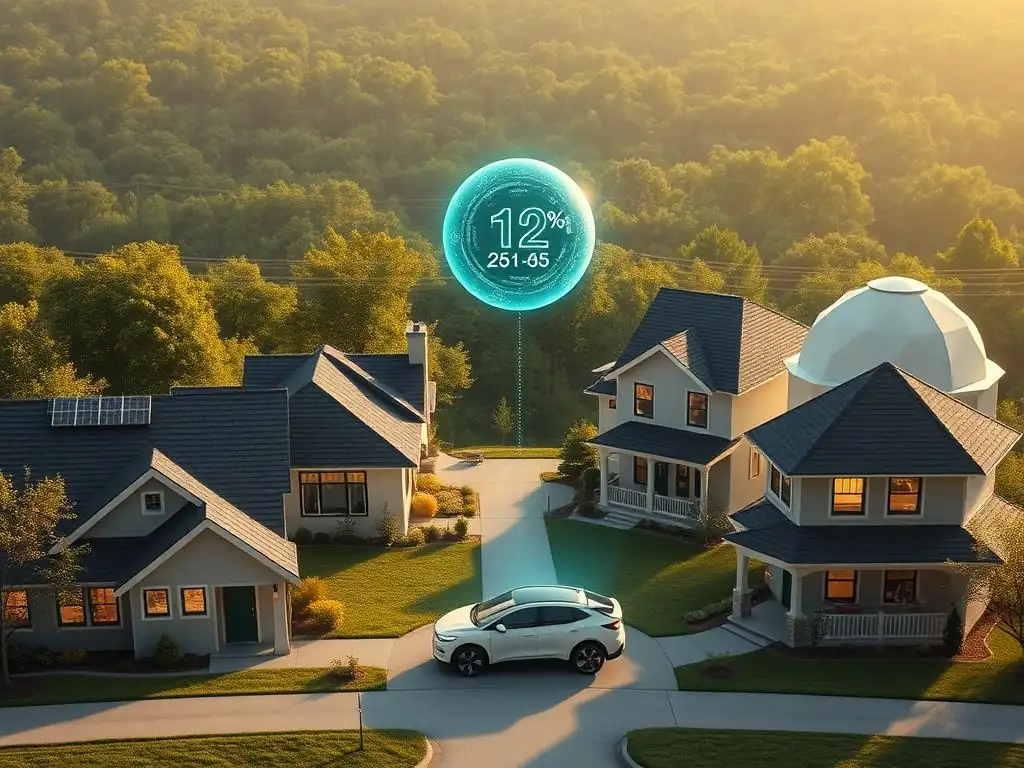
In smart home communities equipped with renewable energy sources like solar panels and smart meters, smart contracts and IoT can facilitate decentralized energy trading. Homes generating surplus energy can sell it directly to neighboring homes within the microgrid, bypassing traditional energy providers.
A smart contract can automate the entire process: IoT smart meters track energy generation and consumption for each home. When a home has a surplus, the smart contract can find a buyer within the network and execute the energy transfer and payment automatically based on predefined market rules or bilateral agreements. Pilot projects in some regions have shown that peer-to-peer energy trading using blockchain can reduce electricity bills by up to 15-25% for participants, showcasing an innovative application of Smart contracts IoT real estate in sustainable living.
Case Study: Integrating Smart Contracts and IoT for Automated Lease Agreements
A notable example, though often in pilot phase, involves the integration of smart contracts and IoT for automating residential lease agreements. Companies are experimenting with platforms where a lease is represented as a smart contract on a blockchain. This contract incorporates clauses linked to IoT device data.
For instance, the smart contract might link to a smart lock for access control, a smart thermostat for monitoring compliance with heating/cooling regulations, and a smart meter for tracking utility usage. Rent payments are scheduled and automated via the smart contract. If rent is paid, the smart contract ensures the smart lock remains functional for the tenant.
If a clause is violated (e.g., excessive energy use outside agreed parameters, verified by the smart meter), the smart contract could trigger a notification or even a penalty as defined in the coded terms. This holistic approach demonstrates how Smart contracts IoT real estate can create truly 'smart' and automated rental experiences.
Challenges and Considerations for Implementing Smart Contracts and IoT in Real Estate
Scalability and Interoperability of IoT Devices and Blockchain Networks
A significant challenge in deploying Smart contracts IoT real estate solutions at scale is ensuring interoperability between a diverse range of IoT devices and different blockchain networks. IoT devices use various communication protocols (Wi-Fi, Bluetooth, Zigbee, Z-Wave) and data formats. Getting these devices to reliably communicate with a blockchain, which itself might be one of several competing protocols (Ethereum, Solana, etc. ), requires robust middleware or standardized APIs.
Furthermore, blockchain networks, especially public ones, can face scalability issues regarding transaction throughput and speed, which might be a bottleneck for processing high volumes of real-time data from numerous IoT devices. For example, a large apartment building could have hundreds or thousands of sensors generating constant data streams. Ensuring the blockchain can handle this data load efficiently and cost-effectively is crucial. Current transaction speeds on some popular blockchains might be too slow or expensive for frequent, low-value data updates required by many IoT applications.
Data Privacy and Security Concerns in IoT-Enabled Smart Homes
While blockchain enhances the security and immutability of transaction records and access logs, the data collected by IoT devices themselves raises significant privacy concerns. Smart homes collect sensitive information about residents' habits, occupancy patterns, energy usage, and potentially even conversations (via voice-activated assistants). Ensuring this data is collected, stored, and used responsibly and securely is paramount.
Linking this data to smart contracts, even if the data itself isn't stored on the public blockchain, requires careful consideration of how data feeds (oracles) are secured and verified. A compromise of an IoT device or an oracle feeding data to a smart contract could lead to incorrect or malicious contract execution. Implementing strong encryption, secure data storage solutions (potentially off-chain with verifiable links on-chain), and clear data governance policies are essential to address these privacy and security challenges in Smart contracts IoT real estate deployments.
Regulatory and Legal Frameworks for Smart Contract Adoption in Real Estate
The legal status and regulatory framework surrounding smart contracts in real estate transactions are still evolving in many jurisdictions. Traditional real estate law is based on physical documents, wet signatures, and established legal processes involving notaries and land registries. Integrating smart contracts requires clarity on their legal enforceability, particularly in complex scenarios like defaults or disputes.
Questions remain about how smart contracts align with existing property laws, consumer protection regulations, and data privacy laws like GDPR. Who is liable if a smart contract malfunctions due to a coding error or faulty data feed? How are disputes resolved when the terms are written in code? The lack of clear legal precedent and standardized regulations presents a significant hurdle for the widespread adoption of Smart contracts IoT real estate solutions in regulated markets.
Barriers to Widespread Adoption: Cost, Complexity, and User Education
Despite the potential benefits, several practical barriers hinder the widespread adoption of Smart contracts IoT real estate technology. The initial cost of implementing integrated systems, including installing smart devices, setting up blockchain infrastructure, and developing or customizing smart contracts, can be substantial. This can be particularly prohibitive for individual homeowners or small property managers.
The complexity of these technologies also poses a challenge. Users, whether homeowners, tenants, or real estate professionals, need to understand how smart contracts work, how they interact with IoT devices, and how to manage digital assets and identities securely. A lack of technical literacy and the perceived difficulty of troubleshooting issues can create resistance to adoption. Extensive user education, simplified interfaces, and reliable support systems are necessary to overcome these barriers and facilitate the adoption of Smart contracts IoT real estate solutions.
The Future of Smart Home Integration: Smart Contracts and IoT
Emerging Trends: Decentralized Autonomous Organizations (DAOs) for Property Management
A significant emerging trend in the future of Smart contracts IoT real estate is the use of Decentralized Autonomous Organizations (DAOs) for property management. A DAO is an organization whose rules are encoded as a transparent computer program, controlled by organization members, and not influenced by a central government. In real estate, a DAO could collectively own and manage a property or a portfolio of properties.
Using smart contracts as the operational backbone, a real estate DAO could automate tasks like rent collection, expense payments (triggered by IoT data), and even collective decision-making on property maintenance or upgrades via tokenized voting. This model allows for fractional ownership and management, potentially democratizing real estate investment and management. While still in early stages, several projects are exploring DAO structures for managing rental properties or co-living spaces, highlighting a future direction for Smart contracts IoT real estate integration.
Predicting the Evolution of Smart Home Ecosystems with Blockchain Technology
The evolution of smart home ecosystems is likely to involve deeper integration with blockchain technology beyond just individual smart contracts. Future smart homes might become part of a decentralized network where devices and services interact securely and autonomously. Blockchain could serve as a trusted backbone for device identity, secure communication, and data monetization within the home.
Imagine a smart home where appliances can securely share usage data with utility providers via blockchain for dynamic pricing, or where homeowners can sell access to specific data streams (e.g., air quality data) to researchers, with transactions managed by smart contracts. This creates a more interconnected and potentially revenue-generating smart home ecosystem. The reliability and security offered by blockchain are expected to become foundational elements in the next generation of smart home technology, solidifying the role of Smart contracts IoT real estate in residential technology.
The Impact of Smart Contracts and IoT on the Future of Real Estate Investment
The synergy between smart contracts and IoT is poised to significantly impact real estate investment. By enabling fractional ownership through tokenization (where property shares are represented by digital tokens on a blockchain), smart contracts can make real estate investment more accessible and liquid. Investors could buy and sell small stakes in properties much like trading stocks, with ownership and rights managed by smart contracts.
Furthermore, real-time data from IoT devices can provide investors with unprecedented transparency into the performance and condition of investment properties, potentially influencing valuation and investment decisions. Automated management via smart contracts can also reduce operational costs, improving investment returns. This convergence is democratizing access to real estate investment and creating new investment models, demonstrating the transformative potential of Smart contracts IoT real estate for the financial side of the industry.
Expert Opinions on the Future of this Synergy
Experts in both blockchain and real estate technology generally agree that the integration of smart contracts and IoT holds immense promise, though the timeline for widespread adoption varies. Many see smart contracts as the key to automating and securing transactions, while IoT provides the essential link between the physical property and the digital contract. Some predict that within the next 5-10 years, we will see significant adoption in specific niches like property management for rental units or fractional ownership platforms.
Others emphasize the need for regulatory clarity and technological standardization before mass market adoption can occur. The potential for increased efficiency, transparency, and new business models like property DAOs is widely acknowledged. However, the challenges related to data privacy, security, and user-friendliness are also frequently cited as critical areas requiring further development and attention. The consensus points towards a future where Smart contracts IoT real estate solutions become increasingly common, fundamentally changing how we interact with properties.
Conclusion: Embracing the Potential of Smart Contracts, IoT, and Blockchain in Real Estate
Key Takeaways: The Transformative Power of Technology in Smart Homes
The integration of smart contracts and the Internet of Things (IoT) is ushering in a new era for real estate, particularly within smart homes. The key takeaways are clear: this synergy enhances security through decentralized access control and verifiable data, streamlines processes like rent collection and maintenance via automation, and increases transparency and trust among all stakeholders. Real-time data from IoT devices fuels the automated execution of secure agreements defined by smart contracts, creating more efficient and intelligent living spaces.
From automated access and predictive maintenance to decentralized energy trading and fractional ownership, the practical applications of Smart contracts IoT real estate are vast and impactful. While challenges related to scalability, interoperability, data privacy, and regulation exist, ongoing developments in technology and evolving legal frameworks are steadily paving the way for broader adoption. The transformative power of this technological convergence lies in its ability to create a more dynamic, secure, and user-centric real estate experience.
Call to Action: Exploring the Opportunities in Blockchain-Based Real Estate
The landscape of real estate is changing, and staying informed about the potential of blockchain, smart contracts, and IoT is crucial for anyone involved in the sector – from homeowners and tenants to investors and property professionals. Exploring the opportunities presented by blockchain-based real estate solutions, particularly those leveraging smart contracts and IoT for smart homes, can provide a competitive edge and open doors to new models of ownership and management.
Consider how these technologies could apply to your specific interests, whether it's investing in tokenized properties, implementing automated property management systems, or enhancing smart home security. Engaging with pilot projects, researching platforms, and understanding the underlying principles of Smart contracts IoT real estate integration are valuable steps towards navigating this evolving market. The time to explore these possibilities is now.
Future Research: Standardizing Smart Contract and IoT Integration in Real Estate
As the field of Smart contracts IoT real estate continues to grow, future research and development efforts should focus on standardization. Establishing common protocols for how IoT devices communicate with blockchain networks and how smart contracts interpret and act upon IoT data is essential for widespread adoption and interoperability across different platforms and device manufacturers.
Further research is also needed on developing robust, legally compliant smart contract templates specifically for real estate applications, addressing various transaction types and jurisdictional nuances. Additionally, exploring decentralized data oracles that can provide reliable, tamper-proof real-world data to smart contracts from diverse IoT sources remains a critical area. Standardization and continued innovation in these areas will be key to unlocking the full potential of smart contracts and IoT in transforming the real estate industry.
Frequently Asked Questions
What are smart contracts, and how can they be used in the context of IoT and real estate?
Smart contracts are self-executing agreements written in code and stored on a blockchain. In real estate, they can automate processes like rent collection and property access control using IoT devices.
How can IoT devices, like smart locks and sensors, be integrated with smart contracts to improve real estate management?
IoT devices provide real-time data to smart contracts, triggering actions based on pre-defined conditions. This enables automated tasks such as unlocking doors for verified tenants or adjusting thermostats based on occupancy.
What are the potential benefits of using smart contracts and IoT together for real estate transactions?
Combining these technologies can lead to increased efficiency, reduced costs, and enhanced security in real estate deals. They also provide greater transparency and trust in managing property.
What are some of the challenges and regulatory considerations when implementing smart contracts and IoT in the real estate sector?
Challenges include scalability issues, data privacy concerns, and the lack of clear legal frameworks surrounding smart contracts. Regulations must adapt to address these complexities.
How might the integration of smart contracts and IoT reshape the future of the real estate industry, especially for smart home integration?
This integration promises a future of seamless property management, autonomous transactions, and personalized living experiences. The concept of the smart home becomes fully realized with the power of blockchain.
Final Reflection: Building Trust in the Connected Home
The convergence of smart contracts and the Internet of Things in real estate, as explored throughout this article, isn't just a technological advancement; it's a fundamental shift in how we perceive trust and security in our living spaces. The potential to automate transactions, streamline property management, and enhance the overall smart home experience is no longer a distant dream, but a tangible reality shaping the future of the industry.
The integration of these technologies has profoundly influenced, and continues to influence, the cultural landscape surrounding homeownership and property management. The promise of increased transparency and efficiency, coupled with the potential for personalized living experiences, is reshaping expectations and driving demand for smart home solutions. The future of real estate is not just about bricks and mortar, but about the seamless integration of technology to create smarter, more efficient, and more secure living environments.
This quote encapsulates the transformative power of smart contracts and IoT, highlighting their ability to redefine the very essence of home.
As we stand on the cusp of this technological revolution, I invite you to reflect on the implications of a world where your home is not just a dwelling, but an intelligent, self-governing entity. Consider how you can embrace these advancements to create a more secure, efficient, and personalized living experience for yourself and future generations. The power to shape the future of real estate lies in our willingness to understand, adopt, and innovate within this exciting new paradigm.
Envision Your Smart Home Future: Start Building Today!
Thank you for exploring the exciting possibilities of smart contracts and IoT in transforming real estate. We hope you've gained a clearer vision of how these technologies can revolutionize smart home integration. Now, it's time to take the next step and bring that vision to life:
- Begin planning your ideal smart home ecosystem. Consider which devices and automation protocols can be integrated with smart contracts to improve security, convenience, and efficiency. Focus on one key area to start with.
- Join local IoT and blockchain meetups or online communities. Share your ideas and learn from others who are actively developing solutions in this field. Collaboration can lead to innovative breakthroughs.
- Research smart contract platforms and development tools tailored for IoT applications. Starting with a small test project can give you valuable hands-on experience.
How do you plan to use smart contracts to create the ultimate smart home experience? Share your initial ideas in the comments below!
Leave a Reply