
Choosing a Blockchain for NFTs: Platforms Powering Digital Collectibles and Art

Welcome to Blockchain Trends, your guide to navigating the ever-evolving world of decentralized technologies. Are you ready to explore how blockchain is revolutionizing industries beyond just cryptocurrencies?
In this article, we dive deep into the exciting realm of digital collectibles, offering a crucial blockchain NFT platform comparison. Discover which platforms are powering the creation and trade of NFTs, and which one might be the perfect fit for your next project. The future of digital ownership is here – let's explore it together!
Choosing a Blockchain for NFTs: Platforms Powering Digital Collectibles and Art
- Blockchain NFT Platform Comparison: A Guide to Selecting the Right Chain
- Top Blockchain Platforms for NFTs: A Detailed Comparison
-
Evaluating Blockchain Platforms for NFT Projects: Key Metrics
- Transaction Fees: Comparing Gas Costs Across Blockchains
- Transaction Speed: Assessing NFT Minting and Trading Times
- Security and Decentralization: Examining Blockchain Robustness
- Smart Contract Capabilities: Evaluating Functionality for NFTs
- Community and Ecosystem: Analyzing Developer and User Support
- NFT Blockchain Platform Comparison Chart: Side-by-Side Analysis
- Case Studies: Successful NFT Projects on Different Blockchains
- The Future of NFTs and Blockchain Technology: Emerging Trends
- Conclusion: Selecting the Optimal Blockchain for Your NFT Needs
-
Frequently Asked Questions
- How does the choice of blockchain impact an NFT's transaction fees?
- What are the key differences between Ethereum and Solana as NFT platforms?
- What are the potential regulatory challenges facing NFT platforms?
- How do enterprise applications of blockchain for NFTs differ from art and collectibles?
- What factors should be considered in a Blockchain NFT platform comparison?
- Final Reflection: Navigating the NFT Landscape
- Ignite Your NFT Journey!
Blockchain NFT Platform Comparison: A Guide to Selecting the Right Chain
Understanding the NFT Landscape and Blockchain Technology
The world of Non-Fungible Tokens (NFTs) has exploded, transforming how we perceive digital ownership, art, collectibles, and even virtual real estate. At the heart of this revolution lies blockchain technology, the immutable and transparent ledger system that underpins the creation, ownership, and transfer of these unique digital assets. Understanding blockchain is crucial when navigating the NFT space, as the choice of blockchain platform directly impacts an NFT project's functionality, accessibility, cost, and overall success.
Different blockchains offer varying features, capabilities, and ecosystems, each catering to distinct needs and priorities within the burgeoning NFT market. This article delves into a detailed blockchain NFT platform comparison to equip creators and collectors with the knowledge necessary to make informed decisions.
The fundamental principle of blockchain technology relevant to NFTs is its ability to provide provable scarcity and ownership of digital items. Unlike easily replicated digital files, NFTs on a blockchain are unique and their ownership is publicly verifiable on the distributed ledger. This inherent characteristic of blockchain is what gives NFTs their value and utility, enabling use cases ranging from digital art and music ownership to in-game assets and virtual identities.
As the NFT market matures, the selection of the underlying blockchain infrastructure becomes increasingly strategic, demanding a careful evaluation of factors beyond just the initial hype. This article will guide you through the critical considerations and top platform choices available for your NFT endeavors.
Key Considerations for NFT Blockchain Selection
Selecting the right blockchain platform for your NFT project is a multifaceted decision, encompassing several crucial factors that can significantly influence its trajectory. One of the primary considerations is transaction fees, often referred to as "gas fees," which can vary dramatically between different blockchains. High gas fees, particularly prevalent on some platforms, can deter potential buyers and sellers, especially for lower-value NFTs or frequent transactions. Therefore, understanding the fee structure and typical transaction costs on a given blockchain is paramount for project viability, especially if aiming for accessibility and broad market appeal.
Beyond cost, transaction speed is another vital aspect. Blockchains differ in their processing speeds, impacting how quickly NFTs can be minted, transferred, and traded. Faster transaction speeds contribute to a smoother user experience, especially during periods of high network activity or for applications requiring real-time interactions. Security and decentralization are also paramount. A robust and decentralized blockchain ensures the integrity and immutability of NFT data, protecting against manipulation and censorship.
Furthermore, the smart contract capabilities of a blockchain are critical, determining the potential functionality and complexity of NFTs that can be developed. Finally, the community and ecosystem surrounding a blockchain play a significant role. A vibrant developer community, readily available tools, and a robust marketplace infrastructure can significantly ease the development, launch, and trading of NFTs. These key considerations form the foundation for a comprehensive blockchain NFT platform comparison, enabling informed choices aligned with specific project goals.
Top Blockchain Platforms for NFTs: A Detailed Comparison
Ethereum for NFTs: The Dominant Platform
Ethereum has undeniably established itself as the leading blockchain for NFTs, boasting the largest and most mature ecosystem. Its first-mover advantage, coupled with its robust smart contract capabilities and strong network effects, has solidified its position as the go-to platform for many NFT creators and collectors. The vast majority of high-value and blue-chip NFT projects, including iconic collections like CryptoPunks and Bored Ape Yacht Club, are built on Ethereum, reflecting its widespread adoption and perceived prestige within the NFT space. This dominance translates to a deep and liquid market, offering substantial trading volume and established marketplaces.
However, Ethereum's popularity comes with its own set of challenges, most notably high transaction fees. During periods of network congestion, "gas fees" on Ethereum can skyrocket, making minting, buying, and selling NFTs prohibitively expensive for many users. This cost barrier can limit accessibility and create a significant hurdle for smaller creators or those targeting a wider audience. Despite ongoing efforts to scale Ethereum and reduce gas fees, these remain a persistent concern. Furthermore, while Ethereum's decentralization is a strength, its complexity can present a steeper learning curve for developers and users compared to some newer, more streamlined platforms.
Ethereum NFT Ecosystem: Advantages and Disadvantages
Advantages of the Ethereum NFT Ecosystem:
- Large and Mature Ecosystem: Ethereum boasts the most extensive NFT ecosystem, with established marketplaces like OpenSea, Rarible, and LooksRare, offering vast liquidity and trading opportunities.
- Strong Community and Network Effects: A massive developer and user community provides extensive support, resources, and network effects, fostering innovation and growth within the Ethereum NFT space.
- Prestige and Brand Recognition: NFTs on Ethereum often carry a certain prestige and brand recognition due to the platform's established position and association with high-value projects.
- Robust Smart Contract Capabilities: Ethereum's mature smart contract platform allows for complex and feature-rich NFTs with advanced functionalities and utilities.
Disadvantages of the Ethereum NFT Ecosystem:
- High Transaction Fees (Gas Fees): Ethereum's gas fees can be extremely volatile and often very high, making transactions expensive, especially during peak network activity.
- Scalability Issues: While Ethereum is transitioning to Ethereum 2.0 to improve scalability, current network congestion can lead to slow transaction speeds and increased costs.
- Environmental Concerns (Proof-of-Work): Ethereum's original Proof-of-Work consensus mechanism was criticized for its high energy consumption, although the move to Proof-of-Stake with Ethereum 2.0 aims to address this.
- Complexity: Ethereum's technical complexity can be a barrier to entry for new developers and users compared to some more user-friendly platforms.
Ethereum NFT Standards: ERC-721 and ERC-1155
Ethereum primarily utilizes two key NFT standards: ERC-721 and ERC-1155. ERC-721 is the most widely recognized standard for NFTs, designed for unique, non-fungible items. Each ERC-721 token represents a distinct digital asset, making it ideal for digital art, collectibles, and unique in-game items. Examples of ERC-721 NFTs include CryptoPunks, Bored Ape Yacht Club, and many other prominent digital art collections. The ERC-721 standard emphasizes individuality and provable scarcity, aligning with the core principles of NFT ownership.
ERC-1155, on the other hand, is a more versatile standard that supports both fungible and non-fungible tokens within a single smart contract. This standard is particularly efficient for projects involving multiple editions or semi-fungible items, such as in-game assets where multiple copies of the same item might exist, or for issuing multiple types of NFTs within a single collection.
ERC-1155 reduces gas fees compared to ERC-721 for batch operations and managing multiple token types, making it suitable for gaming, virtual worlds, and projects requiring a mix of unique and multi-edition assets. Both ERC-721 and ERC-1155 have played crucial roles in shaping the Ethereum NFT ecosystem, catering to different needs and use cases within the broader NFT landscape.
Solana for NFTs: High Speed and Low Costs
Solana emerged as a strong contender in the NFT space, gaining significant traction due to its high transaction speeds and remarkably low transaction costs. Designed for scalability and performance, Solana can process thousands of transactions per second, a stark contrast to Ethereum's earlier limitations. This high throughput translates to significantly lower gas fees, often fractions of a cent, making it a highly attractive platform for creators and collectors seeking affordability and efficiency. Solana's speed and low costs have facilitated the growth of a vibrant NFT ecosystem, attracting projects and users priced out by Ethereum's high fees.
However, Solana's ecosystem, while rapidly growing, is still relatively younger and smaller compared to Ethereum's. While marketplaces like Magic Eden and Solanart have become popular, the overall infrastructure and tooling are still evolving. Furthermore, Solana has experienced periods of network instability and outages, raising concerns about its reliability compared to more established blockchains. Despite these challenges, Solana's technical advantages in speed and cost have positioned it as a compelling alternative for NFT projects, particularly those prioritizing accessibility and high transaction volumes.
Solana NFT Ecosystem: Advantages and Disadvantages
Advantages of the Solana NFT Ecosystem:
- Extremely Low Transaction Fees: Solana boasts incredibly low gas fees, making it significantly more affordable for minting, buying, and selling NFTs compared to Ethereum.
- High Transaction Speed: Solana's high throughput allows for fast transaction processing, ensuring quick confirmation times and a smoother user experience.
- Scalability: Designed for scalability, Solana can handle a large volume of transactions, making it well-suited for projects with high trading activity.
- Growing Ecosystem: Solana's NFT ecosystem is rapidly expanding, with new projects, marketplaces, and tools emerging frequently.
Disadvantages of the Solana NFT Ecosystem:
- Younger and Smaller Ecosystem: Compared to Ethereum, Solana's NFT ecosystem is less mature, with fewer established marketplaces and a smaller overall market size.
- Network Instability: Solana has experienced network outages and instability issues, raising concerns about reliability and uptime.
- Less Established Community (Compared to Ethereum): While growing rapidly, Solana's developer and user community is still smaller and less established than Ethereum's.
- Centralization Concerns: Some critics argue that Solana is less decentralized than Ethereum due to its consensus mechanism and validator set.
Solana NFT Standard: Metaplex
Solana's primary NFT standard is facilitated by Metaplex, a suite of tools and protocols designed to simplify NFT creation and management on the Solana blockchain. Metaplex provides a framework for minting, selling, and managing NFTs, offering features like auction functionality, storefront creation, and metadata management. Unlike Ethereum's token-centric standards (ERC-721 and ERC-1155), Metaplex is more of a framework and a set of on-chain programs that developers utilize to build NFT projects.
Metaplex emphasizes creator tools and aims to empower artists and developers to easily launch and manage their NFT collections on Solana. It provides functionalities that go beyond basic token standards, including features for decentralized marketplaces and creator royalties. The Metaplex standard and ecosystem are closely intertwined with the Solana blockchain's technical capabilities, leveraging its speed and low costs to offer a streamlined and efficient NFT experience. While not a token standard in the same way as ERC-721, Metaplex serves as the de facto standard and infrastructure for NFTs within the Solana ecosystem.
Polygon for NFTs: Layer-2 Scaling Solution for Ethereum
Polygon, formerly known as Matic Network, is a Layer-2 scaling solution for Ethereum, designed to address Ethereum's scalability limitations and high gas fees. By operating as a sidechain linked to Ethereum, Polygon offers significantly faster and cheaper transactions while still benefiting from Ethereum's security and network effects. For NFTs, Polygon provides a compelling alternative for projects seeking to leverage the Ethereum ecosystem without incurring exorbitant gas costs. This makes Polygon particularly attractive for projects targeting mass adoption, gaming NFTs, or applications requiring frequent transactions.
Polygon's compatibility with the Ethereum Virtual Machine (EVM) allows developers to easily port Ethereum-based NFT projects to Polygon with minimal code changes. This interoperability, combined with lower fees, has led to a growing NFT ecosystem on Polygon, attracting projects from gaming, collectibles, and digital art. While Polygon is a Layer-2 solution and relies on Ethereum for security, it offers a distinct trade-off between decentralization and scalability, providing a more cost-effective and efficient platform for many NFT use cases.
Polygon NFT Ecosystem: Advantages and Disadvantages
Advantages of the Polygon NFT Ecosystem:
- Lower Transaction Fees than Ethereum: As a Layer-2 solution, Polygon offers significantly lower gas fees compared to mainnet Ethereum, making NFTs more accessible and affordable.
- Faster Transaction Speeds than Ethereum: Polygon's sidechain architecture enables faster transaction processing and confirmation times compared to Ethereum.
- Ethereum Compatibility (EVM Compatibility): Polygon is compatible with the Ethereum Virtual Machine, making it easy for Ethereum-based NFT projects to migrate or deploy on Polygon.
- Growing Ecosystem within Ethereum: Polygon benefits from being part of the broader Ethereum ecosystem, leveraging its network effects and established infrastructure.
Disadvantages of the Polygon NFT Ecosystem:
- Less Decentralized than Mainnet Ethereum: As a Layer-2 solution, Polygon is inherently less decentralized than mainnet Ethereum, relying on Ethereum for security.
- Bridge Dependency: Moving assets between Ethereum and Polygon requires bridging, which can sometimes be complex or involve fees.
- Smaller Ecosystem than Ethereum (but growing rapidly): While expanding quickly, Polygon's NFT ecosystem is still smaller than mainnet Ethereum's in terms of market size and project volume.
- Security Reliance on Ethereum: Polygon's security is ultimately tied to Ethereum, meaning potential vulnerabilities on Ethereum could affect Polygon.
Polygon NFT and Ethereum Interoperability
Polygon's key strength lies in its interoperability with Ethereum. As an EVM-compatible Layer-2 solution, Polygon seamlessly integrates with the Ethereum ecosystem, allowing for easy migration of assets and applications. This interoperability is particularly relevant for NFTs, as it enables projects to leverage Ethereum's established infrastructure and community while mitigating the challenges of high gas fees. NFTs minted on Polygon can be bridged back to Ethereum mainnet, and vice versa, offering flexibility and optionality for creators and collectors.
This interoperability is facilitated by bridges that allow users to transfer tokens between Ethereum and Polygon. While bridging adds a step to the process, it provides a pathway to access both ecosystems. For NFT projects, Polygon's Ethereum interoperability means they can tap into the vast Ethereum market while offering users a more affordable and efficient experience on Polygon for everyday transactions and interactions. This hybrid approach has made Polygon a popular choice for NFT projects seeking to balance accessibility, cost-effectiveness, and integration with the dominant Ethereum NFT landscape.
Flow for NFTs: Designed for Digital Collectibles
Flow is a blockchain specifically designed for NFTs and gaming, built by Dapper Labs, the creators of CryptoKitties and NBA Top Shot. Flow prioritizes scalability, user experience, and ease of development for NFT-centric applications. Its architecture is optimized for high-throughput and low-cost transactions, making it well-suited for projects involving large volumes of NFTs, such as digital collectibles, gaming assets, and virtual experiences. Flow distinguishes itself through its developer-friendly environment and focus on mainstream adoption of NFTs.
A key feature of Flow is its developer-friendly programming language, Cadence, which is designed to be safer and more accessible than Solidity, Ethereum's primary smart contract language. Flow also employs a unique architecture that separates consensus and execution, enabling higher transaction throughput without compromising decentralization. This design allows for a smoother user experience and lower transaction fees, specifically tailored for NFT and gaming applications. Flow's focus on user experience and developer simplicity has attracted major brands and projects in the digital collectibles and gaming space.
Flow NFT Ecosystem: Advantages and Disadvantages
Advantages of the Flow NFT Ecosystem:
- Designed for NFTs and Gaming: Flow is purpose-built for NFTs and gaming, with architecture and features optimized for these use cases.
- Low Transaction Fees: Flow offers very low transaction fees, making it affordable for users and projects dealing with large volumes of NFTs.
- Scalability and High Throughput: Flow is designed for high transaction throughput, enabling fast and efficient processing of NFT transactions.
- Developer-Friendly (Cadence Language): Flow's Cadence programming language is designed to be safer and easier to learn than Solidity, lowering the barrier to entry for developers.
- User-Friendly Onboarding: Flow emphasizes user-friendly onboarding experiences, making it easier for mainstream users to interact with NFTs.
Disadvantages of the Flow NFT Ecosystem:
- Relatively Newer Ecosystem: Compared to Ethereum, Flow is a newer blockchain with a less established and smaller overall ecosystem.
- Smaller Community (Compared to Ethereum): While growing, Flow's developer and user community is smaller than Ethereum's.
- Less Established Marketplaces: While marketplaces like NBA Top Shot Marketplace and VIV3 exist on Flow, the marketplace infrastructure is less diverse and mature compared to Ethereum.
- Cadence Language Learning Curve (for Solidity Developers): While designed to be easier, developers familiar with Solidity may need to learn a new programming language (Cadence) to build on Flow.
Flow NFT Standard: Cadence Programming Language
Flow's NFT standard is intrinsically linked to its Cadence programming language. Cadence is a resource-oriented programming language specifically designed for smart contracts on the Flow blockchain. It emphasizes safety, clarity, and ease of use, aiming to mitigate common vulnerabilities found in Solidity smart contracts. Cadence's resource-oriented nature is particularly well-suited for representing digital assets like NFTs, providing strong guarantees about ownership and control.
While Flow doesn't have distinct token standards like ERC-721 or ERC-1155, the Cadence language itself provides the tools and framework for creating and managing NFTs. Developers use Cadence to define smart contracts that implement NFT functionalities, leveraging the language's features to ensure secure and efficient NFT creation, transfer, and management. The focus on Cadence as the core development language for NFTs on Flow reflects a holistic approach, integrating the programming language directly with the NFT platform's design and capabilities.
Tezos for NFTs: Energy Efficient and Self-Amending
Tezos is a blockchain known for its energy efficiency and self-amending nature, making it an increasingly attractive platform for environmentally conscious NFT creators and collectors. Tezos utilizes a Proof-of-Stake consensus mechanism, which is significantly more energy-efficient than Proof-of-Work, addressing environmental concerns associated with some other blockchains. Furthermore, Tezos's self-amending governance allows the blockchain to upgrade itself through on-chain voting, avoiding hard forks and ensuring continuous evolution and improvement.
Tezos has cultivated a growing NFT ecosystem, particularly popular within the digital art and generative art communities. Platforms like hic et nunc (now objkt.com) and fx(hash) have emerged as prominent marketplaces for Tezos NFTs, emphasizing artistic expression and community engagement. Tezos's commitment to sustainability, combined with its robust technical features and growing ecosystem, positions it as a compelling choice for NFT projects aligning with environmental responsibility and long-term platform stability.
Tezos NFT Ecosystem: Advantages and Disadvantages
Advantages of the Tezos NFT Ecosystem:
- Energy Efficient (Proof-of-Stake): Tezos's Proof-of-Stake consensus mechanism is significantly more energy-efficient than Proof-of-Work, appealing to environmentally conscious NFT creators and collectors.
- Low Transaction Fees: Tezos offers low transaction fees, making it affordable for NFT transactions.
- Self-Amending Governance: Tezos's on-chain governance allows for seamless blockchain upgrades without hard forks, ensuring long-term platform stability and evolution.
- Growing Art-Focused Community: Tezos has fostered a strong community within the digital art and generative art NFT space.
- Formal Verification: Tezos supports formal verification of smart contracts, enhancing security and reliability.
Disadvantages of the Tezos NFT Ecosystem:
- Smaller Ecosystem (Compared to Ethereum): Tezos's NFT ecosystem is smaller than Ethereum's in terms of market size and overall project volume.
- Less Mainstream Adoption (Compared to Ethereum and Solana): Tezos has not yet achieved the same level of mainstream adoption as Ethereum or Solana in the broader NFT market.
- Fewer Established Marketplaces (Compared to Ethereum): While marketplaces like objkt.com are popular, the marketplace infrastructure on Tezos is less extensive than Ethereum's.
- Slower Transaction Speed (Compared to Solana): Tezos's transaction speeds are generally slower than Solana's, although still sufficient for most NFT use cases.
Tezos NFT and Environmental Sustainability
Tezos stands out in the NFT landscape due to its strong emphasis on environmental sustainability. By utilizing a Proof-of-Stake (PoS) consensus mechanism, Tezos consumes significantly less energy compared to Proof-of-Work (PoW) blockchains like Ethereum (prior to its transition to PoS). This energy efficiency directly translates to a lower carbon footprint for NFT activities on Tezos, aligning with growing environmental awareness within the crypto space and beyond.
The environmental advantage of Tezos is a key selling point for artists, collectors, and projects seeking to minimize their ecological impact. In a world increasingly concerned about climate change, choosing an energy-efficient blockchain like Tezos for NFTs can be a conscious decision to support sustainable practices within the digital art and collectibles market. This focus on sustainability has resonated particularly strongly with the art community on Tezos, making it a platform of choice for environmentally responsible NFT initiatives.
Evaluating Blockchain Platforms for NFT Projects: Key Metrics
Transaction Fees: Comparing Gas Costs Across Blockchains
Transaction fees, or "gas fees," are a critical factor in choosing a blockchain for NFTs, directly impacting the cost of minting, buying, and selling digital collectibles. Ethereum, while dominant, is notorious for its fluctuating and often high gas fees, especially during periods of network congestion. These fees can range from several dollars to hundreds or even thousands of dollars per transaction, depending on network demand and transaction complexity. This cost barrier can significantly hinder accessibility and profitability, especially for smaller creators and lower-value NFTs.
Solana, in stark contrast, offers remarkably low transaction fees, typically fractions of a cent per transaction. This affordability makes Solana highly attractive for projects aiming for mass adoption, frequent trading, or micro-transactions. Polygon, as a Layer-2 solution for Ethereum, also provides significantly lower gas fees compared to mainnet Ethereum, often costing just cents per transaction. Flow and Tezos also boast low transaction fees, generally comparable to or slightly higher than Solana but significantly lower than Ethereum. When evaluating blockchain NFT platforms, carefully consider the typical transaction fees and how they align with your project's budget and target audience.
Transaction Speed: Assessing NFT Minting and Trading Times
Transaction speed is another crucial metric, determining how quickly NFTs can be minted, transferred, and traded on a blockchain. Ethereum's transaction speeds, while improving with upgrades, can still be relatively slow, especially during peak network activity. Confirmation times can range from minutes to hours, potentially causing delays and frustration for users, particularly in fast-paced trading environments.
Solana excels in transaction speed, boasting incredibly fast processing times, often measured in seconds. This speed advantage provides a seamless user experience, especially for high-volume NFT marketplaces and applications requiring real-time interactions. Polygon also offers significantly faster transaction speeds compared to mainnet Ethereum, with confirmations typically occurring within seconds. Flow and Tezos offer moderate transaction speeds, generally faster than Ethereum but slower than Solana. For NFT projects prioritizing speed and responsiveness, Solana and Polygon present compelling options, while Ethereum, Flow, and Tezos offer varying degrees of speed depending on network conditions and platform architecture.
Security and Decentralization: Examining Blockchain Robustness
Security and decentralization are fundamental aspects of blockchain technology, directly impacting the trustworthiness and longevity of NFT platforms. Ethereum, as a mature and widely adopted blockchain, benefits from a robust security infrastructure and a high degree of decentralization, with a large and distributed network of nodes validating transactions. This decentralization enhances security and resilience against attacks and censorship.
Solana, while designed for high performance, has faced some scrutiny regarding its decentralization and network stability. Concerns have been raised about the concentration of validators and instances of network outages. Polygon, as a Layer-2 solution, inherits some of Ethereum's security but also introduces its own security considerations related to its bridge and sidechain architecture.
Flow and Tezos prioritize decentralization and security in their design, although their networks are smaller and newer compared to Ethereum. When evaluating blockchain platforms, consider the level of decentralization, security audits, and track record of each platform to assess their robustness and reliability for long-term NFT projects.
Smart Contract Capabilities: Evaluating Functionality for NFTs
Smart contract capabilities are essential for enabling advanced functionalities and features within NFTs. Ethereum boasts the most mature and versatile smart contract platform, the Ethereum Virtual Machine (EVM), which allows for the development of complex and feature-rich NFTs. Ethereum's Solidity programming language and extensive developer tooling provide a robust ecosystem for building sophisticated NFT applications.
Polygon, being EVM-compatible, inherits Ethereum's smart contract capabilities, allowing developers to easily deploy Ethereum-based smart contracts on Polygon with minimal modifications. Solana, Flow, and Tezos also offer smart contract platforms, but with different architectures and programming languages. Solana's Rust-based smart contracts, Flow's Cadence language, and Tezos's smart contract capabilities offer varying levels of functionality and developer experience. When choosing a blockchain, consider the smart contract capabilities, developer tooling, and programming languages supported, ensuring they align with the desired complexity and functionality of your NFT project.
Community and Ecosystem: Analyzing Developer and User Support
The community and ecosystem surrounding a blockchain play a vital role in the success of NFT projects. Ethereum boasts the largest and most established NFT community, with a vast network of developers, artists, collectors, and marketplaces. This extensive ecosystem provides ample support, resources, and network effects, fostering innovation and growth within the Ethereum NFT space.
Solana, while newer, has a rapidly growing community and ecosystem, driven by its low fees and high performance. Polygon benefits from being part of the broader Ethereum ecosystem, leveraging its community and infrastructure. Flow and Tezos have cultivated dedicated communities, particularly within specific NFT niches like digital collectibles (Flow) and digital art (Tezos). When evaluating blockchain platforms, consider the size and activity of the community, the availability of developer resources and support, and the vibrancy of the marketplace ecosystem, as these factors significantly impact the ease of development, launch, and trading of NFTs.
NFT Blockchain Platform Comparison Chart: Side-by-Side Analysis
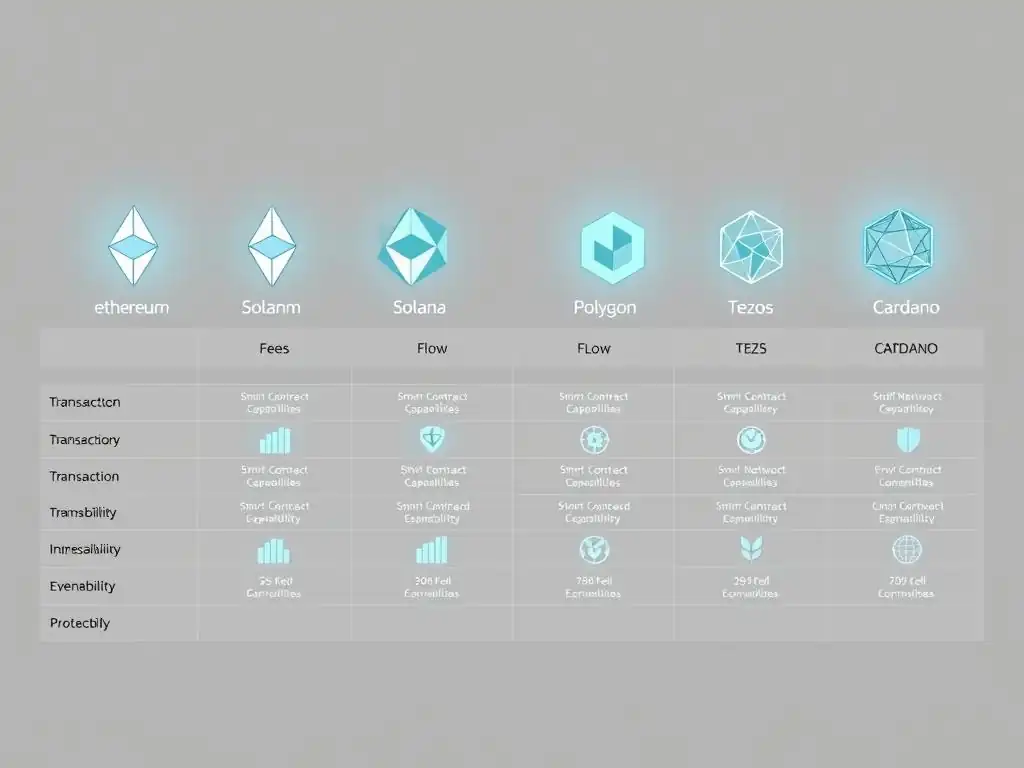
(This section is intended for a visual comparison chart, which cannot be rendered in text format. In a real article, this section would contain a table or chart summarizing the key features, advantages, disadvantages, fees, speeds, security, community, and NFT standards of each blockchain platform discussed: Ethereum, Solana, Polygon, Flow, and Tezos).
Case Studies: Successful NFT Projects on Different Blockchains
CryptoPunks on Ethereum
CryptoPunks, launched in 2017, are considered pioneering NFTs and a cornerstone of the digital art and collectibles movement. These 10,000 unique pixel art characters, generated algorithmically, were initially given away for free and later became highly sought-after digital assets, traded for millions of dollars. CryptoPunks are built on Ethereum and utilize the ERC-721 standard, solidifying Ethereum's position as the leading platform for high-value NFTs and establishing the ERC-721 standard as the blueprint for unique digital collectibles. The success of CryptoPunks demonstrates Ethereum's suitability for projects emphasizing scarcity, provenance, and high-end digital art.
Okay Bears on Solana
Okay Bears, a profile picture (PFP) NFT project featuring cartoon bears, rapidly gained popularity within the Solana ecosystem. Launched in 2022, Okay Bears quickly became one of the top-traded NFT collections on Solana, showcasing the platform's potential for hosting large-scale, high-volume NFT projects. Okay Bears leveraged Metaplex, Solana's NFT framework, and benefited from Solana's low transaction fees and fast speeds, attracting a large community and demonstrating Solana's appeal for projects prioritizing accessibility and efficient trading. The success of Okay Bears highlighted Solana as a viable alternative to Ethereum for major NFT collections.
Zed Run on Polygon
Zed Run is a digital horse racing game where players own, breed, and race NFT horses. Built on Polygon, Zed Run leverages Polygon's low transaction fees and fast speeds to facilitate frequent interactions within the game, including breeding, racing, and trading horses. Polygon's scalability and cost-effectiveness made it an ideal platform for Zed Run's gaming-centric NFT ecosystem, requiring numerous transactions and interactions. Zed Run's success on Polygon demonstrates the platform's suitability for gaming NFTs and applications requiring high transaction volumes and low costs.
NBA Top Shot on Flow
NBA Top Shot is a digital collectibles platform featuring officially licensed NBA moments as NFTs. Developed by Dapper Labs, the creators of the Flow blockchain, NBA Top Shot is built natively on Flow and showcases the blockchain's capabilities for handling large-scale NFT projects and mainstream user adoption. Flow's user-friendly onboarding, low transaction fees, and scalability are crucial for NBA Top Shot's success in attracting a broad audience, including sports fans new to NFTs. NBA Top Shot exemplifies Flow's design as a blockchain optimized for digital collectibles and mainstream NFT experiences.
Hic et Nunc (hic.art) on Tezos
Hic et Nunc (now objkt.com) emerged as a prominent NFT marketplace on Tezos, particularly popular within the digital art and generative art communities. Hic et Nunc, and subsequently objkt.com, leveraged Tezos's energy efficiency and low transaction fees to create a platform accessible to artists and collectors, emphasizing artistic expression and community engagement. Tezos's environmental sustainability and affordability resonated with the art-focused community on Hic et Nunc, demonstrating Tezos's appeal for environmentally conscious NFT projects and artistic communities.
The Future of NFTs and Blockchain Technology: Emerging Trends
Layer-2 Scaling Solutions for NFT Scalability
Layer-2 scaling solutions, like Polygon, are poised to play an increasingly crucial role in the future of NFTs, addressing scalability challenges and high gas fees on platforms like Ethereum. As the NFT market continues to grow, Layer-2 solutions offer a practical path to enhance transaction throughput, reduce costs, and improve user experience without compromising the security and network effects of Layer-1 blockchains. The continued development and adoption of Layer-2 scaling solutions will be vital for enabling mainstream adoption of NFTs and supporting projects requiring high transaction volumes and low fees.
Interoperability Between Blockchains for NFTs
Interoperability between different blockchains is another key trend shaping the future of NFTs. Currently, NFTs are often siloed within their respective blockchain ecosystems, limiting cross-platform interactions and liquidity. Efforts to enhance interoperability, through technologies like cross-chain bridges and multi-chain NFT standards, aim to create a more connected and unified NFT landscape. Interoperable NFTs could be seamlessly transferred and traded across different blockchains, expanding market reach and unlocking new use cases. This trend towards interoperability will be crucial for realizing the full potential of NFTs in a multi-chain future.
Environmentally Friendly NFT Platforms and Solutions
Environmental concerns surrounding blockchain technology, particularly Proof-of-Work consensus mechanisms, are driving a growing demand for environmentally friendly NFT platforms and solutions. Blockchains like Tezos and Flow, utilizing Proof-of-Stake or other energy-efficient consensus mechanisms, are gaining traction as sustainable alternatives. Furthermore, initiatives focused on carbon offsetting, energy-efficient smart contract design, and renewable energy integration are emerging within the NFT space. The future of NFTs will likely see a greater emphasis on environmental responsibility, with platforms and projects actively seeking to minimize their ecological footprint and promote sustainable practices.
Conclusion: Selecting the Optimal Blockchain for Your NFT Needs
Choosing the optimal blockchain for your NFT project is a critical decision that requires careful consideration of various factors, including transaction fees, speed, security, smart contract capabilities, community, and environmental impact. Ethereum, while dominant, faces challenges with high gas fees and scalability. Solana offers speed and affordability, but with a younger ecosystem. Polygon provides a Layer-2 solution for Ethereum with lower fees and faster speeds. Flow is purpose-built for NFTs and gaming with user-friendliness in mind. Tezos emphasizes energy efficiency and appeals to environmentally conscious creators.
Ultimately, the "best" blockchain depends on the specific needs and priorities of your NFT project. For high-value digital art and established collections, Ethereum remains the dominant platform despite its costs. For projects prioritizing accessibility, high transaction volumes, and low fees, Solana and Polygon offer compelling alternatives.
For gaming and mainstream collectibles, Flow provides a tailored and user-friendly environment. For environmentally conscious projects and art communities, Tezos stands out as a sustainable choice. By carefully evaluating these platforms and aligning your choice with your project goals, you can navigate the diverse landscape of blockchain NFT platforms and position your project for success in the evolving world of digital collectibles and art.
Frequently Asked Questions
How does the choice of blockchain impact an NFT's transaction fees?
The blockchain dictates the transaction fees (gas fees) required to mint, buy, and sell NFTs. Some chains, like Solana, offer significantly lower fees than Ethereum, making them more appealing for frequent trading or lower-priced NFTs. This directly impacts profitability for creators and collectors.
What are the key differences between Ethereum and Solana as NFT platforms?
Ethereum is the most established platform, offering a vast ecosystem and strong security. Solana boasts faster transaction speeds and lower fees, making it attractive for scalability. However, it is sometimes considered less decentralized than Ethereum.
What are the potential regulatory challenges facing NFT platforms?
NFT platforms face increasing regulatory scrutiny, particularly regarding securities laws and intellectual property rights. Compliance with regulations is crucial for long-term sustainability and preventing legal issues.
How do enterprise applications of blockchain for NFTs differ from art and collectibles?
Enterprise applications often focus on supply chain management, digital identity, and other practical uses, rather than solely on art or collectibles. These use cases often prioritize data security and provenance, requiring different platform capabilities.
What factors should be considered in a Blockchain NFT platform comparison?
When comparing platforms, consider transaction fees, scalability, security, community size, smart contract capabilities, and the types of NFTs supported. A thorough comparison is vital for choosing the right platform for your specific needs.
Okay, here's a final reflection structured to fit your article "Choosing a Blockchain for NFTs: Platforms Powering Digital Collectibles and Art," optimized for the keyword "Blockchain NFT platform comparison," and adhering to the format you provided:
The proliferation of NFTs has undeniably reshaped the digital art and collectibles market, and understanding the nuances of each blockchain platform is now crucial for creators and collectors alike. This comparison highlights the diverse ecosystems available, each offering unique advantages and challenges that directly impact the value and accessibility of digital assets.
The choice of blockchain isn't merely a technical decision; it's a statement about values, community, and the future of digital ownership. The ongoing evolution of these platforms, with their varying transaction fees, energy consumption, and smart contract capabilities, necessitates continuous learning and adaptation. The future of NFTs is not just about technology, it's about the communities we build and the stories we tell.
- Anonymous NFT Creator
As you navigate the exciting world of NFTs, remember that informed decision-making is your greatest asset. Consider your artistic vision, your target audience, and your long-term goals. Embrace the power of research, explore the possibilities, and choose the blockchain platform that best aligns with your unique journey. The future of digital art is being written now, and your choices will help shape its narrative.
Ignite Your NFT Journey!
Thank you for exploring the exciting world of blockchain technology and digital collectibles with us! We hope this guide has helped you identify the best platforms to launch your art and NFTs. Now, it's time to take the next step and shape the future of digital ownership.
Here's how you can get started today:
- Research a blockchain platform that suits your NFT project goals. Consider factors like transaction fees, security features, and community support.
- Explore existing NFT marketplaces on your chosen platform to find potential collaborators and sources of inspiration.
- Share this article with fellow artists and creators who are interested in minting their own NFTs.
What kind of NFT project are you most excited to create, and which blockchain do you think will support it best? Share your thoughts in the comments below!
Leave a Reply