
Predicting the Future: Will Ethereum, Polkadot, and Cosmos Coexist or Compete?

Welcome to Blockchain Trends, your compass in the rapidly evolving world of decentralized technology!
Intrigued by the potential of blockchain beyond just cryptocurrencies? Dive into a future shaped by DeFi, enterprise solutions, and evolving regulations. Our latest analysis cuts through the noise to explore a critical question: what does the future hold for the leading blockchain platforms? Specifically, will Ethereum, Polkadot, and Cosmos coexist harmoniously, or are they destined for competition? Uncover the insights and predictions that will shape your understanding of this pivotal moment in blockchain history. Let's explore!
- Introduction: The Blockchain Trilemma and the Rise of Interoperability
- Ethereum: The Established Leader and its Evolution
- Polkadot: Building a Multi-Chain Future
- Cosmos: The Internet of Blockchains
-
Ethereum vs. Polkadot vs. Cosmos: A Comparative Analysis
- Scalability Solutions Compared: Sharding (Ethereum), Parachains (Polkadot), and Zones (Cosmos)
- Interoperability Mechanisms: A Deep Dive into Cross-Chain Communication
- Development Environments and Ecosystems: Ease of Use and Developer Adoption
- Governance and Community: Decentralization and Decision-Making Processes
-
Coexistence or Competition: Scenarios for the Future
- Scenario 1: Specialization and Niche Applications - A Collaborative Ecosystem
- Scenario 2: Dominance and Consolidation - A Winner-Takes-All Market
- Scenario 3: Hybrid Models - Interoperability Bridges and Shared Standards
- Factors Influencing the Future Landscape: Regulation, Adoption, and Technological Advancements
- The Role of Layer-2 Solutions in the Ethereum, Polkadot, and Cosmos Ecosystems
- Investment and Adoption Trends in Ethereum, Polkadot, and Cosmos
- Conclusion: Navigating the Future of Blockchain Interoperability
-
Frequently Asked Questions
- How will Ethereum's ongoing upgrades impact its ability to coexist with Polkadot and Cosmos?
- What are the key differences in the architectures of Ethereum, Polkadot, and Cosmos that might lead to competition or collaboration?
- What role will regulation play in shaping the future coexistence of Ethereum, Polkadot, and Cosmos?
- How does the developer community influence the direction of these platforms and their potential for collaboration?
- What are some potential real-world use cases where Ethereum, Polkadot, and Cosmos could work together to create value?
- Final Reflection: Navigating the Multichain Horizon
- Unleash Your Crypto Insight: Shape the Future of Blockchain!
Introduction: The Blockchain Trilemma and the Rise of Interoperability
Addressing the Blockchain Scalability Challenge: Ethereum, Polkadot, and Cosmos as Solutions
The blockchain space, while revolutionary, has long grappled with the scalability trilemma – the inherent difficulty in simultaneously achieving decentralization, security, and scalability. Early blockchain iterations, like Bitcoin, prioritized decentralization and security, often at the expense of transaction throughput and speed. This limitation became increasingly apparent as blockchain technology's potential expanded beyond simple peer-to-peer payments, hindering its broader adoption for more complex applications. High transaction fees and slow confirmation times on networks like pre-Merge Ethereum became significant bottlenecks, prompting the search for innovative solutions to address these challenges.
In response to these scalability hurdles, projects like Ethereum, Polkadot, and Cosmos emerged, each proposing unique architectural approaches to enhance transaction processing capabilities without compromising security or decentralization. Ethereum is transitioning towards sharding to distribute the network load across multiple chains, Polkadot employs parachains to enable parallel transaction processing, and Cosmos utilizes zones and hubs with the Inter-Blockchain Communication (IBC) protocol to create a network of interconnected blockchains. These platforms represent distinct strategies to overcome the scalability limitations of earlier blockchain generations and unlock the potential for mass adoption and more sophisticated decentralized applications.
Understanding the Vision: A Future of Interconnected Blockchains
Beyond merely addressing scalability, Ethereum, Polkadot, and Cosmos share a common, albeit nuanced, vision for the future of blockchain technology: a future characterized by interconnectedness and interoperability. The initial concept of isolated blockchains, while providing security and autonomy, created fragmented ecosystems, limiting the seamless flow of data and value across different platforms. Recognizing this limitation, these projects are not just focused on scaling their individual networks but also on fostering an environment where different blockchains can communicate and interact with each other, creating a more cohesive and versatile blockchain landscape.
This vision of interconnected blockchains goes beyond simple cross-chain token transfers. It encompasses the ability for smart contracts on different chains to interact, for data to be shared securely and efficiently across networks, and for users to seamlessly access services and applications regardless of the underlying blockchain infrastructure. The goal is to move away from siloed blockchain ecosystems towards a more unified and collaborative environment, often referred to as a multi-chain or internet of blockchains, where the strengths of different platforms can be leveraged synergistically, fostering innovation and wider adoption of decentralized technologies.
Ethereum: The Established Leader and its Evolution
Ethereum's Current Status: Strengths and Limitations
Ethereum currently stands as the dominant smart contract platform, boasting the largest ecosystem of decentralized applications (dApps), developers, and users. Its first-mover advantage and the robust Ethereum Virtual Machine (EVM) have fostered a vibrant environment for decentralized finance (DeFi), non-fungible tokens (NFTs), and a wide array of other blockchain-based services.
As of late 2023, Ethereum continues to host the majority of DeFi activity, with billions of dollars in total value locked (TVL) in its protocols, and remains the primary platform for NFT marketplaces and projects. This established network effect provides significant advantages in terms of developer talent, user base, and overall ecosystem maturity.
However, pre-Merge Ethereum faced significant limitations, primarily concerning scalability and high transaction costs. Operating on a proof-of-work (PoW) consensus mechanism, the network struggled to handle peak demand, leading to network congestion and exorbitant gas fees, particularly during periods of high activity like NFT mints or DeFi protocol launches.
Transaction speeds were also relatively slow compared to centralized systems, hindering user experience and limiting the types of applications that could be effectively deployed. These limitations, while not diminishing Ethereum's overall dominance, created a pressing need for upgrades and scalability solutions, paving the way for initiatives like the Merge and subsequent roadmap developments.
Ethereum's Roadmap: The Merge and Beyond
Ethereum's roadmap to address its limitations is ambitious and multifaceted, with the "Merge" marking a pivotal milestone. Completed in September 2022, the Merge transitioned Ethereum's consensus mechanism from proof-of-work (PoW) to proof-of-stake (PoS), drastically reducing energy consumption and laying the groundwork for future scalability improvements. Estimates suggest the Merge reduced Ethereum's energy consumption by over 99.9%, addressing significant environmental concerns associated with PoW. Beyond energy efficiency, PoS is considered a crucial step towards enabling sharding, a key component of Ethereum's long-term scalability strategy.
Following the Merge, Ethereum's roadmap continues with further upgrades focused on enhancing scalability, security, and usability. "The Surge," "The Verge," "The Purge," and "The Splurge" are phases outlined to implement sharding, Verkle trees for state management, protocol simplification, and various optimizations. Sharding, in particular, is expected to significantly increase Ethereum's transaction throughput by dividing the network into multiple shards, each capable of processing transactions in parallel. These ongoing developments aim to transform Ethereum into a more scalable, sustainable, and user-friendly platform capable of supporting mass adoption and a wider range of applications.
The Ethereum Ecosystem: DeFi, NFTs, and Enterprise Adoption
Ethereum's ecosystem is characterized by its diverse and thriving application landscape, particularly in DeFi and NFTs. Decentralized Finance on Ethereum encompasses a wide range of protocols for lending, borrowing, trading, and yield farming, with prominent examples like Uniswap, Aave, and MakerDAO. These platforms have attracted significant capital and user activity, demonstrating the potential of blockchain to disrupt traditional financial services. Similarly, NFTs on Ethereum have revolutionized digital ownership and collectibles, with marketplaces like OpenSea facilitating billions of dollars in trading volume and fostering new forms of digital art, gaming assets, and community engagement.
Beyond DeFi and NFTs, Ethereum is also seeing increasing traction in enterprise adoption. While still in its early stages compared to public blockchain applications, various enterprises are exploring and implementing Ethereum-based solutions for supply chain management, digital identity, and tokenized assets. The Enterprise Ethereum Alliance (EEA), a consortium of companies and organizations, is actively promoting the adoption of Ethereum technology within enterprise settings. This growing enterprise interest, alongside the continued expansion of DeFi and NFTs, underscores Ethereum's versatility and its potential to become a foundational technology across various sectors.
Ethereum's Long-Term Viability: Challenges and Opportunities
Ethereum's long-term viability hinges on its ability to successfully navigate ongoing challenges and capitalize on emerging opportunities. While the Merge addressed critical energy consumption concerns and paved the way for scalability upgrades, the full implementation of sharding and other roadmap milestones remains crucial for Ethereum to maintain its competitive edge. Competition from other Layer-1 blockchains, like Polkadot and Cosmos, as well as Layer-2 scaling solutions, poses a continuous challenge to Ethereum's dominance. High gas fees on Layer-1, even post-Merge, continue to be a barrier to entry for some users, prompting migration to more cost-effective alternatives.
However, Ethereum's established network effect, large developer community, and ongoing technological advancements present significant opportunities for continued growth and leadership. The successful implementation of sharding and Layer-2 scaling solutions could dramatically improve Ethereum's scalability and reduce transaction costs, potentially attracting even more users and applications.
Furthermore, Ethereum's evolving ecosystem, expanding into areas like decentralized autonomous organizations (DAOs) and the metaverse, positions it to be at the forefront of emerging trends in the blockchain space. Ethereum's future will likely depend on its ability to adapt, innovate, and effectively execute its ambitious roadmap in the face of increasing competition and evolving technological landscapes.
Polkadot: Building a Multi-Chain Future
Polkadot's Architecture: Parachains, Relay Chain, and Interoperability
Polkadot distinguishes itself through its unique architecture designed explicitly for interoperability and scalability, centered around the concept of a "multi-chain" future. At its core is the Relay Chain, Polkadot's central chain responsible for security, consensus, and interoperability. Connected to the Relay Chain are Parachains, which are independent blockchains that can be customized for specific use cases and applications. This architecture allows parachains to benefit from the security and interoperability provided by the Relay Chain while maintaining their sovereignty and optimizing for their specific needs.
The Relay Chain utilizes a Nominated Proof-of-Stake (NPoS) consensus mechanism, ensuring security for all connected parachains. Parachains communicate with each other and external networks through message passing and bridges, facilitated by the Cross-Consensus Messaging (XCM) format. This design enables seamless transfer of assets and data between different parachains and, eventually, with blockchains outside the Polkadot ecosystem through bridges. Polkadot's architecture prioritizes modularity and flexibility, allowing developers to build specialized blockchains tailored to specific applications while leveraging the security and interoperability of the Polkadot network.
Polkadot's Governance Model: On-Chain Governance and Community Involvement
Polkadot boasts a sophisticated on-chain governance system, empowering token holders to directly participate in the network's evolution and decision-making processes. This system encompasses mechanisms for proposing and voting on protocol upgrades, treasury spending, and other critical network parameters. The on-chain governance process involves various stakeholders, including the Council, a representative body elected by DOT holders, and the Technical Committee, responsible for evaluating the technical feasibility of proposals. Proposals undergo a series of voting stages, allowing DOT holders to express their preferences and influence the direction of the Polkadot network.
This on-chain governance model promotes decentralization and community involvement in Polkadot's development. It ensures that network upgrades and changes are driven by the community rather than a centralized entity, fostering transparency and accountability. The active participation of DOT holders in governance strengthens the network's resilience and adaptability, allowing it to evolve in response to changing needs and technological advancements. Polkadot's commitment to on-chain governance reflects a broader philosophy of decentralization and community ownership that is central to its ethos.
Polkadot's Use Cases: Acala, Moonbeam, and Astar
Polkadot's ecosystem is rapidly expanding with a diverse range of parachains catering to various use cases. Acala Network is a DeFi hub on Polkadot, offering a suite of financial services, including a stablecoin (aUSD), decentralized exchange, and staking derivatives. Acala aims to bring DeFi functionalities to the Polkadot ecosystem, providing users with access to decentralized financial tools and opportunities.
Moonbeam is a parachain that provides Ethereum compatibility, allowing developers to easily deploy existing Ethereum dApps onto Polkadot. This compatibility bridges the Ethereum and Polkadot ecosystems, enabling developers to leverage Polkadot's scalability and interoperability while utilizing familiar Ethereum development tools and infrastructure.
Astar Network is another prominent parachain focusing on building a multi-chain smart contract platform. Astar supports both EVM and WebAssembly (WASM) smart contracts, offering developers flexibility in choosing their preferred development environment. Astar also emphasizes scalability and interoperability, aiming to become a hub for dApps that require high performance and cross-chain functionality. These are just a few examples of the growing ecosystem of parachains on Polkadot, showcasing the platform's versatility and its potential to support a wide spectrum of decentralized applications across DeFi, gaming, NFTs, and other sectors.
Polkadot's Potential for Cross-Chain Innovation
Polkadot's architecture and focus on interoperability position it as a significant catalyst for cross-chain innovation within the blockchain space. The ability for parachains to communicate and exchange value seamlessly through XCM opens up new possibilities for building interconnected applications and services that span multiple blockchains. Imagine DeFi protocols that can access liquidity and assets across different parachains, or NFT marketplaces that can showcase and trade collectibles from various ecosystems. Polkadot's cross-chain capabilities can unlock synergies and create network effects that are not possible in isolated blockchain environments.
Furthermore, Polkadot's bridges to external blockchains, such as Ethereum and Bitcoin, will further enhance its interoperability and expand its reach. These bridges will allow assets and data to flow between Polkadot and other major blockchain ecosystems, creating a more interconnected and collaborative blockchain landscape. Polkadot's vision of a multi-chain future, combined with its robust architecture and growing ecosystem, positions it as a key player in driving cross-chain innovation and fostering a more unified and interoperable blockchain ecosystem.
Cosmos: The Internet of Blockchains
Cosmos's Architecture: Zones, Hubs, and the Inter-Blockchain Communication (IBC) Protocol
Cosmos takes a different approach to interoperability compared to Polkadot, envisioning an "Internet of Blockchains" composed of independent, sovereign blockchains called "zones." At the heart of Cosmos is the Inter-Blockchain Communication (IBC) protocol, a standardized protocol that enables secure and reliable communication and transfer of value between these independent zones. Cosmos Hub acts as the first hub in the Cosmos network, facilitating interoperability between connected zones. Unlike Polkadot's shared security model, zones in Cosmos maintain their own sovereignty and security, choosing their own consensus mechanisms and governance models.
The IBC protocol allows zones to send and receive packets of data, enabling a wide range of cross-chain interactions, including token transfers, smart contract calls, and data sharing. Cosmos SDK, a modular framework for building blockchains, simplifies the development of custom zones and their integration with the Cosmos network. This modularity allows developers to create blockchains tailored to specific application requirements, fostering innovation and specialization within the Cosmos ecosystem. Cosmos's architecture emphasizes blockchain sovereignty and interoperability through standardized communication protocols.
Cosmos's Modularity and Customization: Building Sovereign Blockchains
A key differentiator of Cosmos is its emphasis on modularity and customization, empowering developers to build sovereign blockchains tailored to their specific needs. The Cosmos SDK provides a comprehensive set of pre-built modules that developers can utilize to construct blockchains with customized functionalities. These modules cover various aspects of blockchain development, including consensus mechanisms, governance, staking, and token management. Developers can also create their own custom modules to implement unique features and functionalities.
This modular approach significantly simplifies the process of building new blockchains, allowing developers to focus on application-specific logic rather than reinventing the wheel for core blockchain infrastructure. The sovereignty aspect means that each Cosmos zone operates independently, with its own validators, governance, and security model. This allows for greater flexibility and control, enabling zones to optimize for their specific use cases and adapt to evolving requirements without being constrained by a shared platform governance. Cosmos empowers developers to build application-specific blockchains that are both interoperable and sovereign.
Cosmos's Use Cases: Terra (Classic), Osmosis, and Secret Network
The Cosmos ecosystem has fostered a diverse array of zones, showcasing the versatility of its architecture. Terra (Classic), while now undergoing recovery and community rebuilding efforts, was initially a prominent example of a Cosmos zone focused on algorithmic stablecoins and payments infrastructure. Osmosis is a decentralized exchange (DEX) built as a Cosmos zone, specializing in cross-chain asset trading within the Cosmos ecosystem and beyond. Osmosis leverages IBC to enable seamless trading of tokens from different Cosmos zones, providing a central hub for cross-chain liquidity.
Secret Network is another notable Cosmos zone focused on privacy-preserving smart contracts and data protection. Secret Network utilizes trusted execution environments (TEEs) to enable computations on encrypted data, allowing for the development of decentralized applications that handle sensitive information while maintaining user privacy. These examples, along with numerous other zones in the Cosmos ecosystem, demonstrate the wide range of applications being built on Cosmos, spanning DeFi, exchanges, privacy, and various other sectors. While Terra (Classic)'s situation presented significant challenges, the Cosmos ecosystem continues to evolve and innovate with a focus on interoperability and application-specific blockchains.
Cosmos's Vision of a Decentralized Future
Cosmos's vision extends beyond just interoperability; it aims to create a truly decentralized future by fostering a network of independent and interconnected blockchains. By empowering developers to build sovereign blockchains and facilitating seamless communication between them through IBC, Cosmos envisions a world where different blockchains can coexist and collaborate without relying on centralized intermediaries. This decentralized approach contrasts with more monolithic blockchain platforms, promoting greater resilience, innovation, and user choice within the blockchain space.
Cosmos's focus on blockchain sovereignty aligns with the broader ethos of decentralization and self-governance within the cryptocurrency community. By enabling zones to maintain their own governance and security, Cosmos promotes a more distributed and resilient blockchain ecosystem, reducing the risks associated with centralized control and single points of failure. The "Internet of Blockchains" vision of Cosmos represents a significant step towards realizing the full potential of blockchain technology by creating a more interconnected, decentralized, and adaptable blockchain ecosystem.
Ethereum vs. Polkadot vs. Cosmos: A Comparative Analysis
Scalability Solutions Compared: Sharding (Ethereum), Parachains (Polkadot), and Zones (Cosmos)
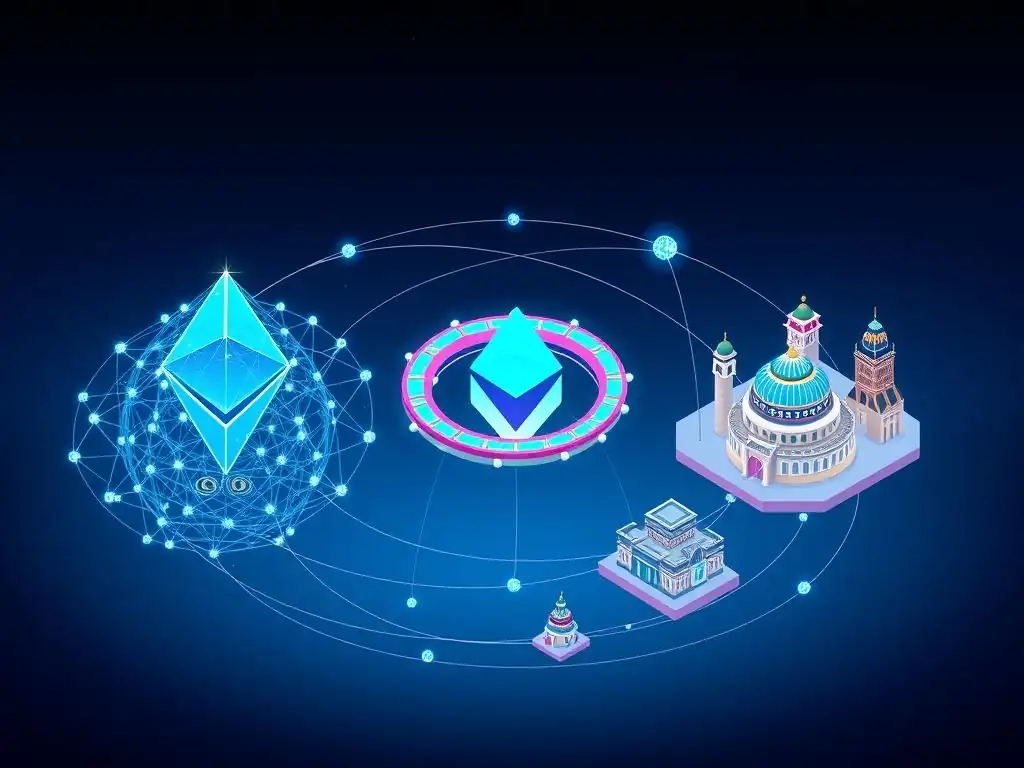
Each platform addresses scalability with distinct architectural approaches. Ethereum aims for scalability through sharding, dividing the blockchain into multiple shards that process transactions in parallel, increasing overall throughput. While still under development and phased rollout, sharding is expected to significantly enhance Ethereum's transaction capacity once fully implemented. Polkadot employs parachains, independent blockchains connected to the Relay Chain, which process transactions in parallel and benefit from the Relay Chain's security. This parachain model offers horizontal scalability, as more parachains can be added to the network to increase overall capacity.
Cosmos utilizes zones, sovereign blockchains connected through IBC, each capable of processing transactions independently. Scalability in Cosmos is achieved by distributing applications across multiple zones, allowing for parallel processing and avoiding congestion on a single chain. While each zone is responsible for its own security and scalability, the IBC protocol enables seamless communication and value transfer between them. In essence, Ethereum focuses on scaling a single blockchain through sharding, Polkadot scales through parallel parachains secured by a central Relay Chain, and Cosmos scales by distributing applications across independent, interoperable zones.
Interoperability Mechanisms: A Deep Dive into Cross-Chain Communication
Interoperability is a core focus for all three platforms, but their mechanisms differ. Ethereum's initial interoperability strategy relied heavily on bridges, often developed by third parties, to connect to other blockchains. However, native cross-shard communication within Ethereum 2.0, once sharding is fully implemented, will enhance interoperability within its own ecosystem. Polkadot's XCM (Cross-Consensus Messaging) format provides a standardized and secure way for parachains to communicate and exchange messages, facilitating native cross-chain interoperability within the Polkadot network.
Cosmos's IBC (Inter-Blockchain Communication) protocol is designed as a generalized standard for cross-chain communication between independent blockchains. IBC enables secure and reliable transfer of value and data between Cosmos zones and, potentially, other blockchains that implement the protocol. While Ethereum's interoperability is evolving, Polkadot and Cosmos have built interoperability directly into their architectures from the outset, with XCM and IBC respectively providing robust frameworks for cross-chain communication within their ecosystems.
Development Environments and Ecosystems: Ease of Use and Developer Adoption
Ethereum benefits from a mature and extensive developer ecosystem, with a large pool of Solidity developers and well-established development tools and infrastructure. The EVM (Ethereum Virtual Machine) is a widely adopted smart contract execution environment, and numerous resources and communities support Ethereum development. Polkadot utilizes Substrate, a modular framework for building blockchains, offering developers significant flexibility and customization options. While Substrate is powerful, it has a steeper learning curve compared to Solidity, and the Polkadot developer ecosystem is still growing relative to Ethereum's.
Cosmos SDK provides a user-friendly framework for building blockchains, simplifying development with modular components and clear documentation. The Cosmos developer ecosystem is also expanding, with a focus on Go programming language, which is used extensively in the Cosmos SDK. Ethereum's established developer base and mature tooling give it an advantage in terms of immediate developer accessibility, while Polkadot's Substrate and Cosmos SDK offer powerful and customizable development environments for those willing to invest in learning platform-specific tools.
Governance and Community: Decentralization and Decision-Making Processes
Governance models also differ across the platforms. Ethereum's governance has historically been more informal and off-chain, with proposals and decisions often driven by core developers and community consensus. However, there is increasing discussion and movement towards more formalized on-chain governance mechanisms within the Ethereum ecosystem. Polkadot has a robust on-chain governance system, empowering DOT token holders to directly participate in network upgrades and decision-making through proposals and voting mechanisms. This on-chain governance model is a core feature of Polkadot's design.
Cosmos also emphasizes decentralized governance, with each zone typically having its own governance model. Cosmos Hub, the central hub in the Cosmos network, also has its own on-chain governance system, allowing ATOM token holders to participate in decision-making related to the hub and the broader Cosmos ecosystem. While Ethereum's governance is evolving towards more formalization, Polkadot and Cosmos have both implemented strong on-chain governance models from their inception, reflecting a commitment to decentralized decision-making and community involvement.
Coexistence or Competition: Scenarios for the Future
Scenario 1: Specialization and Niche Applications - A Collaborative Ecosystem
One plausible future scenario is the specialization and niche application of Ethereum, Polkadot, and Cosmos, leading to a collaborative ecosystem. In this scenario, each platform excels in specific areas, leveraging its unique strengths and architectural advantages. Ethereum could remain the dominant platform for DeFi and complex smart contracts, benefiting from its network effects and mature ecosystem. Polkadot could become a hub for specialized parachains catering to specific industries or use cases, leveraging its interoperability and customizable parachain framework. Cosmos could thrive as a platform for sovereign blockchains focused on application-specific needs and cross-chain communication through IBC.
In this collaborative ecosystem, the platforms coexist and interoperate, complementing each other rather than directly competing for complete dominance. Bridges and cross-chain communication protocols would facilitate the flow of assets and data between Ethereum, Polkadot, and Cosmos, creating a more interconnected and versatile blockchain landscape. This scenario emphasizes the potential for synergy and mutual benefit, where each platform contributes to the overall growth and adoption of blockchain technology by focusing on its comparative advantages and fostering interoperability.
Scenario 2: Dominance and Consolidation - A Winner-Takes-All Market
Alternatively, a more competitive scenario could emerge, characterized by dominance and consolidation in the blockchain platform market. In this "winner-takes-all" scenario, one platform, potentially Ethereum or a rising contender, could achieve overwhelming market dominance, attracting the majority of developers, users, and capital. This dominance could be driven by superior scalability, network effects, developer ecosystem, or successful execution of its roadmap. Other platforms might struggle to compete and could see their market share and developer activity diminish.
This scenario could lead to a more consolidated blockchain landscape, with a few dominant platforms and potentially less diversity and innovation. While competition can be beneficial, a "winner-takes-all" market could stifle experimentation and limit user choice. Factors such as technological breakthroughs, regulatory developments, and shifts in developer and user preferences could influence the likelihood of this scenario, potentially leading to a more concentrated blockchain ecosystem.
A third scenario involves hybrid models, where elements of both coexistence and competition are present. In this scenario, Ethereum, Polkadot, and Cosmos continue to compete for market share and developer mindshare, but also increasingly collaborate through interoperability bridges and shared standards. Bridges connecting Ethereum, Polkadot, and Cosmos could facilitate cross-chain asset transfers and potentially even cross-chain smart contract calls, enabling greater interoperability between these ecosystems. Shared standards for communication protocols and data formats could further enhance interoperability and reduce friction between different blockchain platforms.
This hybrid scenario recognizes both the competitive dynamics and the potential benefits of collaboration in the blockchain space. Platforms may compete for specific applications or market segments, but also recognize the value of interoperability in creating a more interconnected and user-friendly blockchain ecosystem. This scenario suggests a future where coexistence and competition coexist, with platforms both striving for individual success and contributing to the overall growth of the blockchain industry through interoperability and collaboration.
Factors Influencing the Future Landscape: Regulation, Adoption, and Technological Advancements
Several factors will significantly influence the future landscape of Ethereum, Polkadot, and Cosmos, and their coexistence or competition. Regulation is a critical factor, as evolving regulatory frameworks for cryptocurrencies and blockchain technology could favor certain platforms or architectures over others. Clear and favorable regulations could foster adoption and innovation, while restrictive or unclear regulations could hinder growth and create uncertainty. The regulatory landscape remains dynamic and will play a significant role in shaping the future of blockchain platforms.
Adoption rates by both developers and users will also be crucial. Platforms that can attract and retain developers and users will have a significant advantage. Developer adoption drives innovation and application development, while user adoption fuels network effects and economic activity. Real-world adoption cases and enterprise integration will further validate the utility and viability of these platforms. Technological advancements, including breakthroughs in scalability, interoperability, and usability, will also play a key role in determining the competitive landscape. Platforms that can effectively innovate and adapt to technological changes will be better positioned for long-term success.
The Role of Layer-2 Solutions in the Ethereum, Polkadot, and Cosmos Ecosystems
Enhancing Scalability and Reducing Fees: Layer-2 Solutions on Ethereum
Layer-2 solutions are playing an increasingly important role in enhancing scalability and reducing transaction fees within the Ethereum ecosystem. These solutions operate on top of the Ethereum Layer-1 blockchain, processing transactions off-chain and then periodically submitting summarized transaction data back to the main chain for security and finality. Examples of Layer-2 solutions on Ethereum include rollups (Optimistic Rollups like Optimism and Arbitrum, and Zero-Knowledge Rollups like zkSync and StarkNet), state channels, and sidechains.
Optimistic Rollups, for instance, have demonstrated significant reductions in transaction fees compared to Ethereum Layer-1, making DeFi and other applications more accessible to a wider user base. Arbitrum, for example, has processed millions of transactions and hosts a substantial portion of the DeFi activity on Layer-2.
Layer-2 solutions are crucial for Ethereum's scalability roadmap, acting as a near-term solution to address high gas fees and network congestion while sharding and other Layer-1 upgrades are being implemented. The development and adoption of Layer-2 solutions are expanding Ethereum's capacity and improving user experience, making it more competitive and attractive for various applications. These solutions are not intended to replace Layer-1 but rather to complement it, providing a tiered approach to scalability where Layer-1 provides security and decentralization, while Layer-2 solutions optimize for transaction throughput and cost-effectiveness.
Polkadot and Cosmos: Utilizing Layer-2 for Specific Applications
While Layer-2 solutions are most prominently discussed in the context of Ethereum scalability, they also have relevance and potential applications within the Polkadot and Cosmos ecosystems. In Polkadot, parachains themselves can be considered a form of Layer-2 scaling, as they operate in parallel and offload transaction processing from the Relay Chain.
However, within individual parachains, Layer-2 solutions could still be employed to further enhance scalability for specific applications or use cases requiring even higher transaction throughput or lower latency. For instance, a parachain focused on gaming or high-frequency trading might benefit from integrating a Layer-2 solution to handle a large volume of microtransactions efficiently.
Similarly, in Cosmos, while zones provide horizontal scalability, Layer-2 solutions could be utilized within individual zones to optimize for specific application requirements. A Cosmos zone focused on DeFi, for example, might implement a Layer-2 solution to reduce transaction fees and improve transaction speeds for its users. The modularity of Cosmos SDK and Polkadot's Substrate allows for the integration of various Layer-2 technologies, providing developers with flexibility in choosing the most appropriate scaling solutions for their specific needs within these ecosystems.
Investment and Adoption Trends in Ethereum, Polkadot, and Cosmos
Investor Sentiment and Market Capitalization Analysis
Investor sentiment and market capitalization provide insights into the perceived value and potential of Ethereum, Polkadot, and Cosmos. Ethereum, as the established leader, consistently maintains a high market capitalization, reflecting its dominant position and strong investor confidence. Despite market fluctuations, Ethereum's market cap remains significantly larger than Polkadot and Cosmos, indicative of its established network effects and ecosystem size.
Polkadot and Cosmos, while having lower market capitalizations compared to Ethereum, still represent significant projects within the blockchain space, attracting substantial investor interest and capital. Market capitalization rankings fluctuate, but generally, Ethereum remains in the top tier, followed by Polkadot and Cosmos in subsequent tiers of cryptocurrency market capitalization.
Investor sentiment towards these platforms is influenced by various factors, including technological advancements, adoption rates, regulatory developments, and overall market trends. Positive developments, such as successful upgrades, growing ecosystem activity, and favorable regulatory news, tend to boost investor confidence and market capitalization. Conversely, negative news or market downturns can impact investor sentiment and lead to market corrections. Analyzing market capitalization trends and investor sentiment provides a gauge of the perceived strength and future potential of these platforms within the competitive blockchain landscape.
Real-World Adoption Cases and Enterprise Integration
Real-world adoption cases and enterprise integration are crucial indicators of the practical utility and long-term viability of Ethereum, Polkadot, and Cosmos. Ethereum, with its mature ecosystem, has seen significant real-world adoption across various sectors. DeFi protocols on Ethereum are being used for lending, borrowing, and trading, demonstrating the application of blockchain in financial services. NFTs on Ethereum have created new markets for digital art and collectibles, showcasing blockchain's potential in creative industries. Enterprises are also exploring and implementing Ethereum-based solutions for supply chain management, digital identity, and other use cases.
Polkadot and Cosmos, while newer platforms compared to Ethereum, are also starting to see real-world adoption and enterprise interest. Polkadot's parachain model is attracting projects focused on specific industry applications, such as supply chain tracking, decentralized identity solutions, and gaming platforms.
Cosmos's focus on sovereign blockchains is appealing to projects seeking greater control and customization for their blockchain infrastructure, with use cases emerging in areas like supply chain finance and cross-border payments. While Ethereum currently boasts a larger number of real-world adoption cases, Polkadot and Cosmos are steadily gaining traction as their ecosystems mature and their unique architectural advantages become more apparent to businesses and organizations seeking blockchain solutions.
Ethereum, Polkadot, and Cosmos: Shaping the Next Generation of Decentralized Applications
Ethereum, Polkadot, and Cosmos are undeniably shaping the next generation of decentralized applications. Each platform, with its distinct architecture and vision, is contributing to the evolution of blockchain technology and pushing the boundaries of what is possible with decentralized systems. Ethereum, as the established leader, continues to innovate and evolve, addressing scalability challenges and expanding its ecosystem. Polkadot, with its multi-chain architecture and focus on interoperability, is pioneering a new paradigm for interconnected blockchains. Cosmos, with its "Internet of Blockchains" vision and emphasis on sovereignty, is empowering developers to build customized and interoperable blockchain applications.
These platforms are not just competing; they are also collectively driving the advancement and adoption of blockchain technology as a whole. Their efforts to address scalability, enhance interoperability, and foster developer ecosystems are paving the way for a more mature, versatile, and user-friendly blockchain landscape. The future of decentralized applications will likely be shaped by the ongoing development and evolution of these platforms and their ability to collaborate and interoperate, creating a more interconnected and synergistic blockchain ecosystem.
Key Takeaways: Understanding the Strengths and Weaknesses of Each Platform
Understanding the strengths and weaknesses of Ethereum, Polkadot, and Cosmos is crucial for navigating the evolving blockchain landscape. Ethereum's strengths lie in its established network effect, large developer community, and mature ecosystem, particularly in DeFi and NFTs. However, it has historically faced scalability challenges and higher transaction fees, although Layer-2 solutions and sharding are addressing these limitations. Polkadot's strengths are its interoperable multi-chain architecture, on-chain governance, and customizable parachain framework.
Its ecosystem is still developing, and Substrate development can have a steeper learning curve. Cosmos's strengths are its sovereignty, modularity, and IBC protocol for interoperability. It emphasizes application-specific blockchains and decentralized governance, but its ecosystem, while growing, is also still maturing.
Each platform offers unique advantages and caters to different needs and priorities. Ethereum remains the dominant platform for general-purpose smart contracts and a vast ecosystem of applications. Polkadot is well-suited for projects prioritizing interoperability, customization, and on-chain governance. Cosmos is ideal for projects seeking sovereignty, modularity, and building interconnected application-specific blockchains. Choosing the right platform depends on the specific requirements and goals of a project or application.
The Future of Blockchain: A Collaborative and Interoperable Ecosystem?
The future of blockchain is likely to be characterized by a collaborative and interoperable ecosystem, where platforms like Ethereum, Polkadot, and Cosmos coexist and interoperate to create a more unified and versatile blockchain landscape. While competition between platforms will likely persist, the growing recognition of the importance of interoperability suggests a trend towards greater collaboration and integration. Bridges, cross-chain communication protocols, and shared standards will play a crucial role in connecting different blockchain ecosystems and enabling seamless flow of value and data.
This collaborative and interoperable future will unlock new possibilities for decentralized applications, enabling cross-chain functionalities, enhanced user experiences, and greater overall efficiency within the blockchain space. Instead of a "winner-takes-all" scenario, a more likely outcome is a multi-chain future where different platforms specialize in specific areas, leverage their unique strengths, and interoperate to create a more robust and interconnected blockchain ecosystem, ultimately driving wider adoption and realizing the full potential of decentralized technologies.
Frequently Asked Questions
How will Ethereum's ongoing upgrades impact its ability to coexist with Polkadot and Cosmos?
Ethereum's shift to Proof-of-Stake (PoS) and sharding aim to improve scalability and efficiency. This could make it a more viable competitor or a more attractive platform for interoperability with Polkadot and Cosmos. The success of these upgrades is crucial for its future.
What are the key differences in the architectures of Ethereum, Polkadot, and Cosmos that might lead to competition or collaboration?
Ethereum is primarily a smart contract platform, while Polkadot and Cosmos focus on interoperability between blockchains. These architectural differences could lead to specialized use cases, fostering coexistence through complementary strengths.
What role will regulation play in shaping the future coexistence of Ethereum, Polkadot, and Cosmos?
Regulatory clarity surrounding DeFi and cross-chain communication will significantly impact these platforms. Favorable regulations could foster innovation and interoperability, while restrictive ones could hinder growth and increase competition.
How does the developer community influence the direction of these platforms and their potential for collaboration?
A strong developer community is essential for growth and innovation. Active development in each ecosystem and efforts to build cross-chain bridges will determine the level of collaboration or competition.
What are some potential real-world use cases where Ethereum, Polkadot, and Cosmos could work together to create value?
Supply chain management, decentralized finance (DeFi), and digital identity are potential areas. These three platforms could create a more robust and interconnected ecosystem, leveraging each other's strengths to achieve shared goals.
The exploration of Ethereum, Polkadot, and Cosmos reveals more than just technological comparisons; it unveils the fundamental shift towards a multichain future that is already reshaping the blockchain landscape. The potential for coexistence, competition, and collaboration between these ecosystems is not merely a theoretical exercise, but a critical consideration for anyone involved in the development, investment, or understanding of decentralized technologies today.
This ongoing evolution profoundly influences the cultural and social fabric of the digital world. The promise of interoperability and specialized blockchains offers a tantalizing glimpse into a future where innovation is accelerated and user experience is vastly improved. The future is already here – it's just not evenly distributed.
- William Gibson. This quote perfectly encapsulates the current state of blockchain technology, with Ethereum, Polkadot, and Cosmos each representing different stages of this distribution, each striving to bring the future closer to the present.
As we stand on the cusp of this multichain era, let us not be passive observers. Consider how these technologies might impact your own endeavors, whether you're a developer, investor, or simply a curious mind. Embrace the opportunity to learn, experiment, and contribute to the ongoing dialogue. The future of blockchain is not predetermined; it is being actively shaped by the choices we make today. Let us strive to build a future where innovation thrives and the benefits of decentralization are accessible to all.
Unleash Your Crypto Insight: Shape the Future of Blockchain!
Thank you for exploring the potential futures of Ethereum, Polkadot, and Cosmos. We hope this discussion has enhanced your understanding of their distinct roles in the evolving blockchain landscape. Now, it's time to turn that knowledge into action!
Here’s how you can engage further and advance your blockchain journey:
- Deepen your understanding: Choose one of these blockchains—Ethereum, Polkadot, or Cosmos—and spend a week researching its latest developments and community projects.
- Join the conversation: Share this article and your thoughts on whether these platforms will coexist or compete on your favorite social media channels using a dedicated hashtag. Let’s start a meaningful debate!
- Explore alternative consensus mechanisms: Investigate less common methods such as Delegated Proof-of-Stake or Proof-of-Authority and consider how they might shape the future of blockchain interoperability.
Which blockchain’s vision resonates most with you? Is there a particular project within that ecosystem you're eager to explore further? Share your thoughts below!
Leave a Reply