
Security Showdown: Fortifying Your dApp on Ethereum, Polkadot, or Cosmos


Welcome to Blockchain Trends, your compass in the rapidly evolving world of decentralized technology. Beyond the buzz of cryptocurrencies, we delve into the real-world applications shaping industries and redefining trust. Thinking about building a dApp? Our in-depth analysis of dApp security best practices is crucial for developers navigating the nuances of Ethereum, Polkadot, and Cosmos. Discover how to fortify your decentralized application and protect it from emerging threats – the future of blockchain depends on it. Ready to build securely?
Security Showdown: Fortifying Your dApp on Ethereum, Polkadot, or Cosmos
- Introduction: Understanding dApp Security Across Blockchain Ecosystems
- Ethereum dApp Security: Challenges and Solutions
- Polkadot dApp Security: A Multi-Chain Approach
- Cosmos dApp Security: Interoperability and Resilience
- Comparing dApp Security Approaches: Ethereum vs. Polkadot vs. Cosmos
- dApp Security Best Practices: A Cross-Platform Guide
- The Future of dApp Security: Trends and Innovations
- Conclusion: Prioritizing Security for Sustainable dApp Growth
-
Frequently Asked Questions
- How does the choice of blockchain (Ethereum, Polkadot, Cosmos) impact dApp security best practices?
- What are the most common security vulnerabilities found in dApps?
- What are some crucial dApp security best practices for smart contract development?
- How can developers ensure the security of user data and private keys in their dApps?
- What role does regulation play in the future of dApp security?
- Final Reflection: The Enduring Quest for Trustworthy dApps
- Embrace dApp Security: Start Building Today!
Introduction: Understanding dApp Security Across Blockchain Ecosystems
The Growing Importance of dApp Security Best Practices
Decentralized applications (dApps) are rapidly transforming various sectors, from finance and supply chain management to gaming and social media. As these applications handle increasingly sensitive data and substantial financial transactions, ensuring robust dApp security becomes paramount. A security breach in a dApp can lead to significant financial losses, data theft, reputational damage, and erosion of user trust.
The decentralized and often immutable nature of blockchain technology, while offering many advantages, also means that vulnerabilities in dApps can be particularly challenging to remediate post-deployment. Therefore, implementing dApp security best practices from the initial stages of development is not just advisable but absolutely crucial for the long-term success and sustainability of the decentralized ecosystem.
The complexity of dApp development, often involving smart contracts, intricate consensus mechanisms, and novel interaction paradigms, introduces unique security challenges that differ significantly from traditional web applications. For instance, smart contract vulnerabilities, like reentrancy or integer overflows, can be exploited to drain funds or manipulate application logic in ways that are difficult to reverse. The transparency of blockchain, while beneficial for auditability, also means that vulnerabilities in publicly deployed smart contracts are visible to potential attackers.
This necessitates a proactive and comprehensive approach to dApp security, incorporating rigorous testing, auditing, and continuous monitoring to mitigate risks and protect users and their assets. Ignoring dApp security best practices can have severe consequences, as demonstrated by numerous high-profile exploits in the DeFi space, underscoring the urgent need for developers to prioritize security throughout the dApp lifecycle.
Ethereum, Polkadot, and Cosmos: A Security-Focused Comparison
Ethereum, Polkadot, and Cosmos represent leading blockchain platforms each with distinct architectures and approaches to security. Ethereum, as the pioneering smart contract platform, boasts a vast ecosystem and a mature security landscape, albeit one that has learned from numerous historical vulnerabilities. Its security model largely relies on the robustness of its EVM (Ethereum Virtual Machine) and the security of individual smart contracts deployed on the network. Polkadot, on the other hand, champions a multi-chain architecture with a central Relay Chain coordinating security for interconnected parachains.
This shared security model aims to provide a higher level of baseline security for parachains compared to standalone blockchains. Cosmos focuses on interoperability through its Inter-Blockchain Communication Protocol (IBC), allowing independent blockchains to connect and transact securely. Cosmos emphasizes sovereign blockchains, where each chain is responsible for its own security, but IBC provides mechanisms for secure cross-chain interactions.
When comparing these platforms from a dApp security perspective, it's crucial to consider their underlying consensus mechanisms, governance models, and architectural nuances. Ethereum currently utilizes Proof-of-Stake (PoS) after transitioning from Proof-of-Work (PoW), which influences its network-level security. Polkadot also employs a Nominated Proof-of-Stake (NPoS) system, while Cosmos chains often leverage Tendermint BFT consensus or variations thereof.
Each consensus mechanism has its own security strengths and weaknesses. Governance also plays a significant role in security, determining how network upgrades and security patches are implemented. Ethereum's governance is evolving, Polkadot has a more formalized on-chain governance system, and Cosmos allows for sovereign chain governance.
Furthermore, the architecture of each platform—monolithic for Ethereum, multi-chain for Polkadot, and inter-chain for Cosmos—impacts the attack surface and the types of security considerations relevant for dApp developers. Understanding these fundamental differences is essential for choosing the most appropriate platform and implementing effective dApp security best practices tailored to each ecosystem.
Ethereum dApp Security: Challenges and Solutions
Common Ethereum dApp Vulnerabilities: Reentrancy Attacks
Ethereum, despite its maturity, still faces prevalent dApp security challenges, with reentrancy attacks being a historically significant vulnerability. Reentrancy attacks exploit a flaw in smart contracts where an external call is made before state changes are finalized. Imagine a scenario where a smart contract allows users to withdraw ETH.
A malicious contract can recursively call the withdrawal function before the initial withdrawal is completed, potentially draining the contract's funds. The infamous DAO hack in 2016, resulting in the theft of approximately $50 million USD worth of ETH, was a prime example of a reentrancy attack. This attack highlighted the critical need for developers to meticulously manage state changes and external calls in their smart contracts.
Another common vulnerability in Ethereum dApps is integer overflow and underflow. Smart contracts operating on fixed-size integers are susceptible to these issues when arithmetic operations result in values exceeding or falling below the representable range. For instance, if a contract uses an 8-bit unsigned integer (uint8), the maximum value it can hold is 255. Adding 1 to 255 will result in an overflow, wrapping around to 0, potentially leading to unexpected behavior and security exploits.
Similarly, subtracting from zero can cause an underflow, wrapping around to the maximum value. These vulnerabilities can be exploited to manipulate token balances, control flow, or other critical aspects of a dApp. Furthermore, vulnerabilities related to access control, transaction-ordering dependence (front-running), and denial-of-service (DoS) attacks continue to pose threats to Ethereum dApps. Understanding these common attack vectors is the first step in implementing effective dApp security best practices on Ethereum.
Implementing Robust Security Measures for Ethereum dApps
To mitigate the aforementioned vulnerabilities, Ethereum dApp developers must implement robust security measures throughout the development lifecycle. One fundamental practice is employing secure coding principles, such as the Checks-Effects-Interactions pattern. This pattern dictates that state checks should be performed first, then state changes (effects) should be applied, and finally, external calls (interactions) should be made last.
This helps prevent reentrancy attacks by ensuring that state changes are finalized before external calls are executed. Careful attention to data types and arithmetic operations is also crucial to prevent integer overflows and underflows. Using safe math libraries, like OpenZeppelin's SafeMath, can automatically handle these potential issues by reverting transactions when overflows or underflows occur.
Furthermore, implementing robust access control mechanisms is essential to restrict unauthorized access to critical functions and data within a dApp. Employing access control modifiers, such as onlyOwner or role-based access control, ensures that only authorized users or contracts can perform sensitive actions. To address front-running vulnerabilities, developers can utilize commit-reveal schemes or consider employing layer-2 scaling solutions that offer faster transaction finality and reduce the window for front-running. For protection against DoS attacks, implementing rate limiting, gas limits on operations, and robust error handling can help prevent malicious actors from overwhelming a dApp. Beyond these coding practices, rigorous testing, formal verification where feasible, and comprehensive security audits are indispensable components of a robust dApp security strategy on Ethereum.
Auditing Smart Contracts on Ethereum: Finding and Fixing Vulnerabilities
Auditing smart contracts is a critical step in ensuring the security of Ethereum dApps. A security audit involves a thorough review of the smart contract code by independent security experts to identify potential vulnerabilities, logic errors, and areas for improvement. Audits typically involve both automated tools and manual code review.
Automated tools can help detect common vulnerability patterns and coding style issues, while manual review leverages the expertise of security auditors to understand the contract's logic, identify subtle vulnerabilities, and assess the overall security posture. Reputable auditing firms often have established methodologies and checklists based on known smart contract attack vectors and dApp security best practices.
The auditing process usually involves several stages, including understanding the contract's specifications, static analysis, dynamic analysis (testing), and a final report detailing the findings and recommendations. Static analysis tools examine the code without executing it, looking for potential vulnerabilities like reentrancy, integer overflows, and access control issues. Dynamic analysis involves running the contract in a test environment with various inputs to observe its behavior and identify runtime vulnerabilities.
Following an audit, developers should prioritize addressing the identified vulnerabilities and implementing the recommended fixes. It's also considered a dApp security best practice to conduct multiple audits, especially for complex or high-value dApps, and to perform audits after significant code changes or upgrades. Publishing audit reports can also enhance transparency and build user confidence in the dApp's security.
Gas Optimization: Minimizing Attack Surfaces on Ethereum
Gas optimization in Ethereum smart contracts, while primarily focused on reducing transaction costs, also indirectly contributes to dApp security by minimizing attack surfaces. Gas, the unit of computation cost on Ethereum, is paid for every operation performed by a smart contract. Inefficient code can consume excessive gas, making transactions more expensive for users and potentially creating larger attack surfaces. For instance, complex loops, unnecessary storage writes, and inefficient data structures can increase gas consumption and, in some cases, open up opportunities for DoS attacks by making it economically infeasible for legitimate users to interact with the dApp.
Optimizing gas usage often involves writing cleaner, more efficient code, minimizing storage operations, and using gas-efficient data structures. For example, using calldata instead of memory for function arguments where possible, employing assembly language for gas-intensive operations, and carefully structuring loops can significantly reduce gas consumption. Furthermore, understanding gas costs associated with different EVM opcodes and Solidity language constructs is crucial for writing gas-optimized code.
While gas optimization should not come at the expense of code clarity and security, it is an important aspect of dApp security best practices on Ethereum. By reducing the complexity and resource consumption of smart contracts, developers can minimize potential attack vectors and improve the overall resilience of their dApps.
Using Security Libraries and Frameworks for Ethereum dApps
Leveraging established security libraries and frameworks is a cornerstone of dApp security best practices in the Ethereum ecosystem. These resources provide pre-built, well-tested, and audited components that address common security challenges, significantly reducing the risk of introducing vulnerabilities through custom code. OpenZeppelin Contracts is a widely adopted library offering a comprehensive suite of secure smart contract components, including implementations for ERC20 and ERC721 tokens, access control mechanisms, and utility functions like SafeMath. Using OpenZeppelin Contracts can significantly simplify secure dApp development and reduce the likelihood of common coding errors.
Similarly, frameworks like Truffle and Hardhat provide development environments and tools that promote secure development practices. These frameworks often include built-in testing capabilities, static analysis tools, and deployment pipelines that facilitate the creation and deployment of secure dApps. Furthermore, security-focused libraries like ConsenSys Diligence Mythril and Slither offer static analysis capabilities to automatically detect potential vulnerabilities in smart contracts.
Integrating these tools into the development workflow allows for early detection and mitigation of security risks. By utilizing security libraries and frameworks, developers can benefit from the collective knowledge and expertise of the Ethereum security community, ensuring a more robust and secure foundation for their dApps. This approach not only enhances security but also accelerates development by providing readily available and reliable building blocks.
Polkadot dApp Security: A Multi-Chain Approach
Security Considerations in the Polkadot Ecosystem: Relay Chain and Parachain Security
Polkadot's architecture, centered around a Relay Chain and interconnected parachains, introduces unique security considerations for dApp developers. The Relay Chain serves as the central security provider for the entire network, offering shared security to parachains through its Nominated Proof-of-Stake (NPoS) consensus mechanism. This shared security model is a key differentiator of Polkadot, aiming to provide a higher baseline level of security for parachains compared to independent blockchains that must bootstrap their own security. Parachains benefit from the economic security and validator set of the Relay Chain, reducing the risk of 51% attacks and other consensus-related vulnerabilities.
However, relying on shared security also means that the security of a parachain is inherently linked to the security of the Relay Chain. Any vulnerabilities or compromises in the Relay Chain could potentially impact the security of all connected parachains. Furthermore, while the Relay Chain provides consensus-level security, parachains are still responsible for securing their own runtime logic and smart contracts.
Parachain developers need to implement robust security measures within their parachain runtime environment to protect against vulnerabilities specific to their application logic and business logic. This includes securing their WebAssembly (Wasm) runtimes, implementing secure smart contract development practices using languages like Ink!, and carefully managing parachain-specific security parameters. Understanding the interplay between Relay Chain security and parachain-level security is crucial for building secure dApps in the Polkadot ecosystem.
Building Secure dApps on Polkadot: Best Practices
Developing secure dApps on Polkadot requires a nuanced approach that considers both the shared security provided by the Relay Chain and the specific security requirements of parachain runtimes. Leveraging the Substrate framework, the foundation for building parachains, is a dApp security best practice in itself. Substrate provides a modular and extensible architecture that allows developers to incorporate security features and modules directly into their parachain runtime. Utilizing Substrate's security-focused pallets (runtime modules) for identity management, access control, and governance can significantly enhance the security posture of a Polkadot dApp.
When developing smart contracts on Polkadot parachains, using secure programming languages like Ink! and following secure coding practices is paramount. Ink!, a Rust-based smart contract language for Substrate, benefits from Rust's memory safety and robust type system, reducing the risk of common smart contract vulnerabilities.
Implementing rigorous testing and auditing processes for parachain runtimes and smart contracts is equally essential. Furthermore, developers should carefully consider the security implications of cross-chain communication and implement appropriate security measures to protect against vulnerabilities arising from interactions with other parachains and external networks. Regularly updating parachain runtimes and staying informed about the latest security best practices in the Polkadot ecosystem are also crucial for maintaining the security of Polkadot dApps over time.
Implementing Cross-Chain Communication Security in Polkadot
Cross-chain communication is a fundamental aspect of Polkadot's architecture, enabling parachains to interact and exchange data securely. However, this interoperability also introduces new security challenges. Implementing secure cross-chain communication requires careful consideration of potential vulnerabilities in the Inter-chain Message Passing (XCMP) protocol and other cross-chain communication mechanisms used in Polkadot. Ensuring the integrity and authenticity of messages exchanged between parachains is crucial to prevent malicious actors from manipulating cross-chain transactions or exploiting vulnerabilities in inter-parachain communication channels.
One key security measure is implementing robust message validation and verification mechanisms in parachain runtimes. Parachains should thoroughly validate incoming messages from other parachains to ensure they are from legitimate sources and have not been tampered with. Utilizing cryptographic signatures and verifiable data structures can help establish the authenticity and integrity of cross-chain messages.
Furthermore, implementing rate limiting and access control policies for cross-chain communication can mitigate the risk of DoS attacks or unauthorized data exchange. Developers should also be aware of potential relay chain congestion issues that could impact the reliability and security of cross-chain communication. Thorough testing and auditing of cross-chain communication logic are essential to ensure the secure and reliable operation of dApps that rely on inter-parachain interactions.
Runtime Security in Polkadot: Protecting Against Logic Errors
Runtime security in Polkadot focuses on protecting against logic errors and vulnerabilities within the parachain runtime environment itself. The runtime, written in Rust and compiled to WebAssembly (Wasm), defines the logic and state transition function of a parachain. Vulnerabilities in the runtime code can lead to critical security breaches, potentially allowing attackers to manipulate parachain state, disrupt operations, or even gain control of the parachain. Therefore, ensuring the security and correctness of the parachain runtime is paramount.
Employing secure coding practices in Rust, leveraging Rust's memory safety features, and conducting rigorous testing are crucial for mitigating runtime vulnerabilities. Formal verification techniques, where applicable, can also be used to mathematically prove the correctness of critical runtime components. Furthermore, implementing robust error handling and fault tolerance mechanisms within the runtime can help prevent unexpected behavior and security breaches in the face of errors or malicious inputs.
Regular security audits of parachain runtimes by experienced security experts are essential to identify potential vulnerabilities and logic flaws that might not be apparent through standard testing methods. Runtime security is a continuous process that requires ongoing monitoring, updates, and proactive vulnerability management to maintain the security of Polkadot dApps.
Polkadot's Governance and Security Upgrades
Polkadot's on-chain governance system plays a crucial role in maintaining the security and evolution of the network, including parachains. The governance system allows for decentralized decision-making regarding network upgrades, security patches, and protocol changes. This decentralized governance model enables Polkadot to adapt to emerging security threats and implement necessary security improvements in a timely and efficient manner. Security upgrades, such as patches for discovered vulnerabilities or enhancements to the consensus mechanism, can be proposed, voted on, and implemented through the on-chain governance process.
Parachain developers benefit from Polkadot's governance system as security upgrades and improvements to the Relay Chain and core protocols are automatically inherited by parachains. However, parachains also have the autonomy to implement their own governance mechanisms and manage parachain-specific security upgrades independently. Staying informed about Polkadot's governance proposals and participating in the governance process is a dApp security best practice for parachain developers.
Understanding how security upgrades are implemented and how governance decisions impact parachain security is essential for maintaining the long-term security and resilience of Polkadot dApps. The ability to adapt and evolve through on-chain governance is a significant security advantage of the Polkadot ecosystem.
Cosmos dApp Security: Interoperability and Resilience
Securing Inter-Blockchain Communication (IBC) in Cosmos
Cosmos emphasizes interoperability through its Inter-Blockchain Communication Protocol (IBC), enabling secure and trust-minimized communication between independent blockchains. Securing IBC is paramount for the overall security of the Cosmos ecosystem and dApps that rely on cross-chain interactions. IBC provides a standardized protocol for authenticated and ordered packet relay between blockchains, allowing for secure transfer of tokens and data. However, the security of IBC relies on the security of the individual blockchains participating in cross-chain communication and the security of the IBC implementation itself.
One key aspect of IBC security is ensuring the integrity and authenticity of packets relayed between chains. IBC utilizes cryptographic commitments and proofs to verify the state of the sending chain on the receiving chain, ensuring that packets are not tampered with during relay. Relayers, the entities responsible for relaying packets between chains, are economically incentivized to perform their duties honestly, but security measures are in place to mitigate the risk of malicious relayers.
Furthermore, security audits of IBC implementations and ongoing research into potential vulnerabilities are crucial for maintaining the security of cross-chain communication in Cosmos. Developers building dApps that utilize IBC should thoroughly understand the security assumptions and limitations of the protocol and implement appropriate security measures to protect against potential risks associated with cross-chain interactions.
Developing Secure dApps on the Cosmos Network
Developing secure dApps on the Cosmos network requires a focus on both chain-level security and application-level security. Cosmos emphasizes sovereign blockchains, meaning each chain is responsible for its own security. While IBC provides a secure communication layer, the underlying security of each chain is independent. Therefore, dApp developers building on Cosmos need to carefully consider the security of the specific blockchain they are deploying on, including its consensus mechanism, validator set, and governance model.
The Cosmos SDK (Software Development Kit) is a popular framework for building blockchains in the Cosmos ecosystem. The SDK provides a modular architecture and a collection of pre-built modules that simplify blockchain development and promote secure development practices. Utilizing the Cosmos SDK and its security-focused modules is a dApp security best practice.
When developing custom modules or application logic, developers should adhere to secure coding principles, conduct rigorous testing, and perform security audits. Furthermore, implementing robust access control mechanisms, rate limiting, and monitoring systems are essential for securing Cosmos dApps. Understanding the security characteristics of the chosen Cosmos chain and leveraging the security features of the Cosmos SDK are crucial for building secure and resilient dApps in the Cosmos ecosystem.
Account and Permission Management in Cosmos
Account and permission management are fundamental aspects of dApp security in Cosmos. Securely managing user accounts and controlling access to dApp functionalities is crucial for protecting user assets and preventing unauthorized actions. Cosmos blockchains typically utilize cryptographic key pairs for account management, with users controlling their private keys to authorize transactions and interact with dApps. Implementing robust key management practices, such as secure key generation, storage, and recovery mechanisms, is essential for user security.
Furthermore, dApp developers need to implement fine-grained permission management within their applications to control access to specific functionalities and data. Role-based access control (RBAC) or attribute-based access control (ABAC) models can be used to define roles and permissions, ensuring that only authorized users or accounts can perform sensitive operations. Utilizing Cosmos SDK modules for authentication and authorization can simplify the implementation of secure account and permission management. Regularly reviewing and updating permission policies and conducting security audits of account management systems are dApp security best practices in the Cosmos ecosystem.
Cosmos SDK Security Modules: Using Staking and Governance for Security
The Cosmos SDK offers several security modules that can be leveraged to enhance the security of Cosmos blockchains and dApps. The staking module, for instance, is crucial for the security of Proof-of-Stake (PoS) Cosmos chains. Staking mechanisms incentivize validators to act honestly and participate in consensus, as they risk losing their staked tokens if they behave maliciously. A robust staking mechanism with a sufficiently high staking ratio enhances the economic security of the blockchain, making it more resistant to attacks.
The governance module in the Cosmos SDK provides a framework for on-chain governance and decentralized decision-making. Governance can be used to implement security upgrades, patch vulnerabilities, and manage network parameters in a transparent and decentralized manner. Utilizing the governance module for security-related decisions enhances the overall security and resilience of the Cosmos ecosystem.
Furthermore, other SDK modules, such as the auth module for authentication and the crisis module for handling emergency situations, contribute to the overall security posture of Cosmos chains. Leveraging these security modules provided by the Cosmos SDK is a dApp security best practice for developers building on the Cosmos network.
Understanding Tendermint Consensus and its Security Implications
Tendermint BFT (Byzantine Fault Tolerance) consensus is a widely used consensus algorithm in the Cosmos ecosystem, and understanding its security implications is crucial for dApp developers. Tendermint BFT is designed to provide strong security and fault tolerance, even in the presence of malicious or faulty validators. It achieves consensus through a process of voting and message exchange among validators, ensuring that a block is finalized only when a supermajority of validators agree. Tendermint BFT is known for its fast finality and resilience to Byzantine faults, where validators can act arbitrarily or maliciously.
However, Tendermint's security relies on certain assumptions, such as the assumption that at least two-thirds of the validators are honest. If more than one-third of validators collude or become compromised, the security of the consensus mechanism can be undermined. Therefore, ensuring a sufficiently decentralized and robust validator set is crucial for maintaining the security of Tendermint-based Cosmos chains.
Furthermore, understanding the potential attack vectors against Tendermint consensus, such as long-range attacks or validator collusion, is important for dApp developers to assess the security risks and implement appropriate mitigation measures. While Tendermint BFT provides a strong foundation for blockchain security, developers should be aware of its security assumptions and limitations when building dApps on Cosmos.
Comparing dApp Security Approaches: Ethereum vs. Polkadot vs. Cosmos
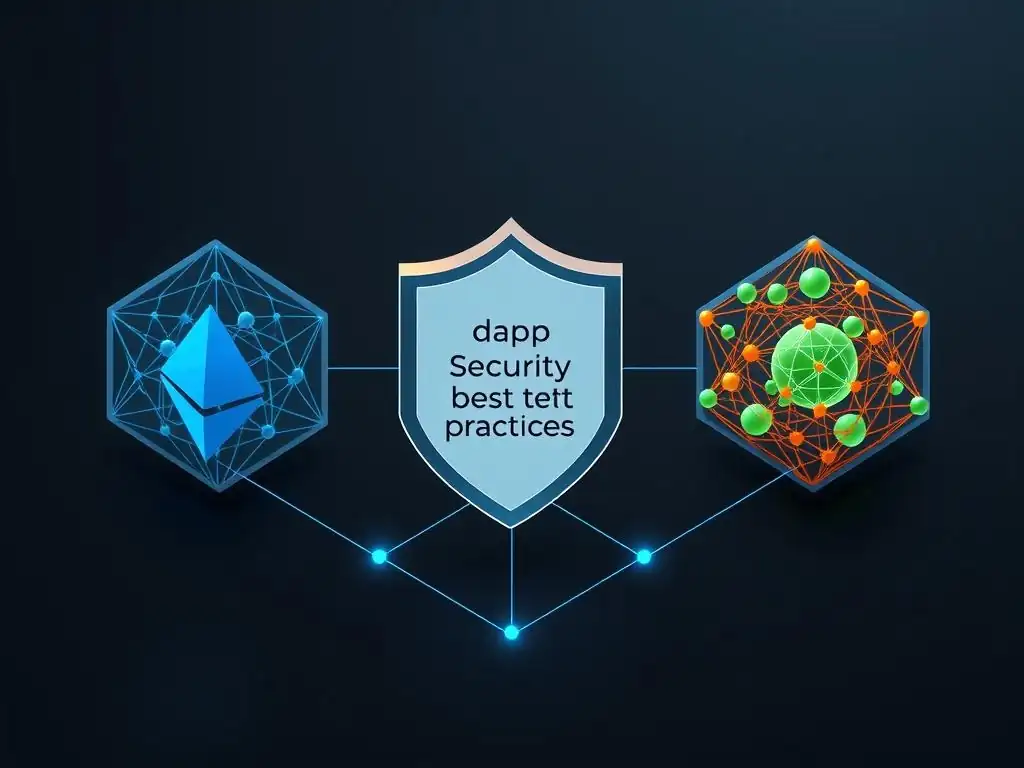
Key Security Differences: Consensus Mechanisms, Governance, and Architecture
Ethereum, Polkadot, and Cosmos exhibit key security differences stemming from their distinct consensus mechanisms, governance models, and architectural approaches. Ethereum, with its mature ecosystem and transition to Proof-of-Stake (PoS), relies on the economic security provided by ETH staking and a large validator set. Its security is primarily focused on the EVM and individual smart contract security, with ongoing efforts to improve network-level security and scalability. Ethereum's governance, while evolving, remains less formalized compared to Polkadot, with off-chain coordination playing a significant role.
Polkadot, with its Nominated Proof-of-Stake (NPoS) and Relay Chain architecture, offers shared security to parachains. This shared security model provides a higher baseline security level for parachains and benefits from Polkadot's on-chain governance system, which facilitates network upgrades and security patches. Polkadot's security focus is on the Relay Chain and the secure interoperability of parachains.
Cosmos, emphasizing sovereign blockchains and interoperability through IBC, relies on the security of individual chains and the security of the IBC protocol itself. Cosmos chains often utilize Tendermint BFT consensus, and governance is typically chain-specific, allowing for greater sovereignty but also requiring each chain to manage its own security independently. Cosmos's security approach is more decentralized and distributed, relying on the collective security of independent blockchains rather than a centralized shared security model.
Security Trade-offs: Scalability vs. Decentralization vs. Security
Choosing a blockchain platform for dApp development often involves navigating the trilemma of scalability, decentralization, and security, as optimizing for one aspect can sometimes come at the expense of others. Ethereum, while highly decentralized and secure, has historically faced scalability challenges, although layer-2 solutions are addressing this. Prioritizing decentralization and security initially led to slower transaction speeds and higher gas costs on Ethereum mainnet.
Polkadot aims to balance scalability, decentralization, and security through its multi-chain architecture and shared security model. Parachains can achieve higher scalability by offloading transaction processing from the Relay Chain, while still benefiting from the Relay Chain's security and decentralization. However, the shared security model introduces dependencies on the Relay Chain, and the complexity of parachain development can present its own challenges.
Cosmos prioritizes scalability and sovereignty, allowing independent blockchains to scale independently and maintain full control over their security and governance. This approach can lead to highly scalable and customizable blockchains, but it also places a greater burden on individual chains to bootstrap and maintain their own security.
The "app-chain" thesis in Cosmos emphasizes application-specific blockchains optimized for particular use cases, potentially enhancing both scalability and security for those specific applications but at the cost of fragmentation. The choice between Ethereum, Polkadot, or Cosmos often depends on the specific security, scalability, and decentralization requirements of the dApp being developed, as well as the desired trade-offs between these factors.
Choosing the Right Blockchain for Your Secure dApp: A Decision Matrix
Selecting the optimal blockchain platform for a secure dApp requires careful consideration of various factors and a clear understanding of the security characteristics of each platform. For dApps prioritizing maximum security and benefiting from a mature ecosystem with extensive security tooling and auditing resources, Ethereum remains a strong contender, particularly as layer-2 solutions improve scalability. Ethereum's large community and established security best practices make it a suitable choice for high-value dApps where security is paramount, despite potential gas costs and scalability limitations on mainnet.
For dApps requiring high scalability and interoperability while still benefiting from a shared security model, Polkadot offers a compelling alternative. Polkadot's parachain architecture and shared security can provide a balance of scalability and security, particularly for dApps that need to interact with multiple blockchains or benefit from cross-chain functionality. Polkadot's on-chain governance and focus on security updates also make it attractive for long-term dApp security and evolution.
For dApps demanding maximum sovereignty, customization, and scalability, with a willingness to manage chain-level security independently, Cosmos provides the greatest flexibility. Cosmos is well-suited for application-specific blockchains and dApps that require highly customized security models and governance structures. The decision matrix should consider factors such as the dApp's security requirements, scalability needs, interoperability demands, governance preferences, development resources, and the desired trade-offs between security, scalability, and decentralization.
dApp Security Best Practices: A Cross-Platform Guide
Secure Coding Practices for dApp Development
Regardless of the chosen blockchain platform, secure coding practices are fundamental to dApp security. This encompasses writing clean, well-documented, and modular code that is easy to understand, audit, and maintain. Adhering to established coding standards and style guides improves code readability and reduces the likelihood of introducing errors. Employing secure design patterns, such as the Checks-Effects-Interactions pattern for smart contracts, helps prevent common vulnerabilities like reentrancy attacks. Thorough input validation and sanitization are crucial to prevent injection attacks and ensure that dApps handle user inputs safely.
Avoiding common coding pitfalls, such as integer overflows/underflows, off-by-one errors, and race conditions, is essential for writing secure dApps. Implementing robust error handling and logging mechanisms allows for early detection and mitigation of potential issues. Utilizing linters and static analysis tools during development can automatically identify potential vulnerabilities and coding style violations. Writing comprehensive unit tests and integration tests is crucial to verify the correctness and security of dApp logic. Secure coding is not a one-time activity but an ongoing process that should be integrated into every stage of the dApp development lifecycle.
Regular Security Audits and Penetration Testing
Regular security audits and penetration testing are indispensable dApp security best practices. Security audits, conducted by independent security experts, provide a thorough review of the dApp's code, architecture, and security posture. Audits help identify potential vulnerabilities, logic errors, and areas for improvement that might be missed during internal testing. Penetration testing, also known as ethical hacking, involves simulating real-world attacks to identify exploitable vulnerabilities and assess the dApp's resilience to attacks.
Audits and penetration tests should be performed at various stages of the dApp lifecycle, including before initial deployment, after significant code changes, and periodically on a regular schedule. Choosing reputable and experienced security firms for audits and penetration testing is crucial to ensure the quality and effectiveness of these security assessments. Following up on audit and penetration testing findings and promptly addressing identified vulnerabilities is essential for maintaining dApp security. Publishing audit reports can also enhance transparency and build user trust. Combining regular audits and penetration testing with proactive security monitoring provides a comprehensive security assurance strategy for dApps.
Implementing Multi-Factor Authentication (MFA)
Multi-factor authentication (MFA) adds an extra layer of security to dApps by requiring users to provide multiple verification factors before granting access. MFA significantly reduces the risk of account compromise due to password theft or phishing attacks. Common MFA factors include something the user knows (password), something the user has (e.g., mobile device, hardware token), and something the user is (biometrics). Implementing MFA for dApps typically involves integrating with authentication providers that support MFA, such as Authy or Google Authenticator.
For blockchain-based dApps, MFA can be particularly relevant for managing access to sensitive functionalities, such as wallet management, transaction authorization, or administrative controls. Requiring MFA for critical operations adds a significant hurdle for attackers attempting to gain unauthorized access. Implementing MFA should be user-friendly and seamlessly integrated into the dApp user experience to avoid user friction. Providing clear instructions and support for users setting up and using MFA is also important. MFA is a valuable dApp security best practice that enhances account security and reduces the risk of unauthorized access and account takeovers.
Monitoring and Incident Response for dApps
Proactive security monitoring and a well-defined incident response plan are essential for maintaining dApp security in the long term. Security monitoring involves continuously monitoring dApp activity, logs, and system metrics for suspicious patterns or anomalies that could indicate security incidents. Implementing real-time monitoring tools and alerts allows for early detection of potential attacks or vulnerabilities being exploited. Setting up logging and auditing systems to track dApp events and user actions provides valuable data for security analysis and incident investigation.
A comprehensive incident response plan outlines the steps to be taken in the event of a security incident, such as a data breach, smart contract exploit, or DoS attack. The incident response plan should include procedures for incident detection, containment, eradication, recovery, and post-incident analysis. Having a dedicated incident response team and conducting regular incident response drills ensures that the team is prepared to effectively handle security incidents when they occur.
Regularly reviewing and updating the incident response plan based on lessons learned from past incidents and evolving threat landscape is a dApp security best practice. Proactive monitoring and a well-prepared incident response plan are crucial for minimizing the impact of security incidents and ensuring the resilience of dApps.
Staying Updated with the Latest dApp Security Threats and Vulnerabilities
The dApp security landscape is constantly evolving, with new threats and vulnerabilities emerging regularly. Staying updated with the latest dApp security threats and vulnerabilities is a continuous and crucial dApp security best practice. This involves actively monitoring security news, vulnerability disclosures, and security research in the blockchain and dApp space. Subscribing to security mailing lists, following security experts on social media, and participating in security communities are valuable ways to stay informed.
Regularly reviewing and updating dApp security practices and defenses based on the latest threat intelligence is essential. Attending security conferences, workshops, and webinars focused on dApp security can provide valuable insights and knowledge. Sharing security information and best practices within the dApp development team and fostering a security-conscious culture are also important. Continuously learning and adapting to the evolving dApp security landscape is key to maintaining the long-term security and resilience of dApps.
The Future of dApp Security: Trends and Innovations
Formal Verification of Smart Contracts
Formal verification of smart contracts is an emerging trend in dApp security that aims to provide mathematical proof of the correctness and security of smart contract code. Formal verification techniques use mathematical models and automated tools to analyze smart contract code and verify that it meets its specifications and does not contain certain types of vulnerabilities, such as reentrancy or integer overflows. While formal verification is still a relatively complex and resource-intensive process, advancements in tooling and methodologies are making it more accessible and practical for securing high-value smart contracts.
Formal verification can provide a higher level of assurance compared to traditional testing and auditing methods, as it can mathematically prove the absence of certain vulnerabilities rather than just detecting their presence in specific test cases. Integrating formal verification into the smart contract development lifecycle, particularly for critical smart contract components, can significantly enhance dApp security. As formal verification tools become more user-friendly and efficient, it is expected to play an increasingly important role in ensuring the security of smart contracts and dApps in the future.
Decentralized Security Solutions: Bug Bounty Programs and Insurance Protocols
Decentralized security solutions, such as bug bounty programs and decentralized insurance protocols, are gaining traction in the dApp space. Bug bounty programs incentivize security researchers and ethical hackers to identify and report vulnerabilities in dApps in exchange for rewards. Decentralized bug bounty platforms leverage blockchain technology to manage bounty payouts and ensure transparency and fairness in the bounty process. Bug bounty programs can complement traditional security audits by leveraging the collective security expertise of the wider community to identify a broader range of vulnerabilities.
Decentralized insurance protocols aim to provide financial protection to dApp users and developers against security breaches and exploits. These protocols utilize smart contracts and decentralized governance to pool risk and provide coverage for potential losses due to dApp vulnerabilities. Decentralized insurance can help mitigate the financial impact of security incidents and build user confidence in dApps. As the dApp ecosystem matures, decentralized security solutions are expected to play an increasingly important role in enhancing overall dApp security and resilience.
The Role of AI and Machine Learning in dApp Security
Artificial intelligence (AI) and machine learning (ML) are beginning to play a role in enhancing dApp security. AI and ML techniques can be used for various security applications, such as anomaly detection, vulnerability prediction, and automated security analysis. AI-powered monitoring systems can analyze dApp activity and identify suspicious patterns or anomalies that might indicate attacks or vulnerabilities being exploited. ML models can be trained to predict potential vulnerabilities in smart contract code based on code patterns and historical vulnerability data.
Automated security analysis tools leveraging AI and ML can assist security auditors in identifying vulnerabilities and prioritizing security risks. AI and ML can also be used to automate incident response tasks and improve the speed and efficiency of security operations. While AI and ML are still in the early stages of adoption in dApp security, their potential to enhance threat detection, vulnerability analysis, and incident response is significant. As AI and ML technologies advance, they are expected to become increasingly integrated into dApp security practices and tools.
Conclusion: Prioritizing Security for Sustainable dApp Growth
Key Takeaways: Fortifying Your dApp Against Attacks
Fortifying your dApp against attacks requires a multi-faceted approach encompassing secure coding practices, regular security audits, proactive monitoring, and staying updated with the latest security threats. Choosing the right blockchain platform—whether Ethereum, Polkadot, or Cosmos—is a crucial initial step, considering their distinct security architectures and trade-offs. Ethereum offers a mature ecosystem and extensive security tooling, Polkadot provides shared security and interoperability, and Cosmos emphasizes sovereignty and scalability with chain-level security. Regardless of the platform, implementing dApp security best practices is paramount, including secure coding, audits, MFA, incident response planning, and continuous security monitoring.
Understanding common dApp vulnerabilities, such as reentrancy attacks on Ethereum, cross-chain communication risks in Polkadot and Cosmos, and runtime vulnerabilities in parachains, is essential for targeted security measures. Leveraging security libraries and frameworks, such as OpenZeppelin Contracts on Ethereum and the Cosmos SDK security modules, can significantly enhance dApp security.
Embracing emerging security trends like formal verification, decentralized security solutions, and AI/ML-powered security tools will further strengthen dApp defenses in the evolving threat landscape. Prioritizing dApp security is not just about preventing immediate attacks but also about building trust, ensuring user safety, and fostering the long-term sustainability of the decentralized ecosystem.
Embracing a Security-First Mindset in dApp Development
Embracing a security-first mindset is crucial for sustainable dApp growth. Security should not be treated as an afterthought but rather integrated into every stage of the dApp development lifecycle, from initial design and architecture to deployment and ongoing maintenance. This mindset requires a proactive approach to security, anticipating potential threats and vulnerabilities rather than reacting to incidents after they occur. Fostering a security-conscious culture within the dApp development team is essential, where security is everyone's responsibility.
Investing in security training and education for developers, conducting regular security awareness programs, and establishing clear security policies and procedures are key components of a security-first mindset. Prioritizing security in resource allocation and project planning ensures that security efforts are adequately supported. Continuously learning and adapting to the evolving dApp security landscape and embracing a culture of continuous security improvement are vital for building resilient and trustworthy dApps. A security-first mindset is not just a technical imperative but also a strategic imperative for the long-term success and adoption of decentralized applications and the broader blockchain ecosystem.
Frequently Asked Questions
How does the choice of blockchain (Ethereum, Polkadot, Cosmos) impact dApp security best practices?
The choice impacts available security tools and the specific vulnerabilities you need to address. Ethereum has a mature ecosystem but high gas fees can incentivize shortcuts. Polkadot and Cosmos offer interoperability and specialized chains, but require understanding their unique security models.
What are the most common security vulnerabilities found in dApps?
Common vulnerabilities include smart contract bugs (e.g., reentrancy attacks, integer overflows), frontend exploits (e.g., XSS, CSRF), and issues related to key management and authentication.
What are some crucial dApp security best practices for smart contract development?
Prioritize rigorous auditing by multiple independent security firms. Implement formal verification to mathematically prove contract correctness. Employ defensive coding techniques to prevent common attacks.
How can developers ensure the security of user data and private keys in their dApps?
Employ secure storage solutions like hardware wallets or encrypted key vaults. Educate users on best practices for managing their private keys. Implement robust authentication and authorization mechanisms.
What role does regulation play in the future of dApp security?
Increased regulation will likely lead to stricter security standards and auditing requirements for dApps. This may increase development costs but ultimately enhance user trust and adoption.
Final Reflection: The Enduring Quest for Trustworthy dApps
The digital frontier, once a boundless expanse of innovation, now demands vigilance. The security of decentralized applications (dApps) is no longer a mere technical consideration, but a fundamental pillar upon which the future of Web3 rests. As we've explored the nuances of fortifying dApps across Ethereum, Polkadot, and Cosmos, it's clear that a proactive and multi-faceted approach is paramount to safeguarding user trust and fostering sustainable growth within the decentralized ecosystem.
This journey through dApp security best practices has highlighted the critical role of robust code audits, rigorous testing, and continuous monitoring. The stakes are high, and the consequences of neglecting security can be devastating, eroding confidence and hindering the widespread adoption of decentralized technologies. Security is not a product, but a process.
This quote underscores the ongoing commitment required to protect dApps from evolving threats and vulnerabilities, ensuring they remain reliable and trustworthy platforms for users worldwide.
As you navigate the ever-evolving landscape of Web3, remember that the security of your dApp is not just a technical challenge, but a moral imperative. Embrace the principles we've discussed, prioritize user safety, and contribute to a future where decentralized applications are synonymous with trust and integrity. Let's build a Web3 where innovation and security go hand in hand, empowering users and fostering a truly decentralized future for all.
Okay, I'm ready to craft a Call to Action (CTA) for the end of your article, "Security Showdown: Fortifying Your dApp on Ethereum, Polkadot, or Cosmos," for Blockchain Trends (blockchaintrends.org). Here it is:
Embrace dApp Security: Start Building Today!
Thanks for diving deep into the crucial world of dApp security across Ethereum, Polkadot, and Cosmos! We hope this exploration has empowered you with the knowledge to build more robust and resilient decentralized applications. Now, let's put that knowledge into action:
- Audit your existing dApp contract for common vulnerabilities. This is the most critical step to ensure your users' safety and your project's longevity.
- Explore the security resources specific to your chosen platform (Ethereum, Polkadot, or Cosmos) and contribute to open-source security tools.
- Share this article with fellow developers and start a discussion about your favorite security best practices on social media using #dAppSecurity!
What's one security measure you're implementing in your next dApp to make it even more secure? Share your insights in the comments below!
Leave a Reply