
The Four Layers of Blockchain Architecture: Data, Network, Consensus, and Application


Welcome to Blockchain Trends, your guide to navigating the revolutionary world beyond Bitcoin. Are you ready to understand the foundational building blocks that power this transformative technology? Dive into our deep dive today and unlock the secrets of blockchain architecture layers explained. Discover how these layers – data, network, consensus, and application – work in harmony to create a secure and decentralized future. Intrigued? Let's begin...
The Four Layers of Blockchain Architecture: Data, Network, Consensus, and Application
- Understanding Blockchain Architecture Layers Explained
- Data Layer: The Foundation of Blockchain Integrity
- Network Layer: Connecting Participants in a Decentralized System
- Consensus Layer: Achieving Agreement in a Trustless Environment
- Application Layer: Building Decentralized Applications (DApps)
- Interoperability Between Blockchain Architecture Layers
- Challenges and Future Trends in Blockchain Architecture
- Conclusion: Mastering Blockchain Architecture for Future Innovation
-
Frequently Asked Questions
- What are the four fundamental layers of blockchain architecture?
- How does the data layer contribute to the security of a blockchain?
- What role does the network layer play in a decentralized blockchain system?
- Why is the consensus layer considered the heart of a blockchain's functionality?
- How does the application layer enable the development of DeFi applications?
- Final Reflection: Unveiling the Future Through Blockchain's Foundation
- Unleash the Power of Blockchain Understanding!
Understanding Blockchain Architecture Layers Explained
Why Understanding Blockchain Architecture is Crucial
Understanding the architecture of blockchain technology is paramount for anyone seeking to grasp its transformative potential. Blockchain is not merely a buzzword or a single technology; it's a layered ecosystem, each layer playing a critical role in its overall functionality and security. A deep understanding of these layers allows businesses and developers to leverage blockchain effectively, moving beyond superficial applications to create robust and innovative solutions. Comprehending the intricacies of blockchain architecture is essential for informed decision-making, whether it's evaluating the suitability of blockchain for a specific use case, designing decentralized applications, or investing in blockchain-related projects.
Furthermore, a solid grasp of blockchain architecture is crucial for navigating the evolving landscape of decentralized technologies. As the technology matures, understanding the underlying layers becomes increasingly important for adapting to new innovations, assessing the security and scalability of different blockchain platforms, and contributing to the ongoing development of the blockchain ecosystem. For instance, knowing how the consensus layer works helps in understanding the energy consumption debates surrounding certain blockchains and the shift towards more sustainable alternatives. This knowledge empowers individuals and organizations to become active participants in shaping the future of decentralized systems.
The Four Fundamental Layers of Blockchain Technology
Blockchain architecture can be conceptually divided into four fundamental layers, each contributing to its unique characteristics: the Data Layer, the Network Layer, the Consensus Layer, and the Application Layer. These layers are interconnected and interdependent, working in harmony to enable the functionality and security of a blockchain.
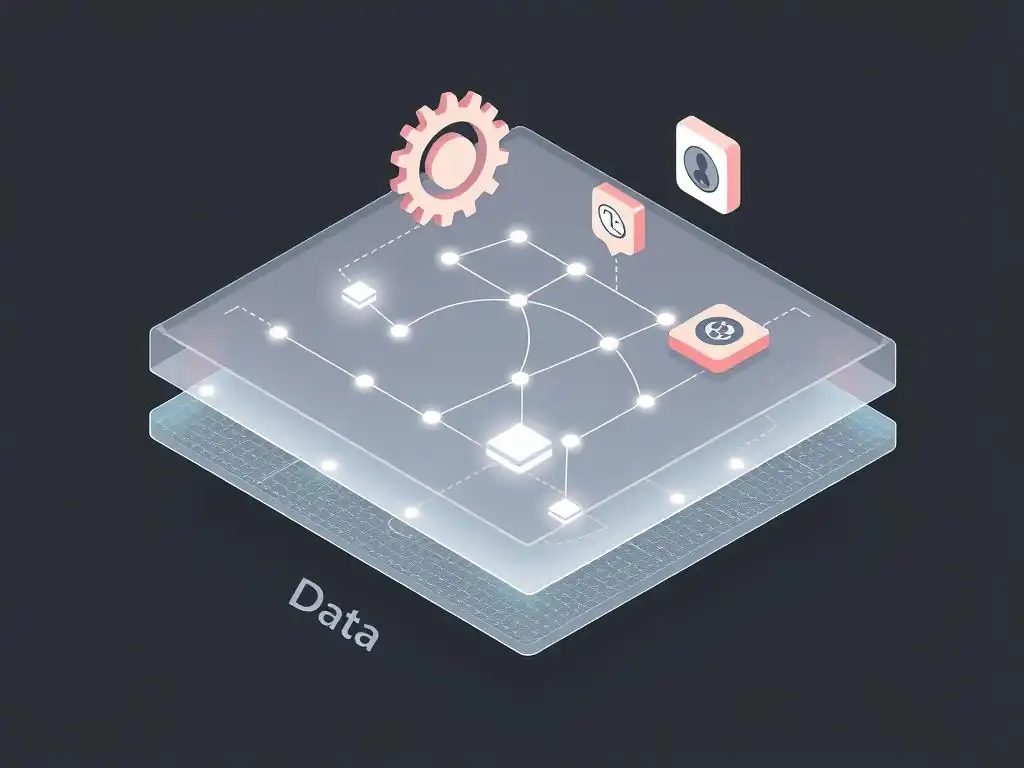
Think of it like a building: the data layer is the foundation, providing the structure for information storage; the network layer is the infrastructure, connecting all the parts; the consensus layer is the governance, ensuring agreement and security; and the application layer is the purpose, where everything comes to life with real-world use cases.
Each layer addresses specific aspects of decentralized operations. The Data Layer deals with the structure of data and cryptographic primitives. The Network Layer focuses on peer-to-peer communication and network maintenance. The Consensus Layer ensures agreement on the state of the blockchain among distributed nodes.
Finally, the Application Layer enables developers to build decentralized applications on top of the blockchain. By dissecting blockchain into these layers, we can systematically analyze its components, understand their individual functions, and appreciate how they collectively create a robust and decentralized system. This layered approach simplifies the complex nature of blockchain and makes it more accessible for both technical and non-technical audiences.
Data Layer: The Foundation of Blockchain Integrity
Block Structure: Understanding Data Organization in Blockchain
The Data Layer is the bedrock of any blockchain, defining how data is structured and stored. At its core, the data layer is responsible for packaging transactions into blocks and chaining these blocks together chronologically and cryptographically. A block in a blockchain typically consists of several components, including the block header, which contains metadata like the timestamp, block version, Merkle root, and hash of the previous block, and the block body, which holds the actual transaction data. This structure ensures that each block is uniquely identified and linked to the preceding block, forming an immutable chain.
Consider Bitcoin, the pioneering cryptocurrency. Each Bitcoin block has a header size of 80 bytes and can contain up to 1 MB of transaction data (before SegWit upgrade, after SegWit, closer to 4MB in practical terms). The block header includes a timestamp, indicating when the block was created, and the hash of the previous block, creating the chain.
The Merkle root, a cryptographic fingerprint of all transactions in the block, allows for efficient verification of transaction inclusion without needing to download the entire block. This meticulously organized structure within the data layer is fundamental to blockchain's integrity and tamper-proof nature.
Hashing and Cryptography in the Data Layer: Ensuring Data Security
Hashing and cryptography are integral to the data layer, providing the security mechanisms that underpin blockchain's trustworthiness. Cryptographic hashing algorithms like SHA-256 (used in Bitcoin) are used to generate unique fingerprints of data blocks. These hashes are deterministic, meaning the same input always produces the same output, and are computationally infeasible to reverse, making it extremely difficult to tamper with block data without detection. If even a single bit of data in a block is altered, the resulting hash will be completely different, breaking the chain and immediately signaling tampering.
Furthermore, public-key cryptography plays a vital role in securing transactions within the data layer. Transactions are digitally signed using private keys, ensuring authenticity and non-repudiation. These digital signatures can be verified by anyone using the corresponding public key, without revealing the private key. For example, in Ethereum, the Elliptic Curve Digital Signature Algorithm (ECDSA) is used for transaction signing. This cryptographic infrastructure ensures that only the legitimate owner of a digital asset can authorize transactions, and that once a transaction is recorded on the blockchain, it cannot be altered or forged.
Data Storage and Distribution within Blockchain Networks
The data layer also dictates how blockchain data is stored and distributed across the network. Unlike traditional centralized databases, blockchain employs a distributed ledger system where the entire blockchain or a significant portion of it is replicated and stored across multiple nodes in the network. This distributed nature enhances security and resilience, as there is no single point of failure. If one node fails or is compromised, the data remains accessible and secure on other nodes.
Different blockchains employ varying strategies for data storage and distribution. Full nodes, for example, store the entire blockchain history, while light nodes may only store block headers to verify transactions. In Bitcoin, full nodes maintain a complete copy of the blockchain, contributing to the network's security and decentralization. This distributed storage mechanism, inherent to the data layer, ensures data redundancy, availability, and resistance to censorship, forming a core tenet of blockchain's decentralized and secure nature.
Network Layer: Connecting Participants in a Decentralized System
Peer-to-Peer (P2P) Networking in Blockchain
The Network Layer is responsible for establishing and maintaining communication between nodes in a blockchain network. It leverages peer-to-peer (P2P) networking, a decentralized architecture where each node acts as both a client and a server, directly interacting with other nodes without relying on a central intermediary. This P2P structure is fundamental to blockchain's decentralized nature, eliminating single points of control and enhancing network resilience. In a P2P blockchain network, nodes share information, validate transactions, and propagate new blocks across the network.
Consider the Ethereum network, a prominent example of P2P blockchain implementation. Ethereum nodes connect to each other in a mesh-like network, exchanging information and synchronizing their blockchain copies. This decentralized communication model contrasts sharply with client-server architectures, where reliance on a central server creates vulnerabilities and bottlenecks. P2P networking in the network layer ensures that blockchain networks are robust, censorship-resistant, and can operate without the need for trusted third parties.
Node Discovery and Communication Protocols
Within the network layer, node discovery and communication protocols are crucial for enabling nodes to find and interact with each other. Node discovery mechanisms allow new nodes joining the network to locate and connect with existing peers. This process typically involves broadcasting requests and utilizing lists of known nodes or bootstrap nodes to initiate connections. Once nodes are connected, communication protocols define the rules and formats for exchanging messages, such as transaction broadcasts, block propagation, and network synchronization messages.
Protocols like TCP/IP are commonly used as the underlying transport layer for blockchain communication. On top of this, blockchain-specific protocols are implemented to handle data exchange and network management. For example, Bitcoin uses its own protocol for message exchange, defining message types for broadcasting transactions, requesting blocks, and announcing new blocks. These protocols ensure that nodes can effectively communicate and coordinate their actions within the decentralized network, maintaining network cohesion and functionality.
Network Security and Sybil Resistance Mechanisms
Security within the network layer is paramount to prevent attacks that could disrupt or compromise the blockchain. Sybil attacks, where a malicious actor attempts to control the network by creating a large number of pseudonymous identities (nodes), are a significant concern. The network layer employs Sybil resistance mechanisms to mitigate these threats and ensure network integrity. These mechanisms aim to limit the influence of any single entity and maintain a fair distribution of network control.
Proof-of-Work (PoW), often associated with the consensus layer, also plays a role in network layer security by making Sybil attacks computationally expensive. To participate meaningfully in a PoW network, nodes must expend significant computational resources, making it costly for attackers to create and maintain a large number of malicious nodes. Beyond PoW, other Sybil resistance techniques include Proof-of-Stake (PoS) and reputation-based systems. The network layer, therefore, incorporates security measures to protect against malicious actors and maintain the decentralized and trustworthy nature of the blockchain network.
Consensus Layer: Achieving Agreement in a Trustless Environment
The Role of Consensus Algorithms in Blockchain
The Consensus Layer is arguably the most critical layer in blockchain architecture, responsible for ensuring that all nodes in a decentralized network agree on the validity and order of transactions. In a trustless environment where participants may not know or trust each other, consensus algorithms provide a mechanism for achieving agreement without relying on a central authority. This agreement is crucial for maintaining the integrity and consistency of the blockchain ledger. Consensus algorithms solve the Byzantine Generals Problem in a distributed computing context, enabling distributed systems to reach agreement even when some participants may be faulty or malicious.
The consensus layer's function is to validate new blocks proposed to be added to the blockchain. Nodes participate in a consensus process to verify transactions within a block, ensuring they adhere to the network's rules and are valid. Once a block is validated by a sufficient number of nodes according to the chosen consensus algorithm, it is added to the blockchain, and the network progresses to the next set of transactions. The choice of consensus algorithm significantly impacts a blockchain's performance, security, and energy consumption, making it a central consideration in blockchain design.
Proof-of-Work (PoW): A Deep Dive into its Mechanism
Proof-of-Work (PoW) is one of the earliest and most well-known consensus algorithms, famously used by Bitcoin. PoW requires nodes, often called miners, to solve complex computational puzzles to validate transactions and create new blocks. This computational work serves as "proof" that the node has expended resources and is therefore more likely to be acting in good faith. The first miner to solve the puzzle and broadcast the solution gets to propose the next block to the network and is typically rewarded with newly minted cryptocurrency and transaction fees.
The computational puzzle in PoW usually involves finding a nonce (a number used only once) that, when combined with the block's data and hashed, produces a hash value that meets certain criteria, such as having a specific number of leading zeros. This process is computationally intensive and time-consuming, but verifying the solution is quick and easy for other nodes.
Bitcoin's PoW algorithm, for instance, uses the SHA-256 hash function and adjusts the difficulty of the puzzle dynamically to maintain a roughly 10-minute block time. While PoW is highly secure and has proven resilient against attacks, it is also criticized for its high energy consumption.
Proof-of-Stake (PoS) and its Variations: A Comprehensive Overview
Proof-of-Stake (PoS) emerged as an alternative to PoW, aiming to reduce energy consumption and address some of PoW's scalability limitations. In PoS, instead of miners, validators are selected to propose and validate new blocks based on the amount of cryptocurrency they "stake" or lock up in the network. Validators with larger stakes have a higher probability of being chosen to create the next block. This mechanism eliminates the need for energy-intensive computations, as the selection process relies on stake rather than computational power.
Various PoS variations exist, including Delegated Proof-of-Stake (DPoS), where token holders delegate their staking power to a smaller set of validators, and Liquid Proof-of-Stake (LPoS), which offers more flexibility in staking and delegation. Ethereum, for example, transitioned from PoW to PoS with its "The Merge" upgrade, significantly reducing its energy consumption. PoS is generally considered more energy-efficient than PoW and can potentially offer faster transaction processing times, but it also introduces different security considerations and potential centralization risks depending on its implementation.
Beyond PoW and PoS: Exploring Alternative Consensus Mechanisms
Beyond PoW and PoS, a variety of alternative consensus mechanisms have been developed, each with its own trade-offs in terms of security, performance, and energy efficiency. Proof-of-Authority (PoA) relies on a set of pre-selected, reputable validators, making it suitable for private or consortium blockchains where trust is established among participants. Proof-of-Elapsed-Time (PoET) is a lottery-based consensus mechanism designed to be fair and resource-efficient, often used in permissioned blockchains. Proof-of-History (PoH) focuses on creating a verifiable record of the order of events, improving scalability and auditability.
Other notable consensus mechanisms include Proof-of-Capacity (PoC), which utilizes hard drive space instead of computational power, and Proof-of-Importance (PoI), which considers factors like network activity and token holdings in validator selection. The continuous innovation in consensus algorithms reflects the ongoing effort to optimize blockchain technology for various use cases, balancing security, scalability, and sustainability. The choice of consensus mechanism is a crucial design decision that directly impacts the characteristics and suitability of a blockchain for specific applications.
Byzantine Fault Tolerance (BFT) and its Relevance
Byzantine Fault Tolerance (BFT) is a class of consensus algorithms designed to function reliably even in the presence of Byzantine faults, where nodes can behave arbitrarily, including sending incorrect or malicious information. BFT algorithms are particularly relevant for blockchain because they provide strong guarantees of fault tolerance and security in decentralized, permissionless environments. These algorithms are designed to reach consensus even if a certain proportion of nodes (typically less than one-third) are faulty or malicious.
Practical Byzantine Fault Tolerance (pBFT) is a well-known BFT algorithm that has been adapted and used in various blockchain platforms. BFT algorithms often involve multiple rounds of communication and voting among nodes to reach agreement on the next block. They are typically more communication-intensive than PoW or PoS but offer stronger guarantees of consistency and finality. BFT algorithms are particularly valuable in applications requiring high levels of security and reliability, such as financial systems and supply chain management, where data integrity and fault tolerance are paramount.
Application Layer: Building Decentralized Applications (DApps)
Smart Contracts: The Building Blocks of DApps
The Application Layer sits atop the other layers, enabling developers to build Decentralized Applications (DApps) on the blockchain platform. Smart contracts are the fundamental building blocks of DApps, acting as self-executing agreements written in code and deployed on the blockchain. These contracts automatically enforce the terms of an agreement when predefined conditions are met, without the need for intermediaries. Smart contracts are immutable and transparent, ensuring that the rules of the application are clearly defined and cannot be unilaterally changed by any single party.
Ethereum is a pioneering platform for smart contract development, offering languages like Solidity and Vyper for writing smart contracts. Once deployed, smart contracts reside on the blockchain and are executed by the Ethereum Virtual Machine (EVM). The logic within smart contracts can range from simple token transfers to complex financial instruments or governance mechanisms. Smart contracts empower developers to create a wide range of decentralized applications, from DeFi platforms to supply chain tracking systems, leveraging the security and transparency of blockchain technology.
Decentralized Finance (DeFi) Applications and the Application Layer
Decentralized Finance (DeFi) is a rapidly growing sector leveraging the application layer of blockchain to build financial services that operate without traditional intermediaries like banks. DeFi applications, built on platforms like Ethereum, utilize smart contracts to automate lending, borrowing, trading, and other financial activities. These applications aim to create a more accessible, transparent, and efficient financial system, reducing reliance on centralized institutions.
Examples of DeFi applications include decentralized exchanges (DEXs) like Uniswap and SushiSwap, lending platforms like Aave and Compound, and stablecoin issuers like MakerDAO. These platforms operate through smart contracts that manage liquidity pools, automate trading, and enforce loan terms. The DeFi sector exemplifies the power of the application layer to disrupt traditional industries by building innovative and decentralized solutions that offer users greater control and transparency over their financial assets. The total value locked in DeFi protocols has fluctuated but reached peaks exceeding $100 billion USD, highlighting the significant growth and adoption of DeFi applications.
Supply Chain Management and Blockchain Applications
Beyond finance, the application layer of blockchain is being utilized to develop solutions for supply chain management. Blockchain's inherent transparency and immutability make it ideal for tracking goods and materials as they move through complex supply chains. DApps built on blockchain can provide a shared, tamper-proof record of product provenance, ownership, and movement, enhancing transparency and accountability across the supply chain.
Companies like Walmart and IBM have explored blockchain-based supply chain solutions. For instance, Walmart has used blockchain to track the origin of mangoes and pork in its supply chain, improving food safety and traceability. IBM's Food Trust platform leverages blockchain to connect various stakeholders in the food supply chain, from farmers to retailers, enabling better tracking and management of food products. These applications demonstrate how the application layer can be used to improve efficiency, reduce fraud, and enhance trust in supply chain operations.
Identity Management Solutions on Blockchain
Identity management is another area where the application layer of blockchain offers promising solutions. Decentralized identity (DID) solutions built on blockchain aim to give individuals greater control over their digital identities and personal data. DIDs allow users to create and manage their own digital identities without relying on centralized identity providers. These identities can be used to securely access services and applications while maintaining privacy and control over personal information.
Projects like Sovrin and uPort are developing blockchain-based DID frameworks. These solutions utilize smart contracts and cryptographic techniques to enable self-sovereign identity, where individuals own and control their identity data. Decentralized identity has the potential to transform how we manage and verify identities online, enhancing privacy, security, and user empowerment. The application layer provides the platform for building these innovative identity solutions, offering a more user-centric approach to digital identity management.
The Future of DApps and the Application Layer of Blockchain
The future of DApps and the application layer of blockchain is poised for continued growth and innovation. As blockchain technology matures and scalability solutions improve, we can expect to see an increasing number and variety of DApps across diverse industries. From gaming and social media to healthcare and governance, the potential applications of decentralized applications are vast. The application layer will continue to evolve, with advancements in smart contract languages, development tools, and interoperability solutions making it easier and more efficient to build and deploy DApps.
Emerging trends in the application layer include the development of more user-friendly DApp interfaces, cross-chain DApps that operate across multiple blockchains, and the integration of DApps with traditional systems. The ongoing development and adoption of DApps are driving the evolution of the entire blockchain ecosystem, showcasing the transformative potential of decentralized applications to reshape various aspects of our digital and physical worlds. The application layer is where the real-world impact of blockchain technology is realized, and its future is bright with possibilities.
Interoperability Between Blockchain Architecture Layers
How the Layers Interact for Optimal Blockchain Functionality
The four layers of blockchain architecture are not isolated entities but rather interconnected components that work in concert to ensure optimal functionality. The Data Layer provides the foundational structure for data storage, which is then utilized by the Network Layer to distribute this data across the network. The Consensus Layer builds upon the network and data layers to achieve agreement on the state of the blockchain, ensuring data integrity and consistency. Finally, the Application Layer leverages all underlying layers to build decentralized applications that interact with the blockchain data and consensus mechanisms.
For example, when a transaction is initiated in a DApp (Application Layer), it is first packaged into a block (Data Layer). This block is then propagated across the P2P network (Network Layer). Nodes in the network then participate in a consensus process (Consensus Layer) to validate the block and add it to the blockchain. This seamless interaction between layers is crucial for the overall operation of a blockchain system. Any inefficiency or bottleneck in one layer can impact the performance and functionality of the entire architecture.
The Importance of Scalability and Layer Optimization
Scalability is a critical challenge for blockchain technology, and optimizing each layer of the architecture is essential to address this issue. Scalability refers to a blockchain's ability to handle an increasing number of transactions and users without compromising performance or security. Optimizing the Data Layer can involve techniques like data sharding to distribute data storage and processing. Network Layer optimization focuses on improving P2P communication protocols and network efficiency. Consensus Layer optimization aims to develop more efficient and scalable consensus algorithms. Application Layer optimization involves designing DApps that are resource-efficient and scalable.
Layer-2 solutions, such as payment channels and sidechains, are also crucial for enhancing scalability by offloading transaction processing from the main blockchain (Layer-1) to separate layers. These solutions leverage the security of the main chain while enabling faster and cheaper transactions in the optimized layers. Effective interoperability between layers, combined with layer-specific optimizations and layer-2 solutions, is vital for achieving the scalability needed for widespread blockchain adoption and supporting high-throughput applications.
Challenges and Future Trends in Blockchain Architecture
Addressing Scalability Issues in Blockchain Design
Scalability remains a significant challenge in blockchain architecture. Traditional blockchain architectures, especially those using PoW consensus, often face limitations in transaction throughput and network congestion as user adoption grows. Addressing scalability requires ongoing innovation and development across all layers of the blockchain architecture. Techniques like sharding, state channels, sidechains, and rollups are being actively explored and implemented to improve blockchain scalability.
Sharding, for instance, aims to divide the blockchain into smaller partitions (shards), allowing parallel transaction processing and increasing overall throughput. Rollups aggregate multiple transactions off-chain and then submit a summary proof to the main chain, reducing on-chain transaction load. State channels enable participants to conduct multiple transactions off-chain and only record the final state on the main chain. These scalability solutions represent ongoing efforts to evolve blockchain architecture and overcome performance bottlenecks, paving the way for wider adoption in high-demand applications.
The Evolution of Consensus Mechanisms
The Consensus Layer is a dynamic area of blockchain architecture, with continuous evolution and innovation in consensus mechanisms. While PoW and PoS remain prominent, research and development continue to explore alternative algorithms that offer improved efficiency, security, and scalability. Hybrid consensus mechanisms that combine aspects of different algorithms are also emerging, aiming to leverage the strengths of each approach.
The shift towards more energy-efficient consensus mechanisms is a key trend, driven by environmental concerns and the need for sustainable blockchain solutions. Proof-of-Stake and its variations are gaining traction as more energy-friendly alternatives to PoW. Furthermore, research into novel consensus algorithms, such as those based on verifiable random functions (VRFs) and zero-knowledge proofs, promises to further enhance the efficiency and security of blockchain networks. The evolution of consensus mechanisms is crucial for shaping the future of blockchain technology and addressing its scalability and sustainability challenges.
The Future of Blockchain Architecture: Sharding, Layer-2 Solutions, and Interoperability Protocols
The future of blockchain architecture is likely to be characterized by advancements in sharding, layer-2 solutions, and interoperability protocols. Sharding is expected to become a more widely adopted technique for scaling Layer-1 blockchains, enabling them to handle significantly higher transaction volumes. Layer-2 solutions will continue to play a vital role in offloading transaction processing and improving scalability for specific use cases. Interoperability protocols, which enable different blockchains to communicate and interact with each other, are crucial for creating a more interconnected and versatile blockchain ecosystem.
Projects like Polkadot and Cosmos are focused on building interoperable blockchain networks, allowing for cross-chain communication and value transfer. The development of standardized interoperability protocols will be key to unlocking the full potential of blockchain technology, enabling seamless interaction between different blockchain platforms and fostering a more collaborative and interconnected decentralized web. These architectural advancements will shape the future trajectory of blockchain, driving its evolution towards greater scalability, interoperability, and real-world applicability.
Conclusion: Mastering Blockchain Architecture for Future Innovation
The Transformative Potential of Understanding Blockchain's Inner Workings
Mastering blockchain architecture is not just about understanding the technical components; it's about unlocking the transformative potential of this technology. A deep understanding of the data, network, consensus, and application layers empowers individuals and organizations to leverage blockchain effectively, build innovative solutions, and contribute to the growth of the decentralized web. By grasping the inner workings of blockchain, we can move beyond superficial applications and create robust, secure, and scalable systems that address real-world challenges across various industries.
From revolutionizing finance with DeFi to enhancing supply chain transparency and enabling decentralized identity, blockchain's transformative potential is vast and growing. Understanding blockchain architecture is the key to unlocking this potential and shaping the future of decentralized technologies. As blockchain continues to evolve, a solid foundation in its architecture will be essential for navigating the landscape, adapting to new innovations, and driving further advancements in this groundbreaking field.
Resources for Further Learning About Blockchain Architecture
For those seeking to deepen their understanding of blockchain architecture, numerous resources are available. Online courses platforms like Coursera, edX, and Udemy offer courses on blockchain technology, often delving into architectural aspects. University programs in computer science and related fields increasingly include blockchain-focused modules. Technical documentation and whitepapers from various blockchain projects provide in-depth insights into specific architectural implementations. Websites like the Bitcoin Wiki and Ethereum Foundation website offer comprehensive resources on their respective architectures.
Books such as "Mastering Bitcoin" and "Mastering Ethereum" provide detailed technical explanations of blockchain architecture and related concepts. Furthermore, engaging with the blockchain developer community through forums, online communities, and conferences can provide valuable learning opportunities and insights. Continuous learning and exploration are crucial for staying at the forefront of blockchain technology and mastering its ever-evolving architecture.
Frequently Asked Questions
What are the four fundamental layers of blockchain architecture?
The four layers are the data layer, which handles data storage; the network layer, which manages communication; the consensus layer, crucial for agreement; and the application layer, which facilitates user interaction and smart contracts.
How does the data layer contribute to the security of a blockchain?
The data layer ensures immutability through cryptographic hashing and linking of blocks. This makes it extremely difficult to tamper with the data stored on the blockchain, enhancing its security.
What role does the network layer play in a decentralized blockchain system?
The network layer is responsible for peer-to-peer communication among nodes. It allows nodes to share and validate transactions, ensuring the decentralized and distributed nature of the blockchain.
Why is the consensus layer considered the heart of a blockchain's functionality?
The consensus layer is critical because it establishes a shared agreement on the validity of transactions. This prevents fraud and ensures the integrity of the blockchain's ledger, making it the heart of the system.
How does the application layer enable the development of DeFi applications?
The application layer provides the interface for users and developers to interact with the blockchain. This includes the ability to create and deploy smart contracts, which are the foundation for many DeFi applications.
Final Reflection: Unveiling the Future Through Blockchain's Foundation
The intricate layers of blockchain architecture – Data, Network, Consensus, and Application – are not merely technical components; they represent a fundamental shift in how we understand trust, transparency, and decentralized systems. Today, as we grapple with issues of data security and the need for verifiable information, understanding these layers becomes crucial for navigating the evolving digital landscape. The potential for blockchain to revolutionize industries, from finance to healthcare, hinges on a solid grasp of its underlying architecture.
This exploration into the four layers has profoundly influenced my understanding of the technology's potential, highlighting its capacity to reshape societal structures. The realization that each layer contributes uniquely to the overall security and functionality of a blockchain network underscores the importance of a holistic approach to development and implementation. Blockchain is the tech. Bitcoin is merely one manifestation of that tech.
- Patrick M. Byrne. This quote perfectly encapsulates the idea that the true power lies not just in the applications, but in the foundational architecture that supports them.
As we move forward, let us not only marvel at the innovative applications built upon blockchain, but also dedicate ourselves to understanding and refining its core architecture. Reflect on how you can contribute to building a more secure, transparent, and decentralized future. Consider how you can leverage your knowledge of these layers to drive innovation and create solutions that benefit society as a whole. The future of blockchain depends on our collective understanding and commitment to its foundational principles.
Unleash the Power of Blockchain Understanding!
Thank you for exploring the foundational layers of blockchain architecture with us! We hope this overview has clarified the complexities and vast potential of this innovative technology. Now, it's time to take that knowledge further.
You can deepen your understanding by identifying which layer poses the greatest challenge for your blockchain projects and researching possible solutions. This step is crucial for applying blockchain effectively in real-world scenarios.
Feel free to share this article with colleagues or friends interested in blockchain. Discussing the different layers together will help reinforce your comprehension.
Visit our website for more insights into blockchain technology, including articles focused on data management, consensus mechanisms, and other key aspects.
What exciting blockchain applications do you envision after learning about these layers? Share your ideas in the comments below!
Leave a Reply