
Trading Fees FaceOff: Coinbase vs Binance vs Kraken Save Money on Your Crypto Trades

Welcome to Blockchain Trends, your go-to source for understanding the evolving world of blockchain technology.
Are you tired of losing money to exorbitant trading fees? In this article, we dive deep into a comprehensive Coinbase vs Binance fees comparison, uncovering the hidden costs and revealing strategies to maximize your crypto profits. Discover which platform truly offers the best value for your trades and unlock the secrets to saving money in the volatile world of cryptocurrency. Read on to find out which exchange emerges as the champion!
- Trading Fees FaceOff: Coinbase vs Binance vs Kraken Save Money on Your Crypto Trades
-
Frequently Asked Questions
- How do Coinbase and Binance compare in terms of basic trading fees?
- What are the key factors influencing trading fees on both Coinbase and Binance?
- Are there any hidden fees or charges to be aware of when using Coinbase or Binance?
- Which platform, Coinbase or Binance, is generally better for beginners concerned about fees?
- How can I minimize trading fees on either Coinbase or Binance?
- Final Reflection: Navigating the Crypto Fee Landscape
- Maximize Your Crypto Savings: Start Trading Smarter Now!
Trading Fees FaceOff: Coinbase vs Binance vs Kraken Save Money on Your Crypto Trades
Why Understanding Trading Costs is Crucial for Profitability
In the dynamic and often volatile realm of cryptocurrency trading, every fractional percentage point can significantly impact your bottom line. Transaction costs, primarily in the form of trading fees, are an unavoidable component of participating in digital asset markets. These fees are levied by exchanges for facilitating trades, and their structure and amount vary widely across platforms. For active traders, or those dealing with substantial capital, seemingly small fees can accumulate rapidly, potentially eroding profits or exacerbating losses. Understanding these costs is not merely an administrative detail; it's a fundamental aspect of developing a profitable trading strategy.
Consider a scenario where a trader executes multiple transactions daily or weekly. Even a fee difference of 0.1% between exchanges can translate into hundreds or thousands of dollars in saved or spent capital over a year, depending on volume. For instance, on a $10,000 trade, a 0.1% fee is $10.
If a trader makes 100 such trades in a month, that's $1,000 in fees. Comparing Coinbase vs Binance fees, or factoring in Kraken's structure, reveals distinct models that favor different trading styles and volumes. Ignoring these differences means potentially leaving money on the table or incurring unnecessary expenses that eat into potential gains from successful trades.
The Fee Challenge: Coinbase vs Binance vs Kraken Overview
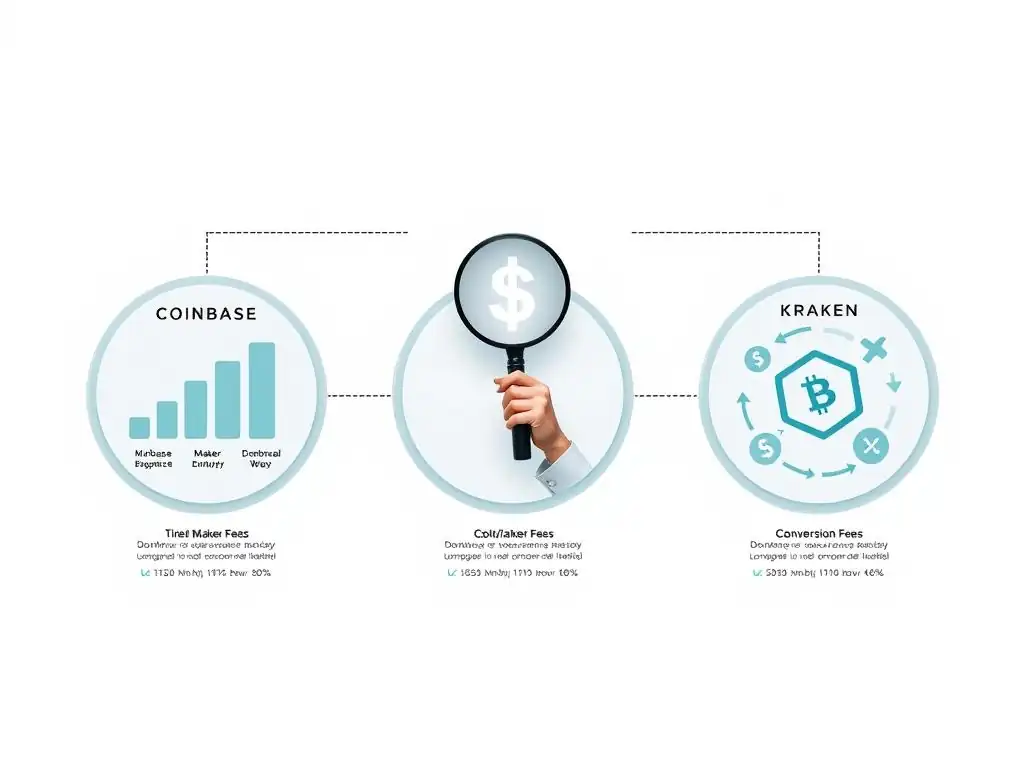
Navigating the fee structures of major cryptocurrency exchanges can feel like deciphering a complex puzzle. Three of the most prominent global platforms—Coinbase, Binance, and Kraken—each present unique approaches to charging users for trading activities. While all aim to provide access to a wide range of digital assets, their fee models diverge significantly, reflecting their target audiences and operational philosophies. This divergence creates a challenge for users seeking the most cost-effective platform for their specific trading habits.
Coinbase, often a gateway for new users in certain regions, has historically been perceived as having a simpler, but potentially higher, fee structure, particularly for smaller trades or through its basic interface which may include a spread and fixed fee. Binance, the world's largest exchange by trading volume, is renowned for its tiered fee system that heavily rewards high-volume traders and users holding its native token, BNB, with substantial discounts.
Kraken, a long-standing player known for its focus on security and diverse offerings, provides a competitive fee schedule, especially on its Kraken Pro platform, utilizing a maker-taker model with various volume-based tiers. The stark contrast in how Coinbase vs Binance fees are calculated, along with Kraken's distinct model, necessitates a detailed examination to determine which platform offers the best value depending on individual trading needs.
Our Goal:
The primary objective of this article is to provide a comprehensive and clear comparison of the trading fee structures employed by Coinbase, Binance, and Kraken. By breaking down the complexities of their respective models—including spot trading fees, maker-taker rates, withdrawal fees (where applicable to trading costs), and volume-based discounts—we aim to equip you with the knowledge needed to make an informed decision.
Ultimately, our goal is to illuminate the differences in Coinbase vs Binance fees, and how Kraken's fee structure fits into the competitive landscape, enabling you to identify the exchange that aligns best with your trading strategy and volume. Understanding these costs is the first step towards optimizing your profitability and saving money on your crypto trades, ensuring that more of your successful trades translate into actual gains rather than being absorbed by fees.
Frequently Asked Questions
How do Coinbase and Binance compare in terms of basic trading fees?
Coinbase's base fees are generally higher than Binance's. Binance offers lower spot trading fees, especially for users with higher trading volumes or BNB holdings. This difference is a crucial factor for many traders.
What are the key factors influencing trading fees on both Coinbase and Binance?
Factors include the user's trading volume, membership tiers (like Binance VIP), and whether they use the platform's native token (BNB on Binance) for fee discounts. Payment methods can also affect the final cost.
Yes, be mindful of withdrawal fees, which vary based on the cryptocurrency and network. Also, conversion fees might apply when trading between different crypto assets, especially on Coinbase.
Which platform, Coinbase or Binance, is generally better for beginners concerned about fees?
Binance often offers lower fees and a wider range of trading options, but Coinbase's simpler interface may be easier for beginners to navigate initially, even with higher fees.
How can I minimize trading fees on either Coinbase or Binance?
Consider using limit orders instead of market orders, increasing your trading volume to qualify for lower fee tiers, and utilizing the platform's native token (BNB on Binance) for fee reductions.
The comparison of Coinbase vs. Binance fees is more than just a cost-saving exercise; it's a critical step towards empowering individuals to participate effectively in the burgeoning world of cryptocurrency. Understanding the nuances of these fee structures allows traders to make informed decisions, maximizing their returns and minimizing unnecessary expenses in a volatile market.
The impact of these fees extends beyond individual wallets, influencing the overall accessibility and democratization of cryptocurrency trading. The ability to navigate these complexities and choose the platform that best aligns with one's trading style and financial goals is paramount. The best investment you can make is an investment in yourself... The more you learn, the more you'll earn.
- Warren Buffett. This holds true in the crypto space, where knowledge of fees and trading strategies directly translates to profitability.
As you embark on your crypto journey, remember that informed decision-making is your greatest asset. Take the time to understand the fee structures of different platforms, explore various trading strategies, and continuously refine your approach. The crypto landscape is constantly evolving, and your ability to adapt and learn will ultimately determine your success. Embrace the challenge, stay informed, and unlock the potential of cryptocurrency trading.
Maximize Your Crypto Savings: Start Trading Smarter Now!
Thanks for diving into the world of crypto trading fees with Blockchain Trends! We hope you found this comparison of Coinbase, Binance, and Kraken helpful in understanding how to minimize your expenses and boost your returns. Now, let's put that knowledge into action:
- Take control of your crypto journey and immediately compare the fee structures of the exchanges based on your specific trading habits. Identify the most cost-effective platform for you and make the switch! This is your primary action!
- Explore Blockchain Trends further! Delve deeper into our resources for more insights on crypto trading strategies and platform reviews.
- Share this article with fellow traders! Help others optimize their trades and grow their crypto portfolios.
What specific strategies are you going to implement today to reduce your trading fees and maximize your profits? Share your thoughts below!
Leave a Reply