
Choosing the Right Hardware Wallet: Ledger vs. Trezor and Beyond

Welcome to Blockchain Trends, your guide to understanding the revolutionary impact of blockchain technology!
Are you ready to secure your digital assets? In this article, we delve into the world of hardware wallets, focusing on the critical decision: Ledger vs. Trezor. Discover which Ledger Trezor hardware wallet best suits your needs and explore the essential features that will protect your crypto investments. But that's just the beginning... what other security considerations should you keep in mind for the ever-evolving landscape of decentralized finance? Read on to find out!
- The Market Leaders: Exploring Ledger Hardware Wallets
-
Frequently Asked Questions
- How do Ledger and Trezor hardware wallets enhance the security of my cryptocurrency assets?
- Besides Ledger and Trezor, are there other reputable hardware wallet options available?
- Can a Ledger Trezor hardware wallet protect against phishing attacks?
- What happens if I lose my Ledger Trezor hardware wallet?
- What are the key differences between Ledger and Trezor hardware wallets?
- Final Reflection: Securing Our Digital Future
- Secure Your Future: Claim Your Crypto Confidence!
The Market Leaders: Exploring Ledger Hardware Wallets
Introduction to Ledger Devices: Security and Features
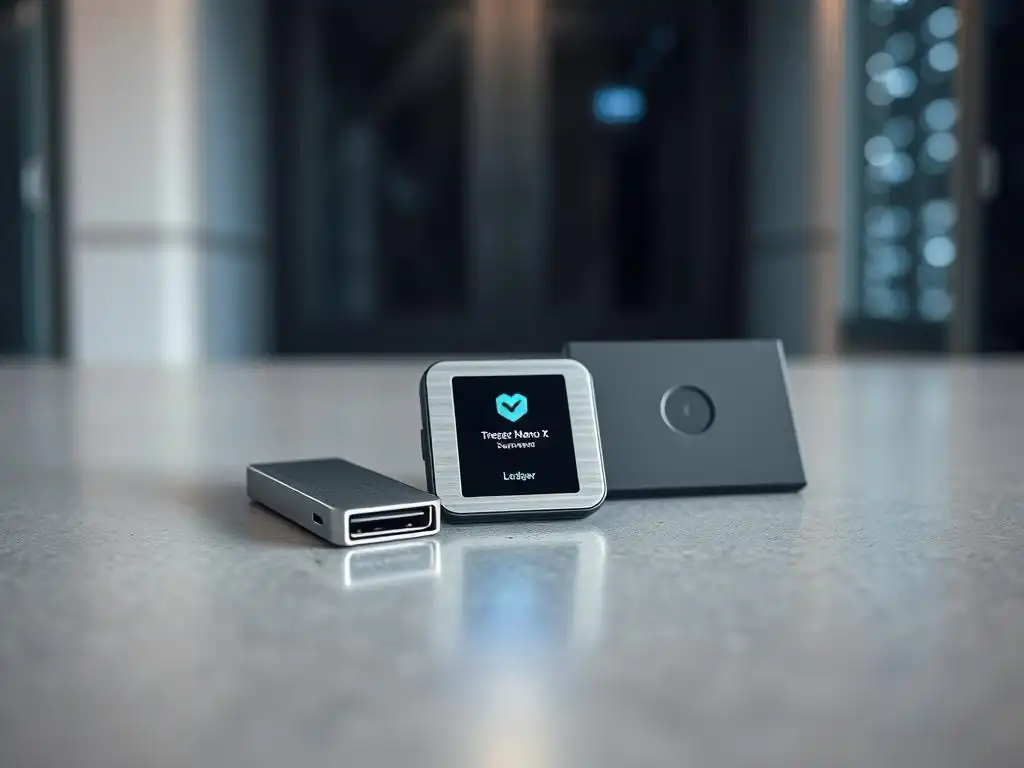
Ledger has established itself as a dominant force in the hardware wallet market, offering a range of devices designed to provide robust security for digital assets. Their core mission revolves around empowering individuals to secure their private keys offline, thereby mitigating the risks associated with online threats and custodial services. Ledger devices operate by isolating the user's private keys within a secure chip, ensuring that these critical pieces of information never leave the device, even when signing transactions. This fundamental principle is central to the appeal of a Ledger Trezor hardware wallet solution.
The Ledger lineup typically includes several models catering to different needs and price points, all built around a proprietary operating system called BOLOS (Blockchain Open Ledger Operating System). This system is designed to run applications for specific cryptocurrencies in an isolated environment on the device. Key features across the range include support for a wide array of cryptocurrencies, a simple interface, and the use of a 24-word recovery phrase (seed phrase) for backup purposes. Understanding these foundational elements is crucial when evaluating a Ledger Trezor hardware wallet comparison.
Deep Dive into the Ledger Nano S Plus
The Ledger Nano S Plus represents an evolution of the highly successful original Nano S, offering significant upgrades while maintaining an accessible price point. This model is designed for users who need reliable security for a substantial number of digital assets without requiring advanced features like Bluetooth connectivity. Its primary enhancement over its predecessor is a significantly larger storage capacity, allowing users to install approximately 100 applications simultaneously, compared to the handful on the older Nano S. This increased space is vital for managing a diverse portfolio on a single device.
Functionally, the Nano S Plus operates via a USB-C connection to a computer or Android phone. Users interact with the device using two physical buttons and verify transactions on a small, monochrome screen. While it lacks a battery and touchscreen, its simplicity and expanded storage make it a compelling choice for many cryptocurrency holders seeking a secure, offline storage solution. It serves as Ledger's entry-level offering in the modern era, providing a solid foundation for securing crypto assets as part of a comprehensive Ledger Trezor hardware wallet strategy.
Key Advantages of the Ledger Nano X (Bluetooth, Battery Life)
The Ledger Nano X stands as Ledger's flagship hardware wallet, packed with features designed for enhanced convenience and mobility. Its most significant advantage is the inclusion of Bluetooth connectivity, which allows users to manage their crypto assets wirelessly via the Ledger Live mobile app on iOS and Android devices. This capability liberates users from needing a computer to access their funds, offering flexibility for managing portfolios on the go. While Bluetooth adds convenience, transactions still require physical confirmation on the device, ensuring security is maintained.
Another key differentiator of the Nano X is its built-in battery, providing several hours of active use and months of standby time on a single charge. This battery, combined with Bluetooth, makes the Nano X a truly portable hardware wallet. It also boasts the same expanded storage as the Nano S Plus, supporting approximately 100 installed applications concurrently. These features position the Nano X as a premium offering for users who prioritize portability and wireless connectivity in their Ledger Trezor hardware wallet choice.
Ledger's Security Architecture: Certified Chips and Firmware
Ledger's security philosophy is heavily reliant on the use of Secure Element chips, a technology commonly found in passports and credit cards. These tamper-resistant chips are designed to withstand sophisticated physical and digital attacks. The Ledger Nano S Plus and Nano X both utilize a certified secure chip, specifically the CC EAL5+ certified ST33J205 Secure Element. This certification level indicates a high level of assurance regarding the chip's resistance to penetration. The private keys are generated and stored exclusively within this secure element, isolated from the device's general processor and firmware.
Complementing the Secure Element is Ledger's custom operating system, BOLOS. This OS enforces strict isolation between different cryptocurrency applications and the core system, preventing vulnerabilities in one application from affecting others or compromising the private keys. Firmware updates, while necessary for adding new features and supporting new cryptocurrencies, are signed cryptographically by Ledger to ensure their authenticity and integrity before installation. This multi-layered security approach, centered around the Secure Element and secure firmware, is a cornerstone of Ledger's strategy and a critical point of comparison in any Ledger Trezor hardware wallet evaluation.
Frequently Asked Questions
How do Ledger and Trezor hardware wallets enhance the security of my cryptocurrency assets?
These wallets store your private keys offline, protecting them from online threats like malware and hacking. This significantly reduces the risk of unauthorized access compared to software wallets.
Besides Ledger and Trezor, are there other reputable hardware wallet options available?
Yes, several alternatives exist, including Coldcard, BitBox02, and KeepKey, each with its own security features and price points. Researching these options is crucial for informed decision-making.
Can a Ledger Trezor hardware wallet protect against phishing attacks?
While they enhance security, hardware wallets alone cannot prevent phishing. Users must remain vigilant and verify website addresses and transaction details before confirming them on the device.
What happens if I lose my Ledger Trezor hardware wallet?
As long as you have your recovery seed phrase (usually 12 or 24 words), you can restore your wallet and access your funds on a new device. Never share your seed phrase with anyone.
What are the key differences between Ledger and Trezor hardware wallets?
Ledger generally supports a wider range of cryptocurrencies, while Trezor is known for its open-source firmware. Both offer excellent security, but user preference often depends on specific coin support and design aesthetics.
Final Reflection: Securing Our Digital Future
The exploration of hardware wallets, specifically the Ledger Trezor hardware wallet comparison, underscores a critical truth in today's digital age: the responsibility for securing our digital assets rests firmly on our own shoulders. As cryptocurrency adoption continues to surge, understanding the nuances of these security devices is no longer a niche concern, but a fundamental requirement for participating safely in the decentralized economy.
The ongoing influence of hardware wallets extends far beyond mere storage; it represents a paradigm shift in how we perceive ownership and control in the digital realm. The ability to truly own and secure our digital assets, free from the vulnerabilities of centralized exchanges, is a powerful and empowering concept. Not your keys, not your coins,
a mantra often repeated within the crypto community, encapsulates the essence of this self-sovereignty and the importance of choosing the right tools to protect it.
As you navigate the complexities of the digital landscape, remember that the choice of a hardware wallet is not just a technical decision, but a commitment to safeguarding your financial future. Take the time to research, understand your own security needs, and choose the device that best aligns with your individual circumstances. The peace of mind that comes from knowing your assets are securely stored is an investment that pays dividends far beyond the initial cost.
Secure Your Future: Claim Your Crypto Confidence!
Thanks for exploring the world of hardware wallets with us at Blockchain Trends! We hope you now feel empowered to take control of your digital assets. It's time to move from simply learning about security to actively implementing it. Here's how you can strengthen your crypto safety:
- Order your first or next hardware wallet today! Compare models like Ledger and Trezor based on your specific needs and security priorities. Don't wait for a potential breach; proactive security is essential.
- Dive deeper into wallet security! Research multi-signature setups and passphrase strategies to add an extra layer of protection. There are plenty of resources available to help you learn the latest techniques.
- Share your experiences! Join the Blockchain Trends community forum to discuss your wallet setup, ask questions, and learn from others. Let’s all work together to secure our digital future.
What security feature matters most to you when choosing a hardware wallet, and why? Share your thoughts in the comments below!
Leave a Reply