
Mobile DApp Development: Reaching Users on the Go with Decentralized Apps


Welcome to Blockchain Trends, your go-to resource for understanding the revolutionary power of blockchain technology!
Ever wondered how to bring the power of decentralization to the palm of your hand? Dive into our latest exploration of Decentralized Applications (DApps) and discover the secrets behind building cutting-edge solutions for mobile devices. This month, we're unraveling the intricacies of blockchain mobile app development tutorial, offering a practical guide to reaching users on the go. Intrigued? Keep reading to unlock the potential of mobile DApps and shape the future of decentralized systems.
Mobile DApp Development: Reaching Users on the Go with Decentralized Apps
- Introduction to Mobile DApp Development
- Understanding Blockchain Mobile App Development
-
Building a Decentralized Task Management Mobile App: Step-by-Step Guide
- Step 1: Choosing the Right Blockchain Platform
- Step 2: Selecting Development Tools and Frameworks
- Step 3: Setting Up Your Development Environment
- Step 4: Designing the User Interface (UI) and User Experience (UX)
- Step 5: Implementing Smart Contract Integration
- Step 6: Testing and Debugging
- Step 7: Deploying to a Testnet and Eventually App Stores
- Optimizing Performance and Security
- The Future of Mobile DApp Development
- Conclusion: Embracing the Mobile DApp Revolution
-
Frequently Asked Questions
- What are the primary benefits of developing mobile DApps (Decentralized Applications) compared to traditional mobile apps?
- What are the key considerations when choosing a blockchain platform for mobile DApp development?
- What programming languages and frameworks are commonly used in Blockchain mobile app development tutorial?
- How does blockchain mobile app development tutorial address security concerns specific to mobile environments?
- What are some potential future trends in mobile DApp development, and how might they impact user experience?
- Final Reflection: Embracing Decentralized Mobility
- Ignite Your Mobile DApp Journey!
Introduction to Mobile DApp Development
What are Decentralized Applications (DApps)? A Quick Recap
Decentralized Applications, or DApps, are applications that run on a decentralized network, typically a blockchain. Unlike traditional applications that rely on centralized servers and databases controlled by a single entity, DApps operate on a peer-to-peer network where data and logic are distributed across many nodes. This inherent decentralization offers key advantages, including censorship resistance, increased transparency, and reduced downtime as there's no single point of failure. The backend logic of a DApp is often implemented using smart contracts, self-executing contracts with the terms of the agreement directly written into code, which run on the blockchain.
These applications interact with user interfaces that can be web-based, desktop-based, or increasingly, mobile-based. The front-end of a DApp is similar to a traditional application's user interface, but instead of communicating with a centralized server API, it interacts directly or indirectly with the smart contracts deployed on the blockchain network. This interaction usually involves a wallet application that manages the user's private keys and facilitates signing transactions, allowing users to interact with the decentralized backend securely.
The Growing Importance of Mobile DApps
The mobile landscape dominates global internet usage. As of early 2024, mobile devices account for over 60% of website visits worldwide, and app usage consistently surpasses browser usage on these devices. This pervasive mobile adoption makes it imperative for decentralized technologies to be accessible on smartphones and tablets if they aim for mainstream adoption. Mobile DApps bridge the gap between the burgeoning blockchain ecosystem and the vast, mobile-first user base, enabling seamless interaction with decentralized services from anywhere at any time.
The rise of mobile DApps is fueled by the increasing sophistication of mobile devices and the growing demand for decentralized finance (DeFi), non-fungible tokens (NFTs), and Web3 services on the go. Users expect the convenience and accessibility of traditional mobile apps when interacting with their digital assets, participating in decentralized governance, or using blockchain-based games. Therefore, mastering blockchain mobile app development is becoming crucial for developers looking to build applications that can truly reach a global audience and drive wider adoption of decentralized technologies.
Why Mobile Matters for Blockchain Adoption
Mobile accessibility is a critical factor in lowering the barrier to entry for blockchain technology. For many people globally, a smartphone is their primary, or even sole, device for accessing the internet and digital services. By making DApps available on mobile, blockchain technology becomes accessible to a much larger and more diverse population, including those in regions with limited access to traditional banking or desktop computers. This widespread accessibility is essential for moving blockchain beyond early adopters and into the hands of everyday users.
Furthermore, the intuitive interfaces and familiar user experiences offered by well-designed mobile applications can significantly simplify the complexity often associated with interacting with blockchain networks and managing cryptographic keys. A user-friendly mobile DApp can abstract away technical details, making it easier for newcomers to create a wallet, send transactions, or interact with smart contracts. This ease of use is paramount for fostering trust and encouraging widespread participation in decentralized ecosystems, ultimately accelerating global blockchain adoption.
Understanding Blockchain Mobile App Development
Key Differences Between Mobile DApps and Traditional Mobile Apps
The fundamental distinction between mobile DApps and traditional mobile apps lies in their backend architecture. Traditional apps rely on centralized servers controlled by a single entity. User data is stored in centralized databases, and the app's logic runs on servers owned by the service provider. Communication occurs via standard HTTP requests to APIs managed by the company. This model offers performance benefits and ease of updates but introduces points of failure and potential censorship.
In contrast, mobile DApps interface with a decentralized backend powered by smart contracts on a blockchain network. User data, or proofs of ownership/interaction, is stored on the distributed ledger, and the application's core logic is executed by the decentralized network of nodes. Instead of API calls to a central server, the mobile DApp interacts with the blockchain via a node or a decentralized gateway service. This requires users to manage cryptographic keys, typically through a mobile wallet, to authorize transactions and interact with the smart contracts, fundamentally changing the interaction model and user experience.
Advantages of Building Mobile DApps
Building mobile DApps offers several compelling advantages rooted in the nature of blockchain technology. Firstly, they inherit the security and transparency benefits of the underlying blockchain. Transactions and interactions are immutable and publicly verifiable (depending on the blockchain), reducing the risk of fraud and increasing trust. Secondly, DApps are resistant to censorship; because they don't rely on a single server that can be shut down, they are more resilient to external interference compared to centralized applications.
Thirdly, mobile DApps can foster a more equitable and open ecosystem. Users typically have more control over their data and digital assets, as they are managed via their private keys rather than being stored in a centralized database owned by a company. This aligns with the principles of Web3, empowering users and creating opportunities for innovative business models built on shared, trustless infrastructure. For developers, building a mobile DApp can mean tapping into a rapidly growing market and contributing to the decentralized future.
Challenges in Mobile DApp Development
Despite the advantages, blockchain mobile app development presents unique challenges. Performance is a significant hurdle; interacting with a blockchain network can be slower and more costly (due to transaction fees like gas on Ethereum) than interacting with a centralized database. Network latency, block confirmation times, and the need for transaction signing can impact the responsiveness and user experience of a mobile DApp compared to its traditional counterparts.
User experience and onboarding also pose challenges. Managing private keys, understanding gas fees, and navigating blockchain concepts can be complex for users unfamiliar with the technology. Developers must design intuitive interfaces and streamlined workflows to abstract away these complexities. Furthermore, the rapidly evolving nature of blockchain technology, the need to handle blockchain-specific errors (like failed transactions), and the complexities of integrating mobile wallets add layers of difficulty not typically found in traditional mobile development.
Building a Decentralized Task Management Mobile App: Step-by-Step Guide
Step 1: Choosing the Right Blockchain Platform
Selecting the appropriate blockchain platform is the foundational step in blockchain mobile app development. The choice impacts everything from transaction speed and cost to the available development tools and the size of the developer community. Factors to consider include scalability, security, cost-effectiveness, and the ease of smart contract development.
Ethereum for Mobile DApps: A Popular Choice
Ethereum remains a highly popular choice for DApp development due to its maturity, large developer community, and extensive tooling ecosystem. Its smart contract functionality, powered by the Ethereum Virtual Machine (EVM), allows for complex decentralized logic. While historically known for high transaction fees (gas costs) and congestion, the transition to Ethereum 2.0 (Proof-of-Stake) and the rise of Layer-2 scaling solutions are addressing these issues, making it more viable for mobile DApps requiring frequent, low-cost interactions. Many existing decentralized protocols and assets reside on Ethereum, offering interoperability benefits.
Alternative Blockchain Platforms: Polygon for Scalability
For mobile DApps requiring higher transaction throughput and lower costs than base-layer Ethereum, Layer-2 scaling solutions like Polygon (a sidechain/Layer-2 aggregator) offer a compelling alternative or complementary platform. Polygon provides a fast, low-cost infrastructure that is compatible with the EVM, meaning developers can often deploy their existing Ethereum smart contracts with minimal changes. Other platforms like Binance Smart Chain (now BNB Chain), Solana, and Polkadot also offer distinct advantages in terms of speed, cost, or interoperability, depending on the specific requirements of the mobile DApp.
Step 2: Selecting Development Tools and Frameworks
Choosing the right development tools and frameworks is crucial for an efficient blockchain mobile app development tutorial. The selection depends on the chosen blockchain platform, the development team's expertise, and the project's requirements.
Mobile DApp Development with React Native and Web3.js
React Native is a widely used framework for building mobile applications for both iOS and Android from a single codebase, making it an excellent choice for mobile DApp front-ends. It allows developers familiar with JavaScript and React to leverage their skills for mobile development. Web3.js is a JavaScript library that provides an interface for interacting with an Ethereum node.
It allows the mobile app to connect to the blockchain, read data from smart contracts, send transactions, and handle events. Combining React Native with Web3.js or a similar library (like Ethers.js) is a common pattern for building cross-platform mobile DApps interacting with EVM-compatible chains.
Expo for Rapid Prototyping
Expo is an open-source platform that simplifies React Native development, particularly for prototyping and smaller projects. It provides a set of tools and services that abstract away some of the complexities of native build processes, allowing developers to focus on writing JavaScript code. While it has some limitations compared to pure React Native (e.g., restricted access to native modules), it can significantly speed up the initial stages of blockchain mobile app development, allowing for quick iteration and testing of the user interface and basic blockchain interactions.
Native Android (Kotlin) with Web3j for DApp Development
For developers preferring native development or requiring deeper integration with device features, building mobile DApps using native languages is an option. For Android, this means using Kotlin or Java. Web3j is a lightweight Java library for working with Ethereum. It provides a comprehensive API for interacting with Ethereum smart contracts and nodes from a Java or Kotlin environment. This approach offers maximum flexibility and performance optimization for the Android platform but requires separate development efforts for an iOS version.
Step 3: Setting Up Your Development Environment
A properly configured development environment is essential before embarking on a blockchain mobile app development tutorial. This involves installing necessary software and tools.
Installing Node.js, Yarn, and Ganache
Node.js is a JavaScript runtime environment required for running development tools like React Native, npm/yarn, and various blockchain development frameworks. Yarn is a package manager for Node.js, often preferred for its speed and reliability in managing project dependencies. Ganache (part of the Truffle Suite) is a personal blockchain for Ethereum development. It provides a local, in-memory blockchain that developers can use to deploy smart contracts, test interactions, and simulate different scenarios without deploying to a public testnet, significantly speeding up the development cycle.
Configuring VS Code for Blockchain Mobile App Development
Visual Studio Code (VS Code) is a popular code editor with extensive support for various programming languages and development workflows. Configuring VS Code for blockchain mobile app development involves installing relevant extensions. Extensions for Solidity (the smart contract language), JavaScript/TypeScript, React Native, and potentially specific blockchain frameworks (like Truffle or Hardhat) can provide syntax highlighting, linting, debugging capabilities, and code completion, greatly enhancing developer productivity and reducing errors during the coding process.
Step 4: Designing the User Interface (UI) and User Experience (UX)
The UI/UX design is critical for the success of any mobile application, and even more so for mobile DApps, which need to simplify complex blockchain interactions. A well-designed interface can make the difference between user adoption and frustration.
Mobile-First Design Principles for DApps
Adopting mobile-first design principles ensures the DApp is optimized for smaller screens and touch interactions from the outset. This involves prioritizing core functionalities, using clear and concise language (especially important when explaining blockchain concepts or transaction details), and designing intuitive navigation. Given the potential for network delays and transaction costs, providing clear feedback to the user during blockchain interactions (e.g., "Transaction pending," "Transaction confirmed") is vital for managing expectations and improving the user experience in blockchain mobile app development.
Creating Intuitive Interfaces with React Native Paper
If using React Native, libraries like React Native Paper provide a set of customizable, production-ready UI components that follow Google's Material Design guidelines. Using such component libraries can significantly speed up the UI development process while ensuring a consistent and familiar look and feel. Designing screens for wallet connection, displaying task lists, adding new tasks, and marking tasks as complete should be straightforward and visually clear, minimizing the cognitive load on the user interacting with the decentralized task management app.
Step 5: Implementing Smart Contract Integration
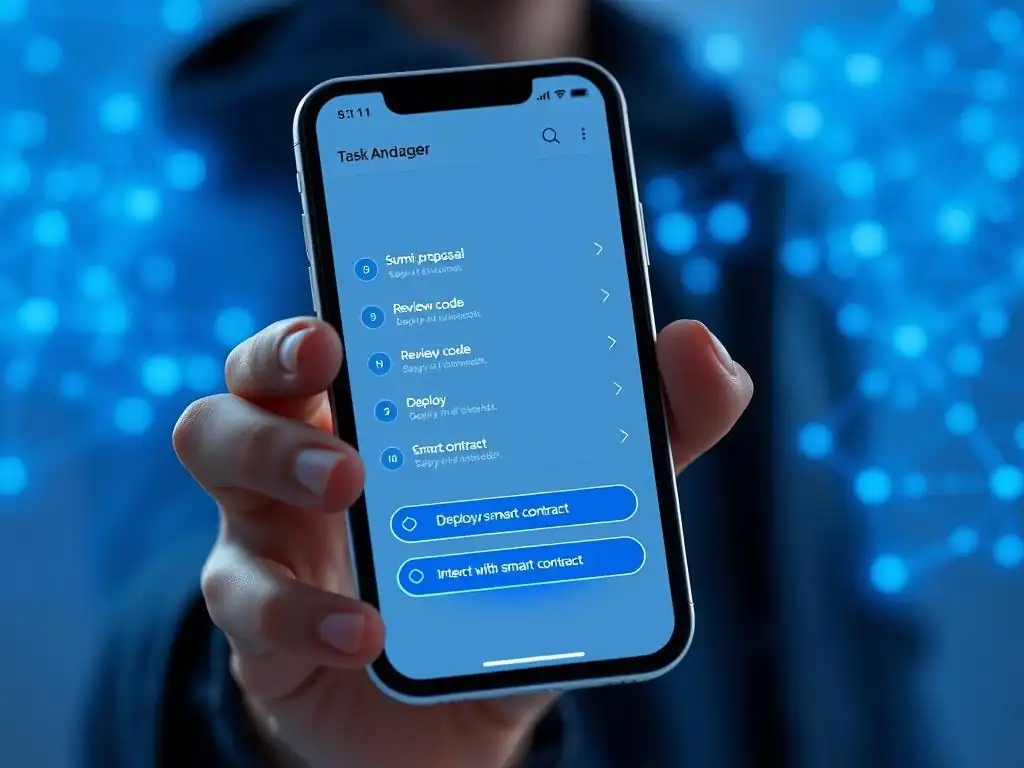
This is where the mobile app connects to the decentralized backend. The mobile DApp needs to be able to read data from the smart contract and send transactions to update the contract's state.
Connecting to a Local Blockchain Network via Web3.js
Using a library like Web3.js, the mobile app establishes a connection to a blockchain node. During development, this is typically a local Ganache instance or a development network. In production, it would connect to a public network node, often via a service provider like Infura or Alchemy, or potentially connect directly to a user's mobile wallet application which manages the node connection. The connection allows the app to instantiate the smart contract using its address and ABI (Application Binary Interface), making its functions accessible from the mobile code.
Calling addTask and markTaskComplete Functions from the Mobile App
Once the smart contract instance is created in the mobile app using Web3.js, the app can call the contract's functions. For a task management DApp, this would involve calling functions like addTask(string description) to add a new task or markTaskComplete(uint taskId) to update a task's status. These calls require constructing a transaction object that specifies the contract address, the function to call, the arguments, and the gas limit and price (or letting the library estimate them).
Handling Transaction Signing and Gas Estimation
Sending a transaction that modifies the blockchain state requires the user's signature using their private key. In a mobile DApp, this is typically handled by a connected mobile wallet (like MetaMask Mobile or Trust Wallet). The wallet intercepts the transaction request from the DApp, prompts the user for approval, and signs and broadcasts the transaction to the network on their behalf. The mobile DApp needs to handle this interaction flow, including estimating the necessary gas for the transaction and providing feedback to the user about the transaction status (pending, confirmed, failed).
Step 6: Testing and Debugging
Thorough testing and debugging are paramount in blockchain mobile app development to ensure the DApp functions correctly and securely, both client-side and smart contract-side.
Unit Testing Smart Contract Interactions with Truffle
The smart contracts forming the backend of the mobile DApp should be rigorously tested in isolation. Frameworks like Truffle provide tools for writing automated tests for smart contracts, often using JavaScript or Solidity. These tests verify that the smart contract functions ( addTask, markTaskComplete, etc.) behave as expected under various conditions, ensuring the core logic is sound and secure before integrating with the mobile front-end. Testing interactions with different user accounts and edge cases is critical.
Debugging React Native Components with Reactotron
Debugging the mobile front-end is also essential. Tools like Reactotron provide a desktop app that connects to your React Native application and offers features like viewing console logs, inspecting application state, monitoring network requests (though blockchain interactions might require specific tooling or wallet debugger integration), and tracking component hierarchy. Effective debugging tools are vital for identifying and resolving issues in the mobile application's UI, state management, and its interaction layer with the Web3.js library and the connected wallet.
Step 7: Deploying to a Testnet and Eventually App Stores
After extensive testing on a local development network, the next step is deploying the smart contracts and the mobile application to a public testnet.
Bundling the App for iOS and Android
Once the mobile DApp is stable and tested, it needs to be bundled into release-ready packages for distribution on app stores. For React Native, this involves generating signed .apk or .aab files for Android and .ipa files for iOS. This process compiles the JavaScript code, assets, and necessary native code into a format that can be installed on devices. The bundling process for blockchain mobile app development is similar to traditional mobile apps but must include the Web3 libraries and handle wallet integration correctly.
Understanding Google Play and Apple App Store Guidelines for DApps
Deploying a mobile DApp to major app stores like Google Play and the Apple App Store requires adherence to their specific guidelines. While these stores are increasingly accommodating of blockchain and crypto applications, there might be restrictions or requirements regarding wallet functionality, handling of cryptocurrencies, NFTs, and user consent. Developers must carefully review these policies to ensure compliance, as violations can lead to app rejection or removal. Clearly communicating the decentralized nature of the app and the user's responsibility for key management is often necessary.
Optimizing Performance and Security
Ensuring Scalability Using Layer-2 Solutions
Scalability is a major concern for DApps, especially as user numbers grow. Directly interacting with congested Layer-1 blockchains like Ethereum can lead to slow transaction times and prohibitively high gas fees during peak periods. Implementing Layer-2 scaling solutions, such as optimistic rollups (e.g., Optimism, Arbitrum) or zero-knowledge rollups (e.g., zkSync, StarkNet), can significantly improve performance. These solutions process transactions off-chain and periodically submit proofs or summarized data back to the Layer-1 chain, enabling much higher transaction throughput and lower costs, which is crucial for a smooth mobile DApp experience.
Another approach is leveraging sidechains like Polygon, which have their own consensus mechanisms but are often compatible with the EVM and bridge assets back to the main chain. Designing the mobile DApp to interact primarily with Layer-2 networks for frequent operations (like adding or completing tasks in a task management app) while reserving Layer-1 for less frequent, high-value actions (like initial setup or asset transfers) is a common strategy to balance security and scalability, enhancing the overall blockchain mobile app development approach.
Mobile DApp Security Best Practices: Key Management
Security is paramount in decentralized applications, particularly concerning private key management. Users' funds and assets are directly controlled by their private keys. The mobile DApp itself should never handle or store the user's private keys. Instead, it should rely on secure mobile wallet applications that use secure hardware enclaves or other robust methods to protect keys. The DApp interacts with the wallet via established protocols (like WalletConnect) to propose transactions for the user to sign.
Developers must also be vigilant against common security vulnerabilities in their smart contracts (e.g., reentrancy attacks, integer overflows) and their mobile front-end (e.g., phishing attempts, malicious input handling). Regular security audits of both the smart contracts and the mobile application code are highly recommended. Educating users about the importance of protecting their wallet seed phrase and being wary of phishing scams is also a crucial aspect of responsible blockchain mobile app development.
Protecting User Data and Privacy in Decentralized Mobile Apps
While blockchain offers transparency, privacy can be a concern, as transactions are often publicly visible. Developers must be mindful of what data is stored on-chain versus off-chain. Personally identifiable information (PII) should generally not be stored directly on the blockchain. Instead, cryptographic techniques or off-chain storage solutions linked by on-chain identifiers can be used.
Designing the mobile DApp with privacy in mind involves minimizing the amount of sensitive data exposed on the blockchain and utilizing privacy-enhancing technologies if necessary. For instance, in a task management app, task descriptions might be stored encrypted on a decentralized storage system (like IPFS) with only a hash stored on-chain, rather than storing the plaintext description directly in the smart contract state. Adhering to data protection regulations relevant to mobile apps (like GDPR or CCPA), even in a decentralized context, is also essential.
The Future of Mobile DApp Development
Emerging Trends: Account Abstraction and WalletConnect
The future of blockchain mobile app development is being shaped by innovations aimed at improving user experience and security. Account Abstraction (ERC-4337 on Ethereum) is a significant trend that aims to make blockchain accounts more like traditional app accounts. It allows for features like social recovery (recovering access via trusted friends), gas payment in tokens other than the native currency, and batch transactions, simplifying the user's interaction with wallets and DApps.
WalletConnect is another crucial technology enabling seamless and secure connections between mobile wallets and DApps (whether web or mobile-based). It uses a QR code or deep link to establish an encrypted connection, allowing the mobile DApp to propose transactions and interactions that the user can approve or reject within their secure mobile wallet. Protocols like this are vital for making mobile DApps interoperable and user-friendly.
The Role of Mobile DApps in Web3
Mobile DApps are poised to play a central role in the widespread adoption of Web3. Web3 envisions a decentralized internet where users have more control over their data and identity, and value can be exchanged peer-to-peer without intermediaries. Mobile devices are the primary gateway to the internet for billions, making mobile DApps the most direct path for mass user interaction with decentralized protocols, services, and digital assets.
From accessing decentralized finance (DeFi) protocols to participating in decentralized autonomous organizations (DAOs), collecting NFTs, or playing blockchain-based games, mobile DApps provide the essential interface. Their ability to bring the power of blockchain to the convenience of a smartphone positions them as a key driver for moving Web3 from a niche concept to a mainstream reality, facilitated by ongoing advancements in blockchain mobile app development.
Opportunities for Innovation
The field of mobile DApp development is ripe with opportunities for innovation. Developers can explore novel ways to integrate blockchain functionality with mobile device features, such as using push notifications for transaction confirmations or leveraging biometric authentication for wallet access (provided it integrates securely with the wallet). There is also significant potential in improving the onboarding process for new users, abstracting away blockchain complexities, and creating mobile-native decentralized experiences that feel as intuitive and performant as their centralized counterparts.
Innovations in areas like decentralized identity, privacy-preserving technologies on mobile, and cross-chain interoperability within mobile DApps will unlock new use cases and value propositions. As the underlying blockchain technology matures and scaling solutions become more robust, the possibilities for what can be built as a mobile DApp will continue to expand, offering developers exciting avenues for building the next generation of decentralized mobile applications.
Conclusion: Embracing the Mobile DApp Revolution
The journey into blockchain mobile app development is challenging but incredibly rewarding. By understanding the core differences from traditional apps, navigating the development process step-by-step, and prioritizing performance and security, developers can build decentralized applications that reach users where they are – on their mobile devices. The growing importance of mobile DApps, their critical role in Web3 adoption, and the continuous innovation in the space highlight the vast potential of this field. Embracing blockchain mobile app development is key to participating in the revolution of decentralized technology and bringing its transformative power to a global audience.
Frequently Asked Questions
What are the primary benefits of developing mobile DApps (Decentralized Applications) compared to traditional mobile apps?
Mobile DApps offer enhanced security through blockchain's immutable ledger and provide greater user control over their data. They also enable direct interaction with decentralized systems, bypassing intermediaries.
What are the key considerations when choosing a blockchain platform for mobile DApp development?
Consider factors like scalability, transaction costs, and the availability of developer tools and resources. Also, evaluate the community support surrounding the blockchain you choose.
What programming languages and frameworks are commonly used in Blockchain mobile app development tutorial?
Popular choices include Solidity (for smart contracts), React Native (for cross-platform UI), and Web3.js or Ethers.js (for blockchain interaction). These tools facilitate efficient development and integration.
How does blockchain mobile app development tutorial address security concerns specific to mobile environments?
Security measures include secure key management, robust authentication protocols, and regular security audits. Additionally, focusing on secure coding practices is crucial to prevent vulnerabilities.
What are some potential future trends in mobile DApp development, and how might they impact user experience?
Expect advancements in scalability solutions, improved user interfaces, and easier onboarding processes. These improvements will likely lead to wider adoption and a more seamless user experience with decentralized applications.
Final Reflection: Embracing Decentralized Mobility
The journey of blockchain mobile app development is no longer a futuristic fantasy, but a tangible reality reshaping how we interact with technology. The ability to access decentralized applications on the go is not just a convenience; it represents a fundamental shift in power, placing control back into the hands of users and fostering a more transparent and secure digital ecosystem.
The rise of mobile DApps has profoundly influenced the cultural and social landscape, offering alternatives to centralized platforms and empowering individuals with greater autonomy. This shift towards decentralized mobility is particularly important in regions with limited access to traditional financial services or where censorship is prevalent. The future is already here – it's just not evenly distributed.
- William Gibson. This quote perfectly encapsulates the potential of mobile DApps to bridge the digital divide and create a more equitable world.
As you navigate this evolving landscape, I encourage you to consider the implications of decentralized mobility and its potential to transform your own life and the lives of others. Embrace the opportunity to explore, learn, and contribute to the development of this groundbreaking technology. The future of the internet is in our hands, and it's mobile.
Ignite Your Mobile DApp Journey!
Thank you for exploring the exciting world of mobile decentralized application development with us! Now that you have gained insights into reaching users on the go, it's time to put your knowledge into action. Are you ready to take the next step and contribute to the future of mobile decentralized experiences?
Here's how you can get started:
- Create a simple prototype of your first mobile DApp. Focus on a small, achievable feature to familiarize yourself with the development process.
- Explore existing mobile DApps on platforms dedicated to decentralized applications to analyze their user experience and identify potential improvements or unique features.
- Share this article with your network and start a discussion: What innovative mobile DApp ideas do you envision that could transform the user experience?
What is the first feature you're planning to build into your mobile DApp?
Leave a Reply