
Unit & Integration Testing for DApp FrontEnds: A Comprehensive Guide


Welcome to Blockchain Trends, your compass navigating the ever-evolving landscape of blockchain technology! Beyond the hype of cryptocurrencies lies a powerful revolution, reshaping industries from finance to supply chain management. Intrigued by the potential of decentralized applications (DApps)? Dive into this comprehensive guide on DApp frontend testing strategies and discover how to build robust and reliable user interfaces that will shape the future of Web3. Let's explore the crucial techniques that ensure your DApp is ready for prime time.
Unit & Integration Testing for DApp Frontends: A Comprehensive Guide
- Introduction to DApp Frontend Testing Strategies
- Core Concepts: Unit and Integration Testing in DApps
- Setting Up Your DApp Frontend Testing Environment
- Implementing Unit Tests for DApp Frontend Components
- Mastering Integration Tests for DApp Frontends
- Advanced DApp Frontend Testing Techniques
- Addressing Common Challenges in DApp Frontend Testing
- Best Practices for DApp Frontend Testing Strategies
- Conclusion: Embracing Robust DApp Frontend Testing
-
Frequently Asked Questions
- What are the primary challenges in testing DApp frontends compared to traditional web applications?
- Why is unit testing crucial for DApp frontend components?
- How does integration testing help in ensuring the reliability of a DApp frontend?
- What are some recommended tools and frameworks for DApp frontend testing?
- What are some key considerations when designing DApp frontend testing strategies?
- Final Reflection: Fortifying the Future of DApp Frontends
- Fortify Your Frontend: Build Reliable DApps!
Introduction to DApp Frontend Testing Strategies
Why Testing DApp Frontends is Crucial for User Experience and Security
Implementing robust DApp frontend testing strategies is not merely a best practice; it is a fundamental requirement for building decentralized applications that users trust and rely upon. Unlike traditional web applications, DApps interact directly with immutable smart contracts and handle sensitive user assets, such as cryptocurrency tokens or NFTs.
A bug in the frontend's logic could lead to significant financial loss for users or expose them to malicious actors through vulnerabilities like injection attacks or improper handling of transaction parameters. Thorough testing ensures that the interface accurately reflects the underlying blockchain state and guides users safely through complex interactions like signing transactions or approving token spending.
Beyond preventing catastrophic failures, effective DApp frontend testing strategies significantly enhance the user experience. A well-tested frontend is reliable, predictable, and provides clear feedback to the user about the status of their blockchain interactions. For instance, tests can verify that the UI correctly updates after a smart contract event is emitted, or that error messages are displayed appropriately when a transaction fails due to insufficient gas or a reverted call.
Studies in user interface design consistently show that reliability and clear communication are paramount for retaining users, especially in a nascent and often intimidating technology space like Web3. By investing in comprehensive DApp frontend testing strategies, developers build confidence and usability, paving the way for broader adoption of decentralized applications.
Understanding the Unique Challenges of DApp Frontend Development: Asynchronicity and Blockchain Interaction
Developing frontends for decentralized applications presents a distinct set of challenges that differ significantly from traditional web development. One of the primary complexities lies in the inherently asynchronous nature of blockchain interactions. Sending a transaction to a smart contract is not an immediate operation; it involves waiting for network propagation, miner/validator inclusion in a block, and achieving sufficient block confirmations to be considered final.
This means frontend code must gracefully handle pending states, potential network delays (which can range from seconds to minutes depending on the chain and congestion), and the possibility of transactions failing at various stages. Testing these asynchronous flows requires specialized techniques to ensure the UI remains responsive and accurately reflects the transaction lifecycle.
Furthermore, the tight coupling between the frontend and the blockchain introduces unique testing hurdles. The frontend relies on external services like Web3 providers (e.g., MetaMask, WalletConnect) and blockchain nodes to read data and send transactions. Testing scenarios involving wallet connections, network switching, gas price fluctuations, and smart contract state changes requires mocking or simulating these external dependencies reliably.
Unlike a traditional backend API that might return a predictable JSON response, blockchain interactions can be non-deterministic (e.g., block timestamps, gas costs) and depend on the dynamic state of a public network. Developing effective DApp frontend testing strategies must account for these variables, simulating realistic blockchain conditions to catch potential issues before they impact users in the live environment.
Core Concepts: Unit and Integration Testing in DApps
Defining Unit Tests for DApp Frontends: Component Isolation
Unit tests in the context of DApp frontends focus on verifying the smallest testable parts of the application in isolation. This typically means testing individual UI components (like buttons, input fields, or display elements) or small, pure functions that handle specific logic, such as formatting blockchain data or validating user input before sending a transaction.
The goal is to ensure that each isolated unit behaves exactly as expected under various conditions, without relying on external factors like a live blockchain connection or a running smart contract. By testing components in isolation, developers can quickly pinpoint bugs within specific parts of the codebase, making debugging significantly more efficient.
To achieve true isolation for unit tests when developing DApp frontend testing strategies, it's crucial to mock any external dependencies. This includes simulating user interactions (e.g., button clicks, input changes), mocking state management logic (like Redux or Zustand stores), and crucially, mocking blockchain interaction libraries (like web3.js or ethers.js) and wallet provider objects (like window.ethereum). For example, instead of actually calling a smart contract function, a unit test would mock the ethers.js library's contract.method.call() function to return a predetermined value, simulating a successful read operation. This isolation ensures that the test fails only if the component's internal logic is incorrect, not because of network issues or smart contract bugs, which are concerns for higher-level tests.
Defining Integration Tests for DApp Frontends: End-to-End Flows
Integration tests for DApp frontends verify that different parts of the application work correctly together, including the interaction between the frontend and the blockchain itself. These tests simulate user flows that involve multiple components and dependencies, such as connecting a wallet, reading data from a smart contract, initiating a transaction, waiting for confirmation, and observing the resulting state change in the UI.
The purpose is to catch issues that arise when distinct units interact, which unit tests, by definition, cannot uncover. This could include problems with data serialization between the frontend and the blockchain, incorrect handling of transaction responses, or failures in state updates triggered by smart contract events.
A key aspect of defining effective DApp frontend testing strategies at the integration level is setting up an environment where the frontend can interact with a realistic blockchain state. This doesn't necessarily mean using a public testnet for every test, which can be slow and unreliable. More often, developers use local blockchain development environments like Hardhat Network or Ganache. These tools allow deploying smart contracts locally and interacting with them programmatically within the test suite. An integration test might, for example, deploy a mock ERC-20 contract to a local network, then use a testing library like Cypress or Playwright to simulate a user connecting a wallet, calling the approve function via the frontend UI, and verifying that the transaction is mined and the UI reflects the updated allowance.
Differentiating Unit and Integration Tests in a Decentralized Environment: Focus and Scope
The primary difference between unit and integration tests when applying DApp frontend testing strategies lies in their focus and scope. Unit tests are narrow in scope, concentrating on the correctness of individual components or functions in isolation, with all external dependencies mocked. They are fast to execute and provide granular feedback on where a specific piece of logic is failing. For instance, a unit test might verify that a function correctly formats a large number using the formatUnits helper from ethers.js, mocking the input value.
Integration tests, conversely, have a broader scope. They validate the interactions between multiple parts of the system, including the critical link between the frontend application and the blockchain. These tests are slower than unit tests because they involve more setup (like deploying contracts to a local network) and waiting for asynchronous operations (like transactions to be mined).
An integration test would take the previous example further by simulating a user entering a number into an input field, clicking a button that calls the formatting function, and verifying that the formatted output is correctly displayed in a specific UI element. While unit tests ensure the formatter works, integration tests ensure the formatter is correctly used within the overall user flow interacting with blockchain data. Both types of tests are essential components of a comprehensive set of DApp frontend testing strategies, providing different levels of confidence in the application's correctness.
Setting Up Your DApp Frontend Testing Environment
Choosing the Right Testing Frameworks for DApp Frontends (e.g., Jest, Mocha, Cypress)
Selecting the appropriate testing frameworks is a foundational step in establishing effective DApp frontend testing strategies. For unit testing JavaScript or TypeScript code, popular choices include Jest and Mocha. Jest is a widely-used framework known for its ease of setup, built-in assertion library, mocking capabilities, and fast performance, making it excellent for testing React, Vue, or Angular components in isolation. Mocha is another flexible testing framework often paired with assertion libraries like Chai and mocking libraries like Sinon, offering great customization for unit and integration tests that don't require a full browser environment. Both Jest and Mocha can be extended with libraries like react-testing-library or @vue/test-utils to facilitate component testing.
For integration and end-to-end testing that involves simulating user interactions in a real browser environment and interacting with a blockchain provider, Cypress is a leading choice. Cypress runs directly in the browser, providing a more realistic testing environment than tools that simulate browser interactions headless-ly. It excels at testing full user flows, including connecting wallets (often via browser extensions or injected providers in the test environment), navigating pages, interacting with UI elements, and waiting for asynchronous operations.
While Jest and Mocha cover the "logic" part of your frontend, Cypress covers the "user experience" part, verifying that the application works correctly from the user's perspective, interacting with the live (or simulated) blockchain. A robust set of DApp frontend testing strategies often employs a combination, using Jest or Mocha for fast unit tests and Cypress for more comprehensive integration and end-to-end scenarios.
Installing and Configuring Testing Libraries for Web3 Interaction: Hardhat and Ganache
To effectively implement DApp frontend testing strategies that involve interacting with smart contracts, you need tools that provide a local blockchain development environment. Hardhat and Ganache are two of the most popular choices for this purpose. Hardhat is an Ethereum development environment that comes with Hardhat Network, a local in-memory blockchain designed specifically for development and testing. It allows you to deploy your smart contracts incredibly quickly, debug transactions using console.log within your contracts, and has a vibrant plugin ecosystem, including plugins for testing with libraries like Waffle (often used with Mocha) or integrating with ethers.js for deployments and interactions within tests.
Ganache, part of the Truffle Suite, is another excellent option that provides a personal blockchain for Ethereum development. It offers both a desktop application and a command-line tool ( ganache-cli or ganache). Ganache is straightforward to set up and provides ten pre-funded accounts, making it easy to simulate multiple users interacting with your DApp. When configuring your testing environment, you'll typically start Ganache or Hardhat Network in the background before running your integration tests. Your frontend testing framework (like Cypress or a Mocha/Chai/Ethers.js setup) will then connect to this local network, usually running on http://127.0.0.1:8545, allowing your tests to deploy contracts, send transactions, and read state without needing a connection to a public network or incurring real gas costs. Incorporating these tools is vital for practical DApp frontend testing strategies.
Integrating Test Nets and Mock Data for Realistic Scenarios: Sepolia and Local Blockchain
While local blockchain environments like Hardhat Network and Ganache are indispensable for fast, deterministic integration tests, integrating public testnets and using realistic mock data are also crucial components of comprehensive DApp frontend testing strategies. Public testnets, such as Ethereum's Sepolia or Polygon's Mumbai, provide an environment that more closely mimics the conditions of the mainnet, including realistic latency, gas price fluctuations, and interactions with deployed versions of common protocols (like Uniswap or Chainlink oracles) if your DApp relies on them.
Testing on a testnet helps uncover issues related to network conditions, transaction propagation, and interactions with live, albeit non-valuable, smart contracts. However, testnets can be less stable than local networks and require obtaining testnet tokens, which can sometimes be a hurdle.
To balance the speed of local testing with the realism of public testnets, effective DApp frontend testing strategies often utilize a combination. Local networks are used for the majority of integration tests covering core functionality, leveraging mock data that simulates different blockchain states (e.g., a user having a specific token balance, a contract being in a particular state). For critical end-to-end flows or interactions with external protocols, tests might be run against a testnet.
Using realistic mock data, whether in local tests or testnet tests, is key. This involves simulating various scenarios: zero balances, very large balances, edge cases for input validation, and different contract states (e.g., paused, active, or in a specific phase of a token sale). Generating or obtaining realistic mock data ensures your tests cover a wide range of potential real-world conditions users might encounter.
Implementing Unit Tests for DApp Frontend Components
Testing Smart Contract Interactions with Web3.js or Ethers.js: Function Call Validation
Unit testing the parts of your DApp frontend that interact with smart contracts via libraries like web3.js or ethers.js is a critical aspect of robust DApp frontend testing strategies. While you won't be performing actual blockchain calls in a unit test, you can verify that your frontend code correctly prepares and attempts to execute these calls. This involves ensuring that the correct contract method is being called, with the right parameters and options (like gas limit or value), based on user input or application state. For instance, if a user enters an amount and clicks a "Transfer" button, a unit test can verify that the frontend code calls myTokenContract.methods.transfer(recipientAddress, amount).send({...}) using web3.js or myTokenContract.transfer(recipientAddress, amount, {...}) using ethers.js, with the recipientAddress and amount correctly derived from the UI state.
To achieve this in a unit test, you'll heavily rely on mocking the web3.js or ethers.js instances and the contract objects they provide. Using a mocking library like Jest's built-in mocks or Sinon, you can replace the actual contract objects with mock objects that have mock methods. These mock methods can then track how they are called. A test would simulate the user interaction (e.g., calling a frontend function triggered by a button click) and then assert that the mock contract method was called exactly once, with the expected arguments. You can also mock the return values or promises of these methods to simulate successful or failed calls and test how your frontend handles the responses or errors, ensuring your DApp frontend testing strategies cover various outcomes.
Mocking External Dependencies in Unit Tests: Wallet Connections and Network Providers
Effectively applying DApp frontend testing strategies at the unit level requires comprehensive mocking of all external dependencies your components interact with. Beyond just the web3.js or ethers.js libraries, this includes mocking the wallet provider object (commonly window.ethereum injected by MetaMask or similar extensions) and the network provider (the connection to the blockchain node). Frontend components often check if a wallet is connected, get the current account address, determine the network ID, or request the user to switch networks. Unit tests for these components must simulate these scenarios by providing mock values for these checks and methods.
For example, a component that displays the user's connected wallet address might check window.ethereum.selectedAddress. In a unit test, you would mock window.ethereum to be an object with a selectedAddress property set to a test address like '0x123...abc'. Similarly, if a component calls provider.getNetwork() using ethers.js to display the current chain name, you would mock the provider object and its getNetwork method to return a mock network object like { chainId: 11155111, name: 'sepolia' }. Mocking these dependencies allows you to test your component's rendering logic and conditional rendering based on connection status or network without needing a real wallet or network connection, making your DApp frontend testing strategies for units fast and reliable.
Examples of Unit Tests for Common DApp Frontend Components: Input Validation and State Management
Let's illustrate with concrete examples of how DApp frontend testing strategies apply to common components. Consider an input field component designed to accept an ERC-20 token amount. This component might need to validate that the input is a positive number and potentially format it based on the token's decimals. A unit test for this component could involve:
- Rendering the component with a testing library like
@testing-library/react. - Simulating user typing different values into the input field (e.g.,
'100','-5','abc','1.5'). - Asserting that the component's internal state or displayed value updates correctly.
- Asserting that validation messages appear or disappear as expected (e.g., an error message for
'-5'or'abc').
This tests the component's internal logic for handling input and validation in isolation.
Another common scenario involves components that manage local state based on blockchain data or user interactions. For instance, a component might fetch a user's token balance and display it. While fetching the actual balance requires integration testing, a unit test can verify the state management logic after the balance is (mock) fetched.
- Render the component.
- Mock the function that would normally fetch the balance to resolve with a specific value (e.g., a mock
BigNumberfromethers). - Simulate the component mounting or triggering the fetch operation.
- Assert that the component's state is updated correctly with the mock balance.
- Assert that the correct balance value is displayed in the UI.
These examples demonstrate how unit tests, by isolating components and mocking dependencies, can effectively verify crucial parts of your DApp frontend's logic and presentation according to your DApp frontend testing strategies.
Mastering Integration Tests for DApp Frontends
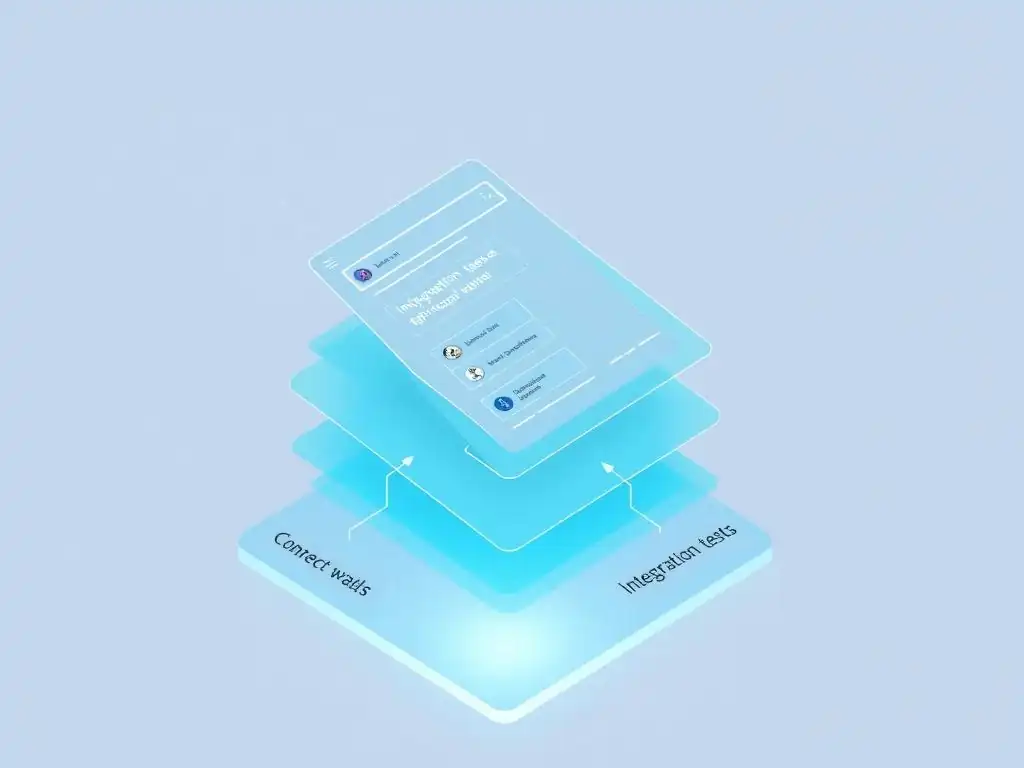
Testing the Integration Between Frontend and Smart Contracts: Contract Deployment and Data Retrieval
A cornerstone of effective DApp frontend testing strategies at the integration level is verifying the seamless interaction between your frontend code and deployed smart contracts. This involves setting up a test environment where your frontend can connect to a local blockchain (like Hardhat Network or Ganache) and interact with instances of your smart contracts deployed specifically for the test run. A typical integration test flow might involve:
- Deploying the required smart contracts to the local test network using libraries like
ethers.jsor Hardhat's deployment scripts within the test setup. - Configuring the frontend's Web3 provider to connect to the local network's RPC endpoint (
http://127.0.0.1:8545). - Using a testing framework (like Cypress) to simulate a user connecting a wallet (mocked to interact with the local network's accounts).
- Simulating navigation to a part of the DApp that reads data from a contract.
- Verifying that the data displayed in the frontend UI matches the actual state of the contract on the local network by directly querying the deployed contract instance within the test code.
For example, if your DApp displays the total supply of an ERC-20 token, an integration test would deploy the token contract, then use Cypress to visit the page showing the supply. Within the test, you would use ethers.js connected to the local network to call the totalSupply() method on the deployed contract and assert that the text displayed in the UI element for total supply matches the value returned by the contract call. This verifies that your frontend is correctly connecting to the network, instantiating the contract interface, calling the right method, and processing the result for display – a crucial step in your DApp frontend testing strategies.
Simulating User Interactions and Transaction Flows: Minting and Transferring Tokens
Integration tests are invaluable for simulating complex user interactions that involve sending transactions and altering blockchain state. These tests go beyond simply reading data and verify the entire lifecycle of a transaction initiated from the frontend. Consider a scenario where a user mints an NFT or transfers tokens. An integration test for this flow would:
- Set up the local blockchain environment with pre-funded accounts.
- Deploy the relevant smart contracts (e.g., an ERC-721 or ERC-20 contract).
- Use a testing framework (like Cypress) to simulate a user connecting their wallet (using one of the test accounts).
- Navigate the frontend UI to the minting or transfer section.
- Simulate the user entering necessary details (e.g., recipient address, amount) into form fields.
- Simulate the user clicking the "Mint" or "Transfer" button.
- The test framework (or underlying Web3 library in the test setup) would intercept the transaction request, sign it using the test account's private key (available in the local environment), and send it to the local blockchain.
- The test would wait for the transaction to be mined and confirmed on the local network.
- Finally, the test would verify the outcome: checking the smart contract state (e.g., the new owner of the NFT, the updated balances of sender and recipient) and verifying that the frontend UI updates correctly to reflect the successful transaction (e.g., a success message, an updated list of owned NFTs). This detailed simulation of transaction flows is a cornerstone of effective DApp frontend testing strategies.
Verifying Data Consistency Across the DApp Frontend and Blockchain: Event Emitted vs. UI Update
Ensuring data consistency between the DApp frontend and the underlying blockchain is a critical validation point for integration tests within your DApp frontend testing strategies. The blockchain is the single source of truth, but the frontend's ability to accurately reflect that truth after asynchronous events (like transaction confirmations or smart contract events) is paramount for user trust. Integration tests should specifically verify that when a change occurs on the blockchain, the frontend UI updates accordingly, and vice versa.
A common pattern involves verifying that frontend actions that trigger smart contract events correctly result in UI updates reflecting the state change indicated by the event. For example, if a smart contract emits a Transfer(from, to, amount) event when tokens are transferred, an integration test would:
- Simulate a token transfer via the frontend UI.
- Wait for the transaction to be mined.
- Within the test code, fetch the transaction receipt and check that the expected
Transferevent was emitted with the correct arguments. - Concurrently or subsequently, verify that the frontend UI elements displaying the balances of the
fromandtoaddresses have updated to reflect the transfer amount.
This type of test confirms that the entire chain of events – from user interaction to transaction, event emission, and frontend data refresh/polling logic – is working correctly. This focus on data consistency is a key differentiator for DApp frontend testing strategies compared to traditional web application testing.
Advanced DApp Frontend Testing Techniques
Testing Asynchronous Operations and Event Handling: Transaction Confirmation and Data Updates
Advanced DApp frontend testing strategies must deeply address the asynchronous nature of blockchain interactions. Testing transaction confirmation isn't just about sending a transaction; it's about waiting for it to be included in a block and achieve sufficient confirmations (often 1-12 depending on the application's security requirements and the blockchain). Tests need to handle this waiting period gracefully. Libraries like ethers.js and web3.js provide methods to wait for transaction receipts ( tx.wait()), which are crucial for this. In testing frameworks like Cypress, you might use commands like cy.wait() combined with checks for UI elements that indicate transaction status (e.g., a "Pending" spinner disappearing, a "Confirmed" message appearing).
Furthermore, DApps often rely on listening for smart contract events to update the UI in real-time without constant polling. Testing this event handling requires simulating event emissions in the test environment. With local blockchain tools like Hardhat, you can programmatically trigger transactions or calls that you know will emit specific events. Your test then verifies that your frontend's event listeners correctly pick up these events and trigger the appropriate state changes or UI updates. For instance, testing a decentralized exchange frontend might involve simulating a Swap event on a mock contract and verifying that the user's balance display updates automatically. Mastering these techniques is vital for developing effective DApp frontend testing strategies for responsive applications.
Handling Blockchain Transaction Confirmation and Error Scenarios: Revert Handling and Gas Estimation Errors
Comprehensive DApp frontend testing strategies must include robust testing of error scenarios, which are particularly nuanced in the blockchain world. Beyond typical network errors, DApps face issues like smart contract reverts, insufficient gas errors, and transaction failures due to logic within the contract itself (e.g., trying to mint more tokens than allowed). Frontend tests should simulate these failures and verify that the application handles them gracefully, providing informative feedback to the user.
Testing reverts involves sending transactions that are deliberately designed to fail based on contract logic (e.g., calling a function that requires a certain condition that isn't met). Your test should then verify that the frontend catches the error thrown by the Web3 library (often containing details about the revert reason) and displays an appropriate error message to the user, rather than crashing or showing a generic error. Similarly, testing insufficient gas involves attempting to send a transaction with a gas limit lower than what the transaction requires.
The test should verify that the frontend either correctly estimates gas beforehand and prevents the underpriced transaction or catches the gas estimation error and prompts the user to increase the gas limit. These specific blockchain error handling tests are critical components of reliable DApp frontend testing strategies.
Implementing Test-Driven Development (TDD) for DApp Frontends: Before Writing Components
Implementing Test-Driven Development (TDD) can significantly improve the quality and design of DApp frontends. TDD involves writing tests before writing the code they are intended to test. The process is typically:
- Write a test for a new piece of functionality. Initially, this test will fail because the code doesn't exist yet.
- Write the minimum amount of code required to make the test pass.
- Refactor the code to improve its structure and readability, ensuring the test still passes.
- Repeat the cycle for the next piece of functionality.
Applying TDD to DApp frontend testing strategies encourages thinking about the desired behavior from the user's perspective and how the frontend should interact with the blockchain before implementation. For example, before writing a component to display an NFT's owner, you would write a test that asserts that given a mock NFT contract with a specific owner, the component renders the owner's address correctly.
This forces you to consider how the component will receive the owner data and how it will handle loading states or errors. TDD, when applied to DApp development, can lead to more modular, testable, and maintainable frontend code, reducing the likelihood of subtle bugs related to asynchronous operations or blockchain data handling.
Addressing Common Challenges in DApp Frontend Testing
Dealing with Non-Deterministic Behavior in Smart Contracts: Block Timestamps and Randomness
One of the inherent challenges in DApp frontend testing strategies is dealing with non-deterministic behavior that originates from smart contracts or the blockchain itself. Aspects like block timestamps ( block.timestamp) or pseudo-randomness implemented within smart contracts can make it difficult to write tests that are perfectly repeatable. For instance, if a smart contract function's outcome depends on the current block timestamp (e.g., a time-locked feature), a frontend test calling this function might behave differently depending on the exact time the test is run or how quickly blocks are mined on the test network.
To mitigate this, DApp frontend testing strategies often involve controlling the test environment as much as possible. When using local development networks like Hardhat Network or Ganache, you have more control. Hardhat, for example, allows you to manipulate the blockchain state programmatically within your tests, including increasing the block timestamp or mining blocks on demand ( evm_increaseTime, evm_mine). This allows you to set up specific, repeatable scenarios for testing time-dependent logic. For testing randomness, if the smart contract uses a common pattern like Chainlink VRF, you would mock the VRF contract's responses in your test environment to return predictable values, ensuring your frontend's handling of random outcomes can be reliably tested.
Managing Gas Costs and Transaction Fees in Testing: Using Gas Estimation and Mock Transactions
Managing gas costs and transaction fees presents another challenge for comprehensive DApp frontend testing strategies. While local development networks don't incur real costs, simulating realistic gas scenarios is important. Frontend applications often display estimated gas fees or require users to confirm them. Tests should verify that the frontend correctly uses gas estimation methods ( provider.estimateGas() or contract.method.estimateGas()) before prompting the user and handles potential errors during estimation (e.g., if the transaction is likely to revert).
Furthermore, in integration tests simulating transactions, you might need to configure the test environment to use specific gas prices or limits to test how the frontend behaves under different network conditions. Hardhat and Ganache allow setting default gas prices and gas limits for the local network.
For more advanced scenarios, you might mock the Web3 provider's gas estimation methods to return predefined values, simulating high or low gas markets, and verify that the frontend UI updates accordingly. While you cannot perfectly predict real-world gas markets in a test, simulating different gas scenarios is a valuable part of robust DApp frontend testing strategies to ensure the UI remains accurate and informative regarding transaction costs.
Testing Cross-Browser Compatibility for DApp Frontends: Different Browser Extensions and Wallet Interactions
Testing cross-browser compatibility is a standard web development challenge, but it gains an extra layer of complexity for DApps due to the reliance on browser extensions and wallet providers. Different browsers (Chrome, Firefox, Brave) and different wallet extensions (MetaMask, Coinbase Wallet, Phantom) can inject the Web3 provider ( window.ethereum) differently or have slightly different behaviors, especially regarding connection requests, network switching, and signing transactions. Effective DApp frontend testing strategies must account for these variations.
End-to-end testing frameworks like Cypress or Playwright can be configured to run tests across multiple browsers. However, simulating different wallet extensions is more challenging. One approach is to use testing libraries or setups that allow injecting a mock Web3 provider into the browser environment that mimics the behavior of various popular wallets. For instance, some testing setups provide utilities to create mock window.ethereum objects with different properties or method stubs to simulate MetaMask being locked, a different network being selected, or a transaction signing request being rejected. While testing with every possible browser/wallet combination is impractical, testing with the most common ones or using mocks that cover known behavioral differences is a crucial part of ensuring your DApp frontend testing strategies cover the diverse user environments.
Best Practices for DApp Frontend Testing Strategies
Writing Clean and Maintainable Tests: Descriptive Names and DRY Principle
Writing clean and maintainable tests is just as important as writing clean application code, especially when implementing comprehensive DApp frontend testing strategies. Tests should be easy to read, understand, and modify as the application evolves. Key practices include using descriptive test names that clearly state what is being tested (e.g., it('should display user balance after fetching from contract') instead of it('test 1')). This makes it easy to identify failing tests and understand the expected behavior.
Applying the DRY (Don't Repeat Yourself) principle is also crucial. Avoid duplicating setup code or assertion logic across multiple tests. Utilize beforeEach, afterEach, beforeAll, and afterAll hooks provided by testing frameworks to set up common test environments (like deploying contracts or connecting a mock wallet) and clean up afterward. Create helper functions or custom commands (in frameworks like Cypress) for repetitive actions like connecting a wallet or submitting a form. Well-organized, clean tests are easier to maintain, debug, and scale alongside your DApp, making your DApp frontend testing strategies sustainable in the long run.
Organizing Your Test Suite for Scalability: Modular Test Files and Test Suites
As your DApp grows in complexity, so too will your test suite. Organizing your tests logically is essential for scalability and manageability. A common best practice in DApp frontend testing strategies is to organize tests into modular files and directories that mirror your application's structure or features. For example, you might have a tests/unit/components directory for component unit tests, tests/integration/wallet for tests related to wallet connection flows, and tests/integration/contracts/erc20 for tests interacting with ERC-20 tokens.
Within these files, group related tests into test suites using describe blocks. For instance, all tests for a specific feature, like "Token Transfer," would be grouped under a describe('Token Transfer Feature') block. This hierarchical organization makes it easy to locate specific tests, run subsets of tests related to a feature being worked on, and understand the overall test coverage of your application. A well-organized test suite is less intimidating and more effective, ensuring that your DApp frontend testing strategies remain practical even for large-scale applications.
Continuous Integration and Continuous Deployment (CI/CD) for DApp Frontends: Automated Testing Pipelines
Integrating DApp frontend testing strategies into a Continuous Integration/Continuous Deployment (CI/CD) pipeline is a best practice that automates the testing process and helps catch bugs early. A typical CI/CD pipeline for a DApp frontend involves:
- Code Commit: A developer pushes code changes to a version control repository (e.g., Git).
- CI Trigger: The commit triggers an automated build process on a CI server (e.g., GitHub Actions, GitLab CI, Jenkins).
- Build & Dependency Install: The CI server pulls the code, installs dependencies, including testing libraries and Web3 tools.
- Test Execution: The pipeline automatically runs the test suite, starting with fast unit tests, followed by integration and end-to-end tests. This usually involves starting a local blockchain environment (
hardhat nodeorganache) in the CI environment for integration tests. - Reporting: Test results are reported back to the developer, indicating whether all tests passed or which ones failed.
- Deployment (if tests pass): If all tests pass, the pipeline can be configured to automatically deploy the updated frontend to a staging or production environment (e.g., IPFS, Netlify, Vercel).
Automating your DApp frontend testing strategies within a CI/CD pipeline ensures that every code change is validated against the test suite before deployment, significantly reducing the risk of introducing regressions or critical bugs into the live application. This automation is key to maintaining a high standard of quality and reliability for your DApp frontend.
Conclusion: Embracing Robust DApp Frontend Testing
The Future of DApp Frontend Testing and Emerging Trends: AI-powered Testing and Formal Verification
The landscape of DApp frontend testing strategies is continually evolving, driven by advancements in testing methodologies and tools. Emerging trends point towards more sophisticated and automated approaches. One such trend is the application of AI and machine learning to testing. AI could potentially analyze user behavior patterns and code changes to automatically generate test cases, identify high-risk areas in the frontend, or even predict potential vulnerabilities in the interaction layer with smart contracts. While still nascent, AI-powered testing holds promise for increasing test coverage and efficiency.
Another trend is exploring formal verification techniques for critical frontend logic, especially concerning how the frontend interprets and presents blockchain state or constructs transactions. While formal verification is more commonly applied to smart contracts, applying rigorous mathematical proofs to key frontend components that handle sensitive data or logic could provide a higher degree of assurance than traditional testing methods. As DApps become more complex and handle larger values, integrating these advanced techniques into DApp frontend testing strategies will become increasingly important to ensure maximum security and reliability.
Key Takeaways for Building Reliable DApp Frontends: Prioritize Testing for Security and Usability
Developing reliable and trustworthy DApp frontends hinges on prioritizing testing throughout the development lifecycle. As this comprehensive guide on DApp frontend testing strategies has illustrated, a multi-faceted approach is necessary, combining unit tests for isolated component logic, integration tests for verifying interactions with the blockchain and other system parts, and end-to-end tests for simulating full user flows. The unique challenges of DApp development – particularly asynchronicity, blockchain dependency, and the potential for significant financial impact from errors – make thorough testing not just a good practice, but a critical requirement.
Developers should invest time in setting up appropriate testing environments, utilizing local blockchains and mock data to ensure test speed and determinism while also considering testnets for more realistic scenarios. Mastering techniques for handling asynchronous operations, error conditions (like reverts and gas issues), and non-deterministic blockchain behavior is paramount. By embracing robust DApp frontend testing strategies, writing clean and organized tests, and integrating testing into CI/CD pipelines, development teams can build DApps that are not only functional but also secure, reliable, and provide a positive user experience, ultimately fostering greater adoption of decentralized technologies.
Frequently Asked Questions
What are the primary challenges in testing DApp frontends compared to traditional web applications?
DApp frontends introduce complexities due to their interaction with the blockchain and smart contracts. Asynchronous operations and the need to verify on-chain data integrity pose unique testing hurdles.
Why is unit testing crucial for DApp frontend components?
Unit testing isolates and verifies the functionality of individual components like UI elements and logic modules. This ensures they behave as expected before interacting with the blockchain.
How does integration testing help in ensuring the reliability of a DApp frontend?
Integration testing validates the interaction between different components, including the frontend and the smart contract. It verifies data flow and ensures that the frontend correctly triggers and handles blockchain transactions.
What are some recommended tools and frameworks for DApp frontend testing?
Popular choices include Jest, Mocha, and Cypress for JavaScript testing. For blockchain interaction, libraries like Web3.js or Ethers.js are commonly used.
What are some key considerations when designing DApp frontend testing strategies?
Focus on testing state management, transaction handling, and data validation. Emphasize security testing to prevent vulnerabilities related to smart contract interactions.
Final Reflection: Fortifying the Future of DApp Frontends
The journey through unit and integration testing for DApp frontends, as outlined in this guide, underscores a critical truth: robust testing is no longer optional, but essential for the widespread adoption and trust in decentralized applications. The complexities of blockchain interactions, coupled with the user-centric demands of modern frontends, necessitate a rigorous approach to quality assurance. Without it, we risk undermining the very principles of security and transparency that DApps are built upon.
This commitment to quality profoundly impacts the cultural landscape of DApp development. It shifts the focus from rapid deployment to sustainable, reliable applications, fostering a culture of meticulousness and user-centric design. The importance of this shift cannot be overstated, as it directly influences user confidence and ultimately, the success of the decentralized web. Quality is not an act, it is a habit.
- Aristotle. This quote encapsulates the essence of integrating comprehensive testing strategies into the DApp development lifecycle; it's about cultivating a habit of excellence.
As you navigate the ever-evolving world of DApp development, remember that the strategies outlined here are not just tools, but a mindset. Embrace the challenge of building resilient and user-friendly frontends. Let this guide serve as a foundation for your own exploration and innovation in DApp frontend testing. The future of decentralized applications depends on our collective commitment to quality. What steps will you take today to fortify your DApp frontend and contribute to a more secure and trustworthy decentralized future?
Fortify Your Frontend: Build Reliable DApps!
Thank you for exploring the essentials of frontend testing for decentralized applications. We hope this guide has equipped you with the confidence and practical skills to ensure the quality and dependability of your DApps. Now, it’s time to put that knowledge into practice!
Here are some actionable steps you can take today:
- Start integrating one of the testing strategies discussed in this article into your current or upcoming DApp project. Don't hesitate—begin coding now!
- Consider exploring advanced testing frameworks and techniques, such as property-based testing or fuzzing, to challenge and enhance your DApp's robustness.
- Share your testing journey—highlighting both successes and hurdles—on your social media channels and tag Blockchain Trends so we can help spread your insights. Let’s grow together.
What new testing tool or technique are you excited to try out and incorporate into your DApp frontend workflow this week? Share your thoughts in the comments below!
Leave a Reply